Sleepy Moloka’i Sunday and Random Observations

Day 8: Molokai

I forgot to mention that April, of Ma’s Kava in Kona, had grown up on Molokai. She told us we should visit her Uncle Ray Naki at the fishponds on the way to Halawa Valley, an area we planned to visit anyway. Jody, one of the sellers at the farmer’s market in Kaunakakai, knew Ray and described his house to us. (She was selling trinkets to fund her son’s trip to New Zealand with his singing group. I bought a kukui nut and shell lei from her to help out.)

Me modeling the kukui nut and shell lei.

Me modeling the kukui nut and shell lei.

Of course, April also told us that the people here were kind of stand-offish. If these people are stand-offish, I am a Ford Agency fashion model. Everyone we talk to is chatty and helpful. Did I mention chatty?

We decided to try to find Uncle Ray, even though all the information we had by way of finding him is that he lived next to the ancient fishpond on the road to Halewa Valley. The night before, I had called Auntie Opu’ulani (“Heavenly House”), a kupuna (elder) who is an expert on mo’olelo Molokai (legends of Moloakai). I left a message, so I thought I would wait a bit to see if she would call back. So I had sort of planned to seek out Uncle Ray today, or at least drive up there and see what could be seen. We started out at dawn going back to Popohaku Beach, but it was readily apparent that the swell had not subsided, so we turned around and came back for breakfast. I cut up a pineapple and made Molokai coffee, then started writing, trying to catch up on my journal.

I caught up, all right. At about 2:00 pm or so.

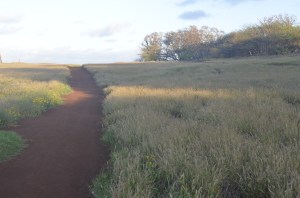
The stores and other businesses are all closed today. Tom and I walked down to Make Horse Beach. I encountered a Swiss man, Olivier, who speaks about five languages, and I got to practice my French for a while.

The red path to Maka Horse Beach.

The red path to Maka Horse Beach.

I noticed a lot more shells on Make Horse. They were small, but they augured greater success than Popohaku. I determined to come back in the morning. Make Horse is a lovely little beach that must be a lot of fun when the surf isn’t so high. There are lots of tide pools, but I didn’t get anywhere near them.


Make Horse Beach. Credit, as with almost all photos because my iPhone is dead, to Tom Keenan.

Make Horse Beach. Credit, as with almost all photos because my iPhone is dead, to Tom Keenan.

Then we came back to the condo. I located the barbecue facilities, then we made teriyaki steak for dinner with rice and asparagus that was actually not terribly expensive.

When I went upstairs to the bathroom after dinner, I left my flip-flops downstairs because Scott (one of the managers) had requested it. They had just installed new carpet on the stairs and second level, and didn’t want it tracked up with the red dirt of the island. When I turned on the light in the bathroom, I immediately saw a three-inch-long centipede, curved into a graceful S-shape on the bathmat.

Wildflowers on the path to Maka Horse.

Wildflowers on the path to Maka Horse.

This was no skinny, mainland-type centipede. It was hefty, with nasty-looking pointy things at front and rear.

I respect nature, but there is a limit. I went down to get my flip-flops, proceeded to beat the damned thing to a pulp, and decided there was no way I was going to walk around barefoot from now on, Scott or no Scott.

Here are a few random comments:

There are deer on Molokai. In 1867, speckled Indian deer were delivered to Molokai at the request of King Kamehameha V. They were released on the island and flourished. There are various signs of them, though I have yet to see one alive. Misaki’s Market, one of the two grocery stores in Kaunakakai, has deer heads mounted on supports on every aisle. We passed a fence completed covered with antlers. We haven’t yet seen deer burgers on a menu though. Much less venison.

The Humane Society consists of two small storage shipping containers with a pen in between. I haven’t seen any animals there, but I don’t know if that’s good or bad.

You can see three other islands from Molokai: Oahu, Lanai and Maui. There is an outrigger race every year from Molokai to Waikiki. Given that this is 38+ miles across very rough water, this is a serious athletic event.

There are huge, black moths here with wingspans of five or six inches. Gorgeous. We will (Tom will) try to get a picture.

The fishponds on Molokai are the oldest in the islands. More on these later. They are constructed of lava rock (not that there is any other kind) walls out into the water where the wave action is low. There is usually a gate where fish can swim in. They could swim out again if they chose, but perhaps they were fed inside the pond, keeping them around. I will find out more tomorrow.

Because Tom Keenan is an amazing photographer!

Because Tom Keenan is an amazing photographer!

A Happy Welcome to Moloka’i Followed by Near-Disaster

Day 7: Hawaii to Moloka’i

Today was a travel day, which is boring. All airlines lead to Honolulu to catch flights to other islands. Our plane to Moloka’i (I have always pronounced it moh-lah-kai, but here it is pronounced moh-lah-kah-ee) was a small prop plane. We crossed the channel from Oahu to Moloka’i, and I had the window seat, graciously ceded by Tom, even though his window seat from Kona to Honolulu was right next to the jet engine, which blocked the view. It was easy to see that the water in the channel was extremely rough, and the little prop plane wobbled a bit as we landed in the adorably tiny airport at Kaunakakai, which is the largest of Molokai’s three towns. And by “town,” I really mean “hamlet,” although they are not especially quaint. The wind was whipping the palm trees around, and leaves were flying everywhere.

We entered the airport. The rental car offices were right inside the door, and a line had formed, so I sat down on what appeared to be a convenient metal bench. After a bit, I began to wonder where the luggage was and asked a pretty, brown-haired woman sitting next to me.

She patted the “bench.” “This is where they put it,” she said cheerfully. “Give them a few minutes.” She asked me where we were staying and why we were here. When I told her, she gave me the following information:

  • Where to find the best meat and produce
  • Where to see hula and music performances
  • Which grocery stores to go to, and their hours
  • -Where and when the farmer’s market was
  • The name and contact info for the local experts on ancient Hawaiian protocol
  • The Aunty who knew the most about local mythology
  • Who the best boat captains were and how to get to the best snorkeling
  • Where and when and from whom to get a hula lesson
  • How to greet people properly in Hawaii (lean forward, touch the right cheek with your right cheek and kiss the cheek once)
  • How to address persons older than oneself, or indicate respect (aunty, uncle)

Needless to say, I was amazed and grateful. I said I would send her a copy of “The Obsidian Mirror” as a way of thanking her.

It took almost no time for Tom to pick up the car (again, I had specified el cheapo mucho, but we got a Jeep instead because they were out of Sparkies), and I had to drag two suitcases and all carry-ons a mere 10 steps to the car. We set off for our rented condo on the west side of Moloka’i.

But before we get to my personal observations of the island, let’s talk a bit about some factors the Moloka’i kama’aina (residents) are facing.

Molokai is one of the least-populated islands. The majority of the state’s citizens live on Oahu, primarily in Honolulu, therefore the political power and money is centered there. The Molokai (I have to stop using the apostrophe to indicate the glottal stop because it’s just too hard to type it  frequently on an iPad keyboard) Ranch Corporation owns virtually all of the leeward side of the island, where most of the arable land is. They used to operate a farm, ranch, hotel, golf course  and other amenities here. The Ranch decided to build some luxury condominiums on the west side near where we are staying.

Molokai kama’aina (Yea! Autocorrect did it for me!) objected to this plan. They don’t want the island to be the next Maui or Oahu, with high-rise hotels and tourist luaus. They like it small, slow, and old-fashioned, a place for the ‘ohana (family). They were successful in blocking the Ranch’s development plans.

The Ranch, the largest employer on the island, retaliated by shutting down ALL operations on Molokai. The ranch land is idle, the hotel is shuttered, the golf course overtaken by weeds and trees. All Molokai employees were laid off.

I am far from being anti-capitalist, but this just seemed incredibly spiteful to me.

Then about two years ago, a power company wanted to put windmills on the west side to generate power, running a cable undersea from Molokai to Oahu. Hawaiians in general seem to agree that the political system here is completely corrupt, largely because of the imbalance of power between Oahu and the other islands. Politicians and money were lined up behind the windmill project, but the Molokai kama’aina objected.

“How reactionary!” you might say. Renewable power is a non-trivial issue out here in the middle of the Pacific, where every drop of fuel must be shipped in.

However, the issue is that NONE of that windmill-generated electricity would be made available to the people of Molokai. You would think that the power company would build one or two extra just to placate the residents by providing them with cheaper electricity, but no. The windmills and cable project were blocked, but wtf?

While I’m on the subject, there’s also the issue of island-to-island travel. Back in the day when Tom and I visited, there were kama’aina prices for inter-island travel, which were lower than tourist prices. There was also a ferry to and from some islands.

All that is gone (except for the ferry between Molokai and Maui, primarily to get workers to Maui). Kama’aina pay the same as tourists for airfare. Hawaiians who want to travel within their own state are stuck paying tourist-level prices for the privilege of traveling a distance that in other states could be easily accomplished by car, bus, or train. You can probably charter a boat, but that is hardly a cheap solution.

I guess my point is that the residents of Molokai are a pretty brave bunch of people. They stand up for what they believe in, even if it hurts them. And Hawaiians in general outside of the population center are being, to put it frankly, screwed over.

Back to our adventure. We drove to the west side where our condo complex is located. The land on this side is bright red earth, mostly covered with grasses and scrubby acacia. Where the earth has eroded, the bones of old lava stick up through it like rotten teeth.

Molokai was formed by two volcanoes, one on the east side, one on the west. Both have been  extinct since before human beings evolved. The one on the east exploded 1.5 million years ago and most of its remains lie at the bottom of the ocean. Its demise left the high sea cliffs (pali) that separated Kalaapapa, the leper colony, from the rest of the island.

Most people have heard of Kalaupapa because of Father Damien and Mother Marianne Cope, who lived with and cared for these unfortunates until their own deaths. They were both recently canonized. Leprosy, or as it is known  today, Hansen’s Disease, is now curable. However, some of the very elderly lepers still live at Kalaupapa, even though they have been cured.

The story of Kalaupapa is a fascinating, terrible and inspiring story, but we will not be visiting. You can hike there or ride a mule down the sheer pali, which is not happening for several reasons, one of which is that Tom and I are both acrophobic (I caught it from him). You can take a helicopter there, which is also not happening, due to my first and only helicopter ride. It was a trip through Waimea Canyon on Kauai. The pilot was an ex-Vietnam fighter pilot who derived a sadistic joy from scaring the crap out of me. He succeeded. There are no boat tours. I don’t feel strongly enough about visiting to charter a boat. So sorry–no Kalaupapa.

Our condo is not near anything, which is great, but we needed to stock up. We drove into Kaunakakai, making our first stop at Paddler’s Inn for lunch. Paddler’s is a local hangout. It’s largely open-air, and like everything here, shabby and comfortable. We both had saimin and poke, and I had a daiquiri–one of the best I have ever had.

Then to the two grocery stores in the island’s largest town, Kaunakakai. The selection is a bit different in each store, and there are a lot of local faves, like Spam. We were a bit disappointed there was not more local fresh fish. We didn’t feel up to gutting and filleting the fish being sold out of a pickup truck on the street, so we bought Atlantic farmed salmon (which I normally never would do; I follow the sustainability guidelines issued by the Monterey Bay Aquarium), and some other necessities. The liquor store in Kaunakakai had a wonderful selection, so that was good, having poured the last of our wine in honor of Joan and Casey back in Captain Cook.

We arrived at the condo complex, which is called Paniolo Hale (cowboy house). We found the condo and got the key out of a lockbox. Then we encountered our first obstacle: we could not figure out how to unlock the door. Our condo managers, Scott and Chad, had thoughtfully given me the number of the housekeeper, whom we called. Fern gave us the magic trick for opening the lock, and we walked in.

We have a two-story condo facing the ocean, which is a few hundred feet away. There is a screened lanai, separated from the living area by huge, louvered glass doors. It was hot and stuffy inside, so we immediately tried to open the louvres and encountered our second obstacle: they wouldn’t budge. I called Fern again, and she called Scott and Chad, and Scott said they would be there shortly.

In the meantime, we went upstairs, where there is a bedroom and bathroom. The bedroom has no windows facing the ocean; this amenity has been sacrificed in favor of the lanai. But it did have a small, screened-in balcony facing mauka-side. As the complex is nicely landscaped with lots of shady trees, this is actually pretty. It has some sort of fine, grassy groundcover that smells like dill when you walk on it.

Paniolo Hale

Paniolo Hale

Scott and Chad arrived and opened the louvres immediately. The problem was that Tom and I, both with Master’s degrees, had been trying to pull them towards us, but they have to be pushed out. Which reminds me of this wonderful Gary Larson cartoon, below.

Cartoon by Gary Larsen

Cartoon b y Gary Larsen

We asked lots of other questions and Chad went upstairs to open a stuck window in the bedroom. We could see huge, turquoise waves dashing against the rocks not far away–the same swell that had kept us out of the water at Honaunau. So I asked Scott if it is safe to swim here once the swell has subsided. The answer was that we could walk down to our right to Make Horse Beach (Dead horse beach. Romantic!), and that was much better, but that winter is a tricky time to swim anyway. I could see another long beach past a rocky point tooth elect and asked about it.

Scott gave me directions to get there. It’s a beach park called Papohaku. “After a big swell like this,” said Scott, “there are lots of shells. You don’t usually find shells there, but you might even find a sunrise shell at Popohaku.”

Well, Scott had me at the word “shell.” I adore shells, and have spent many hours collecting them on beaches around the world and getting seriously sunburned. The albedo of my skin is approximately that of new-fallen snow, so I have to be careful. I wear sunscreen all the time on my face, and when in the tropics, slather it everywhere, whether I plan to be outdoors or not.

Anyway, nothing would make me happier than shell hunting–and I particularly would love to find a sunrise shell. They are both rare and gorgeous. Mind you, I never buy shells or take a live one, because the commerce in shells is creating devastation among the world’s little shell-builders. The rarer the shell, the worse the damage. But any shell I find myself that is not currently occupied is fair game. Here’s a sunrise shell, just to show you how exciting it would be to find one (at least if you were a bit nuts, like me):

Sunrise shell

Sunrise shell

We sat and watched the huge waves for a while, reading and writing, until the sun went down. The wind was still fierce. I began trying to find my way around the kitchen. I wanted to roast some potatoes, but we had neglected to buy any oil (butter, but not oil), I found an unlabeled container of something I was pretty sure was coconut oil in the fridge, so I melted it and dribbled it over the potatoes. Then I discovered there was no salt, except for a bag of sea salt flavored with balsamic vinegar. I sprinkled this over the spuds and stuck them in the oven. I also steamed some broccoli. It was all delicious, and the coconut-balsamic-sea-salt potatoes were lovely.

We were both exhausted and went to bed early. One of my criteria for places to stay, if at all possible, is a king-size bed. Tom and I are largish people, tall and far from slender, so a small bed is uncomfortable. This bed is the softest I have ever encountered. It was like sinking into a humid marshmallow. I was afraid I would wake up with a sore back, but not at all.

Day 8: Molokai

The next morning, I woke early, with shells on the brain. It was still dark, but I roused my patient husband and told him we were going to Papohaku Beach to look for shells. (He really is a saint sometimes.) I should have taken more note of the massive surf still crashing on the rocks out front; the swell had not subsided.

We found Papohaku without much difficulty. It was a little after 7:00 am, and no one else was around. To get to the beach, you walk through a rather enchanting little forest of acacias. It looks like fairies might live there. The beach itself is a long, curving stretch of golden sand.

Fairy forest at Papohaku Beach.

Fairy forest at Papohaku Beach.

I walked along for a while, looking for shells. Of course, there were none–the swell was still going strong. I had a plastic bag with me and picked up the few pieces of plastic I could find. (More about plastic in the oceans later.)

Golden beach at Papohaku.

Golden beach at Papohaku.

I love the ocean. I grew up playing in the surf in Southern California. I am a good swimmer and learned very young how to avoid riptides and getting “boiled” in a big wave. I body-surfed. I used to be able to swim the length of a swimming pool and back under water, though I probably couldn’t do it now. I also learned not to turn your back on the waves, because sometimes a “sneaker” wave can come along without warning.

But I didn’t intend to even get my feet wet on this expedition. I was walking with Tom above the line where the waves were reaching, and forgot to be alert. A huge wave surged up the beach and knocked me down.

I lack the words to tell you how powerful the wave was. It felt like the inexorable hand of God, and I only a gnat spinning out of control. I fell to all fours and the wave closed over me and began to drag me out to sea. I was screaming, but Tom couldn’t even hear me. He grabbed the waistband of my shorts and held on for dear life. It was absolutely terrifying.

The wave receded, and Tom yelled at me to get up, but I couldn’t. I was as shocked and terrified as I have ever been, and weirdly weak. I did manage to crawl on all fours away from the water, and shakily regained my feet, completely soaked.

Tom said, “Did you bring your iPhone?” Of course, I had. I reached into my pocket and withdrew my phone, dripping and covered with sand. Dead. I told Tom that my enthusiasm for shell hunting had been dampened, and started trudging toward the car, dripping sand and salt water in my wake.

Tom said, “I guess the sea god is pissed off because you sided with Pele.” Ulp. I hadn’t even thought about that. I have always been a friend to the sea and vice versa. I somehow was still clutching my plastic bag with plastic debris in it–didn’t that count for something? I confess that I am still a little uneasy about this. After all, if I can accept that Pele has blessed me, how can I then reject out of hand that Kanaloa (the sea god and one of Hawaii’s four top gods) or Pele’s sea-goddess sister who hates her, Na-maka-o-kaha‘i, isn’t miffed by Pele’s blessing?

Scoff if you will. People believe in these things here, at least many do. I hope my iPhone, my dear companion of boring times when I have to wait in doctors’ offices or checkout lines, is sufficient enough sacrifice, but I am not taking any chances until I have had an opportunity to placate whatever is out there.

On my way back, I snagged a piece of white plastic the size of a toddler’s chair, intending to deposit it in the trash. (See, Kanaloa?) I stopped at the restroom in the park to rinse off. I had sand everywhere, but was able to remove only some of it. The rest had to wait until I could get into a blessedly hot shower at the condo, where I discovered sand in places I didn’t know I had places.

Having washed and recovered, Tom and I set off to explore. It was raining, which it did the rest of the day. The first stop was a grocery store in Kualapuu, where we bought a large bag of rice, intending to bury my iPhone in it. This sometimes will dry the phone out sufficiently to get it working again, but I have my doubts; it was completely drenched, and in salt water to boot. We went to the Kualapuu Cook House across the street for lunch. The Cook House is in a small building that, like most places on Molokai, has seen better days. It’s not fancy, and the green and white curtains are grimy. They are a cash-only establishment.

Tom ordered BBQ pork and I had a BLT, feeling the need for comfort food. Both were excellent. Then we started to look for the meat cooperative, said to be the best source of beef on the island, all grass-fed, and Kumu Gardens, the best produce stand. It was Saturday, and there are no stores here open on Sunday except for Misaki’s in Kaunakakai, and that closes early.

Both the meat coop and Kumu were closed on Saturday as well, as it turned out. So we drove into Kaunakakai to stock up. We lucked out and found a tiny farmer’s market there, just starting to pack up. We got into a lengthy conversation with two ladies in the market, who were delighted to share information about the island. People here are incredibly friendly. They know everybody else who lives here, and if they are native Hawaiians, they are also probably related to everyone else.

We returned to our condo with our spoils. Dinner was poke from the market, to which I added an avocado the size of a small balloon, plus some seasonings from the cupboard. I don’t know what all of them are, exactly, but it was great. I served the poke over the rice I didn’t use to bury my iPhone.

Tom said the swell was supposed to be gone the next day. I secretly planned to return to Papohaku Beach the following morning. And this time, I would be a much humbler and more cautious woman.

The Last Day in Kona, Revisiting Sam, Plus Kukui Nuts and Awa

Day 6: Hawaii to Molokai

Our last full day here dawned bright and beautiful. The plan was to visit Pu`uhonua O Hōnaunau National Historical Park, the place of refuge. We had visited years ago and thought it was beautiful. There is a restored heiau, ancient fishponds, interesting plants, and more.

Hōnaunau sits on the opposite arm of the bay where we went snorkeling a couple of days ago. There is an easy entry into the water there, and I hoped to snorkel that side of the bay, as we had done before.

Which reminds me of a story that Bob told me that I forgot to relate. One day in ancient times, the shark god took human form and stepped out of the bay at Hōnaunau. He was greeted in a friendly way by the people, and took a wife among them. He lived with them happily, but in the end had to return to the sea. Before he assumed his shark form, he told the people that because of their kindness and hospitality, the bay between the two points would always be a safe place for them to swim; his people (sharks) would not come there. And so it is to this day.

As I was fixing breakfast on our open lanai kitchen, I heard the sound of crashing surf. This is  thousand feet above the ocean, and perhaps four miles away, as the crow flies. I had never heard the surf from the lanai before. I peered out at the sea and I could see the white spume flying up from the bay at Hōnaunau and along the coastline cliffs. We would not be snorkeling today.

However, Hōnaunau is always worth the visit, so after breakfast, we drove down there. Sadly, the park was closed, a ranger standing at the barricade patiently answering the same question over and over and cars wheeling around and heading away. Of course, we had to ask, too. He told us there was a lot of damage from the storm.

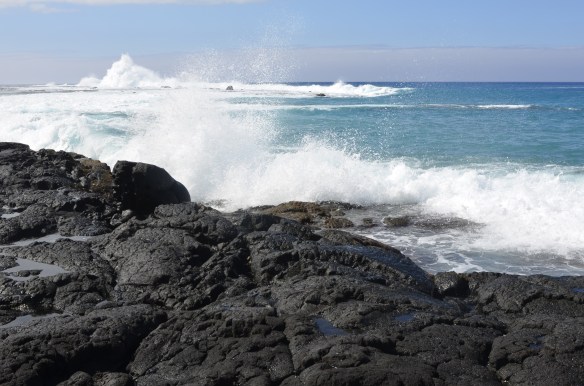
What storm? It had been clear and calm the night before. We headed to Two-Step to see what we could see, and the road was covered with sand and rocks. Huge waves were crashing on the rocks, but people were paddling around in large pools that had been left by the water that splashed over the rocky barrier. We walked out on the rocks (not too far) to take pictures, then left.

Wave surge at Two-Step Beach.

Wave surge at Two-Step Beach.


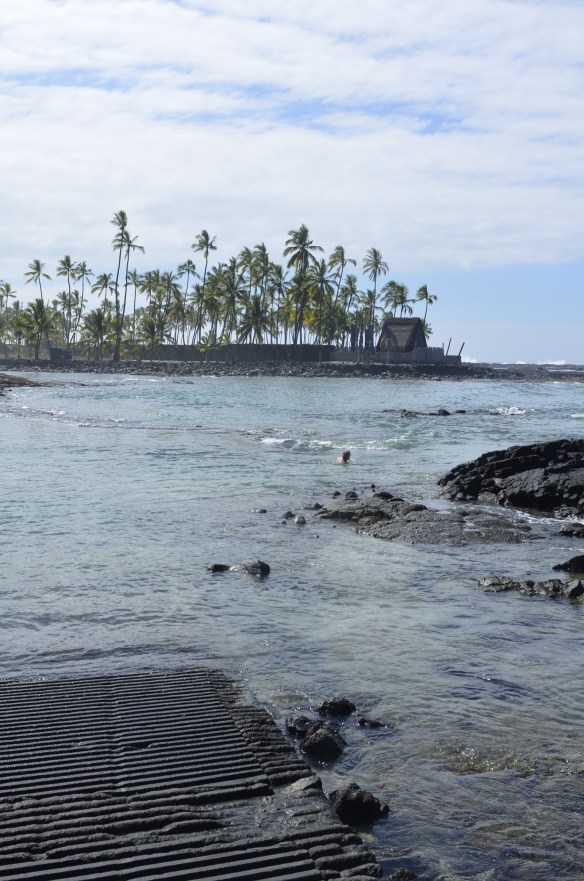
View of Hanaunau from Two-Step. You can see the restored heiau on the point.

View of Hanaunau from Two-Step. You can see the restored heiau on the point.

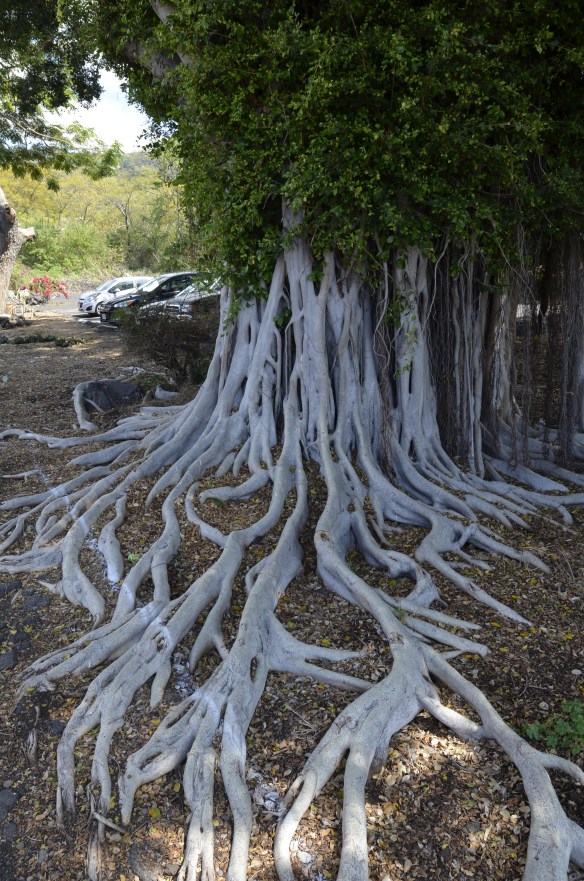
On the way back, I spotted a wonderful tree that looked as though it were melting. I wanted Tom to take pictures. The tree is truly amazing, with aerial roots and twisty white tendrils that looked as though made of wax rivulets from a burning candle. There was a macadamia nut-Kona coffee-fruit store across the road, so we wandered over to look. I asked the shop keeper what kind of tree that was across the road. He looked blank and said, “What tree?” I guess that incredible-looking tree was just same-old, same old to him. (It turned out to be a banyan.)

Is this not an amazing tree?

Is this not an amazing tree?

The shop keeper’s wife asked what we were doing on the Big Island, and I explained I was researching a novel. She said her daughter wanted to write a book, and how did I get published? I said I’d be glad to help her daughter out if she wanted to email me. I don’t think I can help anyone get published, but I can tell her a bit about how the industry works–or doesn’t.

We tried raw macadamias (meh), then roasted and salted (yum!). But the absolute best were chocolate covered with sea salt–to die for. We bought some, needless to say.

I wanted to go see Bob again. I wanted to tell him about my experience with the lei at Kilauwea. I also wanted another healing–this time on my elbow and ankle. My elbow was so sore that day I could barely touch it (don’t know why), and my ankle has arthritis. Also, my hair was beginning to bug me. It is curly, and when it gets longer, it flies around and looks awful. The humidity of Hawaii wasn’t helping any; I might have been walking around under a gray haystack.

Bob was delighted to see us again. He listened to my story with great satisfaction, then told me more tales of his personal encounters. As he was speaking, a lovely Hawaiian lady came in and sat down. Bob talked and snipped, snipped and talked, until finally I said, “my husband is going to kill you if cut any more off.” I was afraid he would just keep on until I had a fashionably bald head (fashionable for young men, but not for ladies my age).

I said he should take the Hawaiian lady next and I would wait for my healing, but she said to go ahead, so we did. It was the same quiet ritual as before. I thanked her for her patience when we were done; I don’t know how long it all took, but where I live, the next customer would have been foaming at the mouth by then.

After the healing, my elbow in particular felt better. Not perfect, but better to the point where I could touch it without pain. I am really indifferent to whether or not I am merely suggestible, so long as the results are there.

Then we headed off to Greenwell Botanical Gardens, as it had been closed the last time we tried to go. It turns out the garden is operated by the Bishop Museum. Ken’s friend Peter was sick that day, so I will have to email him. I selected some books for the grandkids and chatted with Aloha, the lady behind the counter. Tom took off around the garden by himself, and I followed later.

Greenwell is dedicated to growing and preserving native Hawaiian plants. They don’t charge visitors. Tom and I wandered, reading the informative signs, which noted how the Hawaiians used the plants for food, dye, adornment, etc. I collected a list of questions to ask one of the guides. (We had elected to walk around by ourselves for a while.)

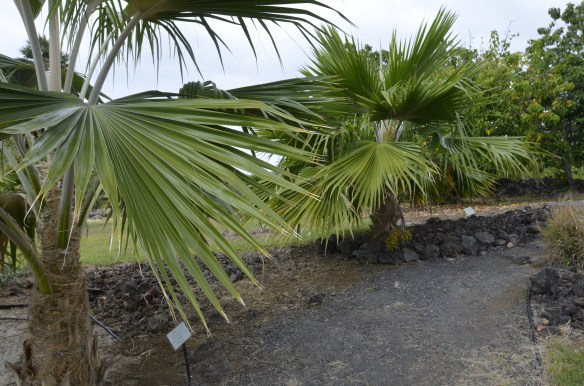
Native loulu palms at Greenwell Botanical Gardens. Highly endangered in the wild, although they once formed forests that carpeted the islands.

Native loulu palms at Greenwell Botanical Gardens. Highly endangered in the wild, although they once formed forests that carpeted the islands.

Back at the visitors center, I introduced myself to Jim, a guide with a magnificent white beard and twinkling blue eyes. After I asked a few questions, Jim cocked an eye at me and said, “Where are you from? You seem pretty well-informed.” That made me happy. After doing all this research, I still feel like the greenest newbie.

I won’t bore you with all the questions I had, but I did think what learned from Jim about Kukui trees was interesting. Kukui nuts were used by the Hawaiians as lights, and are also known as candlenut trees. The nuts are full of oil. The Hawaiians stacked them in a vertical row along a straight sliver of wood and ignited the top nut. It would burn for a while, then ignite the nut below it, which would burn in turn. I knew this, but what I wanted to know was if they were edible. In response, Jim found a good nut lying on the ground and cut it open for me. I tried it. It was a lot like the raw macadamia I ate at the store, and I commented it would probably taste better if toasted a bit. Jim said Kukui is sometimes roasted and salted and used as a condiment for poke. But you can’t eat very much of it, or you get the runs. He hastily added that the small amount I had consumed wouldn’t have that effect on me.

If you shop at Trader Joe’s you have seen some of the staff wearing Kukui nut leis. They polish up beautifully.

Koa trees are acacias, but their leaves are a beautiful, long sickle shape. Koa produces a gorgeous hardwood with light and dark streaks, and it appears the population is not endangered. Ancient Hawaiians made short surfboard and canoes out of the wood. I asked about this peculiarly non-acacia type of foliage, and Jim said they put out juvenile leaves that have the typical feathery appearance of acacia, but this new growth falls off and is replaced by the sickle-shaped leaves–which aren’t leaves. They are structures called “phyllodes,” but as they perform the necessary task of photosynthesis, I don’t think us non-scientists need to worry about the difference.

I noticed what looked like a tiny heiau (temple) constructed of lava rock near the visitors center. It was shaped like a four-sided pyramid, with the top flattened to make a small platform. It had an oval stone standing upright on top of it, like a Ku stone. I asked Jim about it, and he said it was built by the men who worked in the garden. It was not a miniature heiau, it was a replica of a district (aha-pu’a’a) marker. I asked if the stone on top was a Ku stone, and he said, no, it was dedicated to Kama-pu’a’a. I don’t yet know how the Hawaiians could tell the difference between one sacred stone and another.

Now seems as good a time as any to tell you about Kama-pu’a’a, the pig god. Kama (if I may be informal) was born on Oahu to parents who were of divine and chiefly ancestry. Kama was born in the shape of a little pig, and he got into all sorts of mischief in this form. In that sense, he is rather like Coyote the Trickster, of Native American tradition. There are many such gods/culture heroes, like Anansi (Africa), Loki (Norse), and Ti Malice (Vodun).

Kama’s human form was that of a stunningly handsome young man. Eventually he moved to Kahiki and married a woman there. But Pele began to beckon him across the ocean with her smoke. Given what happens next, I am not clear why Pele did this, but if you expect legends to make sense, you should probably stick with mathematics. (Not that math makes any sense to me. That’s why I write fantasy.)

Kama returns home to Oahu first, to recruit the assistance of his family in dealing with Pele, whom he knows is a fierce and powerful goddess. His grandparents agree to follow him to Hawaii (hidden in his genitals, which sounds uncomfortable), and Kama turns into one of his other body forms, the humu-humu-nuku-nuku-a’pu’a,a, and swims to the Big Island.

Kama makes his way to Pele’s home at Kilauwea in his human form, which had been enhanced  by his grandparents until there was no more beautiful man in all of Hawaii. He begins to chant at the crater’s edge. 40,000 of Pele’s people come out of her home to see who is chanting, and her sisters see this dazzling young man and desire him. They tell Pele about him because they are under kapu unless Pele frees them, but she is scornful. She tells them he is a hairy pig, and not worthy of them, but they don’t believe her and think she just wants Kama for herself.

Kama didn’t come for the sisters, he came for Pele. He chants to her with alluring words, whereupon she chants back, heaping insult upon insult. Kama is humiliated, and takes it out on his grandparents by slapping them (talk about adding injury to insult). More insults fly, and then Pele sends her lava right to Kama’s feet. A great fight ensues, and Kama’s family helps him. His sister floods Pele’s house, making it unfit to live in. Pele rekindles her fire and begins to chase Kama, who reverts to his pig form. Pele scorches his bristles, causing one of his grandfathers to die of grief, thinking his grandson dead, but Kama lives.

Pele finally chases Kama into the sea, where he assumes his fish form. Pele sends her eager sisters to the shore to entice him with their bodies (I’m being euphemistic here), but he mocks them from the waves. The Pele clan gives it up as a bad job and goes home. Kama resumes his handsome human form and follows. The sisters being as enthusiastic as ever, Pele releases them from the kapu, and Kama makes love to both of them. But he wants Pele, who has assumed the form of an old woman. Undeceived, Kama sweet-talks her into an assignation. They go at it for days, and Pele is in danger of dying. Another sister of Pele, who has a detachable, flying ma’i (Remember what a ma’i is? It’s her lady parts.), dispatches this organ to distract Kama from his piggish behavior with Pele. This is successful, and Kama goes chasing off to the other side of the island. So the dry side of Hawaii is Pele’s, and the wet side is Kama’s, and they continue their love-hate relationship to this day.

Whew. You wouldn’t believe how much detail I eliminated from this story in the interest of not losing my readers!

Then I asked Jim about awa (pronounced ah-vah, and known as kava in much of Polynesia). I knew that awa was cultivated by the ancient Hawaiians as a social drink, sometimes as part of ceremonies. I wanted to know what it tasted like, and what the effects were. (Research, you know). I asked where I could experience this–as long as it was not prepared in the traditional manner. (Traditionally, people–often children–chewed the root and spat into coconut shells. The resulting ickiness was imbibed.)

Jim looked at me and asked, “Have you tried going to a kava bar?”

Well, no, Jim, we hadn’t. It never occurred to me that such places existed.

So next stop, Ma’s Kava, which turned out to be immediately next door to Shear Magic. Ma’s Kava was a teeny space that shared its commercial doings with Qina Girl Floral. There were several small children surging around behind the bar. There was a diminutive bar made of koa, and three little bar stools. Both businesses are operated by a nice young couple, April and Josh. April has a degree from University of Hawaii, and Josh is a Fijiian ex-British Army guy. They served us two coconut shells full of a cloudy, pale, beige-ish liquid. Tom took two sips before deciding that was enough, so Josh gave him a half-cup of nettle tea to take the taste away. The tea, made of stingless nettles, was tasty, comparable to oolong.

It is abundantly clear that awa is not drunk for the taste, which is muddy, with a slight bitter aftertaste. Because I was, after all, doing research, I drank his as well as mine. It really is not intoxicating. After two shells (as they say), I was perfectly clear-headed, but maybe a little livelier than usual. Awa soothes body soreness, is a muscle relaxant, and a mood elevator, according to April. She and Josh showed us an awa root, which was about 12 feet long, twined and tangled. April said the older the root, the more potent the awa. It is extremely tough and has to be pounded a long time before it can be used. The taste differs with the variety, as does the potency. It left us wondering how anyone originally discovered its effects, as without modern equipment, the stuff is hard to make.

April shows us an awa root.

April shows us an awa root.


Awa is not regulated like alcohol or marijuana. April said there were kava bars in most areas, but not in every town. Their customers were mostly working men who come in for a shell after work to ease soreness and relax at the end of the day. They had no other customers while we were there–maybe we scared them off. We thanked April and Josh and went back to Camp Aloha.

We had a lovely evening. Joan came out and we offered her some wine and talked and talked. Casey eventually showed up, and more wine was poured. And there was more talking. Eventually, our hosts retired, we cleaned up the lanai kitchen a final time, and so to bed.

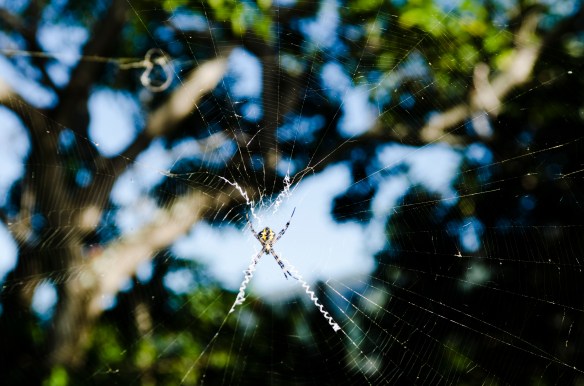
But before we begin the journey to Moloka’i, here is a photo of the amazing spider that hung outside the lanai. It had spun a white “X” in the center of its web, and it always sat right in the middle of the X, as you can see. The X consisted of zigzags of thicker white silk. I looked this up, and they don’t know why spiders sometimes do this. One theory was to make the spider look bigger to discourage predators, and you can see that this might indeed be so. It was quite large enough to discourage me.

X marks the spot.

X marks the spot.


In Which I Encounter Pele, Goddess of Fire

Day 5: Volcanoes National Park

I am not going to play some kind of cutesy metaphoric trick on you. My encounter with Pele was not just me visiting a volcano. Bear with me here–it’s worth it.

We have been to the Big Island a couple of times before–three?–and at none of these times has there been visible eruption from Kilauwea, the most active volcano in the islands at present. Kilauwea has been erupting since 1983, according to the National Park Service. Nonetheless, we visited Volcanoes National Park in the past, and enjoyed walking around the caldera, where wisps of gas and steam were visible rising from cracks below. We saw tiny orchids growing amid the rocks, and hiked Desolation Trail, which was bleak but incredibly impressive.

We heard before we left that Kilauwea was experiencing a resurgence. There were YouTube videos of houses burning as the flow consumed them, and people igniting tree branches from the flaming lava. Some (invariably young men) were walking on the hot lava flow. So we thought we might get to see the lava up-close and personal–or at least be able to see it flowing into the sea at night, which is spectacular.

Kilauea is very important in the legends of Pele, the goddess of fire and volcanos. I am tentatively planning to use Pele and her love-hate relationship with Kama-pu’a’a in my next book. (More about Kama-pu’a’a later.) There are several different versions of the Pele origin story, but the one I’ve encountered most often is this:

Pele was born in Kahiki (Tahiti). She has several brothers and sisters. Pele is very beautiful with a straight back like a cliff and breasts as round as the moon. She makes love to the husband of her older sister, Na-maka-o-kaha‘i, a sea goddess. Na-maka-o-kaha‘i is enraged and pursues Pele, who flees across the ocean, coming first to the island of Ni’i’hau. She is accompanied by her favorite sister, Hi’iaka and a brother or three. Pele tries to find a home on Ni’i’hau, but when she digs into the earth, she encounters water, which is antithetical to her fiery nature. Ni’i’hau is the northernmost habitable island of the Hawai’ian archipelago, and Pele tries each island in turn, coming at last to the Big Island of Hawaii, the last in the island chain. Here, she digs down and does not encounter water, so she makes Hawaii her home, along with her many relatives. She has several homes here, but her favorite is Kilauwea. The ancient Hawaiians also referred to Kilauwea, among other things, as “Pele’s ma’i.” Remember that the ancient Hawaiians were quite straightforward and frank about sex, and I am sure I need not translate.

As we were planning to visit Pele’s home, I thought, “Why not give Pele my precious maile lei and ask for her blessing?” After, all, what did I have to lose? The Hawai’ians I have met believe in Pele. A lot of other people do, too. The post offices here have large collections of stones tourists have taken from volcanoes and mailed back, citing unremitting bad luck ever since taking the souvenirs home. (The National Forest Service is happy to tell you this as well. They have their own collection of souvenirs returned by unlucky tourists.)

We had a leisurely breakfast, then set off. The drive to Volcanoes National Park is about 2 hours from Captain Cook. We drove along the Mamalahoa Hwy., sometimes with ocean visible on the right, sometimes climbing in altitude, going through tiny towns from time to time. We stopped at Punalu’u, the famous black sand beach. There is a legend (try to find some place in Hawaii that doesn’t have a legend) that a sea turtle goddess made her home there. She played with the keiki (kay-ee-kee, children) and protected them. The people in turn protected her keiki, the sea turtles, who come to feed in the bay and lay their eggs in the black sand. The black sand is, of course, pulverized lava. It glitters in the hand like a starry tropical night. We saw several sea turtles in the water, quite close to where we were standing.

Punalu'u black sand beach.

Punalu’u black sand beach.

We gained elevation as we began to climb the side of the volcano. Hawaiian volcanoes are not conical, like Mt. Fuji. They are called “shield volcanoes” because they resemble the shape of a warrior’s shield resting flat on the ground. You wouldn’t know you were on a volcano because the swelling is so gradual, but before we realized it, we were 4,000 feet above sea level. Although the terrain on the slopes of the mountain had been desert, largely fields of jagged chunks of lava (the Hawaiians have names for specific types of lava rock; this is called ‘a’a), as we approached the town of Volcano, it became quite lush.

We stopped at Kilauwea Lodge for lunch. This is a beautiful, old-fashioned establishment with a lovely garden. I had an antelope burger (the antelope is from Texas), largely because I had never had antelope before, and Tom ordered an ahi sandwich. They had decent wine, and we enjoyed ourselves. Antelope, by the way, tastes pretty much like beef, at least in burger form.

We went on to the park. As we went through the entry, the man who took our money said we qualified for a lifetime senior pass to all national parks. $10. There are some advantages to the silvery hair after all. He also admired my maile lei, which I had worn all the way from Captain Cook.

Things have changed. They no longer allow people into the caldera, and Desolation Trail is closed. You can view the caldera from the Jaggar Museum. The problem is that the volcano is emitting so much sulphur dioxide and other toxic gasses that it’s dangerous to get any closer. The path of the lava below the volcano (lava is not spewing out of the caldera, but squeezing through side vents) has been evacuated and quarantined, and no one is allowed near it. There is also a plume of deadly gas traveling across this area. To put a cap on our lava non-viewing experience, lava is not flowing into the sea right now, so that was out, too.

However, the Kilauwea caldera is awesome enough, with a white plume of smoke and steam rising up that can be seen for many miles. The area immediately around the caldera is barren, and it is easy to observe the way the mountain has melted, built and melted again with successive eruptions.

Pele's ma'i.

Pele’s ma’i.

We spent quite a long time at the overlook. A ranger talked about the volcano, Pele, and various related topics, and answered questions. We went through the museum. Then we walked a little way from the museum building and saw a path leading to the railing that prevented unwary tourists from falling over the cliff. There was a sign requesting soft voices and respect for those who had come to revere Pele. We saw a small tree just the other side of the railing that had two leis hanging in it, one of shells and the other of flowers. There was also an orchid lei draped over the railing.

I thought, “This is the place.” I asked Tom not to speak for a minute while I said my silent prayer to Pele. I stood at the brink, overlooking her home, and asked for her blessing on my work. I promised I would always be respectful to her and that which is hers. Then I took my precious lei off and hurled it into the little tree, where it lodged quite firmly. Maile leis are quite long, and this one twined across at least two branches.

Flinging the lei. The green thing in the upper right is the maile lei in flight.

Flinging the lei. The green thing in the upper right is the maile lei in flight.

“Mission accomplished!” I thought and turned away. We hadn’t gone more than four or five steps before I stopped and said, “Tom, let’s get a picture of the lei hanging in the tree.”

It cannot have been more than a few seconds since we stepped away, but when we turned around, the lei was gone.

We got as close as we could, but we couldn’t see it in the little tree (though the other three leis were still there). It was not in the bushes below the tree, nor as far as we could see, anywhere.

What fantasy writer would not kill for such an experience? However, I was accompanied by my rational and logical husband, so I quickly said, “Pele has accepted my offering–and I don’t want to hear any alternative theories!”

Tom, having lived with me for many decades, wisely kept his own counsel. As for me–despite the fact that I am not religious or even particularly woo-woo, at least for a fantasy writer–I was and am and continue to be thrilled. I feel I have Pele’s blessing on my work here, and I am incredibly energized. Every time I think about it, I experience the amazement and thrill I felt when I turned and saw that the lei had utterly vanished.

That might have been all I could ever have asked for, but the day was not over. We got back in the car and headed for Volcano House, which is a hotel and restaurant perched on the caldera, but far enough away from Pele’s antics to have survived since 1941. (There was a series of hotels before it that burned down.) We had heard that even if we couldn’t see actual lava, the glow from the caldera at night was spectacular in itself. We also knew from past experience that the restaurant is very good, so we made reservations for dinner that night.

The view from Volcano House is a panorama of Kilauwea, with its cloud of smoke and steam ever rising. We volcano-gazed for a while and then went to the bar. I intended to journal day 4 while we were waiting for our reservation. I ordered a daiquiri on the rocks because it’s kind of a tropical drink (the only cocktail I really like other than margaritas) and I hadn’t had the obligatory fruity drink yet. The waitress brought me a frozen daiquiri, and I politely reminded her that I had asked for it on the rocks. She said, “Well, you keep that one and I’ll go get you a daiquiri on the rocks.” Two drinks for the price of one! They kept me hydrated until dinner time.

By 7:00 it was dark, so we went outside. Kilauwea glowed a deep red-orange in the near distance, and the glare reflected off the smoke plume and the clouds above. It dominated the entire panorama, but trying to photograph it was hopeless. The best either of us could get was a large black field with a small red smudge in the middle that was as much a representation of this gaping maw of hell as a lit match would be. I do not know if anyone can see this without a frisson of unease up the spine: “I am standing right on top of an active, erupting volcano.”

The dining room also faces the volcano and has a wall of windows allowing an excellent view. Periodically, the staff turned out the lights so diners could appreciate the spectacle. Tom and I both ordered the kampachi, a fish in the skipjack family. It was pan-fried with a lobster and seaweed salad on the side. Heavenly! Sadly, I couldn’t finish it all.

After dinner, we went back outside. It was darker than before, and though Kilauwea’s smoldering glare obscured the stars in that direction, they were blazing overhead like living diamonds. Incidentally, it was quite chilly–59 degrees Fahrenheit (15 degrees Celsius), which is not a temperature one associates with Hawaii. We were inadequately dressed for the temperature, so we stayed as long as we could stand it, then piled back into Sparky (as we now call the Crapmobile) and began the drive back to Captain Cook.

As nothing memorable happened along the drive, thank goodness, I may as well mention that the temperatures in Captain Cook were much cooler than I expected. It stayed in the mid-to-low 70’s (20’s Celsius) during the day and dropped into the 60’s at night. The town is a thousand feet or more above sea level and gets cooling breezes all the time. The sea water is pleasantly refreshing, just the right temperature.

We got back to Camp Aloha around 11 pm. I was still buzzing from the day’s events and spent more time journaling before falling into bed and sleeping the sleep of one who has been incredibly, unbelievably blessed.

The First Day of My Journey to My Next Novel

The view. OMG, The view!

The view. OMG, The view!

As promised, I have gone to Hawaii to research my next novel. I usually journal when I travel because it helps me to retain the memories of my trip, but this time, I have decided to share my journal with you. This is a bit scary for me–maybe some of you will think I’m just farting around over here because to be honest, I’m not entirely sure what I am looking for. Yes, I have a list of things I want to do or find out about, but I also am hoping that I will find something that I didn’t know I was looking for.

If that sounds kind of mystical or arty-farty, sorry. But that’s what I’m doing. I hope you enjoy my journal anyway.

Day 1: San Jose to Kona

After several days of trying to prepare for our trip, the day finally came. I felt underprepared in a way, despite all my lists and fretting. And it did turn out that I forgot a few things, but I figured I could find them in Hawaii–they’d just be more expensive.

We took Hawaiian Air from San Jose. We had the usual cattle-class seats, except that my legroom was cut in half by some reinforcement under the seat in front of me, so I was more uncomfortable than usual. I am 5’10”, so leg room is always an issue for me. Tom took the window seat because he enjoys it. So do I, but I think he enjoys it more, so I make a point of letting him have it. In this case, there would be nothing to see for 5,000 miles except water anyway…

Breakfast was promised, but it turned out to be 6 small and geometrically precise slices of underripe melon, cheese and crackers, and a chocolate-covered macadamia nut candy. Later we got a rum punch with very little rum, hence no punch, served with a bag of Maui onion-flavored chips. I admit that these chips are a particular weakness of mine, but they didn’t make up for the fact that we were both feeling the need for an actual meal by this time, not having eaten since dinner the night before.

I read the inflight magazine, hoping to discover something interesting to see or do. The most interesting article was about Hawaiian native palms. I don’t know about you, but I had always assumed that the palm trees I saw in Hawaii–especially the coconut palms–were mostly native, but it turns out not to be so. There are several subspecies of loulu palm (Pritchardia) that are native, and all are endangered through people, rats, goats and pigs. The large seeds take a year to mature, making them vulnerable to rats, who eat the unripe seeds. When they are ripe, people like them–if they can find them, which is unlikely. The islands were once forested with loulu palms, but they now exist in the wild only in a few places that cannot be reached by people, rats, pigs or goats, which leaves very few places indeed. Coconut palms were brought here by the Polynesians who peopled Hawaii, not by the usual method of floating safely across the sea in their hard shells. Another article I read said that it was difficult for people to get them here in a plantable condition. We tend to forget in this day of air travel how very isolated the Hawaiian Islands really are. It’s astonishing that people ever found them in the days before satellites and airplanes.

Which reminds me of my surprise and disappointment as a child, when I discovered that there were really no undiscovered lands left in the world. I was very fond of books like “The Pearl Lagoon” (Charles Nordhoff) and “The Lost World” (Sir Arthur Conan Doyle), where the protagonists discovered new places, or at least explored little-known places. I desperately wanted to have adventures like that, and the notion that there were no more unknowns was devastating. Of course, I later discovered that there are still plenty of unknowns, and unlimited adventures of the mind and spirit. Not to mention space, where I am definitely not going to go. Ever. But I can imagine it, which is probably much better for someone my age.

We landed in Honolulu (where I removed my fleece jacket) and walked about a mile (I am exaggerating only slightly) to the gate to catch our connection to Kona on the Big Island of Hawaii. This is a very short hop and soon we were landing in the midst of a field of broken black lava. The runway was smooth enough, but although the eruption that laid down the lava here happened a very long time ago, it is still a bleak and almost alien landscape, black, rough rocks with a few brave grasses struggling to eke out a near-waterless existence on the stone.

We collected our bags at tiny Kona airport and caught the shuttle to the rental place. The whole airport operation is so minuscule that it’s easy and quick to do things that might take an hour or more in an urban airport. I had rented the cheapest possible car, which turned out to be a white Chevy Crapmobile. I might have rejected it if I had known it was going to be a Chevy. My parents generously gave me a Chevy Caprice when I graduated from college. Tom and I quickly re-dubbed it the “Chevy Crapice.” I think it was possessed by evil spirits, because it had a crafty habit of waiting to break down until the absolute worst possible moment. Think I’m exaggerating? Try in the middle of a tollbooth on I-90 going into Chicago. In the middle of Lincoln Park in Chicago, the stalking ground of the infamous Lincoln Park Pirates, a towing firm that would tow you even if parked legally and would relent only if offered a healthy bribe. Bits and pieces of it would fall off or stop working even when it was still technically running, which was ruinous to two young students/recent graduates with no money. I still remember my joy when we finally bought a new car (the first Honda car in the US; it had a motorcycle engine), and watched a tow truck haul the Crapice out of our lives forever.

Our rental Crapmobile presented a challenge from the beginning. First, we couldn’t fit my suitcase into its dainty little luggage compartment. I suggested lowering the back seats. There was a mechanism for doing so, but there was no way to lower them completely without removing the back seat bench. And it appeared to be a two-door with no way to put a person in the back seat, much less my enormous suitcase. (In my defense, I selected this case so that I could put our snorkel equipment in it as well as my clothes, etc.) Finally we discovered door handles cleverly concealed in the trim (they looked like vents and were in a strange location at the top rear corners of the doors), got all our luggage in and headed south.

Tom and I both thought there has been a lot of development since we were last here. The first time, I recall that there were “graffiti” messages spelled out against the black lava with chunks of white coral. We didn’t see any of these yesterday. The road seemed wider and there were more houses and other buildings north of the town of Kona.

We headed for Captain Cook along the Mamalahoa Highway. Captain Cook is sort of a long spot along the highway, perched more than 1,000 feet above the ocean. We turned off the highway as instructed and began a winding, narrow approach along the cliffs makai-side (kai meaning the ocean. Hawaiians talk about directions as makai, toward the sea, or mauka, meaning toward the mountains). The steep sides of this descent feature small plantations and a breathtaking view of Keleakakua Bay far below.

We eventually came to our destination, Camp Aloha. The driveway was a severe uphill climb that seriously challenged our Chevy Crapmobile, but we made it. At the top of the drive we found a large outbuilding with lots of mysterious machinery in it. There were trees everywhere. Not a person in sight. We got out and began peering around. Eventually one of our hosts, Joan, came out of the house, which was well concealed behind trees and bushes, and greeted us. Joan and her husband, Casey, have five acres here where they grow macadamias, bananas, papayas and avocados. I asked Joan where they sell their produce, and it all goes to a local grocery store.

Joan showed us around. I had thought we would be in a separate cottage, but we are actually in a wing of their house. The house itself is a one-story bungalow about 30 years, ramshackle and exhibiting a great deal of deferred maintenance. But the view. Oh, the view. The house overlooks Keleakakua Bay, a thousand feet below, and miles out to sea. There are palms and flowering trees all around, and a soft breeze blows all the time. Mynah birds swarm in the trees, as do golden finches, Chinese white-eyes and many others.

We have a bedroom, bathroom and sitting room with a small patio outside. Our kitchen is on the covered lanai overlooking the pool and the mesmerizing view. I now know why it is called “Camp Aloha”; the cooking is over a camp stove or barbecue. There is also a fridge, which our hosts stocked with a variety of foods, a microwave, toaster oven, plastic sink and most of the essential amenities.

After unpacking, we headed into town for some necessities like good wine. We went to dinner at the Manago Hotel, which is an ancient building on the highway. It’s clearly a local hangout. The tables are chrome and Formica, circa 1950s. There are two menus, one for drinks and one for food, posted on the walls. The drinks on offer are a few low-quality California reds, more selection in beers, plus soda, coffee, tea. I ordered a Longboard Lager, which was good, even though I don’t usually drink beer. The food menu had some interesting local fish, plus pork chops and steak. Having read that the pork chops were a specialty of the house, that’s what I ordered, while Tom had the steak–an unusual choice for him. They brought sticky rice, potato-macaroni salad (which was surprisingly good), sprouts and steamed vegetables, which we devoured (our last real meal had been 24 hours previously). Then the meat arrived–enormous portions that neither of us could finish. The meat was fine, but I wouldn’t go with it again. I prefer fish and this is, after all, an island!

We headed home with our wine, opened it and watched part of “Despicable Me,” having missed about 30 minutes of it. Normally, I hate watching a movie after it has started, but last night I didn’t care. Then to bed,and quickly to sleep. The temperature was cool, like a summer evening at home on the Monterey Bay.

Some time in the middle of the night, Tom woke me up by saying, “The stars are amazing!” In my sleep-drugged state, my brain had two responses: “I want to see that!” And simultaneously, “I don’t want to get out of bed.” So I stayed in bed until my bladder had its way with me. After visiting the bathroom, I stepped outside onto the buzz-cut grass and stared. And stared. And stared. And stared.

It was a moonless night, and the stars blazed with so much light I could see the objects around me. The stars were bright right down to the horizon. The North Star flamed overhead, the brightest object in the sky. And the stars glittered and pulsed as though alive. I was tempted to lie down on one of the chaise lounges and stare for an hour or two, but it was cool and I wanted to avoid mosquitoes, so I eventually went back inside, overawed by such unearthly beauty.

It made me realize how much we have sacrificed for our conveniences–the electricity that lights our nighttime. We have lost the beauty and mystery of the stars, the truly spiritual experience of seeing them blaze in the dark like bright promises of a life to come.

I’m just glad I can go places where I can still see the stars as my ancestors saw them. As the ancient Hawaiians-to-be saw these beacons as they steered their tiny and inadequate rafts across the uncharted Pacific. But I will never have the intimacy with the night sky that our ancestors had. To them, each of these gems was an old friend with a story to tell and directions to give. That experience is not mine to have. But I can still rejoice in their beauty, even if I can never understand them.

As the Old Year Dies, My Publisher Goes with It

RIP, AEC Stellar Publishing

RIP, AEC Stellar Publishing

Well, I had a lot of plans for the New Year, including researching and writing a sequel to “The Obsidian Mirror.” That much hasn’t changed. What has changed is that my publisher, AEC Stellar Publishing, is no longer in existence. The publishing rights have reverted to me, and I am once again on the prowl for a publisher and/or a literary agent.

Wow. That was a real surprise. I hadn’t ever considered that AEC Stellar would not be the publisher of my next book. They took me on as a newbie author and gave me a lot of support. It was a small outfit, but they did as much as they could. And they had an unprecedented deal in the publishing industry: authors got 50% of the profits on their books. As a matter of fact, I just got my first royalty check, which was rather exciting, if small.

AEC didn’t go under because it was losing money, either. It was the brainchild of Ray Vogel, the owner, who wanted to create an authors’ community that would nurture and support new writers. And that’s just what they did. Unfortunately, Ray also has a fulltime job and two adorable little girls, and could no longer continue with the enormous demands on his time and energy. I was kind of amazed at everything he was doing, and I completely understand why he needed to get out from under.

So I and several other AEC authors are sadly contemplating our next steps. Amber Skye Forbes has three publishers in mind for her YA series, “When Stars Die.” Ryan Attard—author of the “Legacy” series and “The Pandora Chronicles—wants us to band together and start our own imprint. That’s an exciting—and terrifying—idea. It’s hard for me to imagine taking on more than I already have, and yet the idea is kind of thrilling. I don’t know what the others are thinking, but I suppose I’ll find out as things develop.

I don’t know if this is true or not, but they say that the Chinese ideogram for “crisis” is the same as for “opportunity.” Maybe I’ll find a publisher with more resources. Maybe I’ll get an agent who can negotiate better deals. Maybe I’ll do something enormously challenging and quite possibly stupid, like starting a publishing company. As the old year winds down and a new year begins, I am certain of only one thing: I don’t know what’s to come.

Please Vote for Me for the “50 Great Writers You Should Be Reading”

Authors Show finalist

Thanks to David Prosser, a fellow writer/blogger who is as kind as a summer day is long, the link for final voting is http://questionpro.com/t/AJhWsZRq7r.

Again, “50 Great Writers You Should Be Reading” is a contest sponsored by The Authors Show. My sincerest gratitude to you for voting for me. As a new author, it’s an up-hill climb to get recognition, but this sort of thing really helps.

Author Interview: K.D. Keenan

I am interviewed by blogger/reviewer Liis Pallas.

Liis's avatarCover to Cover

Hi, beloved Brain-Babies readers! I’m back with a new author interview! And again- you’ll love this one! 🙂 I am truly lucky to be contacted by such interesting authors who write even more interesting books!

Don’t forget to check in soon, as I will be posting my review of “The Obsidian Mirror”!!!

You can find K.D. on Facebook

You can find The Obsidian Mirror on Goodreads and on Amazon

And here’s the interview. Enjoy! 🙂

The Obsidian Mirror on Goodreads

**

1. How did the idea for “The Obsidian Mirror” form?

In 2007, I read one of the “Wheel of Time” novels by Robert Jordan. I enjoyed it, but it suddenly made me wonder why so many fantasies are set in a pseudo-European, pre-Industrial Age world or venue. There are thousands of legends, mythologies, folk tales and traditions in the New World; why are these seldom used as source material?…

View original post 1,024 more words

K.D. Keenan Interview on “The Authors Show”

If you missed my interview on “The Authors Show,” here it is again. It’s a quick 15-minute overview of “The Obsidian Mirror,” my background and why I wrote it. Enjoy!