Costa Rica: Days 20 & 21: Our Trip Comes to a Close

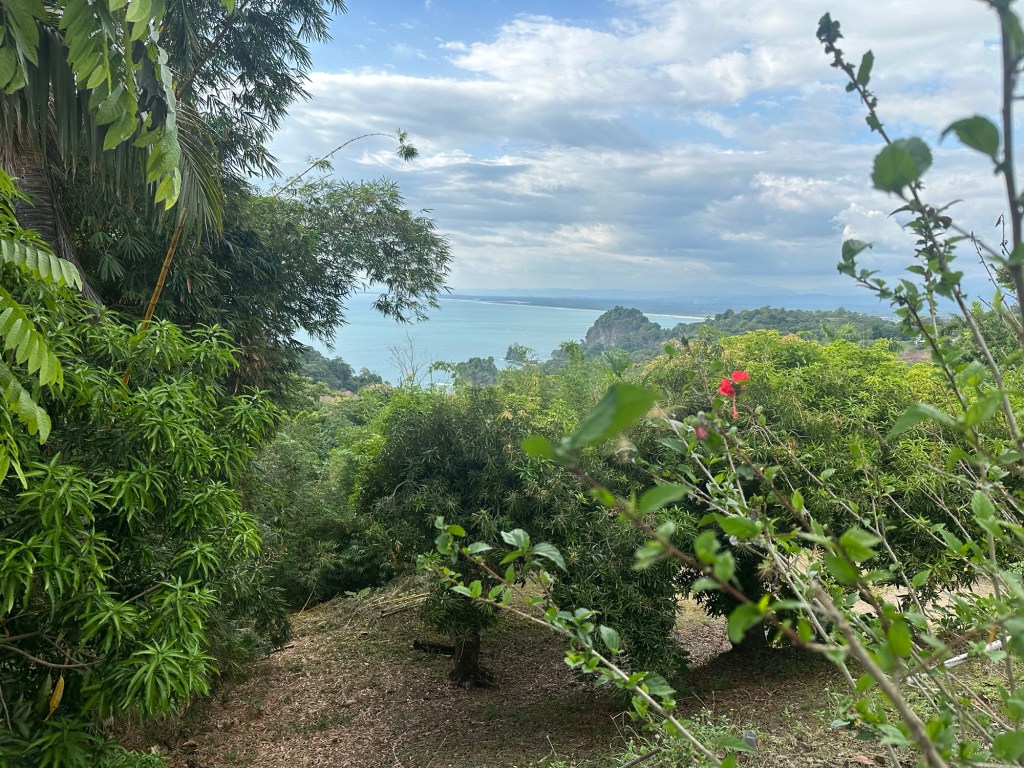
View of the jungle from the spice plantation viewing tower.

This morning when we made our way to the restaurant for breakfast, spider monkeys were everywhere–leaping overhead from bough to bough and chattering. At the restaurant, several of them were intent on snatching some food, but they were shooed away by staff.

Spider monkey looking for mischief.

We visited a spice plantation on day 20. It was about a half-hour drive from the hotel. They grow a number of different spices: vanilla, allspice, cardamom, cloves, cinnamon, black pepper, hibiscus, and more, as well as chocolate and coffee. The chocolate, we were informed, is pollinated by mosquitoes, so there is a reason for them after all. The spice plants were spread along winding, gravel paths among tropical flowers–very picturesque.

Hibiscus drying.
Torch ginger.

Then they took us to a building rather like a fire tower, reached by stairs. The view over the plantation was gorgeous from up there. We sat and tasted chocolate and three different flavors (vanilla, chocolate, and goldenberry, a local delicacy) of ice cream, complemented by “crumbly accoutrements,” as the menu said. Very satisfactory.

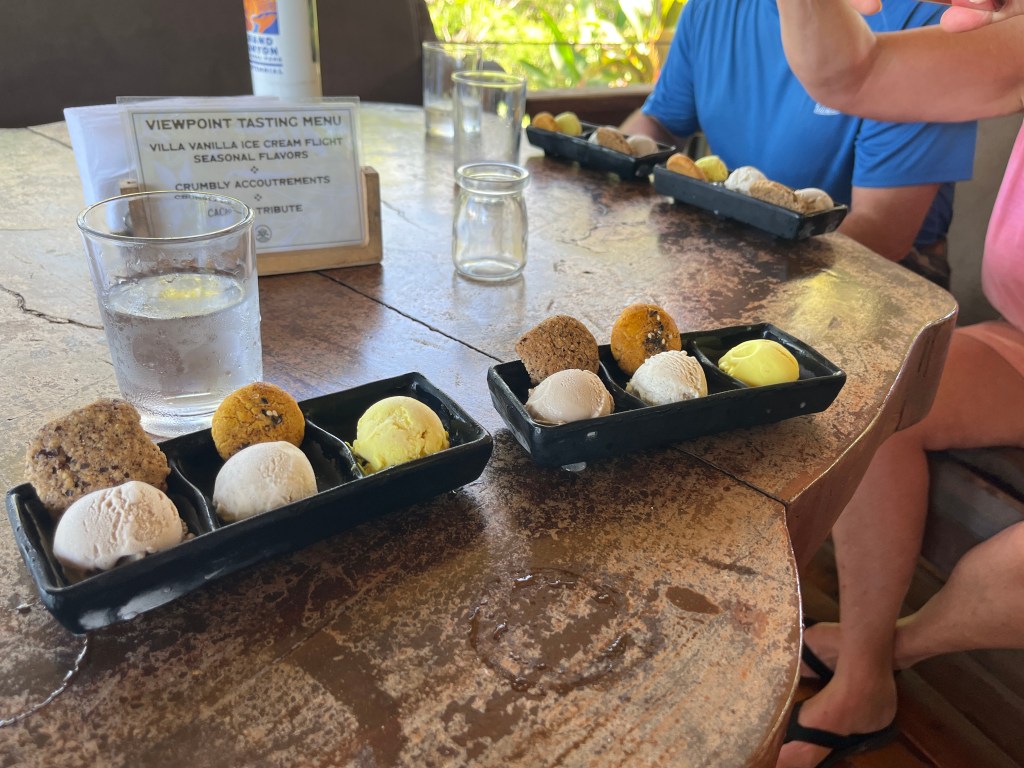
The tasting of local ice cream and crumbly accoutrements.

On our last day, we hired a guide to take us on a short hike through Manuel Antonio National Park, which is an enormous biological reserve. Needless, to say, we only saw a very small part of it. It turned out that the entrance was right across the street from the hotel–the same entrance we used to visit the butterfly sanctuary.

Our guide, David, was a young man whose primary training was in ziplines and such, but he wants additional certification to become a wildlife guide. He likes being in the forest best as he says it makes him feel peaceful. He also mentioned that he has had dengue fever three times, which is one of the things I was worried about until I saw our accommodations and realized that a kissing bug (the vector for dengue) would die from the air conditioning before it reached us. He confirmed that it was very painful (dengue is also called bone-break fever). He spoke good English, which–like most of our guides–he taught himself.

Ginger. Of course.

We saw a sloth high up in a tree, hanging upside-down in archetypal sloth fashion. We also saw a number of iguanas and basilisk lizards, and some spider monkeys. We also saw a column of army ants, no more than an inch wide, but stretching ahead and behind for unknown lengths as they disappeared into the leaf litter. They have no permanent nest, carrying their pupae on their backs as they travel, stopping only at night. We only saw them because they crossed the trail we were on. I was also delighted to spot a gorgeous morpho butterfly, flashing its bright blue, iridescent wings as it wafted through the trees. I had seen them in the sanctuaries, but this one was in the wild.

I apologize for not having more photos of the end of our trip. Technical problems, but I wanted to get this down and finished.

We decided to take a small commuter plane from Manuel Antonio to San Jose airport, where we would catch a flight to Panama City and from there to San Francisco, CA. The drive from Manuel Antonio to San Jose was five hours; the flight was 30 minutes. This was compl=elling enough to overcome my objection to small planes. We arrived at the Manuel Antonio airport, which now holds our record for being the smallest airport we have ever been in. It was basically a large room. The security consisted of a uniformed guy who looked at everyone as they came through the gate. They weighed us and our bags, then we were allowed to board a 12-passenger Cessna. It was a quick trip on a fine day, with very little turbulence.

Costa Rica spread out below us, mountainous and green. We saw a lot on this trip, but I couldn’t help thinking how much more the country has to offer. No army, investing in education and the environment instead. Costa Rica runs on 100% renewable energies–hydroelectric, wind, and thermal. Despite all the sunshine they get, there are few solar panels visible at houses because electricity is subsidized by the government and solar panels are 100% imported and thus expensive. They like Americans. They believe in their “Pura Vida,” and they act accordingly. It appears to be a government that acts on behalf of the people, and not corporations and oligarchs. I know they have their issues, but I really liked the country and the people. I was both sad to leave and yet eager to get home, which I suppose is the hallmark of a great trip.

Costa Rica, Days 16 & 17: the lost hours

I am going to draw a curtain of discretion over day 16. We spent the day pleasantly enough at our gorgeous hotel. It ended with a midnight doctor’s visit, a 6-inch hypodermic to my butt, a bag full of helpful anti-diarrheal drugs, and getting to bed at 3 am. However, I checked the side effects of the medication I was prescribed in Tamarindo, and the leading one (which Dr. Piloto never mentioned) was “severe, ongoing diarrhea.” The food and water here are safe!!! Pura Vida! (Pure Life. You hear it everywhere here, as a greeting, an exclamation, an affirmation of love of country. It is also imprinted on almost every bit of tourist tat available.)

Day 17 was an improvement, but I did not leave the premises. This is an amazingly beautiful hotel, but it is not for the disabled. The way from the reception area to our room involves many steep stairs made of cement coated with volcanic rock that will skin you alive if you fall. Interspersed among the staircases are ramps and bridges, some steep enough. I am using my hiking sticks, both for stability and to spare my bone-on-bone knee, and it is quite an athletic outing for me every time we go to the pool or restaurant. I have sussed the best way to the restaurant, the one that involves fewer staircases but more ramps. There are no other ways to get around. No shortcuts. No elevators.

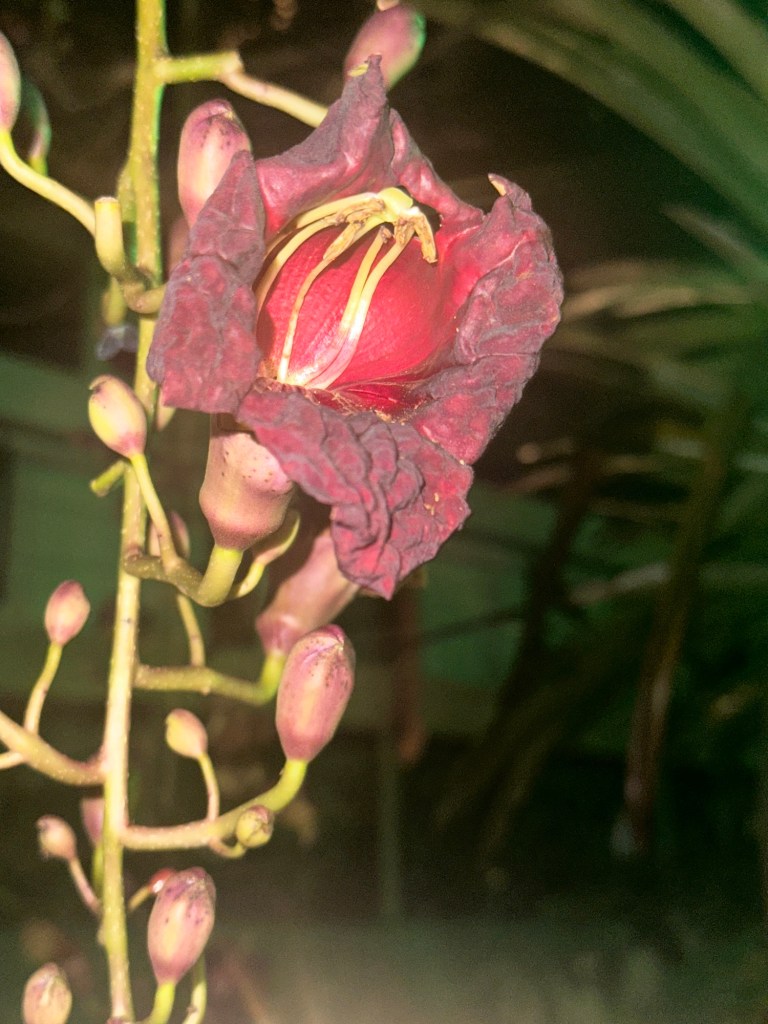
Once you have conquered the stairs and ramps, our room is reached by a bridge overhung with some gorgeous, weird, carnivorous-looking flowers. In the evening, they open, and you can see tiny bees and wasps having a field day in them.

We have decided we like one of the two restaurants here best, TicoRico. It isn’t their fanciest restaurant, but the food is creative and yummy. However, it is apparently cursed.

We were highly amused by this, but then we are easily amused.

You’d expect wonderful fruit in a tropical country, but it is exceptionally good here. They grow seeded watermelon, which is so much more flavorful than the seedless junk from the supermarket. (I wish I knew how to get it at home. We have the wrong climate to grow it). The pineapple is exquisite, and even the papaya is OK, which is a huge concession from me.

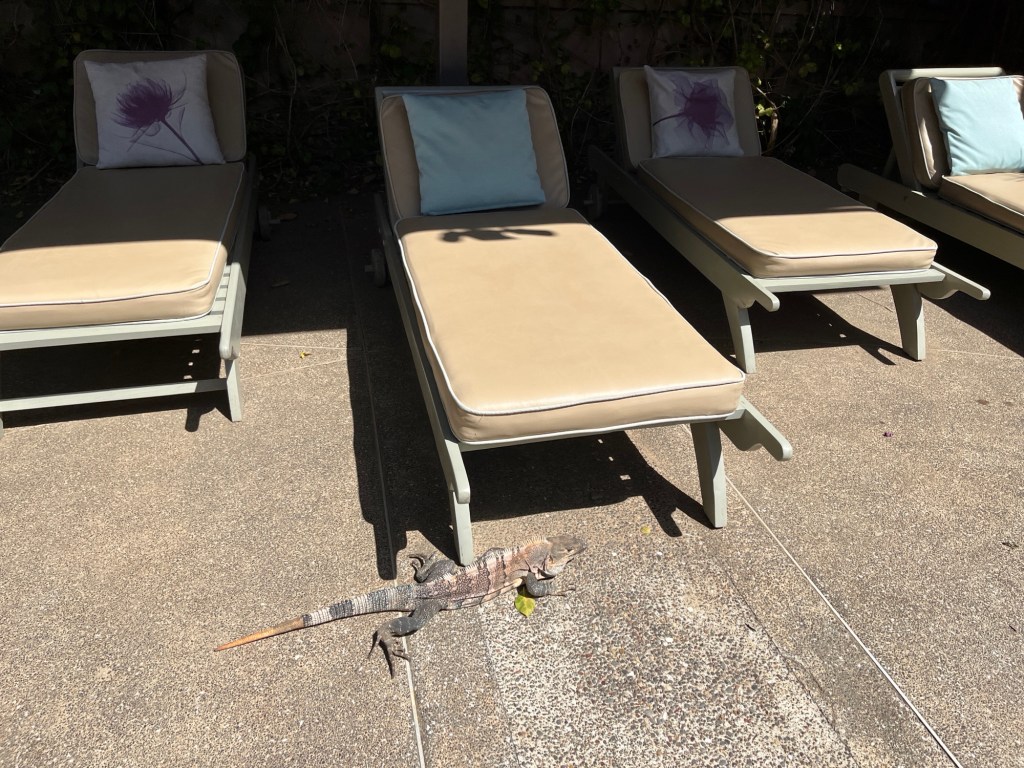
We saw a scarlet macaw in the morning. It is a very large bird, and in flight, trails its tail behind it like a bird of paradise. At lunch, we were visited by Pancho, an iguana that comes into the restaurant to pick up dropped goodies.

Pancho the restaurant cleaner. My foot for scale.

We spent the day quietly, reading and writing. Tom went for a long walk in the afternoon and I went to the pool. Yesterday, the pool bar was full of young, local people, a group of friends. They were drunk and very happy. I had a long conversation in broken English and Spanish with a young lady named Fiorella—she is 21 and she wants to go to New York and Los Angeles and speak many languages and wear beautiful dresses and be glamorous. I wished her luck, sincerely. I hope she lives her dreams.

There are two pools here. One is for families, and is smaller. It has a nice water slide for the kiddos. It also has a pool bar for the adults. The larger pool, with a waterfall, hot tub and another pool bar, is adults-only. How smart is that?!

Today, the pool bar was full of elderly Americans, just like us. (The younger set was at the other pool with their happy, shrieking children.) Some of them had very interesting stories and had lived all over the world. It got dark as gorgeous clouds pulled in, looking as though they had been painted by Tiepolo with sunset gold and pink. We finished our drinks at the pool bar and went to dinner. The day came to an end without any doctors or unnecessary unpleasantness.

Costa Rica, Day 15: you haven’t lived until you are standing in a very public restroom in a foreign country, unclothed from the waist down, washing out your beshitted shorts

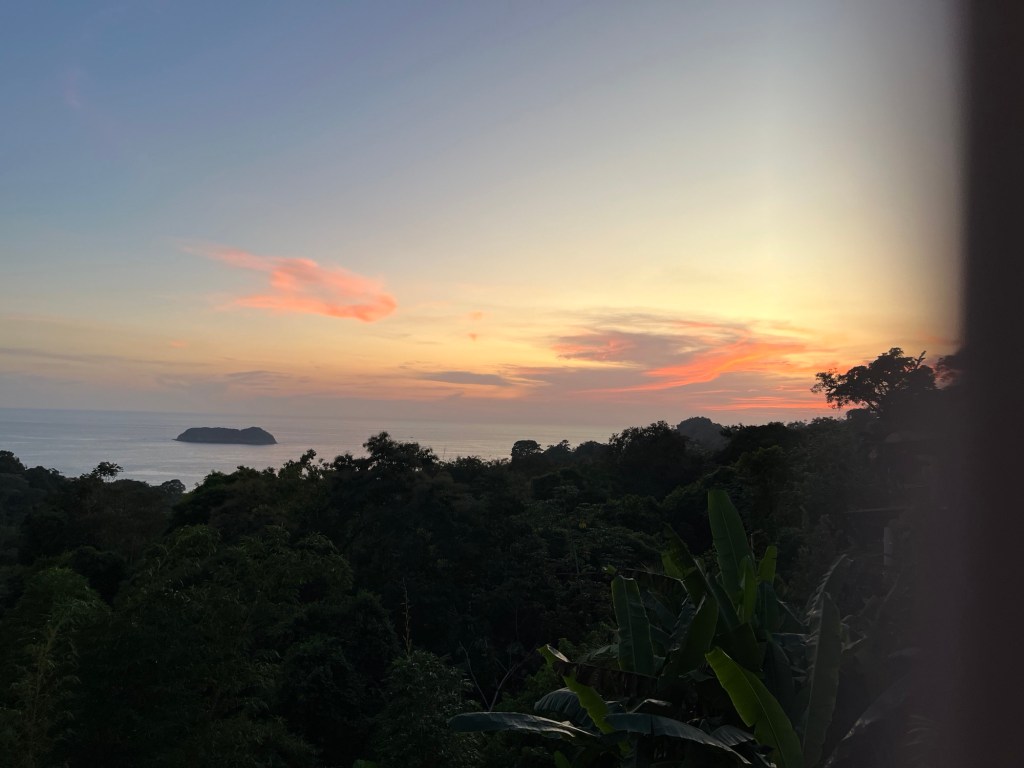
Sunset view from our room at Si, Como No hotel.

And I got to do it twice! We departed Tamarindo with a van and driver, named Johnny. The drive takes about five hours from Tamarindo to the Manuel Antonio area. About an hour later, I realized that my treacherous gut was betraying me again. Johnny stopped at a McDonald’s which had the advantage of being super clean and a bit private.

But it was too late. I tossed the underwear as irredeemable. There was a sink in the bathroom cubicle, so I texted Tom to bring me clean undies and shorts. I washed out my shorts. Then, with nothing covering me but a longish shirt, I went to the bathroom entrance and got the clean clothes from Tom. I laid out the wet shorts to dry in the back of the van and dug out the Imodium, hoping it would work fast.

We stopped to pick up Johnny’s wife, Juanita, at a large bus depot. I urgently sped into the huge, brightly lit, tiled women’s bathroom—and slipped on the slick tiles and fell. I need not tell you what a hard fall produced in my nether regions. I should have brought my walking sticks, but—you know—I was in a hurry.

A number of small, concerned Tico (Costa Rican) ladies helped haul me to my feet, and I limped off, muttering “Muchos gracias, muchos, muchos gracias.” Another pair of undies gone. I’m down three now, and I only brought enough for one week, thinking to launder as we went.

This time, there was no private sink. I ventured into the glaring light of the public bathroom with nothing on below the waist, and washed my shorts. I texted Tom, who appeared at the entrance—at this point, I was visible to the public at large—with my wet shorts from my earlier adventure and no underwear. I was just grateful to cover my ass and didn’t care if the shorts were wet. I congratulated myself on wearing a long shirt that covered most of my problems.

And to top it off, I threw a rib out. I hope you will forgive me if I don’t have much to say about this day. It was not a good day. I am confronting my physical limitations, and not very happy about them. I took more Imodium, which seemed to solve the immediate problem. (BTW, Tom has not suffered any gastric problems at all. I believe the food and water here are safe—I just have a gut that resists any change to its biome.)

I did manage to wish Juanita a happy birthday in Spanish (Johnny told us it was her birthday), and I am proud of my presence of mind, which was more than a little discombobulated by this time. Johnny and Juanita were very cute together in the front of the van, holding hands and giggling. They seemed very fond of each other.

And we made it to this beautiful hotel, Si, Como No. It meets all of Tom’s expectations—tiers of rooms spilling down a jungle-clad hillside with exotic flowers, scarlet macaws, and phlegmatic lizards. Our room overlooks the ocean and is absolutely gorgeous. Tom kindly brought me a double scotch, which was so extremely helpful.

We had a very nice dinner in the hotel restaurant. I had fish tacos, which came on homemade corn tortillas. I have noticed that they do not add much, if any, salt to food here—I sort of expect hot countries to add salt, but not here. With a little salt and sauce picante, the tacos were a delight.

Costa Rica Day 14: a visit to Flamingo Beach which has no flamingos and and never has had any flamingos

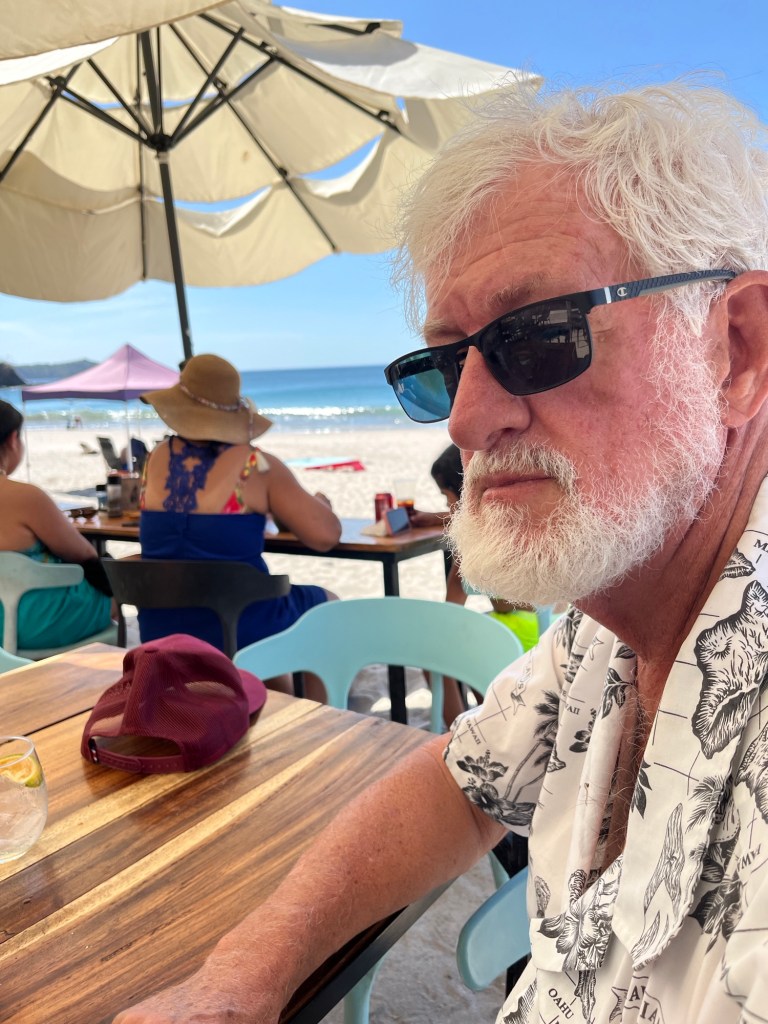
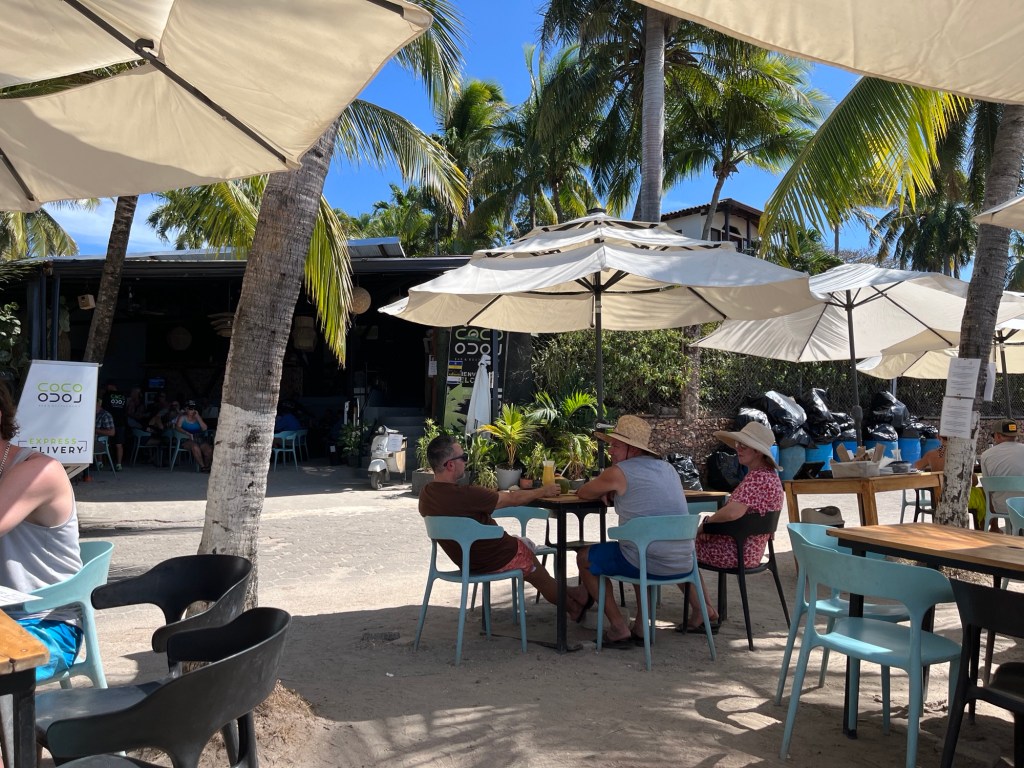
My beloved at CocoLoco.

On the advice of the hotel mom, Marie, we decided to go to Flamingo Beach. She said it was a beautiful white sand beach, but the wave break is pretty strong, and I should be careful. She also recommended a restaurant on the beach called CocoLoco. So we hired a car and driver, whose name was Orlando, and set off, bathing suits under our shorts and shirts.

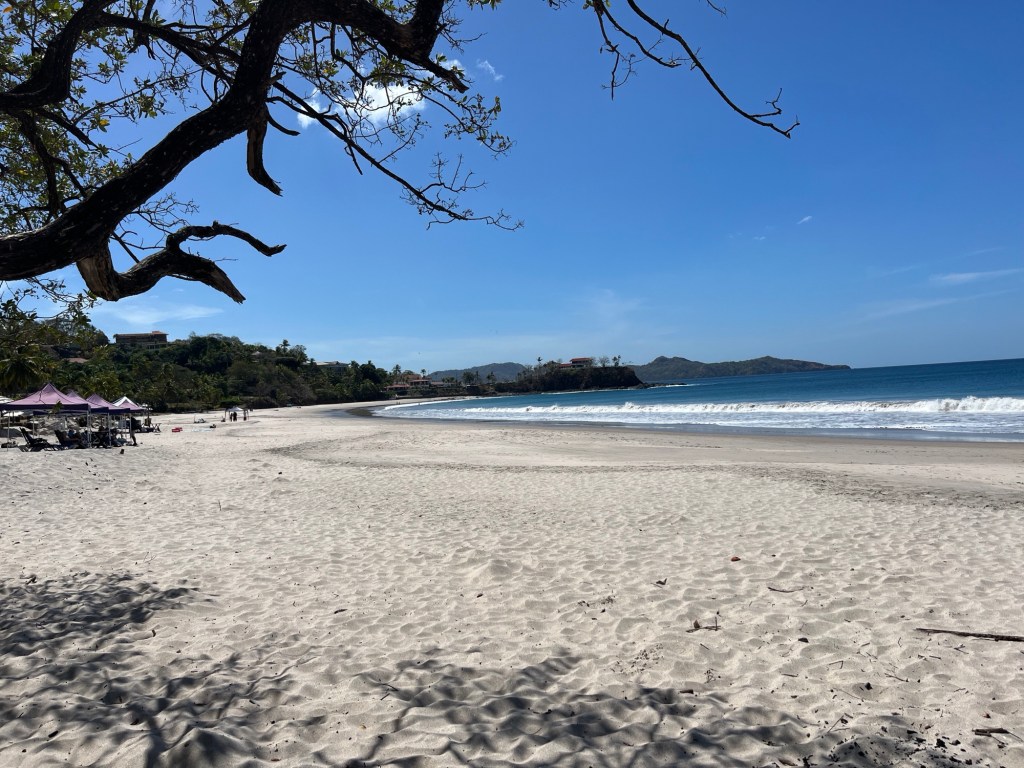
Flamingo Beach

We already knew about Flamingo Beach because our driver Roger said it was very nice and he lived there. He also said there used to be roseate ibis there, which would be exciting to see. People mistook the ibis for flamingoes—hence the name. I doubt there are many ibis left there, as it has been developed. It looks nice to us, but I am sure it ruined the ibis neighborhood.

We rented a tent for shade and some chaise lounges. There was very little shade on the beach, and I am a very white person who burns badly. (Of course, I was wearing sunscreen, but sunscreen only goes so far.)

I waded into the water. Marie was right about the break, but getting out was no problem. The waves were powerful, but small, breaking almost on the beach. Past the surf line, it was still quite shallow very far out. I was cautious about my feet, thinking there might be stingrays. But I didn’t see a single, solitary fish of any sort as I bobbed around in the warm water.

Getting back to the beach through those waves was another matter entirely. The waves broke hard, and then pulled strongly back out. Having grown up swimming in the ocean, I allowed them to knock me down, relaxing into the force and not resisting, trying not to put strain or torque on my knee or shoulder, but making steadily towards the shore when possible. I was absolutely astonished when one of those little waves knocked me down and boiled me! Having learned to survive boiling in the much larger waves of Southern California, I wasn’t hurt. Eventually I found my feet and crawled onto the beach, dripping with compacted sand that filled my bathing suit.

Then Tom went in (we took turns because leaving our stuff unattended would be stupid, right?). Tom saw myriads of baby manta rays (they do not sting), swimming everywhere and surfing in the waves! I could see them in the breaking waves. Evidently, they do it for fun, because they swim back out and go again. He also saw a four foot fish with a dorsal fin that might have been a shark. But the shark, if that’s what it was, was uninterested in him.

CocoLoco

When Tom returned, we packed up and walked the short distance to CocoLoco. We sat at a table on the beach and ordered margaritas. Tom had yellowfin tuna tacos. I had taquitos with chicken, and we shared a watermelon-feta-cashew salad. We ordered more margaritas, and then Orlando showed up, right on time. When we returned to the hotel, I showered in my suit and the amount of sand that flooded out was astounding. Then I went for a brief dip in the hotel pool, which was cool and refreshing. Then I took the suit off and took a real shower. I discovered that my cleverly-designed bathing suit, in addition to drying slowly, was fashioned with many clever nooks and crannies, apparently ideal for sand storage. Another avalanche of sand in the shower.

We ate at Dragonfly again. This time I had beef empanadas and the kale salad. Delicious. The music was ghastly—a monotonous bass beat with an electric guitar tootling around it. Every number sounded just like every other number. I guess people would rather listen to any kind of music rather than have an actual conversation.

Today was the first day since we arrived at Tamarindo that I didn’t take a siesta. Maybe I am acclimating?

Tomorrow we leave for a week in Manuel Antonio, near a large biological reserve. I had my doubts about TamaGringo when we arrived, but we had an enjoyable stay. I can’t close without mentioning how they manage dust control here. They periodically come through and spray the streets from a huge truck. But it’s not water. It’s something with molasses in it, probably combined with oil, because it collects in the ruts, but doesn’t evaporate. The bugs don’t go for it either, although it is sticky with sugar. It sits there in odiferous, dark-brown puddles, making walking all the more interesting.

Costa Rica, Day 13: A country drive to a coffee plantation and almuerzo con comida typica

We got up early to take an hour and a half drive to a coffee plantation. Our hotel hostess provided fresh fruit and other things for breakfast, knowing we would have to leave before the hotel served breakfast.

Our driver was a cheerful gentleman named Roger, who pronounced his name in the Anglo fashion. We asked about it, never having met a Roger in a Spanish-speaking country. He then pronounced it RRRho-hair, explaining that a lot of visitors did not know how to roll their r’s. Still strikes me as an unusual name in this part of the world.

We made our way out of busy, bustling Tamarindo and were soon in open country, dominated by grazing cattle and horses, and dotted with tiny pueblos. Each, as Roger pointed out, had its own church, soccer field and bar. Larger towns might have two or three bars. It is drier here than in La Fortuna, but still lush. Gorgeous plants that I see at home as expensive indoor plants are weeds here.

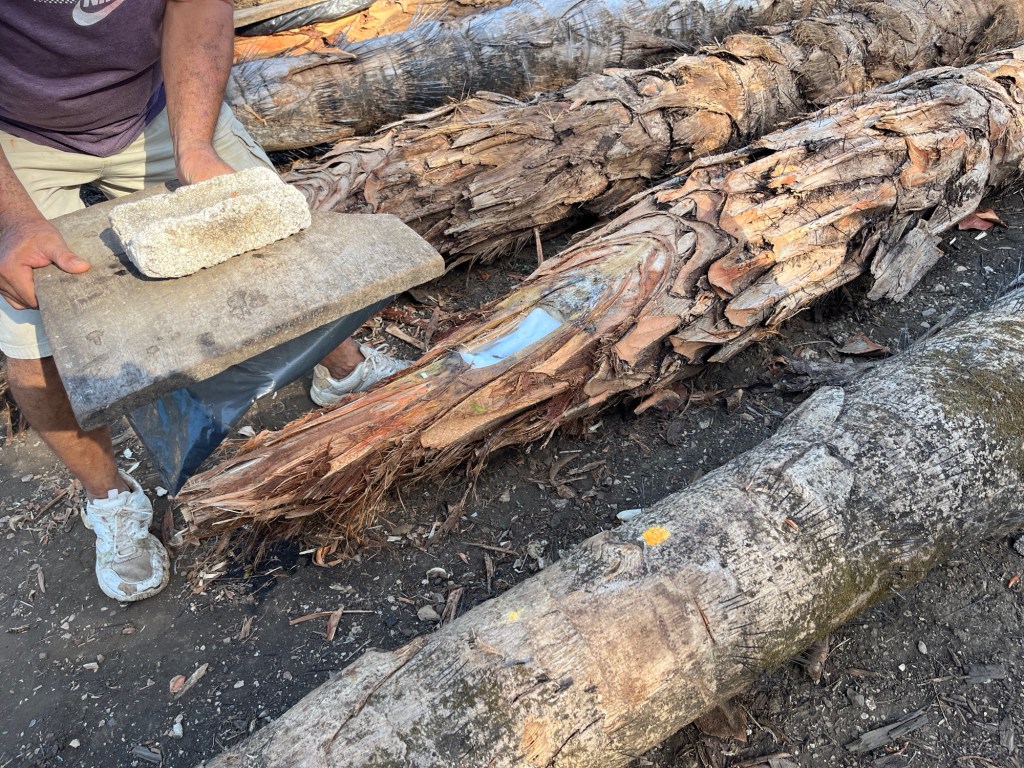
Roger suggested that we stop at a coyol producer. Coyol is a wine made from a particular species of palm tree. The cut trunk is laid flat, and a rectangular well is cut at the end that would normally be supporting the leaves. The sap collects in the cut and is harvested daily. The pre-fermented sap is sweet. It ferments within hours. Interestingly, Wikipedia says, “The wine is purportedly unique in that it causes inebriation not primarily by its alcohol content, but through enzymatic action triggered when one drinks it and then receives significant sun exposure.” Not hard to do here.

The coyol maker removed the protective covering to show us the fresh sap collecting in the palm log. They offered is a taste of coyol that had been harvested 24 hours earlier—the strong stuff, which we accepted. It wasn’t awful, but it will not be my favorite tipple.

We gained a bit of altitude and finally arrived at Coffee Dirià. Several other tourists were already there. They handed us a small cup of coffee, which smelled delicious, but I can no longer drink coffee black, nor do I enjoy it without the modifying elements of milk and sweetening. I am certain it embodied all the taste subtleties that our guide, Dennis (another weirdly Anglo name) described.

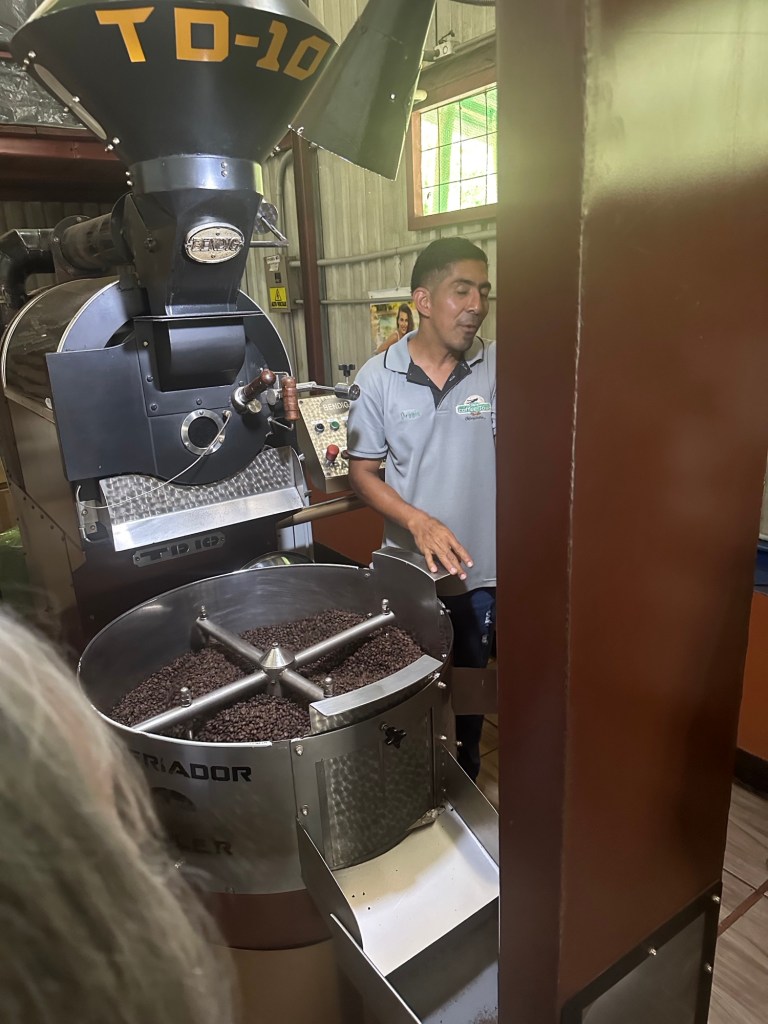
Dennis took us all through the plant and described the process in tremendous detail. I have probably already forgotten much of it, it here’s what I remember:

Dennis showing us the coffee roaster.

The coffee is harvested by hand. It cannot be done by machine because the beans on the same plant ripen at different times. Also, the coffee flowers, which can appear on the coffee plant along with ripe and unripe beans, are quite small and delicate, and they would be destroyed if machinery were used. The flowers resemble jasmine in size and fragrance, though the scent is lighter.

Only the bright red berries are premium quality and fetch the highest price. A mixed lot of picked berries—red, yellow, green—will not fetch a lot of money for the worker (not that they are particularly well-paid even if they get nothing but premium berries.)

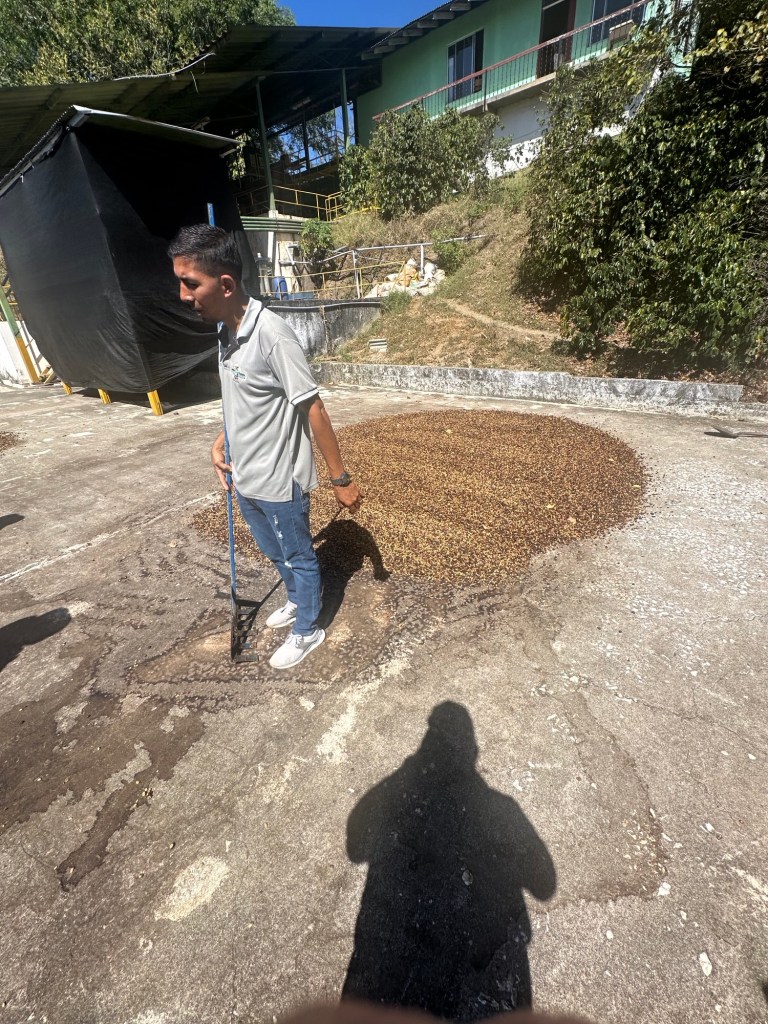
Dennis is standing to one side of premium coffee berries set to dry. The best way to dry them is in the sun, which takes longer than machine drying.

The coffee berry has three “skins.” First, the outer layer, which is the consistency of a very tough grape skin. Then a layer of sweet jelly, similar in looks and taste to the white goo inside a cacao bean. Inside that, there are either two beans or one coffee bean. The singles are the most highly prized, more intense in flavor but smaller in size. These beans have a final “silver” skin that must be removed before roasting.

I’m skipping over the drying, fermenting, roasting, etc. that most of us know about. I was most interested in how they have approached farming coffee organically, without pesticides, and used every part of coffee bean by-products.

Instead of using pesticides, they spray the plants with a tea made of oregano, basil, chilis, and other things. This helps, but there is a weevil that made its way down from Brazil that still manages to infect some of the beans, laying eggs in them. The weevils hatch out and set up housekeeping by eating the house. Dennis selected a bean with a tiny hole and ejected the weevil to show us. It was tiny.

The harvested coffee beans are submerged in water. The good beans sink, and the weevily beans float. The bad beans are submerged for 24 hours in water, which drowns the weevils. The now-unoccupied weevil houses are dried and used for things that are coffee-flavored, like instant coffee. Remember this when you sip that next cup of Nescafé.

The external skin is left on the beans during fermentation and drying, then removed and used for animal feed. The silver skins are dried and turned into paper. The flowers are sometimes used for perfume and skin care products. There are more uses for different parts of the beans, but this is what I recall. Very impressive, IMHO.

We bought some of the plantation’s highest-quality beans, called Black Honey. They had actual honey made from the bees that pollinate the coffee flowers. It was an unusual flavor and delicious, but I didn’t want to carry a heavy glass jar of glutinous sticky stuff in my suitcase. 😢

So then Roger and the Keenans were on the road back to Tamarindo. Roger gave us beers. I am not a beer drinker, but my Mom always said a cold beer on a really hot day hots the spot, and she was right.

We stopped in Villareál, a small town not far from Tamarindo. We were promised lunch at Roger’s favorite soda. A soda is a small, usually family-owned restaurant where you can get local food—la comida typica. The soda in question, Soda y Masqueria Marcel, has its own Facebook page.

Roger had ordered while we were on the road. We all had casada, which is the classic mid-day meal here. It consists of a protein (I and Roger had fish, Tom had chicken), salad with lots of raw veggies, rice and black beans, and plaintains, which in this case were cut into long strips and deep-fried until light and crisp. It struck me as a well-balanced, nutritious meal, and it was delicious.

A word about Costa Rican food in general. It is safe to eat raw vegetables here. I got the squits once, but I always get the squits when I travel outside the US—even in pristine Iceland. Tom has been fine. The tap water is also safe. The food is not at all spicy, though sauce picante is available on request. The food at our hotel at La Fortuna tended to the bland and uninteresting, but we have had really good food in Tamarindo, although you do have to go a bit further abroad if you want la comida typica.

I took my now-habitual siesta in the afternoon and Tom walked in the suffocating heat. (Note that he is the healthy one.) For dinner, we returned to the Falafel Bar because it was really exceptionally good middle eastern food.

This is the hotel’s cat. I don’t know it’s name or gender, but it follows us whenever we emerge from our room. But it does not wish to be petted.
Another hotel guest. He also does not wish to be petted.

Costa Rica, Day 12

I am still laughing at myself, 24 hours after it happened. We were on the way back from Dr. Piloto’s office. I had trouble getting into the taxi van because the first step is quite high, and the van was parked at an angle that made it even higher. My walking sticks signal to most people that I am not terribly agile right now. There were other people in the taxi, and when the driver pulled away. I thought he was leaving. But instead, he reparked the van to make it easier for me to get in and offered me the shotgun seat. I was grateful, but when I tried to tell him my knee required surgery, I misspelled surgery in my translation app and told him that “My knee requires sugar (azucar).” I KNOW the word azucar but said it anyway. He was such a kind man that he did not burst out laughing, which he was certainly entitled to do! He seemed to get it, but I’ve been breaking out in little burst of laughter ever since.

Today we took an estuary tour by boat through the mangrove swamps. We had to leave before our hotel served breakfast, so we walked into town. Most restaurants were closed, but we found a breakfast place and had fruit, avocado toast, yogurt, and coffee. Perfect.

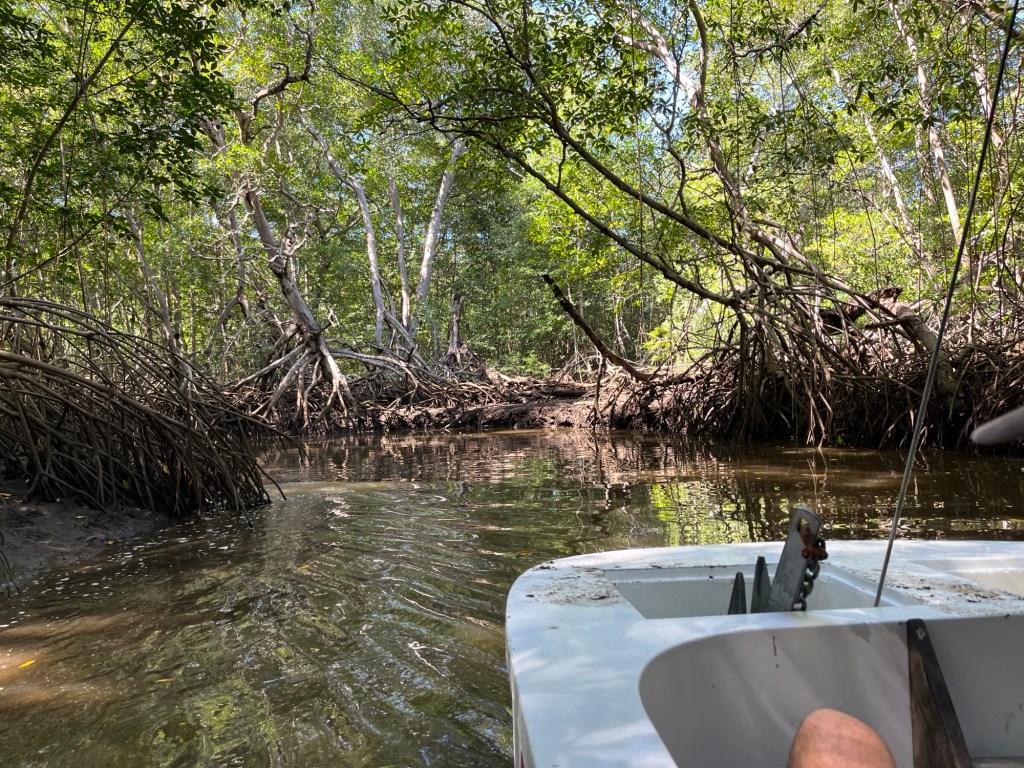
The estuary tour was via a small boat with a canopy, powered by an outboard motor. The guide pointed out several different varieties of mangroves ( I had no idea), and my favorite was the “gentleman mangrove.” Our guide didn’t really know why it was called that.

Gentleman mangroves.

It was very low tide, and the boat got hung up on sandbars several times. This did not worry the men in charge of the boat; they always got us safely sailing again. At the beginning of our tour, the mangrove roots were high out of the water, and they looked like fingers reaching for the tide. By the time we returned, they were underwater again.

We wandered down some very narrow channels. Then we had to wander out again before getting stuck.

We saw a good variety of birds. They don’t have toucans, or macaws (none of which I have seen yet), but we did see:

Yellow-crowned night heron

White ibis (not my photo)

We didn’t get photos of most of them because they were too far away, but we also saw:

Green-backed heron

Little blue heron, adult and juvenile

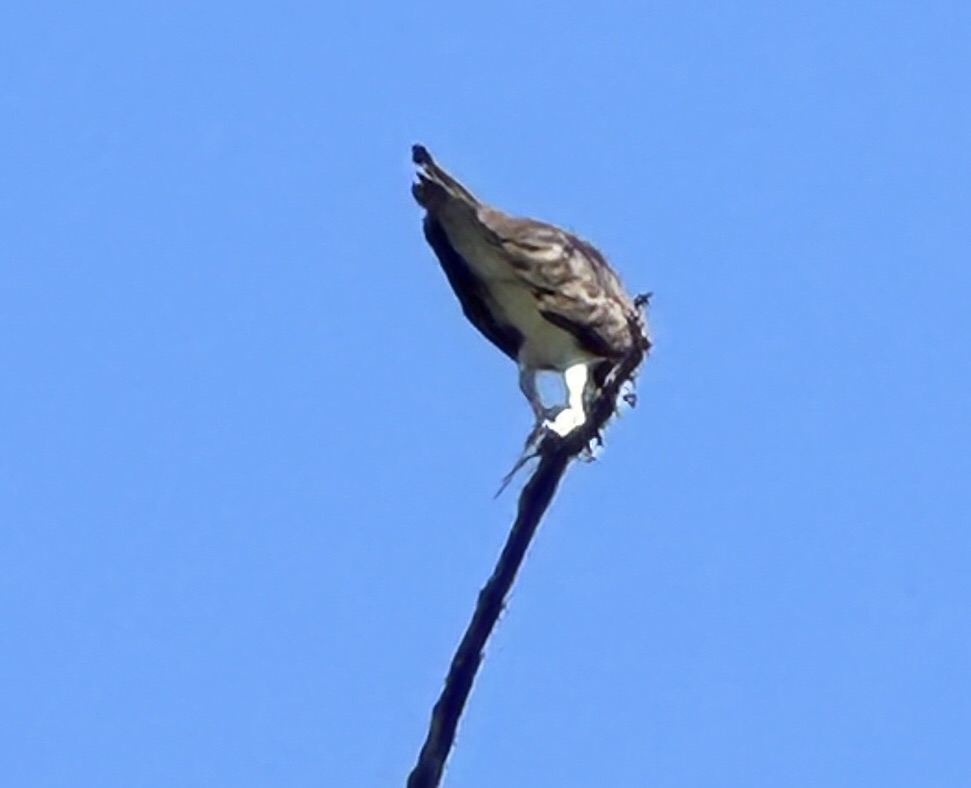
Osprey, sitting in a tree and lunching on a silvery fish

Common black hawk

Great blue heron

Whimbrels

Willets ( migratory birds that look identical to the ones on our beach at Aptos, CA)

Sandpipers (also migratory)

Kingfishers

Mangrove hummingbird

Black-throat trogon (maybe)

About midway along, they served us fresh-cut pineapple, which was refreshing. I guess someone threw extra pineapple onto the beach, because on the way back, there was a very happy and very large iguana chowing down on it.

Happy iguana eating pineapple. What a find for him or her!

We also saw several baby crocodiles in the water. None of them more more than two years old. Sadly, none of the croc videos wants to load.

The guides anchored the boat next to a muddy bank with mangrove roots sticking out of it and invited us to climb up so we could go see howler monkeys. I and my bum knee and torn rotator cuff opted to stay in the boat, much to their surprise, but I was happy with my decision.

At one point, there were howler monkeys in the trees right next to the water, so I got to see them anyway. One of the other boats had a guide who could imitate the howler call and got a rather lackadaisical response from the male troupe leader. You know, it was hot.

Howler monkey.