Speaking of Inca: Elegy for a Small Black Cat

I didn’t think I would have to write this so soon. My cat Inca, my loving companion of 17 years, was dead on the floor when I got up the other morning.

I suppose she was lucky. She was rarely sick, and never seriously ill. She was still lithe and active, her fur thick and glossy. She attacked her evening treat last night with her usual impatient greed. She never suffered as some of my other pets have, with pain and illness. She didn’t have to be put down by the vet—a procedure that would have terrified her, as she was a very shy and nervous girl. Instead, she passed away, apparently in her sleep, with her people there, though we knew nothing about it until the morning. I guess I would be happy to go the same way.

But there is a painful, Inca-shaped hole inside me right now. So let me tell you about Inca.

I got Inca right after my beautiful cat Phoenix died of cancer (actually of vet, but the end was very near). I was heartbroken, but a friend said I should rescue another cat in Phoenix’s honor—he was sure it would make me feel better. (Incidentally, he was right.) I started looking at shelter cats and ran into an organization called 13th Street Cat Rescue in San Jose, CA. I asked about a black cat they had because the very first cat I remember was my brother’s black cat, Flinky, and he was a very sweet boy. The cat I asked about was taken, but they asked if I was interested in adopting a black cat, because people are often highly superstitious about them, so black cats (and other melanistic pets) tend to sit on the shelf. The organization happened to have a nine-month-old black cat, part of a litter that had been rescued from a trailer park. The kittens had been too old for adoption, but the trailer park manager threatened to kill the whole lot if 13th Street didn’t take them.
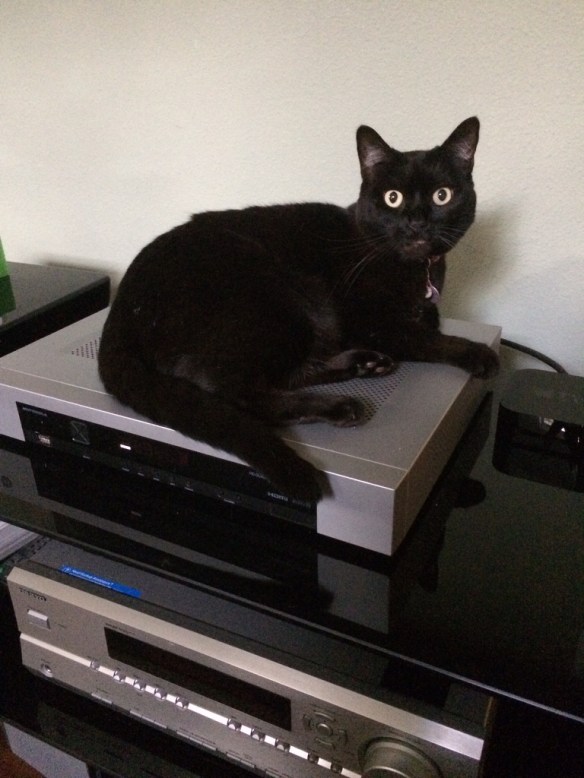
Inca on her personal cat-warmer.

It turned out all the kittens, though feral, were adapting nicely to domestic life. Inky (as she was called then) was no exception. I met her at one of the volunteers’ houses, and she sat on my lap and purred. Inca was beautiful, black with bright yellow-green eyes. She always had a few scattered white hairs among the black. In the sunlight, her fur looked chocolate brown.

We agreed to adopt her. I’m afraid I could not have a black cat named Inky. First I tried naming her Flinky, after that first black kitty, but it never suited her. The name Inca just came out of the blue one day, and I loved it right off. It seemed to suit her elegance.

At the time, we had a wonderful dog named Gigi. Gigi was a German shepherd-Labrador mix, 75 pounds, and, though a sweet and gentle dog, she was obviously terrifying to a tiny black cat. We kept Inca sequestered in a bathroom for a week, then let her out into the house. We really didn’t see her for the next two weeks—just a flicker of black at the corner of the eye, like a bat.

Then one day I was sitting on the couch and Inca strolled calmly into the room and jumped into my lap. I petted her, delighted, and she purred. After a few minutes, Gigi entered the room and I braced for a cat freakout. Instead, Inca ran down the length of the couch toward Gigi, mewing loudly. Gigi came over, and they kissed each other. Somehow, without my ever observing it, Gigi made friends with this timorous wee beastie and convinced her she was in a safe place. Their friendship ended only when Gigi died. I have many photos of the two of them cuddling together.

After Gigi died, Inca became even more attached to her humans, especially my husband, Tom. She began to sit on his lap at night when he watched TV. She was never a playful cat. Once in a while she would bat a toy around for a few minutes, but that was the extent of it. She didn’t have cute habits or do funny things, But she was a powerful engine of love and cuddles, happy to be petted at any time of the day or night.

Inca was also the best-behaved cat I have ever had. She didn’t potty outside her box. She didn’t scratch the furniture. With the exception of one fern, she never touched an indoor plant (the fern survived). She was the opposite of picky about food, eating whatever I put in front of her. She didn’t destroy stuff. Once in a while, we did get cat gak, but hairballs are part of being a cat. She bit gently when she felt affectionate, but rarely scratched. She loved our grandchildren and was gentle with them.

Inca did not like her tummy to be touched. If her tummy was stroked, she did that cat thing, turning into a ball of needles. After Inca was introduced to civilization by Gigi, the two of them tended to go with me wherever I was in the house. One day, Gigi laid down for a good tummy-rub and I obliged her. I rubbed and rubbed, and Gigi moaned with happiness as Inca watched. When I stopped rubbing Gigi’s tummy, Inca flopped over and presented her tummy for a rub. She found that she enjoyed it and would often ask for a tummy rub in the years to come. I was very intrigued that she observed, learned, and experimented.

She even learned some tricks at an advanced age. As she aged, she was still active, but could no longer jump to the top of the bed like Superman in a single bound. I bought her some stairs so she could climb our bed without clawing her way up the sides, shredding the bedclothes and on one occasion, me (it was an accident, but still). She would look at me with those bright eyes, clearly planning to scramble up the side of the bed, and I started gesturing to the stairs and telling her “Go up the stairs.” She learned to do this on command and (mostly) stopped clawing her way up the sheets.

I was facing major surgery and worried that Inca would continue to treat my body as a nice place to stomp around in the evenings. I never could figure out why she sat calmly on Tom’s lap, but wanted to stomp around on me. I had to teach her not to stand on my body, which must have been confusing to her after so many years of doing so. But she did learn, and only ran over me once after the surgery—right over the incision, as it happened. But mostly, she remembered not to. I felt kind of bad about making her stay off me (though I welcomed her to cuddle by my side), especially now, knowing how little time she had left. I did stop many times throughout every day to pet and cuddle her; I wanted her to know that I loved her as much as ever.

Inca was still so beautiful and healthy at 17 years old that I was convinced she would last a couple of years more. Unlike other elderly cats I’ve had, she did not become skinny, her fur was still thick and shiny, and she was as enthusiastic about food, treats, and petting as ever.

When I found Inca’s body yesterday morning, she was already stiff and cold. I wrapped her in a clean towel, but her bowels and bladder did not void after death. She exited this life as she lived it—tidy, without making a fuss.

I miss my friend. I really, really miss her.

Let Me Tell You About Gigi

Gigi as a sweet young thing.


I had a bit of a scare recently. My dog Gigi developed a fever, lost her appetite and began to act lethargic. She’s 12 years old, so I wasted no time taking her to her vet. Dr. Good, who rolls around in a mobile clinic, did a thorough exam, took blood and urine and an X-ray—and found nothing wrong other than the obvious presence of an infection. So Gigi went on antibiotics.

I’m happy to say Gigi recovered and is doing fine. But while she was sick, I began to dread the possibility of losing this amazing creature with whom I share my life and my home. I thought I would write an obituary about her when she dies—because she will die, and at this stage, who knows how long she’s got? She’s a big dog, and the big ones don’t tend to live as long.

So I decided to write about Gigi now, while she’s still with me and I can discuss her unique characteristics without breaking down in floods of tears.

On the surface, Gigi is just a very doggy dog. She’s half Labrador and half German Shepherd, with maybe a dash of Doberman. She’s black-and-tan and shorthaired, with floppy ears. As much as I love her, I do not share my bed with her because she’s 75 pounds of elbows and she farts and groans all night.

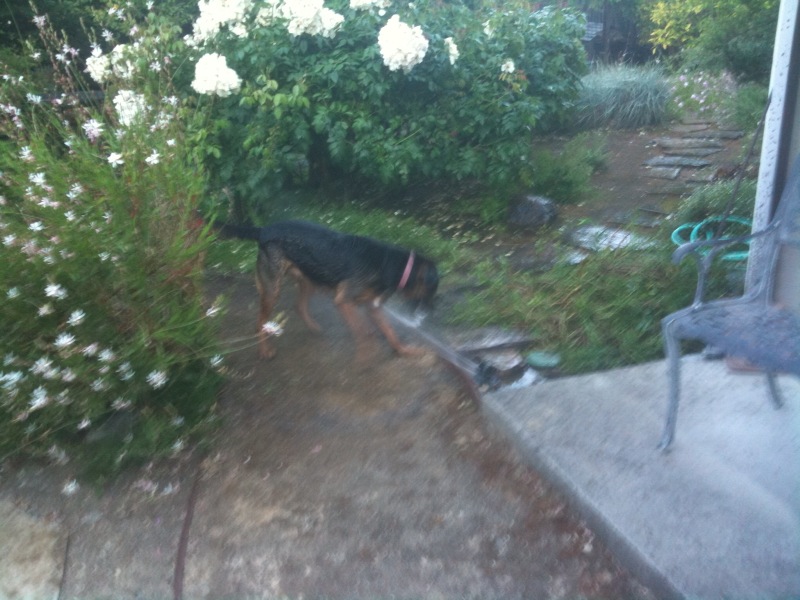
Gigi used to adore playing with water from the hose or a sprinkler. She doesn’t do that anymore.

I wasn’t looking for a dog when Gigi came to my attention. I had lost my last dog, Ringo, a year previously and was still in mourning. My daughter Kerry saw an ad on Craig’s List that said, “Sweetest dog in the world needs a home.” I looked at the picture. This dog was much larger than I wanted. She was black-and-tan, which is not a color scheme I admire. And she lived about 65 miles away.

I called her owner. Apparently, they rescued her when she was about six months old, and loved her dearly. But the landlord of the house they had just moved into said the dog had to go. I asked question after question, because living with Ringo taught me the right questions to ask. (Loved that dog, but he was a hot mess when we first got him.) The answers seemed good, so my husband and I drove 65 miles to meet the dog.

The dog’s name was Gertie, a name I knew I couldn’t live with. She greeted us with kisses and a wildly wagging tail that slapped against our legs like a baseball bat. I observed her with a baby and with cats—completely calm. I did everything I could to elicit a dominant or aggressive response—grab her collar, squeeze her paws, roll her over, and so forth—all of which she responded to with kisses and wags.

I decided I wanted her, but we had five houseguests with a sixth on the way and I felt it was unfair to plop an adopted animal down in the midst of all this chaos, so I said I’d come get her when the house had cleared out. Her owner agreed, but later told me that the landlord had threatened to evict them if the dog wasn’t gone by a certain date. On that day, I drove back to collect her.

In the interim, we had a lively family discussion about what to call the dog, as Gertie just wasn’t going to cut it. I thought we should pick a name that was similar to Gertie so she would adapt to it quickly. I suggested Gigi. My daughter said it sounded like a stripper. After a two-hour discussion, Gigi it was, though still over my daughter’s objections.

When I picked her up, her owner burst into tears and rushed us out the door, handing me a ceramic jar for dog treats. It was clearly a painful parting. I put Gigi in the back of my car and headed home. Gigi rested her chin on my shoulder for the entire trip home, which I thought was a good sign.

It turns out I needn’t have worried about the abundance of guests or about the name. Gigi walked into the house and acted as though she had lived with us her entire life. She also responded to her new name instantly. As a matter of fact, as the houseguests began to go back to their own lives, Gigi seemed to miss the party atmosphere of an overcrowded house. She still loves a good party.

Then we began to get to know her. First of all, Gigi is an extremely obedient dog— except when she isn’t. For example, if she needs to go outside to go to the bathroom or check out the gophers, she will go outside. If she doesn’t, she will wag her tail and refuse to move. I have learned to trust her on things like this and will only insist if there is some compelling reason. She has a stentorian bark that wakes the eldest grandchild from her nap, so I put Gigi out when Jessamyn is napping so that if the doorbell rings or there is a package delivery, she won’t sound the alarm. Gigi goes reluctantly, but she goes.

She can make friends with just about any other animal. I have seen her buddy up to:

  • At least two coyotes
  • A bunny (kisses were exchanged)
  • A feral cat
  • A cat that was so terrified of her that it refused to come into the house until Gigi performed her ambassadorial work
  • Innumerable other cats and dogs and humans

The feral cat is my rescue kitty, Inca. When I first acquired Inca from a rescue organization, they told me she was one of a litter of feral kittens. They were considered too old to domesticate, but they seemed to be adapting to humans, so the rescue decided to place them with families. Inca was okay with me as long as I kept her confined to a bathroom, but she was horrified by Gigi. When I let her out of the bathroom, Inca disappeared for two weeks, flitting about in our peripheral vision like a bat.

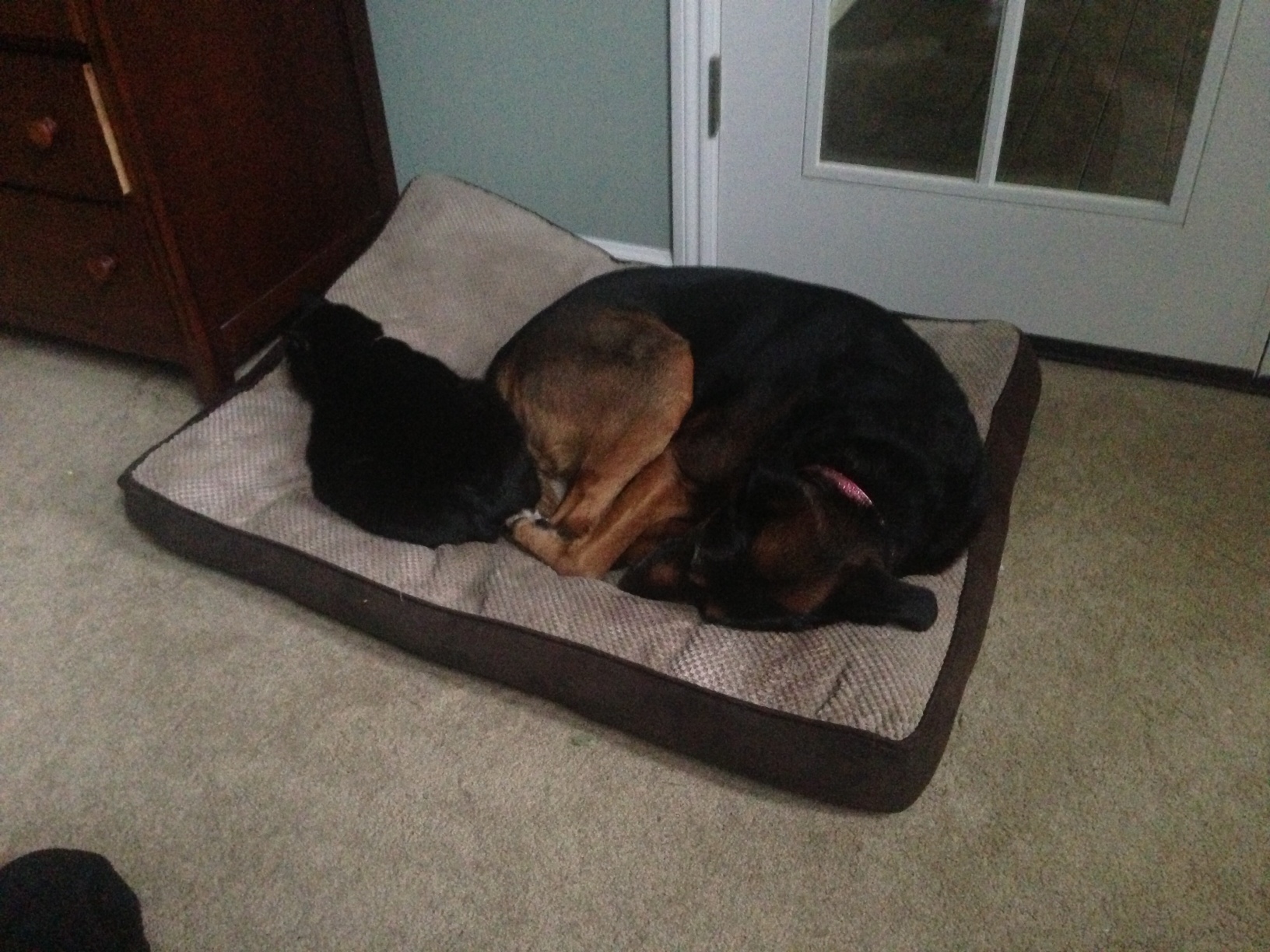
Gigi and her cat take a nap together.

One day, I saw Inca and called to her. To my astonishment, she strolled over and climbed into my lap. After a bit, Gigi came into the room and lay down. Inca trotted down the length of the couch, mewing at Gigi. I had no idea what would happen, as I hadn’t had either of them for very long, but Gigi came over as though Inca had been calling her and proceeded to kiss her. Inca adores Gigi. It’s pretty funny to watch her try to give this enormous dog a bath with her tiny pink tongue.

I give Gigi a lot of credit for the rapidity to which Inca adjusted to domestic life and became an affectionate pet. She never used to let me pet her tummy, which I longed to do (best part of a cat). One day, I gave Gigi an extensive belly rub. Inca watched intently nearby as Gigi groaned with happiness. When I finished with Gigi, I turned to pet the cat. Inca flopped down and presented her own belly for a rub, and she has enjoyed it ever since.

Inca and Gigi have seldom been parted, but there was one weekend when I had to use a pet-sitting service. Gigi went to the sitter’s home, but the service had a large enclosed cat area for feline borders, so they were separated for about four days. When I went to pick them up, Inca was there, but the sitter had not returned Gigi. I told them to have the sitter bring Gigi directly to my house as soon as possible, and left with Inca.

When we got home, Inca shot out of her carrier and began searching the house. She went from room to room, mewing loudly, but of course, Gigi was nowhere to be found. When the sitter showed up with the dog about two hours later, Gigi made for her water dish immediately because it was a sizzling day. She put on the brakes when she saw her kitty friend, and the two of them checked each other out carefully, kissed, and then Gigi got her drink.

You might be wondering about the coyotes I mentioned earlier. I am familiar with the coyote trick of sending a fertile female to lure a male dog to its doom (the original femme fatale.). That wasn’t what was happening here. The first time, I noticed Gigi making play bows along the fence enclosing our yard. Something was moving around vigorously in the tall grass and weeds on the other side of the fence. When I got closer, I saw it was a small, young coyote. The two animals were playing with each other, each on one side of the fence, play-bowing and running, then bowing again. They seemed to be having a lot of fun.

In the second instance, my son-in-law Mike came home and saw Gigi in the back yard with what he thought was a fox, just hanging out together. He videoed it, calling Gigi in, so we were able to see it was a young female coyote that had found a way under the fence. Apparently, Gigi and the coyote had been chilling together in the back yard for quite a while. We don’t really want her socializing with coyotes, so we fixed the fence.

There is an exception to Gigi’s long list of friends. My daughter’s dog, Hendrix, is a Japanese Chin. He’s one of those fluffy, goggle-eyed little dogs. He annoyed Gigi at first acquaintance by biting her ankles. Gigi responded by squashing Hendrix flat with one big paw, but unfortunately, this triggered Hendrix’s bad back, requiring expensive meds. Although he has lived with Gigi now for four years, Hendrix has not improved his behavior and sometimes still bites her ankles. Gigi has learned to ignore/not squash him, but she cannot overlook it when he steals her chew toys.

Gigi with prized new toy. She almost always has something like this in her mouth.

Gigi loves to carry toys around in her mouth, usually a stuffed animal, but sometimes a chew toy. Hendrix isn’t allowed bones or chews because of major, life-threatening allergies, and he steals her toys out of jealousy. One night, Kerry took a bone away from Hendrix and returned it to Gigi. Gigi took it with her customary gentleness, but never stopped staring at Hendrix. Finally, she turned her back, walked away a few paces, turned around, and THREW the bone at Hendrix with a snort worthy of a teenage girl.

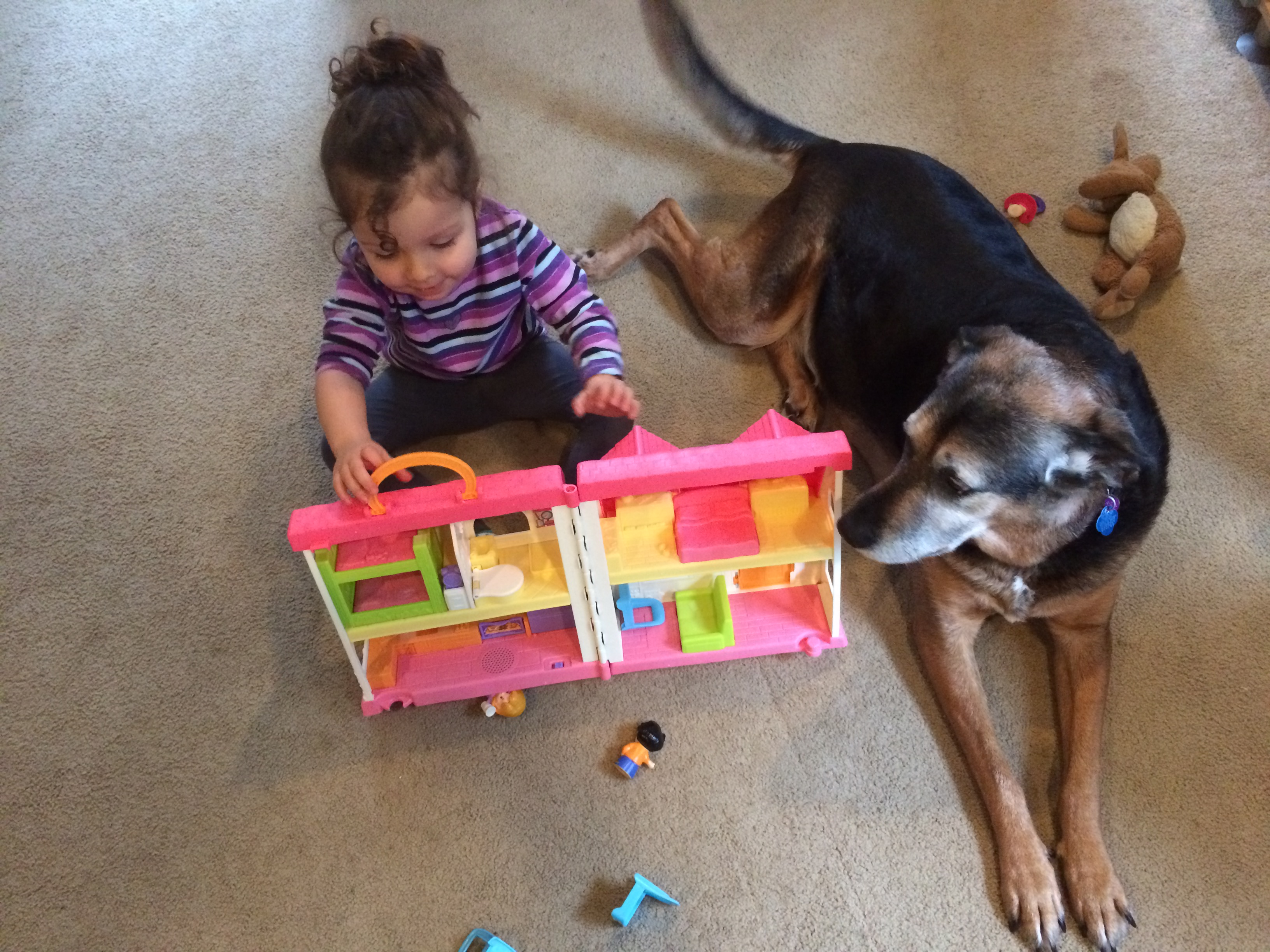
Gigi has been wonderful with the grandkids, gentle and protective. She permitted all kinds of indignities, though we tried to spare her and teach the children to be gentle with animals—which they are. When Tom and I aren’t at home, Gigi sleeps in Lilah’s room, squeezing completely under the bed. She’s so big I’m not sure how she gets out again. Both the grandkids learned early to dodge Gigi’s lethal tail. It smarts when her tail connects with human flesh.

Gigi on duty.

While I don’t doubt that if anyone threatened us, Gigi would rip his throat out, I trust her 100% with children, guests and pets. She is one of the most utterly trustworthy personalities I have ever encountered. It’s not like having a dog around so much as having an odd-looking grandmother. A grandmother who might attack burglars.

Whenever I have had to treat Gigi for an ailment, she is the soul of cooperation. She will do anything the vet asks, patiently enduring indignities such as rectal thermometers and intrusive examinations. Once both her ears became infected. I had a bottle of liquid that I had to flood both ears with twice a day—something most dogs would strenuously resist. When Gigi saw me coming with the bottle, she would lie down on one side and present an ear. When I was done treating that ear, she would roll over and present the other one. She’s that way with every medical treatment—including acupuncture, which helps with her arthritis when it get bad—apparently understanding that we are trying to help her even if she doesn’t understand what we are doing. (Although I wouldn’t take any bets on her lack of comprehension.)

We live in a beach town. It’s also a dog town, and many people bring their dogs to play at the beach. I took Gigi frequently when we first moved here, but after a couple of years she started coming back limping and sore. Age, alas, is catching up with her, and her once-black muzzle and face are now frosty. She has arthritis and some old joint injuries that cause her problems. Unfortunately, she just doesn’t understand moderation. If I take her to the beach, she runs around and greets and plays with every other dog present, and most of the humans, too. We have had to curtail her beach visits, which is sad, because she used to have a blast.

It’s hard to express this without sounding kind of woo-woo, but this animal is enormously spiritual—more than most humans I know. She’s kind, gentle, intuitive and loving. I respect her as much as I would respect another human because she is her own creature. She knows who she is. She has a presence. Don’t get me wrong—she’s still a dog. She begs at the table. Sometimes she pees in the wrong place (but only if desperate). She barks at nothing and she barks at everything. But looking in her eyes, I see a kindred being who communicates with me without words, respects me, and loves me.

And when she goes (may it be many moons from today), I will be as grief-stricken as I would be for any family member. That’s why I’m telling you now, while I can, that I have in my keeping a great and beautiful soul. It’s a beautiful soul that farts and groans all night, that’s all.

Friends