

This morning when we made our way to the restaurant for breakfast, spider monkeys were everywhere–leaping overhead from bough to bough and chattering. At the restaurant, several of them were intent on snatching some food, but they were shooed away by staff.
We visited a spice plantation on day 20. It was about a half-hour drive from the hotel. They grow a number of different spices: vanilla, allspice, cardamom, cloves, cinnamon, black pepper, hibiscus, and more, as well as chocolate and coffee. The chocolate, we were informed, is pollinated by mosquitoes, so there is a reason for them after all. The spice plants were spread along winding, gravel paths among tropical flowers–very picturesque.


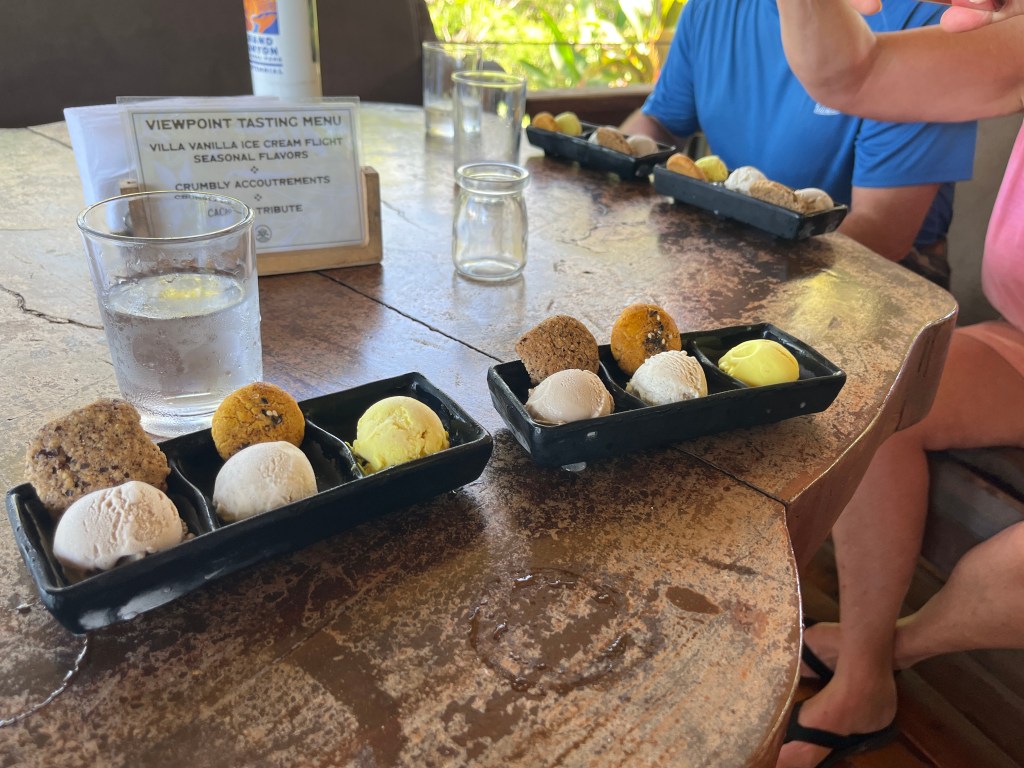
Then they took us to a building rather like a fire tower, reached by stairs. The view over the plantation was gorgeous from up there. We sat and tasted chocolate and three different flavors (vanilla, chocolate, and goldenberry, a local delicacy) of ice cream, complemented by “crumbly accoutrements,” as the menu said. Very satisfactory.

On our last day, we hired a guide to take us on a short hike through Manuel Antonio National Park, which is an enormous biological reserve. Needless, to say, we only saw a very small part of it. It turned out that the entrance was right across the street from the hotel–the same entrance we used to visit the butterfly sanctuary.
Our guide, David, was a young man whose primary training was in ziplines and such, but he wants additional certification to become a wildlife guide. He likes being in the forest best as he says it makes him feel peaceful. He also mentioned that he has had dengue fever three times, which is one of the things I was worried about until I saw our accommodations and realized that a kissing bug (the vector for dengue) would die from the air conditioning before it reached us. He confirmed that it was very painful (dengue is also called bone-break fever). He spoke good English, which–like most of our guides–he taught himself.

We saw a sloth high up in a tree, hanging upside-down in archetypal sloth fashion. We also saw a number of iguanas and basilisk lizards, and some spider monkeys. We also saw a column of army ants, no more than an inch wide, but stretching ahead and behind for unknown lengths as they disappeared into the leaf litter. They have no permanent nest, carrying their pupae on their backs as they travel, stopping only at night. We only saw them because they crossed the trail we were on. I was also delighted to spot a gorgeous morpho butterfly, flashing its bright blue, iridescent wings as it wafted through the trees. I had seen them in the sanctuaries, but this one was in the wild.
I apologize for not having more photos of the end of our trip. Technical problems, but I wanted to get this down and finished.
We decided to take a small commuter plane from Manuel Antonio to San Jose airport, where we would catch a flight to Panama City and from there to San Francisco, CA. The drive from Manuel Antonio to San Jose was five hours; the flight was 30 minutes. This was compl=elling enough to overcome my objection to small planes. We arrived at the Manuel Antonio airport, which now holds our record for being the smallest airport we have ever been in. It was basically a large room. The security consisted of a uniformed guy who looked at everyone as they came through the gate. They weighed us and our bags, then we were allowed to board a 12-passenger Cessna. It was a quick trip on a fine day, with very little turbulence.
Costa Rica spread out below us, mountainous and green. We saw a lot on this trip, but I couldn’t help thinking how much more the country has to offer. No army, investing in education and the environment instead. Costa Rica runs on 100% renewable energies–hydroelectric, wind, and thermal. Despite all the sunshine they get, there are few solar panels visible at houses because electricity is subsidized by the government and solar panels are 100% imported and thus expensive. They like Americans. They believe in their “Pura Vida,” and they act accordingly. It appears to be a government that acts on behalf of the people, and not corporations and oligarchs. I know they have their issues, but I really liked the country and the people. I was both sad to leave and yet eager to get home, which I suppose is the hallmark of a great trip.

 obsidianmirrorblog