My Big, Fat Weight-Loss Campaign: Part 7

It has been a long time since I last posted. With regard to my Big, Fat Weight-Loss Campaign, it’s because it got complicated.

I lost 55 pounds or so in one year. The next year, despite continuing to diet conscientiously and exercising regularly, I lost no weight at all.

None.

I made changes. I was using the Weight Watchers method. I switched to counting calories. I was exercising a few days a week. I upped it to six days a week, alternating cardio and weight training.

Nada.

I started taking protein supplements. My nails went from paper-like to strong and long, and my hair thickened as well.

Not another ounce came off.

I consulted a nutritionist who wanted me to go on a cleanse for 10 days eating nothing but protein and vegetables. This is intended to improve bile production and reduce blood sugar because she couldn’t find anything else impeding my weight loss. I bought her protein powder and supplements, but suddenly, I was scheduled for major surgery—a complete, reverse shoulder replacement. I decided to delay the cleanse, as the surgery was going to interfere in many ways with how my body was working and I didn’t want to play around with nutrition while I was in recovery.

The surgery went fine and I’m glad I did it even though the six weeks in a sling was tedious and uncomfortable. Still, the discomfort was far less (after the first week) than before. Prior to the surgery there were days when I was hurting so much I couldn’t leave the house. As I was lying on a gurney waiting for surgery, I was in so much pain I asked for pain-killers (I was unable to take any prior to getting to the hospital because I was following the surgeon’s orders about taking medication and water.) Bless the nurses. They got me pain-killers. I was grateful because I spent a long time on that gurney.

Then I spent six weeks doing nothing at all except watching television, reading, eating, and doing physical therapy. I couldn’t drive and I didn’t want to leave the house if I didn’t have to. After this slugfest I was sure I would gain weight, but I did not. I’m back to counting calories and just resumed cardio on a recumbent bike.

To be honest, I don’t want to do the cleanse if I can avoid it. I would have to fix all my meals separately from the rest of the family, and just protein and vegetables sounds…boring. I will still do it if I have to, but I am hoping that the surgery did a reset and my body will once more be open to shedding pounds.

#

I had never heard of a total reverse shoulder replacement until I was told I needed one. It’s a technique they use when there is so much damage to the joint that a standard replacement won’t work as well. I have severe arthritis, which pretty much destroyed the humeral head (the “ball”) of the humerus (upper arm bone) and resulted in bone-on-bone action and bone spurs.

The procedure is to expose and dislocate the joint. The humeral head is sawn off and replaced with a titanium and plastic cup which is inserted into the humerus. A titanium ball is screwed into the shoulder blade. Thus, the structure of the joint is reversed. It’s kind of a brutal surgery, and I am DEEPLY grateful for anesthesia. The surgeons did an amazing job, and after the first week, I stopped taking opioids and used only Tylenol and CBD for the pain, which has diminished daily. I have good mobility for this stage of healing (because I do the physical therapy exercises religiously). I don’t think I will ever have the complete range of motion that my other shoulder has, but I’m OK with that—I’m no longer in agony. And at 74, I have no ambition to become a trapeze artist.
My Big, Fat Weight-Loss Campaign, Part 7: The Betrayal of the Body

On the one hand, I have lost 55 pounds in about two years—45 of them during 2024. On the other hand, I have been stuck at the same number for about six months, and I can’t seem to move past it.

There are a few reasons for this. One reason is that my left knee decided to join my right knee by becoming incredibly painful. At times, I could walk only with the help of two canes. This meant that the exercise program came to a grinding halt. Off I went to the orthopedic surgeon to get shots of hyaluronic acid gel. Not much improvement, so the doc felt around a bit and determined I had a “Baker’s cyst.” This, it turns out, is very common in people with arthritis. It is a cyst that forms at the back of the knee, filled with synovial fluid. (Hyaluronic acid is a precursor to synovial fluid, but the cyst appeared prior to the injections.)

So the doc gave me a cortisone shot—and I immediately felt much worse, and took up both canes to walk again. So I spent probably two months or more sidelined from exercising. The knee gradually improved to the point where I started going to the gym again, but I decided to go to physical therapy to see if I could improve the situation a bit further.

The therapist thought the issue was not the Baker’s cyst (although it is definitely there), but an irritated meniscus. He gave me a simple leg-lifting exercise, and told me I would be way better in two weeks. He encouraged me to do the exercise as much as possible. I did a few reps the following day—and everything got worse. (I was spending a FORTUNE in CBD transdermal patches, by the way.) I reported this to the PT people, and during the next visit, I was assigned to another therapist, Kristie, whom I have worked with previously. Kristie determined that my knee was misaligned and I had probably been doing the leg lifts improperly. She gave me other exercises to do, and now, after about two weeks, I am almost pain-free!

Knowing that the knee is misaligned has been very helpful. For example, when I relax with my legs flat, either on my back in bed or sitting up in bed watching TV, my feet tend to rotate outwards significantly, especially my left foot, which shoves the knee out of kilter. I thought about this for a while and realized that for many, many years, I have allowed the weight of my bedcovers to force my feet outward because the pressure hurt my toes. So I bought a “blanket lifter” that keeps the bedclothes elevated over my feet—the relief is incredible. It also allows me to comfortably keep my feet—and ankles and knees and hips—in alignment. Zach, my trainer, suggested that my athletic shoes might be overly worn, and they were. I pronate badly (see misaligned feet), and the soles were badly worn on the outsides. So I bought new shoes. I am thrilled with my return to relative comfort and now I need to get back on the exercise trail in a more serious way.

I weighed myself and I haven’t gained any weight in the past few months, so that is the good news. Encouraged by this, I measured myself and found I had lost 5 inches from around my chest, 7 inches from my waist, and 11 inches from my hips. While I don’t think I will lose a lot of weight during the holiday season, I intend not to gain any either. That seems doable, right?

My Big, Fat Weight Loss Campaign: Part 6—Things Are Odd

In the past, when I tried to lose weight, I ran or walked (when I got older) and dieted. This usually resulted in a slow but steady loss. This time, it’s different. I’ve lost many inches and I have dropped TWO dress sizes—but I’ve lost relatively little weight. Figuring by my scale, I have lost around 23 pounds since the first of February. That might be more than two dress sizes for some people, but I am 5’10”, and 25 pounds usually equals one dress size for me.

So what is going on here? According to 8fit.com, one cubic inch of muscle weighs about 15-20% more than one cubic inch of fat. But by volume, a pound of fat will take up more space than a pound of muscle. I looked this up because everyone says, “muscle weighs more than fat.” It has been a regular chorus in my life as I bitch and moan about not having lost more weight.

Anyway, It’s my own fault. When I started this whole thing, I was stumped and in a downward spiral. I wasn’t exercising because my right knee was too painful. I was gaining weight. I didn’t know how to fix it. I am one of those people who has lived inside their heads for an entire life, hoping that the body would perhaps take care of itself.

Faced with the reality of my situation, and acknowledging that I needed help to fix it, I joined a local health club and hired a personal trainer. Over the past four and a half months, I have tried to get to the gym every day to do cardio on a recumbent bike that doesn’t stress my knees. I don’t make it every day, but I do most days. I worked my way up on the recumbent bike from a quarter of a mile to my current ride of four miles.

Now that I am more familiar with the machines at the club, I also use some of those, and/or use the dumbbells. There are a couple of machines I don’t use unless Zach (my trainer) is there because they involve grasping something and then sitting down. Way down. I’m too nervous about hurting my knee to try that—I need Zach to do the lowering part after I am seated.

And then there are the physical therapy exercises, aimed at improving the musculature around my bad knee and my left shoulder (which also left the planet and needs replacing). Doing a full round of PT usually takes about an hour. So, what with one thing and another, I am exercising more every day than I ever have before. 

The result is that I have put on a lot of muscle. I don’t know how much, but enough to offset quite a bit of fat loss. Muscle burns energy, so adding muscle helps to burn more fat–something else people tell me all the time.

I have continued following Weight Watchers throughout this process. I have never been able to just diet and lose weight. Or just exercise and lose weight. No, I have to do both, which I suspect is true of most people. (Friday nights are splurge nights, though. Sanity is also important.)

And yes, I feel a lot better. I have more energy, my balance is better, and I am moving better. The only question I have is, will my orthopedic surgeon still want me to lose another 27 pounds before he will do the surgery? Or will he see the muscle gain as part of the equation? I’m seeing him this week, so I’ll find out.

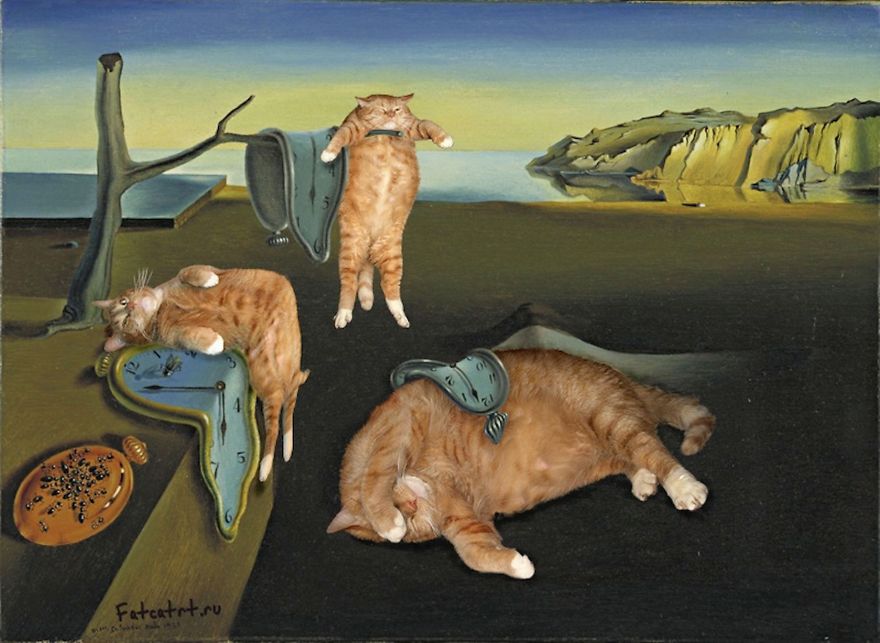
[The painting is “The Persistence of Meowmory,” by Salvador Dali and Svetlana Petrova.]

My Big, Fat Weight Loss Campaign: Part 5—Is That a Light at the End of the Tunnel? Or Is It That Damn Train Again?

My apologies to the artist. This was uncredited, but if anyone knows who the artist is–other than “hir”– I would like
to acknowledge them.

It has now been 15 weeks since the start of my “Big, Fat Weight-Loss Campaign.”

In 15 weeks, I have lost only two pounds. Despite taking Ozempic for six of those weeks. Despite exercising almost every day. Despite the physical therapy, personal trainer, and health club membership (which I am actually using this time). Despite being on Weight Watchers and sticking to it except for Friday dinners.

THIS is why I hate trying to lose weight. It feels like I have to claw it off, ounce by ounce. I only lose in tiny increments, and only if I work at it all the time. That’s why I gave up in the first place— losing weight feels like a full-time job with no salary or benefits. Or promotions. Or stock options. And definitely no holiday party.

I will stop whining now. I wrote a much longer whine, but realized no one would want to read it. Here is what I decided: Ozempic didn’t help and it gives me red, itchy rashes. So, Ozempic is not my knight in shining armor; I need to rescue myself. I stopped taking Ozempic two weeks ago. No change in weight.

But if I am honest about it, there have been significant changes:

  • I dropped a dress size. 
  • I can make it up the 32 steps to my front door without panting (much)
  • My balance is better
  • I don’t get as tired
  • I lost at least five inches around my waist 

I am at a loss to explain how all this could happen without losing any weight, but people keep telling me that muscle weighs more than fat. That’s fine, but I don’t think my surgeon is going to accept dress size as proof that I am ready for knee replacement surgery. And the sense of disappointment when I weigh myself weekly does drag me down.

I don’t see any remedy except to keep on keeping on. I will up my exercise regimen. I have had a glass of wine or two if I had enough WW points to spare at the end of the day. Maybe that is the problem? Can you eliminate all pleasure from your life and still want to live? I guess I’ll find out.

But before I get back to it, I am wrapping myself around a BLTA sandwich, some chips, and a lot of red wine.

My Big, Fat Weight Loss Campaign: Part 4—Disappointment

Disappointment is inherent to the weight-loss process, but that’s not what I’m referring to. I am—so far—disappointed in Ozempic. I have been taking the drug for six weeks, and I have lost possibly two pounds, although some days, it’s nothing at all on the scale.

I already detailed my experience of the first four weeks/injections on this blog. I was unable to get the medication in time to take the fifth injection on my designated day, so the nurse practitioner advised taking a half dose to get started again, to try to avoid the nasty side effects I experienced before. She told me how to get a half-dose or quarter-dose out of my 1mg-only pen.

So I injected .5mg of Ozempic for the past two weeks. It did not curb my appetite as much, but i stuck to the Weight Watchers points program with little trouble. I also continued my exercise program. I felt more or less normal the entire time. But I lost no weight, despite not increasing my caloric intake.

It also turns out I am allergic to Ozempic. It gives me itchy rashes. I am less perturbed by the rashes than I am by the failure to lose more weight. But if it gives me itchy rashes and does not help me to lose weight, it makes it easy to lose the Ozempic. I plan to use the remainder of the pen I currently have. If I see progress (in the form of noticeably less poundage), I will continue. If not, I will gladly stop taking it and the truckloads of antihistimines I take to combat the itching. I can use the $450 a month on something else, I am sure.

By the way, it is really hard to find images for the topic of weight loss that I don’t find offensive. The lady I chose to grace this entry is far too thin, but I liked her expression. Most cartoons, photos, and art I have found depict grossly obese women stuffing their faces with fattening foods. If I did that, I’d have been dead long ago. There are very few positive images of large women out there, and the ones I did find were not appropriate to this particular theme. No surprise, I guess. In honor of honoring our bodies, be they ever so imperfect, here is Hilda, my favorite pin-up girl. Hilda always looks like she is having fun, and nothing stops her from being beautiful AND fat.

My Big Fat Weight Loss Campaign: Part 3—The New Weight-Loss Drug Merry-Go-Round

The media is full of stories about the new class of weight-loss drugs, of which the best-known are Ozempic and Wegovy. I’m not going to get into the other drugs currently on the market. That would take up a lot of time and this post isn’t about the industry.

What is the difference between Ozempic and Wegovy? There isn’t any difference. They are both a drug called semaglutide. They are both manufactured by the pharmaceutical company Novo Nordisk. However, they are approved by the FDA for different conditions. Ozempic is approved for Type 2 diabetes. Wegovy is approved in a higher dosage for overweight. Both drugs are in such high demand that they are difficult to get in the United States.

How does Semaglutide work? From Drugs.com: “Semaglutide works by mimicking the action of GLP-1, a naturally occurring hormone that helps to regulate blood glucose levels. By binding to and activating the GLP-1 receptor, it stimulates insulin secretion and lowers glucagon secretion when blood glucose levels are high. It also causes a slowing down in how fast the stomach empties.” The end result is that it dramatically reduces appetite.

What are the potential side effects? Low blood sugar levels, nausea, vomiting, diarrhea, abdominal pain, and constipation are the most common side effects. There is also an increased risk of pancreatitis. And people with certain medical conditions shouldn’t take it. Do your research before starting one of these drugs.

My Experience of Taking Semaglutide:  The first step was that the nurse practitioner I was working with, Ashzra, prescribed Wegovy. My insurance turned it down because weight loss is not a condition covered by Medicare Part D. Then she sent me a prescription for Ozempic and gave me a Canadian pharmacy to contact. I did so, and without any further ado, I received my first Ozempic pen in the mail. I had to wait for more than a month to receive instruction from a physician on how to use it, so it sat in my refrigerator for all that time—it has to be kept cold.

I finally got a doctor to go over how to use it. So one Tuesday morning three weeks ago, I sat in my home office with the patient instructions Ashzra sent me. The instructions said to prep the pen and make sure no bubbles were in it, etc, which I did. Then the instruction said to turn the pen until the proper dosage appeared in the little window. I thought I’d start with .25mg, as I was worried about side effects.

I dutifully clicked the pen until a number appeared in the window. It was a 1. A second try yielded the same result. I pondered this for a while, and then pulled out the instruction sheet inside the prescription box. It turns out that my pen injects 1mg every time—you cannot select the dosage.

Okay. I swabbed my upper thigh with rubbing alcohol and regarded the needle protruding from the end of the pen. It is a short needle, and very fine. But I still needed to—willingly—shove this needle into my tender skin. I set up the pen and stabbed my thigh. I depressed the plunger, and it clicked back to its starting position. I held the pen against my skin for another six seconds, as instructed, to make sure the entire dosage was injected.

It didn’t hurt much, I will say that. There was a tiny red dot at the injection site, and I covered it with a little bandaid, just like at the doctor’s office.

By dinner time, I was feeling distinctly uninterested in food. The next morning, I fixed my usual breakfast, something I normally enjoy—one piece of avocado toast with fried eggs and hot sauce. I wasn’t just feeling uninterested, but nauseous. I ate about a fourth of it because I wasn’t sure whether this was how I was supposed to be feeling, but could go no further. Another couple of hours found me giving back not just breakfast but everything I had eaten after giving myself the injection. I also felt extremely fatigued.

The nausea and fatigue lessened a bit every day. The nausea went away entirely when I remembered how effective ginger is against nausea and other stomach troubles. Despite a total lack of interest in food, I forced myself to eat because I didn’t want to get malnourished. By the end of the week, I started enjoying eating again. I recognized that constipation was going to be an issue, and took stool softeners and dietary fiber to combat it.

After the second injection, I felt mildly nauseous but did not vomit. I wondered whether “reduced appetite” actually meant “revolted by food.” The fatigue got a little better, but I still felt pretty tired. The third injection left me feeling fairly normal, except for a reduced appetite. I have resumed enjoying food, but I can’t eat a lot of it. I think this is the desired state.

Semaglutide will reduce your appetite, but you still have to eat properly to lose weight. I am sticking to the Weight Watchers diet and gradually increasing my physical activity. I have not lost any weight over the past two weeks, but I am still hopeful. Weight loss is unpredictable and tends to happen when I least expect it.

The weight loss physician who instructed me about using the pen also tried to get a prescription for Weygovy approved, as she said there are some new guidelines.  After the second injection, I tried to find out from my clinic how to get the second semaglutide pen—should I go back to the person who prescribed the Ozempic? Should I coordinate with the weight-loss physician who was trying to get me Weygovy? Or…?

It was a bit of a clown show. Every time I tried to contact someone like Ashzra, someone else would answer my email who had not read the case notes and didn’t know what was going on. Even Ashzra didn’t answer my direct question about whom to coordinate with about getting another prescription. I finally drove to the clinic and asked to speak to a member of my doctor’s staff, explaining that I needed a new prescription and had been unable to get information from anyone I contacted via email. After a wait of perhaps half an hour, a nurse came out to talk to me. She had spent the time reading all the emails and understood the problem. I left the clinic with a prescription, emailed it to the Canadian pharmacy, and received a rapid acknowledgment.

By the way, my insurance for Medicare Part D refused the second prescription because weight loss is not a condition…etc. Being overweight creates other medical conditions that they WILL have to pay for, but if you expect the insurance industry to make sense, don’t. All they are concerned about is making profits. I worked for an insurance lobbyist for a while; I know what I’m talking about.

I hear many worse tales about our current medical system from others. Apparently, we lost a lot of medical personnel during the pandemic, and the strain on our system is showing. I completely understood putting Ashzra in place to shoulder some of the doctor’s load, and she is a very impressive person. But it seems that the load-spreaders are overwhelmed, too. If things get worse, we will lose more medical people who just can’t take the stress.

I can’t report any more reduced poundage, but here’s another token of progress: my belt. I am now on the last notch.