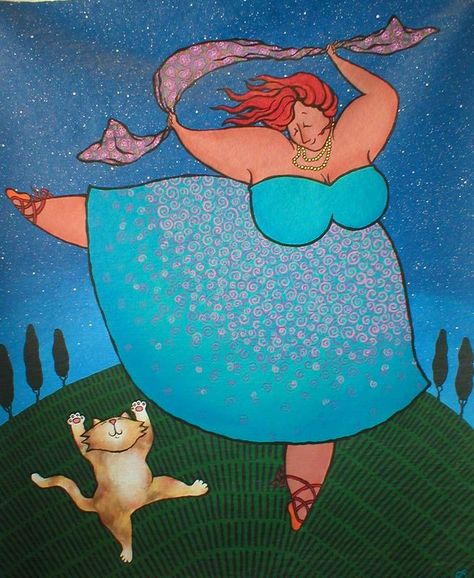
My apologies to the artist. This was uncredited, but if anyone knows who the artist is–other than “hir”– I would like to acknowledge them.
It has now been 15 weeks since the start of my “Big, Fat Weight-Loss Campaign.”
In 15 weeks, I have lost only two pounds. Despite taking Ozempic for six of those weeks. Despite exercising almost every day. Despite the physical therapy, personal trainer, and health club membership (which I am actually using this time). Despite being on Weight Watchers and sticking to it except for Friday dinners.
THIS is why I hate trying to lose weight. It feels like I have to claw it off, ounce by ounce. I only lose in tiny increments, and only if I work at it all the time. That’s why I gave up in the first place— losing weight feels like a full-time job with no salary or benefits. Or promotions. Or stock options. And definitely no holiday party.
I will stop whining now. I wrote a much longer whine, but realized no one would want to read it. Here is what I decided: Ozempic didn’t help and it gives me red, itchy rashes. So, Ozempic is not my knight in shining armor; I need to rescue myself. I stopped taking Ozempic two weeks ago. No change in weight.
But if I am honest about it, there have been significant changes:
I dropped a dress size.
I can make it up the 32 steps to my front door without panting (much)
My balance is better
I don’t get as tired
I lost at least five inches around my waist
I am at a loss to explain how all this could happen without losing any weight, but people keep telling me that muscle weighs more than fat. That’s fine, but I don’t think my surgeon is going to accept dress size as proof that I am ready for knee replacement surgery. And the sense of disappointment when I weigh myself weekly does drag me down.
I don’t see any remedy except to keep on keeping on. I will up my exercise regimen. I have had a glass of wine or two if I had enough WW points to spare at the end of the day. Maybe that is the problem? Can you eliminate all pleasure from your life and still want to live? I guess I’ll find out.
But before I get back to it, I am wrapping myself around a BLTA sandwich, some chips, and a lot of red wine.
The media is full of stories about the new class of weight-loss drugs, of which the best-known are Ozempic and Wegovy. I’m not going to get into the other drugs currently on the market. That would take up a lot of time and this post isn’t about the industry.
What is the difference between Ozempic and Wegovy? There isn’t any difference. They are both a drug called semaglutide. They are both manufactured by the pharmaceutical company Novo Nordisk. However, they are approved by the FDA for different conditions. Ozempic is approved for Type 2 diabetes. Wegovy is approved in a higher dosage for overweight. Both drugs are in such high demand that they are difficult to get in the United States.
How does Semaglutide work? From Drugs.com: “Semaglutide works by mimicking the action of GLP-1, a naturally occurring hormone that helps to regulate blood glucose levels. By binding to and activating the GLP-1 receptor, it stimulates insulin secretion and lowers glucagon secretion when blood glucose levels are high. It also causes a slowing down in how fast the stomach empties.” The end result is that it dramatically reduces appetite.
What are the potential side effects? Low blood sugar levels, nausea, vomiting, diarrhea, abdominal pain, and constipation are the most common side effects. There is also an increased risk of pancreatitis. And people with certain medical conditions shouldn’t take it. Do your research before starting one of these drugs.
My Experience of Taking Semaglutide: The first step was that the nurse practitioner I was working with, Ashzra, prescribed Wegovy. My insurance turned it down because weight loss is not a condition covered by Medicare Part D. Then she sent me a prescription for Ozempic and gave me a Canadian pharmacy to contact. I did so, and without any further ado, I received my first Ozempic pen in the mail. I had to wait for more than a month to receive instruction from a physician on how to use it, so it sat in my refrigerator for all that time—it has to be kept cold.
I finally got a doctor to go over how to use it. So one Tuesday morning three weeks ago, I sat in my home office with the patient instructions Ashzra sent me. The instructions said to prep the pen and make sure no bubbles were in it, etc, which I did. Then the instruction said to turn the pen until the proper dosage appeared in the little window. I thought I’d start with .25mg, as I was worried about side effects.
I dutifully clicked the pen until a number appeared in the window. It was a 1. A second try yielded the same result. I pondered this for a while, and then pulled out the instruction sheet inside the prescription box. It turns out that my pen injects 1mg every time—you cannot select the dosage.
Okay. I swabbed my upper thigh with rubbing alcohol and regarded the needle protruding from the end of the pen. It is a short needle, and very fine. But I still needed to—willingly—shove this needle into my tender skin. I set up the pen and stabbed my thigh. I depressed the plunger, and it clicked back to its starting position. I held the pen against my skin for another six seconds, as instructed, to make sure the entire dosage was injected.
It didn’t hurt much, I will say that. There was a tiny red dot at the injection site, and I covered it with a little bandaid, just like at the doctor’s office.
By dinner time, I was feeling distinctly uninterested in food. The next morning, I fixed my usual breakfast, something I normally enjoy—one piece of avocado toast with fried eggs and hot sauce. I wasn’t just feeling uninterested, but nauseous. I ate about a fourth of it because I wasn’t sure whether this was how I was supposed to be feeling, but could go no further. Another couple of hours found me giving back not just breakfast but everything I had eaten after giving myself the injection. I also felt extremely fatigued.
The nausea and fatigue lessened a bit every day. The nausea went away entirely when I remembered how effective ginger is against nausea and other stomach troubles. Despite a total lack of interest in food, I forced myself to eat because I didn’t want to get malnourished. By the end of the week, I started enjoying eating again. I recognized that constipation was going to be an issue, and took stool softeners and dietary fiber to combat it.
After the second injection, I felt mildly nauseous but did not vomit. I wondered whether “reduced appetite” actually meant “revolted by food.” The fatigue got a little better, but I still felt pretty tired. The third injection left me feeling fairly normal, except for a reduced appetite. I have resumed enjoying food, but I can’t eat a lot of it. I think this is the desired state.
Semaglutide will reduce your appetite, but you still have to eat properly to lose weight. I am sticking to the Weight Watchers diet and gradually increasing my physical activity. I have not lost any weight over the past two weeks, but I am still hopeful. Weight loss is unpredictable and tends to happen when I least expect it.
The weight loss physician who instructed me about using the pen also tried to get a prescription for Weygovy approved, as she said there are some new guidelines. After the second injection, I tried to find out from my clinic how to get the second semaglutide pen—should I go back to the person who prescribed the Ozempic? Should I coordinate with the weight-loss physician who was trying to get me Weygovy? Or…?
It was a bit of a clown show. Every time I tried to contact someone like Ashzra, someone else would answer my email who had not read the case notes and didn’t know what was going on. Even Ashzra didn’t answer my direct question about whom to coordinate with about getting another prescription. I finally drove to the clinic and asked to speak to a member of my doctor’s staff, explaining that I needed a new prescription and had been unable to get information from anyone I contacted via email. After a wait of perhaps half an hour, a nurse came out to talk to me. She had spent the time reading all the emails and understood the problem. I left the clinic with a prescription, emailed it to the Canadian pharmacy, and received a rapid acknowledgment.
By the way, my insurance for Medicare Part D refused the second prescription because weight loss is not a condition…etc. Being overweight creates other medical conditions that they WILL have to pay for, but if you expect the insurance industry to make sense, don’t. All they are concerned about is making profits. I worked for an insurance lobbyist for a while; I know what I’m talking about.
I hear many worse tales about our current medical system from others. Apparently, we lost a lot of medical personnel during the pandemic, and the strain on our system is showing. I completely understood putting Ashzra in place to shoulder some of the doctor’s load, and she is a very impressive person. But it seems that the load-spreaders are overwhelmed, too. If things get worse, we will lose more medical people who just can’t take the stress.
I can’t report any more reduced poundage, but here’s another token of progress: my belt. I am now on the last notch.
I gave up on losing weight a long time ago. I have all my life found the subject of my weight a huge embarrassment. I was not fat as a child, but I was plump, and bullies discovered early on that they could make me miserable by singing “Fatty Fatty Two-By-Four” on every occasion. My father harped on my weight all the time. He was thin as a blade without making any effort, and couldn’t understand why I wasn’t—clearly, it was some sort of character flaw in me. Extra weight always seemed to me like an embarrassing sin—but a sin that EVERYONE could SEE. It felt shameful.
In the past, I had lost significant amounts of weight. My methodology was to starve and run a few miles a day. I really had to dedicate a huge amount of awareness, energy, time, and brain power to make this happen. After a while, I just didn’t have the energy to put into this one more time—I kind of quit the whole idea that I would ever be a normal weight. It was too easy to gain, and way too hard to lose. I just wanted to enjoy life. Also, I had reached a point where running was uncomfortable—pregnancy and nursing had inflated my boobs to proportions that did not appreciate being violently bounced around.
I wasn’t always overweight. I was slender in my late teens and 20s. I started gaining weight after the birth of my first child in my 30s, and gradually kept on gaining. At my heaviest, I was over 300 pounds. Mind you, I am 5’10 inches tall, not a shortie, but still way, way too much weight.
It annoyed me seriously that my diet was pretty healthy while I gained all this weight. After about age 35, I ate very little sugar, never had sugary drinks or many sweets. I didn’t eat fast food or junk food. I avoided processed food and focused on whole foods, mostly prepared at home. I noticed that other people ate more than me—I often couldn’t finish portions that others did. I rarely took seconds. I didn’t eat between meals. I ate lots of vegetables, lean meats, and recently, began baking my own einkorn bread (I am allergic to modern wheat), which is lower in refined carbs and higher in protein and dietary fiber than modern wheat. You wouldn’t think I would gain a lot of weight this way—but I did. The difficulty of losing weight, despite a healthy diet, merely made me want to ignore the whole problem even more vigorously. What’s the point, if nothing works?
I began having knee problems. My form of exercise was walking. I went from four miles to two miles to one mile. During the pandemic, it was mostly no miles, as I disliked leaving the house for a while. In the meantime, severe arthritis ate away at my knee, and unbeknownst to myself, my shoulder.
My body finally gave me an ultimatum. My right knee became increasingly painful. Then at Christmas last year (2023), I was strolling to the front door with a glass of wine in my hand, intending to lock the door, as it had gotten dark. As I approached the door, a jolt of agony surged up my leg from my right knee and I collapsed. Fortunately, I had the presence of mind to hurl my wine glass away from me as I fell, so I didn’t wind up being cut to shreds by glass shards. I landed hard, throwing my back into spasm.
My beautiful family rallied around. My son-in-law Mike cleaned up the glass and spilled wine. My husband Tom got me a muscle relaxer and pillows. My dear friend Meg and Tom sat with me for a half an hour until the medication kicked in and I was able to get off the floor. This was definitely a warning, and I fell again the next day—luckily for me on a carpeted floor, and I didn’t hurt myself this time. I began walking with a cane or hiking sticks, even around the house.
As it happened, I already had an appointment with an orthopedist for January 2. He looked at my X-rays and told me my knee was bone-on-bone. I needed knee replacement surgery. But I couldn’t have the surgery until I lost 50 pounds (at this point I was under 300 pounds, but 50 pounds is a lot to lose no matter how much you weigh). He also gave me a cortisone shot in the knee, which had amazing effects, enabling me to walk without a cane for the most part.
Later, after my shoulder also became agonizingly painful, I was informed I needed a complete reverse shoulder replacement. And I had to lose weight for that surgery as well.
So now I had no choice. I could no longer ignore the elephant in the room. I had to lose the weight. I also had to lose the shame I felt around the whole subject of weight—the shame that made me just ignore it. (I recognize the irrationality of my last statement. But this is how it was.) I was going to be dealing with a lot of people for quite some time about my accumulation of avoirdupois, and continuing to be embarrassed and ashamed just seemed stupid. I let shame get me to this space; I didn’t want shame to keep me here.
At the same time, I had no idea how I could alter my already-healthy diet to trigger weight loss, and with a bum knee, how would I exercise? I knew if I didn’t exercise, I would never lose the weight by diet alone. Also, I needed to build up muscle to prepare for the surgery. How could I exercise? And what exercises should I be doing?
I didn’t have the faintest idea. I needed outside help. Next installment: getting help.
A word about body positivity: I am all for it. I did my best to feel positively about my body—beauty comes in all shapes, etc. Sadly, my body did not react positively to being so heavy. When you come right down to it, how you feel is more important than how you look.
Note: Since keeping track of weight loss is how success is measured in this arena, here’s the latest progress. You have no idea how excruciating it is for me to make this public:
2020: 315 lbs
2023: 285 lbs
As of 4/5/2024: 270 lbs
Note: I have no intention of posting “Before” or “After” photos here. Use your imagination.


 obsidianmirrorblog