I didn’t think I would have to write this so soon. My cat Inca, my loving companion of 17 years, was dead on the floor when I got up the other morning.
I suppose she was lucky. She was rarely sick, and never seriously ill. She was still lithe and active, her fur thick and glossy. She attacked her evening treat last night with her usual impatient greed. She never suffered as some of my other pets have, with pain and illness. She didn’t have to be put down by the vet—a procedure that would have terrified her, as she was a very shy and nervous girl. Instead, she passed away, apparently in her sleep, with her people there, though we knew nothing about it until the morning. I guess I would be happy to go the same way.
But there is a painful, Inca-shaped hole inside me right now. So let me tell you about Inca.
I got Inca right after my beautiful cat Phoenix died of cancer (actually of vet, but the end was very near). I was heartbroken, but a friend said I should rescue another cat in Phoenix’s honor—he was sure it would make me feel better. (Incidentally, he was right.) I started looking at shelter cats and ran into an organization called 13th Street Cat Rescue in San Jose, CA. I asked about a black cat they had because the very first cat I remember was my brother’s black cat, Flinky, and he was a very sweet boy. The cat I asked about was taken, but they asked if I was interested in adopting a black cat, because people are often highly superstitious about them, so black cats (and other melanistic pets) tend to sit on the shelf. The organization happened to have a nine-month-old black cat, part of a litter that had been rescued from a trailer park. The kittens had been too old for adoption, but the trailer park manager threatened to kill the whole lot if 13th Street didn’t take them.
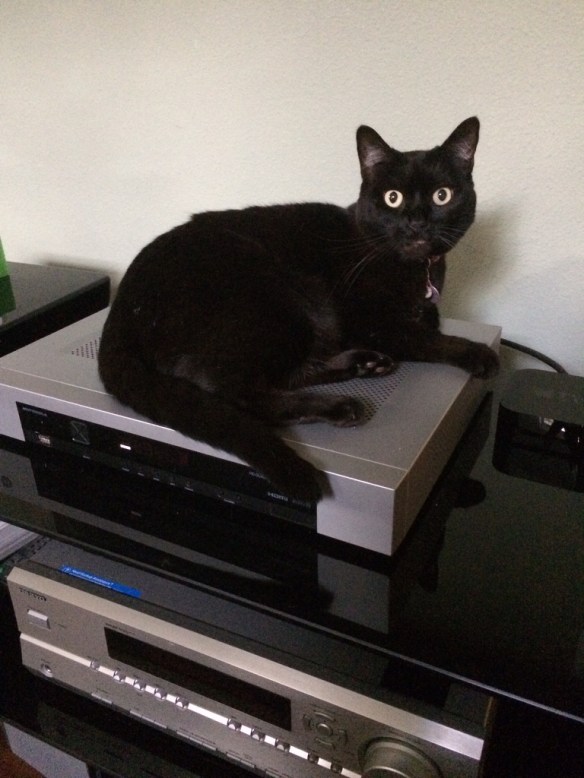
Inca on her personal cat-warmer.
It turned out all the kittens, though feral, were adapting nicely to domestic life. Inky (as she was called then) was no exception. I met her at one of the volunteers’ houses, and she sat on my lap and purred. Inca was beautiful, black with bright yellow-green eyes. She always had a few scattered white hairs among the black. In the sunlight, her fur looked chocolate brown.
We agreed to adopt her. I’m afraid I could not have a black cat named Inky. First I tried naming her Flinky, after that first black kitty, but it never suited her. The name Inca just came out of the blue one day, and I loved it right off. It seemed to suit her elegance.
At the time, we had a wonderful dog named Gigi. Gigi was a German shepherd-Labrador mix, 75 pounds, and, though a sweet and gentle dog, she was obviously terrifying to a tiny black cat. We kept Inca sequestered in a bathroom for a week, then let her out into the house. We really didn’t see her for the next two weeks—just a flicker of black at the corner of the eye, like a bat.
Then one day I was sitting on the couch and Inca strolled calmly into the room and jumped into my lap. I petted her, delighted, and she purred. After a few minutes, Gigi entered the room and I braced for a cat freakout. Instead, Inca ran down the length of the couch toward Gigi, mewing loudly. Gigi came over, and they kissed each other. Somehow, without my ever observing it, Gigi made friends with this timorous wee beastie and convinced her she was in a safe place. Their friendship ended only when Gigi died. I have many photos of the two of them cuddling together.
After Gigi died, Inca became even more attached to her humans, especially my husband, Tom. She began to sit on his lap at night when he watched TV. She was never a playful cat. Once in a while she would bat a toy around for a few minutes, but that was the extent of it. She didn’t have cute habits or do funny things, But she was a powerful engine of love and cuddles, happy to be petted at any time of the day or night.
Inca was also the best-behaved cat I have ever had. She didn’t potty outside her box. She didn’t scratch the furniture. With the exception of one fern, she never touched an indoor plant (the fern survived). She was the opposite of picky about food, eating whatever I put in front of her. She didn’t destroy stuff. Once in a while, we did get cat gak, but hairballs are part of being a cat. She bit gently when she felt affectionate, but rarely scratched. She loved our grandchildren and was gentle with them.
Inca did not like her tummy to be touched. If her tummy was stroked, she did that cat thing, turning into a ball of needles. After Inca was introduced to civilization by Gigi, the two of them tended to go with me wherever I was in the house. One day, Gigi laid down for a good tummy-rub and I obliged her. I rubbed and rubbed, and Gigi moaned with happiness as Inca watched. When I stopped rubbing Gigi’s tummy, Inca flopped over and presented her tummy for a rub. She found that she enjoyed it and would often ask for a tummy rub in the years to come. I was very intrigued that she observed, learned, and experimented.
She even learned some tricks at an advanced age. As she aged, she was still active, but could no longer jump to the top of the bed like Superman in a single bound. I bought her some stairs so she could climb our bed without clawing her way up the sides, shredding the bedclothes and on one occasion, me (it was an accident, but still). She would look at me with those bright eyes, clearly planning to scramble up the side of the bed, and I started gesturing to the stairs and telling her “Go up the stairs.” She learned to do this on command and (mostly) stopped clawing her way up the sheets.
I was facing major surgery and worried that Inca would continue to treat my body as a nice place to stomp around in the evenings. I never could figure out why she sat calmly on Tom’s lap, but wanted to stomp around on me. I had to teach her not to stand on my body, which must have been confusing to her after so many years of doing so. But she did learn, and only ran over me once after the surgery—right over the incision, as it happened. But mostly, she remembered not to. I felt kind of bad about making her stay off me (though I welcomed her to cuddle by my side), especially now, knowing how little time she had left. I did stop many times throughout every day to pet and cuddle her; I wanted her to know that I loved her as much as ever.
Inca was still so beautiful and healthy at 17 years old that I was convinced she would last a couple of years more. Unlike other elderly cats I’ve had, she did not become skinny, her fur was still thick and shiny, and she was as enthusiastic about food, treats, and petting as ever.
When I found Inca’s body yesterday morning, she was already stiff and cold. I wrapped her in a clean towel, but her bowels and bladder did not void after death. She exited this life as she lived it—tidy, without making a fuss.
In my last post on the subject, I explained that I have been unable to move past a set-point weight. I have been at the same weight for almost two years, giver or take a few pounds
No one can continue to deprive themselves and do things they don’t want to do for two years in pursuit of an unattainable goal. it’s just not human nature. I confess there were weeks in which I decided that being fat wasn’t the worst fate in the world. Chocolate and red wine played a large factor in those weeks.
As I detailed earlier, I tried everything in the book to try to break past that stubborn set-point. I couldn’t believe that nothing was working. (I am still unwilling to do the 10-day vegetable cleanse.) So I decided to increase my cardio again and skip lunch, having a protein drink instead (I add a medium-sized banana to the smoothie for texture and ballast). I started doing six miles a day on the recumbent bike, with the intention of working up to ten.
Last week, I weighed myself, and I was five pounds over the set point. Today, I weighed myself, and I am five pounds UNDER the set point for the first time in who knows how long. I almost woke my husband up to tell him, but he was up late last night so I took pity on him.
Totally made my day. I am still grinning. Now I have to keep it going. My personal trainer (“Lord Taskmaster”) is pushing for weight training prior to doing the cardio because he swears it gets the weight off faster (and he is the personal trainer, so he probably knows more than me). So I’ve started doing that as well. He is also pushing for seven miles. All in good time, your Taskmastership.
It has been a long time since I last posted. With regard to my Big, Fat Weight-Loss Campaign, it’s because it got complicated.
I lost 55 pounds or so in one year. The next year, despite continuing to diet conscientiously and exercising regularly, I lost no weight at all.
None.
I made changes. I was using the Weight Watchers method. I switched to counting calories. I was exercising a few days a week. I upped it to six days a week, alternating cardio and weight training.
Nada.
I started taking protein supplements. My nails went from paper-like to strong and long, and my hair thickened as well.
Not another ounce came off.
I consulted a nutritionist who wanted me to go on a cleanse for 10 days eating nothing but protein and vegetables. This is intended to improve bile production and reduce blood sugar because she couldn’t find anything else impeding my weight loss. I bought her protein powder and supplements, but suddenly, I was scheduled for major surgery—a complete, reverse shoulder replacement. I decided to delay the cleanse, as the surgery was going to interfere in many ways with how my body was working and I didn’t want to play around with nutrition while I was in recovery.
The surgery went fine and I’m glad I did it even though the six weeks in a sling was tedious and uncomfortable. Still, the discomfort was far less (after the first week) than before. Prior to the surgery there were days when I was hurting so much I couldn’t leave the house. As I was lying on a gurney waiting for surgery, I was in so much pain I asked for pain-killers (I was unable to take any prior to getting to the hospital because I was following the surgeon’s orders about taking medication and water.) Bless the nurses. They got me pain-killers. I was grateful because I spent a long time on that gurney.
Then I spent six weeks doing nothing at all except watching television, reading, eating, and doing physical therapy. I couldn’t drive and I didn’t want to leave the house if I didn’t have to. After this slugfest I was sure I would gain weight, but I did not. I’m back to counting calories and just resumed cardio on a recumbent bike.
To be honest, I don’t want to do the cleanse if I can avoid it. I would have to fix all my meals separately from the rest of the family, and just protein and vegetables sounds…boring. I will still do it if I have to, but I am hoping that the surgery did a reset and my body will once more be open to shedding pounds.
#
I had never heard of a total reverse shoulder replacement until I was told I needed one. It’s a technique they use when there is so much damage to the joint that a standard replacement won’t work as well. I have severe arthritis, which pretty much destroyed the humeral head (the “ball”) of the humerus (upper arm bone) and resulted in bone-on-bone action and bone spurs.
The procedure is to expose and dislocate the joint. The humeral head is sawn off and replaced with a titanium and plastic cup which is inserted into the humerus. A titanium ball is screwed into the shoulder blade. Thus, the structure of the joint is reversed. It’s kind of a brutal surgery, and I am DEEPLY grateful for anesthesia. The surgeons did an amazing job, and after the first week, I stopped taking opioids and used only Tylenol and CBD for the pain, which has diminished daily. I have good mobility for this stage of healing (because I do the physical therapy exercises religiously). I don’t think I will ever have the complete range of motion that my other shoulder has, but I’m OK with that—I’m no longer in agony. And at 74, I have no ambition to become a trapeze artist.
When life gets tough, I tend to disappear into books. I had a rather difficult childhood and adolescence, during which I consumed literally thousands of books. As a teenager, I attended a private girls’ boarding school. I wasn’t happy with it, but I think I recognized it was a better alternative to living at home with my father, who was going through a really destructive phase of rage-drinking. During the summers I lived at home and I developed a safety schedule. I would start reading as soon as I got up, around noon. By this time, my father was out of the house and at work. I read, sequestered in my room, until around 4:00 in the morning. The primal danger was dinner time. My father would be home and drinking, and I was expected to attend a sit-down dinner with the family and assist with chores. I managed to stay out of the line of fire for the most part—reading was the one thing my father did not like to interrupt.
I still read lots of books as an adult, but since the election in November, I’ve been doing about a book and a half per day—far less than my adolescent average of four books daily, but it’s literally all that is keeping me from insanity at this point. My drug of choice? Cozy mysteries. I think it’s partly that in murder mysteries, justice is served and the wrong is righted. This is exactly what is missing from real life right now.
The problem is that I have already read a huge number of cozy mysteries and I worked through much of my favorite authors’ work. Some are now dead, and I am not expecting much from them, but others—come ON, people, get working! G.M. Malliet, I am talking to you!
I started using Libby, the free library app for eBooks and audiobooks, and picked a few authors at random. I am overjoyed to share with you that I have discovered two authors entirely new to me that are highly binge-worthy. I am still working through their offerings and I am as happy as a pig in shit—as long as I keep reading and ignoring the world at large.
First, let’s talk about Elly Griffiths and her Ruth Galloway series. So far, I have read seven out of the seventeen books in the series. The stories are set in the north of England, in Norfolk, which makes a nice change from London, the Cotswolds, and Cornwall, which are favorite venues for murder mysteries. Ruth is a forensic archeologist who teaches at a fictional university. Because of her expertise, she is frequently called in by the local police to determine the age, gender, etc. of human remains. Ruth lives in a cottage on the Salt Marsh—another fictional location—an isolated, windswept, and bird-haunted area. Which is how Ruth likes it.
Ruth reminds me of Agatha Raisin. She isn’t like Agatha in any way other than being middle-aged, but she is an interesting and original character. She’s a bit overweight and usually prefers frumpy clothes because they are practical for digging. She’s introverted and likes her alone time out on the marshes. She’s passionate about her profession but wary of romance, although there is this one DCI who is special… One of her best friends is Cathbad the Druid. His real name is Michael Malone, but everyone calls him Cathbad, and often he turns up out of nowhere when most needed.
There is a touch of the supernatural that wends its way through these stories. It is done with a light hand and never spirals into ghost story territory. There is a tendency to use threats to children as the plot engine, but not every book is about children in danger. The sub-plots about who is sleeping with whom and who is the father of which little moppet create interesting complications that affect the main story. Who knew that Norfolk was such a hotbed of erotic passions?
Ruth is a likable protagonist because she feels real. She’s a introvert, but she cares deeply about people. She is far from perfect, but in relatable ways, like not wanting to go to a party or being annoyed with her boss. I’d love to have a glass of wine with Ruth and talk about bronze-age culture. Or murder.
The second author I discovered is Sujata Massey with her Perveen Mistry mystery series. (I love that the protagonist’s name is Mistry!) Perveen is a young Parsi (Zoroasterian) woman living in Bombay during the 1920s, while the British Raj still ruled India. Against many obstacles, Perveen has trained as a lawyer and works with her father, a well-known barrister. Under British law at the time, she could neither take her exams at Oxford, nor could she speak in court. She is allowed to work as a lawyer outside of the courts, writing contracts and so forth. Her one advantage is that she can deal directly with women in purdah for whom contact with men outside their family is forbidden. As Perveen is one of only two women lawyers in India at the time, there is a need for her services in that arena.
Perveen also must deal with the incredible complexity of the legal system in India in the 1920s. Different religious laws applied to Hindus, Muslims, Parsis, Jews, and Christians, while British law held sway over all. Despite Perveen’s family’s wealth and standing, as a woman, there is much she is unable to do professionally without jeopardizing her own reputation or that of her family or her father’s law firm. Perveen herself has a backstory that makes her life even more complicated, as she believes she can never marry or have children of her own.
The complexity of her society is part of the fascination of these stories. The caste system, the strict delineations between ethnicities and religions, the low status of women, and the divide between British and “native” all contribute to the colorful and complex tapestry of these mysteries. The stories are richly atmospheric, allowing the reader to experience second-hand the heat, the smell of spices, the texture of saris, the sounds of monkeys and birds that the author conjures up from an India of the past.
Perveen is an appealing protagonist, but not because she is “bucking the system.” I get annoyed by historical fiction depicting women living in the past but with modern sensibilities around women’s rights and behavior. Perveen is no rebel. As an Oxford-trained lawyer, she is in a peculiar situation for a young Parsi woman, but she got there in a traditional manner: by marrying the wrong man. She is just trying to make the best she can of her life without causing further problems or scandal. Her intelligence allows her to devise unusual solutions to desperate problems.
If, like me, you need to dive into other worlds to escape the unpleasantness of this one, I highly recommend these two mystery series. (I also read a stand-alone mystery by Elly Griffiths, “The Stranger Diaries,” and could not put it down.) Here are the series book titles, in order:
Ruth Galloway Mysteries:
The Crossing Places
The Janus Stone
The House at Sea’s End
A Room Full of Bones
Ruth’s First Christmas Tree
A Dying Fall
The Outcast Dead
The Ghost Fields
The Woman in Blue
The Chalk Pit
The Dark Angel
The Stone Circle
The Lantern Men
The Man in Black
The Night Hawks
The Black Room
The Last Remains
Perveen Mistry Mysteries:
The Widows of Malabar Hill
The Satapur Moonstone
The Bombay Prince
The Mistress of Bhatia House
Ooops. Looks like I just ran out of Perveen Mistry books. Please, Ms. Massey—write more!
Political cartoon by Bramhall for the NewYork Daily News.
I don’t know what’s going to happen under the Fourth Reich any more than you do. The election hit me like the Acme Safe hit Wile E. Coyote, and I disappeared beneath the weight of it for a while. I needed to think, to process the horror that just happened. Although it was less a present horror than a realization of the nastiness to come.
My preference at this point is frankly to say fuck it and leave this country. I honestly have no hope for us. A citizenry that would elect a career criminal, a rapist, a profoundly stupid and uneducated man, and an obvious traitor does not seem to me like a good place to live, and I think Trump and his cronies are all too eager to prove that.
Unfortunately, my preferences are not the guiding factor here. I have a large, close, and loving family. I cannot leave them, and they are at this point unwilling to go. They point out that we don’t know what is going to happen. This is true, but I think I’m on solid ground by saying it will be bad. “Stay and fight!” say some. My issue with that is “How?” I have been fighting for liberal causes my entire adult life, only to find my efforts wasted in the face of a galactically stupid and uninformed electorate. Remember? You can’t fix stupid. You can thank the Republicans for dumbing down our educational system for the past 45 years or so.
After several weeks of mourning for a country that I guess never existed, I came to a few conclusions about how to get through this if I can’t leave. I don’t mean get through this intact—just survive the coming tide of chaotic evil. I would like to share my conclusions with you, and I invite you to share yours with me. This is a time when people who have a conscience, integrity, empathy, decency, and love need to stand together against those who do not.
For me, it comes down to protecting oneself and one’s family. I do not see that there is anything I can do to affect what will be happening on a national scale, or even a state level. I believe that ordinary families—not billionaire families, perish the thought!—will be facing certain threats in these areas:
Food safety and continuity of the food supply chain
Healthcare
Finances/cost of living
Disinformation/biased reporting
The country is now an oligarchy, fronted by a kakistocracy. An oligarchy is a government run by corporations. A kakistocracy is a government run by the worst of society. We have been living in an oligarchy for quite some time, thanks to the Republicans—remember Citizens United? Now the corporations will have even fewer boundaries, regulations, or limits on what they do. We already know what they do when the restraints are off:
Profiteer, raising prices unreasonably and unnecessarily in pursuit of ever-higher profits
Create shoddy products for higher prices—or sell you less for more
Create harmful products for which they will never be held accountable
Slash customer service
Cheat (remember Enron?)
That means that the rest of us will have more trouble making ends meet—and in some cases, even getting our basic needs met. If Trump does what he did the last time, he will endanger food safety by firing USDA agricultural inspectors, opening the gate to listeria, e. coli, salmonella, and a host of other food-borne diseases, most of them extremely dangerous. This in turn endangers the food supply chain. There will also apparently be tariffs on certain foreign goods, which means that the healthy and nutritious food we get from Mexico, for example—like avocados and mangos—will become exorbitantly expensive. Because tariffs don’t hurt the foreign seller—they hurt the U.S. buyer. Trump just can’t get that through his stupid pumpkin head.
Avoid Giving Huge Corporations Your Money
There’s only one way to resist: break your ties to the corporations to the extent you can. If you don’t buy their stuff, they can’t hurt you. Amazon would be a great place to start. My husband thinks that is ridiculous—Amazon does things right. They have great customer service. They have rapid delivery. They have good prices (sometimes). They have great variety. They keep track of everything for you. They are incredibly convenient.
And Amazon is a ginormous corporation that threatens every small business on the planet. Jeff Bezos, Amazon’s owner, owns the Washington Post, which served us poorly over the past nine years and capitulated in advance of Trump’s victory by refusing to endorse a presidential candidate after the staff had prepared to announce Kamala Harris. He’s busy cozying up to the new regime as we speak. Do you really want to give him more money?
So I decided to cut Amazon out of my life unless there was really no other way to get what I wanted or needed. This has not been easy, but I am doing it in stages. I get ebooks and audiobooks now through an app called Chirp or through the free library app called Libby. I order other products directly from the manufacturers or non-Amazon suppliers. Is it more work? A bit, but worth it to be free of Amazon. It’s tough to get to 100%. I try to purchase products online directly from the manufacturer or other suppliers, but sometimes I can’t do this. Amazon is like a metastasized cancer. I recently ordered Christmas candles from the Petalura catalog. They arrived with my latest order from Amazon. They are listed in my Amazon purchases. More and more, we really don’t know with whom we are doing business.
Take the same approach to other things you buy. Shop at locally owned businesses as much as possible. Question your choices. I used to buy a lot of personal care items from the drug store or wherever without really thinking about it. I became allergic to a lot of random things and began to scrutinize the ingredients very carefully. A hand lotion from the drug store can have 25 ingredients or more, most of which are unpronounceable chemicals. I started making my own dry skin salve with just three ingredients. (It’s easy. It’s also cheap.) I make some of my own condiments instead of buying bottles at the grocery store. We cook whole foods from scratch (purchased at a locally owned market), and avoid processed foods, which are bad for you anyway. All the garbage that corporations pour into their products, or feed their agricultural animals, or include in their packaged foods is just plain bad for human beings. And the more of this stuff we consume, the sicker we get, and the healthier the corporations’ profit margins. This will not improve under the Fourth Reich, because this government will be about making the wealthy oligarchs even more wealthy. It’s definitely not about YOU.
The old refrain of “make do, re-use, repair, recycle” further protects us from corporate control. Making something last longer is good for your wallet. Get over the idea that everything has to be new and stylish—who told you it had to be new and stylish? Right—the corporations who thrive on our lust for the latest thing. Consider bartering things you don’t need for things you do. There are specialty barter groups aimed at moms, for instance, where mothers can trade clothes, baby equipment, and toys. You can find barter groups online—I can’t recommend any because I have just started looking into this myself. Also, consider passing along unused and unwanted possessions to others who want or need them. There are “freecycle” groups in every community.
“New to me” is just as much fun as “new.” I buy most of my clothes on eBay because I don’t care if the clothing is new as long as it is in good condition and looks good. I can get designer clothing inexpensively and support individual entrepreneurs instead of corporations.
When I suggested some of this on FaceBook, many thought I was saying “Hurt the corporations by not buying their products.” That is not what I am saying. I do not think the corporations will be harmed if you cut your spending, although I wish I could say otherwise. No, this is about protecting you and your family, not about going after the billionaires and their companies. The less you rely on giant, impersonal, and soon-to-be-unregulated corporations, the better.
Obviously, you can’t get to 100% on this. There are too many obstacles, obfuscations, and dependencies—unless you decide to go off-grid and live off the land.
Protect Yourself Against Disruptions to the Food Supply
If Trump again fires USDA inspectors or in some other way disrupts the safety of the food supply, we all need to make some choices. Consumption of meat, fowl, and fish may become more hazardous. It is possible to contaminate vegetables and fruits as well, but less likely, and vegetables and fruit can be washed. In the event of a serious threat to food safety, I intend to eat vegetarian food. I like it, it can be prepared in a million versatile ways, and it is generally speaking better for you.
There is another way to detach yourself from huge corporations—eat less processed food. Some processed food is fine—frozen vegetables, for instance. Freezing is just a good way to preserve food. But a lot of processed food has ridiculous amounts of added sodium, nitrates, sugar, preservatives, artificial dyes and chemicals, etc. As an examples, in a single-size package of Yoplait yogurt (6 ounces), there are 19 grams of sugar (nearly two-thirds of an ounce) and 90 ml of sodium. Yoplait, despite yogurt’s reputation as health food, is just junk. Say no to processed food to resist the oligarchy (and be healthier, too).
I am also in the process of collecting and storing staples for long-term storage such as flour, sugar, salt, pasta, canned goods, dry beans, water, etc. I’m not going nuts and gathering years’ worth of food—just enough to get by in the event of an emergency. It could be a waste of time and money. Or it might get this family through a bad patch—there’s no way of knowing right now.
Producing some of your own food gives you a bit of distance from the corporate control of what goes in your mouth. Apartment living makes this hard to do, but if you have a small amount of land available, you can at least produce some vegetables. We have a small vegetable garden, some fruit trees, and backyard chickens. That isn’t going to provide enough food to sustain a family for long, but it’s at least something we can do to be more independent.
Threats to Health Care
It’s impossible to say at this time what the specific threats are to our access to health care. Judging by Trump’s response to the COVID-19 pandemic, we’d better hope there isn’t another pandemic because we know he doesn’t care if we live or die. Also of concern is his pick for head of Health and Human Services, Robert F. Kennedy, Jr. RFK Jr. does not believe in vaccines. He has a history of making false statements and believes in debunked conspiracy theories on subjects like HIV and AIDS, antidepressants, and autism. If there were another pandemic would we have a militarized response to vaccine development—or would RFK block this? I don’t know. I doubt if RFK Jr. knows, frankly, and it makes me nervous.
The Kakistocrats want to destroy Social Security and Medicare. Also the Affordable Care Act (the ACA, or “Obamacare”). I guess I don’t have to say much more to indicate how this would devastate our population, especially seniors, the disabled, and the poor. Again, I have no idea how this will play out, nor do I have any bright ideas about how to protect yourself against this particular brand of idiocy. The best I have to offer, for those that can manage it, is seek medical and dental care in Mexico if our healthcare system goes south. The national healthcare system in Mexico is modern, well-developed, and affordable. Any town in Mexico with an American expat population will also have dentists and physicians that are competent and speak English. There are lists of towns with American expat populations online.
Misinformation/Biased Reporting
Misinformation is why we are in this position to begin with. The world has been flooded with lies, conspiracy theories, and fear-mongering, and apparently a fair number of people have lost their minds because of it.
Making the situation worse is that the mainstream media (MSM) in this country has abandoned its responsibility to report the truth and rolled over to appease its new master. Here are a few examples:
Trump sued ABC because George Stephanolpoulos stated that a jury found that Trump had raped E. Jean Carroll. To lose this case, Trump would have had to prove actual malice, whereas Stephanopoulos had merely been reporting the facts. But ABC caved to placate Trump.
Time Magazine named Trump Person of the Year. I know they once named Hitler Person of the Year, but I guarantee you Trump saw this as homage to his greatness, not a burn.
Joe Scarborough and Mika Brzezinski, hosts of MSNBC’s flagship AM program “Morning Joe,” went down to Mooch-a-Lago to kiss the ring. I guess they forgot all about Trump’s attacks on them some years ago, when he accused Mika of “bleeding all over the place” from plastic surgery when she visited the Golden Palace.
And then there’s Bezos, showing his underbelly to the dictator and hoping that he won’t be kicked to the curb.
I can’t take the space to document all the MSM mentions of “he was joking” or downplaying some atrocity that Trump committed or intends to commit. Bottom line, our former bastion of free speech, the media, is suspect and can’t be trusted.
We certainly can’t trust social media, either. Anything we see on social media should be vetted and verified before it is passed along—but how do you verify it? Are there media out there that are unbiased and reporting the truth? I don’t know. National Public Radio and the Public Broadcast System (NPR and PBS) appear to still be providing actual news—although I have caught even them making statements that soften the reality of what Trump and the Republicans are doing. The MAGATs want to destroy these organizations by defunding them. What they don’t realize—because they know nothing about how this government works—is that NPR and PBS don’t have much government funding. So donate to these organizations to make up for the small amount of funding they will inevitably lose. And let’s hope they don’t join the MSM in pandering to the new regime.
Let me know if you have discovered more reliable, independent news sources by leaving a comment. Also, are any of the major newspapers in this country trustworthy? Boston Globe? Chicago Times? Christian Science Monitor? Anything? We may end up looking to English-language media from other countries to figure out what’s real and what isn’t.
What Do YOU Say?
I would be interested in your ideas for surviving the coming years under the oligarchic kakistocratic Fourth Reich. As I said, we must stick together and help one another out. As Ben Franklin once said, we hang together or we hang separately.
On the one hand, I have lost 55 pounds in about two years—45 of them during 2024. On the other hand, I have been stuck at the same number for about six months, and I can’t seem to move past it.
There are a few reasons for this. One reason is that my left knee decided to join my right knee by becoming incredibly painful. At times, I could walk only with the help of two canes. This meant that the exercise program came to a grinding halt. Off I went to the orthopedic surgeon to get shots of hyaluronic acid gel. Not much improvement, so the doc felt around a bit and determined I had a “Baker’s cyst.” This, it turns out, is very common in people with arthritis. It is a cyst that forms at the back of the knee, filled with synovial fluid. (Hyaluronic acid is a precursor to synovial fluid, but the cyst appeared prior to the injections.)
So the doc gave me a cortisone shot—and I immediately felt much worse, and took up both canes to walk again. So I spent probably two months or more sidelined from exercising. The knee gradually improved to the point where I started going to the gym again, but I decided to go to physical therapy to see if I could improve the situation a bit further.
The therapist thought the issue was not the Baker’s cyst (although it is definitely there), but an irritated meniscus. He gave me a simple leg-lifting exercise, and told me I would be way better in two weeks. He encouraged me to do the exercise as much as possible. I did a few reps the following day—and everything got worse. (I was spending a FORTUNE in CBD transdermal patches, by the way.) I reported this to the PT people, and during the next visit, I was assigned to another therapist, Kristie, whom I have worked with previously. Kristie determined that my knee was misaligned and I had probably been doing the leg lifts improperly. She gave me other exercises to do, and now, after about two weeks, I am almost pain-free!
Knowing that the knee is misaligned has been very helpful. For example, when I relax with my legs flat, either on my back in bed or sitting up in bed watching TV, my feet tend to rotate outwards significantly, especially my left foot, which shoves the knee out of kilter. I thought about this for a while and realized that for many, many years, I have allowed the weight of my bedcovers to force my feet outward because the pressure hurt my toes. So I bought a “blanket lifter” that keeps the bedclothes elevated over my feet—the relief is incredible. It also allows me to comfortably keep my feet—and ankles and knees and hips—in alignment. Zach, my trainer, suggested that my athletic shoes might be overly worn, and they were. I pronate badly (see misaligned feet), and the soles were badly worn on the outsides. So I bought new shoes. I am thrilled with my return to relative comfort and now I need to get back on the exercise trail in a more serious way.
I weighed myself and I haven’t gained any weight in the past few months, so that is the good news. Encouraged by this, I measured myself and found I had lost 5 inches from around my chest, 7 inches from my waist, and 11 inches from my hips. While I don’t think I will lose a lot of weight during the holiday season, I intend not to gain any either. That seems doable, right?
If this book doesn’t make you furious, you’re probably not human.
I had expected the book to be a collection of biographies of normal women throughout history—not queens or the elite, but ordinary women, though little has come down to us about ordinary women in history. This book is not that. Philippa Gregory, the author of numerous historical novels about women, has written a master class in the history of misogyny, at least in England, though America or the United States is mentioned because it perpetuated much of its colonists’ culture in the New World. The book is painstakingly researched, in many cases using ancient records to bolster her points—the production of wool thread, for example, or the number of licenses issued to “femes soles” (in Medieval times, women who were working for themselves with no husband or other man involved in their businesses).
Prior to 1066, when William the Conqueror forayed into England and defeated the Anglo-Saxons, women in Anglo-Saxon society had a reasonable say in their own affairs, and could own their own land and monies. (This is not to say they were considered equal to men, just that they had more rights until William came along.) The Norman Conquest changed all that. Women became legal nonentities; they had no rights under the law separate from their husbands. Misogyny flourished in the succeeding centuries, fueled by religion, classism, racism, superstition, and the pronouncements in every age by learned men on what the true “nature of women” was.
Women, being intelligent and resourceful, strove in many different ways to overcome the obstacles set them. They became proficient and profitable at one trade or another—only to find that a law might be passed prohibiting women from engaging in that trade. Women who found themselves beating men at sports quickly found their participation in men’s sports prohibited. “Normal Women” documents this snatch-the-football trick over and over, up to the modern day.
Women did not feel a sense of sisterhood for much of this history largely because of classism: upper-class women were thought to be delicate and frigid—yet prone to extremes of emotion and irrationality. Working class women were thought to be sturdy, resilient, and sexually available. The classes didn’t mix, and they did not see that they had common cause until the mid-19th Century. White women did not initially see they had anything in common with women of other ethnicities. When women joined hands across class and ethnicity, progress began to be made, though not without many setbacks and failures.
Ms. Gregory is crystal-clear about why the progress of women’s rights has been so painfully slow: men. Men have a vested interest in the unpaid labor of women even today. And when women are able to out-compete men, that appears to trigger the need to shut them down. Why? “Normal Women” explains why, and it is infuriating because it is based on the musings of non-scientific Greek philosophers, an eight-thousand-year-old story created by goat herders about the fall of Adam and Eve (Eve thereby making all females everywhere suspect and inferior in the millennia since), Medieval fantasies about chivalry, completely unscientific “truths” about the female body and its workings, and similar nonsense. These attitudes persist today, as does widespread ignorance about the female body.
I told my husband about some of the anti-women measures mentioned in the book during Medieval times, and he immediately said, “Not all men were responsible for this.” Well, there were no women in Parliament writing the laws. There were no women sheriffs or bailiffs enforcing the laws. There were no women lawyers defending or prosecuting the laws. There were no women judges making decisions about the laws and their enforcement. And there were no men opposing the unjust laws against women, either. So yeah, all men, at least at that particular time. Thankfully, there has been some progress since, and today—not all men. Just a lot of them.
So I guess if you’re a man, “Normal Women” will infuriate you because “not all men.” If you are a woman, you will be infuriated because of the relentless and irrational war against women over the centuries. And if you aren’t infuriated—you are probably an alien.
What is Project 2025? Project 2025 is a blueprint for actions the Trump administration should take once it regains power. It was sponsored and paid for by the Heritage Foundation, and an extreme right-wing think-tank.
The following is just a smattering of the extreme and dangerous measures Project 2025 advocates. I had to cherry-pick or this post would be as long as the Project document. The interpretation of what is being proposed is mine. If you disagree with my take, please go read Project 2025 for yourself at https://theobsidianmirror.net/project-2025-in-its-entirety/
What actions does Project 2025 advocate? Project 2025 is nearly 900 pages long, and the language is not always as direct as its meaning. For example, it says, “”For the sake of child well-being, programs should affirm that children require and deserve both the love and nurturing of a mother and the play and protection of a father.” This does not baldly state that Republicans want one man with one woman to be the only legitimate form of marriage–but it clearly means that the Republicans want one man/one woman to be the only form of acceptable marriage.
If you want to take solid action against Project 2025, I recommend filing a formal complaint against the foundation with the IRS for violating the injunction against political activity or expression for 501c3 non-profits. If you read Project 2025 or have a good understanding of it, it is clearly in violation of the foundation’s non-profit status. I have created a page on this blog called “Filing a Complaint Against the Heritage Foundation (https://theobsidianmirror.net/file-a-complaint-against-the-heritage-foundation/), and it contains a copy of the complaint form and accompanying letter that I filed with the IRS–so I’ve done the work for you. Start by downloading Form 13909 from irs.gov.
Family and Marriage: Project 2025 is clear that the only legitimate marriage is between one man and one women. A quote from the Project: “Protect faith-based grant recipients from religious liberty violations and maintain a biblically based, social science–reinforced definition of marriage and family.” When they say “Biblical,” they are specifically leaving out all but the Christian and (maybe) Jewish religions. Of course, anyone familiar with the Bible knows that there are many different versions of marriage on offer in the Bible, but the authors of Project 2025 are oblivious to this.
From Project 2025: “Unfortunately, family policies and programs under President Biden’s HHS are fraught with agenda items focusing on “LGBTQ+ equity,” subsidizing single-motherhood, disincentivizing work, and penalizing marriage. These policies should be repealed and replaced by policies that support the formation of stable, married, nuclear families.” Obviously, by “nuclear families,” they do not mean “same-sex families,” and they are making that clear.
“Additionally, Congress should pass the Child Welfare Provider Inclusion Act62 to ensure that providers and organizations cannot be subjected to discrimination for providing adoption and foster care services based on their beliefs about marriage.” In other words, religious-based adoption agencies will be free to discriminate against LGBTQ+ couples and anyone who doesn’t fit the Republican definition of marriage.
“The HMRE program should receive a fair and realistic assessment. Additionally, the positive role of faith-based programs should be protected— 481 —Department of Health and Human Services and prioritized so that these programs do not receive undue scrutiny or pressure to conform to nonreligious definitions of marriage and family as put forward by the recently enacted Respect for Marriage Act.” In other words, discrimination against anyone who does not conform to the ReThuglikkkon idea of marriage is fine.
“Protect faith-based grant recipients from religious liberty violations and maintain a biblically based, social science–reinforced definition of marriage and family. Social science reports that assess the objective outcomes for children raised in homes aside from a heterosexual, intact marriage are clear: All other family forms involve higher levels of instability (the average length of same-sex marriages is half that of heterosexual marriages); financial stress or poverty; and poor behavioral, psychological, or educational outcomes.” This references a study performed by The New Family Structures Study (abbreviated NFSS), a sociological study of LGBT parenting conducted by sociologist Mark Regnerus of the University of Texas at Austin. The study surveyed over 15,000 Americans of ages 18 to 39. The first research article based on data from the study was published in July 2012 in Social Science Research, and concluded that people who had had a parent who had been in a same-gender relationship were at a greater risk of several adverse outcomes, including “being on public assistance, being unemployed, and having poorer educational attainment.” From Wikipedia: “The study was met with considerable criticism from many academics and scholarly organizations. Of note, only two children in the study had actually lived with homosexually partnered parents for their entire childhoods, because many of the same-sex partnered parents were in previous heterosexual marriages. Thus, negative outcomes or events cannot be attributed to having same-sex parents, because many of these children also spent their childhoods with opposite-sex parents, and experienced family disruption and parental divorce. A 2015 reanalysis raised serious questions about the validity of the study, finding misclassification of families, inconsistency in answers suggesting mischief, and evidence that many respondents did not live with their non-heterosexual parents. When these cases were excluded, differences in outcome between children raised by parents in opposite-sex and same-sex relationships largely vanished.”
“For the sake of child well-being, programs should affirm that children require and deserve both the love and nurturing of a mother and the play and protection of a father.” This clearly states that the Republicans want one man/one woman to be the only form of acceptable marriage.
Health: “…the project recommends withdrawing the abortion pill mifepristone from the market and stopping the drug from being mailed, eliminating mandated insurance coverage for the week-after pill, prohibit funding for patients traveling across state lines for reproductive health care and prohibit funding for health care centers that provide abortions.” (https://abcnews.go.com/Politics/project-2025-conservative-presidential-list/story?id=111952315)
Quote from Project 2025: “The Office of the Secretary should eliminate the HHS Reproductive Healthcare Access Task Force and install a pro-life task force to ensure that all of the department’s divisions seek to use their authority to promote the life and health of women and their unborn children.” Additionally, HIPAA law will be revised to assure that all fetuses are regarded as fully human beings.
The Office of Science and Medicine will withdraw all recommendations for gender-affirming care. “…the project proposes eliminating several terms from “every federal rule, agency regulation, contract, grant, regulation, and piece of legislation that exists” including: “sexual orientation,” “gender,” “gender equality,” “gender awareness,” “gender-sensitive” “abortion,” “reproductive health,” “reproductive rights,” “diversity, equity, and inclusion” and more.” (https://abcnews.go.com/Politics/project-2025-conservative-presidential-list/story?id=111952315)
Immigration: The border will be sealed. ICE will be given full reign to arrest immigrants anywhere in the United States, as there will be no sanctuary zones. Immigrants will be evaluated for legal entry based on their skills and not on their need–“…gang violence and domestic violence are not grounds for asylum.”
Foreign policy: End our economic relationship with China. (I hope I need not point out how economically disruptive this would be.)
All ambassadors who have liberal views or have expressed negative opinions about Trump will be fired and replaced with Trump loyalists.
Bear in mind that much of Project 2025 is based on misinformation. In the area of foreign policy, Project 2025 states, “…the Obama Administration threw the brutal regime an economic lifeline by giving hundreds of billions of dollars to the Iranian government and providing other sanctions relief.” The facts of the matter are that Obama made $1.7 billion dollar payment in non-US currency as the resolution of an arbitration case that had gone on for years. (https://apnews.com/united-states-government-fd4113419276444eba1d2a46d5c29752) Obama used the payment as leverage to free US hostages.
From Project 2025: “Shift strategic focus from assistance to growth. Reorient the focus of U.S. overseas development assistance away from stand-alone humanitarian development aid and toward fostering free market systems in African countries by incentivizing and facilitating U.S. private sector engagement in these countries.” In other words, exploit African resources to the fullest extent to the benefit of U.S. corporations and abandon humanitarian and financial aid. A return to 19th-Century-style economic colonialism.
Withdraw support from international organizations unless they directly serve U.S. interests. “.For example, the Trump Administration withdrew from, or terminated funding for, the United Nations Human Rights Council, the United Nations Educational, Scientific and Cultural Organization, the United Nations Relief and Works Agency, and the WHO. The results were redeployment of taxpayer dollars to better uses—and other organizations “getting the message” that the United States will not allow itself and its money to be used to undermine its own interests.” A selfish and self-serving policy that typifies Project 2025 throughout.
Governance: We all are aware that Republicans want “smaller government,” even if that means destroying the value that we have built over the years. Project 2025 refers to federal employees as “…largely underworked, overcompensated, and unaccountable federal civilian workforce.” It states that federal employees are “ideologically aligned, not with the American people—but with one another, posing a profound problem for Republican government, a government “of, by, and for” the people.” This is just untrue. Statistics show that the American people in general are “unaligned” with Republican values. For example, 62% of Americans believe abortion should be legal in most cases (https://www.pewresearch.org/short-reads/2022/07/15/key-facts-about-the-abortion-debate-in-america/) A majority (57%) of adults say the U.S. hasn’t gone far enough when it comes to giving women equal rights with men. (https://www.pewresearch.org/short-reads/2020/08/13/key-takeaways-on-americans-views-on-gender-equality-a-century-after-u-s-women-gained-the-right-to-vote/) This is in direct opposition to Republicans, who have taken the right to abortion away from women, and are clearly working on other means of controlling and suppressing women.
Social Services: “…according to the American Main Street Initiative’s analysis of official federal tallies—Medicare and Medicaid combined cost $17.8 trillion, while our combined federal deficits over that same span were $17.9 trillion. In essence, our deficit problem is a Medicare and Medicaid problem.” This is just a baldfaced lie. Medicare is not funded through taxes, but by individual contributions and investment. Medicare has NOTHING to do with the deficit, and Republicans are well aware of this. Medicaid is funded through a joint partnership of the states and the Federal government. Medicaid and CHIP combined are only 13% of the nation’s spending on healthcare, so it is not an obvious villain in this piece. The largest spending is 70% on something labeled “Other Federal Outlays.” (https://www.kff.org/medicare/issue-brief/faqs-on-health-spending-the-federal-budget-and-budget-enforcement-tools/) Maybe someone should be looking into “Other Federal Outlays.”
And yet, the stated intention is to end Medicare, Social Security, and Medicaid. There are no plans to replace these services.
Taxes: Republicans have been unable to wean themselves from the idea that giving more money to already obscenely wealthy people will result in general prosperity. Trump gave billionaires a tax break and sent the National Debt into the stratosphere. FromProPublica: “The national debt has risen by almost $7.8 trillion during Trump’s time in office. That’s nearly twice as much as what Americans owe on student loans, car loans, credit cards and every other type of debt other than mortgages, combined, according to data from the Federal Reserve Bank of New York. It amounts to about $23,500 in new federal debt for every person in the country.”(https://www.propublica.org/article/national-debt-trump)
And they want to do it again under a new Trump administration. This approach is completely false, has never worked, never will work, and will create more economic chaos. Ordinary citizens will wind up paying more than billionaires (which they already do in many cases). (https://finance.yahoo.com/news/project-2025-wants-radically-change-230008655.html)
Education: “Bureaucrats at the Department of Education inject racist, anti-American, ahistorical propaganda into America’s classrooms.” No substantiation for this is provided, and I believe it just means they don’t like historical facts–like the way slaves were treated in the United States.
“Through the CCP’s Confucius Institutes, Beijing has been just as successful at compromising and coopting our higher education system as they have at compromising and coopting corporate America.” Again, no substantiation is offered, and my basic response is, “Huh?”
The Department of Education will be “shuttered,” returning 100% of responsibility for education to the states. I think we know what the result of that will be: red-state children will be thoroughly indoctrinated in extreme right-wing ideologies, while children in blue states will get an actual education.
Unions: Re unions of public employees: “Congress should also consider whether public-sector unions are appropriate in the first place. The bipartisan consensus up until the middle of the 20th century held that these unions were not compatible with constitutional government.” Spoiler alert: they are not in favor of public employees having unions.
All unions in the Department of Homeland Security would be removed “for national security purposes.” It never states how unions would be a national security threat.
“The next Administration should make new options available to workers and push Congress to pass labor reforms that create non-union ’employee involvement organizations’ as well as a mechanism for worker representation on corporate boards.” Translation: we will replace unions with pro forma organizations within corporations composed of both workers and management. I think we all know how that one goes.
This is just a sampling of the ill-conceived, thoughtless, radical changes that Trump will be making if he is re-elected. If he is not re-elected, don’t think Project 2025 goes away. They’ll just pursue it a lot more quietly. Vote blue.
In the past, when I tried to lose weight, I ran or walked (when I got older) and dieted. This usually resulted in a slow but steady loss. This time, it’s different. I’ve lost many inches and I have dropped TWO dress sizes—but I’ve lost relatively little weight. Figuring by my scale, I have lost around 23 pounds since the first of February. That might be more than two dress sizes for some people, but I am 5’10”, and 25 pounds usually equals one dress size for me.
So what is going on here? According to 8fit.com, one cubic inch of muscle weighs about 15-20% more than one cubic inch of fat. But by volume, a pound of fat will take up more space than a pound of muscle. I looked this up because everyone says, “muscle weighs more than fat.” It has been a regular chorus in my life as I bitch and moan about not having lost more weight.
Anyway, It’s my own fault. When I started this whole thing, I was stumped and in a downward spiral. I wasn’t exercising because my right knee was too painful. I was gaining weight. I didn’t know how to fix it. I am one of those people who has lived inside their heads for an entire life, hoping that the body would perhaps take care of itself.
Faced with the reality of my situation, and acknowledging that I needed help to fix it, I joined a local health club and hired a personal trainer. Over the past four and a half months, I have tried to get to the gym every day to do cardio on a recumbent bike that doesn’t stress my knees. I don’t make it every day, but I do most days. I worked my way up on the recumbent bike from a quarter of a mile to my current ride of four miles.
Now that I am more familiar with the machines at the club, I also use some of those, and/or use the dumbbells. There are a couple of machines I don’t use unless Zach (my trainer) is there because they involve grasping something and then sitting down. Way down. I’m too nervous about hurting my knee to try that—I need Zach to do the lowering part after I am seated.
And then there are the physical therapy exercises, aimed at improving the musculature around my bad knee and my left shoulder (which also left the planet and needs replacing). Doing a full round of PT usually takes about an hour. So, what with one thing and another, I am exercising more every day than I ever have before.
The result is that I have put on a lot of muscle. I don’t know how much, but enough to offset quite a bit of fat loss. Muscle burns energy, so adding muscle helps to burn more fat–something else people tell me all the time.
I have continued following Weight Watchers throughout this process. I have never been able to just diet and lose weight. Or just exercise and lose weight. No, I have to do both, which I suspect is true of most people. (Friday nights are splurge nights, though. Sanity is also important.)
And yes, I feel a lot better. I have more energy, my balance is better, and I am moving better. The only question I have is, will my orthopedic surgeon still want me to lose another 27 pounds before he will do the surgery? Or will he see the muscle gain as part of the equation? I’m seeing him this week, so I’ll find out.
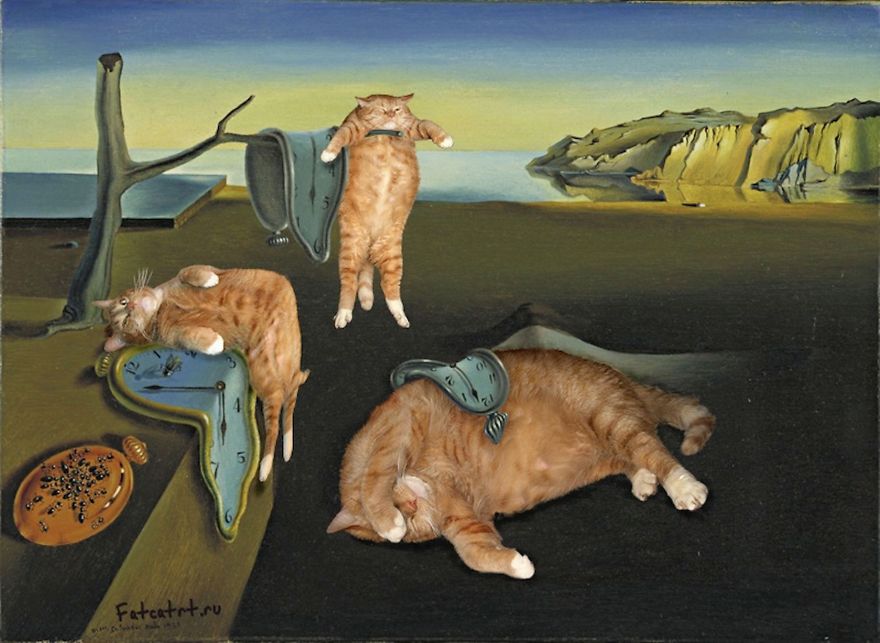
[The painting is “The Persistence of Meowmory,” by Salvador Dali and Svetlana Petrova.]
My apologies to the artist. This was uncredited, but if anyone knows who the artist is–other than “hir”– I would like to acknowledge them.
It has now been 15 weeks since the start of my “Big, Fat Weight-Loss Campaign.”
In 15 weeks, I have lost only two pounds. Despite taking Ozempic for six of those weeks. Despite exercising almost every day. Despite the physical therapy, personal trainer, and health club membership (which I am actually using this time). Despite being on Weight Watchers and sticking to it except for Friday dinners.
THIS is why I hate trying to lose weight. It feels like I have to claw it off, ounce by ounce. I only lose in tiny increments, and only if I work at it all the time. That’s why I gave up in the first place— losing weight feels like a full-time job with no salary or benefits. Or promotions. Or stock options. And definitely no holiday party.
I will stop whining now. I wrote a much longer whine, but realized no one would want to read it. Here is what I decided: Ozempic didn’t help and it gives me red, itchy rashes. So, Ozempic is not my knight in shining armor; I need to rescue myself. I stopped taking Ozempic two weeks ago. No change in weight.
But if I am honest about it, there have been significant changes:
I dropped a dress size.
I can make it up the 32 steps to my front door without panting (much)
My balance is better
I don’t get as tired
I lost at least five inches around my waist
I am at a loss to explain how all this could happen without losing any weight, but people keep telling me that muscle weighs more than fat. That’s fine, but I don’t think my surgeon is going to accept dress size as proof that I am ready for knee replacement surgery. And the sense of disappointment when I weigh myself weekly does drag me down.
I don’t see any remedy except to keep on keeping on. I will up my exercise regimen. I have had a glass of wine or two if I had enough WW points to spare at the end of the day. Maybe that is the problem? Can you eliminate all pleasure from your life and still want to live? I guess I’ll find out.
But before I get back to it, I am wrapping myself around a BLTA sandwich, some chips, and a lot of red wine.




 obsidianmirrorblog