Speaking of Inca: Elegy for a Small Black Cat

I didn’t think I would have to write this so soon. My cat Inca, my loving companion of 17 years, was dead on the floor when I got up the other morning.

I suppose she was lucky. She was rarely sick, and never seriously ill. She was still lithe and active, her fur thick and glossy. She attacked her evening treat last night with her usual impatient greed. She never suffered as some of my other pets have, with pain and illness. She didn’t have to be put down by the vet—a procedure that would have terrified her, as she was a very shy and nervous girl. Instead, she passed away, apparently in her sleep, with her people there, though we knew nothing about it until the morning. I guess I would be happy to go the same way.

But there is a painful, Inca-shaped hole inside me right now. So let me tell you about Inca.

I got Inca right after my beautiful cat Phoenix died of cancer (actually of vet, but the end was very near). I was heartbroken, but a friend said I should rescue another cat in Phoenix’s honor—he was sure it would make me feel better. (Incidentally, he was right.) I started looking at shelter cats and ran into an organization called 13th Street Cat Rescue in San Jose, CA. I asked about a black cat they had because the very first cat I remember was my brother’s black cat, Flinky, and he was a very sweet boy. The cat I asked about was taken, but they asked if I was interested in adopting a black cat, because people are often highly superstitious about them, so black cats (and other melanistic pets) tend to sit on the shelf. The organization happened to have a nine-month-old black cat, part of a litter that had been rescued from a trailer park. The kittens had been too old for adoption, but the trailer park manager threatened to kill the whole lot if 13th Street didn’t take them.
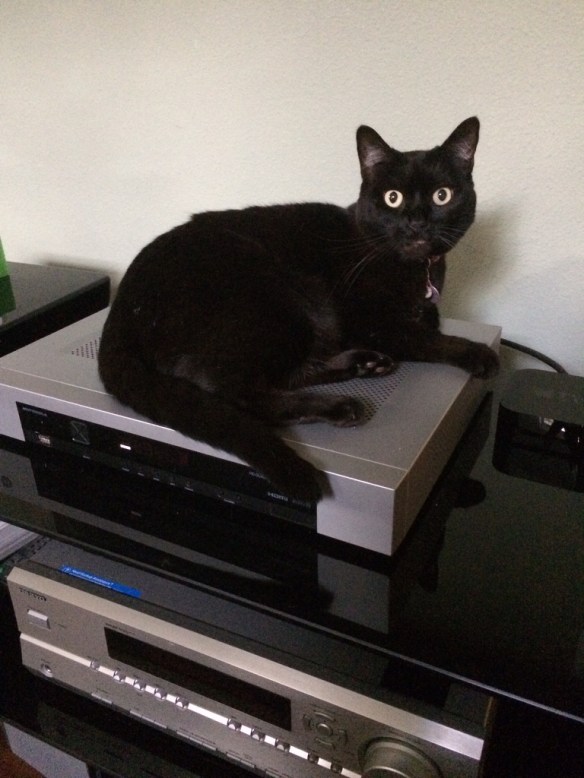
Inca on her personal cat-warmer.

It turned out all the kittens, though feral, were adapting nicely to domestic life. Inky (as she was called then) was no exception. I met her at one of the volunteers’ houses, and she sat on my lap and purred. Inca was beautiful, black with bright yellow-green eyes. She always had a few scattered white hairs among the black. In the sunlight, her fur looked chocolate brown.

We agreed to adopt her. I’m afraid I could not have a black cat named Inky. First I tried naming her Flinky, after that first black kitty, but it never suited her. The name Inca just came out of the blue one day, and I loved it right off. It seemed to suit her elegance.

At the time, we had a wonderful dog named Gigi. Gigi was a German shepherd-Labrador mix, 75 pounds, and, though a sweet and gentle dog, she was obviously terrifying to a tiny black cat. We kept Inca sequestered in a bathroom for a week, then let her out into the house. We really didn’t see her for the next two weeks—just a flicker of black at the corner of the eye, like a bat.

Then one day I was sitting on the couch and Inca strolled calmly into the room and jumped into my lap. I petted her, delighted, and she purred. After a few minutes, Gigi entered the room and I braced for a cat freakout. Instead, Inca ran down the length of the couch toward Gigi, mewing loudly. Gigi came over, and they kissed each other. Somehow, without my ever observing it, Gigi made friends with this timorous wee beastie and convinced her she was in a safe place. Their friendship ended only when Gigi died. I have many photos of the two of them cuddling together.

After Gigi died, Inca became even more attached to her humans, especially my husband, Tom. She began to sit on his lap at night when he watched TV. She was never a playful cat. Once in a while she would bat a toy around for a few minutes, but that was the extent of it. She didn’t have cute habits or do funny things, But she was a powerful engine of love and cuddles, happy to be petted at any time of the day or night.

Inca was also the best-behaved cat I have ever had. She didn’t potty outside her box. She didn’t scratch the furniture. With the exception of one fern, she never touched an indoor plant (the fern survived). She was the opposite of picky about food, eating whatever I put in front of her. She didn’t destroy stuff. Once in a while, we did get cat gak, but hairballs are part of being a cat. She bit gently when she felt affectionate, but rarely scratched. She loved our grandchildren and was gentle with them.

Inca did not like her tummy to be touched. If her tummy was stroked, she did that cat thing, turning into a ball of needles. After Inca was introduced to civilization by Gigi, the two of them tended to go with me wherever I was in the house. One day, Gigi laid down for a good tummy-rub and I obliged her. I rubbed and rubbed, and Gigi moaned with happiness as Inca watched. When I stopped rubbing Gigi’s tummy, Inca flopped over and presented her tummy for a rub. She found that she enjoyed it and would often ask for a tummy rub in the years to come. I was very intrigued that she observed, learned, and experimented.

She even learned some tricks at an advanced age. As she aged, she was still active, but could no longer jump to the top of the bed like Superman in a single bound. I bought her some stairs so she could climb our bed without clawing her way up the sides, shredding the bedclothes and on one occasion, me (it was an accident, but still). She would look at me with those bright eyes, clearly planning to scramble up the side of the bed, and I started gesturing to the stairs and telling her “Go up the stairs.” She learned to do this on command and (mostly) stopped clawing her way up the sheets.

I was facing major surgery and worried that Inca would continue to treat my body as a nice place to stomp around in the evenings. I never could figure out why she sat calmly on Tom’s lap, but wanted to stomp around on me. I had to teach her not to stand on my body, which must have been confusing to her after so many years of doing so. But she did learn, and only ran over me once after the surgery—right over the incision, as it happened. But mostly, she remembered not to. I felt kind of bad about making her stay off me (though I welcomed her to cuddle by my side), especially now, knowing how little time she had left. I did stop many times throughout every day to pet and cuddle her; I wanted her to know that I loved her as much as ever.

Inca was still so beautiful and healthy at 17 years old that I was convinced she would last a couple of years more. Unlike other elderly cats I’ve had, she did not become skinny, her fur was still thick and shiny, and she was as enthusiastic about food, treats, and petting as ever.

When I found Inca’s body yesterday morning, she was already stiff and cold. I wrapped her in a clean towel, but her bowels and bladder did not void after death. She exited this life as she lived it—tidy, without making a fuss.

I miss my friend. I really, really miss her.
My Big, Fat, Weight-Loss Campaign Part 8: In Which I Finally Break through the Brick Wall

In my last post on the subject, I explained that I have been unable to move past a set-point weight. I have been at the same weight for almost two years, giver or take a few pounds

No one can continue to deprive themselves and do things they don’t want to do for two years in pursuit of an unattainable goal. it’s just not human nature. I confess there were weeks in which I decided that being fat wasn’t the worst fate in the world. Chocolate and red wine played a large factor in those weeks.

As I detailed earlier, I tried everything in the book to try to break past that stubborn set-point. I couldn’t believe that nothing was working. (I am still unwilling to do the 10-day vegetable cleanse.) So I decided to increase my cardio again and skip lunch, having a protein drink instead (I add a medium-sized banana to the smoothie for texture and ballast). I started doing six miles a day on the recumbent bike, with the intention of working up to ten.

Last week, I weighed myself, and I was five pounds over the set point. Today, I weighed myself, and I am five pounds UNDER the set point for the first time in who knows how long. I almost woke my husband up to tell him, but he was up late last night so I took pity on him.

Totally made my day. I am still grinning. Now I have to keep it going. My personal trainer (“Lord Taskmaster”) is pushing for weight training prior to doing the cardio because he swears it gets the weight off faster (and he is the personal trainer, so he probably knows more than me). So I’ve started doing that as well. He is also pushing for seven miles. All in good time, your Taskmastership.

My Big, Fat Weight-Loss Campaign: Part 7

It has been a long time since I last posted. With regard to my Big, Fat Weight-Loss Campaign, it’s because it got complicated.

I lost 55 pounds or so in one year. The next year, despite continuing to diet conscientiously and exercising regularly, I lost no weight at all.

None.

I made changes. I was using the Weight Watchers method. I switched to counting calories. I was exercising a few days a week. I upped it to six days a week, alternating cardio and weight training.

Nada.

I started taking protein supplements. My nails went from paper-like to strong and long, and my hair thickened as well.

Not another ounce came off.

I consulted a nutritionist who wanted me to go on a cleanse for 10 days eating nothing but protein and vegetables. This is intended to improve bile production and reduce blood sugar because she couldn’t find anything else impeding my weight loss. I bought her protein powder and supplements, but suddenly, I was scheduled for major surgery—a complete, reverse shoulder replacement. I decided to delay the cleanse, as the surgery was going to interfere in many ways with how my body was working and I didn’t want to play around with nutrition while I was in recovery.

The surgery went fine and I’m glad I did it even though the six weeks in a sling was tedious and uncomfortable. Still, the discomfort was far less (after the first week) than before. Prior to the surgery there were days when I was hurting so much I couldn’t leave the house. As I was lying on a gurney waiting for surgery, I was in so much pain I asked for pain-killers (I was unable to take any prior to getting to the hospital because I was following the surgeon’s orders about taking medication and water.) Bless the nurses. They got me pain-killers. I was grateful because I spent a long time on that gurney.

Then I spent six weeks doing nothing at all except watching television, reading, eating, and doing physical therapy. I couldn’t drive and I didn’t want to leave the house if I didn’t have to. After this slugfest I was sure I would gain weight, but I did not. I’m back to counting calories and just resumed cardio on a recumbent bike.

To be honest, I don’t want to do the cleanse if I can avoid it. I would have to fix all my meals separately from the rest of the family, and just protein and vegetables sounds…boring. I will still do it if I have to, but I am hoping that the surgery did a reset and my body will once more be open to shedding pounds.

#

I had never heard of a total reverse shoulder replacement until I was told I needed one. It’s a technique they use when there is so much damage to the joint that a standard replacement won’t work as well. I have severe arthritis, which pretty much destroyed the humeral head (the “ball”) of the humerus (upper arm bone) and resulted in bone-on-bone action and bone spurs.

The procedure is to expose and dislocate the joint. The humeral head is sawn off and replaced with a titanium and plastic cup which is inserted into the humerus. A titanium ball is screwed into the shoulder blade. Thus, the structure of the joint is reversed. It’s kind of a brutal surgery, and I am DEEPLY grateful for anesthesia. The surgeons did an amazing job, and after the first week, I stopped taking opioids and used only Tylenol and CBD for the pain, which has diminished daily. I have good mobility for this stage of healing (because I do the physical therapy exercises religiously). I don’t think I will ever have the complete range of motion that my other shoulder has, but I’m OK with that—I’m no longer in agony. And at 74, I have no ambition to become a trapeze artist.

My Big, Fat Weight-Loss Campaign, Part 7: The Betrayal of the Body

On the one hand, I have lost 55 pounds in about two years—45 of them during 2024. On the other hand, I have been stuck at the same number for about six months, and I can’t seem to move past it.

There are a few reasons for this. One reason is that my left knee decided to join my right knee by becoming incredibly painful. At times, I could walk only with the help of two canes. This meant that the exercise program came to a grinding halt. Off I went to the orthopedic surgeon to get shots of hyaluronic acid gel. Not much improvement, so the doc felt around a bit and determined I had a “Baker’s cyst.” This, it turns out, is very common in people with arthritis. It is a cyst that forms at the back of the knee, filled with synovial fluid. (Hyaluronic acid is a precursor to synovial fluid, but the cyst appeared prior to the injections.)

So the doc gave me a cortisone shot—and I immediately felt much worse, and took up both canes to walk again. So I spent probably two months or more sidelined from exercising. The knee gradually improved to the point where I started going to the gym again, but I decided to go to physical therapy to see if I could improve the situation a bit further.

The therapist thought the issue was not the Baker’s cyst (although it is definitely there), but an irritated meniscus. He gave me a simple leg-lifting exercise, and told me I would be way better in two weeks. He encouraged me to do the exercise as much as possible. I did a few reps the following day—and everything got worse. (I was spending a FORTUNE in CBD transdermal patches, by the way.) I reported this to the PT people, and during the next visit, I was assigned to another therapist, Kristie, whom I have worked with previously. Kristie determined that my knee was misaligned and I had probably been doing the leg lifts improperly. She gave me other exercises to do, and now, after about two weeks, I am almost pain-free!

Knowing that the knee is misaligned has been very helpful. For example, when I relax with my legs flat, either on my back in bed or sitting up in bed watching TV, my feet tend to rotate outwards significantly, especially my left foot, which shoves the knee out of kilter. I thought about this for a while and realized that for many, many years, I have allowed the weight of my bedcovers to force my feet outward because the pressure hurt my toes. So I bought a “blanket lifter” that keeps the bedclothes elevated over my feet—the relief is incredible. It also allows me to comfortably keep my feet—and ankles and knees and hips—in alignment. Zach, my trainer, suggested that my athletic shoes might be overly worn, and they were. I pronate badly (see misaligned feet), and the soles were badly worn on the outsides. So I bought new shoes. I am thrilled with my return to relative comfort and now I need to get back on the exercise trail in a more serious way.

I weighed myself and I haven’t gained any weight in the past few months, so that is the good news. Encouraged by this, I measured myself and found I had lost 5 inches from around my chest, 7 inches from my waist, and 11 inches from my hips. While I don’t think I will lose a lot of weight during the holiday season, I intend not to gain any either. That seems doable, right?

My Big, Fat Weight Loss Campaign: Part 6—Things Are Odd

In the past, when I tried to lose weight, I ran or walked (when I got older) and dieted. This usually resulted in a slow but steady loss. This time, it’s different. I’ve lost many inches and I have dropped TWO dress sizes—but I’ve lost relatively little weight. Figuring by my scale, I have lost around 23 pounds since the first of February. That might be more than two dress sizes for some people, but I am 5’10”, and 25 pounds usually equals one dress size for me.

So what is going on here? According to 8fit.com, one cubic inch of muscle weighs about 15-20% more than one cubic inch of fat. But by volume, a pound of fat will take up more space than a pound of muscle. I looked this up because everyone says, “muscle weighs more than fat.” It has been a regular chorus in my life as I bitch and moan about not having lost more weight.

Anyway, It’s my own fault. When I started this whole thing, I was stumped and in a downward spiral. I wasn’t exercising because my right knee was too painful. I was gaining weight. I didn’t know how to fix it. I am one of those people who has lived inside their heads for an entire life, hoping that the body would perhaps take care of itself.

Faced with the reality of my situation, and acknowledging that I needed help to fix it, I joined a local health club and hired a personal trainer. Over the past four and a half months, I have tried to get to the gym every day to do cardio on a recumbent bike that doesn’t stress my knees. I don’t make it every day, but I do most days. I worked my way up on the recumbent bike from a quarter of a mile to my current ride of four miles.

Now that I am more familiar with the machines at the club, I also use some of those, and/or use the dumbbells. There are a couple of machines I don’t use unless Zach (my trainer) is there because they involve grasping something and then sitting down. Way down. I’m too nervous about hurting my knee to try that—I need Zach to do the lowering part after I am seated.

And then there are the physical therapy exercises, aimed at improving the musculature around my bad knee and my left shoulder (which also left the planet and needs replacing). Doing a full round of PT usually takes about an hour. So, what with one thing and another, I am exercising more every day than I ever have before. 

The result is that I have put on a lot of muscle. I don’t know how much, but enough to offset quite a bit of fat loss. Muscle burns energy, so adding muscle helps to burn more fat–something else people tell me all the time.

I have continued following Weight Watchers throughout this process. I have never been able to just diet and lose weight. Or just exercise and lose weight. No, I have to do both, which I suspect is true of most people. (Friday nights are splurge nights, though. Sanity is also important.)

And yes, I feel a lot better. I have more energy, my balance is better, and I am moving better. The only question I have is, will my orthopedic surgeon still want me to lose another 27 pounds before he will do the surgery? Or will he see the muscle gain as part of the equation? I’m seeing him this week, so I’ll find out.

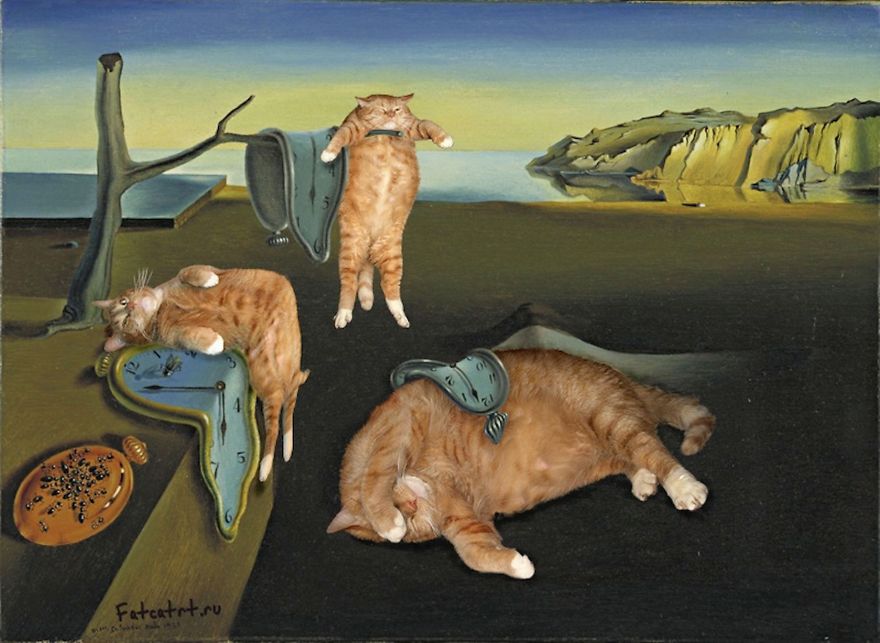
[The painting is “The Persistence of Meowmory,” by Salvador Dali and Svetlana Petrova.]

My Big, Fat Weight Loss Campaign: Part 5—Is That a Light at the End of the Tunnel? Or Is It That Damn Train Again?

My apologies to the artist. This was uncredited, but if anyone knows who the artist is–other than “hir”– I would like
to acknowledge them.

It has now been 15 weeks since the start of my “Big, Fat Weight-Loss Campaign.”

In 15 weeks, I have lost only two pounds. Despite taking Ozempic for six of those weeks. Despite exercising almost every day. Despite the physical therapy, personal trainer, and health club membership (which I am actually using this time). Despite being on Weight Watchers and sticking to it except for Friday dinners.

THIS is why I hate trying to lose weight. It feels like I have to claw it off, ounce by ounce. I only lose in tiny increments, and only if I work at it all the time. That’s why I gave up in the first place— losing weight feels like a full-time job with no salary or benefits. Or promotions. Or stock options. And definitely no holiday party.

I will stop whining now. I wrote a much longer whine, but realized no one would want to read it. Here is what I decided: Ozempic didn’t help and it gives me red, itchy rashes. So, Ozempic is not my knight in shining armor; I need to rescue myself. I stopped taking Ozempic two weeks ago. No change in weight.

But if I am honest about it, there have been significant changes:

  • I dropped a dress size. 
  • I can make it up the 32 steps to my front door without panting (much)
  • My balance is better
  • I don’t get as tired
  • I lost at least five inches around my waist 

I am at a loss to explain how all this could happen without losing any weight, but people keep telling me that muscle weighs more than fat. That’s fine, but I don’t think my surgeon is going to accept dress size as proof that I am ready for knee replacement surgery. And the sense of disappointment when I weigh myself weekly does drag me down.

I don’t see any remedy except to keep on keeping on. I will up my exercise regimen. I have had a glass of wine or two if I had enough WW points to spare at the end of the day. Maybe that is the problem? Can you eliminate all pleasure from your life and still want to live? I guess I’ll find out.

But before I get back to it, I am wrapping myself around a BLTA sandwich, some chips, and a lot of red wine.

My Big, Fat Weight Loss Campaign: Part 4—Disappointment

Disappointment is inherent to the weight-loss process, but that’s not what I’m referring to. I am—so far—disappointed in Ozempic. I have been taking the drug for six weeks, and I have lost possibly two pounds, although some days, it’s nothing at all on the scale.

I already detailed my experience of the first four weeks/injections on this blog. I was unable to get the medication in time to take the fifth injection on my designated day, so the nurse practitioner advised taking a half dose to get started again, to try to avoid the nasty side effects I experienced before. She told me how to get a half-dose or quarter-dose out of my 1mg-only pen.

So I injected .5mg of Ozempic for the past two weeks. It did not curb my appetite as much, but i stuck to the Weight Watchers points program with little trouble. I also continued my exercise program. I felt more or less normal the entire time. But I lost no weight, despite not increasing my caloric intake.

It also turns out I am allergic to Ozempic. It gives me itchy rashes. I am less perturbed by the rashes than I am by the failure to lose more weight. But if it gives me itchy rashes and does not help me to lose weight, it makes it easy to lose the Ozempic. I plan to use the remainder of the pen I currently have. If I see progress (in the form of noticeably less poundage), I will continue. If not, I will gladly stop taking it and the truckloads of antihistimines I take to combat the itching. I can use the $450 a month on something else, I am sure.

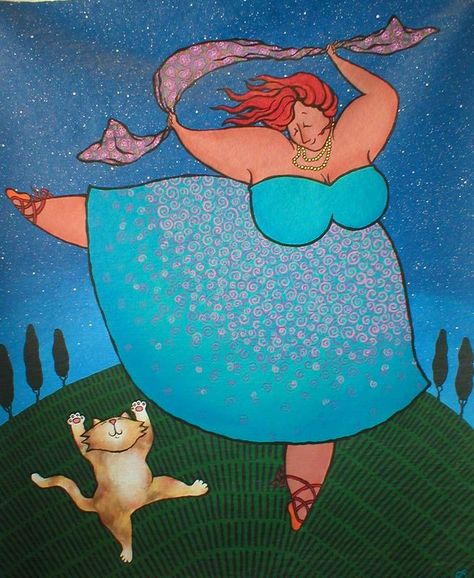
By the way, it is really hard to find images for the topic of weight loss that I don’t find offensive. The lady I chose to grace this entry is far too thin, but I liked her expression. Most cartoons, photos, and art I have found depict grossly obese women stuffing their faces with fattening foods. If I did that, I’d have been dead long ago. There are very few positive images of large women out there, and the ones I did find were not appropriate to this particular theme. No surprise, I guess. In honor of honoring our bodies, be they ever so imperfect, here is Hilda, my favorite pin-up girl. Hilda always looks like she is having fun, and nothing stops her from being beautiful AND fat.

My Big Fat Weight Loss Campaign: Part 3—The New Weight-Loss Drug Merry-Go-Round

The media is full of stories about the new class of weight-loss drugs, of which the best-known are Ozempic and Wegovy. I’m not going to get into the other drugs currently on the market. That would take up a lot of time and this post isn’t about the industry.

What is the difference between Ozempic and Wegovy? There isn’t any difference. They are both a drug called semaglutide. They are both manufactured by the pharmaceutical company Novo Nordisk. However, they are approved by the FDA for different conditions. Ozempic is approved for Type 2 diabetes. Wegovy is approved in a higher dosage for overweight. Both drugs are in such high demand that they are difficult to get in the United States.

How does Semaglutide work? From Drugs.com: “Semaglutide works by mimicking the action of GLP-1, a naturally occurring hormone that helps to regulate blood glucose levels. By binding to and activating the GLP-1 receptor, it stimulates insulin secretion and lowers glucagon secretion when blood glucose levels are high. It also causes a slowing down in how fast the stomach empties.” The end result is that it dramatically reduces appetite.

What are the potential side effects? Low blood sugar levels, nausea, vomiting, diarrhea, abdominal pain, and constipation are the most common side effects. There is also an increased risk of pancreatitis. And people with certain medical conditions shouldn’t take it. Do your research before starting one of these drugs.

My Experience of Taking Semaglutide:  The first step was that the nurse practitioner I was working with, Ashzra, prescribed Wegovy. My insurance turned it down because weight loss is not a condition covered by Medicare Part D. Then she sent me a prescription for Ozempic and gave me a Canadian pharmacy to contact. I did so, and without any further ado, I received my first Ozempic pen in the mail. I had to wait for more than a month to receive instruction from a physician on how to use it, so it sat in my refrigerator for all that time—it has to be kept cold.

I finally got a doctor to go over how to use it. So one Tuesday morning three weeks ago, I sat in my home office with the patient instructions Ashzra sent me. The instructions said to prep the pen and make sure no bubbles were in it, etc, which I did. Then the instruction said to turn the pen until the proper dosage appeared in the little window. I thought I’d start with .25mg, as I was worried about side effects.

I dutifully clicked the pen until a number appeared in the window. It was a 1. A second try yielded the same result. I pondered this for a while, and then pulled out the instruction sheet inside the prescription box. It turns out that my pen injects 1mg every time—you cannot select the dosage.

Okay. I swabbed my upper thigh with rubbing alcohol and regarded the needle protruding from the end of the pen. It is a short needle, and very fine. But I still needed to—willingly—shove this needle into my tender skin. I set up the pen and stabbed my thigh. I depressed the plunger, and it clicked back to its starting position. I held the pen against my skin for another six seconds, as instructed, to make sure the entire dosage was injected.

It didn’t hurt much, I will say that. There was a tiny red dot at the injection site, and I covered it with a little bandaid, just like at the doctor’s office.

By dinner time, I was feeling distinctly uninterested in food. The next morning, I fixed my usual breakfast, something I normally enjoy—one piece of avocado toast with fried eggs and hot sauce. I wasn’t just feeling uninterested, but nauseous. I ate about a fourth of it because I wasn’t sure whether this was how I was supposed to be feeling, but could go no further. Another couple of hours found me giving back not just breakfast but everything I had eaten after giving myself the injection. I also felt extremely fatigued.

The nausea and fatigue lessened a bit every day. The nausea went away entirely when I remembered how effective ginger is against nausea and other stomach troubles. Despite a total lack of interest in food, I forced myself to eat because I didn’t want to get malnourished. By the end of the week, I started enjoying eating again. I recognized that constipation was going to be an issue, and took stool softeners and dietary fiber to combat it.

After the second injection, I felt mildly nauseous but did not vomit. I wondered whether “reduced appetite” actually meant “revolted by food.” The fatigue got a little better, but I still felt pretty tired. The third injection left me feeling fairly normal, except for a reduced appetite. I have resumed enjoying food, but I can’t eat a lot of it. I think this is the desired state.

Semaglutide will reduce your appetite, but you still have to eat properly to lose weight. I am sticking to the Weight Watchers diet and gradually increasing my physical activity. I have not lost any weight over the past two weeks, but I am still hopeful. Weight loss is unpredictable and tends to happen when I least expect it.

The weight loss physician who instructed me about using the pen also tried to get a prescription for Weygovy approved, as she said there are some new guidelines.  After the second injection, I tried to find out from my clinic how to get the second semaglutide pen—should I go back to the person who prescribed the Ozempic? Should I coordinate with the weight-loss physician who was trying to get me Weygovy? Or…?

It was a bit of a clown show. Every time I tried to contact someone like Ashzra, someone else would answer my email who had not read the case notes and didn’t know what was going on. Even Ashzra didn’t answer my direct question about whom to coordinate with about getting another prescription. I finally drove to the clinic and asked to speak to a member of my doctor’s staff, explaining that I needed a new prescription and had been unable to get information from anyone I contacted via email. After a wait of perhaps half an hour, a nurse came out to talk to me. She had spent the time reading all the emails and understood the problem. I left the clinic with a prescription, emailed it to the Canadian pharmacy, and received a rapid acknowledgment.

By the way, my insurance for Medicare Part D refused the second prescription because weight loss is not a condition…etc. Being overweight creates other medical conditions that they WILL have to pay for, but if you expect the insurance industry to make sense, don’t. All they are concerned about is making profits. I worked for an insurance lobbyist for a while; I know what I’m talking about.

I hear many worse tales about our current medical system from others. Apparently, we lost a lot of medical personnel during the pandemic, and the strain on our system is showing. I completely understood putting Ashzra in place to shoulder some of the doctor’s load, and she is a very impressive person. But it seems that the load-spreaders are overwhelmed, too. If things get worse, we will lose more medical people who just can’t take the stress.

I can’t report any more reduced poundage, but here’s another token of progress: my belt. I am now on the last notch.

My Big Fat Weight Loss Campaign: Part 2—The Plan

Art by Nerita De Jong.

As I mentioned at the end of my last post, I needed outside help to successfully lose weight this time. I couldn’t put on my Nikes and run a few miles. I wasn’t even supposed to walk for exercise anymore, due to one knee being bone-on-bone and the other knee threatening to go the same way.

And yet, I have never lost weight through diet alone. Exercise is half of the equation. (God, I hate exercising.) I had no idea how to exercise without making the knee worse—or what kinds of exercises I needed to be doing to prepare for surgery. Obviously, I needed to get expert help.

Okay, another thing I have avoided in the past is paying for something I think I ought to be able to do myself for free. I avoided any sport that required an investment in memberships or expensive equipment, such as golf or skiing. I hated the idea of health club membership because I thought I ought to be able to exercise on my own by walking. But health clubs are where they have exercise equipment, so I needed to join one. I signed up with the health club down the street, which I had used (infrequently) in the past. Endearingly, it is a part of the local “Toadal Fitness” group of health clubs.

Physical therapy was also on my list, but PT only goes so far. I wanted to hire a personal trainer, someone who understood which areas I needed to focus on, and who could tell me how to use the equipment and create a workout routine for me. I mentioned this to my physical therapist, who recommended two trainers who work at my health club. The trainers had undergone training at my PT’s practice on how to work with people with injuries and constraints. So I trotted down to the club and was introduced to Zach. Zach showed me around and listened to me, asked a lot of questions, and we talked.

I don’t know what your idea of a personal trainer is, but Zach wasn’t mine. I guess I thought a trainer would be a lot younger than me, nauseatingly fit, and perky. Zach is starting to push past middle age. He’s fit enough, but not the muscle-bound person I was expecting, and he has his own issues relating to age and injury, so I feel comfortable talking to him about my multiple physical shortcomings. He’s got a sense of humor, which I enjoy. He also pushes me—not hard, but enough that I make progress every time we have a session.

What are we working on? For cardio, I do the recumbent bike. When I started, I could only do a quarter of a mile before my knees became too sore to continue. I decided I would just do what I could do when I could do it. I told myself all I had to do every day was go to the club and bicycle for a quarter of a mile. That seemed easy enough, and it got me to the club. Before long, I was doing a half a mile, then three-quarters, and so on. I am at two and a half miles now.

The program I am using on the recumbent bike is a racecourse, which I carefully selected because its steepest incline is only 3%, and the incline doesn’t last long, either. Right now, I am going for mileage, not endurance. I hate hills, don’t you?

Zach works with me on the machines and weights. We started with machines that work the thighs and hips and the muscles above and below the knees. I am one of God’s Clumsy Children, and some of those machines—especially the clamshells, the ones you exercise your thighs on—are lurking deathtraps, just waiting to break bones. Zach watches me anxiously as I slowly negotiate these complex contraptions—getting in and out is the hardest part. So far, I haven’t broken me or one of the machines. I am actually getting more graceful as I get used to them. Any day now, I might try using them without Zach to watch over me like a mother hen.

I meet Zach once a week at my health club. I haven’t said much about the club, but it’s friendly, and a large percentage of the clientele has gray or white hair. It feels neighborhood. It isn’t fancy, but it has all the stuff, including a saltwater pool.

Now, what about diet? I lost a fair amount of weight in the past using Weight Watchers. I found it an easy program to follow, but I did not enjoy the meetings. I was eating unprocessed, fresh foods. The people in my meeting seemed to find the time involved in preparing fresh food unacceptable. To be fair, many of them had kids at home to feed and deal with, and I certainly could empathize with that, but the discussions weren’t centered around any of my concerns.

These days, you can purchase the WW app for your phone and not go to any of the meetings if you prefer (I do). The app allows you to look up the point value for a huge range of foods and adjust quantities. It tracks your points daily and weekly and keeps a food diary. You can create your own recipes for quickly entering meals you eat frequently. You can track your weight and the app adjusts your available points as you lose. It has lots of other features that track water consumption and exercise, and you can also look up WW recipes, but I don’t use all of its capabilities.

I was working with my doctor’s nurse practitioner, Ashzra, on all this. Ashzra questioned the Weight Watchers approach. She said I should be consuming no more than 1500 calories a day. Did WW conform to that? So for a week I tracked WW points versus calories. I was honest about it—WW counts certain things as zero points, such as fruit and fish, that still have calories. I tracked ALL the calories I consumed during that week. It turned out that using all the WW points for a given day came in at or under 1500 calories. One day, it was 1700, but I had come under the 1500 mark enough times that I was unconcerned.

So, physical therapy—check. Health club, personal trainer, and exercise program—check. Diet—check. The one element remaining was medication. The news is brimming with stories about the new weight loss drugs like Ozempic and Wegovy. The news is also full of how expensive these drugs are and how hard they are to get. 

Next installment: Part 3—The New Weight-Loss Medication Merry-Go-Round

My Big Fat Weight Loss Campaign: Part 1—How It Began

Image by Lazardo Art.

I gave up on losing weight a long time ago. I have all my life found the subject of my weight a huge embarrassment. I was not fat as a child, but I was plump, and bullies discovered early on that they could make me miserable by singing “Fatty Fatty Two-By-Four” on every occasion. My father harped on my weight all the time. He was thin as a blade without making any effort, and couldn’t understand why I wasn’t—clearly, it was some sort of character flaw in me. Extra weight always seemed to me like an embarrassing sin—but a sin that EVERYONE could SEE. It felt shameful.

In the past, I had lost significant amounts of weight. My methodology was to starve and run a few miles a day. I really had to dedicate a huge amount of awareness, energy, time, and brain power to make this happen. After a while, I just didn’t have the energy to put into this one more time—I kind of quit the whole idea that I would ever be a normal weight. It was too easy to gain, and way too hard to lose. I just wanted to enjoy life. Also, I had reached a point where running was uncomfortable—pregnancy and nursing had inflated my boobs to proportions that did not appreciate being violently bounced around.


I wasn’t always overweight. I was slender in my late teens and 20s. I started gaining weight after the birth of my first child in my 30s, and gradually kept on gaining. At my heaviest, I was over 300 pounds. Mind you, I am 5’10 inches tall, not a shortie, but still way, way too much weight.

It annoyed me seriously that my diet was pretty healthy while I gained all this weight. After about age 35, I ate very little sugar, never had sugary drinks or many sweets. I didn’t eat fast food or junk food. I avoided processed food and focused on whole foods, mostly prepared at home. I noticed that other people ate more than me—I often couldn’t finish portions that others did. I rarely took seconds. I didn’t eat between meals. I ate lots of vegetables, lean meats, and recently, began baking my own einkorn bread (I am allergic to modern wheat), which is lower in refined carbs and higher in protein and dietary fiber than modern wheat. You wouldn’t think I would gain a lot of weight this way—but I did. The difficulty of losing weight, despite a healthy diet, merely made me want to ignore the whole problem even more vigorously. What’s the point, if nothing works?

I began having knee problems. My form of exercise was walking. I went from four miles to two miles to one mile. During the pandemic, it was mostly no miles, as I disliked leaving the house for a while. In the meantime, severe arthritis ate away at my knee, and unbeknownst to myself, my shoulder. 

My body finally gave me an ultimatum. My right knee became increasingly painful. Then at Christmas last year (2023), I was strolling to the front door with a glass of wine in my hand, intending to lock the door, as it had gotten dark. As I approached the door, a jolt of agony surged up my leg from my right knee and I collapsed. Fortunately, I had the presence of mind to hurl my wine glass away from me as I fell, so I didn’t wind up being cut to shreds by glass shards. I landed hard, throwing my back into spasm.

My beautiful family rallied around. My son-in-law Mike cleaned up the glass and spilled wine. My husband Tom got me a muscle relaxer and pillows. My dear friend Meg and Tom sat with me for a half an hour until the medication kicked in and I was able to get off the floor. This was definitely a warning, and I fell again the next day—luckily for me on a carpeted floor, and I didn’t hurt myself this time. I began walking with a cane or hiking sticks, even around the house.

As it happened, I already had an appointment with an orthopedist for January 2. He looked at my X-rays and told me my knee was bone-on-bone. I needed knee replacement surgery. But I couldn’t have the surgery until I lost 50 pounds (at this point I was under 300 pounds, but 50 pounds is a lot to lose no matter how much you weigh). He also gave me a cortisone shot in the knee, which had amazing effects, enabling me to walk without a cane for the most part.

Later, after my shoulder also became agonizingly painful, I was informed I needed a complete reverse shoulder replacement. And I had to lose weight for that surgery as well.

So now I had no choice. I could no longer ignore the elephant in the room. I had to lose the weight. I also had to lose the shame I felt around the whole subject of weight—the shame that made me just ignore it. (I recognize the irrationality of my last statement. But this is how it was.) I was going to be dealing with a lot of people for quite some time about my accumulation of avoirdupois, and continuing to be embarrassed and ashamed just seemed stupid. I let shame get me to this space; I didn’t want shame to keep me here. 

At the same time, I had no idea how I could alter my already-healthy diet to trigger weight loss, and with a bum knee, how would I exercise? I knew if I didn’t exercise, I would never lose the weight by diet alone. Also, I needed to build up muscle to prepare for the surgery. How could I exercise? And what exercises should I be doing?

I didn’t have the faintest idea. I needed outside help. Next installment: getting help.

A word about body positivity: I am all for it. I did my best to feel positively about my body—beauty comes in all shapes, etc. Sadly, my body did not react positively to being so heavy. When you come right down to it, how you feel is more important than how you look.

Note: Since keeping track of weight loss is how success is measured in this arena, here’s the latest progress. You have no idea how excruciating it is for me to make this public:

2020: 315 lbs

2023: 285 lbs

As of 4/5/2024: 270 lbs

Note: I have no intention of posting “Before” or “After” photos here. Use your imagination.