Speaking of Inca: Elegy for a Small Black Cat

I didn’t think I would have to write this so soon. My cat Inca, my loving companion of 17 years, was dead on the floor when I got up the other morning.

I suppose she was lucky. She was rarely sick, and never seriously ill. She was still lithe and active, her fur thick and glossy. She attacked her evening treat last night with her usual impatient greed. She never suffered as some of my other pets have, with pain and illness. She didn’t have to be put down by the vet—a procedure that would have terrified her, as she was a very shy and nervous girl. Instead, she passed away, apparently in her sleep, with her people there, though we knew nothing about it until the morning. I guess I would be happy to go the same way.

But there is a painful, Inca-shaped hole inside me right now. So let me tell you about Inca.

I got Inca right after my beautiful cat Phoenix died of cancer (actually of vet, but the end was very near). I was heartbroken, but a friend said I should rescue another cat in Phoenix’s honor—he was sure it would make me feel better. (Incidentally, he was right.) I started looking at shelter cats and ran into an organization called 13th Street Cat Rescue in San Jose, CA. I asked about a black cat they had because the very first cat I remember was my brother’s black cat, Flinky, and he was a very sweet boy. The cat I asked about was taken, but they asked if I was interested in adopting a black cat, because people are often highly superstitious about them, so black cats (and other melanistic pets) tend to sit on the shelf. The organization happened to have a nine-month-old black cat, part of a litter that had been rescued from a trailer park. The kittens had been too old for adoption, but the trailer park manager threatened to kill the whole lot if 13th Street didn’t take them.
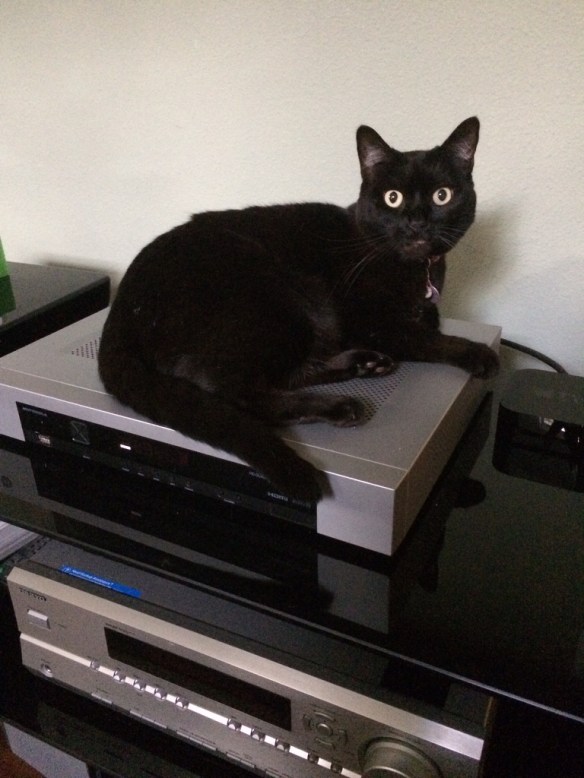
Inca on her personal cat-warmer.

It turned out all the kittens, though feral, were adapting nicely to domestic life. Inky (as she was called then) was no exception. I met her at one of the volunteers’ houses, and she sat on my lap and purred. Inca was beautiful, black with bright yellow-green eyes. She always had a few scattered white hairs among the black. In the sunlight, her fur looked chocolate brown.

We agreed to adopt her. I’m afraid I could not have a black cat named Inky. First I tried naming her Flinky, after that first black kitty, but it never suited her. The name Inca just came out of the blue one day, and I loved it right off. It seemed to suit her elegance.

At the time, we had a wonderful dog named Gigi. Gigi was a German shepherd-Labrador mix, 75 pounds, and, though a sweet and gentle dog, she was obviously terrifying to a tiny black cat. We kept Inca sequestered in a bathroom for a week, then let her out into the house. We really didn’t see her for the next two weeks—just a flicker of black at the corner of the eye, like a bat.

Then one day I was sitting on the couch and Inca strolled calmly into the room and jumped into my lap. I petted her, delighted, and she purred. After a few minutes, Gigi entered the room and I braced for a cat freakout. Instead, Inca ran down the length of the couch toward Gigi, mewing loudly. Gigi came over, and they kissed each other. Somehow, without my ever observing it, Gigi made friends with this timorous wee beastie and convinced her she was in a safe place. Their friendship ended only when Gigi died. I have many photos of the two of them cuddling together.

After Gigi died, Inca became even more attached to her humans, especially my husband, Tom. She began to sit on his lap at night when he watched TV. She was never a playful cat. Once in a while she would bat a toy around for a few minutes, but that was the extent of it. She didn’t have cute habits or do funny things, But she was a powerful engine of love and cuddles, happy to be petted at any time of the day or night.

Inca was also the best-behaved cat I have ever had. She didn’t potty outside her box. She didn’t scratch the furniture. With the exception of one fern, she never touched an indoor plant (the fern survived). She was the opposite of picky about food, eating whatever I put in front of her. She didn’t destroy stuff. Once in a while, we did get cat gak, but hairballs are part of being a cat. She bit gently when she felt affectionate, but rarely scratched. She loved our grandchildren and was gentle with them.

Inca did not like her tummy to be touched. If her tummy was stroked, she did that cat thing, turning into a ball of needles. After Inca was introduced to civilization by Gigi, the two of them tended to go with me wherever I was in the house. One day, Gigi laid down for a good tummy-rub and I obliged her. I rubbed and rubbed, and Gigi moaned with happiness as Inca watched. When I stopped rubbing Gigi’s tummy, Inca flopped over and presented her tummy for a rub. She found that she enjoyed it and would often ask for a tummy rub in the years to come. I was very intrigued that she observed, learned, and experimented.

She even learned some tricks at an advanced age. As she aged, she was still active, but could no longer jump to the top of the bed like Superman in a single bound. I bought her some stairs so she could climb our bed without clawing her way up the sides, shredding the bedclothes and on one occasion, me (it was an accident, but still). She would look at me with those bright eyes, clearly planning to scramble up the side of the bed, and I started gesturing to the stairs and telling her “Go up the stairs.” She learned to do this on command and (mostly) stopped clawing her way up the sheets.

I was facing major surgery and worried that Inca would continue to treat my body as a nice place to stomp around in the evenings. I never could figure out why she sat calmly on Tom’s lap, but wanted to stomp around on me. I had to teach her not to stand on my body, which must have been confusing to her after so many years of doing so. But she did learn, and only ran over me once after the surgery—right over the incision, as it happened. But mostly, she remembered not to. I felt kind of bad about making her stay off me (though I welcomed her to cuddle by my side), especially now, knowing how little time she had left. I did stop many times throughout every day to pet and cuddle her; I wanted her to know that I loved her as much as ever.

Inca was still so beautiful and healthy at 17 years old that I was convinced she would last a couple of years more. Unlike other elderly cats I’ve had, she did not become skinny, her fur was still thick and shiny, and she was as enthusiastic about food, treats, and petting as ever.

When I found Inca’s body yesterday morning, she was already stiff and cold. I wrapped her in a clean towel, but her bowels and bladder did not void after death. She exited this life as she lived it—tidy, without making a fuss.

I miss my friend. I really, really miss her.
My Big, Fat, Weight-Loss Campaign Part 8: In Which I Finally Break through the Brick Wall

In my last post on the subject, I explained that I have been unable to move past a set-point weight. I have been at the same weight for almost two years, giver or take a few pounds

No one can continue to deprive themselves and do things they don’t want to do for two years in pursuit of an unattainable goal. it’s just not human nature. I confess there were weeks in which I decided that being fat wasn’t the worst fate in the world. Chocolate and red wine played a large factor in those weeks.

As I detailed earlier, I tried everything in the book to try to break past that stubborn set-point. I couldn’t believe that nothing was working. (I am still unwilling to do the 10-day vegetable cleanse.) So I decided to increase my cardio again and skip lunch, having a protein drink instead (I add a medium-sized banana to the smoothie for texture and ballast). I started doing six miles a day on the recumbent bike, with the intention of working up to ten.

Last week, I weighed myself, and I was five pounds over the set point. Today, I weighed myself, and I am five pounds UNDER the set point for the first time in who knows how long. I almost woke my husband up to tell him, but he was up late last night so I took pity on him.

Totally made my day. I am still grinning. Now I have to keep it going. My personal trainer (“Lord Taskmaster”) is pushing for weight training prior to doing the cardio because he swears it gets the weight off faster (and he is the personal trainer, so he probably knows more than me). So I’ve started doing that as well. He is also pushing for seven miles. All in good time, your Taskmastership.

My Big, Fat Weight-Loss Campaign, Part 7: The Betrayal of the Body

On the one hand, I have lost 55 pounds in about two years—45 of them during 2024. On the other hand, I have been stuck at the same number for about six months, and I can’t seem to move past it.

There are a few reasons for this. One reason is that my left knee decided to join my right knee by becoming incredibly painful. At times, I could walk only with the help of two canes. This meant that the exercise program came to a grinding halt. Off I went to the orthopedic surgeon to get shots of hyaluronic acid gel. Not much improvement, so the doc felt around a bit and determined I had a “Baker’s cyst.” This, it turns out, is very common in people with arthritis. It is a cyst that forms at the back of the knee, filled with synovial fluid. (Hyaluronic acid is a precursor to synovial fluid, but the cyst appeared prior to the injections.)

So the doc gave me a cortisone shot—and I immediately felt much worse, and took up both canes to walk again. So I spent probably two months or more sidelined from exercising. The knee gradually improved to the point where I started going to the gym again, but I decided to go to physical therapy to see if I could improve the situation a bit further.

The therapist thought the issue was not the Baker’s cyst (although it is definitely there), but an irritated meniscus. He gave me a simple leg-lifting exercise, and told me I would be way better in two weeks. He encouraged me to do the exercise as much as possible. I did a few reps the following day—and everything got worse. (I was spending a FORTUNE in CBD transdermal patches, by the way.) I reported this to the PT people, and during the next visit, I was assigned to another therapist, Kristie, whom I have worked with previously. Kristie determined that my knee was misaligned and I had probably been doing the leg lifts improperly. She gave me other exercises to do, and now, after about two weeks, I am almost pain-free!

Knowing that the knee is misaligned has been very helpful. For example, when I relax with my legs flat, either on my back in bed or sitting up in bed watching TV, my feet tend to rotate outwards significantly, especially my left foot, which shoves the knee out of kilter. I thought about this for a while and realized that for many, many years, I have allowed the weight of my bedcovers to force my feet outward because the pressure hurt my toes. So I bought a “blanket lifter” that keeps the bedclothes elevated over my feet—the relief is incredible. It also allows me to comfortably keep my feet—and ankles and knees and hips—in alignment. Zach, my trainer, suggested that my athletic shoes might be overly worn, and they were. I pronate badly (see misaligned feet), and the soles were badly worn on the outsides. So I bought new shoes. I am thrilled with my return to relative comfort and now I need to get back on the exercise trail in a more serious way.

I weighed myself and I haven’t gained any weight in the past few months, so that is the good news. Encouraged by this, I measured myself and found I had lost 5 inches from around my chest, 7 inches from my waist, and 11 inches from my hips. While I don’t think I will lose a lot of weight during the holiday season, I intend not to gain any either. That seems doable, right?

My Big, Fat Weight Loss Campaign: Part 6—Things Are Odd

In the past, when I tried to lose weight, I ran or walked (when I got older) and dieted. This usually resulted in a slow but steady loss. This time, it’s different. I’ve lost many inches and I have dropped TWO dress sizes—but I’ve lost relatively little weight. Figuring by my scale, I have lost around 23 pounds since the first of February. That might be more than two dress sizes for some people, but I am 5’10”, and 25 pounds usually equals one dress size for me.

So what is going on here? According to 8fit.com, one cubic inch of muscle weighs about 15-20% more than one cubic inch of fat. But by volume, a pound of fat will take up more space than a pound of muscle. I looked this up because everyone says, “muscle weighs more than fat.” It has been a regular chorus in my life as I bitch and moan about not having lost more weight.

Anyway, It’s my own fault. When I started this whole thing, I was stumped and in a downward spiral. I wasn’t exercising because my right knee was too painful. I was gaining weight. I didn’t know how to fix it. I am one of those people who has lived inside their heads for an entire life, hoping that the body would perhaps take care of itself.

Faced with the reality of my situation, and acknowledging that I needed help to fix it, I joined a local health club and hired a personal trainer. Over the past four and a half months, I have tried to get to the gym every day to do cardio on a recumbent bike that doesn’t stress my knees. I don’t make it every day, but I do most days. I worked my way up on the recumbent bike from a quarter of a mile to my current ride of four miles.

Now that I am more familiar with the machines at the club, I also use some of those, and/or use the dumbbells. There are a couple of machines I don’t use unless Zach (my trainer) is there because they involve grasping something and then sitting down. Way down. I’m too nervous about hurting my knee to try that—I need Zach to do the lowering part after I am seated.

And then there are the physical therapy exercises, aimed at improving the musculature around my bad knee and my left shoulder (which also left the planet and needs replacing). Doing a full round of PT usually takes about an hour. So, what with one thing and another, I am exercising more every day than I ever have before. 

The result is that I have put on a lot of muscle. I don’t know how much, but enough to offset quite a bit of fat loss. Muscle burns energy, so adding muscle helps to burn more fat–something else people tell me all the time.

I have continued following Weight Watchers throughout this process. I have never been able to just diet and lose weight. Or just exercise and lose weight. No, I have to do both, which I suspect is true of most people. (Friday nights are splurge nights, though. Sanity is also important.)

And yes, I feel a lot better. I have more energy, my balance is better, and I am moving better. The only question I have is, will my orthopedic surgeon still want me to lose another 27 pounds before he will do the surgery? Or will he see the muscle gain as part of the equation? I’m seeing him this week, so I’ll find out.

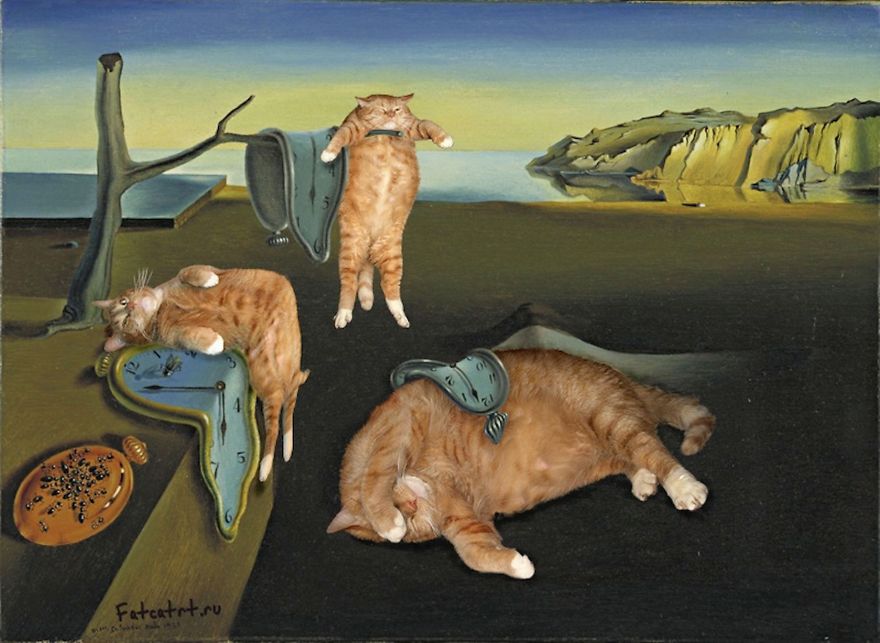
[The painting is “The Persistence of Meowmory,” by Salvador Dali and Svetlana Petrova.]

My Big, Fat Weight Loss Campaign: Part 5—Is That a Light at the End of the Tunnel? Or Is It That Damn Train Again?

My apologies to the artist. This was uncredited, but if anyone knows who the artist is–other than “hir”– I would like
to acknowledge them.

It has now been 15 weeks since the start of my “Big, Fat Weight-Loss Campaign.”

In 15 weeks, I have lost only two pounds. Despite taking Ozempic for six of those weeks. Despite exercising almost every day. Despite the physical therapy, personal trainer, and health club membership (which I am actually using this time). Despite being on Weight Watchers and sticking to it except for Friday dinners.

THIS is why I hate trying to lose weight. It feels like I have to claw it off, ounce by ounce. I only lose in tiny increments, and only if I work at it all the time. That’s why I gave up in the first place— losing weight feels like a full-time job with no salary or benefits. Or promotions. Or stock options. And definitely no holiday party.

I will stop whining now. I wrote a much longer whine, but realized no one would want to read it. Here is what I decided: Ozempic didn’t help and it gives me red, itchy rashes. So, Ozempic is not my knight in shining armor; I need to rescue myself. I stopped taking Ozempic two weeks ago. No change in weight.

But if I am honest about it, there have been significant changes:

  • I dropped a dress size. 
  • I can make it up the 32 steps to my front door without panting (much)
  • My balance is better
  • I don’t get as tired
  • I lost at least five inches around my waist 

I am at a loss to explain how all this could happen without losing any weight, but people keep telling me that muscle weighs more than fat. That’s fine, but I don’t think my surgeon is going to accept dress size as proof that I am ready for knee replacement surgery. And the sense of disappointment when I weigh myself weekly does drag me down.

I don’t see any remedy except to keep on keeping on. I will up my exercise regimen. I have had a glass of wine or two if I had enough WW points to spare at the end of the day. Maybe that is the problem? Can you eliminate all pleasure from your life and still want to live? I guess I’ll find out.

But before I get back to it, I am wrapping myself around a BLTA sandwich, some chips, and a lot of red wine.

My Big Fat Weight Loss Campaign: Part 1—How It Began

Image by Lazardo Art.

I gave up on losing weight a long time ago. I have all my life found the subject of my weight a huge embarrassment. I was not fat as a child, but I was plump, and bullies discovered early on that they could make me miserable by singing “Fatty Fatty Two-By-Four” on every occasion. My father harped on my weight all the time. He was thin as a blade without making any effort, and couldn’t understand why I wasn’t—clearly, it was some sort of character flaw in me. Extra weight always seemed to me like an embarrassing sin—but a sin that EVERYONE could SEE. It felt shameful.

In the past, I had lost significant amounts of weight. My methodology was to starve and run a few miles a day. I really had to dedicate a huge amount of awareness, energy, time, and brain power to make this happen. After a while, I just didn’t have the energy to put into this one more time—I kind of quit the whole idea that I would ever be a normal weight. It was too easy to gain, and way too hard to lose. I just wanted to enjoy life. Also, I had reached a point where running was uncomfortable—pregnancy and nursing had inflated my boobs to proportions that did not appreciate being violently bounced around.


I wasn’t always overweight. I was slender in my late teens and 20s. I started gaining weight after the birth of my first child in my 30s, and gradually kept on gaining. At my heaviest, I was over 300 pounds. Mind you, I am 5’10 inches tall, not a shortie, but still way, way too much weight.

It annoyed me seriously that my diet was pretty healthy while I gained all this weight. After about age 35, I ate very little sugar, never had sugary drinks or many sweets. I didn’t eat fast food or junk food. I avoided processed food and focused on whole foods, mostly prepared at home. I noticed that other people ate more than me—I often couldn’t finish portions that others did. I rarely took seconds. I didn’t eat between meals. I ate lots of vegetables, lean meats, and recently, began baking my own einkorn bread (I am allergic to modern wheat), which is lower in refined carbs and higher in protein and dietary fiber than modern wheat. You wouldn’t think I would gain a lot of weight this way—but I did. The difficulty of losing weight, despite a healthy diet, merely made me want to ignore the whole problem even more vigorously. What’s the point, if nothing works?

I began having knee problems. My form of exercise was walking. I went from four miles to two miles to one mile. During the pandemic, it was mostly no miles, as I disliked leaving the house for a while. In the meantime, severe arthritis ate away at my knee, and unbeknownst to myself, my shoulder. 

My body finally gave me an ultimatum. My right knee became increasingly painful. Then at Christmas last year (2023), I was strolling to the front door with a glass of wine in my hand, intending to lock the door, as it had gotten dark. As I approached the door, a jolt of agony surged up my leg from my right knee and I collapsed. Fortunately, I had the presence of mind to hurl my wine glass away from me as I fell, so I didn’t wind up being cut to shreds by glass shards. I landed hard, throwing my back into spasm.

My beautiful family rallied around. My son-in-law Mike cleaned up the glass and spilled wine. My husband Tom got me a muscle relaxer and pillows. My dear friend Meg and Tom sat with me for a half an hour until the medication kicked in and I was able to get off the floor. This was definitely a warning, and I fell again the next day—luckily for me on a carpeted floor, and I didn’t hurt myself this time. I began walking with a cane or hiking sticks, even around the house.

As it happened, I already had an appointment with an orthopedist for January 2. He looked at my X-rays and told me my knee was bone-on-bone. I needed knee replacement surgery. But I couldn’t have the surgery until I lost 50 pounds (at this point I was under 300 pounds, but 50 pounds is a lot to lose no matter how much you weigh). He also gave me a cortisone shot in the knee, which had amazing effects, enabling me to walk without a cane for the most part.

Later, after my shoulder also became agonizingly painful, I was informed I needed a complete reverse shoulder replacement. And I had to lose weight for that surgery as well.

So now I had no choice. I could no longer ignore the elephant in the room. I had to lose the weight. I also had to lose the shame I felt around the whole subject of weight—the shame that made me just ignore it. (I recognize the irrationality of my last statement. But this is how it was.) I was going to be dealing with a lot of people for quite some time about my accumulation of avoirdupois, and continuing to be embarrassed and ashamed just seemed stupid. I let shame get me to this space; I didn’t want shame to keep me here. 

At the same time, I had no idea how I could alter my already-healthy diet to trigger weight loss, and with a bum knee, how would I exercise? I knew if I didn’t exercise, I would never lose the weight by diet alone. Also, I needed to build up muscle to prepare for the surgery. How could I exercise? And what exercises should I be doing?

I didn’t have the faintest idea. I needed outside help. Next installment: getting help.

A word about body positivity: I am all for it. I did my best to feel positively about my body—beauty comes in all shapes, etc. Sadly, my body did not react positively to being so heavy. When you come right down to it, how you feel is more important than how you look.

Note: Since keeping track of weight loss is how success is measured in this arena, here’s the latest progress. You have no idea how excruciating it is for me to make this public:

2020: 315 lbs

2023: 285 lbs

As of 4/5/2024: 270 lbs

Note: I have no intention of posting “Before” or “After” photos here. Use your imagination.

Costa Rica, Days 9, 10, and 11

On Day 9, we said farewell to the Royal Corin Spa, where they treated us like royalty. We filled out a survey, and we did not rate everything 100%. The food, in particular, was hit-or-miss. To our surprise, they wanted to ask us in person what was not perfectly to our satisfaction. A first, and I was impressed. We rated everything else very highly.

We hired a car and driver to get to Tamarindo—far cheaper than renting a car alone here. Misa spoke very good English. We saw a couple of coatis near the road, begging, but otherwise, the wildlife kept pretty much out of sight. The scenery gradually changed from lush cloud forest to dry chaparral as we came down out of the mountains and got closer to the coast.

We discussed the party atmosphere of Tamarindo. Misa said it was crazy this time of year, and it is. He also called it “TamaGringo,” which is accurate.

The Tamarindo Bay Boutique Hotel is a nice place, but it cannot compete with the luxury of the Royal Corin. Our room is large, with a huge dressing room, a bathroom, and a small kitchen. Very clean and comfortable.

Tamarindo is HOT, which my lizard husband loves. Me, not so much, and there is a howling, burning wind to boot. An American who is staying here said that going to the beach is an excellent exfoliant.

I am hurting rather badly, not from any expected source, like my bone-on-bone knee. I seem to have torn my rotary cuff, and it is not getting better. I may have to see a doctor as the pain is intense.

I saw a squirrel here within the first few minutes of arrival. I didn’t photograph it because he was too qui k for me, it there’s what he looked like.

Costa Rican squirrel.

We managed to eat at a restaurant that was only blasting rock music, and didn’t feature fire eaters or live bands, Green Papaya. They serve only tacos. I had shrimp tacos, and they were lovely and fresh.

On Day 10, we ran around taking care of laundry, buying food for lunches, etc. We discovered that in Costa Rica, pharmacists can administer cortisone shots. Filled with hope, we went to the local pharmacy, but they didn’t have the right kind of cortisone, so I will have to see a doctor.

I am sorry to say I spent the rest of the day in bed. We had dinner at a restaurant called the Falafel Bar. We weren’t especially in the mood for Middle Eastern food, but it came highly recommended. It was truly excellent food. We chatted with the couple next to us—Americans, of course. Turns out the husband, John, has had just about all of his major joints replaced—truly the bionic man. He seems fit and active, so there is hope! (This is what old people talk about all the time. I now understand the fascination.)

Early to bed, No photos. Sorry.

Day 11 started with getting a doctor’s appointment for 11 am. I have rarely been more thrilled with getting a doctor’s appointment. The owner or manager here is Marie, and she has been very helpful.

It is still very hot and very windy.

Doctor Piloto was a nice man maybe a few years younger than us. He said he could not do a shoulder injection because he wasn’t an orthopedic doctor. The nearest orthopedist is in Liberia, a city some 46 km from here. But he did offer me some anti-inflammatories and steroid pills, yay. There was a pharmacist right door, so that was easily taken care of.

While we were waiting for a taxi, we chatted with another American couple who were waiting for the doctor. They plan to move here next year. He can work remotely and she is retired. They are looking to get away from the stress, politics, and racism of the US. They mentioned seeing a very large snake in the road that acted quite aggressively. I found a photo of the very scary terciopelo (fer-de-lance), which is one of the deadliest and most aggressive snakes in the world. They agreed it was the snake they saw. I am hoping not to see one.

We waited for about an hour for the taxi back to the hotel. The medic who manned the front desk of Dr. Piloto’s tiny office invited us to stay inside in the air conditioning, and called the taxi company several times. So very kind.

We returned to Tamarindo Bay Boutique Hotel and ate some things we had picked up at the local supermercado (but not until I eagerly downed Dr. Piloto’s prescriptions). Then for the second day in a row, I flopped down and had a siesta. I am not a napper, but I do not do well with either heat or pain, so I guess my body was trying to tell me something.

In the evening, we went to a nearby restaurant called La Oveja Surf House, which means “the sheep surf house,” which makes no sense at all. The food was delicious, and we took our leftovers back to the hotel for lunch the next day.

Sorry this post wasn’t more exciting. ☹️

Costa Rica, Day 8

The view from our room this morning. I keep trying to memorize the Spanish word for fog (niebla), but for some reason my brain absolutely refuses to retain this.

Today we visited a butterfly sanctuary, located in a tiny pueblo about 30 minutes from La Fortuna. It’s on the opposite side of the Arenal volcano from our hotel, which is also the side of the volcano that gets all the lava. It you wouldn’t know that at the sanctuary, which has never gotten lava flow (in historical times, anyway)

We were greeted by the owner of the sanctuary, a man who moved here from Texas 27 years ago. (We agreed that Texas was a good state to be FROM). He proceeded to go over the butterfly life cycle, and I patiently prepared to be bored (I nailed this in elementary school). But he pointed something out that caught my attention; he said the reason for the larval stage is because the tiny eggs just don’t have enough energy to produce a butterfly. The caterpillar stage is intended to store up enough energy for the ultimate transformation. I guess that’s obvious, but I had never viewed it in quite that light before. What an amazing adaptation.

He also told us that moths (which he insisted on calling “night butterflies”) came before butterflies, evolutionarily. I didn’t know that.

We walked down the rather steep but paved path into the sanctuary, first encountering the butterfly habitats. There were three large, domed cages, each providing a slightly different environment for the different butterflies. The first cage featured many owl-faced butterflies, like the one we saw on the sloth walk, each almost as large as my hand. The defensive side of their wings has a very scary brown owl face, and their attractant side is brilliantly colored.

A couple of owl-faced butterflies having a romantic moment.

Owl-faced butterflies feeding.

The next enclosure featured glass-winged butterflies. There weren’t a lot of them and they weren’t interested in sitting still for a photo. They are almost entirely invisible when they aren’t flying, and when they are flying, I can see they would be confusing to predators—they sort of flicker in the air like tiny ghosts.

Glass wing butterfly photo found on the Internet. We were not so lucky as to get a photo of these elusive little guys.

The final enclosure held many, many morphos—the national butterfly of Costa Rica, and surely one of the most beautiful of all butterflies. They are as big as my hand, and far from shy. Several landed on my hat for a brief rest, and I could hear their tiny feet scraping against the cloth. To our surprise, we also saw monarch butterflies. I didn’t get a photo of the morphos (the available specimens were bedraggled and clearly at the end of their short days), but I did get some of the others.

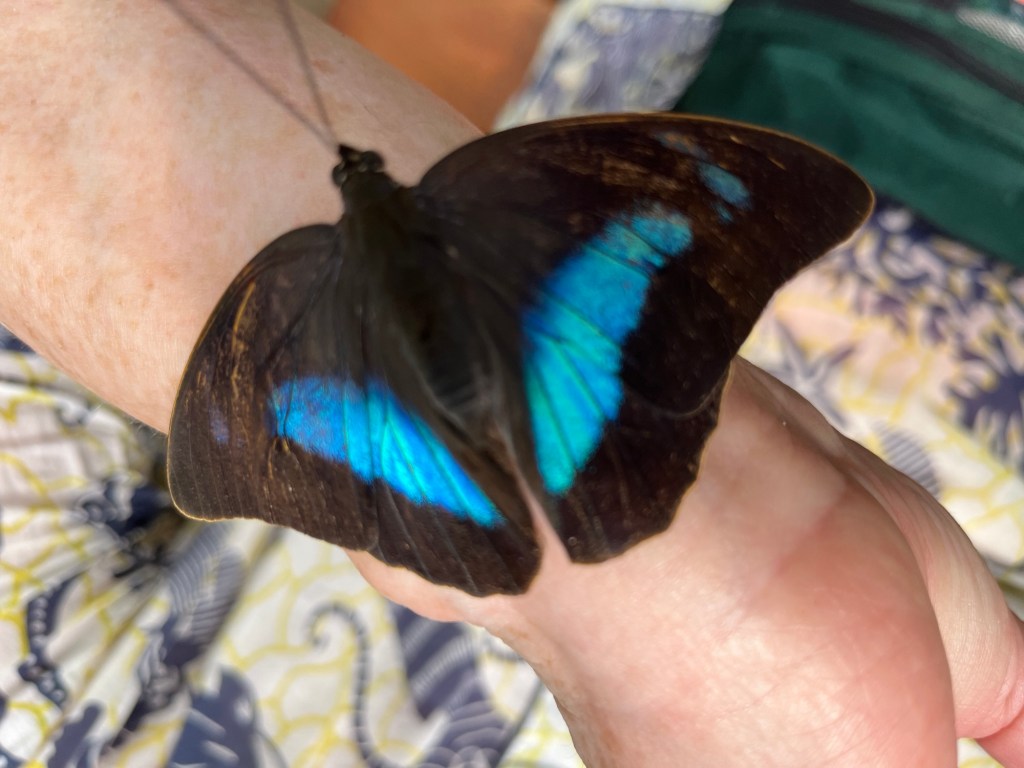
The prepona butterflies were quite friendly and sat on my hat and arms.
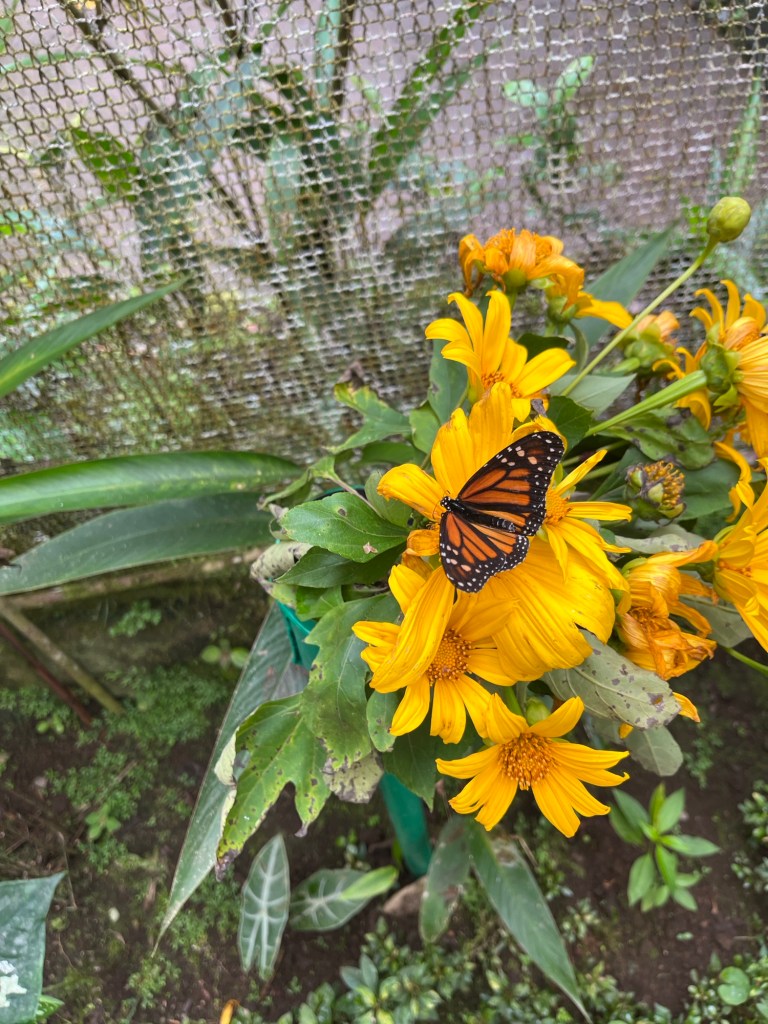
Monarch butterfly
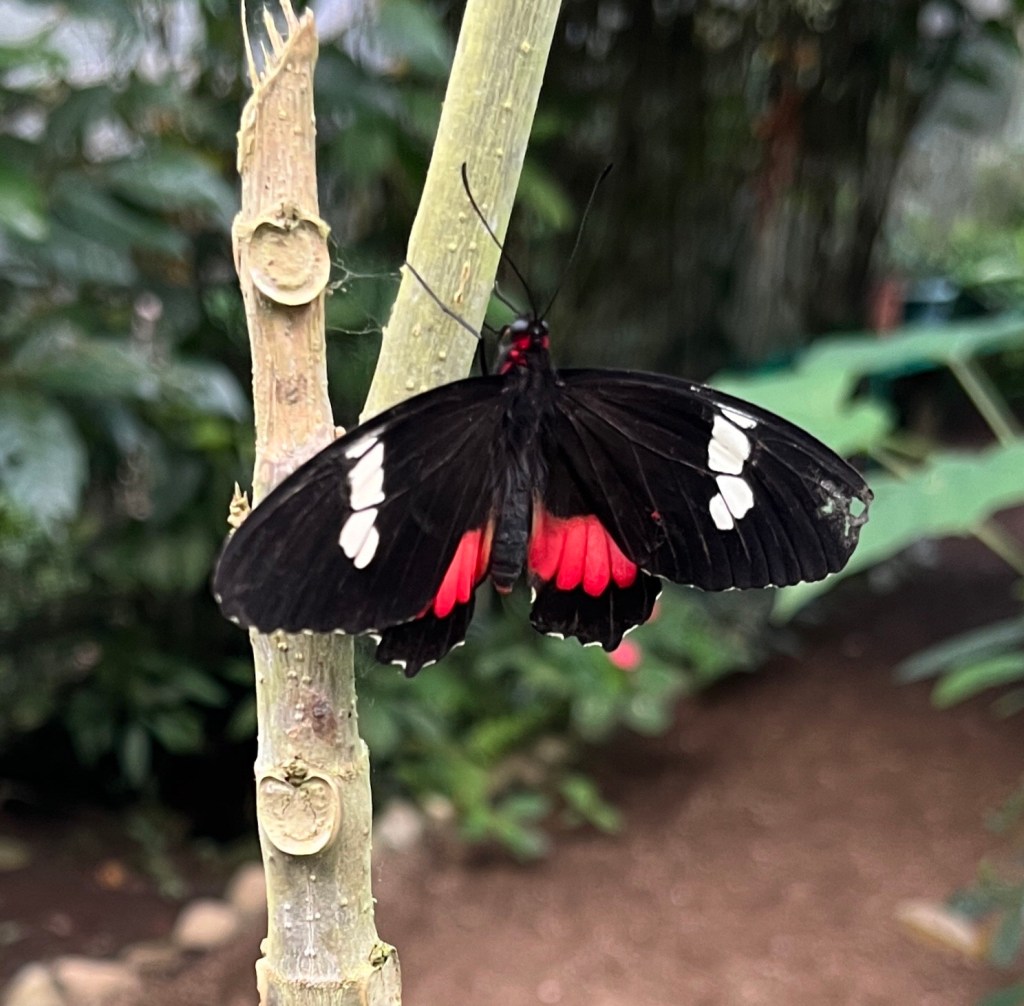
Paridies butterfly.

The next stop was the frog enclosure. The butterflies are free to mate and reproduce here, but the frogs are separated by gender. It has to do with laws restricting the breeding of frogs for the pet and zoo trade. It was broad daylight, and frogs being nocturnal, they were all tucked away out of sight. Fortunately, a docent arrived to open the cages and gently part the leaves to reveal the frogs. The first frog we saw was the national frog of Costa Rica, the red eyed frog. But her eyes were very small, sunken into her Kermit-colored face. The docent said she was asleep, but showed us another one, an apparent insomniac who was wide awake. Her eyes were popping out of her face and a brilliant red. Now I know how to tell if a frog is asleep or awake! There must be a Girl Scout badge for this.

Sleeping red-eyed frog.
Wide-awake red-eyed frog.

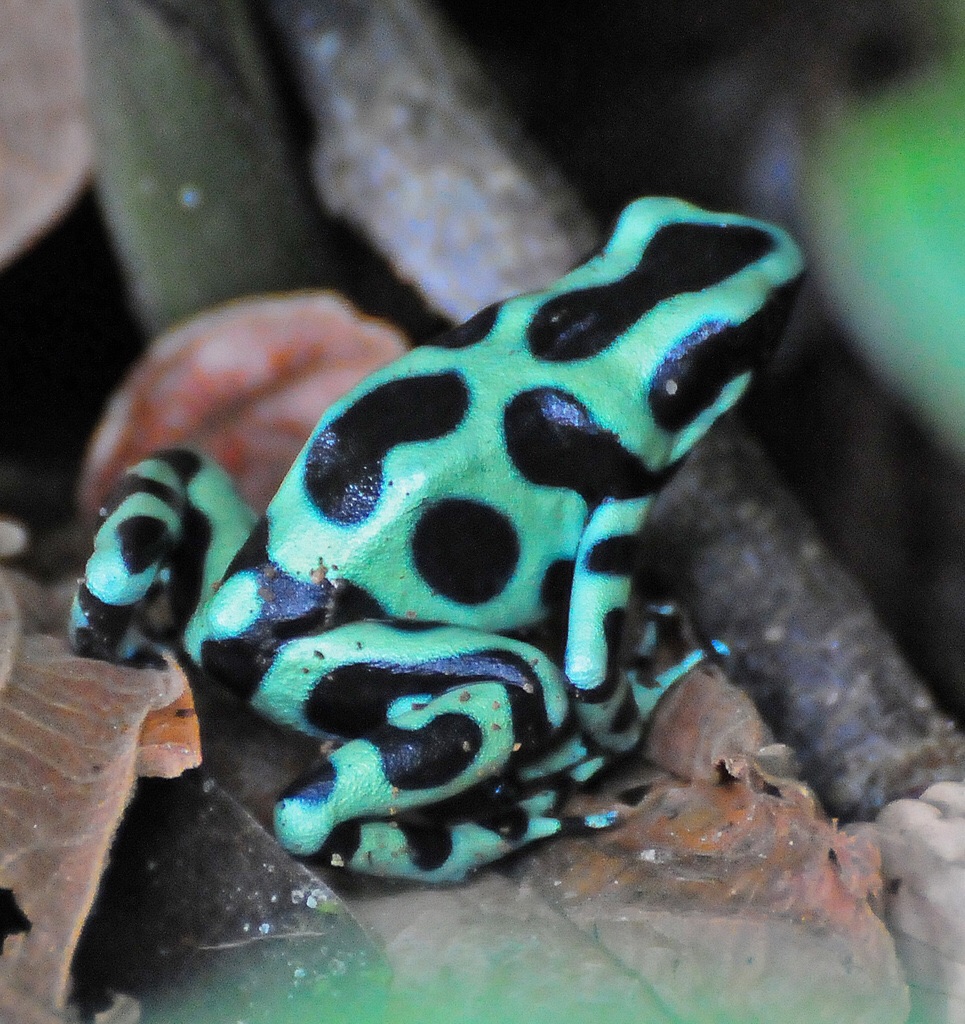
We encountered many other amphibians, including our old friend the blue jean poison dart frog,also called the strawberry poison dart frog. They also had another type of poison dart frog, which has the creative name of “green and black poison dart frog.” The photo below illustrates that this is far from being a misnomer.

The eponymous green and black poison dart frog.

Our docent mentioned that the indigenous peoples who used the poison from these frogs did not kill them—merely rubbed the darts over their backs because the toxin sits on the skin. No tocar los ranos.

This frog’s skin changes color in response to how much light is striking it. In direct sunlight, it changes to brown. At night, it turns bright green. This little guy was sitting in mottled sun and shade, resulting in nice camouflage.

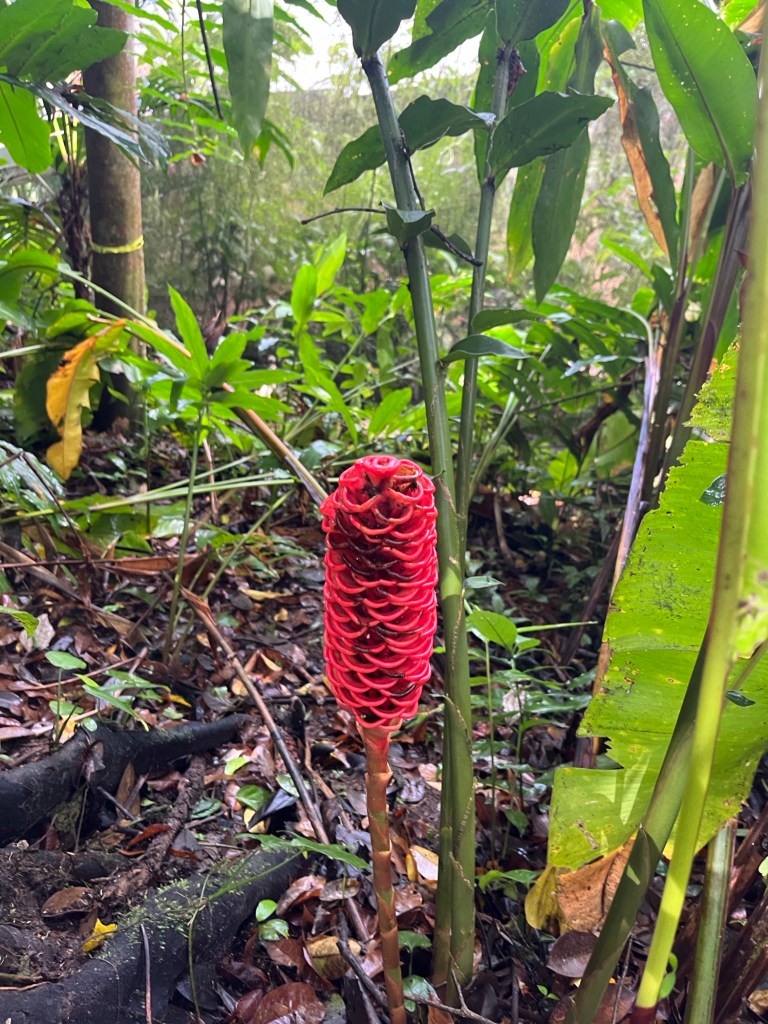
We also saw some rather exotic flowers in the sanctuary. The weirdest-looking ones tended to be some sort of ginger.

Yeah. Ginger.
I have no idea what this is.
This is Hairyensis Trumpiana. No, actually I have no idea.
I don’t remember the name of this frog, but at rest, it looks like a snake, which is enough for many animals to vacate the area.

On the way back to the hotel, we saw a coatimundi in the road, stopping traffic and begging for food. It’s the largest one I have ever seen—about the size of a medium-sized dog and four feet from tail to snout. He was a handsome character, too, but I took too long to get my phone out to take a photo, and he wandered off, disappointed. I wasn’t about to roll down the window or get out of the car.

Our coati friend looked a lot like this. They are related to raccoons, and are just as cute and clever and obnoxious as raccoons.

We leave this hotel tomorrow and have hired a car and driver to take us to Tamarindo. The lady at the front desk asked if we were going to party. So did everyone else. I have a sneaking suspicion that Tamarindo is a party town. Don’t know why.

Costa Rica: Day 1

Here it is! Exotic San Salvador International airport!

This was supposed to be the first day of our trip to Costa Rica. The plan was that we would drive to SFO, leave the car in long-term parking, and catch a Panamanian plane (COPA airlines) to Panama City, where we would catch a flight to San Jose, Costa Rica.

Sounds simple, doesn’t it? We all know what happens to plans. The FAA had just grounded all Boeing 737 Max airliners because the door flew off an Alaskan flight recently. So our connecting flight was canceled and the people at COPA could not provide an alternative flight, so they sent us to Avianca Air. The Avianca flight would not be until the next day, so COPA sent us to a Comfort Inn, promising dinner to boot.

The Comfort Inn did not ask us what we would like to eat. They presented us with Chinese takeout, consisting of slabs of chicken, some wilted greasy vegetables, two scoops of white rice and a scoop of—what else?—macaroni salad. This came with billious green cans of some sort of sugary soda. It was now around 7:30 pm and we didn’t have a car. We were tired. We accepted the Chinese food but asked for sparkling water instead of soda, which was provided. We didn’t eat very much.

The Avianca flight was 9 hours long, and it was cattle class because the plane didn’t have anything else. We waited an age at the airport for a shuttle to the Quality Hotel where we would be staying. I was convinced that by the time we got to the hotel, around 10 pm, there would be no food. But I was wrong, and had lobster for dinner. And a large margarita. The room at the hotel was several steps up from the Comfort Inn in every way. So what if we were supposed to be in an entirely different country?

This doesn’t begin to recount all the phone calls Tom had to make to various hotels and airlines, and other travel things to shuffle our schedule around.

We are now at the San Salvador International Airport, waiting for a flight that leaves at 9:50 pm, hopefully to San Jose, Costa Rica. We got here around 11:30 am because there was really nothing else to do with the time in the immediate area. We splurged for the Avianca VIP Lounge, which they charge extra for and it took about 20 minutes to arrange. There’s food, booze, bathrooms, Wi-Fi—all the comforts of home! Except that most of the food has raw vegetables in it (salad, sandwiches), and Frommer’s says this is a no-no in El Salvador. I took one tiny bite of salad before the alarms went off, so I hope my body can overcome any bad stuff I consumed. They had chicken soup, so I ate that instead.

My So-Called Writing Process

This is my writing process, right here.

I don’t usually write about my “writing process.” (In point of fact, I hardly ever write things for this blog, but I’m trying to change all that.)

I had someone ask me once if I lit a candle before writing, or had a favorite shirt or something that I wore only to write. As someone who used to get paid to sit in an office and write all day, I find that notion hysterical. I can see me now: sitting in an open workspace in a Cisco Systems building, surrounded by my co-workers, wearing my favorite schlumpfy nightgown and fuzzy slippers, surrounded by rose-scented candles as I feverishly pound the keyboard. If that is what it took to inspire me to write, I would never have had a writing job. At least, I never would have kept a writing job.

My writing process is basically sitting down and writing. However, I do have a process for researching before writing, and it is the most enjoyable part. Until recently, I don’t start out with a story in mind. I decide where I want the story to be and I go there. I let the location tell me the story.

You might say that is an elaborate and expensive process for a fantasy writer. Why not just make it up? 

There are a couple of reasons why not. First, I have placed most of my fantasy fiction in the real world (past or present). I have not (until my current WIP) made up an entire world and the way it works like Brian Sanderson, who is a master of world-building and magical systems. My first novel, “The Obsidian Mirror,” took place primarily in Northern California. This was convenient, as I have lived in Northern California for more than 40 years, so I didn’t have to do much location research. I did revisit a few locales to refresh my memory. I also researched Native American traditions and folklore, and also threw in Voudún and meso-American elements just because I find them interesting. 

This is a fantasy rendering of my villain in “The Obsidian Mirror, Necocyotl. He is not a nice god.

I didn’t have a storyline before I started writing “The Obsidian Mirror.” Actually, I didn’t set out to write a book. I have done that before and never gotten anywhere. This time, I started with the concept of fantasy based on New World traditions and mythologies, which I hadn’t seen much of at this point. The first draft clearly reflected that I had written it by the seat of my pants. (Authors call this “pantsing.” Some writers do it well. I learned that I do not.) I rewrote the entire book and discovered that creating a plot outline is just a swell idea. 

During the time I was writing “The Obsidian Mirror,” I also had a full-time writing job at Cisco Systems, and it was tough to write all day at work and come home and write for fun. I took a few “staycations” just to work on the novel. It took me seven years to write, but I did learn a lot about what to do/not to do when writing a novel, so it was hardly time wasted.

After ”The Obsidian Mirror” was published, I decided to locate the next novel in Hawai’i, using the same set of characters. Like a good researcher, I tried to make appointments with a few experts on Hawai’ian culture, but never received any replies to my emails. So I changed all my travel plans and went to Moloka’i. I had never been there, but I found ancient references to the island as “the island of sorcerers,” which sounded about right for my purposes. 

I have told this story elsewhere (https://wordpress.com/post/theobsidianmirror.net/381Z), but long story short, before going to Moloka’i, I had an encounter with Pele, goddess of fire, and she blessed my work. Everything from that point flowed like hot maple syrup, so easily, so effortlessly, that I really did not doubt that I had been blessed. I met with every person I had intended to meet, and they gave me information so generously that “Fire in the Ocean” practically wrote itself. (I know that sounds woo-woo, and my husband would be the first to agree with you. I am not normally a woo-woo person, but I stand firm on this point. We still don’t know everything about this world or this life.)

Pele, goddess of fire.

I did a lot of book research for “Fire in the Ocean.” I read as much as I could from older sources about the religion and culture of the ancient Hawai’ians, with an emphasis on Moloka’i. Each of the islands had their own, slightly different culture, and I wanted this novel to be firmly rooted in the traditions of Moloka’i. I also wrote a plot outline for “Fire in the Ocean.” This time, the novel took me about a year and a half to write—a big improvement!

For the third novel in the trilogy, “Lords of the Night,” I had some difficult choices to make that involved whether or not to kill off a particular character. And there were some characters that had been central to “The Obsidian Mirror” and somewhat less involved in “Fire in the Ocean” that I just didn’t want to deal with in a third novel—but I also didn’t want to kill them. They didn’t deserve that. (Yes, these characters became absolutely real to me during the process of writing about them.)

So for various reasons—including that I just wanted to do it—I set the third novel in the pre-Columbian Mayan empire of the Yucatán Peninsula. This meant that I got to go to the Yucatán and wander around ancient ruins, which was irresistible. The story began to come together for me in the ruins of Calakmul, a once-great city in the middle of dense jungle. Calakmul was a peak experience for me. It is so remote that few tourists make it that far. The trees growing throughout the ruins made the heat and humidity somewhat more bearable. I had all the time I needed to wander and think. Calakmul—or as it was originally known, Ox Té Tuun—generated one of the major characters in “Lords of the Night,” a teenaged Mayan girl who was a strong enough character that she nearly upstaged my original characters, Sierra and Chaco. Again, the story almost wrote itself once I had generated a plot outline. The novel took me about a year to write—getting better!

Again, I did an enormous amount of book research for “Lords of the Night.” I read one of the few Mayan codexes still in existence, the “Popol Vuh,” in addition to books and academic articles on Mayan religion, culture, crafts, religion, and folktales. 

This is a minor character in “Lords of the Night: a mosquito. It is rendered and colored from a Mayan painting. The Maya drew lovely little caricatures of animals, some, like this one, anthropormorphized.

Sadly, this is where I lost my publisher, which decided to publish only non-fiction going forward. My first two novels are still with them, but “Lords of the Night” is available only as a Kindle book. Talking to agents, editors, and publishers convinced me that no publisher was going to pick up the final book of a trilogy.

I wanted to move on from the characters and premises of the trilogy at this point. I decided the next book would be set in Iceland. I originally had some vague ideas about setting it in modern Iceland and making it a paranormal mystery, but that is not the story that Iceland told me. I went to Iceland and visited many areas associated with the supernatural and magic. In the Settlement days of Iceland a thousand years ago, magic was accepted as normal and necessary, and magicians served an accepted purpose. Even after Christianity came to the island, Christian priests were sometimes known to be magicians without any stigma attached. 

I was standing deep underground in a massive lava tube in western Iceland when the story came to me almost full-blown. From that point on, everything I did was aimed at filling out the characters and plot. The people I talked to in Iceland were generous with their time and information—and again, I did the book research and even learned how to read Icelandic runes. (I’m out of practice now, so don’t ask for a reading.) It took me nine months to write “The Spell Book of Thorfinn Bare-Butt.” It isn’t on Amazon because I have been looking for an agent. 

The lava tube where the story for “The Spell Book of Thorfinn Bare-Butt” came to me.
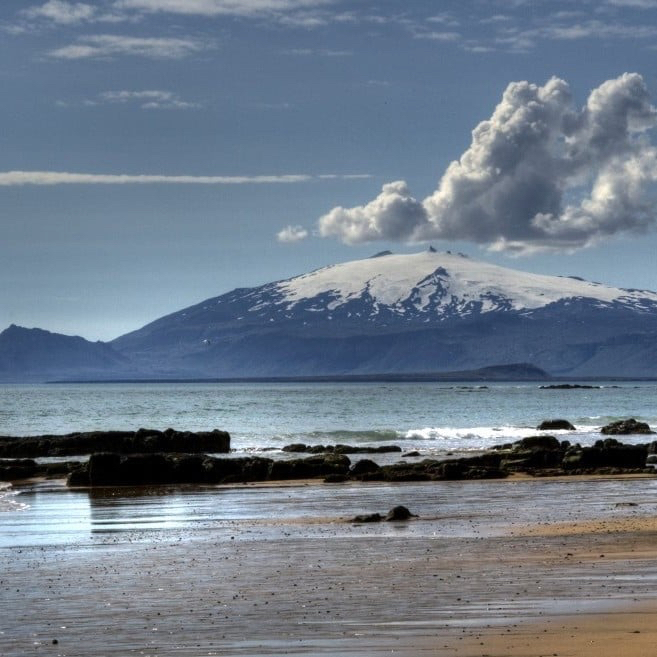
Iceland is a wild and beautiful place.

If there is a Hades, he makes deceased writers eternally look for an agent in Hell. It’s like Sisyphus rolling the boulder uphill, or Tantalus, who can never reach the water or fruit to quench his thirst and hunger. I have contacted seventy-two agents so far without more than a “thanks but no thanks,” if that. I will keep trying for a while, but it was easier by far to find two publishers than it has been to find an agent. 

In the meantime, I am trying my hand at a middle-grade fantasy. This is my first stab at world-building, and also my first serious attempt at writing for young people. My process? There is no location or culture to research, because they are entirely fictional and created by my own imagination. So my process is that I wrote a plot outline and now I sit at the computer and write. Works for me.