I am skipping Day Two, as we spent the entire day in the Avianca VIP lounge at San Salvadore International Airport. We caught a connecting flight to San Jose, Costa Rica, about 10:50 pm and staggered into our hotel room in San Jose after midnight.
Cost Rica Day Three
A rental car was supposed to arrive at our hotel this morning, but it didn’t. We were planning to drive to La Fortuna today. It was unclear what is going to happen at this point. We asked the front desk for help and were soon on the road with a taxi. The driver, Enrique, was a wealth of the obvious as we moved through the suburban, then pastoral countryside. He explained to us that Jersey cows give the best milk. He explained that sugar was made from sugar cane. He explained that farmers had to go to town to buy things they need. And so forth, but all very pleasant. The 45-mile trip cost about $8, which was kind of astonishing. Costa Rica is not a cheap visit, by and large.
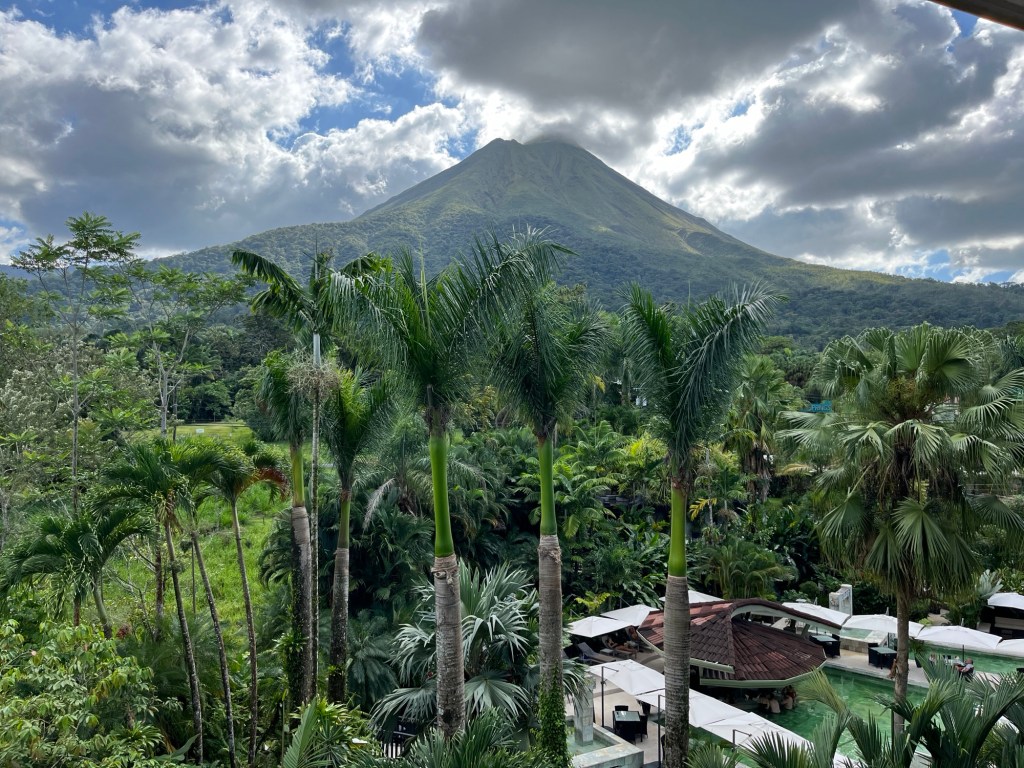
Our hotel in La Fortuna, the Royal Corin, is situated at the base of Volcàn Arénal, a perfectly conical volcano that towers over the surrounding forest. The hotel has many thermal hot pools, fed by the volcano, with or without Jacuzzi, two warm pools, one with a pool bar, and one cool water pool. I doubt that it is cold, but I haven’t ventured into it yet. The grounds are beautifully landscaped, and the room looks out directly over the grounds at the impressive volcano. It’s the kind of volcano that is prone to pyroclastic explosions, like Mt. St. Helens, but apparently has never done so. I would not like to be here if it ever does.
The view of Arenal from our room.
We tried out the hot pools, then went to dinner, which was excellent. We both had salmon, perfectly prepared. Tom had some sort of chocolate amazement for dessert, which I had a delicious spoonful of. Then we watched a couple of favorite shows on Tom’s laptop and went to bed.
I really need to mention an amazing device my chiropractor sold me. If you’ve ever been to a chiropractor, you may have experienced electrical stimulation of your muscles to loosen things up before the chiropractor gets to work. My chiro recommended a mini muscle stimulator in a neat little lightweight kit. It operates on an 8V battery and has four electrodes.
I might not have survived the ordeal getting here without this device. I have severe arthritis in my spine, and sitting for hours on end doesn’t help this at all, especially since my back went into spasm only a few days before our departure. My back HURT. I used the device whenever possible. Once I attached the electrodes while in the women’s bathroom at the San Salvador airport, and sat in the lounge for an hour with no one the wiser, treating myself. The pain relief is astounding—it worked so well that I almost didn’t need any of the Vicodin that I brought with me.
By the time we reached La Fortuna, my back was feeling good, but my rotator cuff and deltoid attachment in my left arm were really pissed off by all the luggage wrangling, so I put the device on my shoulder and upper arm. Blessed relief! All for only $75. Totally, totally worth it, especially if you consider what opioids can do to you.
This is a Tens 7000 from Compass Health. It is my new best friend.
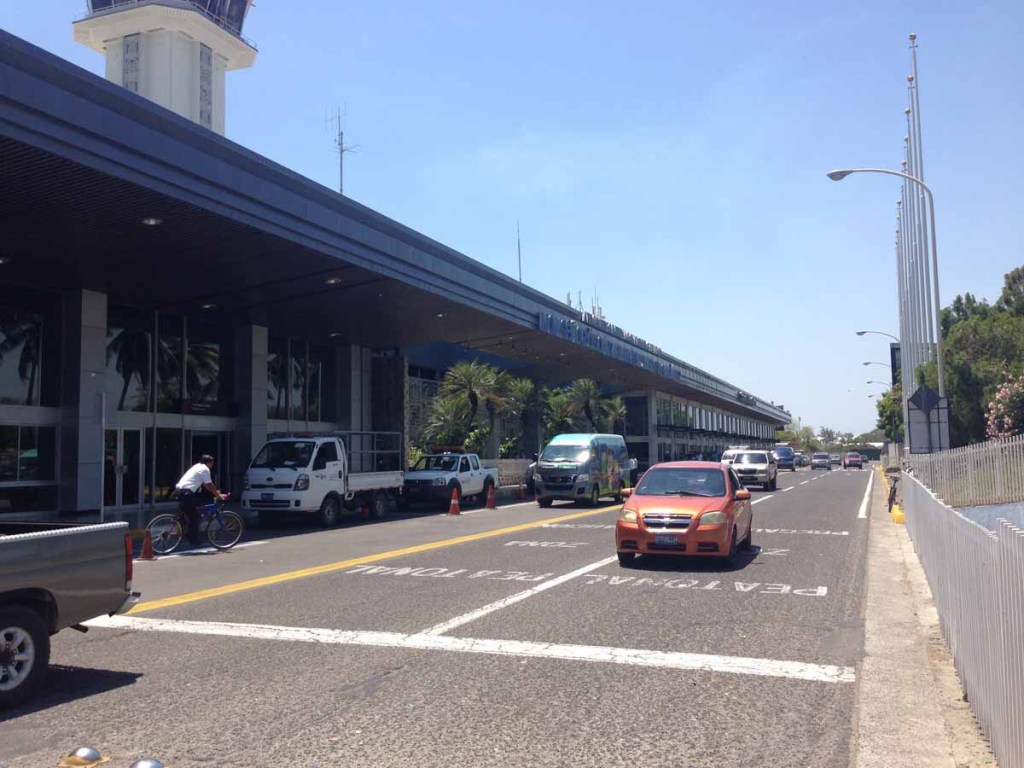
Here it is! Exotic San Salvador International airport!
This was supposed to be the first day of our trip to Costa Rica. The plan was that we would drive to SFO, leave the car in long-term parking, and catch a Panamanian plane (COPA airlines) to Panama City, where we would catch a flight to San Jose, Costa Rica.
Sounds simple, doesn’t it? We all know what happens to plans. The FAA had just grounded all Boeing 737 Max airliners because the door flew off an Alaskan flight recently. So our connecting flight was canceled and the people at COPA could not provide an alternative flight, so they sent us to Avianca Air. The Avianca flight would not be until the next day, so COPA sent us to a Comfort Inn, promising dinner to boot.
The Comfort Inn did not ask us what we would like to eat. They presented us with Chinese takeout, consisting of slabs of chicken, some wilted greasy vegetables, two scoops of white rice and a scoop of—what else?—macaroni salad. This came with billious green cans of some sort of sugary soda. It was now around 7:30 pm and we didn’t have a car. We were tired. We accepted the Chinese food but asked for sparkling water instead of soda, which was provided. We didn’t eat very much.
The Avianca flight was 9 hours long, and it was cattle class because the plane didn’t have anything else. We waited an age at the airport for a shuttle to the Quality Hotel where we would be staying. I was convinced that by the time we got to the hotel, around 10 pm, there would be no food. But I was wrong, and had lobster for dinner. And a large margarita. The room at the hotel was several steps up from the Comfort Inn in every way. So what if we were supposed to be in an entirely different country?
This doesn’t begin to recount all the phone calls Tom had to make to various hotels and airlines, and other travel things to shuffle our schedule around.
We are now at the San Salvador International Airport, waiting for a flight that leaves at 9:50 pm, hopefully to San Jose, Costa Rica. We got here around 11:30 am because there was really nothing else to do with the time in the immediate area. We splurged for the Avianca VIP Lounge, which they charge extra for and it took about 20 minutes to arrange. There’s food, booze, bathrooms, Wi-Fi—all the comforts of home! Except that most of the food has raw vegetables in it (salad, sandwiches), and Frommer’s says this is a no-no in El Salvador. I took one tiny bite of salad before the alarms went off, so I hope my body can overcome any bad stuff I consumed. They had chicken soup, so I ate that instead.
Jessamyn, my nine-year-old granddaughter, handed me a book she had written and illustrated. It was all of 7 pages long and classically bound in staples. I read it and offered praise for her creativity and humor.
Jessamyn looked up at me with enormous brown eyes and an expression of perfect faith.
“Can you find me a publisher, Nana?” she asked.
She knows I have published novels and she was sure that I could find her a publisher with my vast literary connections. It is hard for me to describe what I was feeling at this point. Touched by her belief that I have vast connections in the publishing world (I do not). Also thrilled that she wants to write books and be a published author, like her Nana. And a protective feeling spurred by the innocence of her request.
After a moment of consideration, I told Jessamyn that I could not find a publisher for her book, but I could put it on my blog. Lots of people would see it. Would that be satisfactory?
It was. Presenting the debut novel of Jessamyn Gil, “The First Unicorn.”
I don’t usually write about my “writing process.” (In point of fact, I hardly ever write things for this blog, but I’m trying to change all that.)
I had someone ask me once if I lit a candle before writing, or had a favorite shirt or something that I wore only to write. As someone who used to get paid to sit in an office and write all day, I find that notion hysterical. I can see me now: sitting in an open workspace in a Cisco Systems building, surrounded by my co-workers, wearing my favorite schlumpfy nightgown and fuzzy slippers, surrounded by rose-scented candles as I feverishly pound the keyboard. If that is what it took to inspire me to write, I would never have had a writing job. At least, I never would have kept a writing job.
My writing process is basically sitting down and writing. However, I do have a process for researching before writing, and it is the most enjoyable part. Until recently, I don’t start out with a story in mind. I decide where I want the story to be and I go there. I let the location tell me the story.
You might say that is an elaborate and expensive process for a fantasy writer. Why not just make it up?
There are a couple of reasons why not. First, I have placed most of my fantasy fiction in the real world (past or present). I have not (until my current WIP) made up an entire world and the way it works like Brian Sanderson, who is a master of world-building and magical systems. My first novel, “The Obsidian Mirror,” took place primarily in Northern California. This was convenient, as I have lived in Northern California for more than 40 years, so I didn’t have to do much location research. I did revisit a few locales to refresh my memory. I also researched Native American traditions and folklore, and also threw in Voudún and meso-American elements just because I find them interesting.
This is a fantasy rendering of my villain in “The Obsidian Mirror, Necocyotl. He is not a nice god.
I didn’t have a storyline before I started writing “The Obsidian Mirror.” Actually, I didn’t set out to write a book. I have done that before and never gotten anywhere. This time, I started with the concept of fantasy based on New World traditions and mythologies, which I hadn’t seen much of at this point. The first draft clearly reflected that I had written it by the seat of my pants. (Authors call this “pantsing.” Some writers do it well. I learned that I do not.) I rewrote the entire book and discovered that creating a plot outline is just a swell idea.
During the time I was writing “The Obsidian Mirror,” I also had a full-time writing job at Cisco Systems, and it was tough to write all day at work and come home and write for fun. I took a few “staycations” just to work on the novel. It took me seven years to write, but I did learn a lot about what to do/not to do when writing a novel, so it was hardly time wasted.
After ”The Obsidian Mirror” was published, I decided to locate the next novel in Hawai’i, using the same set of characters. Like a good researcher, I tried to make appointments with a few experts on Hawai’ian culture, but never received any replies to my emails. So I changed all my travel plans and went to Moloka’i. I had never been there, but I found ancient references to the island as “the island of sorcerers,” which sounded about right for my purposes.
I have told this story elsewhere (https://wordpress.com/post/theobsidianmirror.net/381Z), but long story short, before going to Moloka’i, I had an encounter with Pele, goddess of fire, and she blessed my work. Everything from that point flowed like hot maple syrup, so easily, so effortlessly, that I really did not doubt that I had been blessed. I met with every person I had intended to meet, and they gave me information so generously that “Fire in the Ocean” practically wrote itself. (I know that sounds woo-woo, and my husband would be the first to agree with you. I am not normally a woo-woo person, but I stand firm on this point. We still don’t know everything about this world or this life.)
Pele, goddess of fire.
I did a lot of book research for “Fire in the Ocean.” I read as much as I could from older sources about the religion and culture of the ancient Hawai’ians, with an emphasis on Moloka’i. Each of the islands had their own, slightly different culture, and I wanted this novel to be firmly rooted in the traditions of Moloka’i. I also wrote a plot outline for “Fire in the Ocean.” This time, the novel took me about a year and a half to write—a big improvement!
For the third novel in the trilogy, “Lords of the Night,” I had some difficult choices to make that involved whether or not to kill off a particular character. And there were some characters that had been central to “The Obsidian Mirror” and somewhat less involved in “Fire in the Ocean” that I just didn’t want to deal with in a third novel—but I also didn’t want to kill them. They didn’t deserve that. (Yes, these characters became absolutely real to me during the process of writing about them.)
So for various reasons—including that I just wanted to do it—I set the third novel in the pre-Columbian Mayan empire of the Yucatán Peninsula. This meant that I got to go to the Yucatán and wander around ancient ruins, which was irresistible. The story began to come together for me in the ruins of Calakmul, a once-great city in the middle of dense jungle. Calakmul was a peak experience for me. It is so remote that few tourists make it that far. The trees growing throughout the ruins made the heat and humidity somewhat more bearable. I had all the time I needed to wander and think. Calakmul—or as it was originally known, Ox Té Tuun—generated one of the major characters in “Lords of the Night,” a teenaged Mayan girl who was a strong enough character that she nearly upstaged my original characters, Sierra and Chaco. Again, the story almost wrote itself once I had generated a plot outline. The novel took me about a year to write—getting better!
Again, I did an enormous amount of book research for “Lords of the Night.” I read one of the few Mayan codexes still in existence, the “Popol Vuh,” in addition to books and academic articles on Mayan religion, culture, crafts, religion, and folktales.
This is a minor character in “Lords of the Night: a mosquito. It is rendered and colored from a Mayan painting. The Maya drew lovely little caricatures of animals, some, like this one, anthropormorphized.
Sadly, this is where I lost my publisher, which decided to publish only non-fiction going forward. My first two novels are still with them, but “Lords of the Night” is available only as a Kindle book. Talking to agents, editors, and publishers convinced me that no publisher was going to pick up the final book of a trilogy.
I wanted to move on from the characters and premises of the trilogy at this point. I decided the next book would be set in Iceland. I originally had some vague ideas about setting it in modern Iceland and making it a paranormal mystery, but that is not the story that Iceland told me. I went to Iceland and visited many areas associated with the supernatural and magic. In the Settlement days of Iceland a thousand years ago, magic was accepted as normal and necessary, and magicians served an accepted purpose. Even after Christianity came to the island, Christian priests were sometimes known to be magicians without any stigma attached.
I was standing deep underground in a massive lava tube in western Iceland when the story came to me almost full-blown. From that point on, everything I did was aimed at filling out the characters and plot. The people I talked to in Iceland were generous with their time and information—and again, I did the book research and even learned how to read Icelandic runes. (I’m out of practice now, so don’t ask for a reading.) It took me nine months to write “The Spell Book of Thorfinn Bare-Butt.” It isn’t on Amazon because I have been looking for an agent.
The lava tube where the story for “The Spell Book of Thorfinn Bare-Butt” came to me.Iceland is a wild and beautiful place.
If there is a Hades, he makes deceased writers eternally look for an agent in Hell. It’s like Sisyphus rolling the boulder uphill, or Tantalus, who can never reach the water or fruit to quench his thirst and hunger. I have contacted seventy-two agents so far without more than a “thanks but no thanks,” if that. I will keep trying for a while, but it was easier by far to find two publishers than it has been to find an agent.
In the meantime, I am trying my hand at a middle-grade fantasy. This is my first stab at world-building, and also my first serious attempt at writing for young people. My process? There is no location or culture to research, because they are entirely fictional and created by my own imagination. So my process is that I wrote a plot outline and now I sit at the computer and write. Works for me.
I am condensing these days because Covid aftereffects have slowed us down so much—me, in particular—that we didn’t do much.
On Day 23, Tom and I visited the Hofburg Palace, the imperial residence of the Habsburgs. I have said that once you’ve seen one palace, you’ve seen them all, and this is true of the Hofburg as well. It is actually a massive complex of palace buildings, but we only chose to see the Imperial Residences, which includes the silver and china collection, the Sissi Museum, and the residence of Sissi and Franz Joseph, the last rulers of the 600+ year reign of the Hapsburgs.
We entered the silver and china collection because someone directed us there, but not because we wanted to see it. It was rather like the funhouse of mirrors. We went around and around the exhibit, which was an endless collection of plates, candelabras, épèrgnes, bowls, basins, tableware, flasks, vases, etc., etc., including a monstrous gold centerpiece used for state dinners that must have been made in multiple pieces, as it went on forever. They don’t let you near that one, but you can see it through windows. We could not find our way out for the longest time, but finally emerged and entered the Sissi Museum.
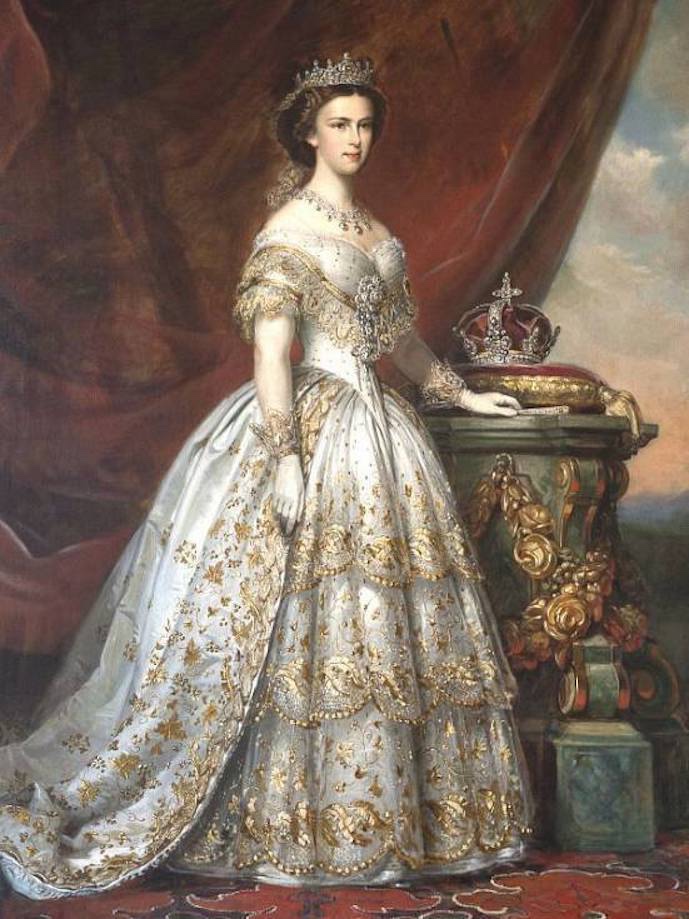
Sissi was the Empress Elisabeth, known as Sissi all her life. She married her first cousin Emperor Franz Joseph when she was 16. She reminded me of Princess Diana. She was raised in a carefree atmosphere in Bavaria, but the Habsburg court was rigidly bound with traditions and rules that she found constraining in the extreme. The marriage was happy at first, and Franz Joseph seemed to adore her without ceasing, but after the birth of their last child, Sissi began spending all her time away from court. Under the excuse of ill health (some of which was caused by her poor diet and beauty regimen), she traveled widely, returning only rarely to Vienna.
Sissi and her 20-inch waist.
The couple’s only son and heir, Crown Prince Rudolf, committed murder-suicide with his 17-year-old mistress, Baroness Mary von Vetsera. This is referred to as the Meyerling incident as it took place at his hunting lodge in Meyerling. Apparently Rudolf shot the poor child, then sat there for several hours before offing himself.
The worst part of this was that Mary wasn’t even his first choice for this grisly double suicide. Rudolf had first asked a courtesan, who had the good sense to to turn him down. Mary, whom he had seduced and who was, at 17, emotionally vulnerable, agreed. Rudolf had syphillis, which he generously shared with his wife, Princess Stephanie, who became sterile. No doubt that explains in part his choices in life and in death. Poor Mary was disinterred several times over the years by people trying to prove various theories of what “actually” happened.
After this scandal, Sissi wore black for the rest of her life. She wrote a great deal of self-pitying poetry about how she longed for the sea, or wanted to escape on the wings of a seagull, and no one ever born could understand her. The original drama queen.
However, no one deserved to die as Sissi did. She was assassinated by an Italian anarchist in Geneva. She wasn’t even his first choice; he was in Geneva to kill the Duke of Orlėans.
As far as I could tell, Sissi spent most of her time on herself: her ankle-length hair took two to three hours to arrange and an entire day to wash. She starved and exercised to maintain her 20-inch waist and developed a horror of fat women which she passed on to her daughter, who was terrified when she met Queen Victoria—a royal not known for her wasp-waist. Sissy’s obsession with remaining a great beauty is reminiscent of some modern women I could think of. She refused to have photographs or portraits taken after the age of 30.
On the plus side, she defied the court and her in-laws in many—most—ways, maintaining her independence and doing things her way. A narcissistic woman, but strong and independent.
Emperor Franz Joseph as a young man. He was saved from an assassination attempt by that high, thick, tough collar. He wore military regalia at all times unless alone with the family.
Franz Joseph, in contrast, was a hard-working and dutiful monarch who tried very hard to be the epitome of a good king. He was under the impression that he was abstemious, eschewing all luxury by, for instance, sleeping in a plain, iron bed. This, of course, was nonsense, as anyone touring his private apartments could see. I think he was well-meaning, though.
Anyway, when Franz Joseph died, that was the end of the Habsburg empire. Not entirely the end of the Habsburgs, though. They spread their DNA throughout Europe through intermarriage with other royal families. Queen Elizabeth II, for example, is a descendent of this vast royal family.
Once we got through this museum, Tom and I were wiped out. I had hoped to see the Imperial Treasury, but we just couldn’t do it. We stopped for lunch at the first outdoor cafe we came to, and it was absolutely delicious. Then we headed back to the Daniel Hotel for a five-hour nap, dinner, and then slept for 10.5 hours. This post-Covid thing is not to be taken lightly.
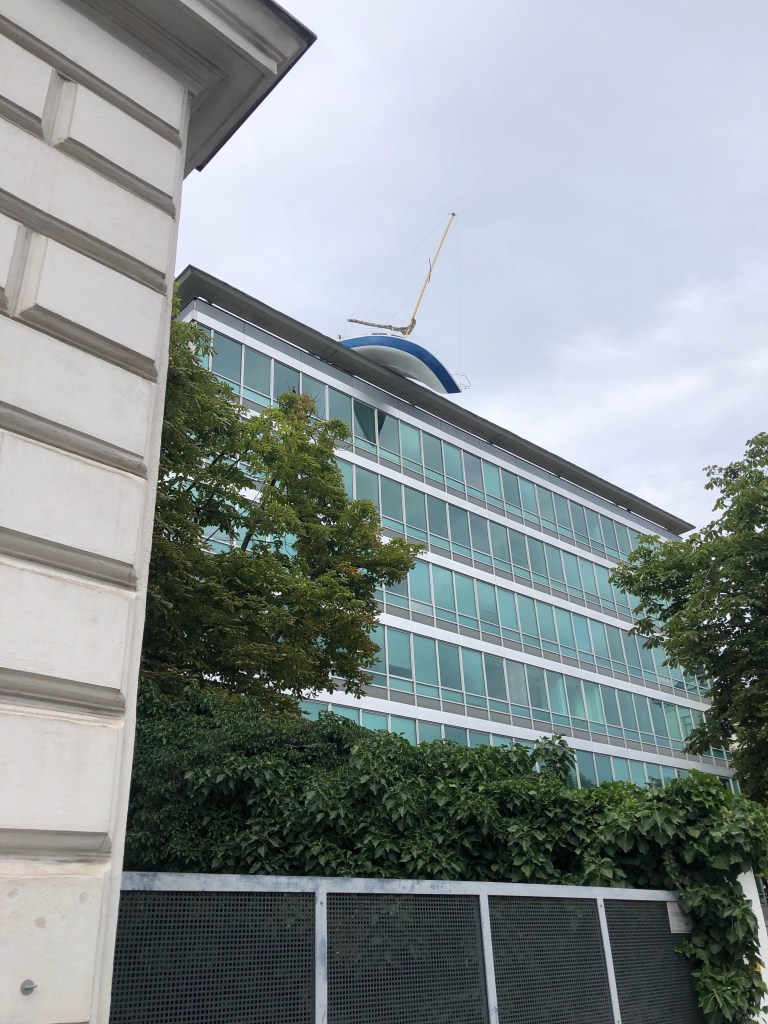
A better view of the sailboat sculpture that sits mysteriously atop the Hotel Daniel, keeping the urban bees company.
On Day 24, we walked to the botanical garden next door, where we couldn’t read the signs, then had water and ice cream at the Belvedere Palace cafe. Then back to the Daniel for more napping. I feel I missed most of Vienna, thanks to the aftermath of Covid, but we have learned not to push it. We checked out and flew to Amsterdam, where we will depart for home.
We are staying at the Linden Hotel. We checked in very late, around 11:30 pm. Exhausted, we fell into bed. I thought we would instantly be asleep, but the noise was ridiculous. We could hear every person who walked by, talking. Dogs barked, motorcycles roared, trunks rumbled by, and people kept it up until well after midnight. It sounded like they were all in our room. We finally fell asleep after all the late-night revealers went home. In the (late) morning when we got up, we discovered that all the windows in our pie-shaped corner room were wide open. We had been too exhausted to notice. We are hoping to have a better sleep our second night. It is a Sunday, too, so there should be fewer partiers out there.
On Day 25, we walked to an outdoor cafe for breakfast, then went to an apothecary to get some meds for Tom, who is still coughing. Then back to the hotel for more napping.
Tom in a little street near our hotel in Amsterdam.
I think this concludes my recording of our journey. We are too exhausted to do much, and tomorrow, we fly home. I can hardly wait. My advice to anyone recovering from Covid is not to push yourself as we did at first, thinking it was just like a five-day cold. Rest. Rest. And more rest. This stuff is serious, and I am hoping I don’t experience this deep fatigue for too long. It is truly debilitating.
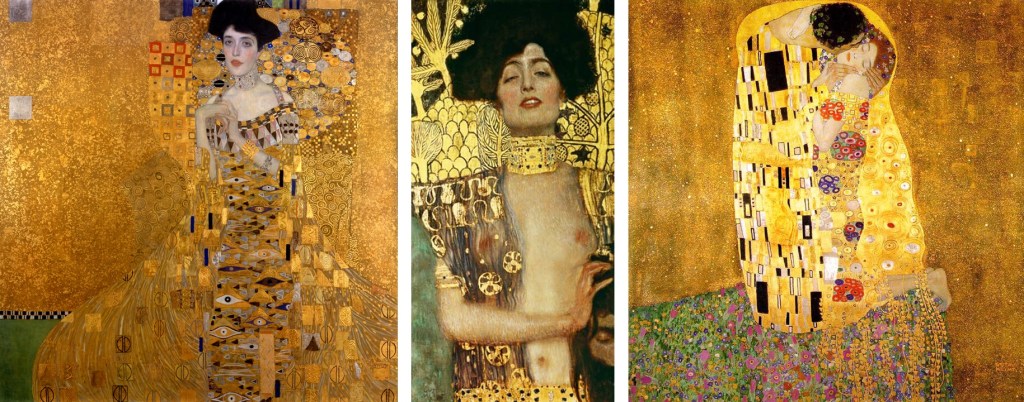
We visited the Belvedere Palace today, which is just around the corner from our hotel. The highlight of the visit was the large collection of Klimt paintings, including the ultra-famous “The Kiss.” The museum also has an extensive collection of Austrian and German paintings by lesser-known painters. I found the paintings by women especially good, as they seemed to capture the individuality and personality of their subjects so well.
A few Klimt paintings: left to right “Woman in Gold,” “ “Judith,” and “The Kiss.” I find “Judith” fascinating. Her face is not the face of a woman who has just decapitated her enemy (Holofernes’ head appears as something of an afterthought at the lower right). She looks like a woman who just had the best orgasm of her life.
While the Belvedere is just a minor palace compared to the Schönbrunn or the Hofburg, it is nonetheless a palace, with all the marble, gold accents, sweeping vistas, statues, fountains, etc. that one could wish. I find it quietly satisfying that where once these were the exclusive previews of the aristocratic uber-wealthy, they are now visited by the People, who gain experience, knowledge, and pleasure from these former haunts of the rich. I look forward to the day when we can tour the gaudy, overblown mansions of the likes of Dr. Oz, Joel Osteen, and other multi-billionaires. I shall take pleasure in dribbling melted ice cream on their marble terraces.
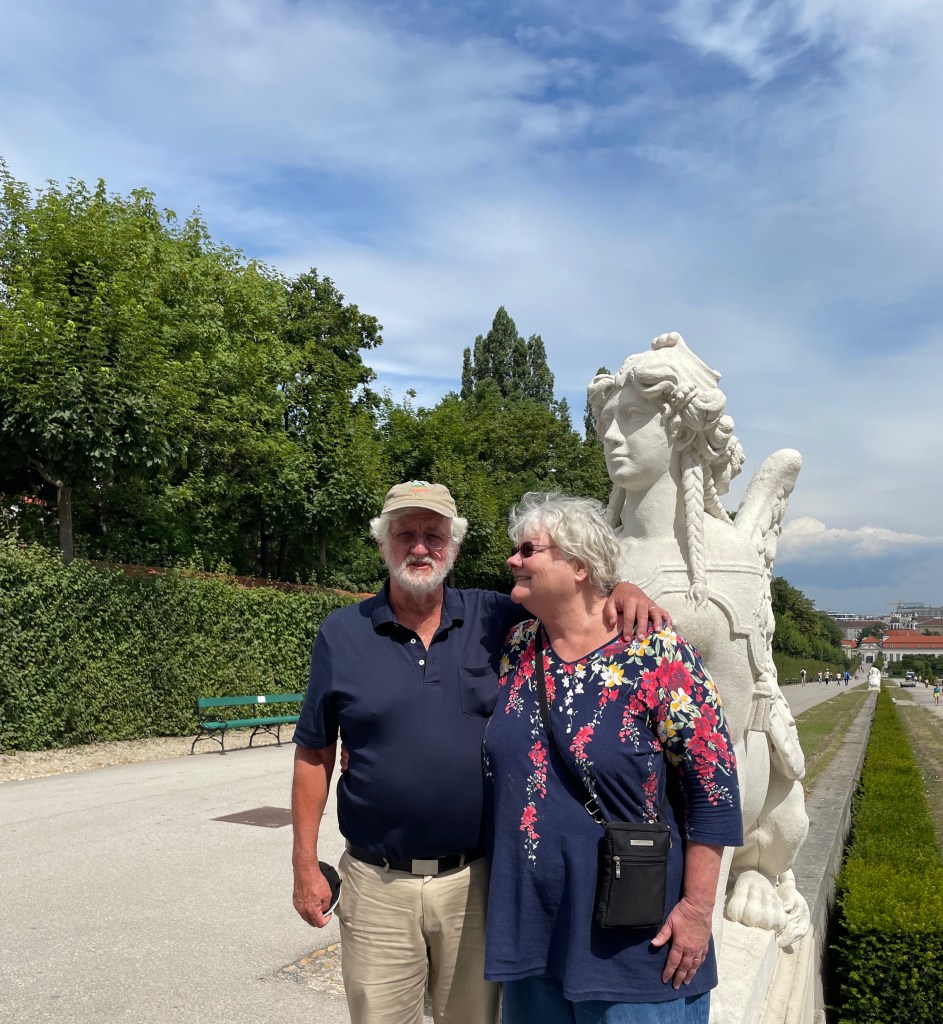
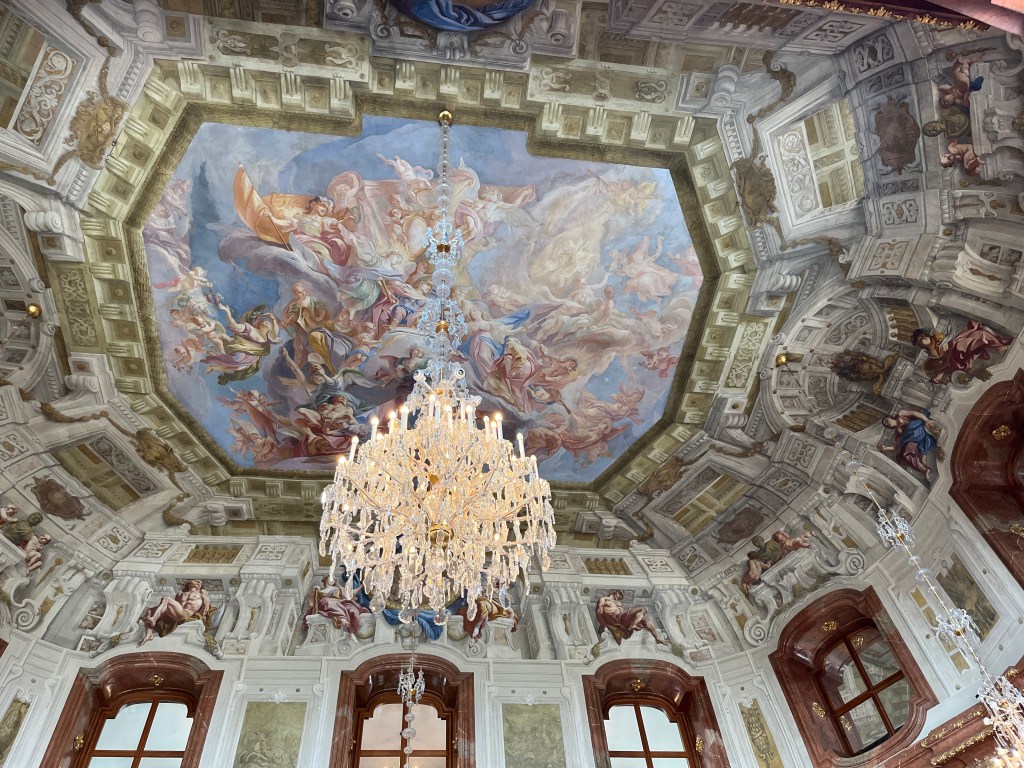
Tom, me, and a sphinx.The Belvedere Palace.Ceiling, the Belvedere.Belvedere Palace gardens—some of them, anyway.
We ate outside in the museum cafe. The food was delicious. There were some yellowjacket-type waspy things that thought so, too. They haven’t anywhere near the mean aggression of an American yellowjacket. Those girls will take you down if you get in their way.
David, Susan, Linda, and Clod all departed today. We are staying for another two days, then on to Amsterdam again for a couple of days before returning home. We spent the afternoon doing nothing, which felt just right. Tom and I are both still feeling the after-affects of Covid and are more tired than usual.
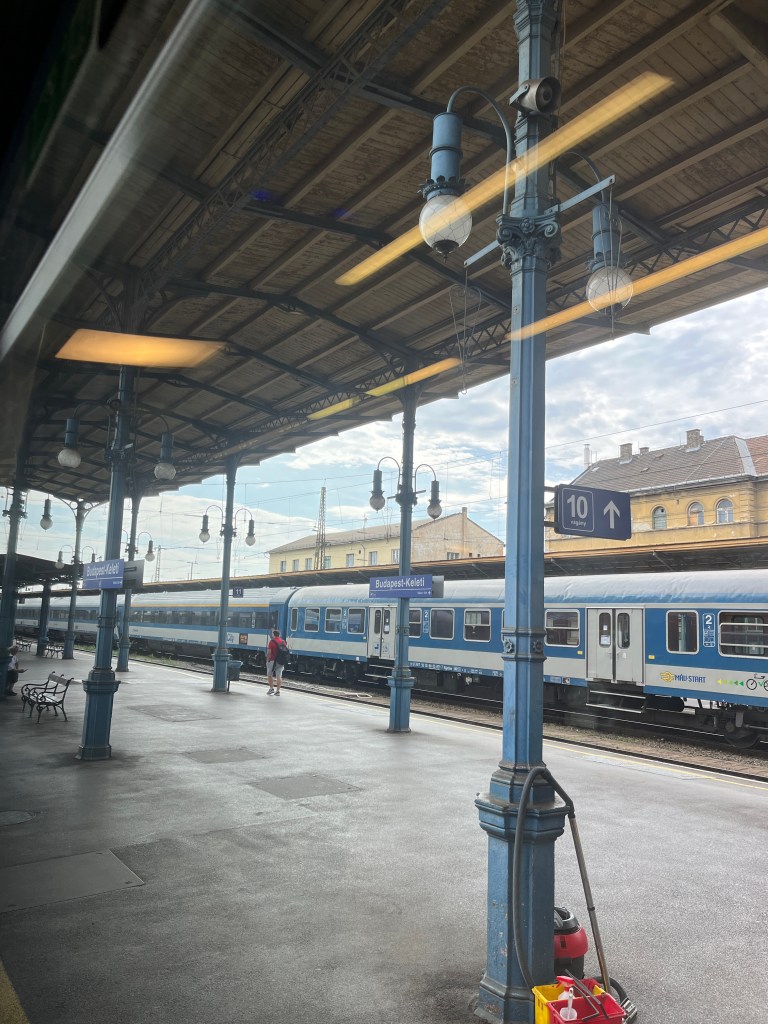
We planned to take a train from Budapest to Vienna. I went down to the lobby a bit early, hoping for tea and maybe a pastry. When I sat down, the hotel manager asked if he could get me anything. I asked for tea and a pastry. He indicated the breakfast buffet in the bar and I said I didn’t want to buy a whole breakfast, thanks. He said he would see what he could do. A pot of tea and a basket of pastries arrived shortly, on the house.
The hotel arranged the train journey and called a cab, which was inadequate for the luggage of six people. The hotel manager took our overflow luggage to the train station in a separate cab, which he paid for himself because he said he should have ordered a larger cab. The service at the Clark Hotel is beyond amazing, and it was inexpensive, compared to a similar hotel in the US. Highly recommend.
The train ride was about 2.5 hours. We checked in to the Daniel Hotel in Vienna. The Daniel is a bit eccentric in a charming, hip and happening way. I could have done without the hammock in the room, which hit my head every time I walked by it, but I wound it up out of the way and only bumped into it occasionally after that. The roof of the hotel features a strange sculpture of a warping sailboat. They keep bees on the roof and sell the honey, which they also use in their unexpectedly delicious cafe food. There is an airstream trailer parked in the front garden, near the grape vines and rose garden.
The rooftop sailboat sculpture.
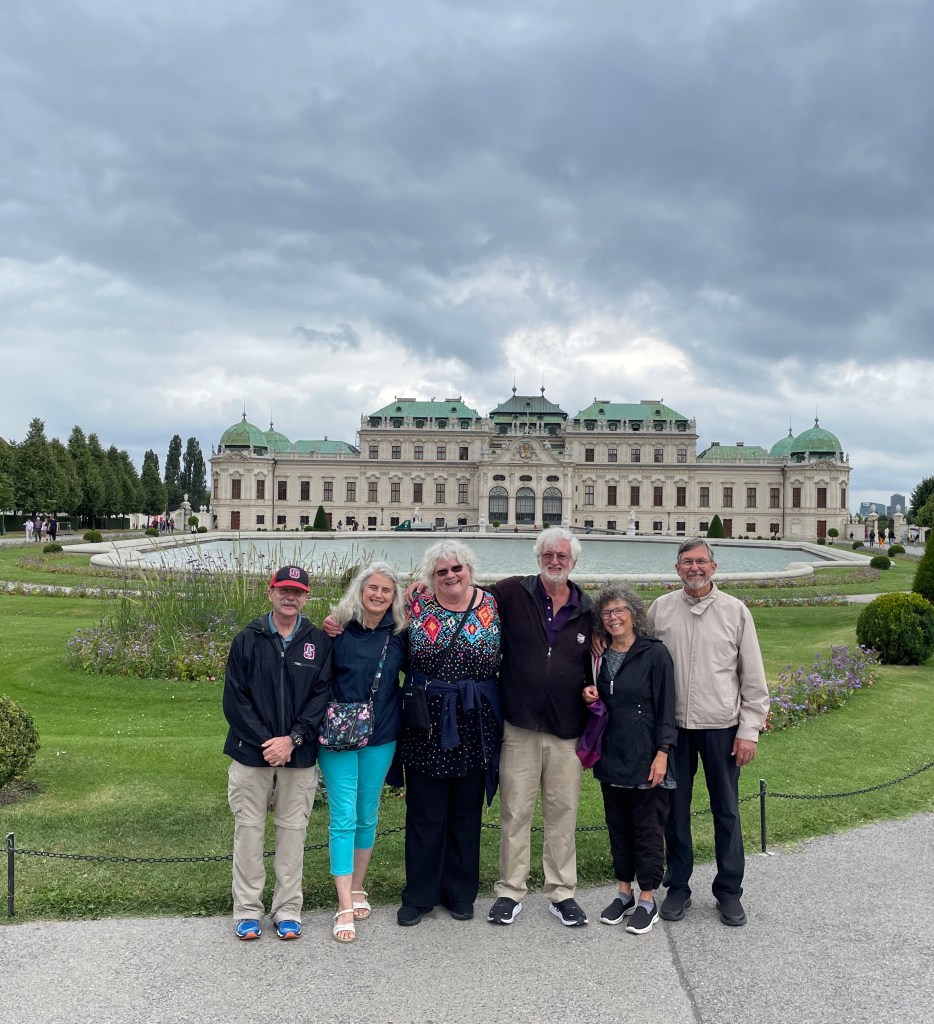
We walked down to the Belvedere Palace, not far from the hotel. Apparently, a prince was given it for defeating Napoleon in a battle. It’s huge, with gardens and fountains and furbelows, and now houses an excellent art museum. We were on a mission to find an outdoor cafe, which we didn’t find for a while because we were not in the outdoor cafe section of town.
Here we all are, posing in front of the Belvedere Palace. Just a weekend getaway place for the prince.
By the time we found an outdoor cafe, I was at the end of my rope. I didn’t realize it, but I had been experiencing lingering effects of Covid even though I was technically over it. We got a table and I nearly put my head down and cried before going to sleep, but managed to order smoked salmon instead. I felt marginally improved after eating, but took a taxi back to the hotel to take a nap while the others walked to the town center.
I found out later that I wasn’t the only one who had been feeling the after-effects of the disease. I guess I thought that once we passed the five-day mark, it would all be over, just like a cold—which is what it felt like. Not so, and I continued to feel ill for another day. So ill that I took a Covid test, convinced I was still sick with it, but it was negative. I guess I was pretty naive to think I could just bounce back, especially at my age. Thinking back, I had experienced a lot of pain and muscle weakness in Budapest that I passed off as caused by the extreme heat and my general lack of fitness.
The next day was pretty much a zero for me. The others visited the Schönbrunn Palace outside Vienna. I elected not to go, which turned out to be a good call, as I felt very ill. (This is when I tested myself.) By evening, I was somewhat recovered.
We walked to a brewery restaurant for dinner known for its local specialties and beer. I knew I had never had good wiener schnitzel before—unless it is supposed to taste like extra-crispy shoe leather—so I ordered that, plus a beer which I knew nothing about. The beer was tasty. The wiener schnitzel arrived in two golden slabs, piping hot. I can now say I have had probably the best possible wiener schnitzel, and I intend never to order it again. It’s not bad, just kind of boring.
So hopefully, I have recovered from the lingering effects of Covid and can go enjoy Vienna!
The next day was as scorching as the day before. Linda, Tom, and I started with the Great Market Hall, with its soaring girders and colorful exterior. The building is absolutely enormous and we never even made it to the second or third floors. If we had been able to read Hungarian, we would have known that all the gifty-type stuff was on the second floor, while the third floor was restaurants. The first floor is food—piles of sausages and meats, mounds of fresh fruits and vegetables, bins full of paprikas and other spices. It was a feast for the senses, and reminded me of the open-air market on Las Ramblas in Barcelona.
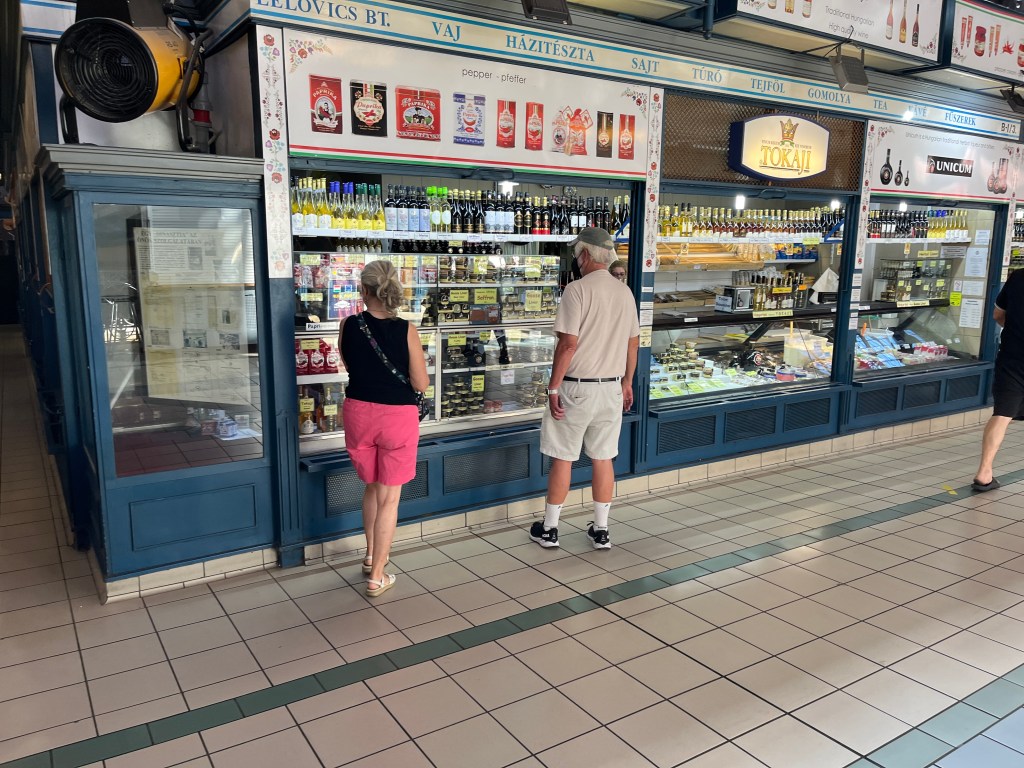
Ex Teri or of the Great Market Hall. It is impossible to get a photo of the entire, enormous building.First floor of the Great Market Hall.Tom and Linda at a wine stall in the Hall. Linda was looking for a Hungarian varietal called Tokaji, known as Tokay in English. You buy it according to its sweetness rating, from 1 to 10.
To tell the truth, I was reluctant to tackle the stairs. My knees have tendonitis, and it has worsened considerably on this trip. The extreme heat hasn’t helped. We shopped on the first floor, then wandered down the shopping street we noticed the day before, running into Susan and David at an outdoor cafe—at least Tom did. Linda and I went into a linen store and disappeared for a while.
We walked to the Great Mosque. The tour guide was very knowledgeable. She explained that when the synagogue was built, in the mid-1800s, the Neolog Jewish community wanted to assimilate with Hungarian society. The interior is very church-like and unlike any other synagogue I have seen. It even has an organ, when musical instruments are usually forbidden in temple. The Neolog community, she explained, was neither Orthodox nor Reform, but rather a movement to modernize without sacrificing many of the traditional elements of Judaism.
Exterior of the Great Synagogue.
The building combines Moorish and Christian architectural and decorative elements while retaining Jewish symbolism. The Ark of the Covenant is vast, containing, if I remember correctly, 60 Torah scrolls, which is a lot. They are enormous scrolls, always hand-written, and very expensive.
Interior of the Great Synagogue. The enormous golden structure with the red curtain is the ark. While it resembles a Christian sanctuary, you can see the tablets of the 10 Commandments near the top, it is crowned with a Star of David, and there are many other Jewish elements that are harder to make out in this photo. The Moorish elements are everywhere, in juxtaposition with a massive pipe organ.
The synagogue was abandoned and damaged during WWII. I am ashamed that I didn’t know more about the eager willingness of the Hungarian Nazis to exterminate the Jews, causing staff at Auschwitz to complain they were sending too many Jews too quickly to the camp. There is a graveyard on the premises (also very different for a synagogue), and most of the dates were 1944 and 1945. There is a smaller temple dedicated to the heroes of WWI, and a very touching memorial to the dead of WWII; a silvery metal weeping willow with leaves inscribed with the names of those who perished. I will never understand this, and I am appalled and frightened by the ugly resurgence of Nazism in my own country—our ancestors fought and died to make sure Nazism was defeated. It weighs very heavily on my spirit.
Memorial to the victims of the Holocaust. It is beautiful and austere. The leaves are inscribed with the names of the dead.
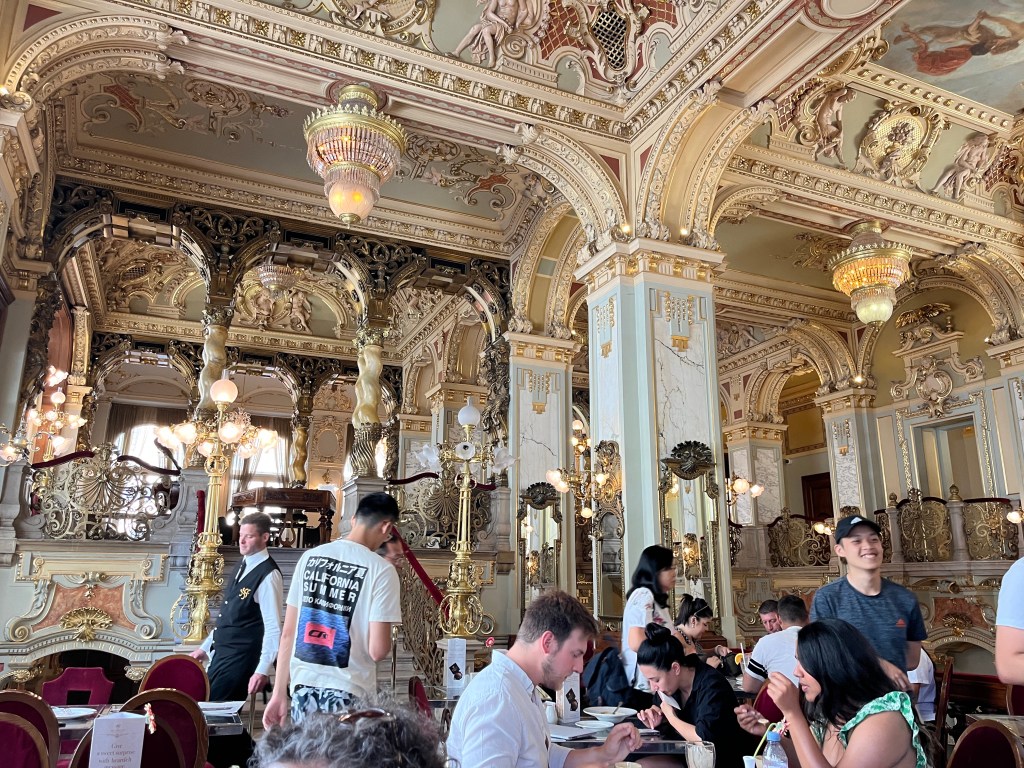
Susan, David, Tom, and I went to the New York Cafe for lunch, which was delicious, but it could hardly compete with the decor, which was as much over the top as any palace. It’s also the size of a small palace. There was also live music, an excellent violinist and pianist playing classical music. A lovely experience.
The New York. Cafe.Ceiling detail, the New York Cafe.
I returned to the hotel after that, exhausted from the heat. Later, we went to a charming restaurant called Déryné Bisztró. It was very close to the hotel, but walking involved going through a massive tunnel through the cliff behind the hotel, and we opted for a cab. The restaurant had a nice patio seating area, the food was delightful, and the service excellent. However, it was probably the noisiest restaurant I have ever eaten at. It is right on the street, and trams went by regularly, as did sirens. Just as a lovely jazz ensemble started up, the church across the street started ringing its very loud bells at 8 ‘o clock. It didn’t stop for at least 10 minutes. We braced ourselves when the next hour rolled around, it it just bonged softly a few times and quit. I asked our server why it rang forever at eight, but hardly at all at nine. He looked puzzled, so I guess he has stopped noticing. We did enjoy the jazz ensemble during the quieter moments.
We spent a lot of ti e staring out of our stateroom window at the scenery. This is some of it.
We docked at Vienna, so the view from our stateroom changed. We were facing across the river from the old city, which meant a view of very modern buildings, including a tall skyscraper with a weird wavy design, and a spire that looked like it might be a control tower.
Cute little Austrian town on theDanube. Don’t ask me which one.This is all we saw of Vienna. I assume there’s a lot more to see.
Not moving around is tiring, if you can believe it. I still feel like I have a bad cold, but the inactivity is getting to me. It is so much worse for Tom, who normally averages six miles of walking a day.
I spent my time working on a little graphic novel for our middle granddaughter about her favorite stuffed animal. Bunny is no longer as important to Jessamyn as she once was, but I promised, so I will deliver. I am refreshing my skills on Procreate—I let myself get rusty.
I finished an audiobook called “The House in the Cerulean Sea,” by TJ Klune. It is a gently humorous fantasy about the healing properties of love and the moral courage required to buck a bad system. I absolutely loved it. I had intended to buy it as a Kindle book, but I. Screwed up. However, the narrator, Daniel Henning, was very good, and added to the humor with the different voices for a very diverse cast of characters.
By late afternoon, I was beginning to feel better. If the experience of my travel companions is anything to go by, recovery is rapid. Just about everyone but me is back to normal except for the occasional cough. Glory to the house of science, which brought us the vaccine.
We left Vienna this evening. The six of us had already planned to go back to Vienna for a few days, so I am not upset about not seeing it on the tour. I am a little worried about the weight I must be gaining, sitting here and eating three squares plus an afternoon snack and getting no exercise. But seriously, the meals are by way of entertainment. We watched another stupid movie called “Blythe Spirit,” based on a play by Noel Coward and featuring Judi Dench. It sounded promising, but wasn’t.
We knew we were risking Covid when we embarked. But all six of us were fully vaccinated and boosted, and we were careful about masking. Unfortunately, not all of our fellow travelers were as careful.
Early in the trip, a gentleman from Australia was taken off the ship sick with Covid and sent to the hospital. We heard later he had been seriously ill. He was discharged from the hospital and went directly home. He had isolated in his room for the first few days, so none of us had been anywhere near him. We weren’t overly concerned.
As the days went by, we noticed more and more people hacking and coughing, and mask wearing was only about 40%. One guy NEVER wore a mask.
Then, the evening we set sail for Regensburg, Clod tested positive for Covid. We all did the quick results test. I was the only one not feeling symptoms, and my test was negative. Tom’s was positive.
We all disembarked in Regensburg and took a taxi to a little booth to take a PCR test. Results were reported in two hours. By this time, I was feeling a faint tickle in my chest.
We stopped at an apothecary for some meds and walked back to the ship, a stroll of about 10 minutes. We got to the quay where River Duchess was moored. There was a long bench close to the ship.
We all sat down and stared glumly at the ship. Once we got back on board, we knew we would be confined to our staterooms and would not be allowed to socialize with each other. We talked for a few minutes and then one of the officers appeared and herded us gently back on to the ship.
We were all positive. The protocol was to stay in quarantine for five days, which meant that on the last day, when we were due to disembark in Budapest, we would be released from quarantine. Everyone assured us that all we had to do was ask for something (other than leaving our staterooms), and it would be brought to us. The phone rang constantly with people checking on us and asking if we needed anything. Our rooms would not be cleaned, but we could get fresh sheets and towels any time, and they would do our laundry.
They have been as good as their word. In addition to taking our meal orders, Alex brings everyone a snack in the afternoon, and anything we have asked for has been quickly fulfilled. Alex has been taking care of all of us.
I have taken a few photos, but much of the time, there isn’t much to see from our stateroom. We haven’t been bored, but Tom greatly misses his daily walk. My ankles were very swollen from all the walking in the heat, and are back to their normal size.
None of us are seriously ill, though I, being the last to get it, am experiencing a worsening of symptoms as the others are recovering. It feels like a cold, no worse.
Every day, we get a paper agenda informing us of all the activities we will not be participating in that day. But we did enjoy the 2/3 of the trip that we did get to experience outside of our staterooms
The view from our stateroom for one entire day. I don’t remember where.

















 obsidianmirrorblog