My apologies to the artist. This was uncredited, but if anyone knows who the artist is–other than “hir”– I would like to acknowledge them.
It has now been 15 weeks since the start of my “Big, Fat Weight-Loss Campaign.”
In 15 weeks, I have lost only two pounds. Despite taking Ozempic for six of those weeks. Despite exercising almost every day. Despite the physical therapy, personal trainer, and health club membership (which I am actually using this time). Despite being on Weight Watchers and sticking to it except for Friday dinners.
THIS is why I hate trying to lose weight. It feels like I have to claw it off, ounce by ounce. I only lose in tiny increments, and only if I work at it all the time. That’s why I gave up in the first place— losing weight feels like a full-time job with no salary or benefits. Or promotions. Or stock options. And definitely no holiday party.
I will stop whining now. I wrote a much longer whine, but realized no one would want to read it. Here is what I decided: Ozempic didn’t help and it gives me red, itchy rashes. So, Ozempic is not my knight in shining armor; I need to rescue myself. I stopped taking Ozempic two weeks ago. No change in weight.
But if I am honest about it, there have been significant changes:
I dropped a dress size.
I can make it up the 32 steps to my front door without panting (much)
My balance is better
I don’t get as tired
I lost at least five inches around my waist
I am at a loss to explain how all this could happen without losing any weight, but people keep telling me that muscle weighs more than fat. That’s fine, but I don’t think my surgeon is going to accept dress size as proof that I am ready for knee replacement surgery. And the sense of disappointment when I weigh myself weekly does drag me down.
I don’t see any remedy except to keep on keeping on. I will up my exercise regimen. I have had a glass of wine or two if I had enough WW points to spare at the end of the day. Maybe that is the problem? Can you eliminate all pleasure from your life and still want to live? I guess I’ll find out.
But before I get back to it, I am wrapping myself around a BLTA sandwich, some chips, and a lot of red wine.
Note: I am taking a break from “My Big Fat Weight Loss Campaign.” I hope to have positive progress soon, but right now I am stuck in the doldrum of dieting, despite Ozempic. Here’s something else to chew on.
I have been rewatching Star Trek: The Original Series (ST:TOS to fans), which is the first time I have viewed the series since its original airing in the 1960s. I just watched an episode called “Turnabout Intruder,” story by Gene Roddenberry and teleplay by Arthur H. Singer. It’s an episode I have no memory of. Apparently it was pre-empted by a presidential speech at the time it was supposed to air. It aired later, but I must have missed it.
Briefly, the story is that Kirk visits Camus II, responding to a distress call. Among the survivors are one of Kirk’s former girlfriends (right on brand here, but there’s a twist), Dr. Janice Lester, and a physician, Dr. Arthur Coleman. It quickly becomes apparent that Dr. Lester and Kirk did not part on friendly terms. Kirk was going off to be a starship captain. Lester also wanted to be a starship captain–but was not allowed to hold that position because of her gender. She was angry, and took it out on Kirk, who skedaddled off to the stars.
Hold on–it’s the year 225something, and WOMEN ARE NOT ALLOWED TO CAPTAIN STARSHIPS. It kind of made me sad that Roddenberry’s vision didn’t stretch to that.
Continuing with the story, Dr. Lester assaults Kirk and subjects him to an alien technology that switches their personalities or selves into the other’s body. So Kirk is now in Lester’s body and vice versa. Her claims that she is actually Kirk are dismissed as illness, but Spock does a mind-meld with her and knows the truth. Spock attempts to free “Lester,” but is caught.
Kirk (actually Lester) calls for a court-martial of Spock, with himself, Scotty and Bones as the judges. During the procedure, Kirk (in Dr. Lester’s body) is allowed to testify, and this is what Kirk says about Lester: “Most of all, she wanted to murder James Kirk, the man who once loved her. But her intense hatred of her own womanhood made life with her impossible.”
Really? Was it “her intense hatred of her own womanhood”? Or was she an ambitious person who was deeply thwarted, all because she lacked a penis?
During this show trial, Lester (in the person of Kirk) does some table pounding and red-faced shouting. Scotty and Bones meet outside the courtroom to confer. Scotty says. “I’ve seen the captain feverish, sick, drunk, delirious, terrified, overjoyed, boiling mad, but up to now, I have never seen him red-faced with hysteria.”
“Hysteria,” of course, is a dog-whistle for “like a woman.” I assume most people know that the word derives from a Latin word meaning “womb,” as the womb was believed to be the cause of it. Thus, men were considered incapable of hysteria.
At the end, Kirk and Lester are switched back by some unclear methodology. Janice Lester, back in her own body, collapses weeping in Kirk’s arms, and then in the arms of Dr. Armstrong, who has aided and abetted her all along. Armstrong takes charge of the sobbing woman and leads her away “to take care of her.”
Kirk puts the cap on it by noting, “Her life could have been as rich as any woman’s…if only…if only…”
I noticed he did not claim that her life could have been as rich as any man’s. And a woman’s life, it went without saying, is limited, and women should just accept these limitations and be happy with them.
Although I expected some misogyny/discrimination against women from TOS, this episode shocked me. As a woman born in 1950, it made me realize how far I have come in my own thinking that I could be shocked by this. There are now two generations of women who have grown up believing they are equal to men and deserve the same rights. I find this extremely encouraging.
The media is full of stories about the new class of weight-loss drugs, of which the best-known are Ozempic and Wegovy. I’m not going to get into the other drugs currently on the market. That would take up a lot of time and this post isn’t about the industry.
What is the difference between Ozempic and Wegovy? There isn’t any difference. They are both a drug called semaglutide. They are both manufactured by the pharmaceutical company Novo Nordisk. However, they are approved by the FDA for different conditions. Ozempic is approved for Type 2 diabetes. Wegovy is approved in a higher dosage for overweight. Both drugs are in such high demand that they are difficult to get in the United States.
How does Semaglutide work? From Drugs.com: “Semaglutide works by mimicking the action of GLP-1, a naturally occurring hormone that helps to regulate blood glucose levels. By binding to and activating the GLP-1 receptor, it stimulates insulin secretion and lowers glucagon secretion when blood glucose levels are high. It also causes a slowing down in how fast the stomach empties.” The end result is that it dramatically reduces appetite.
What are the potential side effects? Low blood sugar levels, nausea, vomiting, diarrhea, abdominal pain, and constipation are the most common side effects. There is also an increased risk of pancreatitis. And people with certain medical conditions shouldn’t take it. Do your research before starting one of these drugs.
My Experience of Taking Semaglutide: The first step was that the nurse practitioner I was working with, Ashzra, prescribed Wegovy. My insurance turned it down because weight loss is not a condition covered by Medicare Part D. Then she sent me a prescription for Ozempic and gave me a Canadian pharmacy to contact. I did so, and without any further ado, I received my first Ozempic pen in the mail. I had to wait for more than a month to receive instruction from a physician on how to use it, so it sat in my refrigerator for all that time—it has to be kept cold.
I finally got a doctor to go over how to use it. So one Tuesday morning three weeks ago, I sat in my home office with the patient instructions Ashzra sent me. The instructions said to prep the pen and make sure no bubbles were in it, etc, which I did. Then the instruction said to turn the pen until the proper dosage appeared in the little window. I thought I’d start with .25mg, as I was worried about side effects.
I dutifully clicked the pen until a number appeared in the window. It was a 1. A second try yielded the same result. I pondered this for a while, and then pulled out the instruction sheet inside the prescription box. It turns out that my pen injects 1mg every time—you cannot select the dosage.
Okay. I swabbed my upper thigh with rubbing alcohol and regarded the needle protruding from the end of the pen. It is a short needle, and very fine. But I still needed to—willingly—shove this needle into my tender skin. I set up the pen and stabbed my thigh. I depressed the plunger, and it clicked back to its starting position. I held the pen against my skin for another six seconds, as instructed, to make sure the entire dosage was injected.
It didn’t hurt much, I will say that. There was a tiny red dot at the injection site, and I covered it with a little bandaid, just like at the doctor’s office.
By dinner time, I was feeling distinctly uninterested in food. The next morning, I fixed my usual breakfast, something I normally enjoy—one piece of avocado toast with fried eggs and hot sauce. I wasn’t just feeling uninterested, but nauseous. I ate about a fourth of it because I wasn’t sure whether this was how I was supposed to be feeling, but could go no further. Another couple of hours found me giving back not just breakfast but everything I had eaten after giving myself the injection. I also felt extremely fatigued.
The nausea and fatigue lessened a bit every day. The nausea went away entirely when I remembered how effective ginger is against nausea and other stomach troubles. Despite a total lack of interest in food, I forced myself to eat because I didn’t want to get malnourished. By the end of the week, I started enjoying eating again. I recognized that constipation was going to be an issue, and took stool softeners and dietary fiber to combat it.
After the second injection, I felt mildly nauseous but did not vomit. I wondered whether “reduced appetite” actually meant “revolted by food.” The fatigue got a little better, but I still felt pretty tired. The third injection left me feeling fairly normal, except for a reduced appetite. I have resumed enjoying food, but I can’t eat a lot of it. I think this is the desired state.
Semaglutide will reduce your appetite, but you still have to eat properly to lose weight. I am sticking to the Weight Watchers diet and gradually increasing my physical activity. I have not lost any weight over the past two weeks, but I am still hopeful. Weight loss is unpredictable and tends to happen when I least expect it.
The weight loss physician who instructed me about using the pen also tried to get a prescription for Weygovy approved, as she said there are some new guidelines. After the second injection, I tried to find out from my clinic how to get the second semaglutide pen—should I go back to the person who prescribed the Ozempic? Should I coordinate with the weight-loss physician who was trying to get me Weygovy? Or…?
It was a bit of a clown show. Every time I tried to contact someone like Ashzra, someone else would answer my email who had not read the case notes and didn’t know what was going on. Even Ashzra didn’t answer my direct question about whom to coordinate with about getting another prescription. I finally drove to the clinic and asked to speak to a member of my doctor’s staff, explaining that I needed a new prescription and had been unable to get information from anyone I contacted via email. After a wait of perhaps half an hour, a nurse came out to talk to me. She had spent the time reading all the emails and understood the problem. I left the clinic with a prescription, emailed it to the Canadian pharmacy, and received a rapid acknowledgment.
By the way, my insurance for Medicare Part D refused the second prescription because weight loss is not a condition…etc. Being overweight creates other medical conditions that they WILL have to pay for, but if you expect the insurance industry to make sense, don’t. All they are concerned about is making profits. I worked for an insurance lobbyist for a while; I know what I’m talking about.
I hear many worse tales about our current medical system from others. Apparently, we lost a lot of medical personnel during the pandemic, and the strain on our system is showing. I completely understood putting Ashzra in place to shoulder some of the doctor’s load, and she is a very impressive person. But it seems that the load-spreaders are overwhelmed, too. If things get worse, we will lose more medical people who just can’t take the stress.
I can’t report any more reduced poundage, but here’s another token of progress: my belt. I am now on the last notch.
I am going to draw a curtain of discretion over day 16. We spent the day pleasantly enough at our gorgeous hotel. It ended with a midnight doctor’s visit, a 6-inch hypodermic to my butt, a bag full of helpful anti-diarrheal drugs, and getting to bed at 3 am. However, I checked the side effects of the medication I was prescribed in Tamarindo, and the leading one (which Dr. Piloto never mentioned) was “severe, ongoing diarrhea.” The food and water here are safe!!! Pura Vida! (Pure Life. You hear it everywhere here, as a greeting, an exclamation, an affirmation of love of country. It is also imprinted on almost every bit of tourist tat available.)
Day 17 was an improvement, but I did not leave the premises. This is an amazingly beautiful hotel, but it is not for the disabled. The way from the reception area to our room involves many steep stairs made of cement coated with volcanic rock that will skin you alive if you fall. Interspersed among the staircases are ramps and bridges, some steep enough. I am using my hiking sticks, both for stability and to spare my bone-on-bone knee, and it is quite an athletic outing for me every time we go to the pool or restaurant. I have sussed the best way to the restaurant, the one that involves fewer staircases but more ramps. There are no other ways to get around. No shortcuts. No elevators.
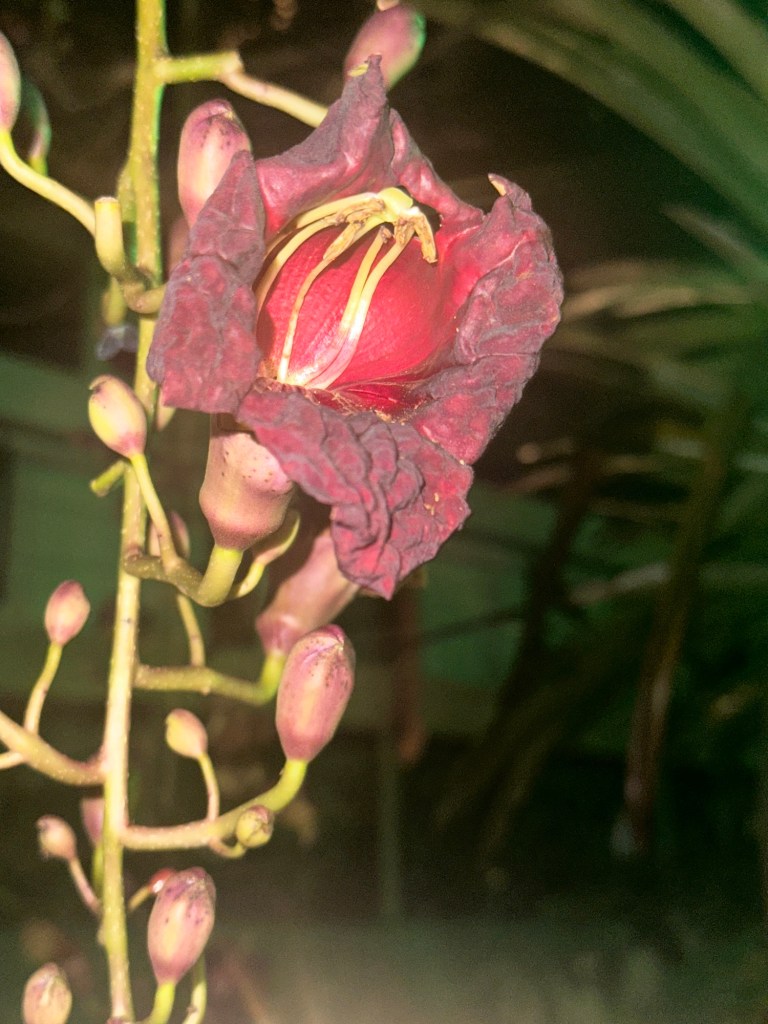
Once you have conquered the stairs and ramps, our room is reached by a bridge overhung with some gorgeous, weird, carnivorous-looking flowers. In the evening, they open, and you can see tiny bees and wasps having a field day in them.
We have decided we like one of the two restaurants here best, TicoRico. It isn’t their fanciest restaurant, but the food is creative and yummy. However, it is apparently cursed.
We were highly amused by this, but then we are easily amused.
You’d expect wonderful fruit in a tropical country, but it is exceptionally good here. They grow seeded watermelon, which is so much more flavorful than the seedless junk from the supermarket. (I wish I knew how to get it at home. We have the wrong climate to grow it). The pineapple is exquisite, and even the papaya is OK, which is a huge concession from me.
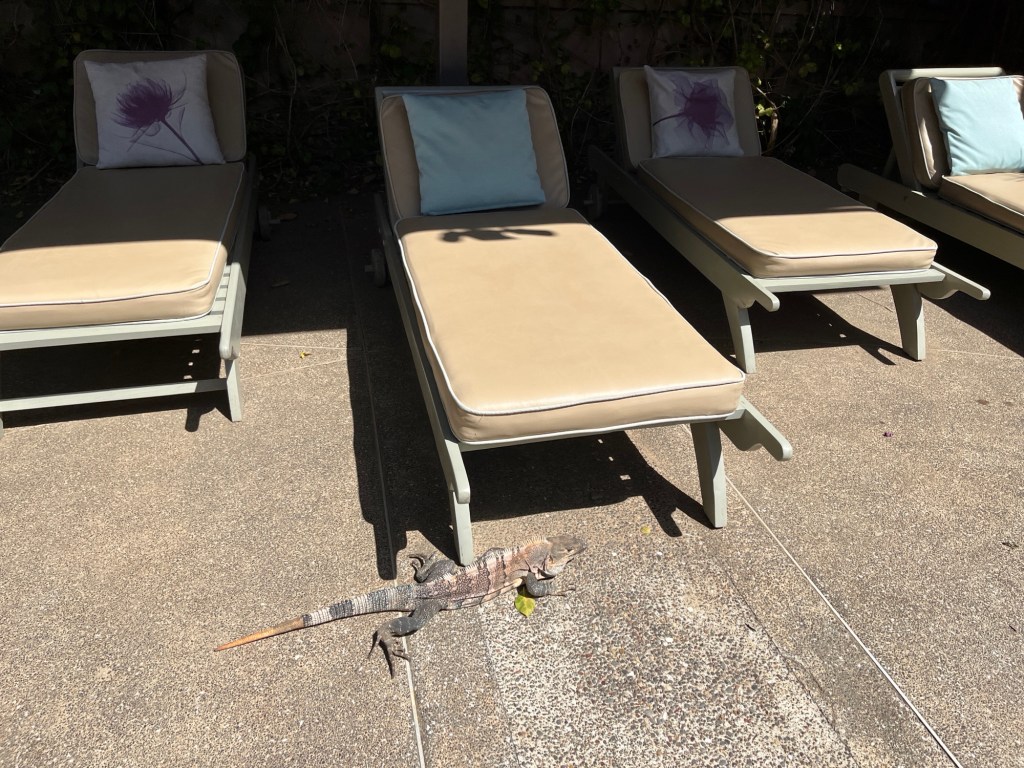
We saw a scarlet macaw in the morning. It is a very large bird, and in flight, trails its tail behind it like a bird of paradise. At lunch, we were visited by Pancho, an iguana that comes into the restaurant to pick up dropped goodies.
Pancho the restaurant cleaner. My foot for scale.
We spent the day quietly, reading and writing. Tom went for a long walk in the afternoon and I went to the pool. Yesterday, the pool bar was full of young, local people, a group of friends. They were drunk and very happy. I had a long conversation in broken English and Spanish with a young lady named Fiorella—she is 21 and she wants to go to New York and Los Angeles and speak many languages and wear beautiful dresses and be glamorous. I wished her luck, sincerely. I hope she lives her dreams.
There are two pools here. One is for families, and is smaller. It has a nice water slide for the kiddos. It also has a pool bar for the adults. Thelarger pool, with a waterfall, hot tub and another pool bar, is adults-only. How smart is that?!
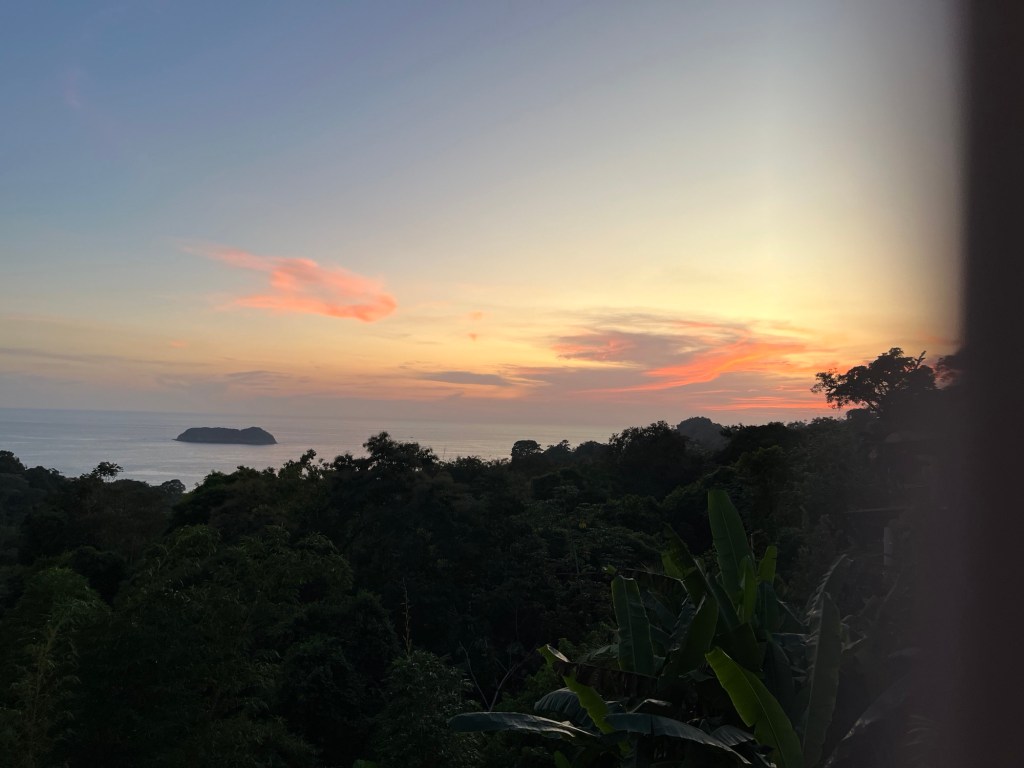
Today, the pool bar was full of elderly Americans, just like us. (The younger set was at the other pool with their happy, shrieking children.) Some of them had very interesting stories and had lived all over the world. It got dark as gorgeous clouds pulled in, looking as though they had been painted by Tiepolo with sunset gold and pink. We finished our drinks at the pool bar and went to dinner. The day came to an end without any doctors or unnecessary unpleasantness.
And I got to do it twice! We departed Tamarindo with a van and driver, named Johnny. The drive takes about five hours from Tamarindo to the Manuel Antonio area. About an hour later, I realized that my treacherous gut was betraying me again. Johnny stopped at a McDonald’s which had the advantage of being super clean and a bit private.
But it was too late. I tossed the underwear as irredeemable. There was a sink in the bathroom cubicle, so I texted Tom to bring me clean undies and shorts. I washed out my shorts. Then, with nothing covering me but a longish shirt, I went to the bathroom entrance and got the clean clothes from Tom. I laid out the wet shorts to dry in the back of the van and dug out the Imodium, hoping it would work fast.
We stopped to pick up Johnny’s wife, Juanita, at a large bus depot. I urgently sped into the huge, brightly lit, tiled women’s bathroom—and slipped on the slick tiles and fell. I need not tell you what a hard fall produced in my nether regions. I should have brought my walking sticks, but—you know—I was in a hurry.
A number of small, concerned Tico (Costa Rican) ladies helped haul me to my feet, and I limped off, muttering “Muchos gracias, muchos, muchos gracias.” Another pair of undies gone. I’m down three now, and I only brought enough for one week, thinking to launder as we went.
This time, there was no private sink. I ventured into the glaring light of the public bathroom with nothing on below the waist, and washed my shorts. I texted Tom, who appeared at the entrance—at this point, I was visible to the public at large—with my wet shorts from my earlier adventure and no underwear. I was just grateful to cover my ass and didn’t care if the shorts were wet. I congratulated myself on wearing a long shirt that covered most of my problems.
And to top it off, I threw a rib out. I hope you will forgive me if I don’t have much to say about this day. It was not a good day. I am confronting my physical limitations, and not very happy about them. I took more Imodium, which seemed to solve the immediate problem. (BTW, Tom has not suffered any gastric problems at all. I believe the food and water here are safe—I just have a gut that resists any change to its biome.)
I did manage to wish Juanita a happy birthday in Spanish (Johnny told us it was her birthday), and I am proud of my presence of mind, which was more than a little discombobulated by this time. Johnny and Juanita were very cute together in the front of the van, holding hands and giggling. They seemed very fond of each other.
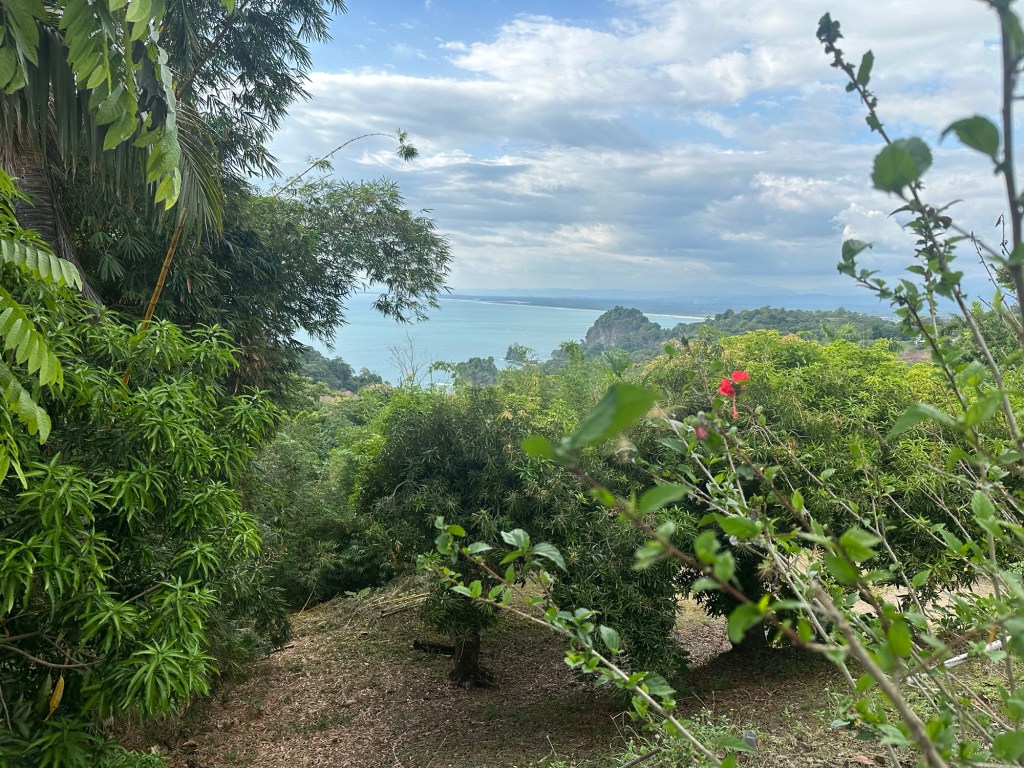
And we made it to this beautiful hotel, Si, Como No. It meets all of Tom’s expectations—tiers of rooms spilling down a jungle-clad hillside with exotic flowers, scarlet macaws, and phlegmatic lizards. Our room overlooks the ocean and is absolutely gorgeous. Tom kindly brought me a double scotch, which was so extremely helpful.
We had a very nice dinner in the hotel restaurant. I had fish tacos, which came on homemade corn tortillas. I have noticed that they do not add much, if any, salt to food here—I sort of expect hot countries to add salt, but not here. With a little salt and sauce picante, the tacos were a delight.
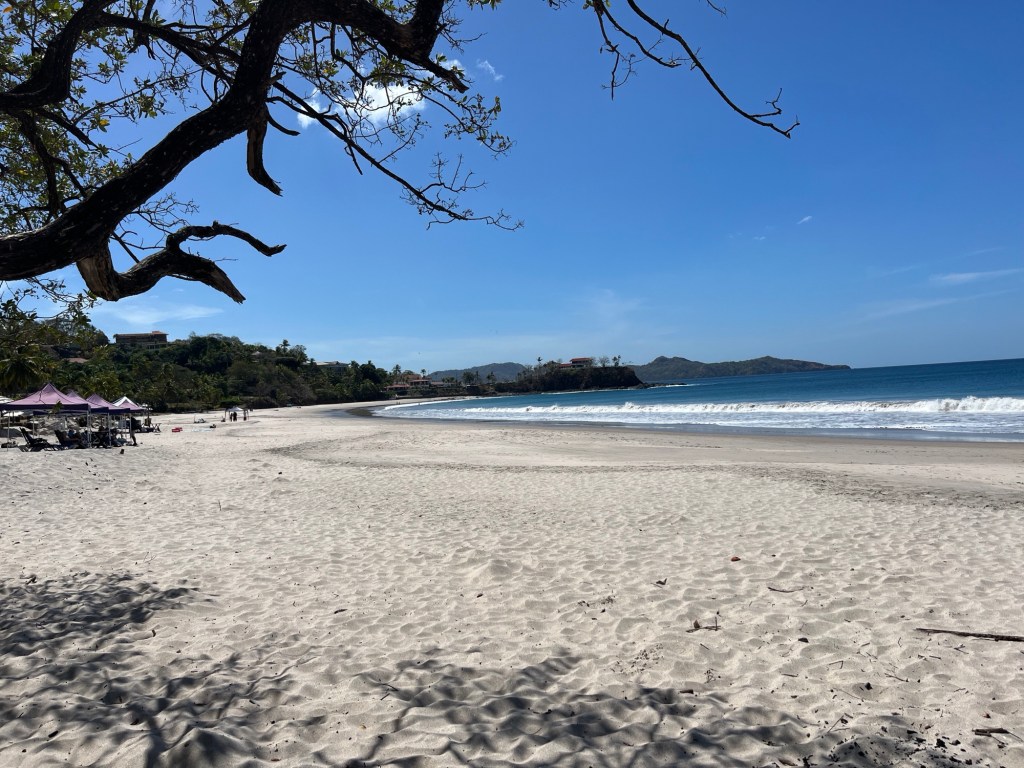
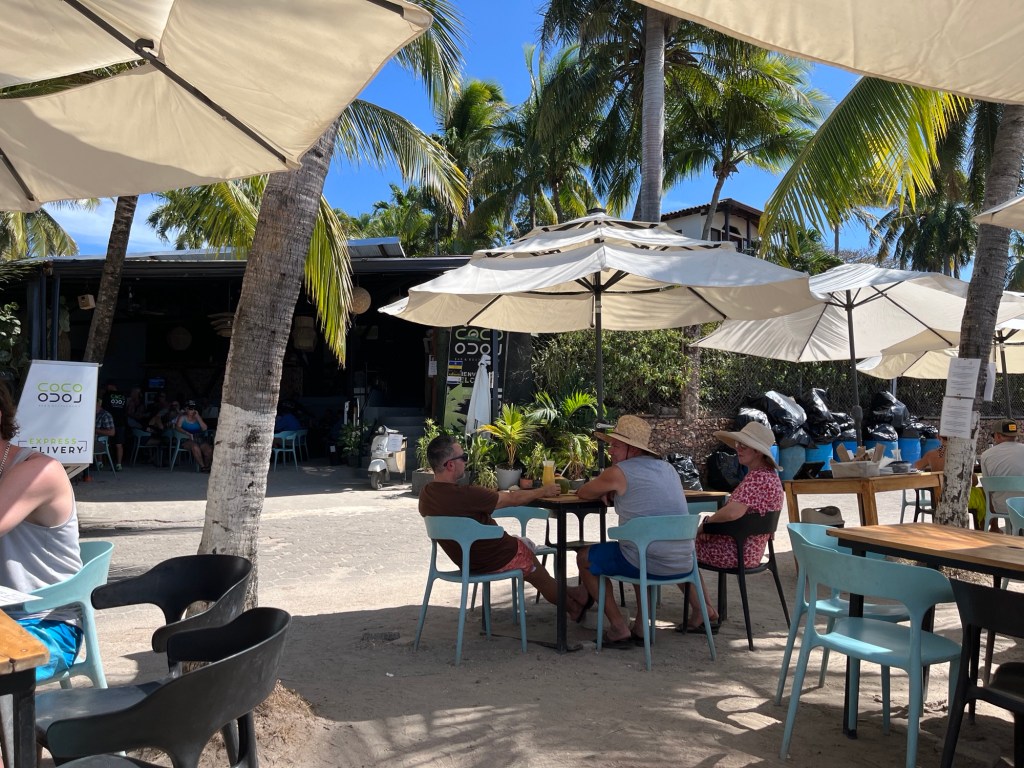
On the advice of the hotel mom, Marie, we decided to go to Flamingo Beach. She said it was a beautiful white sand beach, but the wave break is pretty strong, and I should be careful. She also recommended a restaurant on the beach called CocoLoco. So we hired a car and driver, whose name was Orlando, and set off, bathing suits under our shorts and shirts.
Flamingo Beach
We already knew about Flamingo Beach because our driver Roger said it was very nice and he lived there. He also said there used to be roseate ibis there, which would be exciting to see. People mistook the ibis for flamingoes—hence the name. I doubt there are many ibis left there, as it has been developed. It looks nice to us, but I am sure it ruined the ibis neighborhood.
We rented a tent for shade and some chaise lounges. There was very little shade on the beach, and I am a very white person who burns badly. (Of course, I was wearing sunscreen, but sunscreen only goes so far.)
I waded into the water. Marie was right about the break, but getting out was no problem. The waves were powerful, but small, breaking almost on the beach. Past the surf line, it was still quite shallow very far out. I was cautious about my feet, thinking there might be stingrays. But I didn’t see a single, solitary fish of any sort as I bobbed around in the warm water.
Getting back to the beach through those waves was another matter entirely. The waves broke hard, and then pulled strongly back out. Having grown up swimming in the ocean, I allowed them to knock me down, relaxing into the force and not resisting, trying not to put strain or torque on my knee or shoulder, but making steadily towards the shore when possible. I was absolutely astonished when one of those little waves knocked me down and boiled me! Having learned to survive boiling in the much larger waves of Southern California, I wasn’t hurt. Eventually I found my feet and crawled onto the beach, dripping with compacted sand that filled my bathing suit.
Then Tom went in (we took turns because leaving our stuff unattended would be stupid, right?). Tom saw myriads of baby manta rays (they do not sting), swimming everywhere and surfing in the waves! I could see them in the breaking waves. Evidently, they do it for fun, because they swim back out and go again. He also saw a four foot fish with a dorsal fin that might have been a shark. But the shark, if that’s what it was, was uninterested in him.
CocoLoco
When Tom returned, we packed up and walked the short distance to CocoLoco. We sat at a table on the beach and ordered margaritas. Tom had yellowfin tuna tacos. I had taquitos with chicken, and we shared a watermelon-feta-cashew salad. We ordered more margaritas, and then Orlando showed up, right on time. When we returned to the hotel, I showered in my suit and the amount of sand that flooded out was astounding. Then I went for a brief dip in the hotel pool, which was cool and refreshing. Then I took the suit off and took a real shower. I discovered that my cleverly-designed bathing suit, in addition to drying slowly, was fashioned with many clever nooks and crannies, apparently ideal for sand storage. Another avalanche of sand in the shower.
We ate at Dragonfly again. This time I had beef empanadas and the kale salad. Delicious. The music was ghastly—a monotonous bass beat with an electric guitar tootling around it. Every number sounded just like every other number. I guess people would rather listen to any kind of music rather than have an actual conversation.
Today was the first day since we arrived at Tamarindo that I didn’t take a siesta. Maybe I am acclimating?
Tomorrow we leave for a week in Manuel Antonio, near a large biological reserve. I had my doubts about TamaGringo when we arrived, but we had an enjoyable stay. I can’t close without mentioning how they manage dust control here. They periodically come through and spray the streets from a huge truck. But it’s not water. It’s something with molasses in it, probably combined with oil, because it collects in the ruts, but doesn’t evaporate. The bugs don’t go for it either, although it is sticky with sugar. It sits there in odiferous, dark-brown puddles, making walking all the more interesting.
We got up early to take an hour and a half drive to a coffee plantation. Our hotel hostess provided fresh fruit and other things for breakfast, knowing we would have to leave before the hotel served breakfast.
Our driver was a cheerful gentleman named Roger, who pronounced his name in the Anglo fashion. We asked about it, never having met a Roger in a Spanish-speaking country. He then pronounced it RRRho-hair, explaining that a lot of visitors did not know how to roll their r’s. Still strikes me as an unusual name in this part of the world.
We made our way out of busy, bustling Tamarindo and were soon in open country, dominated by grazing cattle and horses, and dotted with tiny pueblos. Each, as Roger pointed out, had its own church, soccer field and bar. Larger towns might have two or three bars. It is drier here than in La Fortuna, but still lush. Gorgeous plants that I see at home as expensive indoor plants are weeds here.
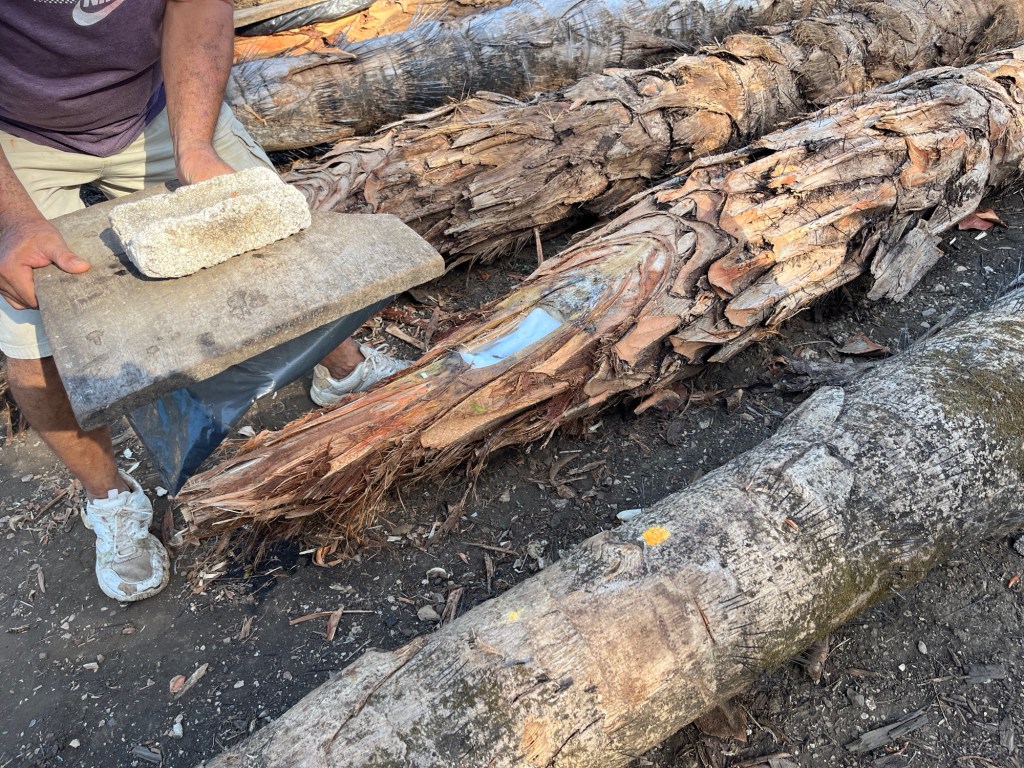
Roger suggested that we stop at a coyol producer. Coyol is a wine made from a particular species of palm tree. The cut trunk is laid flat, and a rectangular well is cut at the end that would normally be supporting the leaves. The sap collects in the cut and is harvested daily. The pre-fermented sap is sweet. It ferments within hours. Interestingly, Wikipedia says, “The wine is purportedly unique in that it causes inebriation not primarily by its alcohol content, but through enzymatic action triggered when one drinks it and then receives significant sun exposure.” Not hard to do here.
The coyol maker removed the protective covering to show us the fresh sap collecting in the palm log. They offered is a taste of coyol that had been harvested 24 hours earlier—the strong stuff, which we accepted. It wasn’t awful, but it will not be my favorite tipple.
We gained a bit of altitude and finally arrived at Coffee Dirià. Several other tourists were already there. They handed us a small cup of coffee, which smelled delicious, but I can no longer drink coffee black, nor do I enjoy it without the modifying elements of milk and sweetening. I am certain it embodied all the taste subtleties that our guide, Dennis (another weirdly Anglo name) described.
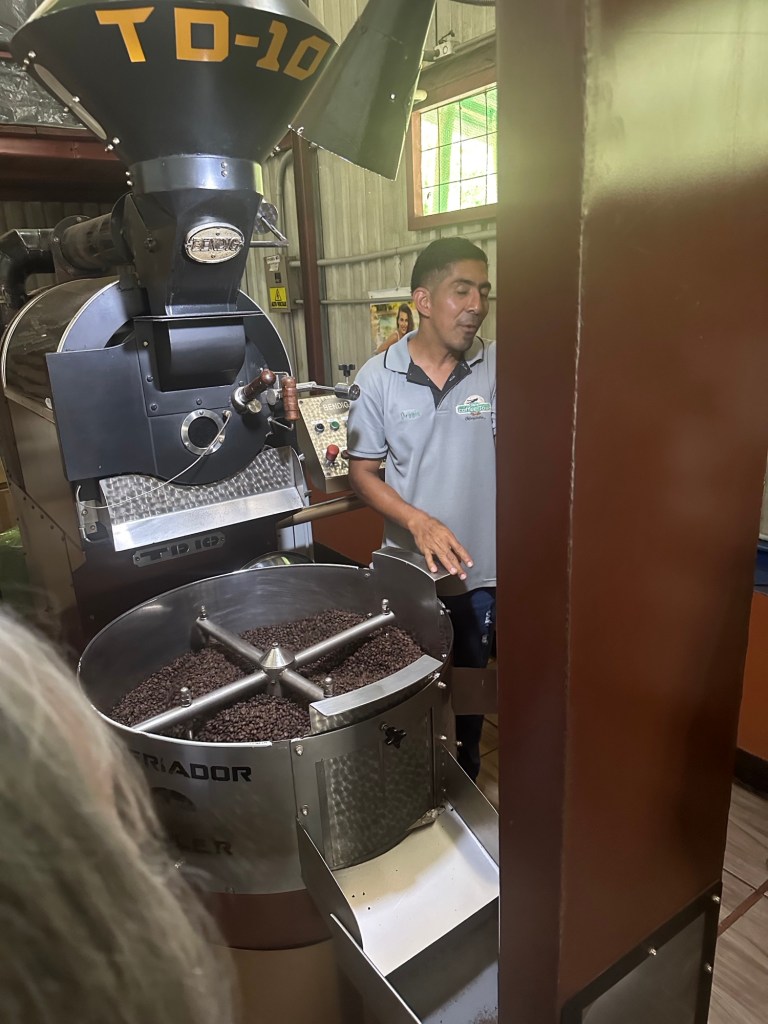
Dennis took us all through the plant and described the process in tremendous detail. I have probably already forgotten much of it, it here’s what I remember:
Dennis showing us the coffee roaster.
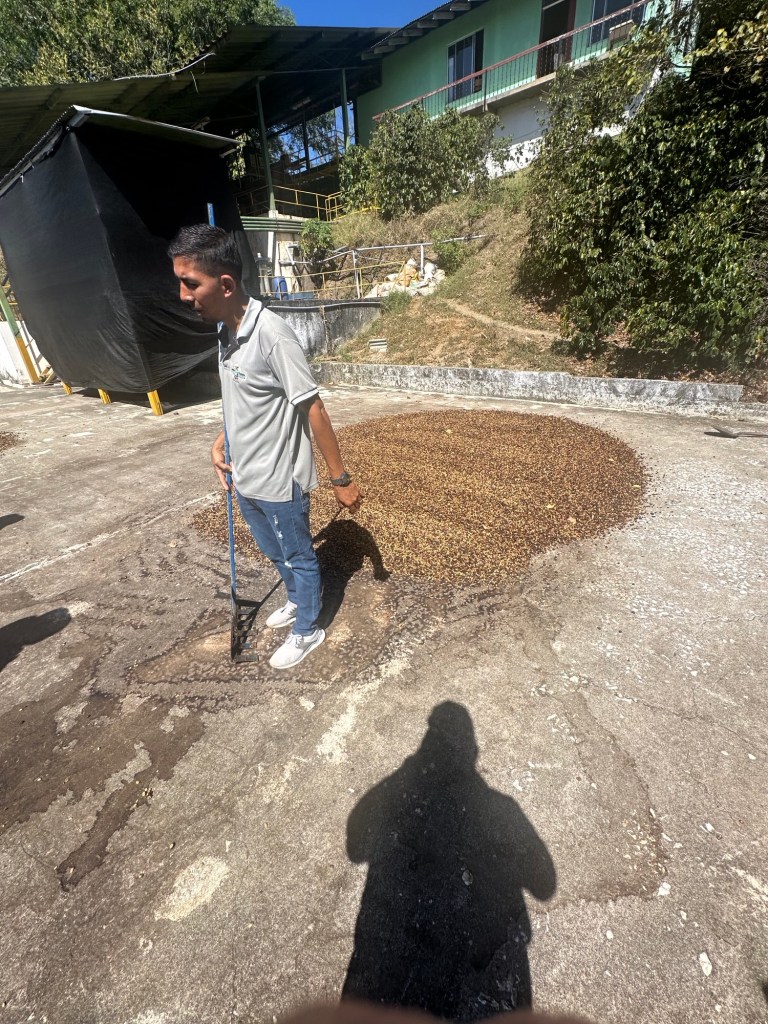
The coffee is harvested by hand. It cannot be done by machine because the beans on the same plant ripen at different times. Also, the coffee flowers, which can appear on the coffee plant along with ripe and unripe beans, are quite small and delicate, and they would be destroyed if machinery were used. The flowers resemble jasmine in size and fragrance, though the scent is lighter.
Only the bright red berries are premium quality and fetch the highest price. A mixed lot of picked berries—red, yellow, green—will not fetch a lot of money for the worker (not that they are particularly well-paid even if they get nothing but premium berries.)
Dennis is standing to one side of premium coffee berries set to dry. The best way to dry them is in the sun, which takes longer than machine drying.
The coffee berry has three “skins.” First, the outer layer, which is the consistency of a very tough grape skin. Then a layer of sweet jelly, similar in looks and taste to the white goo inside a cacao bean. Inside that, there are either two beans or one coffee bean. The singles are the most highly prized, more intense in flavor but smaller in size. These beans have a final “silver” skin that must be removed before roasting.
I’m skipping over the drying, fermenting, roasting, etc. that most of us know about. I was most interested in how they have approached farming coffee organically, without pesticides, and used every part of coffee bean by-products.
Instead of using pesticides, they spray the plants with a tea made of oregano, basil, chilis, and other things. This helps, but there is a weevil that made its way down from Brazil that still manages to infect some of the beans, laying eggs in them. The weevils hatch out and set up housekeeping by eating the house. Dennis selected a bean with a tiny hole and ejected the weevil to show us. It was tiny.
The harvested coffee beans are submerged in water. The good beans sink, and the weevily beans float. The bad beans are submerged for 24 hours in water, which drowns the weevils. The now-unoccupied weevil houses are dried and used for things that are coffee-flavored, like instant coffee. Remember this when you sip that next cup of Nescafé.
The external skin is left on the beans during fermentation and drying, then removed and used for animal feed. The silver skins are dried and turned into paper. The flowers are sometimes used for perfume and skin care products. There are more uses for different parts of the beans, but this is what I recall. Very impressive, IMHO.
We bought some of the plantation’s highest-quality beans, called Black Honey. They had actual honey made from the bees that pollinate the coffee flowers. It was an unusual flavor and delicious, but I didn’t want to carry a heavy glass jar of glutinous sticky stuff in my suitcase. 😢
So then Roger and the Keenans were on the road back to Tamarindo. Roger gave us beers. I am not a beer drinker, but my Mom always said a cold beer on a really hot day hots the spot, and she was right.
We stopped in Villareál, a small town not far from Tamarindo. We were promised lunch at Roger’s favorite soda. A soda is a small, usually family-owned restaurant where you can get local food—la comida typica. The soda in question, Soda y Masqueria Marcel, has its own Facebook page.
Roger had ordered while we were on the road. We all had casada, which is the classic mid-day meal here. It consists of a protein (I and Roger had fish, Tom had chicken), salad with lots of raw veggies, rice and black beans, and plaintains, which in this case were cut into long strips and deep-fried until light and crisp. It struck me as a well-balanced, nutritious meal, and it was delicious.
A word about Costa Rican food in general. It is safe to eat raw vegetables here. I got the squits once, but I always get the squits when I travel outside the US—even in pristine Iceland. Tom has been fine. The tap water is also safe. The food is not at all spicy, though sauce picante is available on request. The food at our hotel at La Fortuna tended to the bland and uninteresting, but we have had really good food in Tamarindo, although you do have to go a bit further abroad if you want la comida typica.
I took my now-habitual siesta in the afternoon and Tom walked in the suffocating heat. (Note that he is the healthy one.) For dinner, we returned to the Falafel Bar because it was really exceptionally good middle eastern food.
This is the hotel’s cat. I don’t know it’s name or gender, but it follows us whenever we emerge from our room. But it does not wish to be petted.Another hotel guest. He also does not wish to be petted.
I am still laughing at myself, 24 hours after it happened. We were on the way back from Dr. Piloto’s office. I had trouble getting into the taxi van because the first step is quite high, and the van was parked at an angle that made it even higher. My walking sticks signal to most people that I am not terribly agile right now. There were other people in the taxi, and when the driver pulled away. I thought he was leaving. But instead, he reparked the van to make it easier for me to get in and offered me the shotgun seat. I was grateful, but when I tried to tell him my knee required surgery, I misspelled surgery in my translation app and told him that “My knee requires sugar (azucar).” I KNOW the word azucar but said it anyway. He was such a kind man that he did not burst out laughing, which he was certainly entitled to do! He seemed to get it, but I’ve been breaking out in little burst of laughter ever since.
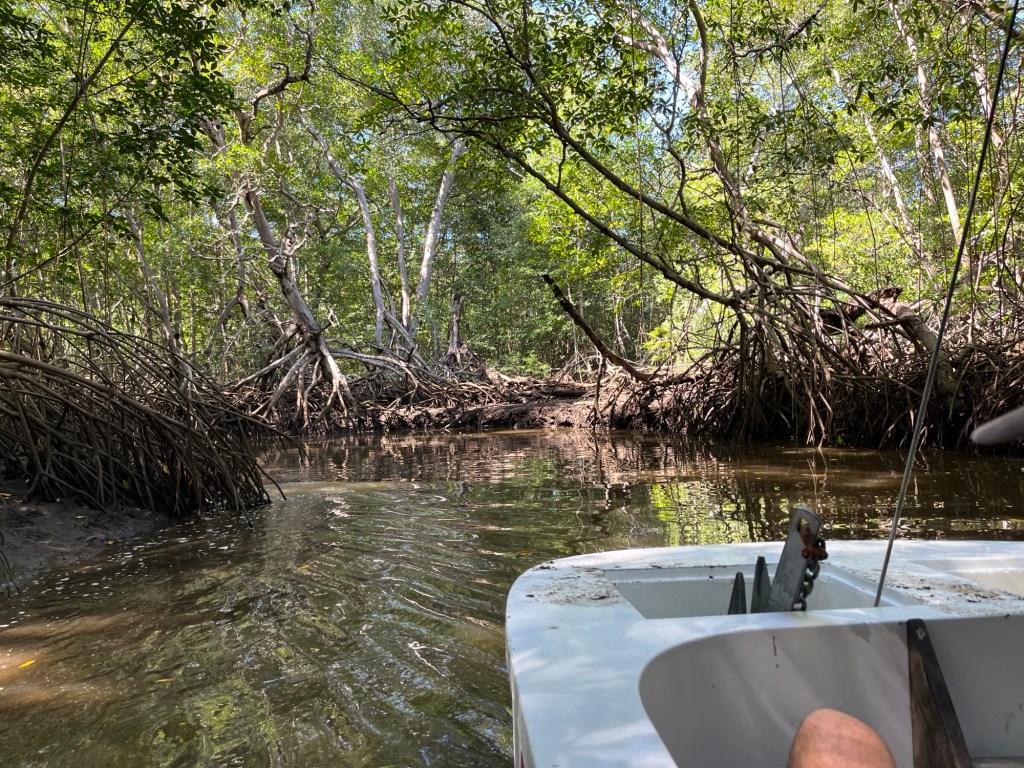
Today we took an estuary tour by boat through the mangrove swamps. We had to leave before our hotel served breakfast, so we walked into town. Most restaurants were closed, but we found a breakfast place and had fruit, avocado toast, yogurt, and coffee. Perfect.
The estuary tour was via a small boat with a canopy, powered by an outboard motor. The guide pointed out several different varieties of mangroves ( I had no idea), and my favorite was the “gentleman mangrove.” Our guide didn’t really know why it was called that.
Gentleman mangroves.
It was very low tide, and the boat got hung up on sandbars several times. This did not worry the men in charge of the boat; they always got us safely sailing again. At the beginning of our tour, the mangrove roots were high out of the water, and they looked like fingers reaching for the tide. By the time we returned, they were underwater again.
We wandered down some very narrow channels. Then we had to wander out again before getting stuck.
We saw a good variety of birds. They don’t have toucans, or macaws (none of which I have seen yet), but we did see:
Yellow-crowned night heronWhite ibis (not my photo)
We didn’t get photos of most of them because they were too far away, but we also saw:
Green-backed heron
Little blue heron, adult and juvenile
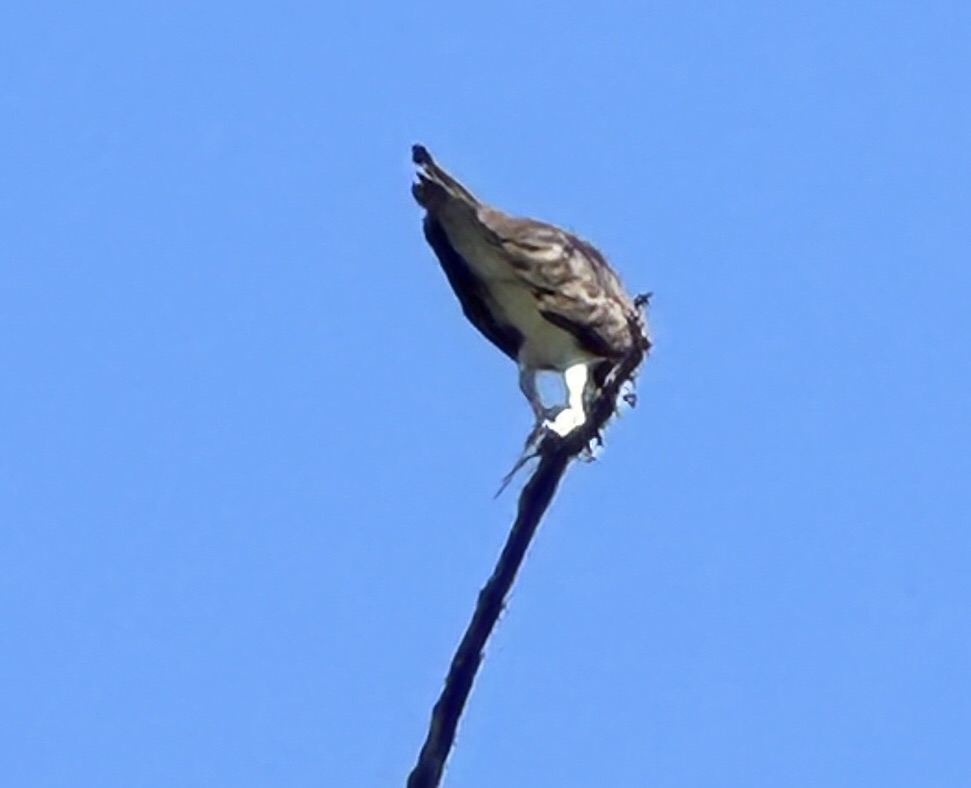
Osprey, sitting in a tree and lunching on a silvery fish
Common black hawk
Great blue heron
Whimbrels
Willets ( migratory birds that look identical to the ones on our beach at Aptos, CA)
Sandpipers (also migratory)
Kingfishers
Mangrove hummingbird
Black-throat trogon (maybe)
About midway along, they served us fresh-cut pineapple, which was refreshing. I guess someone threw extra pineapple onto the beach, because on the way back, there was a very happy and very large iguana chowing down on it.
Happy iguana eating pineapple. What a find for him or her!
We also saw several baby crocodiles in the water. None of them more more than two years old. Sadly, none of the croc videos wants to load.
The guides anchored the boat next to a muddy bank with mangrove roots sticking out of it and invited us to climb up so we could go see howler monkeys. I and my bum knee and torn rotator cuff opted to stay in the boat, much to their surprise, but I was happy with my decision.
At one point, there were howler monkeys in the trees right next to the water, so I got to see them anyway. One of the other boats had a guide who could imitate the howler call and got a rather lackadaisical response from the male troupe leader. You know, it was hot.
I don’t usually write about my “writing process.” (In point of fact, I hardly ever write things for this blog, but I’m trying to change all that.)
I had someone ask me once if I lit a candle before writing, or had a favorite shirt or something that I wore only to write. As someone who used to get paid to sit in an office and write all day, I find that notion hysterical. I can see me now: sitting in an open workspace in a Cisco Systems building, surrounded by my co-workers, wearing my favorite schlumpfy nightgown and fuzzy slippers, surrounded by rose-scented candles as I feverishly pound the keyboard. If that is what it took to inspire me to write, I would never have had a writing job. At least, I never would have kept a writing job.
My writing process is basically sitting down and writing. However, I do have a process for researching before writing, and it is the most enjoyable part. Until recently, I don’t start out with a story in mind. I decide where I want the story to be and I go there. I let the location tell me the story.
You might say that is an elaborate and expensive process for a fantasy writer. Why not just make it up?
There are a couple of reasons why not. First, I have placed most of my fantasy fiction in the real world (past or present). I have not (until my current WIP) made up an entire world and the way it works like Brian Sanderson, who is a master of world-building and magical systems. My first novel, “The Obsidian Mirror,” took place primarily in Northern California. This was convenient, as I have lived in Northern California for more than 40 years, so I didn’t have to do much location research. I did revisit a few locales to refresh my memory. I also researched Native American traditions and folklore, and also threw in Voudún and meso-American elements just because I find them interesting.
This is a fantasy rendering of my villain in “The Obsidian Mirror, Necocyotl. He is not a nice god.
I didn’t have a storyline before I started writing “The Obsidian Mirror.” Actually, I didn’t set out to write a book. I have done that before and never gotten anywhere. This time, I started with the concept of fantasy based on New World traditions and mythologies, which I hadn’t seen much of at this point. The first draft clearly reflected that I had written it by the seat of my pants. (Authors call this “pantsing.” Some writers do it well. I learned that I do not.) I rewrote the entire book and discovered that creating a plot outline is just a swell idea.
During the time I was writing “The Obsidian Mirror,” I also had a full-time writing job at Cisco Systems, and it was tough to write all day at work and come home and write for fun. I took a few “staycations” just to work on the novel. It took me seven years to write, but I did learn a lot about what to do/not to do when writing a novel, so it was hardly time wasted.
After ”The Obsidian Mirror” was published, I decided to locate the next novel in Hawai’i, using the same set of characters. Like a good researcher, I tried to make appointments with a few experts on Hawai’ian culture, but never received any replies to my emails. So I changed all my travel plans and went to Moloka’i. I had never been there, but I found ancient references to the island as “the island of sorcerers,” which sounded about right for my purposes.
I have told this story elsewhere (https://wordpress.com/post/theobsidianmirror.net/381Z), but long story short, before going to Moloka’i, I had an encounter with Pele, goddess of fire, and she blessed my work. Everything from that point flowed like hot maple syrup, so easily, so effortlessly, that I really did not doubt that I had been blessed. I met with every person I had intended to meet, and they gave me information so generously that “Fire in the Ocean” practically wrote itself. (I know that sounds woo-woo, and my husband would be the first to agree with you. I am not normally a woo-woo person, but I stand firm on this point. We still don’t know everything about this world or this life.)
Pele, goddess of fire.
I did a lot of book research for “Fire in the Ocean.” I read as much as I could from older sources about the religion and culture of the ancient Hawai’ians, with an emphasis on Moloka’i. Each of the islands had their own, slightly different culture, and I wanted this novel to be firmly rooted in the traditions of Moloka’i. I also wrote a plot outline for “Fire in the Ocean.” This time, the novel took me about a year and a half to write—a big improvement!
For the third novel in the trilogy, “Lords of the Night,” I had some difficult choices to make that involved whether or not to kill off a particular character. And there were some characters that had been central to “The Obsidian Mirror” and somewhat less involved in “Fire in the Ocean” that I just didn’t want to deal with in a third novel—but I also didn’t want to kill them. They didn’t deserve that. (Yes, these characters became absolutely real to me during the process of writing about them.)
So for various reasons—including that I just wanted to do it—I set the third novel in the pre-Columbian Mayan empire of the Yucatán Peninsula. This meant that I got to go to the Yucatán and wander around ancient ruins, which was irresistible. The story began to come together for me in the ruins of Calakmul, a once-great city in the middle of dense jungle. Calakmul was a peak experience for me. It is so remote that few tourists make it that far. The trees growing throughout the ruins made the heat and humidity somewhat more bearable. I had all the time I needed to wander and think. Calakmul—or as it was originally known, Ox Té Tuun—generated one of the major characters in “Lords of the Night,” a teenaged Mayan girl who was a strong enough character that she nearly upstaged my original characters, Sierra and Chaco. Again, the story almost wrote itself once I had generated a plot outline. The novel took me about a year to write—getting better!
Again, I did an enormous amount of book research for “Lords of the Night.” I read one of the few Mayan codexes still in existence, the “Popol Vuh,” in addition to books and academic articles on Mayan religion, culture, crafts, religion, and folktales.
This is a minor character in “Lords of the Night: a mosquito. It is rendered and colored from a Mayan painting. The Maya drew lovely little caricatures of animals, some, like this one, anthropormorphized.
Sadly, this is where I lost my publisher, which decided to publish only non-fiction going forward. My first two novels are still with them, but “Lords of the Night” is available only as a Kindle book. Talking to agents, editors, and publishers convinced me that no publisher was going to pick up the final book of a trilogy.
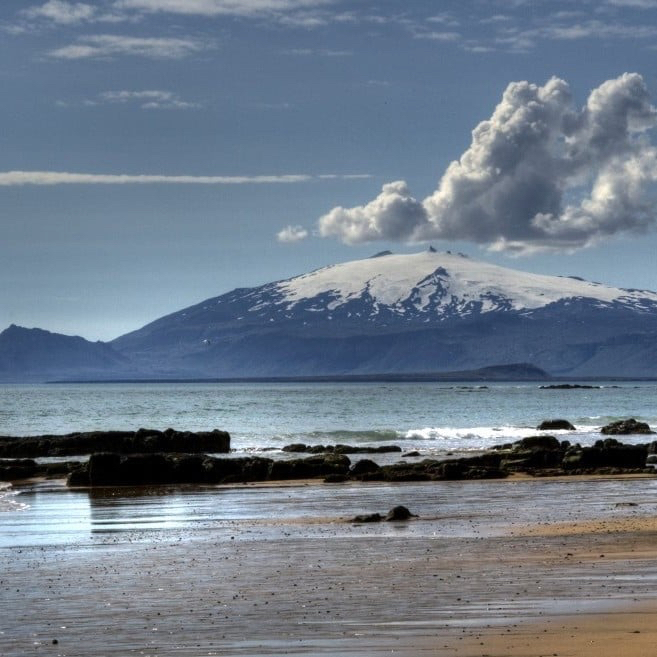
I wanted to move on from the characters and premises of the trilogy at this point. I decided the next book would be set in Iceland. I originally had some vague ideas about setting it in modern Iceland and making it a paranormal mystery, but that is not the story that Iceland told me. I went to Iceland and visited many areas associated with the supernatural and magic. In the Settlement days of Iceland a thousand years ago, magic was accepted as normal and necessary, and magicians served an accepted purpose. Even after Christianity came to the island, Christian priests were sometimes known to be magicians without any stigma attached.
I was standing deep underground in a massive lava tube in western Iceland when the story came to me almost full-blown. From that point on, everything I did was aimed at filling out the characters and plot. The people I talked to in Iceland were generous with their time and information—and again, I did the book research and even learned how to read Icelandic runes. (I’m out of practice now, so don’t ask for a reading.) It took me nine months to write “The Spell Book of Thorfinn Bare-Butt.” It isn’t on Amazon because I have been looking for an agent.
The lava tube where the story for “The Spell Book of Thorfinn Bare-Butt” came to me.Iceland is a wild and beautiful place.
If there is a Hades, he makes deceased writers eternally look for an agent in Hell. It’s like Sisyphus rolling the boulder uphill, or Tantalus, who can never reach the water or fruit to quench his thirst and hunger. I have contacted seventy-two agents so far without more than a “thanks but no thanks,” if that. I will keep trying for a while, but it was easier by far to find two publishers than it has been to find an agent.
In the meantime, I am trying my hand at a middle-grade fantasy. This is my first stab at world-building, and also my first serious attempt at writing for young people. My process? There is no location or culture to research, because they are entirely fictional and created by my own imagination. So my process is that I wrote a plot outline and now I sit at the computer and write. Works for me.
I am condensing these days because Covid aftereffects have slowed us down so much—me, in particular—that we didn’t do much.
On Day 23, Tom and I visited the Hofburg Palace, the imperial residence of the Habsburgs. I have said that once you’ve seen one palace, you’ve seen them all, and this is true of the Hofburg as well. It is actually a massive complex of palace buildings, but we only chose to see the Imperial Residences, which includes the silver and china collection, the Sissi Museum, and the residence of Sissi and Franz Joseph, the last rulers of the 600+ year reign of the Hapsburgs.
We entered the silver and china collection because someone directed us there, but not because we wanted to see it. It was rather like the funhouse of mirrors. We went around and around the exhibit, which was an endless collection of plates, candelabras, épèrgnes, bowls, basins, tableware, flasks, vases, etc., etc., including a monstrous gold centerpiece used for state dinners that must have been made in multiple pieces, as it went on forever. They don’t let you near that one, but you can see it through windows. We could not find our way out for the longest time, but finally emerged and entered the Sissi Museum.
Sissi was the Empress Elisabeth, known as Sissi all her life. She married her first cousin Emperor Franz Joseph when she was 16. She reminded me of Princess Diana. She was raised in a carefree atmosphere in Bavaria, but the Habsburg court was rigidly bound with traditions and rules that she found constraining in the extreme. The marriage was happy at first, and Franz Joseph seemed to adore her without ceasing, but after the birth of their last child, Sissi began spending all her time away from court. Under the excuse of ill health (some of which was caused by her poor diet and beauty regimen), she traveled widely, returning only rarely to Vienna.
Sissi and her 20-inch waist.
The couple’s only son and heir, Crown Prince Rudolf, committed murder-suicide with his 17-year-old mistress, Baroness Mary von Vetsera. This is referred to as the Meyerling incident as it took place at his hunting lodge in Meyerling. Apparently Rudolf shot the poor child, then sat there for several hours before offing himself.
The worst part of this was that Mary wasn’t even his first choice for this grisly double suicide. Rudolf had first asked a courtesan, who had the good sense to to turn him down. Mary, whom he had seduced and who was, at 17, emotionally vulnerable, agreed. Rudolf had syphillis, which he generously shared with his wife, Princess Stephanie, who became sterile. No doubt that explains in part his choices in life and in death. Poor Mary was disinterred several times over the years by people trying to prove various theories of what “actually” happened.
After this scandal, Sissi wore black for the rest of her life. She wrote a great deal of self-pitying poetry about how she longed for the sea, or wanted to escape on the wings of a seagull, and no one ever born could understand her. The original drama queen.
However, no one deserved to die as Sissi did. She was assassinated by an Italian anarchist in Geneva. She wasn’t even his first choice; he was in Geneva to kill the Duke of Orlėans.
As far as I could tell, Sissi spent most of her time on herself: her ankle-length hair took two to three hours to arrange and an entire day to wash. She starved and exercised to maintain her 20-inch waist and developed a horror of fat women which she passed on to her daughter, who was terrified when she met Queen Victoria—a royal not known for her wasp-waist. Sissy’s obsession with remaining a great beauty is reminiscent of some modern women I could think of. She refused to have photographs or portraits taken after the age of 30.
On the plus side, she defied the court and her in-laws in many—most—ways, maintaining her independence and doing things her way. A narcissistic woman, but strong and independent.
Emperor Franz Joseph as a young man. He was saved from an assassination attempt by that high, thick, tough collar. He wore military regalia at all times unless alone with the family.
Franz Joseph, in contrast, was a hard-working and dutiful monarch who tried very hard to be the epitome of a good king. He was under the impression that he was abstemious, eschewing all luxury by, for instance, sleeping in a plain, iron bed. This, of course, was nonsense, as anyone touring his private apartments could see. I think he was well-meaning, though.
Anyway, when Franz Joseph died, that was the end of the Habsburg empire. Not entirely the end of the Habsburgs, though. They spread their DNA throughout Europe through intermarriage with other royal families. Queen Elizabeth II, for example, is a descendent of this vast royal family.
Once we got through this museum, Tom and I were wiped out. I had hoped to see the Imperial Treasury, but we just couldn’t do it. We stopped for lunch at the first outdoor cafe we came to, and it was absolutely delicious. Then we headed back to the Daniel Hotel for a five-hour nap, dinner, and then slept for 10.5 hours. This post-Covid thing is not to be taken lightly.
A better view of the sailboat sculpture that sits mysteriously atop the Hotel Daniel, keeping the urban bees company.
On Day 24, we walked to the botanical garden next door, where we couldn’t read the signs, then had water and ice cream at the Belvedere Palace cafe. Then back to the Daniel for more napping. I feel I missed most of Vienna, thanks to the aftermath of Covid, but we have learned not to push it. We checked out and flew to Amsterdam, where we will depart for home.
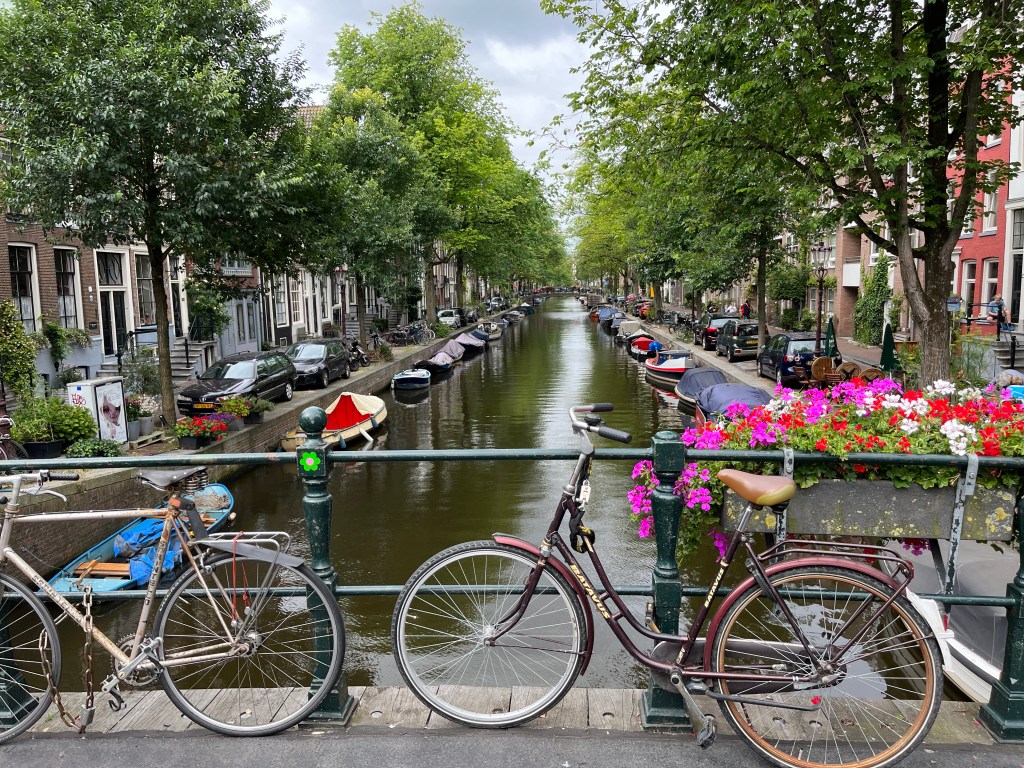
We are staying at the Linden Hotel. We checked in very late, around 11:30 pm. Exhausted, we fell into bed. I thought we would instantly be asleep, but the noise was ridiculous. We could hear every person who walked by, talking. Dogs barked, motorcycles roared, trunks rumbled by, and people kept it up until well after midnight. It sounded like they were all in our room. We finally fell asleep after all the late-night revealers went home. In the (late) morning when we got up, we discovered that all the windows in our pie-shaped corner room were wide open. We had been too exhausted to notice. We are hoping to have a better sleep our second night. It is a Sunday, too, so there should be fewer partiers out there.
On Day 25, we walked to an outdoor cafe for breakfast, then went to an apothecary to get some meds for Tom, who is still coughing. Then back to the hotel for more napping.
Tom in a little street near our hotel in Amsterdam.
I think this concludes my recording of our journey. We are too exhausted to do much, and tomorrow, we fly home. I can hardly wait. My advice to anyone recovering from Covid is not to push yourself as we did at first, thinking it was just like a five-day cold. Rest. Rest. And more rest. This stuff is serious, and I am hoping I don’t experience this deep fatigue for too long. It is truly debilitating.

















 obsidianmirrorblog