When the Going Gets Tough, the Tough Read Cozy Mysteries

When life gets tough, I tend to disappear into books. I had a rather difficult childhood and adolescence, during which I consumed literally thousands of books. As a teenager, I attended a private girls’ boarding school. I wasn’t happy with it, but I think I recognized it was a better alternative to living at home with my father, who was going through a really destructive phase of rage-drinking. During the summers I lived at home and I developed a safety schedule. I would start reading as soon as I got up, around noon. By this time, my father was out of the house and at work. I read, sequestered in my room, until around 4:00 in the morning. The primal danger was dinner time. My father would be home and drinking, and I was expected to attend a sit-down dinner with the family and assist with chores. I managed to stay out of the line of fire for the most part—reading was the one thing my father did not like to interrupt.

I still read lots of books as an adult, but since the election in November, I’ve been doing about a book and a half per day—far less than my adolescent average of four books daily, but it’s literally all that is keeping me from insanity at this point. My drug of choice? Cozy mysteries. I think it’s partly that in murder mysteries, justice is served and the wrong is righted. This is exactly what is missing from real life right now. 

The problem is that I have already read a huge number of cozy mysteries and I worked through much of my favorite authors’ work. Some are now dead, and I am not expecting much from them, but others—come ON, people, get working! G.M. Malliet, I am talking to you!

I started using Libby, the free library app for eBooks and audiobooks, and picked a few authors at random. I am overjoyed to share with you that I have discovered two authors entirely new to me that are highly binge-worthy. I am still working through their offerings and I am as happy as a pig in shit—as long as I keep reading and ignoring the world at large.

First, let’s talk about Elly Griffiths and her Ruth Galloway series. So far, I have read seven out of the seventeen books in the series. The stories are set in the north of England, in Norfolk, which makes a nice change from London, the Cotswolds, and Cornwall, which are favorite venues for murder mysteries. Ruth is a forensic archeologist who teaches at a fictional university. Because of her expertise, she is frequently called in by the local police to determine the age, gender, etc. of human remains. Ruth lives in a cottage on the Salt Marsh—another fictional location—an isolated, windswept, and bird-haunted area. Which is how Ruth likes it.

Ruth reminds me of Agatha Raisin. She isn’t like Agatha in any way other than being middle-aged, but she is an interesting and original character. She’s a bit overweight and usually prefers frumpy clothes because they are practical for digging. She’s introverted and likes her alone time out on the marshes. She’s passionate about her profession but wary of romance, although there is this one DCI who is special… One of her best friends is Cathbad the Druid. His real name is Michael Malone, but everyone calls him Cathbad, and often he turns up out of nowhere when most needed.

There is a touch of the supernatural that wends its way through these stories. It is done with a light hand and never spirals into ghost story territory. There is a tendency to use threats to children as the plot engine, but not every book is about children in danger. The sub-plots about who is sleeping with whom and who is the father of which little moppet create interesting complications that affect the main story. Who knew that Norfolk was such a hotbed of erotic passions?

Ruth is a likable protagonist because she feels real. She’s a introvert, but she cares deeply about people. She is far from perfect, but in relatable ways, like not wanting to go to a party or being annoyed with her boss. I’d love to have a glass of wine with Ruth and talk about bronze-age culture. Or murder.

The second author I discovered is Sujata Massey with her Perveen Mistry mystery series. (I love that the protagonist’s name is Mistry!) Perveen is a young Parsi (Zoroasterian) woman living in Bombay during the 1920s, while the British Raj still ruled India. Against many obstacles, Perveen has trained as a lawyer and works with her father, a well-known barrister. Under British law at the time, she could neither take her exams at Oxford, nor could she speak in court. She is allowed to work as a lawyer outside of the courts, writing contracts and so forth. Her one advantage is that she can deal directly with women in purdah for whom contact with men outside their family is forbidden. As Perveen is one of only two women lawyers in India at the time, there is a need for her services in that arena.

Perveen also must deal with the incredible complexity of the legal system in India in the 1920s. Different religious laws applied to Hindus, Muslims, Parsis, Jews, and Christians, while British law held sway over all. Despite Perveen’s family’s wealth and standing, as a woman, there is much she is unable to do professionally without jeopardizing her own reputation or that of her family or her father’s law firm. Perveen herself has a backstory that makes her life even more complicated, as she believes she can never marry or have children of her own.

The complexity of her society is part of the fascination of these stories. The caste system, the strict delineations between ethnicities and religions, the low status of women, and the divide between British and “native” all contribute to the colorful and complex tapestry of these mysteries. The stories are richly atmospheric, allowing the reader to experience second-hand the heat, the smell of spices, the texture of saris, the sounds of monkeys and birds that the author conjures up from an India of the past.

Perveen is an appealing protagonist, but not because she is “bucking the system.” I get annoyed by historical fiction depicting women living in the past but with modern sensibilities around women’s rights and behavior. Perveen is no rebel. As an Oxford-trained lawyer, she is in a peculiar situation for a young Parsi woman, but she got there in a traditional manner: by marrying the wrong man. She is just trying to make the best she can of her life without causing further problems or scandal. Her intelligence allows her to devise unusual solutions to desperate problems. 

If, like me, you need to dive into other worlds to escape the unpleasantness of this one, I highly recommend these two mystery series. (I also read a stand-alone mystery by Elly Griffiths, “The Stranger Diaries,” and could not put it down.) Here are the series book titles, in order:

Ruth Galloway Mysteries:

The Crossing Places

The Janus Stone

The House at Sea’s End

A Room Full of Bones

Ruth’s First Christmas Tree

A Dying Fall

The Outcast Dead

The Ghost Fields

The Woman in Blue

The Chalk Pit

The Dark Angel

The Stone Circle

The Lantern Men

The Man in Black

The Night Hawks

The Black Room

The Last Remains

Perveen Mistry Mysteries:

The Widows of Malabar Hill

The Satapur Moonstone

The Bombay Prince

The Mistress of Bhatia House

Ooops. Looks like I just ran out of Perveen Mistry books. Please, Ms. Massey—write more!
Book Review: “Magpie Murders” by Anthony Horowitz


Mysteries are different from other genres in that the author has a specific contract with the reader. This contract says, roughly:
1. Thou shalt provide the reader with the clues needed to solve the mystery, if the reader manages to look at the clues in the right way.
2. Thou shalt not conceal the one piece of information needed to identify the criminal.
3. Thou shalt not make the criminal easy to identify because that would be no fun at all.
4. Thou shalt not invent random crap like time travel to explain how the criminal managed to pull off the crime.

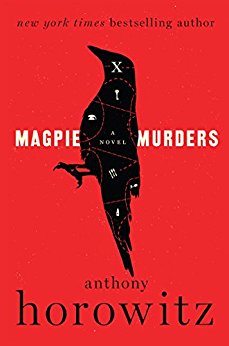
These restrictions can make mysteries rather formulaic, but great mystery writers rise above them. And occasionally, an author manages to pull off a tour de force that both respects the contract and rises above it. “Magpie Murders” by Anthony Horowitz is just that kind of mystery.

But before we get into the novel, let’s talk about the two basic genres of murder mystery: cozy and hardboiled. It’s actually more like two separate genres, because cozy readers often don’t like hardboiled mysteries, and vice versa. Agatha Christie is, of course, the great-grandmother of the cozy mystery with her English villages, eccentric detectives, crumpets and tea. Dashiell Hammett and Mickey Spillane epitomize the hardboiled mystery, with gritty, urban settings and down-at-heel, cynical detectives like Mike Hammer.

“Magpie Murders” is by definition a cozy and an English cozy at that. My favorite kind of mystery, in short. Don’t ask me why I am so enamored of vicars, fêtes and jumble sales—I just am. “But “Magpie Murders” is a cozy mystery within a cozy mystery, giving the happy reader not one but TWO mysteries to solve. The murders are unconnected except that the author of “Magpie Murders,” the book within the book, is also the victim in “Magpie Murders,” the novel.

Okay, that might have been a tad confusing so I’ll back up. The story opens with a book editor, Susan Ryeland, reading a manuscript. The manuscript, “Magpie Murders,” was written by Alan Conway, an enormously successful mystery writer and the mainstay of Susan’s employer, a small publishing firm. Susan warns the reader that the manuscript changed her life completely, and then we plunge into the story of “Magpie Murders.”

This story within a story is set in post-WWII England. An apparently accidental death occurs in Pie Hall, the residence of the local gentry, Sir Magnus Pie and his wife. But was it an accident? Small-town tongues are wagging. Then Sir Magnus is found dead in his front hall, decapitated by a sword from a nearby suit of armor. There are carloads of suspects, but nothing that makes any sense. Conway’s fictional detective, Atticus Pünt, is called in. Pünt appears to have solved the mystery—perhaps—by the time Susan Ryeland comes to the end of the manuscript. But the final chapters are missing. And then her boss gets a letter from Conway that sounds a great deal like a suicide note, and they discover he is dead, apparently having thrown himself off a high tower attached to his historic residence.

Susan begins investigating on her own because she needs to find the missing chapters—her publishing firm might not survive without bringing out Conway’s final book. She doesn’t find them, but does discover that someone has taken Conway’s notes and wiped all versions of the book on his computer. She begins to suspect that Conway was murdered. She also finds that there are several people who had excellent motives for murdering him, from his recently discarded lover to his next-door neighbor.

At this point, the reader is working on two murder mysteries, both taking place in English villages, and both involving assorted vicars, village residents, and mysterious visitors. Horowitz does a credible job of keeping the stories distinct. A lesser writer might have led the reader into an inextricable bog of confusion. I listened to the audiobook version, and splitting the narration between a man and a woman helped to keep the two stories straight. Samantha Bond narrated those portions told by Susan Ryeland, and Allan Cordune narrated the manuscript mystery. Both did an excellent job.

Eventually Susan solves the modern mystery and finds the missing pages. She nearly loses her life in the attempt, but then we get to read the end of the story-within-a-story. Both mysteries resolve satisfactorily and adhere strictly to the reader-author contract outlined above. I didn’t guess the solution to the manuscript mystery at all, and only sussed the modern mystery toward the end. Far from feeling frustrated by this, I am always happy when the author outsmarts me—as long as the author plays fair. “Magpie Murders” is one of the most enjoyable reads I’ve had in a while, and I will look for more mysteries by Anthony Horowitz.

Fans of Amelia Peabody, Rejoice!

I first encountered the Amelia Peabody mystery series immediately after my father died in a car crash. My mother was alone in a rented condo in Laguna Beach, CA. I flew to John Wayne Airport in Orange County after she called me with the news. I drove around lost in the dark for a few hours (this was pre-GPS), before I finally found the condo and my frail, shocked mother.

By the time we wept with each other and had a glass of wine, it was 3:30 am. Mom went off to bed. I tried but failed to sleep, so I rifled the condo’s bookshelves for something to read. There were several paperbacks left by former occupants, and I selected a book with the intriguing title of “The Mummy Case” by Elizabeth Peters.

And promptly fell in love. The doughty heroine of this mystery series is Amelia Peabody, a no-nonsense Victorian lady who inherits enough money from her father to set off on a grand tour of Europe and North Africa. In Egypt, she encounters a rude, abrasive, black-haired archeologist named Emerson who tends to bellow at her with rage at every turn. So naturally, they fall in love. (I have read everything Peters has written, under her two pseudonyms and her real name, Barbara Mertz, and I can always identify the romantic male lead by his rudeness and irascibility. This is a forgivable foible in my opinion.) I discovered later that Mertz was an Egyptologist, accounting for her extensive knowledge of archeology and ancient Egyptian history.

The mystery was well plotted, but more than that, I adored the humor and Amelia’s unique personality. Peters pokes gentle fun at Victorian conventions. Amelia is prone to admiring Emerson’s “sapphirine orbs” and “manly physique.” At all other times, she is practical, down-to-earth and prepared for anything. Another bow to Victoriana is Sethos, the “Master Criminal” who haunts their archeological adventures—but nurses an unquenchable tendress for Amelia.

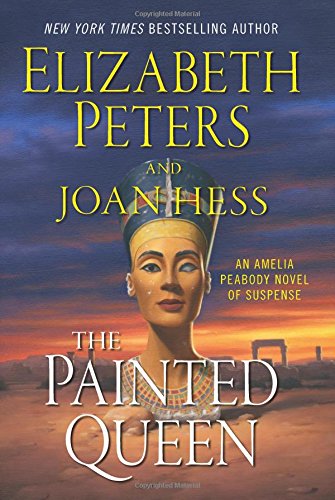
Loving the series and its distinctive voice, I was skeptical and a bit afraid to read “The Painted Queen.” Peters died in 2013, leaving a partially finished manuscript and notes for this novel. Her close friend and fellow writer and archeologist, Joan Hess, finished the book. Attempts to continue an author’s work as a franchise—álà the “Dune” series—usually disappoint. I doubted the book would succeed and satisfy.

I am so happy to tell you I was wrong. “The Painted Queen” is faithful to its author’s original vision and style. There were very few false notes. The main one is Emerson’s rather too-frequent declarations of undying passion to Amelia. Not that Emerson never does this, but he usually restricts himself to once or twice per book.

The plot centers on the spectacular and famous painted bust of Nefertiti that was discovered in the ruins of Amarna, site of Pharoah Ankhenaton’s capitol city. The bust was spirited out of Egypt by German archeologists and now resides in Berlin, but this story centers on skullduggery aimed at stealing the statue prior to its removal from Egypt—all fictional, of course.

I chose to listen to an audiobook version of the novel. Barbara Rosenblat, my favorite voice for Amelia, narrates this book. Rosenblat’s raspy tones suit Amelia’s brisk personality, and she handles the humor with subtle slyness. Rosenblat (who is American) employs a British accent with ease and her other accents—she is required to handle German, Arabic, and French voices—seem spot-on to me, though I have no real idea what an Egyptian Arab accent sounds like, outside of Omar Sharif. She delivers a sweet, melodic voice for young women and gruff male voices that are equally convincing.

All our favorite characters come together to tell the tale—including Master Criminal Sethos. There are kidnappings, murders, disguises, poison, hallucinogenic drugs, mistaken identities, and misdirections of all sorts as our heroes and heroines battle to save the bust from the clutches of the villains, dodging assassins as they go. It’s a satisfying adventure that wraps up every plot thread, with the exception of one. Ramses and Nefret, whom faithful readers will know are destined for each other but forever being torn apart—are now both free and obviously interested in one another, but they are not united by the end of the story. I believe there may be yet another Amelia Peabody tale in the future.

Given the deft, note-perfect character of “The Painted Queen,” I am very much looking forward to it.