
I didn’t think I would have to write this so soon. My cat Inca, my loving companion of 17 years, was dead on the floor when I got up the other morning.
I suppose she was lucky. She was rarely sick, and never seriously ill. She was still lithe and active, her fur thick and glossy. She attacked her evening treat last night with her usual impatient greed. She never suffered as some of my other pets have, with pain and illness. She didn’t have to be put down by the vet—a procedure that would have terrified her, as she was a very shy and nervous girl. Instead, she passed away, apparently in her sleep, with her people there, though we knew nothing about it until the morning. I guess I would be happy to go the same way.
But there is a painful, Inca-shaped hole inside me right now. So let me tell you about Inca.
I got Inca right after my beautiful cat Phoenix died of cancer (actually of vet, but the end was very near). I was heartbroken, but a friend said I should rescue another cat in Phoenix’s honor—he was sure it would make me feel better. (Incidentally, he was right.) I started looking at shelter cats and ran into an organization called 13th Street Cat Rescue in San Jose, CA. I asked about a black cat they had because the very first cat I remember was my brother’s black cat, Flinky, and he was a very sweet boy. The cat I asked about was taken, but they asked if I was interested in adopting a black cat, because people are often highly superstitious about them, so black cats (and other melanistic pets) tend to sit on the shelf. The organization happened to have a nine-month-old black cat, part of a litter that had been rescued from a trailer park. The kittens had been too old for adoption, but the trailer park manager threatened to kill the whole lot if 13th Street didn’t take them.
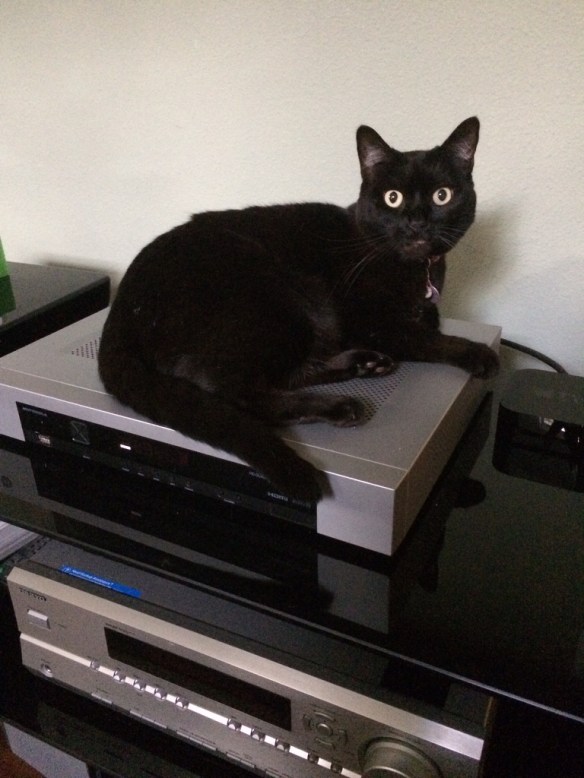
It turned out all the kittens, though feral, were adapting nicely to domestic life. Inky (as she was called then) was no exception. I met her at one of the volunteers’ houses, and she sat on my lap and purred. Inca was beautiful, black with bright yellow-green eyes. She always had a few scattered white hairs among the black. In the sunlight, her fur looked chocolate brown.
We agreed to adopt her. I’m afraid I could not have a black cat named Inky. First I tried naming her Flinky, after that first black kitty, but it never suited her. The name Inca just came out of the blue one day, and I loved it right off. It seemed to suit her elegance.
At the time, we had a wonderful dog named Gigi. Gigi was a German shepherd-Labrador mix, 75 pounds, and, though a sweet and gentle dog, she was obviously terrifying to a tiny black cat. We kept Inca sequestered in a bathroom for a week, then let her out into the house. We really didn’t see her for the next two weeks—just a flicker of black at the corner of the eye, like a bat.
Then one day I was sitting on the couch and Inca strolled calmly into the room and jumped into my lap. I petted her, delighted, and she purred. After a few minutes, Gigi entered the room and I braced for a cat freakout. Instead, Inca ran down the length of the couch toward Gigi, mewing loudly. Gigi came over, and they kissed each other. Somehow, without my ever observing it, Gigi made friends with this timorous wee beastie and convinced her she was in a safe place. Their friendship ended only when Gigi died. I have many photos of the two of them cuddling together.
After Gigi died, Inca became even more attached to her humans, especially my husband, Tom. She began to sit on his lap at night when he watched TV. She was never a playful cat. Once in a while she would bat a toy around for a few minutes, but that was the extent of it. She didn’t have cute habits or do funny things, But she was a powerful engine of love and cuddles, happy to be petted at any time of the day or night.
Inca was also the best-behaved cat I have ever had. She didn’t potty outside her box. She didn’t scratch the furniture. With the exception of one fern, she never touched an indoor plant (the fern survived). She was the opposite of picky about food, eating whatever I put in front of her. She didn’t destroy stuff. Once in a while, we did get cat gak, but hairballs are part of being a cat. She bit gently when she felt affectionate, but rarely scratched. She loved our grandchildren and was gentle with them.
Inca did not like her tummy to be touched. If her tummy was stroked, she did that cat thing, turning into a ball of needles. After Inca was introduced to civilization by Gigi, the two of them tended to go with me wherever I was in the house. One day, Gigi laid down for a good tummy-rub and I obliged her. I rubbed and rubbed, and Gigi moaned with happiness as Inca watched. When I stopped rubbing Gigi’s tummy, Inca flopped over and presented her tummy for a rub. She found that she enjoyed it and would often ask for a tummy rub in the years to come. I was very intrigued that she observed, learned, and experimented.
She even learned some tricks at an advanced age. As she aged, she was still active, but could no longer jump to the top of the bed like Superman in a single bound. I bought her some stairs so she could climb our bed without clawing her way up the sides, shredding the bedclothes and on one occasion, me (it was an accident, but still). She would look at me with those bright eyes, clearly planning to scramble up the side of the bed, and I started gesturing to the stairs and telling her “Go up the stairs.” She learned to do this on command and (mostly) stopped clawing her way up the sheets.

I was facing major surgery and worried that Inca would continue to treat my body as a nice place to stomp around in the evenings. I never could figure out why she sat calmly on Tom’s lap, but wanted to stomp around on me. I had to teach her not to stand on my body, which must have been confusing to her after so many years of doing so. But she did learn, and only ran over me once after the surgery—right over the incision, as it happened. But mostly, she remembered not to. I felt kind of bad about making her stay off me (though I welcomed her to cuddle by my side), especially now, knowing how little time she had left. I did stop many times throughout every day to pet and cuddle her; I wanted her to know that I loved her as much as ever.
Inca was still so beautiful and healthy at 17 years old that I was convinced she would last a couple of years more. Unlike other elderly cats I’ve had, she did not become skinny, her fur was still thick and shiny, and she was as enthusiastic about food, treats, and petting as ever.
When I found Inca’s body yesterday morning, she was already stiff and cold. I wrapped her in a clean towel, but her bowels and bladder did not void after death. She exited this life as she lived it—tidy, without making a fuss.
I miss my friend. I really, really miss her.









 obsidianmirrorblog