Good Versus Evil

I have spent many hours that might have been more productively spent weeding a garden thinking about the nature of good and evil. Like many of my species, I have questioned why there is evil in the world. (Presumably there is evil in the universe as well, but my experience is limited.)

I was brought up Episcopalian (Catholic Lite). The Judeo-Christian explanation of good and evil makes perfect sense until you start asking questions: “If God is good and all-powerful, why doesn’t He just get rid of the Devil and make everything wonderful?” That’s when Father Cummins would narrow his eyes, purse his lips and croak something like, “The Devil is there to test your faith. Copy this 500 times on the blackboard.” A few more answers like that, and I learned to shut up, which was what Father Cummins wanted in the first place.

I no longer believe in the Devil. Or Santa Claus. Or any number of other things I believed in as a child. But there are things in the world that I can only classify as evil, whether or not there is an actively evil entity behind them. Much of what I perceive as evil is unnatural: murder, kidnapping, cruelty. But there are so many cruelties that occur in nature. What a mother wasp does to nurture her babies is a living hell to the spider she catches. Is it evil if it’s a behavior an animal has naturally evolved to survive? If I were on the receiving end, I don’t think I would have any doubts about it, so maybe it’s all a matter of perspective.

And then there’s deliberate evil, committed with knowledge of the consequences and executed without the excuse of needing to do it to survive. As a child of the 1950s, I believed the brightly illustrated textbooks that told me about the beauty and natural riches of our great nation. Imagine my shock and astonishment when I discovered in my teens there were rivers so polluted that they periodically caught on fire. If you fell into the Potomac, you had to rush to the hospital for treatment because of the sewage in the river.

People were knowingly pouring poisons into the air they and their children breathed and into the water they and their families drank. I found this gobstoppingly unbelievable—and still do. Doesn’t this kind of behavior qualify as evil? Why would anyone in his or her right mind do something like this?

There’s been some progress in curbing various forms of pollution, but there are still those who try to game the rules and get away with it. It seems to be a constant battle to retain clean air and water standards, or to keep endangered animals on the protected species list. (Of course, a lot of them have fallen off the list because they are now extinct.) And don’t get me started on the climate change deniers, or the people who want to build more nuclear power plants. (Chernobyl. Three-Mile Island. Fukushima. Does anyone remember?)

My bemusement over these issues was one reason I wrote “The Obsidian Mirror.” I tried to imagine what would influence people all over the world to deliberately ignore the damage they were causing to the world, the environment, other people, their families, and themselves. It’s a fantasy novel, so the driving evil is the ancient meso-American god Necocyaotl (which means The Obsidian Mirror or The Smoking Mirror in Nahuatl). As the novel is set in present-day Silicon Valley, I devised a modern, technological way that he could disseminate his nefarious influence worldwide. (No spoilers; I’m not going to tell you how he does it.)

In contrast, my heroine Sierra loves nature and likes to hike and camp. She doesn’t want to see the wild places spoiled and destroyed. Not being stupid, Sierra is reluctant to take on an ancient, evil god—but she does.

I tried hard not to get preachy about the environment. There are lots of dramatic clashes between the camps of good and evil and a romantic subplot. And humor. I’m a firm believer that you can’t convince anybody of anything unless you season it well with humor. But the underlying theme of the book is doing the right thing for the world.

Just my little stand against the forces of darkness.
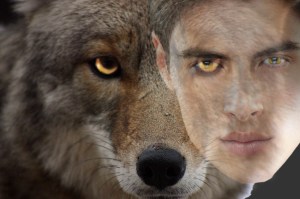
Talking Coyote? Holy Mannegishi!

Well, I did it. I wrote a novel, titled “The Obsidian Mirror.” And, yes, it WAS on my bucket list. Now I’ve reached the inevitable next stage of writing a book; I’m trying to get it published.

But I get ahead of myself. Maybe I should explain how I came to write a contemporary adult fantasy novel, in the process becoming entangled with a talking coyote and a mannegishi. Bear with me; I will explain.

In January 2007, I finished reading a fantasy novel. I can’t remember which one, but it was a familiar scenario: armored men in cloaks riding horses and fighting each other with swords. There were also elves, dwarves, trolls, wizards—you know what I’m talking about. Not that it was a bad novel; I thoroughly enjoy this kind of story and am a huge “Lord of the Rings” fan. But I found myself wondering why most fantasies seem to be set in a pre-industrial, proto-European world with all the trappings, such as dragons and/or faeries.

Why, I wondered to myself, aren’t more novels based on American archetypes? The rich landscape of Native American tradition, the awfulness and grandeur of the Maya and the Inca, Vodun (you probably call it Voodoo), and folk tales from every region all offer an amazing breadth of ideas and potential for fantasy.

I’m not an expert in these things, but I did pick up an appreciation for Native American culture from my mother, who was an archeologist prior to WWII, specializing in Southwestern Indian cultures. My childhood home included such necessary décor as ancient pots and arrowheads, pre-Columbian art, and a skull named Yorick.

Also—for reasons that I cannot explain—I have always been interested in Vodun and have read several books on the subject, including the amazing non-fiction book “The Serpent and the Rainbow,” by Wade Davis. I had a small adventure in the Voodoo Museum of New Orleans, but that will have to wait for another blog post.

In early 2007, my freelance writing business hit a slow stretch, so I whiled away some of the hours by writing a novel rooted in American archetypes, just to see where it would take me. I went about researching the novel in the most cavalier way possible; I would troll around the Internet until I found something that struck my fancy, and I’d use it. The resulting story contains a mishmash of North American, South American, Caribbean, and Canadian folklore and legend. In some cases, I have attributed supernatural beings to one tribe that rightly belong to another. Well, if C.S. Lewis could do it, so can I.

I set my story in present-day Silicon Valley because this is where I live and work. I made my protagonist, Sierra Carter, a public relations executive because this is what I used to do before I decided I was really more interested in writing than in bugging other writers (journalists) to write about whatever doodad my clients were selling. (Sierra is not me, by the way. She’s much younger and more athletic, and she reads non-fiction more than fiction—so not me.)

In selecting Sierra’s magical companions, I knew I wanted to use Coyotl. The coyote figures in many Native American stories as the Trickster. Like Loki in the Norse myths, or Anansi in West African and Caribbean folklore, Coyote is always playing tricks, and the tricks sometimes turn out quite differently than he intends. Often, he is portrayed as a friend to people, bringing them fire from the gods or solving their problems accidentally when one of his tricks goes wrong.

This, of course, is where the talking coyote comes in. In my story, Coyotl is able to take the form of a ridiculously handsome young man called Chaco. Chaco is sweet, helpful, intelligent, sexy—and a bit unreliable.

The mannegishi is Fred, which is more pronounceable than his real name, Shoemowetochawcawewahcatoe (meaning “High-backed Wolf” in one of the Native American languages). Mannegishis, according to Wikipedia, are “semi-humanoid, being sexdactylous humans with very thin and lanky arms and legs and big heads minus a nose.” A description I read of the Dover Devil, sometimes identified as a mannegishi, mentions greenish skin and large orange eyes. Who could resist? Fred, while lovable, makes Chaco look like the Rock of Gibraltar in the reliability department.

So my characters mutinied, took over the project, and left me swimming in their wake, trying to catch up. Now, five years later, here I am, arms wide, looking for a publisher to love.

Why did it take me five years to finish, you ask? Well, I write for a living. It’s hard to write all day and come home and relax by writing all evening. The other reason is that I have a lot of interests, which is diametrically opposed to being an author like Isaac Asimov, who pretty much hated doing anything but sitting in front of his typewriter. Asimov, undistracted by external interests, wrote 515 books (not counting individual short stories, individual essays, or criticism). I, like Sierra, design and fabricate sterling silver jewelry. I have a close-knit family and circle of friends, and enjoy spending time with them. I like to travel, I sometimes paint in oils, I belong to a cooperative art gallery, I love good wines and food—oh, an endless list of things I enjoy. It’s a miracle I ever finished this book, in fact.

But I did.

Know any good fantasy publishers?