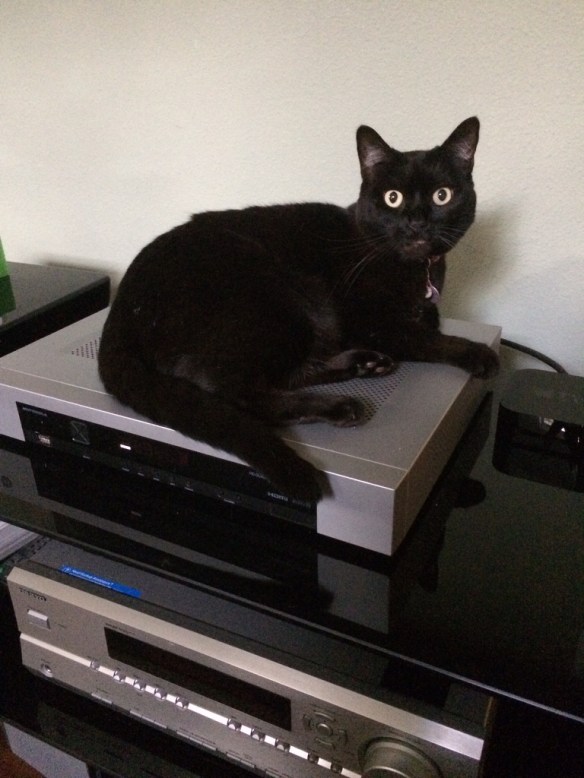
I didn’t think I would have to write this so soon. My cat Inca, my loving companion of 17 years, was dead on the floor when I got up the other morning.
I suppose she was lucky. She was rarely sick, and never seriously ill. She was still lithe and active, her fur thick and glossy. She attacked her evening treat last night with her usual impatient greed. She never suffered as some of my other pets have, with pain and illness. She didn’t have to be put down by the vet—a procedure that would have terrified her, as she was a very shy and nervous girl. Instead, she passed away, apparently in her sleep, with her people there, though we knew nothing about it until the morning. I guess I would be happy to go the same way.
But there is a painful, Inca-shaped hole inside me right now. So let me tell you about Inca.
I got Inca right after my beautiful cat Phoenix died of cancer (actually of vet, but the end was very near). I was heartbroken, but a friend said I should rescue another cat in Phoenix’s honor—he was sure it would make me feel better. (Incidentally, he was right.) I started looking at shelter cats and ran into an organization called 13th Street Cat Rescue in San Jose, CA. I asked about a black cat they had because the very first cat I remember was my brother’s black cat, Flinky, and he was a very sweet boy. The cat I asked about was taken, but they asked if I was interested in adopting a black cat, because people are often highly superstitious about them, so black cats (and other melanistic pets) tend to sit on the shelf. The organization happened to have a nine-month-old black cat, part of a litter that had been rescued from a trailer park. The kittens had been too old for adoption, but the trailer park manager threatened to kill the whole lot if 13th Street didn’t take them.
Inca on her personal cat-warmer.
It turned out all the kittens, though feral, were adapting nicely to domestic life. Inky (as she was called then) was no exception. I met her at one of the volunteers’ houses, and she sat on my lap and purred. Inca was beautiful, black with bright yellow-green eyes. She always had a few scattered white hairs among the black. In the sunlight, her fur looked chocolate brown.
We agreed to adopt her. I’m afraid I could not have a black cat named Inky. First I tried naming her Flinky, after that first black kitty, but it never suited her. The name Inca just came out of the blue one day, and I loved it right off. It seemed to suit her elegance.
At the time, we had a wonderful dog named Gigi. Gigi was a German shepherd-Labrador mix, 75 pounds, and, though a sweet and gentle dog, she was obviously terrifying to a tiny black cat. We kept Inca sequestered in a bathroom for a week, then let her out into the house. We really didn’t see her for the next two weeks—just a flicker of black at the corner of the eye, like a bat.
Then one day I was sitting on the couch and Inca strolled calmly into the room and jumped into my lap. I petted her, delighted, and she purred. After a few minutes, Gigi entered the room and I braced for a cat freakout. Instead, Inca ran down the length of the couch toward Gigi, mewing loudly. Gigi came over, and they kissed each other. Somehow, without my ever observing it, Gigi made friends with this timorous wee beastie and convinced her she was in a safe place. Their friendship ended only when Gigi died. I have many photos of the two of them cuddling together.
After Gigi died, Inca became even more attached to her humans, especially my husband, Tom. She began to sit on his lap at night when he watched TV. She was never a playful cat. Once in a while she would bat a toy around for a few minutes, but that was the extent of it. She didn’t have cute habits or do funny things, But she was a powerful engine of love and cuddles, happy to be petted at any time of the day or night.
Inca was also the best-behaved cat I have ever had. She didn’t potty outside her box. She didn’t scratch the furniture. With the exception of one fern, she never touched an indoor plant (the fern survived). She was the opposite of picky about food, eating whatever I put in front of her. She didn’t destroy stuff. Once in a while, we did get cat gak, but hairballs are part of being a cat. She bit gently when she felt affectionate, but rarely scratched. She loved our grandchildren and was gentle with them.
Inca did not like her tummy to be touched. If her tummy was stroked, she did that cat thing, turning into a ball of needles. After Inca was introduced to civilization by Gigi, the two of them tended to go with me wherever I was in the house. One day, Gigi laid down for a good tummy-rub and I obliged her. I rubbed and rubbed, and Gigi moaned with happiness as Inca watched. When I stopped rubbing Gigi’s tummy, Inca flopped over and presented her tummy for a rub. She found that she enjoyed it and would often ask for a tummy rub in the years to come. I was very intrigued that she observed, learned, and experimented.
She even learned some tricks at an advanced age. As she aged, she was still active, but could no longer jump to the top of the bed like Superman in a single bound. I bought her some stairs so she could climb our bed without clawing her way up the sides, shredding the bedclothes and on one occasion, me (it was an accident, but still). She would look at me with those bright eyes, clearly planning to scramble up the side of the bed, and I started gesturing to the stairs and telling her “Go up the stairs.” She learned to do this on command and (mostly) stopped clawing her way up the sheets.
I was facing major surgery and worried that Inca would continue to treat my body as a nice place to stomp around in the evenings. I never could figure out why she sat calmly on Tom’s lap, but wanted to stomp around on me. I had to teach her not to stand on my body, which must have been confusing to her after so many years of doing so. But she did learn, and only ran over me once after the surgery—right over the incision, as it happened. But mostly, she remembered not to. I felt kind of bad about making her stay off me (though I welcomed her to cuddle by my side), especially now, knowing how little time she had left. I did stop many times throughout every day to pet and cuddle her; I wanted her to know that I loved her as much as ever.
Inca was still so beautiful and healthy at 17 years old that I was convinced she would last a couple of years more. Unlike other elderly cats I’ve had, she did not become skinny, her fur was still thick and shiny, and she was as enthusiastic about food, treats, and petting as ever.
When I found Inca’s body yesterday morning, she was already stiff and cold. I wrapped her in a clean towel, but her bowels and bladder did not void after death. She exited this life as she lived it—tidy, without making a fuss.
In my last post on the subject, I explained that I have been unable to move past a set-point weight. I have been at the same weight for almost two years, giver or take a few pounds
No one can continue to deprive themselves and do things they don’t want to do for two years in pursuit of an unattainable goal. it’s just not human nature. I confess there were weeks in which I decided that being fat wasn’t the worst fate in the world. Chocolate and red wine played a large factor in those weeks.
As I detailed earlier, I tried everything in the book to try to break past that stubborn set-point. I couldn’t believe that nothing was working. (I am still unwilling to do the 10-day vegetable cleanse.) So I decided to increase my cardio again and skip lunch, having a protein drink instead (I add a medium-sized banana to the smoothie for texture and ballast). I started doing six miles a day on the recumbent bike, with the intention of working up to ten.
Last week, I weighed myself, and I was five pounds over the set point. Today, I weighed myself, and I am five pounds UNDER the set point for the first time in who knows how long. I almost woke my husband up to tell him, but he was up late last night so I took pity on him.
Totally made my day. I am still grinning. Now I have to keep it going. My personal trainer (“Lord Taskmaster”) is pushing for weight training prior to doing the cardio because he swears it gets the weight off faster (and he is the personal trainer, so he probably knows more than me). So I’ve started doing that as well. He is also pushing for seven miles. All in good time, your Taskmastership.
It has been a long time since I last posted. With regard to my Big, Fat Weight-Loss Campaign, it’s because it got complicated.
I lost 55 pounds or so in one year. The next year, despite continuing to diet conscientiously and exercising regularly, I lost no weight at all.
None.
I made changes. I was using the Weight Watchers method. I switched to counting calories. I was exercising a few days a week. I upped it to six days a week, alternating cardio and weight training.
Nada.
I started taking protein supplements. My nails went from paper-like to strong and long, and my hair thickened as well.
Not another ounce came off.
I consulted a nutritionist who wanted me to go on a cleanse for 10 days eating nothing but protein and vegetables. This is intended to improve bile production and reduce blood sugar because she couldn’t find anything else impeding my weight loss. I bought her protein powder and supplements, but suddenly, I was scheduled for major surgery—a complete, reverse shoulder replacement. I decided to delay the cleanse, as the surgery was going to interfere in many ways with how my body was working and I didn’t want to play around with nutrition while I was in recovery.
The surgery went fine and I’m glad I did it even though the six weeks in a sling was tedious and uncomfortable. Still, the discomfort was far less (after the first week) than before. Prior to the surgery there were days when I was hurting so much I couldn’t leave the house. As I was lying on a gurney waiting for surgery, I was in so much pain I asked for pain-killers (I was unable to take any prior to getting to the hospital because I was following the surgeon’s orders about taking medication and water.) Bless the nurses. They got me pain-killers. I was grateful because I spent a long time on that gurney.
Then I spent six weeks doing nothing at all except watching television, reading, eating, and doing physical therapy. I couldn’t drive and I didn’t want to leave the house if I didn’t have to. After this slugfest I was sure I would gain weight, but I did not. I’m back to counting calories and just resumed cardio on a recumbent bike.
To be honest, I don’t want to do the cleanse if I can avoid it. I would have to fix all my meals separately from the rest of the family, and just protein and vegetables sounds…boring. I will still do it if I have to, but I am hoping that the surgery did a reset and my body will once more be open to shedding pounds.
#
I had never heard of a total reverse shoulder replacement until I was told I needed one. It’s a technique they use when there is so much damage to the joint that a standard replacement won’t work as well. I have severe arthritis, which pretty much destroyed the humeral head (the “ball”) of the humerus (upper arm bone) and resulted in bone-on-bone action and bone spurs.
The procedure is to expose and dislocate the joint. The humeral head is sawn off and replaced with a titanium and plastic cup which is inserted into the humerus. A titanium ball is screwed into the shoulder blade. Thus, the structure of the joint is reversed. It’s kind of a brutal surgery, and I am DEEPLY grateful for anesthesia. The surgeons did an amazing job, and after the first week, I stopped taking opioids and used only Tylenol and CBD for the pain, which has diminished daily. I have good mobility for this stage of healing (because I do the physical therapy exercises religiously). I don’t think I will ever have the complete range of motion that my other shoulder has, but I’m OK with that—I’m no longer in agony. And at 74, I have no ambition to become a trapeze artist.
On the one hand, I have lost 55 pounds in about two years—45 of them during 2024. On the other hand, I have been stuck at the same number for about six months, and I can’t seem to move past it.
There are a few reasons for this. One reason is that my left knee decided to join my right knee by becoming incredibly painful. At times, I could walk only with the help of two canes. This meant that the exercise program came to a grinding halt. Off I went to the orthopedic surgeon to get shots of hyaluronic acid gel. Not much improvement, so the doc felt around a bit and determined I had a “Baker’s cyst.” This, it turns out, is very common in people with arthritis. It is a cyst that forms at the back of the knee, filled with synovial fluid. (Hyaluronic acid is a precursor to synovial fluid, but the cyst appeared prior to the injections.)
So the doc gave me a cortisone shot—and I immediately felt much worse, and took up both canes to walk again. So I spent probably two months or more sidelined from exercising. The knee gradually improved to the point where I started going to the gym again, but I decided to go to physical therapy to see if I could improve the situation a bit further.
The therapist thought the issue was not the Baker’s cyst (although it is definitely there), but an irritated meniscus. He gave me a simple leg-lifting exercise, and told me I would be way better in two weeks. He encouraged me to do the exercise as much as possible. I did a few reps the following day—and everything got worse. (I was spending a FORTUNE in CBD transdermal patches, by the way.) I reported this to the PT people, and during the next visit, I was assigned to another therapist, Kristie, whom I have worked with previously. Kristie determined that my knee was misaligned and I had probably been doing the leg lifts improperly. She gave me other exercises to do, and now, after about two weeks, I am almost pain-free!
Knowing that the knee is misaligned has been very helpful. For example, when I relax with my legs flat, either on my back in bed or sitting up in bed watching TV, my feet tend to rotate outwards significantly, especially my left foot, which shoves the knee out of kilter. I thought about this for a while and realized that for many, many years, I have allowed the weight of my bedcovers to force my feet outward because the pressure hurt my toes. So I bought a “blanket lifter” that keeps the bedclothes elevated over my feet—the relief is incredible. It also allows me to comfortably keep my feet—and ankles and knees and hips—in alignment. Zach, my trainer, suggested that my athletic shoes might be overly worn, and they were. I pronate badly (see misaligned feet), and the soles were badly worn on the outsides. So I bought new shoes. I am thrilled with my return to relative comfort and now I need to get back on the exercise trail in a more serious way.
I weighed myself and I haven’t gained any weight in the past few months, so that is the good news. Encouraged by this, I measured myself and found I had lost 5 inches from around my chest, 7 inches from my waist, and 11 inches from my hips. While I don’t think I will lose a lot of weight during the holiday season, I intend not to gain any either. That seems doable, right?
Note: I am taking a break from “My Big Fat Weight Loss Campaign.” I hope to have positive progress soon, but right now I am stuck in the doldrum of dieting, despite Ozempic. Here’s something else to chew on.
I have been rewatching Star Trek: The Original Series (ST:TOS to fans), which is the first time I have viewed the series since its original airing in the 1960s. I just watched an episode called “Turnabout Intruder,” story by Gene Roddenberry and teleplay by Arthur H. Singer. It’s an episode I have no memory of. Apparently it was pre-empted by a presidential speech at the time it was supposed to air. It aired later, but I must have missed it.
Briefly, the story is that Kirk visits Camus II, responding to a distress call. Among the survivors are one of Kirk’s former girlfriends (right on brand here, but there’s a twist), Dr. Janice Lester, and a physician, Dr. Arthur Coleman. It quickly becomes apparent that Dr. Lester and Kirk did not part on friendly terms. Kirk was going off to be a starship captain. Lester also wanted to be a starship captain–but was not allowed to hold that position because of her gender. She was angry, and took it out on Kirk, who skedaddled off to the stars.
Hold on–it’s the year 225something, and WOMEN ARE NOT ALLOWED TO CAPTAIN STARSHIPS. It kind of made me sad that Roddenberry’s vision didn’t stretch to that.
Continuing with the story, Dr. Lester assaults Kirk and subjects him to an alien technology that switches their personalities or selves into the other’s body. So Kirk is now in Lester’s body and vice versa. Her claims that she is actually Kirk are dismissed as illness, but Spock does a mind-meld with her and knows the truth. Spock attempts to free “Lester,” but is caught.
Kirk (actually Lester) calls for a court-martial of Spock, with himself, Scotty and Bones as the judges. During the procedure, Kirk (in Dr. Lester’s body) is allowed to testify, and this is what Kirk says about Lester: “Most of all, she wanted to murder James Kirk, the man who once loved her. But her intense hatred of her own womanhood made life with her impossible.”
Really? Was it “her intense hatred of her own womanhood”? Or was she an ambitious person who was deeply thwarted, all because she lacked a penis?
During this show trial, Lester (in the person of Kirk) does some table pounding and red-faced shouting. Scotty and Bones meet outside the courtroom to confer. Scotty says. “I’ve seen the captain feverish, sick, drunk, delirious, terrified, overjoyed, boiling mad, but up to now, I have never seen him red-faced with hysteria.”
“Hysteria,” of course, is a dog-whistle for “like a woman.” I assume most people know that the word derives from a Latin word meaning “womb,” as the womb was believed to be the cause of it. Thus, men were considered incapable of hysteria.
At the end, Kirk and Lester are switched back by some unclear methodology. Janice Lester, back in her own body, collapses weeping in Kirk’s arms, and then in the arms of Dr. Armstrong, who has aided and abetted her all along. Armstrong takes charge of the sobbing woman and leads her away “to take care of her.”
Kirk puts the cap on it by noting, “Her life could have been as rich as any woman’s…if only…if only…”
I noticed he did not claim that her life could have been as rich as any man’s. And a woman’s life, it went without saying, is limited, and women should just accept these limitations and be happy with them.
Although I expected some misogyny/discrimination against women from TOS, this episode shocked me. As a woman born in 1950, it made me realize how far I have come in my own thinking that I could be shocked by this. There are now two generations of women who have grown up believing they are equal to men and deserve the same rights. I find this extremely encouraging.
As I mentioned at the end of my last post, I needed outside help to successfully lose weight this time. I couldn’t put on my Nikes and run a few miles. I wasn’t even supposed to walk for exercise anymore, due to one knee being bone-on-bone and the other knee threatening to go the same way.
And yet, I have never lost weight through diet alone. Exercise is half of the equation. (God, I hate exercising.) I had no idea how to exercise without making the knee worse—or what kinds of exercises I needed to be doing to prepare for surgery. Obviously, I needed to get expert help.
Okay, another thing I have avoided in the past is paying for something I think I ought to be able to do myself for free. I avoided any sport that required an investment in memberships or expensive equipment, such as golf or skiing. I hated the idea of health club membership because I thought I ought to be able to exercise on my own by walking. But health clubs are where they have exercise equipment, so I needed to join one. I signed up with the health club down the street, which I had used (infrequently) in the past. Endearingly, it is a part of the local “Toadal Fitness” group of health clubs.
Physical therapy was also on my list, but PT only goes so far. I wanted to hire a personal trainer, someone who understood which areas I needed to focus on, and who could tell me how to use the equipment and create a workout routine for me. I mentioned this to my physical therapist, who recommended two trainers who work at my health club. The trainers had undergone training at my PT’s practice on how to work with people with injuries and constraints. So I trotted down to the club and was introduced to Zach. Zach showed me around and listened to me, asked a lot of questions, and we talked.
I don’t know what your idea of a personal trainer is, but Zach wasn’t mine. I guess I thought a trainer would be a lot younger than me, nauseatingly fit, and perky. Zach is starting to push past middle age. He’s fit enough, but not the muscle-bound person I was expecting, and he has his own issues relating to age and injury, so I feel comfortable talking to him about my multiple physical shortcomings. He’s got a sense of humor, which I enjoy. He also pushes me—not hard, but enough that I make progress every time we have a session.
What are we working on? For cardio, I do the recumbent bike. When I started, I could only do a quarter of a mile before my knees became too sore to continue. I decided I would just do what I could do when I could do it. I told myself all I had to do every day was go to the club and bicycle for a quarter of a mile. That seemed easy enough, and it got me to the club. Before long, I was doing a half a mile, then three-quarters, and so on. I am at two and a half miles now.
The program I am using on the recumbent bike is a racecourse, which I carefully selected because its steepest incline is only 3%, and the incline doesn’t last long, either. Right now, I am going for mileage, not endurance. I hate hills, don’t you?
Zach works with me on the machines and weights. We started with machines that work the thighs and hips and the muscles above and below the knees. I am one of God’s Clumsy Children, and some of those machines—especially the clamshells, the ones you exercise your thighs on—are lurking deathtraps, just waiting to break bones. Zach watches me anxiously as I slowly negotiate these complex contraptions—getting in and out is the hardest part. So far, I haven’t broken me or one of the machines. I am actually getting more graceful as I get used to them. Any day now, I might try using them without Zach to watch over me like a mother hen.
I meet Zach once a week at my health club. I haven’t said much about the club, but it’s friendly, and a large percentage of the clientele has gray or white hair. It feels neighborhood. It isn’t fancy, but it has all the stuff, including a saltwater pool.
Now, what about diet? I lost a fair amount of weight in the past using Weight Watchers. I found it an easy program to follow, but I did not enjoy the meetings. I was eating unprocessed, fresh foods. The people in my meeting seemed to find the time involved in preparing fresh food unacceptable. To be fair, many of them had kids at home to feed and deal with, and I certainly could empathize with that, but the discussions weren’t centered around any of my concerns.
These days, you can purchase the WW app for your phone and not go to any of the meetings if you prefer (I do). The app allows you to look up the point value for a huge range of foods and adjust quantities. It tracks your points daily and weekly and keeps a food diary. You can create your own recipes for quickly entering meals you eat frequently. You can track your weight and the app adjusts your available points as you lose. It has lots of other features that track water consumption and exercise, and you can also look up WW recipes, but I don’t use all of its capabilities.
I was working with my doctor’s nurse practitioner, Ashzra, on all this. Ashzra questioned the Weight Watchers approach. She said I should be consuming no more than 1500 calories a day. Did WW conform to that? So for a week I tracked WW points versus calories. I was honest about it—WW counts certain things as zero points, such as fruit and fish, that still have calories. I tracked ALL the calories I consumed during that week. It turned out that using all the WW points for a given day came in at or under 1500 calories. One day, it was 1700, but I had come under the 1500 mark enough times that I was unconcerned.
So, physical therapy—check. Health club, personal trainer, and exercise program—check. Diet—check. The one element remaining was medication. The news is brimming with stories about the new weight loss drugs like Ozempic and Wegovy. The news is also full of how expensive these drugs are and how hard they are to get.
Next installment: Part 3—The New Weight-Loss Medication Merry-Go-Round
I don’t usually write about my “writing process.” (In point of fact, I hardly ever write things for this blog, but I’m trying to change all that.)
I had someone ask me once if I lit a candle before writing, or had a favorite shirt or something that I wore only to write. As someone who used to get paid to sit in an office and write all day, I find that notion hysterical. I can see me now: sitting in an open workspace in a Cisco Systems building, surrounded by my co-workers, wearing my favorite schlumpfy nightgown and fuzzy slippers, surrounded by rose-scented candles as I feverishly pound the keyboard. If that is what it took to inspire me to write, I would never have had a writing job. At least, I never would have kept a writing job.
My writing process is basically sitting down and writing. However, I do have a process for researching before writing, and it is the most enjoyable part. Until recently, I don’t start out with a story in mind. I decide where I want the story to be and I go there. I let the location tell me the story.
You might say that is an elaborate and expensive process for a fantasy writer. Why not just make it up?
There are a couple of reasons why not. First, I have placed most of my fantasy fiction in the real world (past or present). I have not (until my current WIP) made up an entire world and the way it works like Brian Sanderson, who is a master of world-building and magical systems. My first novel, “The Obsidian Mirror,” took place primarily in Northern California. This was convenient, as I have lived in Northern California for more than 40 years, so I didn’t have to do much location research. I did revisit a few locales to refresh my memory. I also researched Native American traditions and folklore, and also threw in Voudún and meso-American elements just because I find them interesting.
This is a fantasy rendering of my villain in “The Obsidian Mirror, Necocyotl. He is not a nice god.
I didn’t have a storyline before I started writing “The Obsidian Mirror.” Actually, I didn’t set out to write a book. I have done that before and never gotten anywhere. This time, I started with the concept of fantasy based on New World traditions and mythologies, which I hadn’t seen much of at this point. The first draft clearly reflected that I had written it by the seat of my pants. (Authors call this “pantsing.” Some writers do it well. I learned that I do not.) I rewrote the entire book and discovered that creating a plot outline is just a swell idea.
During the time I was writing “The Obsidian Mirror,” I also had a full-time writing job at Cisco Systems, and it was tough to write all day at work and come home and write for fun. I took a few “staycations” just to work on the novel. It took me seven years to write, but I did learn a lot about what to do/not to do when writing a novel, so it was hardly time wasted.
After ”The Obsidian Mirror” was published, I decided to locate the next novel in Hawai’i, using the same set of characters. Like a good researcher, I tried to make appointments with a few experts on Hawai’ian culture, but never received any replies to my emails. So I changed all my travel plans and went to Moloka’i. I had never been there, but I found ancient references to the island as “the island of sorcerers,” which sounded about right for my purposes.
I have told this story elsewhere (https://wordpress.com/post/theobsidianmirror.net/381Z), but long story short, before going to Moloka’i, I had an encounter with Pele, goddess of fire, and she blessed my work. Everything from that point flowed like hot maple syrup, so easily, so effortlessly, that I really did not doubt that I had been blessed. I met with every person I had intended to meet, and they gave me information so generously that “Fire in the Ocean” practically wrote itself. (I know that sounds woo-woo, and my husband would be the first to agree with you. I am not normally a woo-woo person, but I stand firm on this point. We still don’t know everything about this world or this life.)
Pele, goddess of fire.
I did a lot of book research for “Fire in the Ocean.” I read as much as I could from older sources about the religion and culture of the ancient Hawai’ians, with an emphasis on Moloka’i. Each of the islands had their own, slightly different culture, and I wanted this novel to be firmly rooted in the traditions of Moloka’i. I also wrote a plot outline for “Fire in the Ocean.” This time, the novel took me about a year and a half to write—a big improvement!
For the third novel in the trilogy, “Lords of the Night,” I had some difficult choices to make that involved whether or not to kill off a particular character. And there were some characters that had been central to “The Obsidian Mirror” and somewhat less involved in “Fire in the Ocean” that I just didn’t want to deal with in a third novel—but I also didn’t want to kill them. They didn’t deserve that. (Yes, these characters became absolutely real to me during the process of writing about them.)
So for various reasons—including that I just wanted to do it—I set the third novel in the pre-Columbian Mayan empire of the Yucatán Peninsula. This meant that I got to go to the Yucatán and wander around ancient ruins, which was irresistible. The story began to come together for me in the ruins of Calakmul, a once-great city in the middle of dense jungle. Calakmul was a peak experience for me. It is so remote that few tourists make it that far. The trees growing throughout the ruins made the heat and humidity somewhat more bearable. I had all the time I needed to wander and think. Calakmul—or as it was originally known, Ox Té Tuun—generated one of the major characters in “Lords of the Night,” a teenaged Mayan girl who was a strong enough character that she nearly upstaged my original characters, Sierra and Chaco. Again, the story almost wrote itself once I had generated a plot outline. The novel took me about a year to write—getting better!
Again, I did an enormous amount of book research for “Lords of the Night.” I read one of the few Mayan codexes still in existence, the “Popol Vuh,” in addition to books and academic articles on Mayan religion, culture, crafts, religion, and folktales.
This is a minor character in “Lords of the Night: a mosquito. It is rendered and colored from a Mayan painting. The Maya drew lovely little caricatures of animals, some, like this one, anthropormorphized.
Sadly, this is where I lost my publisher, which decided to publish only non-fiction going forward. My first two novels are still with them, but “Lords of the Night” is available only as a Kindle book. Talking to agents, editors, and publishers convinced me that no publisher was going to pick up the final book of a trilogy.
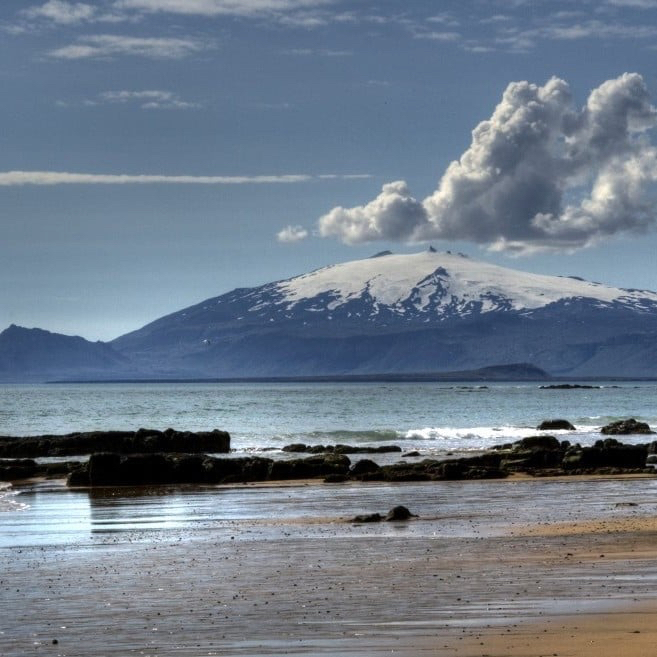
I wanted to move on from the characters and premises of the trilogy at this point. I decided the next book would be set in Iceland. I originally had some vague ideas about setting it in modern Iceland and making it a paranormal mystery, but that is not the story that Iceland told me. I went to Iceland and visited many areas associated with the supernatural and magic. In the Settlement days of Iceland a thousand years ago, magic was accepted as normal and necessary, and magicians served an accepted purpose. Even after Christianity came to the island, Christian priests were sometimes known to be magicians without any stigma attached.
I was standing deep underground in a massive lava tube in western Iceland when the story came to me almost full-blown. From that point on, everything I did was aimed at filling out the characters and plot. The people I talked to in Iceland were generous with their time and information—and again, I did the book research and even learned how to read Icelandic runes. (I’m out of practice now, so don’t ask for a reading.) It took me nine months to write “The Spell Book of Thorfinn Bare-Butt.” It isn’t on Amazon because I have been looking for an agent.
The lava tube where the story for “The Spell Book of Thorfinn Bare-Butt” came to me.Iceland is a wild and beautiful place.
If there is a Hades, he makes deceased writers eternally look for an agent in Hell. It’s like Sisyphus rolling the boulder uphill, or Tantalus, who can never reach the water or fruit to quench his thirst and hunger. I have contacted seventy-two agents so far without more than a “thanks but no thanks,” if that. I will keep trying for a while, but it was easier by far to find two publishers than it has been to find an agent.
In the meantime, I am trying my hand at a middle-grade fantasy. This is my first stab at world-building, and also my first serious attempt at writing for young people. My process? There is no location or culture to research, because they are entirely fictional and created by my own imagination. So my process is that I wrote a plot outline and now I sit at the computer and write. Works for me.
I will admit I am an infrequent blogger. It’s not because I’m lazy or have nothing to say. It’s because I have too much to say.
I wanted to keep politics out of my blog and focus on my novels, and curious things I have noticed, or journal my travels. I haven’t traveled in three years for obvious reasons, which eliminated one source of material. And my brain has been on political red alert ever since 45 was elected. His subsequent loss to Joe Biden did not douse my three-alarm brain fire. As his supporters continue to perpetuate 45’s vile lies and to behave like poorly raised six-year-olds, my anxiety over politics has not diminished one bit.
Even public health issues have to be politicized by the right, resulting in enormous numbers of deaths from Covid. Deaths that in many cases could have been avoided with simple precautions—which were also politicized.
The ugliness and willful ignorance of millions of the people with whom I share a country has been depressing and difficult to deal with. I once believed that most people are basically good, kind, and helpful. I now know beyond any shadow of a doubt that’s not true. Amid the right’s cheering for Putin in his bloody, terrorist war, the vitriol and denigration aimed at good people like Col. Vindeman, and the rightwing hero status of murderer Kyle Rittenhouse— I see a mindless mob, full of hatred and seething with resentment for anyone who isn’t just like them. I see people who have embraced Nazism, who wanted to overthrow our democracy and still do, who would, if given immunity, cheerfully slaughter their fellow Americans for being different in race, religion, ethnicity, sexual orientation, or political principles.
How did America, land of the brave, turn out so many ugly, hateful, ignorant people? I think Fox News, with its endless rabble-rousing and lies, is a huge part of the reason. The Republican Party used Fox as its official propaganda mouthpiece, but they did more, developing rightwing “think tanks” and research centers to bolster their own point of view. They nurtured resentment and anger, depicting Democrats as lazy, snowflake, pot-smoking losers on welfare with no religion, decency, or jobs. (I was accused of all that myself by Republicans.) I was told, at the age of 70 or so, to move out of my parents’ basement and get a job. (This was online, obviously. Anyone who saw me would realize my parents were most likely no longer on this planet.) One man told me that saying that Democrats went to church was a lie—no godless Democrats ever went to church. This is the kind of ignorant hysteria the Republicans have been cultivating for decades.
I could go on. And on. And on. But I’ve probably said enough about how dismal these people are. Why I want to know is how we fix this. I want to know how Fox News can get away for more than 40 years of lying and spreading false information without consequences. Why have we allowed uneducated trash like Marjorie Taylor Green and Lauren Bobert to profane the halls of Congress? How do we put this particular evil genie back in the bottle?
There are no easy solutions, but there are urgent ones. I think one of the most effective things we can do to muzzle Fox’s firehose of lies is to reinstate the Fairness Doctrine of the Federal Communications Commission (FCC).
Most people probably don’t remember the Fairness Doctrine because it was abolished under Reagan in 1987—thus opening the door to Fox News and other sources of grotesquely biased media. The Fairness Doctrine was introduced in 1949 by the FCC. According to Wikipedia, the Fairness Doctrine “…required broadcasters to devote some of their airtime to discussing controversial matters of public interest, and to air contrasting views regarding those matters. Stations were given wide latitude as to how to provide contrasting views: It could be done through news segments, public affairs shows, or editorials. The doctrine did not require equal time for opposing views but required that contrasting viewpoints be presented. The demise of this FCC rule has been considered by some to be a contributing factor for the rising level of party polarization in the United States.[5][6]“
Modern media—including social media, which didn’t exist in 1987—mandates that a new Fairness Doctrine must be updated to include these seismic changes in communications technology. But it is long past time to demand of the Federal government that the Fairness Doctrine be updated and reinstated to restrain the false information, lies, and propaganda flooding our media.
Please write your senators and representatives and demand that they support a new Fairness Doctrine for our modern world. Let’s pull Fox’s fangs.
Note: In the interests of transparency and truth, the image depicted with this post is not that of a fox. It’s a jackal. I think that would be a much better name for the organization under discussion–Jackal News. Anyway, none of the fox images I saw were snarling unless they were taxidermied. The live ones just looked really cute.
The following is the entirety of Chapter 1 from “Lords of the Night,” now available at Amazon.com:
“Who do you think you are, Chaco? A drill sergeant?” Sierra snarled. She slipped off the greased bowling ball, dropping the dishes she had been balancing on the end of a broomstick. The dishes shattered on the tile floor of her kitchen. She picked her way through the shards in oily bare feet, muttering, and seized a glass of water, gulping it as she wiped away the sweat pouring down her face and neck.
“I warned you this would be hard,” said Chaco. He passed a hand over the ruined dishes and they disappeared. He cocked his head at her, amber eyes steady.
“Yeah, you did,” Sierra responded. “But what the hell does standing on a greased bowling ball and destroying crockery have to do with becoming a sorceress? I’m not applying to Cirque du Soleil for a job.”
“Take a break,” Chaco replied peaceably, but his equanimity did not soothe her.
“I AM taking a break,” Sierra shot back. “Are you going to answer my question?”
Chaco lowered his lithe body into a chair, raking fingers through his dark hair. “As I told you when we started, the training is mental, spiritual, and physical. This is part of the physical training. A magic worker will often find him—or her—self in physically dangerous situations. You need to be strong, very strong, and your balance, aim, and precision must be honed to the highest degree. Think of yourself as an Olympic athlete…”
Sierra glanced down at her body, clad in shorts and tank top. She had been toned and on the slender side when she and Chaco had begun her training. Now she saw muscle definition in her thighs, where before they had merely been strong and well-shaped. The training was definitely making a difference. But god, she was working hard! And she hated it.
“I don’t get it,” she said, still cross. She knew Chaco was only doing his best to help, but at the moment, she didn’t care. “You never exercise. You never practice. Sure, you noodle around with trying new magics once in a while, but I’ve never seen you balancing on a greasy bowling ball. Do you do it when I’m not around or something?”
Sensing that Sierra was easing up a bit, Chaco laughed. “I’m a demigod. I don’t have to practice. When you become a demigod—or full-on goddess—you won’t have to practice either.”
“What? What are you talking about?”
“Well, you can’t expect to become a goddess overnight. You have to work at it. Like becoming Miss Universe or something.”
“Are you telling me that I’ll become a goddess if I continue the training?”
“Oh, no. There are no guarantees. Once you complete the training, there are still the traditional trials and tribulations.”
“I don’t want to be a goddess, Chaco. Your training sucks and I’m done.” Sierra put down her glass and stalked away, leaving Chaco in the kitchen, smiling to himself.
#
One year previously, Sierra had inherited a comfortable sum of money and a house from her fiancé, Clancy Forrester. There was only one problem; she suspected Clancy wasn’t actually dead. No body had been found and her friend Rose, who had witnessed Clancy’s fall from the side of a boat, said Clancy had never hit the water. If he had, he would have died, as the water was boiling from an undersea volcanic eruption.
The inheritance bothered her conscience, but she rationalized that if Clancy were alive somewhere, she would need the money to find him. She quit her job as communications executive with the Clear Days Foundation—a job she loved—to have the time to search for him. She thought Clancy would forgive her for selling his house and spending his money when and if she ever found him. And she knew she needed training to fully harness the powers that would enable her to find Clancy and rescue him from . . . whatever he needed to be rescued from. Unfortunately, she didn’t know what he needed to be rescued from. In point of fact, she also didn’t know when he needed to be rescued, but she and her friends were working on that.
While she was figuring out what she needed to do to find Clancy, she sold her own modest townhouse in Mountain View, California as well as Clancy’s highly sought-after ranch house in Sunnyvale. She added those proceeds to the three million dollars Clancy had left her in investments and began looking for a house where she could train in privacy. Her friend Rose, a Native American shaman, had suggested purchasing a remote cabin.
“You’re going to need privacy—real privacy—and alone time now,” Rose had said. “This training is serious business and you need to concentrate. And you don’t need nosy neighbors.” Sierra bought a cabin in a redwood forest in the Santa Cruz Mountains, which was remote enough to satisfy her friend.
However, Rose had refused to train Sierra herself. “You’ve already gone beyond me in strength,” Rose had said. “There’s really nothing more I can teach you.”
Sierra also asked her friend Mama Labadie to train her. Mama Labadie was a Voudún houngan whose ability to communicate with her loa—or at least with the loa called Madame Ézilée—had come in handy many times during Sierra’s earlier adventures. “No, uh-uh, and absolutely not,” was the houngan’s response. “You’re already scary strong. You should ask Madam Ézilée, not me. She might be strong enough to teach you before you get somebody killed.”
Kaylee, Sierra’s former work colleague and now a fast friend, was a Voudún practitioner, but claimed absolutely no occult powers. “I’ve been watching you,” Kaylee told her when Sierra groused a bit about Mama and Rose’s refusals to train her. “You’re powerful. You’ve gone wa-a-ay beyond Mama and Rose. They were right to turn you down. Sugar, you need to find someone who’s got more oomph than you do.”
#
One evening, as Sierra was unwrapping china mugs in her new kitchen and putting them on shelves, she complained to Chaco, “They’ve been telling me forever that I need to exercise my powers. That I need to train. But when I ask now? No dice. Mama and Rose won’t help me. Kaylee says she can’t help me. I don’t get it—they like Clancy. They want to get him back. I mean . . . don’t they?”
Chaco, his hands full of packing materials, took a moment to answer. “Of course they like him,” he finally said, swiping raven-black hair away from his face. “They probably liked Clancy more than he liked them.”
Sierra had to admit this was likely true, even if she didn’t like the past tense. Clancy had never been entirely comfortable around the “Three Weird Sisters,” as he called her three closest female friends. “Okay, but still. Wouldn’t you think they would help me to find him?”
Chaco put down a salt and pepper shaker set and sat in one of the kitchen chairs. “Do you want to have a serious conversation about this, or are you just bitching?”
Sierra set two mugs in a cupboard and sat down opposite Chaco. “I want a serious conversation. Tell me.”
“Let me make an analogy. Let’s say you’re a golfer, and you want to improve your game, maybe even play competitively. Do you go to your golfing buddy for training? The one who plays worse than you?”
“Well, obviously no. I take your point. But how am I going to find a teacher who’s better than me, if I’ve somehow gotten so strong?”
Chaco sat quietly, regarding her with his amber eyes. His expressive lips were slightly curved, his body relaxed and boneless-looking in the wooden chair. Like his alternate form, a coyote, he had the gift of seeming at home wherever he was. He continued to gaze at her in silence.
“You mean . . . you?” she finally asked.
“Who else is there?”
And that was that. She began her training in magic to find and rescue Clancy, wherever and whenever he might be. Chaco moved into Sierra’s second bedroom (she didn’t ask where he had been living before) to dedicate his time to her training. She expected that his residency would result in a renewed interest in getting her into his bed, but to her surprise he treated her as a comrade-in-arms with none of his usual sly suggestions. She found herself staring from time to time at Chaco’s face, with its long, chiseled planes, his golden eyes, his nicely muscled…and then she would flush with guilt at the thought of Clancy. Clancy, who would not be lost if it weren’t for his love for Sierra. But having Chaco around was convenient, and he was behaving himself, so the arrangement made sense.
Chaco had concentrated first on her powers, her mana. In the beginning, Sierra had envisioned her mana as colored flames, erratic and difficult to control. Gradually, she had come to see her powers as brightly colored ribbons twining in space, of every color she knew and some she didn’t. Chaco was able to visualize along with her. “There, right there,” he’d say. “That bright pink one? That’s for healing. Wrap it around your sore knee and see what happens.”
In the next moment, Sierra blinked at him in surprise. “The pain is gone!”
“You can heal other people, too. Try it the next time you see someone limping or with a bandage.”
“Won’t that be kind of obvious?”
“How would they know?” he asked reasonably. “You don’t have to wave a magic wand or recite a spell. They can’t see your mana—only you can. And me, of course.”
Sierra rather enjoyed the mana-strengthening sessions. She no longer endured sprained muscles or headaches. The gold ribbons were for battle. The silver ones were for moving things, the black ones were for…Sierra didn’t know what the black ones were for. They weren’t actually black, as they shifted between deepest indigo, bottle green, copper, and . . . something else . . . as she watched them.
“Chaco, what are the black ribbons for?” she inquired one day as she and Chaco took a break by the little creek that ran near her cabin.
“Black ribbons?”
“Yeah, like this,” and she called the black ribbons up, letting them twist and coil in her mind’s eye, glittering slowly.
“No!” Chaco yelled. He shook her and the twining black ribbons vanished.
“What the hell?”” Sierra scrambled to her feet and glared at him. “What’d you do that for?”
Chaco remained seated, gazing at her seriously. “Sorry. I didn’t mean to scare you. Those … black ribbons. Don’t use them. That is not mana that you can control. If you try, the mana will control you.”
“Then why do I have it?”
Chaco just shook his head. “I suppose we all have something like that inside. Something uncontrollable and dark. Just don’t use dark mana.” He rose in one smooth motion, then effected a dizzying transformation. His face elongated like melting wax, and as Sierra watched, his body hunched, arms and legs growing crooked and furry. Within a few heartbeats, a large, handsomely furred coyote stood next to her. He turned and trotted away into the shadows between the redwoods. Sierra watched him go, a hundred questions unanswered.
#
While she was training, Sierra tried to determine where Clancy had gone, specifically. The loa had indicated in their usual infuriatingly vague way that Clancy was alive and in the Yucatan Peninsula, but had then become tight-lipped and uncommunicative. The Yucatan constituted 76,300 square miles, which was impossibly large to search. Of even greater concern was the question of when. If Clancy had been whisked off to the Mayan Riviera, or even to a remote jungle, surely, he would have been found by now. Unless he’s dead, whispered a sombre voice in Sierra’s mind.
“Are we certain Clancy didn’t die when he went over the side of the boat?” she asked Rose and Kaylee, not for the first time. Kaylee hadn’t been in Moloka’i when Clancy disappeared, but Rose had been present.
“No, he never went into the water,” said Rose, patiently. “I don’t want to get too graphic here, but do you remember what happened to all those sharks and other fish?”
Sierra shuddered. She remembered the pale, poached bodies of tiger sharks, boiled to death by the wrath of Pele beneath the sea.
“Yes, I do, and Clancy wasn’t among them. But I feel like I’m grasping at straws here. We have nothing to go on but your amulet. Why did you give it to Clancy, by the way? He didn’t—doesn’t—believe in things like that.”
“Once in a while, I ‘see’ a darkness hanging around a person. It usually means they’re about to die, whether by accident or suicide. I saw this darkness around Clancy shortly before we went out to the wind farm where he went over the side of our boat. My amulet is powerfully protective, so I asked Clancy to wear it. When I handed it to him it was in a little leather medicine bag, but he took the amulet out and wore it around his neck, under his shirt. Probably so people wouldn’t see it, is my guess.”
“Do you know anything about the amulet? Where it was made? When it was made?” asked Kaylee.
“I know it was made in the Yucatan Peninsula during Mayan times, because it represents a scroll serpent or spirit snake, which was peculiar to the region. It represents Kukulcan, the feathered serpent, with an ancestor spirit emerging from its mouth. I don’t know anything more about it,” concluded Rose.
“Wait a minute,” said Kaylee. “I thought Quetzalcoatl was the feathered serpent?”
Rose smiled. “Yep. He was—is. He was the plumed serpent of the Aztecs. But Kukulcan came first, with the Maya. If you encounter him again you could ask, but I suspect they are the same Avatar, viewed through different lenses.”
The women thought for several minutes, each pursuing the question of how the amulet might help them locate Clancy. Rose said, “You know, a few years ago I took pictures of all the Native American artifacts that I’ve collected, just in case I needed them for insurance. I must have photographed the amulet, too. The pictures are on a flash drive that I put in my safety deposit box. Maybe the photo will show us some detail that I’ve forgotten.”
A quick trip to the bank, and the flash drive was inserted into Rose’s computer, Sierra and Kaylee hanging impatiently over her shoulder. She located the right files and brought up two photographs of a green stone carving, an elaborately curlicued serpent figure. Rose pointed out the figure of the ancestor spirit emerging from the creature’s mouth.
“What’s this other one?” asked Kaylee, pointing at the second photo. At first, it looked like a reverse image of the first, then Sierra realized it depicted the back of the intricately carved amulet.
“Rose, there’s something carved on the back! What does it say?” Sierra asked, pointing to the screen.
Rose peered at the image. She shook her head. “I have no idea.”
People sometimes ask me how I get ideas for my books. The short answer is: I don’t. I think people sometimes envision authors sitting at their elaborately carved Renaissance desk, complete with quill pen, and an exclamation point appears with a brand-new, amazing idea for a story! Eureka!
Maybe that’s how it works for some authors, I don’t know. The way it works for me is that I decide what part of the world I want a story to take place in, and then I go to that place. I let the place tell me the story. If that sounds mystical or authorish, it isn’t. It’s just how it works for me.
The first book of my trilogy, “The Obsidian Mirror,” took place mostly in Silicon Valley because that’s where I was living and working at the time. I understood the high tech industries, so my protagonist, Sierra, was a high tech public relations person (as I had been, many moons ago). The idea for the basis of the story came from my familiarity with the semiconductor industry and the ubiquity of integrated circuits around the world.
The second novel, “Fire in the Ocean,” had its origins in a Hawai‘ian vacation on the island of Oahu. I decided I wanted to set a novel in Hawai’i. Once home, I began planning a research trip the way I thought an author ought to—I contacted the Bishop Museum, the leading museum of Polynesian culture in the world. I contacted the University of Hawaii Dept. of Hawaiian Studies (or some such). I made reservations to go to Oahu to meet with these knowledgeable people.
Crickets. No one ever responded to my requests. So I decided that the story would be set on Moloka‘i, because that is the island of sorcery, according to the ancient Hawai’ians, which made it extremely attractive to a fantasy writer (that would be me). I also wanted to visit my friend in Captain Cook on the Big Island, because I hoped he would introduce me to some local people who could tell me about myths and legends. I changed all the reservations, abandoning the idea of speaking to the academic experts in Oahu.
At this point in my journey, I didn’t have a story. I knew i would be using my protagonist Sierra, and probably her friend, Coyotl the Trickster, but there were several other characters involved, and I wasn’t sure how I would be using them: Clancy, Rose, Mama Labadie—and especially Fred.
So my husband Tom and I jetted off to the Big Island. My friend was not available to meet for a few days, so Tom and I found ways to entertain ourselves—snorkeling, sampling the local goods like honey and macadamia nuts and coffee. We tried the local Captain Cook grocery store for wine, but the selection was unappealing, so we made a trip to Costco in Kona. While standing in line, I noticed an enormous refrigerator nearby, full of leis. I have always wanted a maile leaf lei. They are made as garlands rather than necklaces, and they often use only the pleasantly vanilla-scented leaves, not flowers. Sure enough Costco had them, and I took my prize back to Captain Cook.
I wore the lei the next day on a visit to Volcano National Park. Kilawea, Pele’s home volcano, was erupting, so I decided to sacrifice my lei to Pele, Goddess of Fire, and ask for her blessing on my work (which I hadn’t started because no story yet). To my disappointment, they wouldn’t let us anywhere near the actual flowing lava, but we were able to approach the rim of the caldera. It was clear this was the right place because there were other offering leis hanging in a tiny tree next to the railing, as well as on the railing itself. I held up my lei, asked for Pele’s blessing and whanged it right into the little tree, where it was securely caught in the branches. Then we turned around and started to walk away, but I wanted a photo of my lei hanging in the tree, so we went back after only a few steps.
Flinging my maile lei into the tree at the rim of the Kilawea cauldera.
My lei had vanished. All the other leis were still there. It was absolutely still without a breath of wind. We looked all around the ground under the tree. No maile leaf lei to be seen. With that incident, the story began to take shape in my head, with Pele taking an important role.
When I started thinking about “Lords of the Night” (I didn’t have a title at this point, by the way), I decided to write a historical fantasy—even though my characters were 21st century people. Why? I think it was the challenge. And I wanted to learn more about the ancient Maya. My mother helped to excavate several Mayan ruins in Yucatan and Guatemala, back when most of those great cities were still covered in jungle, and there were no roads to the excavation sites. So in addition to reading intensively about the Maya, their history, arts, mathematics, science, and culture, I set up a trip to the Yucatan Peninsula. (Actually, Tom does all the actual trip planning, based on what I want to see. He is wonderful that way!)
The ruins of a palace at Calakmul
I was blissfully untroubled by the problem of getting my 21st century characters back to the 5th century. This is fantasy! I can just make it up! As a writer, I adore that freedom. Why do you think I don’t write science fiction?
I also cleverly invited a couple to go along with us. Clod, the male half of the couple, was born and lived as a young person in Mexico City, with vacations in the Yucatan, which is where his father was raised. Linda studied Spanish in school. I speak Spanish like a first-year student with a strangely good accent (thanks to my Spanish-speaking mother). Tom has never studied Spanish. See how I did that?
The story began to take shape for me when we visited the ruins of Calakmul, which lie within the borders of a large biological reserve on the Guatemalan border. Calakmul had been my primary destination, though we did visit Tulum, Uxmal, and a few other archeological sites. I don’t know why Calakmul drew me so strongly. My mother didn’t excavate there, and I had never heard of it before beginning research for this trip. I had seen photos, and the city has a temple that rivals Egypt’s Great Pyramid for size. Plus, it is located in the middle of a jungle, far from the well-trod tourist trails. Intriguing, no?
There is only one hotel within the borders of the biological reserve. If you want to visit Calakmul, you more or less have to stay at Hotel Puerta Calakmul, because the hotel, deep in the jungle, is still 60 kilometers or so from the ruins, along an unpaved road. When you get to the drop-off place for the ruins, you still have to walk a kilometer to arrive at the actual city.
At the base of one of the temples in Calakmul.
All of which made my visit to Calakmul everything I could have hoped for. As we walked along, I picked our guide’s brain about Mayan folk tales and we saw peacock-gorgeous oscillated turkeys, and monkeys, and javelinas. The ruins themselves were pleasantly shaded, with very few other people around. It was nothing like the wait-in-line-in-the-tropical-sun-with-a-million-other-tourists experience of the more popular sites. The temples, all of which have not yet been excavated, are impressive. In its time, Calakmul was one of the most powerful cities of the ancient Mayan world, and its name was Ox Té Tuun. Ox Té Tuun is central to “Lords of the Night,” and as I strolled along its broad avenues I developed the character of Ix Mol, a young Mayan girl from Ox Té Tuun with a very big problem who enlivens the pages of “Lords of the Night.”
More Calakmul.
All of which is a long-winded way of saying that place is central to my process as a writer. I have no idea why, but there’s nothing like a good trip to someplace far, far away to stimulate my creative juices.










 obsidianmirrorblog