Die, Vampire, Die!

No VampiresFor the record, I’m still trying to get my novel, “The Obsidian Mirror,” published through conventional channels. Yes, I know all about how respectable self-publishing has become in the digital age. That’s my Plan B. But I would like to get it published conventionally if I can swing it.

So far, no joy. And I have a theory about why this is so. (Other than that my book is no good. I’ve read it and it’s great! No, seriously, it’s a fun, fast read, which is what I usually want from a book myself. And it’s well written, too, she noted modestly.)

So bear with me here for a moment while I tell you a story.

Long, long ago, when dinosaurs roamed the earth and poodles ran wild and free, I wrote a children’s novel called “The Singer and the Song.” It was about a city-dwelling girl who found she could pass from her world to another, magical world. As I recall, there was a talking cat involved. I wrote it for a graduate class in children’s literature in lieu of writing another essay on something like “Christian Influences in C.S. Lewis’ ‘The Chronicles of Narnia,’” or something else equally boring and trite. My professor loved it and so did my Mom. My mother had always supported my writing and she thought this one had a lot of potential, so she paid for me to take it to the William Morris Agency in New York City. William Morris charged $100 to review and evaluate the manuscript. (Mom and I didn’t know any better.)

I think I kept the letter from the agency, but I am between houses right now, and everything is in storage so I can’t give an exact quote. But the general gist of it was that children today (Remember the dinosaurs? That day.) aren’t interested in magic and talking animals. They want realistic, gritty urban tales that reflect their own lives.

So take that, J.K. Rowling! No one’s interested in your silly little stories about magic and talking animals, okay?

I may have been all of 21 years old, but even then I knew William Morris Agency was full of shit. The marketing fashion of the time happened to be gritty urban tales, but fashion and marketing have never influenced what children like to read about. Which in many, if not most cases, definitely includes magic—with talking animals if possible.

Nonetheless, I was embarking on a more or less adult life by that time, which meant earning a living, and I put my poor novel away. I thought I might read it to my kids some day, but I don’t believe I ever did.

Fast-forward to our dinosaur-free present. “The Obsidian Mirror” features magic and at least one talking animal, who isn’t really an animal, but an avatar of Coyotl, the Trickster of Native American legend. (My personal tastes have changed some, but not that much.) Various American myths, legends and traditions come into it in a manner that I haven’t seen elsewhere—which could be good or bad, depending on your personal viewpoint. Apparently, the editors and agents who have seen the synopsis so far aren’t intrigued.

Now for my theory. I think agents and publishers weren’t intrigued because what I wrote about isn’t currently fashionable in fantasy fiction. I don’t have to tell you what is currently fashionable, but I will anyway: vampires, zombies and werewolves.

I used to like a good vampire story as much as the next person. Bram Stoker: fabulous. Anne Rice: new twist on an old tale (at least at first). But then they came fast and furious: “Buffy,”  “Twilight,” the Sookie Stackhouse series, “Dark Vampire Knight” series, “The Vampire Coalition” series, and so on ad nauseum. I thought the genre had burned itself out (or been buried with a stake through its black heart) with the advent of “Abraham Lincoln: Vampire Hunter,” but no! Hollywood made a movie out of it.

I suppose I’m not making any friends with this, but c’mon, people. Aren’t you just the teensiest, tiniest bit bored with vampires yet?

But this isn’t sour grapes, honest. I’m just dealing with a marketing trend. All marketing trends die—at least, theoretically they do. Vampire stories, like their deathless subjects, show every sign of living forever, sucking the lifeblood out of other fantasy genres.

I’ll wait a bit longer, then it’s on to Plan B, I guess. Where’s the garlic?

So You Think You’re a Reader?

by Lin Kristensen

by Lin Kristensen

The BBC believes most people will have read only six of the 100 books listed below. How do your reading habits stack up?

Instructions: Copy the note below and paste it into Word (or whatever). Look at the list and put an ‘x’ next to those you have read. Post on FB or your blog and brag about it. The x’s in the list below are for the ones I have read.

[x ] Pride and Prejudice – Jane Austen
[x ] The Lord of the Rings – JRR Tolkien
[x ] Jane Eyre – Charlotte Bronte
[x] Harry Potter series – JK Rowling
[x ] To Kill a Mockingbird – Harper Lee
[x] The Bible
[x] Wuthering Heights – Emily Bronte
[x ] Nineteen Eighty Four – George Orwell
[x] His Dark Materials – Philip Pullman
[x ]Great Expectations – Charles Dickens
[x ] Little Women – Louisa M Alcott
[x ] Tess of the D’Urbervilles – Thomas Hardy
[x ] Catch 22 – Joseph Heller
[x ] Complete Works of Shakespeare
[x ] Rebecca – Daphne Du Maurier
[x ] The Hobbit – JRR Tolkien
[ ] Birdsong – Sebastian Faulk
[x ] Catcher in the Rye – JD Salinger
[x] The Time Traveler’s Wife – Audrey Niffenegger
[ ] Middlemarch – George Eliot
[x ] Gone With The Wind – Margaret Mitchell
[x ] The Great Gatsby – F Scott Fitzgerald
[x] Bleak House – Charles Dickens
[x] War and Peace – Leo Tolstoy
[x] The Hitch Hiker’s Guide to the Galaxy – Douglas Adams
[x] Crime and Punishment – Fyodor Dostoyevsky
[x] Grapes of Wrath – John Steinbeck
[x] Alice in Wonderland – Lewis Carroll
[x] The Wind in the Willows – Kenneth Grahame
[x] Anna Karenina – Leo Tolstoy
[x] David Copperfield – Charles Dickens
[x] Chronicles of Narnia – CS Lewis
[x] Emma – Jane Austen
[x] Persuasion – Jane Austen
[x] The Lion, The Witch and The Wardrobe – CS Lewis
[x] The Kite Runner – Khaled Hosseini
[x] Captain Corelli’s Mandolin – Louis De Bernieres
[x] Memoirs of a Geisha – Arthur Golden
[x ] Winnie the Pooh – AA Milne
[x ] Animal Farm – George Orwell
[x] The Da Vinci Code – Dan Brown
[x] One Hundred Years of Solitude – Gabriel Garcia Marquez
[x] A Prayer for Owen Meaney – John Irving
[x] The Woman in White – Wilkie Collins
[x] Anne of Green Gables – LM Montgomery
[x] Far From The Madding Crowd – Thomas Hardy
[x] The Handmaid’s Tale – Margaret Atwood
[x] Lord of the Flies – William Golding
[ ] Atonement – Ian McEwan
[x ] Life of Pi – Yann Martel
[x ]Dune – Frank Herbert
[x] Cold Comfort Farm – Stella Gibbons
[x] Sense and Sensibility – Jane Austen
[x] A Suitable Boy – Vikram Seth
[ ] The Shadow of the Wind – Carlos Ruiz Zafon
[x] A Tale Of Two Cities – Charles Dickens
[x ] Brave New World – Aldous Huxley
[x] The Curious Incident of the Dog in the Night – Mark Haddon
[x] Love In The Time Of Cholera – Gabriel Garcia Marquez
[x] Of Mice and Men – John Steinbeck
[x] Lolita – Vladimir Nabokov
[ ] The Secret History – Donna Tartt
[Couldn’t finish] The Lovely Bones – Alice Sebold
[x] Count of Monte Cristo – Alexandre Dumas
[x] On The Road – Jack Kerouac
[ ] Jude the Obscure – Thomas Hardy
[x] Bridget Jones’s Diary – Helen Fielding
[ ] Midnight’s Children – Salman Rushdie
[x] Moby Dick – Herman Melville
[x] Oliver Twist – Charles Dickens
[x] Dracula – Bram Stoker
[x] The Secret Garden – Frances Hodgson Burnett
[ ]Notes From A Small Island – Bill Bryson
[ ] Ulysses – James Joyce
[ ] The Inferno – Dante
[ ] Swallows and Amazons – Arthur Ransome
[ ] Germinal – Emile Zola
[x] Vanity Fair – William Makepeace Thackeray
[ ] Possession – AS Byatt
[x] A Christmas Carol – Charles Dickens
[reading now] Cloud Atlas – David Mitchell
[x] The Color Purple – Alice Walker
[ ] The Remains of the Day – Kazuo Ishiguro
[x] Madame Bovary – Gustave Flaubert
[ ] A Fine Balance – Rohinton Mistry
[x] Charlotte’s Web – EB White
[x] The Five People You Meet In Heaven – Mitch Albom
[x] Adventures of Sherlock Holmes – Sir Arthur Conan Doyle
[ ] The Faraway Tree Collection – Enid Blyton
[x] Heart of Darkness – Joseph Conrad
[x] The Little Prince – Antoine De Saint-Exupery
[ ] The Wasp Factory – Iain Banks
[x] Watership Down – Richard Adams
[x] A Confederacy of Dunces – John Kennedy Toole
[x] A Town Like Alice – Nevil Shute
[x] The Three Musketeers – Alexandre Dumas
[x] Hamlet – William Shakespeare
[x ] Charlie and the Chocolate Factory – Roald Dahl
[x] Les Miserables – Victor Hugo


An Unexpected Backlash: A Tolkien Commentary

This is a guest blog by Michelle Browne, author of “The Loved, the Lost, the Dreaming.” She is also the author of “SciFi Magpie,” where this blog post was originally published.

# # # #

So, by now, most of you have probably seen ‘The Hobbit’. I finally caught up to it in theatres just recently. I wanted to touch on the relevance of that, but I’m going to splice an analysis of Lord of the Rings in here too, and look at why the series has been so instrumental in creating the fantasy worlds of writers today. However, I also have a few choice remarks to make on culture and possibly colonialism, so don’t expect an entirely comfortable post. Get your sword, your bow, and your axe; this could get ugly.
For the sake of expediency, and because I don’t have time to reread the entire trilogy AND The Hobbit AND The Sillmarillion (blech!) before writing this review, there may be a few factual detail errors. However, given my ‘to be read’ shelves on GoodReads and Amazon, I figured it was best just to get on with it.

Photo belongs to the internets.
So, what makes the series so special? Let’s have a look at some common misconceptions and ideas while we’re trying to figure it out.

Lord of the Rings was the first book of its kind! Well…actually…

It’s more than just clever marketing, certainly. Although The Lord of the Rings series was written during WWII and published in three volumes between 1954-55, it wasn’t the first high fantasy work ever written. Before The Hobbit in 1937, Robert Howard’s Conan the Barbarian hit the shelves in 1932. Weird Tales, the magazine that started it all, had hit shelves back in 1923, bringing stories of horror, science fiction, and the fantastic to pulp readers everywhere. Reading these contemporary works definitely reveals some very common themes. If you’ve read H.P. Lovecraft’s work and a bit of Howard–which I have–you can see the overlap in the style of the antagonists, as well as in other elements. The spooky and mysterious forces even return in modern game narratives, such as DragonAge, The Elder Scrolls, and World of Warcraft. 

What LoTR did, though, was refine the style and give it a voice, a look, an emblematic work that encompassed new ground. Only children’s stories had been written about knights and beasts and dragons, and before that, the mythology of a people. Tolkein managed to combine children’s stories, folklore, and the organization of mythos into a single work. There’s no getting around it–the Middle Earth stories are the sort of creation myth territory that had previously belonged to whole cultures.

He single-handledly defined orcs (inventing those himself), dwarves, elves, and halfings/hobbits for generations of fantasy writers. He defined the period and setting (a sort of sparsely populated mediaeval Britain/Germany/France amalgam) for what high fantasy would become. He defined the idea of a big bad scary villain working through armies of henchmen. He codified the Merlin-like figure of a wise old wizard and crafted many tropes and archetypes that we still rely on. High fantasy, as it currently exists, just wouldn’t have come to be without Tolkein, or would have been markedly different.

Source. Some time, we’ll have a long talk about my mixed feelings about dragons, but this is a pretty epic picture.

So, what can you possibly say about LoTR’s impact that could be negative? He invented the genre, right?

LoTR begat many other authors’ works. Ursula Le Guin and her literary descendents have diverged a bit, but both Arthurian structure and LoTR dominate the flavour and types of worlds created by modern writers. Stories revolve around magic and whether it ought to be used (or not), kings and their courts, power struggles, fantasy racism and ancient grudges, looming evil forces or ideological conflicts, the role (or lack thereof) for women, and Epic Grand Battle Royales. Tamora Pierce, Terry Brooks, Robin Hobb, George R. R. Martin, and many other authors have all experimented with variations on this formula, with varying levels of success.

There is some really wonderful high fantasy out there, but as one reads the list, certain patterns emerge. Even from titles alone, a tendency towards the mediaeval is obvious. That’s all right on its own, surely, but a second glance reveals more. The vast majority, in fact, almost every single book, is set in some sort of British/Germanic/French/Nordic world. Mongolians, Chinese, Arabs, or Africans are the antagonist forces–sometimes cloaked in scales or green skin or in various deformities. While some books do deviate and head to a Middle-Eastern world–Tamora Pierce’s Circle, Guy Gavriel Kay’s canon, or G. R. R. Martin’s Fire and Ice quintet–most stay firmly in the classic mediaeval Europe zone.

Now, I am citing classics of the genre. I’m not all that keen on high fantasy, as stated in previous posts, but there are some books here that I truly love. Pullman, Zelazny, Martin, Bakker, Rowling, Pratchett, Nix, Gentle, Goodkind, and yes, Tolkein, are authors I’ve absolutely adored and who have influenced me. However, even these interesting and fairly diverse voices tend to gravitate to that European mediaeval standard I’ve mentioned. LGBTQ people are an endangered species, diversity is limited to a few strange folk and tokens, and everything is based on a muddy mix of the worst of 11th century daydreams.

So, why insist that I dislike the genre if I’ve read so much of it?

The problem is that reading one or two books in the genre, by and large, is like reading all of them. Sure, some of the authors have the excuse of time on their side, but new authors are still imitating their forebears with religious accuracy. Simply put, if you’re reading high fantasy these days, you can count on a lack of cultural diversity and different ideas, and there’s not much point in picking up a new book in the genre. I’m not saying the whole thing needs to be chucked out, or that these books are bad, per se, but I do think there’s a danger of intellectual bankruptcy and negatively influencing younger, newer authors.

Source.  This is basically how I feel when I pick up a book and find out that it’s exactly the same as a classic fantasy work. This has happened recently. Multiple times.

So, why has Lord of The Rings continued to keep such a hold on the public imagination?

I think some of it has to do with not only the greatness of the work and the shocking faithfulness of its adherence in works that followed, but also with comfort zones. I’m not going to rant about American/Eurocentric media right now, but I will say that it’s simply what we’re used to–Britain and Germany as cultural centres, with blurred understanding of how much even these two nations have changed in modern times. We know Tolkien and we know the works of authors inspired by him, and their sameness and familiarity may actually be a selling point. When people like something, they want more of it. That isn’t necessarily a bad thing, but when even smaller-name, newer authors feel compelled to repeat the same formulas–and the formulas come from only one or two sources–you’re bound to encounter a lot of repetition. It’s a standard epic escape route.

Going back to an earlier point, not all the writings were intended to be this homogeneous. Arguably, a lot of these works cross into the real world, and when urban fantasy is lumped into High Fantasy (which it is on the Wikipedia page), you see a bit more wriggle-room and creativity. However, the idea of pushing boundaries isn’t a welcome one in fantasy circles. Consider how many of the greats–even those writing in the present–have prominent gay or lesbian characters who are open about their sexuality. Answer: Very few. Even G. R. R. Martin’s fiction, which does move away from the Euro-zone a bit, maintains misogyny (though it’s explored) and ‘European’ main characters for all the named, prominent protagonists.

It’s also given people the wrong idea about the actual mediaeval era, which–according to scholarly research I’ve done–is essentially nothing like the books supposedly written to imitate it. Even without the more exotic and non-realistic aspects, the time between the fall of Rome and the rise of the Medicis in the Renaissance was a very busy period for human history, not just a wasteland of political struggle and plague. The myth has faded into legend, and some things that should not have been forgotten–such as the surprising diversity of mediaeval science and some tolerant attitudes towards gay people–were. However, it doesn’t mean that it’s the end of the world, or that the genre is doomed to continue cannibalizing itself and Tolkein.

Okay, smartypants, how do we fix it?

I’ve been leading up to this, but the answer isn’t really that difficult: we need to diversify. I would read the living crap out of a book set in ancient China or Africa. Mediaeval setting and all. Most authors are Europeans or Americans (yours truly included, though I’m Canadian) and there are certain knowledge limits imposed by that. That said, we’re running out of options; ideas are basically tapped dry, and being recycled at this point. Stretching beyond the classics and taking inspiration from other cultures–respectfully–could do a world of good. As well, adding new elements to the classic books, such as clashes over technology, LGBTQ and non-traditional marital structures, and different ideologies, would also change up the formula.  Some issues might arise from incompetent treatment of other cultures and LGBTQ people. That’s going to be a problem as people expand their reach and subject matter, without question, and you can bet I’ll have more to say about cultural appropriation in future.
On the other hand, nobody really likes change as a process. It’s uncomfortable. I can also anticipate a lot of screaming over destruction of the genre and that sort of thing. Given how well classic high fantasy has survived so far, I wouldn’t describe that as a real problem. In fact, some authors have already started to mess heavily with the formulas, and to excellent effect. Bakker, one of the authors mentioned, does a pretty good job of changing around traditional elements in his Prince of Nothing series, in my opinion. Eve Forward’s The Animist is another example of a book that bent a few rules by varying the races and species used.
While there’s a good discussion to be had about the realistic value about fantasy (and sci fi) stories for the real world, there’s also a need for even the most fantastical works to relate to contemporary circumstances. Our circumstances are just so different from fifty or sixty years ago that travelling back to the make-believe mediaeval Disneyland setting designed in that era is no longer realistic. Real Britain has a very diverse population, women comfortably work in many different industries (and men demonstrate far more than mere combat skills, proving to be excellent solo parents), and equal marriage is becoming a very important issue worldwide. Fantasy just doesn’t represent this very well, and a few updates will help the genre stay relevant and interesting for our children and children’s children. And that’s why we need to dethrone Tolkien as the one and only golden standard of fantasy, especially for new authors: if things stay the way they are, fantasy will fail to move forward. We’ll have the classics, sure, but those little pockets of racism and sexism will remain, and no culture needs that.
So, in conclusion: I actually like a fair bit of high fantasy, and have respect for many authors in the genre, but it’s already suffering from some serious inbreeding. I haven’t touched on the issues in science fiction, and I will get to that eventually. For now, it’s time for you guys to tell me your thoughts: is fantasy oversaturated with a certain setting style? Is it just the traits of the genre? Or do we need to change things? Any recommendations of new and unique fantasy series are also very welcome. I want to hear your thoughts in the comments!

Whack Me Twice and I’ll Listen

Smack Me

Despite my conviction that I had finished rewriting my novel, “The Obsidian Mirror,” I once again found myself in the throes of a rewrite.

Rewriting sucks. You know that if you’re a writer. It’s like taking apart a complex piece of machinery and putting it all back together so that it works better than it did before. You don’t want to go through all that labor, sigh happily at your achievement—then spy a couple of leftover parts on the floor that are absolutely required for the thing to operate.

But I suddenly became convinced that yes, indeed, I needed to revise the prologue and first two chapters. It came about because of a comment I received from a publisher. He said that the first chapter was full of a lot of unimportant stuff that didn’t push the plot forward, and it took too long to get to the intriguing fantasy elements.

To be honest, I had heard this before. An agent said the first chapter was “boring, boring, boring.” With a crit like that, you’d have thought I’d have jumped on it. However, the agent in question turned out not to be interested in fantasy. I questioned the judgment of someone who didn’t even care about my genre. Also, the manuscript had been read carefully by a published fantasy writer who did a fantastic job of reviewing the book and giving me feedback—and she was cool with the first chapter, so I figured what does the non-fantasy-reading agent know? I was wary of succumbing to self-doubt as well, because self-doubt will suck all the vitality out of your writing if you let it.

But a second critique that basically said the same thing convinced me that self-doubt was very far from being the issue here. A rereading of the prologue and first two chapters confirmed it.

There was nothing wrong with the prologue; it just needed to be tucked into the first chapter in a logical way. But the first chapter—oh, dear. It was all about how my heroine, Sierra, got fired. It contained a lot of backstory, which would be needed at some point, but I focused on her firing, talking about it to her friend Kaylee, going home, feeling bad, etc. In my naiveté, I thought this would introduce conflict and engage the reader. But I guess getting fired isn’t as interesting as I had assumed. In fact, I was personally bored with the whole thing.

So I condensed the prologue and chapters one and two into a single chapter. It’s a long one—about 4,000 words. I slashed about 3,000 words from the overall length of the novel, bringing it to nearly 100,000. I was worried about losing critical backstory, but I found various places in the early chapters to slip it all in. (Fingers crossed. Knock on wood and all that.)

I’m very happy with the result. It pulls the reader in quickly, keeps the action moving, introduces the fantasy elements immediately, and (I hope) piques the reader’s curiosity from the start.

I’d be humbly delighted if you would take a little time to read the new chapter one of my novel. If you agree with me that it works well, would you be kind enough to leave a comment? And if you don’t agree with me, I’d like to hear that, too.

I do listen. Most of the time. Really.

It’s Time To Talk About LOVE! (And Sex.)

heart fractalAfter all, this is the month of lacy hearts, cupids, flowers, chocolates, etc. etc. Now, I’m as romantic as the next woman, which is to say, lots more romantic than any guy. I suspect that is the basis for much of what irritates me about most romance novels. The typical scenario involves (usually) two people who are attracted to each other but suffer untold complications and misunderstandings based on one party wrongly perceiving the other party’s intentions, or personal insecurities, untold secrets, ridiculous upholding of honor, and so forth.

The scenario that REALLY annoys me is the one where the heroine keeps rejecting the hero because she thinks she’s not good enough for him—not pretty enough, too poor, class differences, whatever. GRRRR.

A lot of today’s romance novels seem determined to prove that women are just as horny as men, and include descriptions of sexual scenes that rival the “Esquire Letters.” (Do they still publish those letters, by the way? I haven’t read “Esquire” in quite a while.) “She groaned as he thrust his turgid, throbbing member into her sweet recesses,” and the like is a turn-off—for me, at any rate. If the principals are going to tango, I prefer a decorous fade to black on the proceedings. If I want graphic descriptions of sex, I’ll read the  “Esquire Letters.”

On the other hand, I enjoy a romantic subplot, as long as it neither takes over the story nor involves turgid members. When I began writing “The Obsidian Mirror,” I was thinking that the Avatar Coyote (“Chaco” to his friends) would be the source of the sexual tension. After all, he was gorgeous, considerate, brave and a good cook. As long as my protagonist, Sierra, could deal with him morphing into a small wolf from time to time, he seemed like a perfect love interest.

But then I reconsidered. Coyote was supposed to be The Trickster, not entirely reliable, and based on Native American stories, quite the lad with the ladies. Sierra isn’t a prude or a stick-in-the-mud, but she wants a stable relationship with a future. (I didn’t decide this. Sierra just came out that way. I couldn’t have made her into a bed-hopping free spirit if I had tried.) So I created sexual tension by having Chaco come on to Sierra in a nice sort of way. Sierra is tempted (he IS good-looking and a nice guy), but passes. Chaco moves on to Sierra’s friend Kaylee—and gets way more than he expects. Sierra finds a more solid-citizen-type in Clancy Forrester. Okay, they do have one or two misunderstandings, but when you’re trying to get a practical, down-to-earth chief of security to believe that the guy he thinks is your boyfriend is actually a sort of shape-shifting minor deity—well, there are bound to be some difficulties, right?

So in this month of hearts and flowers, let’s celebrate romance—the heightened awareness, the exchange of tender mementos, the thrill of loving and being loved. Does all this have to lead to sex? Well, sure, why not? But the ecstasy of good sex is only enhanced by the dance of courtship.

My Mom: the Female Indiana Jones

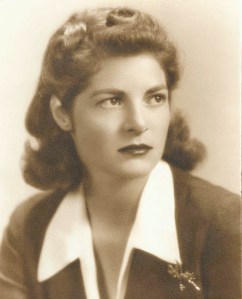
Barbara IndianaAs I have mentioned a few times in this blog, I wrote “The Obsidian Mirror” based on American archetypes. I am no expert on Native American folklore, but perhaps I know a little bit more than the average person because my mother was an archeologist specializing in southwestern Native American cultures. She also excavated in Yucatan and Guatamala, helping to uncover Mayan pyramids and temples that had been lost to the jungle hundreds of years ago.

In fact, my mom, Barbara Moore Doyle, was sort of a young, female Indiana Jones. She was excavating at about the same time—the late 1930’s. In the service of archeology, she wielded a machete, slashing through the Central American jungles. At a dig somewhere in the wilds of Arizona she got blood poisoning after falling off the buckboard of a roadster and scraping up her legs. They were excavating far from any hospital—in fact they were far from any roads at the time. A young Apache medical student named Tom White Cloud (what a romantic name!) fixed up a drip of some sort and saved her life.

My mother-to-be climbed up the side of a pyramid in Guatamala and came face-to-face with a fer-de-lance, one of the most poisonous and aggressive snakes in the world.

“What did you do?” I asked breathlessly when she told me this story.

“I made a split-second decision between snakebite in the middle of the jungle where there were no hospitals or anti-venom—or falling. I decided to fall, and…just let go.”

“What did the snake do?”

“I don’t know, but I think he was just as surprised as I was.”

Fortunately, she rolled to the bottom of the pyramid with nothing worse than a bruise or two.

She witnessed strange rituals during the night of Dia de las Muertes in Tegucigalpa, and was perhaps the first and only woman, white or Indian, who was invited into a working Hopi Kiva.

Most of the time, of course, she spent crouched in ditches with a pick and camelhair brush, painstakingly removing dirt and rocks to discover whatever was there to be found. She taught me to walk in the desert with the “archeologist’s stoop,” scanning the ground for potsherds or worked flints. (Also rattlesnakes.) It was like a treasure hunt, and I still have the bits of ancient painted pottery and arrowheads gleaned from these expeditions.

My young mother even ran afoul of the Nazis. During a sojourn in Mexico City, she dated a man named Oswald (last name forgotten by me) who was the brother of the head of the Nazi Party in Mexico. He would take her to the Nazi Officer’s Club, where there was a huge portrait of Adolf Hitler hanging in the dining room. I was scandalized that she would date a Nazi, but she said that Oswald himself was not a Nazi and said that he quietly scoffed at the self-important posturing of the party members.

My mother’s archeology career came to an end with the entrance of the United States into WWII. She returned home to California and got a job as a riveter at Lockheed-Martin. Being bright, she worked her way up and obtained Top Secret clearance as an aircraft inspector. Inspecting aircraft equipped with radar required Top Secret clearance, as it was still highly classified technology. One day, she came home after work to find two FBI men waiting in her parents’ living room. They had intercepted a letter to her from her friend Oswald. Oswald had crossed the Mexican border into Arizona, possibly to avoid being drafted into the German army. He was promptly picked up and placed in an internment camp for suspect nationals. Oswald, with touching sentimentality, wrote to my mother asking her to marry him so that he could get out of the camp. As all the mail from camp inmates was intercepted and read, the FBI decided his plea was actually code—and addressed to a woman with Top Secret clearance, it set off alarm bells.

My mother explained the situation. Wonder of wonders, they believed her, and she served out the war at Lockheed-Martin, inspecting airplanes. She never went back to archeology. She had met my father when he was stationed at the University of Redlands with a VF12 unit of Marines. They fell in love, and were married toward the end of the war. My father had distinctly Victorian ideas, and disapproved of working women, so that was that.

As a child, I was fascinated by my mother’s early adventures, and asked to hear her stories over and over. I also asked her to tell me Native American folktales, and explain the different cultures and religions to me. As an adult, I asked Mom to write down her adventures for me, because I was afraid I would forget the details. She promised to do so, but was always too busy. By the time I thought to record them on tape, it was too late. My funny, bright, kindhearted, brave mother had descended into dementia, never to recover.

But I had grown up in a house decorated with Navajo rugs, Hopi kachinas, and many ancient pots, arrowheads, fired clay sculptures from Mayan ruins, spearheads, spindles, and other archeological bricabrac she had squirreled away for herself. (These days, it would be considered criminal to take such things from their sites, but back in the day, if the young archeologists took a few souvenirs, nobody cared.) I had the best show-and-tell possession ever: a human skull. (My grandfather had found it on an unpopulated island in 1917 and gave it to me for my sixth birthday—much to my mother’s disgust. She had wanted that skull herself, and it was one of the reasons she had become interested in archeology.) So it was no surprise that these influences came through when I finally decided to write a novel.

When (I won’t say if) my novel is published, I will dedicate it to my mother. She not only gave me a love of Native American traditions, she also believed in me as a writer. My only regret is that she didn’t live to read “The Obsidian Mirror,” because she would have loved it.

Getting Published: The Waiting Game

Image by By David Sedlecký

Image by By David Sedlecký

Waiting is hard. I heard from my book consultant about two months ago that a literary agent had my book “under consideration.” Wow! Cause for celebration!

Weeks went by. Nothing. Then the consultant emailed me that the agent had actually started READING my manuscript! Yippee! More cause for celebration!

And now I am again waiting to hear: did the agent like it or hate it? As of this writing, I have no idea.

The process of submitting a manuscript to a publisher or an agent takes time—lots of time. First you have to write the darned thing. Then you have to dissociate yourself from your work sufficiently to write book synopses—short, medium, long. This is harder than you might think. You have to go from being completely absorbed in every detail of your story to being able to summarize it in one or two pages. What do you put in? What do you leave out? And you have to make the synopsis itself interesting and intriguing enough to entice someone to read the MS. And write the synopsis in such a way that the reader will gain some understanding of the tone you have used in your book.

You also have to write a pitch letter snappy enough to entice the same reader into reading the synopsis. All of this takes considerable time, blood, sweat and tears. I found it far more painful to write a synopsis than I did to write the whole book (but it didn’t take as long). Fortunately, the consultant helped me out, so in the end I had three synopses that I could actually use.

I know that if the agent turns me down, I will go through the same process with another agent, and so on until I find one that bites. Once I get an agent, I will have to wait for the agent to shop the book around to publishers. And I will have to wait until a publisher is found who is intrepid or foolish enough to take on an unknown author. And then I will have to wait for the book to be published, but I’m hoping that will be less painful.

I’ve been wondering if I should start another book. I’d like to write a sequel to “The Obsidian Mirror,” but the idea of writing a sequel to an unpublished book is a bit daunting. What do you think? Should I wait to see if my story is published—or have faith and start the sequel anyway? Or try my hand at something completely new? What would YOU do?