Really nice coverage of the book launch by the Palo Alto Weekly! Thanks to my friend Bob Stetson (who bought the very first copy sold of “The Obsidian Mirror”) for sending this to me!


Really nice coverage of the book launch by the Palo Alto Weekly! Thanks to my friend Bob Stetson (who bought the very first copy sold of “The Obsidian Mirror”) for sending this to me!

Chaco, the Coyote Trickster
The launch party for “The Obsidian Mirror” went beautifully last Saturday afternoon. Kepler’s Bookstore in Menlo Park, CA graciously hosted the event, and there was a good crowd of people there. I did a very brief reading and answered questions.
Here’s a sampling of what I was asked:
Q: Is your protagonist (Sierra) autobiographical?
A: Sierra is concerned about the environment; so am I. Sierra is a PR executive, and used to be one. Sierra designs silver jewelry, and I do, too. There the resemblance ends because Sierra is way cooler than I am. (I didn’t mention this, but she’s also younger and more athletic than me.)
Q: What started you writing the book?
A: I had recently finished a Robert Jordan novel that involved riding horses, armor, swords, sorcery, etc. I really enjoyed the book, but later I wondered why, with thousands of legends, mythologies, folk tales and traditions, the New World is rarely used as inspiration for fantasy. Most epic fantasy, at any rate, is usually set in some pre-Industrial Age, pseudo-European environment. Elves, faeries, trolls, ogres, goblins, vampires, etc. are staple fare.
I love swords-and-sorcery, don’t get me wrong! But I had time (my freelance writing business was slow at the time), so I began writing a story based on New World traditions as an experiment. Before long, the characters took over and I HAD to finish the story.
Q: Is Chaco (Coyotl the Trickster) based on a person in your life?
A: I said Chaco was based on my husband, Tom, but I was kidding. Coyotl the Trickster is a folk hero among many of the Native American tribes. I should have mentioned that appearance-wise, I saw Chaco, in his manifestation as a deliciously sexy young man (as opposed to his coyote gig), as Gael García Bernal, the excellent Mexican actor who (among many other roles) played Ché Guevara in “The Motorcycle Diaries.”
One person thanked me for not making Chaco the villain. I started out thinking that since Chaco was The Trickster, he ought to be rather ambiguous; the reader would not be sure whether he was good or bad. I really, truly would have liked to write him that way, but he came out more of a scamp than a real rogue. (That was all his doing, not mine. I had other ideas.)
Q: What other characters are in the book?
A: There’s Fred the Mannegishi. Mannegishi are sort of like leprechauns in that they are small and green, but mostly because they are mischievous. Mannegishi are from legends of the Cree tribe. Fred is truly unreliable, but as one person present said (she had edited the manuscript for me), “Fred seemed like a pain in the butt at first, but he became my favorite character.”
I was asked if I made up Fred’s appearance, but I followed the description of Mannegishi in Wikipedia. I rarely made up anything about the supernatural characters; I tended to follow the traditional descriptions if they were available. Of course, much of my research consisted of strolling around the Internet when I needed a new monster. As the New Yorker cartoon has it, “Nobody knows you’re a dog on the Internet.” By the same token, it’s hard to know whether you’re reading something authentic, or a made-up legend by a tequila company or something. As “The Obsidian Mirror” is fiction—and fantasy fiction at that—I didn’t worry too much about academic purity.
Q: Do you have a sequel planned?
A: Yes, two. The next book will be set in Hawai’I, where Fred might meet some cousins of his. “The Obsidian Mirror” has an underlying theme of threat to our natural environment, which will continue to be a theme of my work. I am very concerned about the Pacific Gyre, also known as the Pacific Garbage Patch, a continent-size vortex of plastic particles in the ocean swirling around Hawai’i. But I do not plan on getting preachy. The books have to be fun to read, or no one will read them.
Of course, I may have to make the ultimate sacrifice and travel to Hawai’i to do research. A writer’s life is so hard.
The third sequel will be set in Mexico, and will have something to do with the Virgin of Guadalupe as Tonantzin, the Aztec flower goddess. I don’t know much more about it yet.
After answering questions, I sat down at the assigned table and signed books. The store sold out, with Kepler’s purchasing the last one for the staff. I hope they enjoy it as much as I enjoyed the party. I got a ton of compliments on the food—which I never touched because I was too wound-up!

Image: High Contrast
Growing up, I learned in school about the natural wonders of our great land—the deep forests, crystalline rivers, wide and sweeping plans, and pristine deserts. This was probably reinforced by various Disney nature films depicting animals in the wild, with not a telephone line in sight.
Imagine my surprise when I got a little older and found out about “dead” lakes so polluted that nothing much could live in them. Rivers that caught on fire from time to time. Sweeping landscapes of gray factories belching dirty smoke into the air, surrounded by heaps of toxic slag. And because I lived a mere 100 miles from Los Angeles, that mother of all urban blight, the pall of grayish-brown smog that obscured the nearby 8,000-foot-plus-high mountains on many days.
I know it sounds as if I were a complete naïf, but I was stunned. The people who were dumping toxins and garbage into the water had to live here, too. Their children were being exposed to poison in the air and water. They had to look at the blight of human ingenuity, right along with the rest of us. So what could they possibly be thinking?
Many decades later, I am still wondering. It has never made sense to me that people would crap all over their own dinner tables. And it has never made sense to me that governments allow them to do this. Every time I read about some scheme to defang the EPA, or lower air and water quality standards, or build another nuclear power plant even after the disasters at Three-Mile Island, Chernobyl and Fukishima, I am newly gob-stopped. Why would anyone knowingly and deliberately destroy the only home we possess?
That’s one reason I wrote “The Obsidian Mirror.” In it, the ancient and evil Necocyaotl devises a new way to entice people to “look into the obsidian mirror,” after which they become so focused on their personal wants and desires that they are willing to despoil the earth to obtain them. He does this by spreading his evil essence in a fiendishly clever way, using modern technology.
To be honest, it’s the only explanation I can understand. Nothing else makes any sense at all. Profit motive, you say? That’s like burning down your own house to warm your hands for a bit. Until I get a better explanation, I’m sticking with the Necocyaotl Theory.
Our son-in-law, Mike, went camping overnight with Lilah (our granddaughter) and some family friends. This is a traditional trip for the dads and girls, and they camp at New Brighton Beach, which is quite close to us. Tom and I decided to walk down the beach to say hello, but found they were tired and packing up to come home.
But we saw some amazing things on the walk. We have, against all logic, a cement boat here. That is, it once was a boat. Now it is a wrecked remnant of a boat, used by pelicans and other seabirds as a roost and nesting area above deck, and the interior (broken open long ago by waves and storms) has been populated by a rich array of sea life.
The cement boat has a history (and yes, it once did float on the water, despite being made of concrete). It was built as a tanker toward the end of WWI, and christened “S.S. Palo Alto,” but never saw service. It was purchased by an entertainment company and towed to Seacliff Beach in 1929. It was grounded a few yards offshore, and they built a pier out to it. For a brief time, it was a tourist amusement with a swimming pool, dances, refreshments, and all the other accoutrements of a seaside tourist trap. After two years, the entertainment company went bankrupt and the boat was abandoned. She cracked open amidships, but was used by the locals as a fishing pier.
Today, the pier still runs out to the boat, but there is a wide gap between the end of the pier and the boat. There is a barrier at the end of the pier, apparently to prevent people from attempting to leap the gap. The pier is still used for fishing, but the S.S. Palo Alto is basically a tiny manmade island, a bird refuge, and a synthetic reef.

The black fuzzy-looking stuff beyond the boat is thousands of birds.
And, lest this sound romantic, it stinks to high heaven of bird shit. It is one of the most highly-polluted beaches in Northern California, thanks to the birds, but this doesn’t seem to deter campers and picnickers one bit, even though I personally find the stench gagulous.
But we had to walk past the concrete boat today, and as we headed down the beach, tens of thousands of sooty shearwaters appeared and began to settle on the water to feed. Sooty shearwaters, which look like dirty seagulls, are migratory. They nest in New Zealand, but migrate around the Pacific, spending much of the summer in Northern California. In New Zealand, they are often referred to as “muttonbirds,” which is indicative of what the NZ settlers did with them. The Maori still harvest about 250,000 sooty shearwaters every year for food, oils, and fat. Yet many thousands (of shearwaters, not Maori) still wind up in Northern California every summer, where the natives prefer virtually anything over fricaseed seabird.
The shearwaters were joined by the pelicans, gulls, dolphins and seals, all of which followed the unseen school of fish back and forth along the coast, gobbling as fast as possible. All in all, it wasn’t a good day to be an anchovie.
Chaco #1
This is it–my first podcast! I am reading Chapter One of “The Obsidian Mirror,” due out from AEC Stellar Publishing on June 27.
I will be hosting a launch party for the book at Kepler’s Books in Menlo Park, California on June 28 at 2:00 pm. I’ll be reading a portion of Chapter One and signing books. Come on down! Wine and munchies provided. (Leave a comment here to let me know if you’re coming. I’d hate to run out of food.)
I’ve written posts in the past about the fact that I live in an intergenerational living situation (see “An Experiment in Intergenerational Living,” and “Intergenerational Living: The Experiment Continues”). My husband and I sold our house last June and our daughter and her husband sold their house in July. We bought a house together in a new community. With Kerry and Mike came our granddaughter Lilah, 4, and two geriatric Japanese chins. (Chins are small, fluffy dogs with bulging eyes, squashed-in noses and a gremlin-like ability to find trouble anywhere, anytime.) Tom and I brought with us a third geriatric dog (large mutt) and a small black cat.
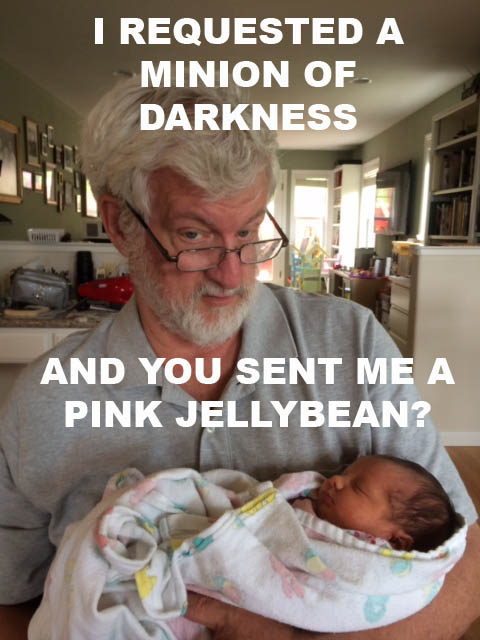
Now we have a new addition to the family: Jessamyn, one week old today. Jessamyn arrived a couple of weeks early because Kerry developed pre-eclampsia and what with one thing and another, had a caesarian delivery. (Getting the baby out is the only treatment for pre-eclampsia, which is the beginning of kidney failure and results in death if untreated.) So we were all a bit surprised by Jessamyn’s early debut, including Jessamyn.
All newborns are unbelievably tiny and fragile-looking, and Jessamyn is no exception. So far, she has been fairly easy. She sleeps, eats and poops. The only time I’ve heard her cry is when her diaper is changed or when she’s hungry. Lilah is delighted with her and tries hard to be helpful by fetching things for her mother. She is fascinated by Jessamyn’s tiny nose, which she touches very gently. Marley (#1 geriatric chin) wants to cuddle. The other animals have noted Jessamyn’s presence, but are keeping their distance.
Tom loves to hold the baby. He will hold her literally for hours. The photo above isn’t really fair—but I couldn’t resist, given the expression I caught on his face.
So another life has joined the family, and I wonder what she will be like. Will she dance through the house singing off-key, like her big sister? Will she like to draw? Will she love words? Will she want to be a poet, or an engineer? Jessamyn is physically here, but I don’t know who she is yet. It’s odd, feeling all this love for someone I don’t even know. I look at her little face, and she owns me, just like her big sister Lilah owns me. I am theirs for as long as I’m alive.
When I turned six years old, my grandfather gave me a present. It wasn’t wrapped, as I recall, but just placed in a plain cardboard box. As it happened, it was my favorite gift that year: a genuine human skull.
My grandfather, Frank W. Moore, was an adventurous man. In the earlier days of the 20th century, he helled around California in a Model T, driving across the desert before there was such a thing as “off-road” driving. He had a sailboat called “Amy H” in which he explored the California coast and offshore islands. (My grandmother was not named Amy H. I think the boat came with the name and he never got around to changing it.) In those days, California was underpopulated and he had the freedom to go pretty much wherever he wanted to do whatever he felt like. One of the things he liked to do was go out with his buddy, Dr. Walter B. Power, and cut down billboards.
On one occasion in 1917, he landed on San Nicholas Island, later made famous by writer Scott O’Dell as “The Island of the Blue Dolphins.” On or near the beach, he saw a white dome poking up out of the sand. He uncovered it and found a skull with half of its lower mandible. The teeth (those that were left) were ground down quite smooth as a result of the inhabitants’ diet of shellfish which contained a lot of sand. My grandfather took the skull home, where it became an object of envy for my mother, who had ambitions of becoming an archeologist (and eventually did). Mom named it Yorick after the skull in “Hamlet.”
In those days, there was no Native American Repatriation Act, aimed at restoring the remains of Native Americans to their tribes and homelands. The battle of Wounded Knee was a mere 27 years in the past when my grandfather found the skull, and the term “Native American” hadn’t yet been coined. Indians, in short, were not highly regarded by the mainstream culture back then. No one thought twice about my grandfather taking Yorick from his resting place on San Nicholas Island.
In 1917, there were no inhabitants on the island. The Nicoleños (or Ghalas-at) had been almost exterminated by Russian fur-trappers. In 1835, the padres of the California mission system moved five of the six remaining inhabitants to the mainland. The one who stayed, Juana Maria, became known as “The Lone Woman.” She lived there, utterly alone, until her removal from the island in 1853. She died not long after.
My mother thought the skull was that of a young male in his 20’s, pointing to the supra-orbital ridges and cranial sutures, and we continued to refer to it as Yorick. Sensibilities toward Native Americans hadn’t improved too much by the time my childhood rolled around, so I happily took Yorick to show-and-tell sessions at school–and I have to tell you, he never failed to make a hit appearance. No one could top me when it came to show-and-tell; imagine following my human skull with your toy cap gun (also a perfectly acceptable show-and-tell item in the 1950’s).
I took as much care of Yorick as a small child might be expected to do, but one day, something heavy fell on him as he rested in my off-duty Easter basket. My mother undertook to glue him back together–and while she was engaged in this project, the chipmunk I had taken home for the weekend from my third grade classroom escaped in the family room and took up residence in the couch. Mom thought this would be a good way to start a book: “While I was glueing my daughter’s skull back together, the chipmunk got loose.” I thought this had promise, but she never did write the book.
When my own children were in elementary school, I let them take Yorick to their show-and-tell sessions. He was as much a hit as ever, but I heard back from one teacher that Yorick was an inappropriate show-and-tell subject. She mentioned the Native American Repatriation Act, and I realized with something of a shock that Yorick was, of course, subject to that law. That ended Yorick’s career in show-and-tell.
I suppose I should have realized earlier that Yorick had been a human being whose remains had been wrested from his native land in an insensitive and chauvinistic manner. But Yorick had been a fixture in my life, and I hadn’t really thought of him as such. He spent the next couple of decades in a cardboard box. Out of sight, out of mind.
When I finished “The Obsidian Mirror” and began to look for a publisher, I remembered my unfulfilled obligation. My novel is based on New World legends, myths, and folk tales, and I recognized my enormous debt to the Native Americans and their many cultures. I thought if I got published–by a real publisher, not self-published–the finest way to celebrate this would be to repatriate Yorick to whichever Native American tribe now held the responsibility for those long-dead people of San Nicholas Island. I thought the Chumash were the most likely, as they are the tribe that lives around Santa Barbara now. I pledged to Yorick and the Powers That Be that I would repatriate Yorick if my book were picked up by a publisher. (I planned to self-publish if I failed to find a publisher, but I didn’t even contemplate what I would do with Yorick in that case.)
Well, AEC Stellar Publishing is bringing out “The Obsidian Mirror” sometime this summer. So I had a promise to keep.
To be honest, I had never before investigated where San Nicholas Island was, precisely, or what had become of it. I had assumed, as the island is considered part of the Channel Islands group, it had been rid of its introduced species like rats and goats and made into a nature preserve like Anacapa. A group of us sat in our living room this past holiday season and did some research. Some of us (not me) were voluble in proposing that we hire a fishing boat and go out to San Nicholas to rebury Yorick ourselves.
It turned out that San Nicholas Island is considerably south of the other Channel Islands (except for Santa Catalina and San Clemente), and sits perhaps 100 miles out to sea from the Southern California coast.
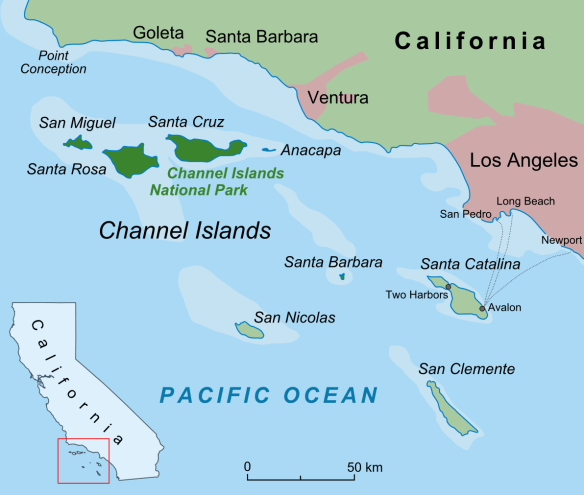
The Channel Islands
It also turned out that the island is under the jurisdiction of the United States Navy, which uses it for weapons research. The occupants of a fishing boat that attempted to land would probably be arrested. Some of the group still wanted to do it. “We’ll just tell them we’re old and we got lost,” said my friend Meg. Nope. Nope. Nope. Not going there. I reserve my feckless adventuring for my fiction writing.
I contacted my cousin Sally, who lives near Santa Barbara. Sally suggested contacting Dr. John Johnson, an anthropologist specializing in the Channel Island Indians. Dr. Johnson, a very kind and knowledgeable man, explained that there was an investigation underway to try to determine who (if any) were the legitimate descendants of the Nicoleños. And the organization in charge of the investigation? The U.S. Navy. I don’t have a whole lot of faith that the U.S. Navy feels any urgency about resolving this problem, but according to Dr. Johnson, there isn’t any alternative. Repatriated remains go to the Santa Barbara Museum of Natural History, where Dr. Johnson works. He assured me that there is a special area where these remains are kept until they can be interred in an appropriate manner and place. Yorick would stay in the museum until the Navy decided where he belonged.
Well, Santa Barbara was at least closer to San Nicholas Island than Yorick has been in more than half a century. I made an appointment with Dr. Johnson to turn Yorick over.
When my husband and I went to Santa Barbara, Dr. Johnson spent some time examining the skull, then said, “I think what we have here is actually Yoricka.” He believes that the skull was that of an older woman, not a young man, and showed us why he thought so. (Sorry, Mom. I think he’s right.) He asked me details about my grandfather and mother and I filled out some paperwork. Then it was time to say goodbye. On the way out of the museum, my husband turned to me and asked, “Feeling a little sad?”
I said, “Yes.” I wish I had taken a picture of Yorick before we left. After all, he–she–was a member of my family for 97 years. I wish I had known who you really were, Yorika. I hope you find your way back to your Island of the Blue Dolphins.
I’ve gone back and forth a couple of times with the publisher, AEC Stellar, and I think we’ve probably arrived at an agreement.
So now I get to do something fun: design my own cover art. AEC Stellar has people who will do this, but from my standpoint, one of the advantages of working with a small company is that they are willing to let me do my own cover design if I want (and it meets their standards). I realize that most people wouldn’t think this was fun, but I also paint in oils and design jewelry and I’m pretty good at Photoshop. You can purchase excellent photography and illustrations from an online stock provider for very reasonable prices and manipulate these images in Photoshop. I did a lot of this when I was working on marketing materials for Cisco, and I enjoy it.
Here’s my first concept. Do you like it? Dislike it? I’d love to know.

 The book contract arrived. It seemed pretty straightforward to me, but I’ve never laid eyes on a book contract before, so what do I know? I followed the advice of my book consultant and shelled out some bucks to have someone knowledgeable review it.
I recognized that the contract was unusual. The publisher is unusual. It required some shared expenses. Having talked with the publisher, I was aware of this, and given that the author gets 50% of the net (as compared to maybe 12% from standard publishers), that didn’t seem unfair to me, especially as this is a new, startup publisher.
The reviewer sent the contract back with many, many comments. I looked at them all carefully. There were a few that I didn’t agree with, but some of the others seemed more than reasonable. For example, the contract specified that all rights to the work in other media such as TV, movies, audiobook, etc. would belong to the publisher. Now, the likelihood of my little novel being made into a movie is remote, but I didn’t see why I should give up the rights to my own work, even so. So I marked up the contract accordingly and returned it to the publisher with a polite note indicating that everything was up for discussion.
That was yesterday. No response so far. Of course, I reasoned, he needs time to look it over. I took my time, after all. But still. Is he pissed off? Insulted? Did he even see it yet? Am I stressing unnecessarily? Or is this an indication of thunderclouds on the horizon? Should I stop thinking about it? Should I call?
Or maybe I’ll just go for a walk on the beach and forget about it.
It has been a long time since Tom and I lived with a preschooler. Lilah, the preschooler in question, is four. She sailed through the twos without becoming terrible, skipped through the threes without becoming awful—and then hit the Frightful Fours.
Her former response to being thwarted was to assume a deeply saddened and affronted expression, rather like Mother Theresa confronted by, say, Lady Gaga. Then she would turn her back on everyone like an anchorite abandoning a wicked world. She did all this in perfect silence, which I thought was a dramatic underscore to her soul-gnawing sorrow at being denied Goldfish crackers for lunch.
Now if Lilah is thwarted, she will frequently throw herself to the floor with a scream. She will begin pounding the unoffending floor with her heels or fist, punctuating this with more shrieks. This is usually in response to being asked to eat something (healthy) or being told she can’t eat something (unhealthy), but there are many other triggers.
This bothers her parents a lot, but it doesn’t perturb Tom or me very much. She’s kind of a piker compared with her Mom or her Uncle Sean, although they went through it earlier than Lilah. It does raise the question of discipline, though. As Tom and I are sometimes the only adults around, permitting her parents to carry on their work lives, we are sometimes on the spot when it comes to applying corrective action. And disciplining someone else’s child is a sensitive matter. She might be our granddaughter, but she isn’t our child.
When Kerry and Mike are present, they get to do the disciplining. Tom and I are merely interested observers who need earplugs. When they are not here, we have relied on the Grandparent Card a lot, but who knows how long that will last? Counting to three (very slowly) usually works. Once in a while, a short timeout helps. So far, so good, but one of these days, Lilah is going to pitch a complete hissy fit on us, and we’re going to have to deal. The only advantage we have is that it really just doesn’t bother us. Raising her mother toughened us up a lot.

A Gummy Bee
Now, what about those gummy bees? This is one of the great things about living with a grandchild—getting to hear a completely new set of wonderful mispronunciations. Her mother used to call flowerpots “flower pants,” which I always thought was brilliant. Her uncle used to go to “pretty school,” until Kerry finally scorned him into saying “preschool.” (Too bad.) Lilah has gummy bees: “I gummy bee a builder when I grow up.” “I gummy bee happy to see Auntie Cara.” I envision all these little gummy bees flying around her as she dances her way through life. They are all different pastel colors, and they have little smiles on their cute little gummy bee faces.
Because most of the time, Lilah is a delight. She has the most beautiful, sunny smile. She sings to herself as she plays, lining up her toys in the upstairs hall to “teach them school” or read them a story. She laughs readily and cuddles when she’s tired. She loves animals and art and playing games with Nana.
She can scream all she wants. She’s still my darling.
 obsidianmirrorblog