In my last post on the subject, I explained that I have been unable to move past a set-point weight. I have been at the same weight for almost two years, giver or take a few pounds
No one can continue to deprive themselves and do things they don’t want to do for two years in pursuit of an unattainable goal. it’s just not human nature. I confess there were weeks in which I decided that being fat wasn’t the worst fate in the world. Chocolate and red wine played a large factor in those weeks.
As I detailed earlier, I tried everything in the book to try to break past that stubborn set-point. I couldn’t believe that nothing was working. (I am still unwilling to do the 10-day vegetable cleanse.) So I decided to increase my cardio again and skip lunch, having a protein drink instead (I add a medium-sized banana to the smoothie for texture and ballast). I started doing six miles a day on the recumbent bike, with the intention of working up to ten.
Last week, I weighed myself, and I was five pounds over the set point. Today, I weighed myself, and I am five pounds UNDER the set point for the first time in who knows how long. I almost woke my husband up to tell him, but he was up late last night so I took pity on him.
Totally made my day. I am still grinning. Now I have to keep it going. My personal trainer (“Lord Taskmaster”) is pushing for weight training prior to doing the cardio because he swears it gets the weight off faster (and he is the personal trainer, so he probably knows more than me). So I’ve started doing that as well. He is also pushing for seven miles. All in good time, your Taskmastership.
It has been a long time since I last posted. With regard to my Big, Fat Weight-Loss Campaign, it’s because it got complicated.
I lost 55 pounds or so in one year. The next year, despite continuing to diet conscientiously and exercising regularly, I lost no weight at all.
None.
I made changes. I was using the Weight Watchers method. I switched to counting calories. I was exercising a few days a week. I upped it to six days a week, alternating cardio and weight training.
Nada.
I started taking protein supplements. My nails went from paper-like to strong and long, and my hair thickened as well.
Not another ounce came off.
I consulted a nutritionist who wanted me to go on a cleanse for 10 days eating nothing but protein and vegetables. This is intended to improve bile production and reduce blood sugar because she couldn’t find anything else impeding my weight loss. I bought her protein powder and supplements, but suddenly, I was scheduled for major surgery—a complete, reverse shoulder replacement. I decided to delay the cleanse, as the surgery was going to interfere in many ways with how my body was working and I didn’t want to play around with nutrition while I was in recovery.
The surgery went fine and I’m glad I did it even though the six weeks in a sling was tedious and uncomfortable. Still, the discomfort was far less (after the first week) than before. Prior to the surgery there were days when I was hurting so much I couldn’t leave the house. As I was lying on a gurney waiting for surgery, I was in so much pain I asked for pain-killers (I was unable to take any prior to getting to the hospital because I was following the surgeon’s orders about taking medication and water.) Bless the nurses. They got me pain-killers. I was grateful because I spent a long time on that gurney.
Then I spent six weeks doing nothing at all except watching television, reading, eating, and doing physical therapy. I couldn’t drive and I didn’t want to leave the house if I didn’t have to. After this slugfest I was sure I would gain weight, but I did not. I’m back to counting calories and just resumed cardio on a recumbent bike.
To be honest, I don’t want to do the cleanse if I can avoid it. I would have to fix all my meals separately from the rest of the family, and just protein and vegetables sounds…boring. I will still do it if I have to, but I am hoping that the surgery did a reset and my body will once more be open to shedding pounds.
#
I had never heard of a total reverse shoulder replacement until I was told I needed one. It’s a technique they use when there is so much damage to the joint that a standard replacement won’t work as well. I have severe arthritis, which pretty much destroyed the humeral head (the “ball”) of the humerus (upper arm bone) and resulted in bone-on-bone action and bone spurs.
The procedure is to expose and dislocate the joint. The humeral head is sawn off and replaced with a titanium and plastic cup which is inserted into the humerus. A titanium ball is screwed into the shoulder blade. Thus, the structure of the joint is reversed. It’s kind of a brutal surgery, and I am DEEPLY grateful for anesthesia. The surgeons did an amazing job, and after the first week, I stopped taking opioids and used only Tylenol and CBD for the pain, which has diminished daily. I have good mobility for this stage of healing (because I do the physical therapy exercises religiously). I don’t think I will ever have the complete range of motion that my other shoulder has, but I’m OK with that—I’m no longer in agony. And at 74, I have no ambition to become a trapeze artist.
Note: I am taking a break from “My Big Fat Weight Loss Campaign.” I hope to have positive progress soon, but right now I am stuck in the doldrum of dieting, despite Ozempic. Here’s something else to chew on.
I have been rewatching Star Trek: The Original Series (ST:TOS to fans), which is the first time I have viewed the series since its original airing in the 1960s. I just watched an episode called “Turnabout Intruder,” story by Gene Roddenberry and teleplay by Arthur H. Singer. It’s an episode I have no memory of. Apparently it was pre-empted by a presidential speech at the time it was supposed to air. It aired later, but I must have missed it.
Briefly, the story is that Kirk visits Camus II, responding to a distress call. Among the survivors are one of Kirk’s former girlfriends (right on brand here, but there’s a twist), Dr. Janice Lester, and a physician, Dr. Arthur Coleman. It quickly becomes apparent that Dr. Lester and Kirk did not part on friendly terms. Kirk was going off to be a starship captain. Lester also wanted to be a starship captain–but was not allowed to hold that position because of her gender. She was angry, and took it out on Kirk, who skedaddled off to the stars.
Hold on–it’s the year 225something, and WOMEN ARE NOT ALLOWED TO CAPTAIN STARSHIPS. It kind of made me sad that Roddenberry’s vision didn’t stretch to that.
Continuing with the story, Dr. Lester assaults Kirk and subjects him to an alien technology that switches their personalities or selves into the other’s body. So Kirk is now in Lester’s body and vice versa. Her claims that she is actually Kirk are dismissed as illness, but Spock does a mind-meld with her and knows the truth. Spock attempts to free “Lester,” but is caught.
Kirk (actually Lester) calls for a court-martial of Spock, with himself, Scotty and Bones as the judges. During the procedure, Kirk (in Dr. Lester’s body) is allowed to testify, and this is what Kirk says about Lester: “Most of all, she wanted to murder James Kirk, the man who once loved her. But her intense hatred of her own womanhood made life with her impossible.”
Really? Was it “her intense hatred of her own womanhood”? Or was she an ambitious person who was deeply thwarted, all because she lacked a penis?
During this show trial, Lester (in the person of Kirk) does some table pounding and red-faced shouting. Scotty and Bones meet outside the courtroom to confer. Scotty says. “I’ve seen the captain feverish, sick, drunk, delirious, terrified, overjoyed, boiling mad, but up to now, I have never seen him red-faced with hysteria.”
“Hysteria,” of course, is a dog-whistle for “like a woman.” I assume most people know that the word derives from a Latin word meaning “womb,” as the womb was believed to be the cause of it. Thus, men were considered incapable of hysteria.
At the end, Kirk and Lester are switched back by some unclear methodology. Janice Lester, back in her own body, collapses weeping in Kirk’s arms, and then in the arms of Dr. Armstrong, who has aided and abetted her all along. Armstrong takes charge of the sobbing woman and leads her away “to take care of her.”
Kirk puts the cap on it by noting, “Her life could have been as rich as any woman’s…if only…if only…”
I noticed he did not claim that her life could have been as rich as any man’s. And a woman’s life, it went without saying, is limited, and women should just accept these limitations and be happy with them.
Although I expected some misogyny/discrimination against women from TOS, this episode shocked me. As a woman born in 1950, it made me realize how far I have come in my own thinking that I could be shocked by this. There are now two generations of women who have grown up believing they are equal to men and deserve the same rights. I find this extremely encouraging.
The media is full of stories about the new class of weight-loss drugs, of which the best-known are Ozempic and Wegovy. I’m not going to get into the other drugs currently on the market. That would take up a lot of time and this post isn’t about the industry.
What is the difference between Ozempic and Wegovy? There isn’t any difference. They are both a drug called semaglutide. They are both manufactured by the pharmaceutical company Novo Nordisk. However, they are approved by the FDA for different conditions. Ozempic is approved for Type 2 diabetes. Wegovy is approved in a higher dosage for overweight. Both drugs are in such high demand that they are difficult to get in the United States.
How does Semaglutide work? From Drugs.com: “Semaglutide works by mimicking the action of GLP-1, a naturally occurring hormone that helps to regulate blood glucose levels. By binding to and activating the GLP-1 receptor, it stimulates insulin secretion and lowers glucagon secretion when blood glucose levels are high. It also causes a slowing down in how fast the stomach empties.” The end result is that it dramatically reduces appetite.
What are the potential side effects? Low blood sugar levels, nausea, vomiting, diarrhea, abdominal pain, and constipation are the most common side effects. There is also an increased risk of pancreatitis. And people with certain medical conditions shouldn’t take it. Do your research before starting one of these drugs.
My Experience of Taking Semaglutide: The first step was that the nurse practitioner I was working with, Ashzra, prescribed Wegovy. My insurance turned it down because weight loss is not a condition covered by Medicare Part D. Then she sent me a prescription for Ozempic and gave me a Canadian pharmacy to contact. I did so, and without any further ado, I received my first Ozempic pen in the mail. I had to wait for more than a month to receive instruction from a physician on how to use it, so it sat in my refrigerator for all that time—it has to be kept cold.
I finally got a doctor to go over how to use it. So one Tuesday morning three weeks ago, I sat in my home office with the patient instructions Ashzra sent me. The instructions said to prep the pen and make sure no bubbles were in it, etc, which I did. Then the instruction said to turn the pen until the proper dosage appeared in the little window. I thought I’d start with .25mg, as I was worried about side effects.
I dutifully clicked the pen until a number appeared in the window. It was a 1. A second try yielded the same result. I pondered this for a while, and then pulled out the instruction sheet inside the prescription box. It turns out that my pen injects 1mg every time—you cannot select the dosage.
Okay. I swabbed my upper thigh with rubbing alcohol and regarded the needle protruding from the end of the pen. It is a short needle, and very fine. But I still needed to—willingly—shove this needle into my tender skin. I set up the pen and stabbed my thigh. I depressed the plunger, and it clicked back to its starting position. I held the pen against my skin for another six seconds, as instructed, to make sure the entire dosage was injected.
It didn’t hurt much, I will say that. There was a tiny red dot at the injection site, and I covered it with a little bandaid, just like at the doctor’s office.
By dinner time, I was feeling distinctly uninterested in food. The next morning, I fixed my usual breakfast, something I normally enjoy—one piece of avocado toast with fried eggs and hot sauce. I wasn’t just feeling uninterested, but nauseous. I ate about a fourth of it because I wasn’t sure whether this was how I was supposed to be feeling, but could go no further. Another couple of hours found me giving back not just breakfast but everything I had eaten after giving myself the injection. I also felt extremely fatigued.
The nausea and fatigue lessened a bit every day. The nausea went away entirely when I remembered how effective ginger is against nausea and other stomach troubles. Despite a total lack of interest in food, I forced myself to eat because I didn’t want to get malnourished. By the end of the week, I started enjoying eating again. I recognized that constipation was going to be an issue, and took stool softeners and dietary fiber to combat it.
After the second injection, I felt mildly nauseous but did not vomit. I wondered whether “reduced appetite” actually meant “revolted by food.” The fatigue got a little better, but I still felt pretty tired. The third injection left me feeling fairly normal, except for a reduced appetite. I have resumed enjoying food, but I can’t eat a lot of it. I think this is the desired state.
Semaglutide will reduce your appetite, but you still have to eat properly to lose weight. I am sticking to the Weight Watchers diet and gradually increasing my physical activity. I have not lost any weight over the past two weeks, but I am still hopeful. Weight loss is unpredictable and tends to happen when I least expect it.
The weight loss physician who instructed me about using the pen also tried to get a prescription for Weygovy approved, as she said there are some new guidelines. After the second injection, I tried to find out from my clinic how to get the second semaglutide pen—should I go back to the person who prescribed the Ozempic? Should I coordinate with the weight-loss physician who was trying to get me Weygovy? Or…?
It was a bit of a clown show. Every time I tried to contact someone like Ashzra, someone else would answer my email who had not read the case notes and didn’t know what was going on. Even Ashzra didn’t answer my direct question about whom to coordinate with about getting another prescription. I finally drove to the clinic and asked to speak to a member of my doctor’s staff, explaining that I needed a new prescription and had been unable to get information from anyone I contacted via email. After a wait of perhaps half an hour, a nurse came out to talk to me. She had spent the time reading all the emails and understood the problem. I left the clinic with a prescription, emailed it to the Canadian pharmacy, and received a rapid acknowledgment.
By the way, my insurance for Medicare Part D refused the second prescription because weight loss is not a condition…etc. Being overweight creates other medical conditions that they WILL have to pay for, but if you expect the insurance industry to make sense, don’t. All they are concerned about is making profits. I worked for an insurance lobbyist for a while; I know what I’m talking about.
I hear many worse tales about our current medical system from others. Apparently, we lost a lot of medical personnel during the pandemic, and the strain on our system is showing. I completely understood putting Ashzra in place to shoulder some of the doctor’s load, and she is a very impressive person. But it seems that the load-spreaders are overwhelmed, too. If things get worse, we will lose more medical people who just can’t take the stress.
I can’t report any more reduced poundage, but here’s another token of progress: my belt. I am now on the last notch.
Here it is! Exotic San Salvador International airport!
This was supposed to be the first day of our trip to Costa Rica. The plan was that we would drive to SFO, leave the car in long-term parking, and catch a Panamanian plane (COPA airlines) to Panama City, where we would catch a flight to San Jose, Costa Rica.
Sounds simple, doesn’t it? We all know what happens to plans. The FAA had just grounded all Boeing 737 Max airliners because the door flew off an Alaskan flight recently. So our connecting flight was canceled and the people at COPA could not provide an alternative flight, so they sent us to Avianca Air. The Avianca flight would not be until the next day, so COPA sent us to a Comfort Inn, promising dinner to boot.
The Comfort Inn did not ask us what we would like to eat. They presented us with Chinese takeout, consisting of slabs of chicken, some wilted greasy vegetables, two scoops of white rice and a scoop of—what else?—macaroni salad. This came with billious green cans of some sort of sugary soda. It was now around 7:30 pm and we didn’t have a car. We were tired. We accepted the Chinese food but asked for sparkling water instead of soda, which was provided. We didn’t eat very much.
The Avianca flight was 9 hours long, and it was cattle class because the plane didn’t have anything else. We waited an age at the airport for a shuttle to the Quality Hotel where we would be staying. I was convinced that by the time we got to the hotel, around 10 pm, there would be no food. But I was wrong, and had lobster for dinner. And a large margarita. The room at the hotel was several steps up from the Comfort Inn in every way. So what if we were supposed to be in an entirely different country?
This doesn’t begin to recount all the phone calls Tom had to make to various hotels and airlines, and other travel things to shuffle our schedule around.
We are now at the San Salvador International Airport, waiting for a flight that leaves at 9:50 pm, hopefully to San Jose, Costa Rica. We got here around 11:30 am because there was really nothing else to do with the time in the immediate area. We splurged for the Avianca VIP Lounge, which they charge extra for and it took about 20 minutes to arrange. There’s food, booze, bathrooms, Wi-Fi—all the comforts of home! Except that most of the food has raw vegetables in it (salad, sandwiches), and Frommer’s says this is a no-no in El Salvador. I took one tiny bite of salad before the alarms went off, so I hope my body can overcome any bad stuff I consumed. They had chicken soup, so I ate that instead.
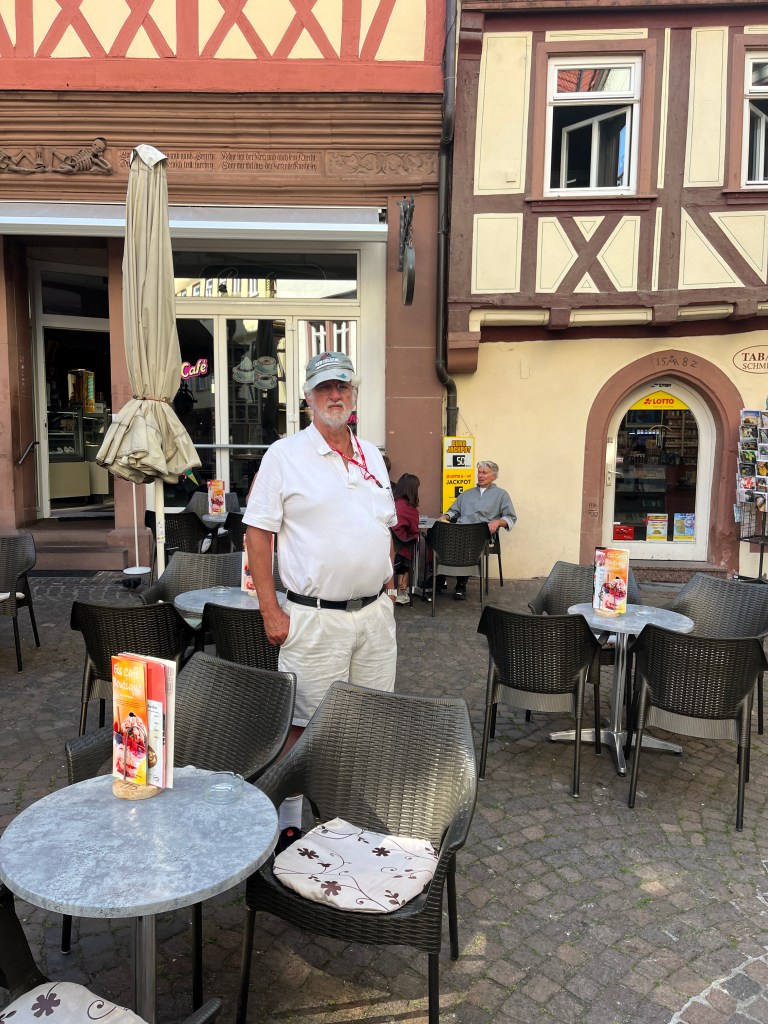
This morning, we were moored at Wertheim, a village on the Main that had not been destroyed in WWII and still has its 16th Century buildings intact. The temperature was supposed to be in the high 80s, which sounded dreadful, but wasn’t too bad. For one thing, the town was right there, a few minutes’ walk from the river. For another, the excursion was shorter. For another, there was always shade somewhere, and there were an abundance of chairs for the footsore—something other towns were distinctly short of.
There was an enormous castle on the hill above the town—second only to Heidelberg in size according to our guide, Elke. There were two guides, but I gravitated to Elke because she was wearing a pretty dirndl. Why not? I learned later that her “real” job is as a nurse, and she does guiding as a refreshing change.
The leaning tower of Wertheim. We resisted any urge to pose with it as though we were holding it up.
There was a strange leaning tower at the entrance to the town. It had once been part of the town ramparts, but stands by itself now. The lower half was built of stone with 7-foot-thick walls, and this is the leaning part. The top, a later addition, attempted to correct the leaning. it was once called “the hall of fear” because it was used as a jail. The interior was cramped because of the thick walls. It was completely dark, cold, and damp. They would lower prisoners into the tower on a rope, and that was that, I guess.
The old town is very quaint, with narrow, tall, half-timbered buildings. The bakery was built in the 1600s and is still a bakery. The baker is the 13th generation of bakers. He gave us a pretzel demonstration as part of the excursion . More on that later. It seemed many of the buildings still serve their original purposes, judging by the symbols on the fronts of the buildings. It’s a very pretty place, with flower boxes and cafes, and ancient buildings.
There are still remnants of the old town ramparts. This gate to the old town is now part of a hotel.
Elke gave us a brief history of the town, including the sending of Jews to concentration camps. One of the houses now memorializes the Jews, and is decorated with suns, stars, the Star of David, a cross, and the word shalom. In the cobbles in front of the house are some brass stumblestones with the names of the residents. Elke told us that in 1972, the town’s mayor tracked down as many of the surviving Jewish residents as he could and invited them back for a reconciliation ceremony and apology from what was done to them.
The memorial to Wertheim’s vanished Jewish population.The “stumblestones” memorializing the Jews who lived in the house above.
The town’s church started as a Catholic Church, but was later converted to Lutheran. Because it was the only church in town, Catholic residents also attended, and they and the the Lutherans had separate entrances for a while until it became just Lutheran again, presumably because there weren’t enough Catholics left.
Outside a striking blue and white half-timbered house stands a fairly appalling— but large—bright blue plastic statue of a dwarf, intended to symbolize the optimism of Wertheim. Um, OK.
The optimistic, if ugly, dwarf statue in front of the beautiful blue and White House where glassmakers lived. Maybe they still do—there’s a glass blower’s shop a few yards away.Two houses in Wertheim leaning toward each other like old friends.My beloved.
One group went off to walk in the vineyards while the rest of us wandered around town. Then we met up by bus for a wine tasting and pretzel making demonstration. The wine tasting was more like four large glasses of different wines. I liked the sparkling wine and the Riesling the best.
The baker of 13 generations gave a pretzel demonstration. He had a lot of mildly naughty jokes—quite the fellow. If anyone asked a question he liked, they were gifted with many pretzels. I asked why they were dipped in lye before being salted and baked. He said he asked his father, who had asked his father, and no one knew. Then he said he discovered that 200 years ago, a pretzel accidentally fell into a cleaning bucket with lye water in it, and the baker used it anyway. It turned out crisp, brown, and different from the others and has been the custom ever since. I am not sure I believe this tale, but I got four enormous pretzels for asking. We headed back to the boat full of wine and pretzels and ate lunch as the boat took off again.
At the winery, which has a long and complicated German name that I didn’t record. On the left, in the white coat, our merry pretzel-maker. On the left in the pretty dirndl, our guide, Elke.Me with my prize pretzels for asking about why food might be dipped in poison to make it delicious.
Back at the River Duchess, Captain Ronny gave a presentation on nautical matters, starting with how he became a captain. I found his story really different and fascinating. He was born on a cargo boat that his parents operated out of Rotterdam. At the age of five, he attended floating kindergartens that were set up for the children of such maritime families. But he had to attend boarding schools as an older child. At the age of 16 he returned home (his parents had a larger cargo boat by that time) and worked with his parents until he attended navigational school. After graduating, he worked on different cargo ships but basically had no social life until he married a Swedish woman and moved to Sweden to start a family.
He started a ship maintenance businessin Sweden, but apparently neither the business nor the marriage prospered, so he went back to cargo boats, first hauling fuels, then chemicals. One day he was docked somewhere and the cargo exploded while he was in the wheelhouse. He took this as a sign to do something different, and started working for Uniworld. It took him some time to learn how to maneuver the river boats because instead of the standard propellers and tiller, they have propellers and bow thrusters, which allow for the precise navigation that makes for a trip that doesn’t spill the guests’ drinks. It is a very smooth trip, I must say.
He also presented a lot of info about the River Duchess (where he has worked for seven years). I will skip over the tonnage and draft and so forth. From the appearance of the boat, we thought it was pretty new, but it was built in 2003. Turns out they spend the winter months refurbishing the boat, which accounts for its pristine appearance. Uniworld didn’t lay off any staff during the pandemic, accounting for very low turnover. Respect!
Susan’s birthday dinner. Lovely food and wine! The best company.Alex (left, in the butler gear) and Todor, the dining room manager, served our private dinner.
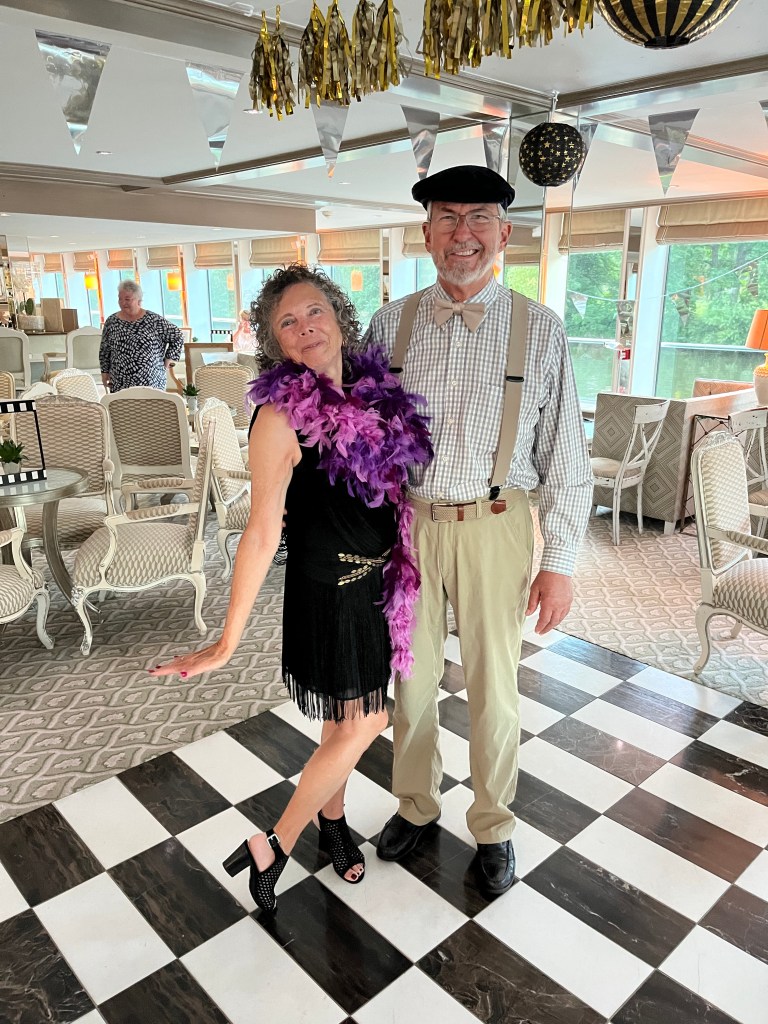
This evening, we had a private dinner for Susan’s birthday, and I wish I could have eaten it all, but I couldn’t. There’s a Roaring Twenties party in the lounge tonight, and Susan and David dressed for it. Don’t they look wonderful?
The following is the entirety of Chapter 1 from “Lords of the Night,” now available at Amazon.com:
“Who do you think you are, Chaco? A drill sergeant?” Sierra snarled. She slipped off the greased bowling ball, dropping the dishes she had been balancing on the end of a broomstick. The dishes shattered on the tile floor of her kitchen. She picked her way through the shards in oily bare feet, muttering, and seized a glass of water, gulping it as she wiped away the sweat pouring down her face and neck.
“I warned you this would be hard,” said Chaco. He passed a hand over the ruined dishes and they disappeared. He cocked his head at her, amber eyes steady.
“Yeah, you did,” Sierra responded. “But what the hell does standing on a greased bowling ball and destroying crockery have to do with becoming a sorceress? I’m not applying to Cirque du Soleil for a job.”
“Take a break,” Chaco replied peaceably, but his equanimity did not soothe her.
“I AM taking a break,” Sierra shot back. “Are you going to answer my question?”
Chaco lowered his lithe body into a chair, raking fingers through his dark hair. “As I told you when we started, the training is mental, spiritual, and physical. This is part of the physical training. A magic worker will often find him—or her—self in physically dangerous situations. You need to be strong, very strong, and your balance, aim, and precision must be honed to the highest degree. Think of yourself as an Olympic athlete…”
Sierra glanced down at her body, clad in shorts and tank top. She had been toned and on the slender side when she and Chaco had begun her training. Now she saw muscle definition in her thighs, where before they had merely been strong and well-shaped. The training was definitely making a difference. But god, she was working hard! And she hated it.
“I don’t get it,” she said, still cross. She knew Chaco was only doing his best to help, but at the moment, she didn’t care. “You never exercise. You never practice. Sure, you noodle around with trying new magics once in a while, but I’ve never seen you balancing on a greasy bowling ball. Do you do it when I’m not around or something?”
Sensing that Sierra was easing up a bit, Chaco laughed. “I’m a demigod. I don’t have to practice. When you become a demigod—or full-on goddess—you won’t have to practice either.”
“What? What are you talking about?”
“Well, you can’t expect to become a goddess overnight. You have to work at it. Like becoming Miss Universe or something.”
“Are you telling me that I’ll become a goddess if I continue the training?”
“Oh, no. There are no guarantees. Once you complete the training, there are still the traditional trials and tribulations.”
“I don’t want to be a goddess, Chaco. Your training sucks and I’m done.” Sierra put down her glass and stalked away, leaving Chaco in the kitchen, smiling to himself.
#
One year previously, Sierra had inherited a comfortable sum of money and a house from her fiancé, Clancy Forrester. There was only one problem; she suspected Clancy wasn’t actually dead. No body had been found and her friend Rose, who had witnessed Clancy’s fall from the side of a boat, said Clancy had never hit the water. If he had, he would have died, as the water was boiling from an undersea volcanic eruption.
The inheritance bothered her conscience, but she rationalized that if Clancy were alive somewhere, she would need the money to find him. She quit her job as communications executive with the Clear Days Foundation—a job she loved—to have the time to search for him. She thought Clancy would forgive her for selling his house and spending his money when and if she ever found him. And she knew she needed training to fully harness the powers that would enable her to find Clancy and rescue him from . . . whatever he needed to be rescued from. Unfortunately, she didn’t know what he needed to be rescued from. In point of fact, she also didn’t know when he needed to be rescued, but she and her friends were working on that.
While she was figuring out what she needed to do to find Clancy, she sold her own modest townhouse in Mountain View, California as well as Clancy’s highly sought-after ranch house in Sunnyvale. She added those proceeds to the three million dollars Clancy had left her in investments and began looking for a house where she could train in privacy. Her friend Rose, a Native American shaman, had suggested purchasing a remote cabin.
“You’re going to need privacy—real privacy—and alone time now,” Rose had said. “This training is serious business and you need to concentrate. And you don’t need nosy neighbors.” Sierra bought a cabin in a redwood forest in the Santa Cruz Mountains, which was remote enough to satisfy her friend.
However, Rose had refused to train Sierra herself. “You’ve already gone beyond me in strength,” Rose had said. “There’s really nothing more I can teach you.”
Sierra also asked her friend Mama Labadie to train her. Mama Labadie was a Voudún houngan whose ability to communicate with her loa—or at least with the loa called Madame Ézilée—had come in handy many times during Sierra’s earlier adventures. “No, uh-uh, and absolutely not,” was the houngan’s response. “You’re already scary strong. You should ask Madam Ézilée, not me. She might be strong enough to teach you before you get somebody killed.”
Kaylee, Sierra’s former work colleague and now a fast friend, was a Voudún practitioner, but claimed absolutely no occult powers. “I’ve been watching you,” Kaylee told her when Sierra groused a bit about Mama and Rose’s refusals to train her. “You’re powerful. You’ve gone wa-a-ay beyond Mama and Rose. They were right to turn you down. Sugar, you need to find someone who’s got more oomph than you do.”
#
One evening, as Sierra was unwrapping china mugs in her new kitchen and putting them on shelves, she complained to Chaco, “They’ve been telling me forever that I need to exercise my powers. That I need to train. But when I ask now? No dice. Mama and Rose won’t help me. Kaylee says she can’t help me. I don’t get it—they like Clancy. They want to get him back. I mean . . . don’t they?”
Chaco, his hands full of packing materials, took a moment to answer. “Of course they like him,” he finally said, swiping raven-black hair away from his face. “They probably liked Clancy more than he liked them.”
Sierra had to admit this was likely true, even if she didn’t like the past tense. Clancy had never been entirely comfortable around the “Three Weird Sisters,” as he called her three closest female friends. “Okay, but still. Wouldn’t you think they would help me to find him?”
Chaco put down a salt and pepper shaker set and sat in one of the kitchen chairs. “Do you want to have a serious conversation about this, or are you just bitching?”
Sierra set two mugs in a cupboard and sat down opposite Chaco. “I want a serious conversation. Tell me.”
“Let me make an analogy. Let’s say you’re a golfer, and you want to improve your game, maybe even play competitively. Do you go to your golfing buddy for training? The one who plays worse than you?”
“Well, obviously no. I take your point. But how am I going to find a teacher who’s better than me, if I’ve somehow gotten so strong?”
Chaco sat quietly, regarding her with his amber eyes. His expressive lips were slightly curved, his body relaxed and boneless-looking in the wooden chair. Like his alternate form, a coyote, he had the gift of seeming at home wherever he was. He continued to gaze at her in silence.
“You mean . . . you?” she finally asked.
“Who else is there?”
And that was that. She began her training in magic to find and rescue Clancy, wherever and whenever he might be. Chaco moved into Sierra’s second bedroom (she didn’t ask where he had been living before) to dedicate his time to her training. She expected that his residency would result in a renewed interest in getting her into his bed, but to her surprise he treated her as a comrade-in-arms with none of his usual sly suggestions. She found herself staring from time to time at Chaco’s face, with its long, chiseled planes, his golden eyes, his nicely muscled…and then she would flush with guilt at the thought of Clancy. Clancy, who would not be lost if it weren’t for his love for Sierra. But having Chaco around was convenient, and he was behaving himself, so the arrangement made sense.
Chaco had concentrated first on her powers, her mana. In the beginning, Sierra had envisioned her mana as colored flames, erratic and difficult to control. Gradually, she had come to see her powers as brightly colored ribbons twining in space, of every color she knew and some she didn’t. Chaco was able to visualize along with her. “There, right there,” he’d say. “That bright pink one? That’s for healing. Wrap it around your sore knee and see what happens.”
In the next moment, Sierra blinked at him in surprise. “The pain is gone!”
“You can heal other people, too. Try it the next time you see someone limping or with a bandage.”
“Won’t that be kind of obvious?”
“How would they know?” he asked reasonably. “You don’t have to wave a magic wand or recite a spell. They can’t see your mana—only you can. And me, of course.”
Sierra rather enjoyed the mana-strengthening sessions. She no longer endured sprained muscles or headaches. The gold ribbons were for battle. The silver ones were for moving things, the black ones were for…Sierra didn’t know what the black ones were for. They weren’t actually black, as they shifted between deepest indigo, bottle green, copper, and . . . something else . . . as she watched them.
“Chaco, what are the black ribbons for?” she inquired one day as she and Chaco took a break by the little creek that ran near her cabin.
“Black ribbons?”
“Yeah, like this,” and she called the black ribbons up, letting them twist and coil in her mind’s eye, glittering slowly.
“No!” Chaco yelled. He shook her and the twining black ribbons vanished.
“What the hell?”” Sierra scrambled to her feet and glared at him. “What’d you do that for?”
Chaco remained seated, gazing at her seriously. “Sorry. I didn’t mean to scare you. Those … black ribbons. Don’t use them. That is not mana that you can control. If you try, the mana will control you.”
“Then why do I have it?”
Chaco just shook his head. “I suppose we all have something like that inside. Something uncontrollable and dark. Just don’t use dark mana.” He rose in one smooth motion, then effected a dizzying transformation. His face elongated like melting wax, and as Sierra watched, his body hunched, arms and legs growing crooked and furry. Within a few heartbeats, a large, handsomely furred coyote stood next to her. He turned and trotted away into the shadows between the redwoods. Sierra watched him go, a hundred questions unanswered.
#
While she was training, Sierra tried to determine where Clancy had gone, specifically. The loa had indicated in their usual infuriatingly vague way that Clancy was alive and in the Yucatan Peninsula, but had then become tight-lipped and uncommunicative. The Yucatan constituted 76,300 square miles, which was impossibly large to search. Of even greater concern was the question of when. If Clancy had been whisked off to the Mayan Riviera, or even to a remote jungle, surely, he would have been found by now. Unless he’s dead, whispered a sombre voice in Sierra’s mind.
“Are we certain Clancy didn’t die when he went over the side of the boat?” she asked Rose and Kaylee, not for the first time. Kaylee hadn’t been in Moloka’i when Clancy disappeared, but Rose had been present.
“No, he never went into the water,” said Rose, patiently. “I don’t want to get too graphic here, but do you remember what happened to all those sharks and other fish?”
Sierra shuddered. She remembered the pale, poached bodies of tiger sharks, boiled to death by the wrath of Pele beneath the sea.
“Yes, I do, and Clancy wasn’t among them. But I feel like I’m grasping at straws here. We have nothing to go on but your amulet. Why did you give it to Clancy, by the way? He didn’t—doesn’t—believe in things like that.”
“Once in a while, I ‘see’ a darkness hanging around a person. It usually means they’re about to die, whether by accident or suicide. I saw this darkness around Clancy shortly before we went out to the wind farm where he went over the side of our boat. My amulet is powerfully protective, so I asked Clancy to wear it. When I handed it to him it was in a little leather medicine bag, but he took the amulet out and wore it around his neck, under his shirt. Probably so people wouldn’t see it, is my guess.”
“Do you know anything about the amulet? Where it was made? When it was made?” asked Kaylee.
“I know it was made in the Yucatan Peninsula during Mayan times, because it represents a scroll serpent or spirit snake, which was peculiar to the region. It represents Kukulcan, the feathered serpent, with an ancestor spirit emerging from its mouth. I don’t know anything more about it,” concluded Rose.
“Wait a minute,” said Kaylee. “I thought Quetzalcoatl was the feathered serpent?”
Rose smiled. “Yep. He was—is. He was the plumed serpent of the Aztecs. But Kukulcan came first, with the Maya. If you encounter him again you could ask, but I suspect they are the same Avatar, viewed through different lenses.”
The women thought for several minutes, each pursuing the question of how the amulet might help them locate Clancy. Rose said, “You know, a few years ago I took pictures of all the Native American artifacts that I’ve collected, just in case I needed them for insurance. I must have photographed the amulet, too. The pictures are on a flash drive that I put in my safety deposit box. Maybe the photo will show us some detail that I’ve forgotten.”
A quick trip to the bank, and the flash drive was inserted into Rose’s computer, Sierra and Kaylee hanging impatiently over her shoulder. She located the right files and brought up two photographs of a green stone carving, an elaborately curlicued serpent figure. Rose pointed out the figure of the ancestor spirit emerging from the creature’s mouth.
“What’s this other one?” asked Kaylee, pointing at the second photo. At first, it looked like a reverse image of the first, then Sierra realized it depicted the back of the intricately carved amulet.
“Rose, there’s something carved on the back! What does it say?” Sierra asked, pointing to the screen.
Rose peered at the image. She shook her head. “I have no idea.”
People sometimes ask me how I get ideas for my books. The short answer is: I don’t. I think people sometimes envision authors sitting at their elaborately carved Renaissance desk, complete with quill pen, and an exclamation point appears with a brand-new, amazing idea for a story! Eureka!
Maybe that’s how it works for some authors, I don’t know. The way it works for me is that I decide what part of the world I want a story to take place in, and then I go to that place. I let the place tell me the story. If that sounds mystical or authorish, it isn’t. It’s just how it works for me.
The first book of my trilogy, “The Obsidian Mirror,” took place mostly in Silicon Valley because that’s where I was living and working at the time. I understood the high tech industries, so my protagonist, Sierra, was a high tech public relations person (as I had been, many moons ago). The idea for the basis of the story came from my familiarity with the semiconductor industry and the ubiquity of integrated circuits around the world.
The second novel, “Fire in the Ocean,” had its origins in a Hawai‘ian vacation on the island of Oahu. I decided I wanted to set a novel in Hawai’i. Once home, I began planning a research trip the way I thought an author ought to—I contacted the Bishop Museum, the leading museum of Polynesian culture in the world. I contacted the University of Hawaii Dept. of Hawaiian Studies (or some such). I made reservations to go to Oahu to meet with these knowledgeable people.
Crickets. No one ever responded to my requests. So I decided that the story would be set on Moloka‘i, because that is the island of sorcery, according to the ancient Hawai’ians, which made it extremely attractive to a fantasy writer (that would be me). I also wanted to visit my friend in Captain Cook on the Big Island, because I hoped he would introduce me to some local people who could tell me about myths and legends. I changed all the reservations, abandoning the idea of speaking to the academic experts in Oahu.
At this point in my journey, I didn’t have a story. I knew i would be using my protagonist Sierra, and probably her friend, Coyotl the Trickster, but there were several other characters involved, and I wasn’t sure how I would be using them: Clancy, Rose, Mama Labadie—and especially Fred.
So my husband Tom and I jetted off to the Big Island. My friend was not available to meet for a few days, so Tom and I found ways to entertain ourselves—snorkeling, sampling the local goods like honey and macadamia nuts and coffee. We tried the local Captain Cook grocery store for wine, but the selection was unappealing, so we made a trip to Costco in Kona. While standing in line, I noticed an enormous refrigerator nearby, full of leis. I have always wanted a maile leaf lei. They are made as garlands rather than necklaces, and they often use only the pleasantly vanilla-scented leaves, not flowers. Sure enough Costco had them, and I took my prize back to Captain Cook.
I wore the lei the next day on a visit to Volcano National Park. Kilawea, Pele’s home volcano, was erupting, so I decided to sacrifice my lei to Pele, Goddess of Fire, and ask for her blessing on my work (which I hadn’t started because no story yet). To my disappointment, they wouldn’t let us anywhere near the actual flowing lava, but we were able to approach the rim of the caldera. It was clear this was the right place because there were other offering leis hanging in a tiny tree next to the railing, as well as on the railing itself. I held up my lei, asked for Pele’s blessing and whanged it right into the little tree, where it was securely caught in the branches. Then we turned around and started to walk away, but I wanted a photo of my lei hanging in the tree, so we went back after only a few steps.
Flinging my maile lei into the tree at the rim of the Kilawea cauldera.
My lei had vanished. All the other leis were still there. It was absolutely still without a breath of wind. We looked all around the ground under the tree. No maile leaf lei to be seen. With that incident, the story began to take shape in my head, with Pele taking an important role.
When I started thinking about “Lords of the Night” (I didn’t have a title at this point, by the way), I decided to write a historical fantasy—even though my characters were 21st century people. Why? I think it was the challenge. And I wanted to learn more about the ancient Maya. My mother helped to excavate several Mayan ruins in Yucatan and Guatemala, back when most of those great cities were still covered in jungle, and there were no roads to the excavation sites. So in addition to reading intensively about the Maya, their history, arts, mathematics, science, and culture, I set up a trip to the Yucatan Peninsula. (Actually, Tom does all the actual trip planning, based on what I want to see. He is wonderful that way!)
The ruins of a palace at Calakmul
I was blissfully untroubled by the problem of getting my 21st century characters back to the 5th century. This is fantasy! I can just make it up! As a writer, I adore that freedom. Why do you think I don’t write science fiction?
I also cleverly invited a couple to go along with us. Clod, the male half of the couple, was born and lived as a young person in Mexico City, with vacations in the Yucatan, which is where his father was raised. Linda studied Spanish in school. I speak Spanish like a first-year student with a strangely good accent (thanks to my Spanish-speaking mother). Tom has never studied Spanish. See how I did that?
The story began to take shape for me when we visited the ruins of Calakmul, which lie within the borders of a large biological reserve on the Guatemalan border. Calakmul had been my primary destination, though we did visit Tulum, Uxmal, and a few other archeological sites. I don’t know why Calakmul drew me so strongly. My mother didn’t excavate there, and I had never heard of it before beginning research for this trip. I had seen photos, and the city has a temple that rivals Egypt’s Great Pyramid for size. Plus, it is located in the middle of a jungle, far from the well-trod tourist trails. Intriguing, no?
There is only one hotel within the borders of the biological reserve. If you want to visit Calakmul, you more or less have to stay at Hotel Puerta Calakmul, because the hotel, deep in the jungle, is still 60 kilometers or so from the ruins, along an unpaved road. When you get to the drop-off place for the ruins, you still have to walk a kilometer to arrive at the actual city.
At the base of one of the temples in Calakmul.
All of which made my visit to Calakmul everything I could have hoped for. As we walked along, I picked our guide’s brain about Mayan folk tales and we saw peacock-gorgeous oscillated turkeys, and monkeys, and javelinas. The ruins themselves were pleasantly shaded, with very few other people around. It was nothing like the wait-in-line-in-the-tropical-sun-with-a-million-other-tourists experience of the more popular sites. The temples, all of which have not yet been excavated, are impressive. In its time, Calakmul was one of the most powerful cities of the ancient Mayan world, and its name was Ox Té Tuun. Ox Té Tuun is central to “Lords of the Night,” and as I strolled along its broad avenues I developed the character of Ix Mol, a young Mayan girl from Ox Té Tuun with a very big problem who enlivens the pages of “Lords of the Night.”
More Calakmul.
All of which is a long-winded way of saying that place is central to my process as a writer. I have no idea why, but there’s nothing like a good trip to someplace far, far away to stimulate my creative juices.
Sorry—that may have been a bit misleading. I mean that I finished the third book in my “Gods of the New World” trilogy. And it took a long time to get here. But you don’t want to hear all that—you want to know all about “Lords of the Night,” the final book? Right?
In “Lords of the Night,” Sierra and Chaco travel back in time to rescue Clancy from 6th Century Yucatan. (Spoiler Alert: Clancy didn’t die in the boiling ocean in “Fire in the Ocean” after all. Okay, I did consider letting him die in Moloka‘i. But Clancy was there at the beginning of this adventure in “The Obsidian Mirror.” After all this time, I really wanted him to be there at the end.)
Sierra and Chaco discover that Clancy was saved from death by boiling, but is now lost in the distant past, somewhere in the huge expanse of the ancient Yucatan jungle.
In the process of trying to locate Clancy, they encounter a young Mayan girl, Ix Mol, who has an agenda of her own. Ix Mol knows how to find Clancy, but it involves walking the White Road all the way to the great city of Ox Té Tuun, hundreds of miles away.
They arrive just in time to see Clancy sacrificed at the Temple of Chaak.
Well, being dead didn’t stop Clancy before. But the real excitement is where Sierra and Chaco wind up. Clancy and Ix Mol also have surprise endings to their sagas.
And Fred? Well, if you want to know the role that Fred plays in this story, you’ll just have to read it.
I can say no more. But I can guarantee a satisfying climax to Sierra’s story. To read the first chapter:
Sorry—that may have been a bit misleading. I mean that I finished the third book in my “Gods of the New World” trilogy. And it took a long time to get here. But you don’t want to hear all that—you want to know all about “Lords of the Night,” the final book? Right?
In “Lords of the Night,” Sierra and Chaco travel back in time to rescue Clancy from 6th Century Yucatan. (Spoiler Alert: Clancy didn’t die in the boiling ocean in “Fire in the Ocean” after all. Okay, I did consider letting him die in Moloka‘i. But Clancy was there at the beginning of this adventure in “The Obsidian Mirror.” After all this time, I really wanted him to be there at the end.)
Sierra and Chaco discover that Clancy was saved from death by boiling, but is now lost in the distant past, somewhere in the huge expanse of the ancient Yucatan jungle.
In the process of trying to locate Clancy, they encounter a young Mayan girl, Ix Mol, who has an agenda of her own. Ix Mol knows how to find Clancy, but it involves walking the White Road all the way to the great city of Ox Té Tuun, hundreds of miles away.
They arrive just in time to see Clancy sacrificed at the Temple of Chaak.
Well, being dead didn’t stop Clancy before. But the real excitement is where Sierra and Chaco wind up. Clancy and Ix Mol also have surprise endings to their sagas.
And Fred? Well, if you want to know the role that Fred plays in this story, you’ll just have to read it.
I can say no more. But I can guarantee a satisfying climax to Sierra’s story.
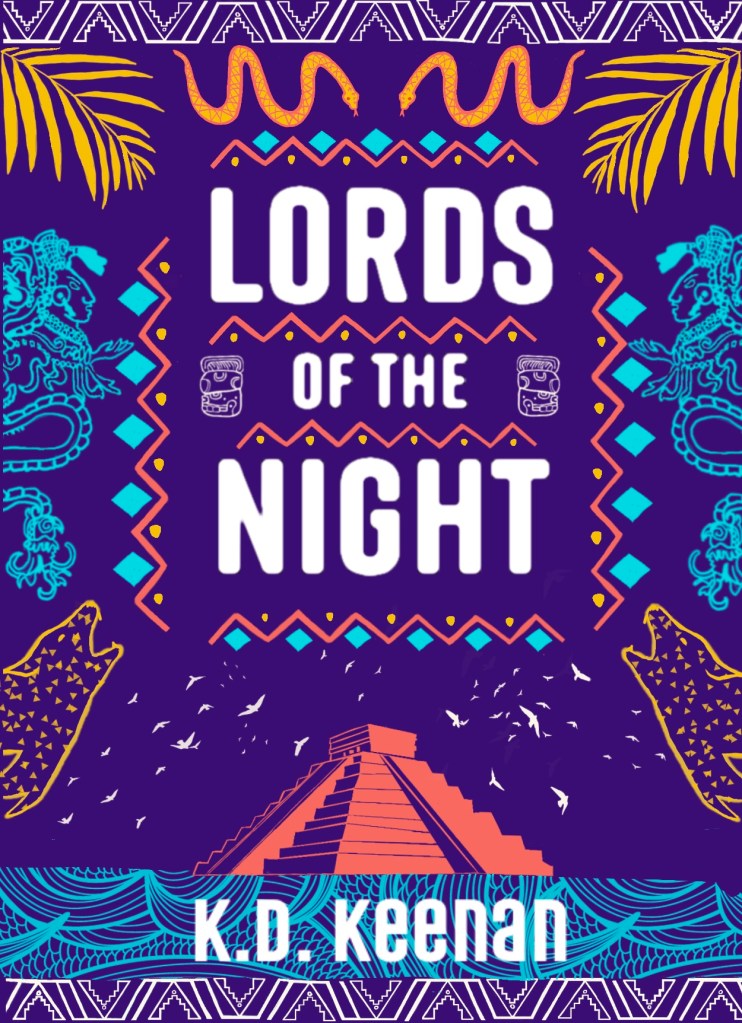
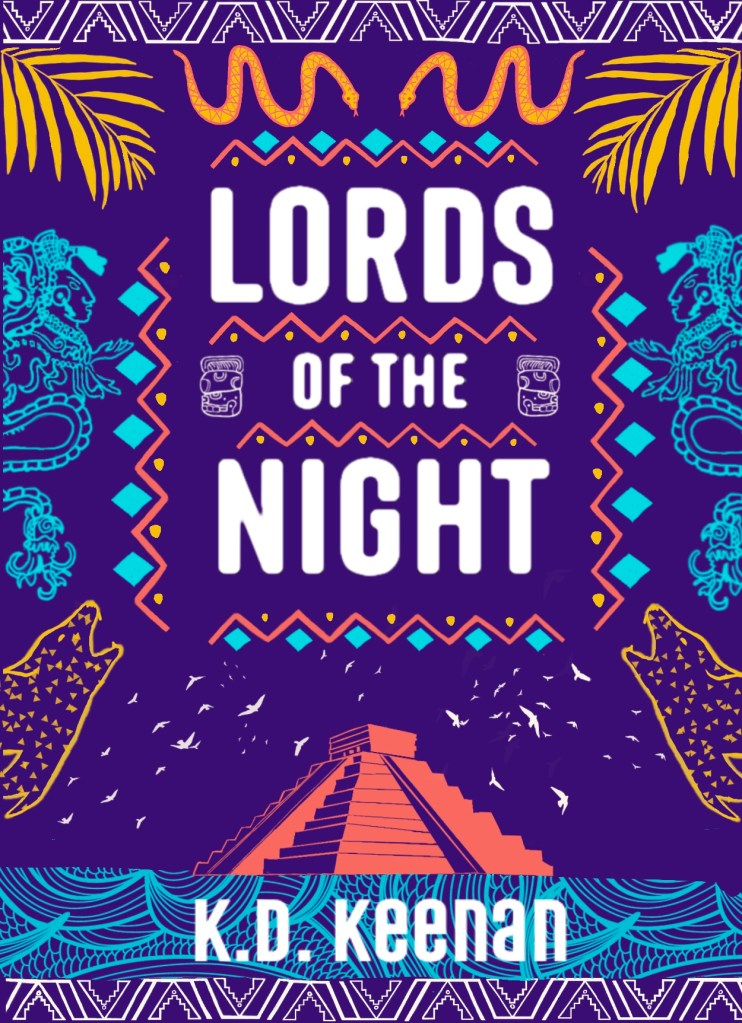
I couldn’t have done this without the help of several people who took the time and trouble to offer me advice. I was also smart enough to ask my artistic daughter, Kerry Gil, who has formal training in graphic arts, for feedback.
I am super pleased with the resulting cover. I probably went through eight different iterations before getting to this one. I didn’t post all of them, but I got wonderful feedback from my friends online as well as family. I suppose I have had more difficult creative challenges, but mimicking someone else’s style in a field in which my competence is minimal is one of the tougher goals I have set myself.
In particular, I am pleased that everything fits the ancient Mayan theme of the book–ocean, snakes, temple, palm fronds, Spirit Snake amulet, coyote (Chaco!). The birds flying around the temple refer to a climactic scene in the book (although it’s not the only climax, I assure you).
I hope you like the cover. I will be back soon to announce the publication of “Lords of the Night,” the final (and climactic) ending to “The Gods of the New World” trilogy.









 obsidianmirrorblog