My Mom: the Female Indiana Jones

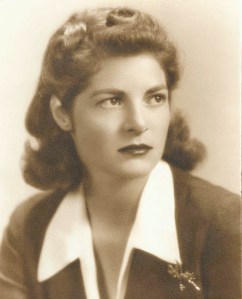
Barbara IndianaAs I have mentioned a few times in this blog, I wrote “The Obsidian Mirror” based on American archetypes. I am no expert on Native American folklore, but perhaps I know a little bit more than the average person because my mother was an archeologist specializing in southwestern Native American cultures. She also excavated in Yucatan and Guatamala, helping to uncover Mayan pyramids and temples that had been lost to the jungle hundreds of years ago.

In fact, my mom, Barbara Moore Doyle, was sort of a young, female Indiana Jones. She was excavating at about the same time—the late 1930’s. In the service of archeology, she wielded a machete, slashing through the Central American jungles. At a dig somewhere in the wilds of Arizona she got blood poisoning after falling off the buckboard of a roadster and scraping up her legs. They were excavating far from any hospital—in fact they were far from any roads at the time. A young Apache medical student named Tom White Cloud (what a romantic name!) fixed up a drip of some sort and saved her life.

My mother-to-be climbed up the side of a pyramid in Guatamala and came face-to-face with a fer-de-lance, one of the most poisonous and aggressive snakes in the world.

“What did you do?” I asked breathlessly when she told me this story.

“I made a split-second decision between snakebite in the middle of the jungle where there were no hospitals or anti-venom—or falling. I decided to fall, and…just let go.”

“What did the snake do?”

“I don’t know, but I think he was just as surprised as I was.”

Fortunately, she rolled to the bottom of the pyramid with nothing worse than a bruise or two.

She witnessed strange rituals during the night of Dia de las Muertes in Tegucigalpa, and was perhaps the first and only woman, white or Indian, who was invited into a working Hopi Kiva.

Most of the time, of course, she spent crouched in ditches with a pick and camelhair brush, painstakingly removing dirt and rocks to discover whatever was there to be found. She taught me to walk in the desert with the “archeologist’s stoop,” scanning the ground for potsherds or worked flints. (Also rattlesnakes.) It was like a treasure hunt, and I still have the bits of ancient painted pottery and arrowheads gleaned from these expeditions.

My young mother even ran afoul of the Nazis. During a sojourn in Mexico City, she dated a man named Oswald (last name forgotten by me) who was the brother of the head of the Nazi Party in Mexico. He would take her to the Nazi Officer’s Club, where there was a huge portrait of Adolf Hitler hanging in the dining room. I was scandalized that she would date a Nazi, but she said that Oswald himself was not a Nazi and said that he quietly scoffed at the self-important posturing of the party members.

My mother’s archeology career came to an end with the entrance of the United States into WWII. She returned home to California and got a job as a riveter at Lockheed-Martin. Being bright, she worked her way up and obtained Top Secret clearance as an aircraft inspector. Inspecting aircraft equipped with radar required Top Secret clearance, as it was still highly classified technology. One day, she came home after work to find two FBI men waiting in her parents’ living room. They had intercepted a letter to her from her friend Oswald. Oswald had crossed the Mexican border into Arizona, possibly to avoid being drafted into the German army. He was promptly picked up and placed in an internment camp for suspect nationals. Oswald, with touching sentimentality, wrote to my mother asking her to marry him so that he could get out of the camp. As all the mail from camp inmates was intercepted and read, the FBI decided his plea was actually code—and addressed to a woman with Top Secret clearance, it set off alarm bells.

My mother explained the situation. Wonder of wonders, they believed her, and she served out the war at Lockheed-Martin, inspecting airplanes. She never went back to archeology. She had met my father when he was stationed at the University of Redlands with a VF12 unit of Marines. They fell in love, and were married toward the end of the war. My father had distinctly Victorian ideas, and disapproved of working women, so that was that.

As a child, I was fascinated by my mother’s early adventures, and asked to hear her stories over and over. I also asked her to tell me Native American folktales, and explain the different cultures and religions to me. As an adult, I asked Mom to write down her adventures for me, because I was afraid I would forget the details. She promised to do so, but was always too busy. By the time I thought to record them on tape, it was too late. My funny, bright, kindhearted, brave mother had descended into dementia, never to recover.

But I had grown up in a house decorated with Navajo rugs, Hopi kachinas, and many ancient pots, arrowheads, fired clay sculptures from Mayan ruins, spearheads, spindles, and other archeological bricabrac she had squirreled away for herself. (These days, it would be considered criminal to take such things from their sites, but back in the day, if the young archeologists took a few souvenirs, nobody cared.) I had the best show-and-tell possession ever: a human skull. (My grandfather had found it on an unpopulated island in 1917 and gave it to me for my sixth birthday—much to my mother’s disgust. She had wanted that skull herself, and it was one of the reasons she had become interested in archeology.) So it was no surprise that these influences came through when I finally decided to write a novel.

When (I won’t say if) my novel is published, I will dedicate it to my mother. She not only gave me a love of Native American traditions, she also believed in me as a writer. My only regret is that she didn’t live to read “The Obsidian Mirror,” because she would have loved it.

Getting Published: The Waiting Game

Image by By David Sedlecký

Image by By David Sedlecký

Waiting is hard. I heard from my book consultant about two months ago that a literary agent had my book “under consideration.” Wow! Cause for celebration!

Weeks went by. Nothing. Then the consultant emailed me that the agent had actually started READING my manuscript! Yippee! More cause for celebration!

And now I am again waiting to hear: did the agent like it or hate it? As of this writing, I have no idea.

The process of submitting a manuscript to a publisher or an agent takes time—lots of time. First you have to write the darned thing. Then you have to dissociate yourself from your work sufficiently to write book synopses—short, medium, long. This is harder than you might think. You have to go from being completely absorbed in every detail of your story to being able to summarize it in one or two pages. What do you put in? What do you leave out? And you have to make the synopsis itself interesting and intriguing enough to entice someone to read the MS. And write the synopsis in such a way that the reader will gain some understanding of the tone you have used in your book.

You also have to write a pitch letter snappy enough to entice the same reader into reading the synopsis. All of this takes considerable time, blood, sweat and tears. I found it far more painful to write a synopsis than I did to write the whole book (but it didn’t take as long). Fortunately, the consultant helped me out, so in the end I had three synopses that I could actually use.

I know that if the agent turns me down, I will go through the same process with another agent, and so on until I find one that bites. Once I get an agent, I will have to wait for the agent to shop the book around to publishers. And I will have to wait until a publisher is found who is intrepid or foolish enough to take on an unknown author. And then I will have to wait for the book to be published, but I’m hoping that will be less painful.

I’ve been wondering if I should start another book. I’d like to write a sequel to “The Obsidian Mirror,” but the idea of writing a sequel to an unpublished book is a bit daunting. What do you think? Should I wait to see if my story is published—or have faith and start the sequel anyway? Or try my hand at something completely new? What would YOU do?


Comedy: The Cinderella of Art

Comedy and TragedyComedy, regardless of medium, is an undervalued genre when it comes to artistic endeavor. Here’s the test: name a comedic movie that has won an Academy Award for Best Picture.

Still thinking? That’s because not many comedies win Academy Awards, much less an award for Best Picture. There have been a few: “Annie Hall,” “Shakespeare in Love,” and “It Happened One Night,” are rare examples.

As I see it, comedy is the leavening that provides texture to almost any art form. I find this especially true in television serials. “ThirtySomething” started out with a delicious blend of comedy and drama that made it a “must-watch’ show in our household. The show dealt with serious themes, but every show had its comedic moments, providing needed relief from the heaviness of the drama. After two seasons, the comedy element began to disappear. Finally, we were left with unalleviated gloom: cancer, unemployment, business failure, marriages in trouble. We stopped watching because it was no longer entertaining, just depressing.

But the comedic artist is often discounted or overlooked. Only now, 34 years after his death, is painter Norman Rockwell beginning to be recognized as a superbly skilled artist, as subtle in technique and execution as many of the great masters. He was always viewed as a mere illustrator of ephemeral things like magazine covers and ads—because his paintings were usually funny, or at least amusing.

Charles Dickens understood the importance of comedy as a writer’s tool. He used comedy as a way of pointing up the absurdity of society’s conventions or people’s hypocrisy. He was instrumental in initiating important social reforms—and did so largely not by preaching but by making people want to read his books because they were entertaining. For every murderous villain like Bill Sykes in “Oliver Twist” is an offsetting comic figure like the Artful Dodger. Comedy does not obscure the seriousness of Dickens’ message about the misery of the London poor. Comedy makes his message stronger, because his deft juggling of comedy and tragedy make his books a joy to read.

I tried for years to write “literature,” serious work with serious themes that would fulfill me as an artist. I never got very far with any of these efforts, mostly because I bored myself. When I started writing “The Obsidian Mirror,” I didn’t even think about “literature.” I wanted primarily to write a fantasy based on American myths and legends. And I wanted it to be a story that I would enjoy reading myself, which meant that it had to have a lot of comedy in it. (I don’t know why it took so long to realize that I needed to write the kind of story I read. But it did.)

I quickly discovered that comedy isn’t easy to write. It’s easy to write suspenseful, tear-jerking scenes. All you have to do is make the reader care about the character, then do something awful to that character. John Irving is the greatest living master at that (an author I avoid because I don’t like being tear-jerked). Writing comedy means you have to make the reader care about the character while laughing at him or her, and that’s harder.

Also, the book’s underlying theme is environmental conservation, which is a huge personal concern. I wanted to get my message across, but I knew that to become preachy would condemn the book to failure. I worked on upholding the theme throughout, but in such a way that it didn’t become the focus, but the background for the nonstop action and interaction of my characters.

I enjoyed writing the book, and I hope to write another and another and another. None of them will be “literature.” I have embraced being an entertainer rather than an artist (or rather, I hope to be, as the book is not yet published).

If it was good enough for Dickens, I guess it’s more than good enough for me.


The Coyote Who Taught Me How To Live

Okay, instead of writing this blog post, I’m actually supposed to be finishing up a white paper on implementation of the new ICD-10 codes in the healthcare industry. Hard to believe I could tear myself away from that kind of topic to write about coyotes—but that’s what I’m doing.

One of the main characters in “The Obsidian Mirror” is Coyotl, the Trickster. Like Anansi, the trickster spider in African folktales, Coyotl or Coyote is the loveable but sneaky culture hero who tries to put things over on others and sometimes ends up tricking himself. He often attempts to be helpful, as in the tale where he brings fire to the people from the gods. In that story, coyote winds up burning his tail, which is why the coyote’s tail tip is always black. There are many ribald stories about Coyote and various beautiful maidens, including the time that Coyote lost his penis…ahem. Getting off track here…

Coyotl is described as an Avatar in “The Obsidian Mirror” because I wanted to stay away from defining the immortal characters too closely. I also wanted to stay away from religion as much as possible. Religion today is a touchy subject, and I just didn’t want to go there.

In “The Obsidian Mirror,” Coyotl can take the form of a beautiful, sexy young man named Chaco. I originally named the character “Chuy,” (pronounced “Chewy”) which is the Mexican nickname for people named “Jésus.”  There were two problems with this. Unless you speak Spanish, you wouldn’t know how to pronounce his name. And those who do know that people nicknamed Chuy are really named Jésus might think I was trying to create a Christ figure—which I was, most emphatically, not trying to do. I wanted the character to be uninhibitedly sexy and approachable, with a hint of rascal. “Chaco” sounds good, and it is also the name of a marvelous archeological site in New Mexico, Chaco Canyon. As the novel uses American myths and legends, many of which are Native American, it just felt right. (I kind of missed Chuy, though. I named the character after my hairdresser.)

I had a transformative adventure with a coyote once. I was young, and I had a broken heart. I called my cousin Esther, who was about my mother’s age, to ask if I could stay with her for a few days. Esther lived (still does, at the age of 100) on a ranch near the coast of California, one of the happiest places I have ever known, and very beautiful. Esther and her family had always been kind to me, and the ranch was my emotional refuge. So, packing my aching heart and some jeans, I got on a Greyhound bus to visit.

Esther welcomed me and gave me ample space to reflect on where I was and how I had come to be there. I was at a true turning point in my life, hurt, confused, and wondering what on earth I was going to do. My self-confidence was at an all-time low, and at that age, self-confidence wasn’t something I possessed in huge measure.

I developed a daily routine. I would get up, have breakfast with Esther, and then take my little knapsack out for a lengthy walk around the ranch. The knapsack had a notebook for writing and a sketchbook and watercolors for painting. Accompanied by the ranch dogs, Doña and Jack, I would wander all over the ranch, stopping to do nude sunbathing now and again. I wrote and wrote and wrote in my journal, pouring out my misery, uncertainty and pain on paper.

The ranch was about 2,000 acres of rolling hills covered with golden grass and dark-green California liveoak trees. There was no one around except for the cattle and the dogs. It was quiet except for the wind whistling through the grass, making it toss like waves on the ocean. It smelled wonderful—sagebrush, wildflowers and a soupçon of cattle flop. It was the perfect place to be introspective and miserable.

One day, probably four or five days into my visit, I was walking on the ranch road with Doña and Jack. Suddenly, the dogs took off like a shot, something they had never done before. Then I saw they were chasing a coyote through the brush. I eventually wrote a poem about the experience that followed, as it had a huge impact on me that has reverberated ever since:

Coyote

I took the ranch road in the morning

hefting a backpack and an aching heart

the dogs went with me

ranging front and back

I sent my feet ahead, forcing one step and then another

the point is to keep going, don’t you see

the dogs launched into the brush

white dust sparkling above the road

they ran like greyhounds

though both were furry and fat

squinting into the sun I saw him

a lean gray shape loping easily

soaring over fragrant sagebrush

dogs crashing in his wake

coyote

trickster

survivor

little wolf

god’s dog

dogs and coyote

all vanished into the spiced gold of the hillside

the dogs came back

tongues flopping loose

dripping foam

ribs heaving

paws caked with dust

their faces said don’t ask

we sat in the cool of a gray-green liveoak

there he was again

the dogs could not resist

coyote’s gray brush held high

he paused to look over his shoulder

not once but many times

were they following?

could they keep up?

he grinned all the same

I heard him laugh

I know I heard him laugh

the dogs came back quickly

collapsing to either side of me

fat sides

shuddering like overheated engines

hairy faces downcast and pained

I sat in the shade and waited

he sauntered into our clearing

the Fred Astaire of small wolves

the dogs gave not one sign

of his presence but panted on

coyote cocked his head, curious

barked once or twice

the dogs now deaf and blind

turned their pleading eyes to me

he sat on his haunches and studied us

a sorry lot, I guess

he tipped his pointed snout to heaven

and howled

howled like all the mad things of earth

howled like a girl with a broken heart

the sulking dogs were still

but I howled back

he stopped to listen

he answered me

howl for howl we made the dry hills ring

I howled for the pain of losing

for the pain of past loss

for the pain to come

and ended laughing

coyote picked up his paws and yapped three times

once more stung to action

the dogs crashed after him

in hot-breathed pursuit

the last I saw of coyote

was his gray tail sailing over the thistles

coyote

trickster

survivor

little wolf

god’s dog

I’m still laughing

During our mutual hootenanny, the coyote was sitting about 15 feet away from me. I was frightened at first; he wasn’t acting like a normal coyote, so I wondered whether he had rabies. He approached a human and two dogs with no fear at all. But it became quickly clear to me that he wasn’t sick. He was having a lot of very obvious fun. He thought I was pretty amusing, but he loved it when he could persuade the dogs to run after him. He was jaunty and quite sure of himself.

Coyotes are consummate survivors. Their numbers and their range have increased dramatically since the 1800’s because they deal quite well with the presence of humans (and the presence of human garbage and pets). They are omnivores who both hunt and scavenge, living off just about anything, from salmonberries to the occasional shi’tsu.

After meeting that coyote, I decided to be a survivor myself. I decided that I was strong, and that no one would ever make me feel small and weak again. I decided to fight for what I wanted, and refuse to allow anyone else to determine the course of my life.

I returned from my visit with Esther to a fresh round of heartbreak. But this time, I fought back. I didn’t let it overwhelm me. I endured a steep depression that I thought would never end. I made some terrible mistakes, but in the end, I learned to love myself and discovered how to be happy most of the time.

I owe much of that to a lesson from a mischievous little wolf who spent a few minutes singing to me. In a way, “The Obsidian Mirror” is my love song back to him.

Criticism

“Criticism” by Julio Ruelas

I am in writer’s limbo. The book is finished. I am working with someone who is supposed to help me find a literary agent. (If she is successful, I will sing her praises from the rooftop!) And I am waiting for that someone to deliver a judgment on the way I have chosen to open the book. This not because I doubt myself, but because the fantasy author that she hired to review the draft (I paid for it) doesn’t think I need the prologue. The first time she read the draft, she told me to ditch the prologue, but the second time around (reviewing a draft where the prologue had been excised, much to my chagrin), she thought I needed to introduce the fantasy element more quickly.

Well, that was what the prologue was for, so I put it back in; I liked it better that way in the first place. An agent who actually read the first few chapters told me that my opening scene (sans prologue) was boring. I didn’t think it was boring, but it did delay the introduction of the fantasy element. The prologue also teases the reader with a puzzle, making it more likely that s/he will continue to read. (Interested? You can read my preferred first chapters at https://obsidianmirrorblog.wordpress.com/about/first-two-chapters-of-the-obsidian-mirror-an-urban-fantasy/)

So who is right? Me? The agent? The fantasy writer? I am waiting breathlessly for the person who is supposed to find an agent to weigh in—so far, I don’t think she has read the manuscript at all, but has relied upon the fantasy writer’s opinion.

I suppose this is the lot of every fiction writer. Everyone’s got an opinion, so who ya gonna trust?

In my day job as a high tech marketing content creator (aka “writer”), I hear multiple opinions on everything I write. This doesn’t bother me. I have set responses, depending on the nature of the criticism:

  • “There are typos.” OK. I’ll fix them.
  • “The grammar is incorrect.” My grammar is usually correct. I know more about grammar than most people have forgotten. But if it’s wrong, I’ll fix it.
  • “Take out this comma…or period…or whatever.” Why not? My name won’t be on it.
  • “Tone down the writing style.” Sure. You’re the customer, and if you want to bore people, that’s fine by me.
  • “I don’t know…it’s fine, but it doesn’t quite say what I want to say.” No worries. Get back to me when you do know.

(Okay, I don’t actually say these things. Tact works better than sarcasm in a client relationship. Usually.)

I can be phlegmatic about critiques of my marketing writing because I am providing a product. The product has to meet the customer’s needs and conform to h/her taste. If my writing doesn’t do this, I will change it until it does.

But the fiction writing I do (and my poetry, which I haven’t submitted to the public eye to the same degree) is another matter. I am open to informed criticism, but when my gut tells me it’s right, it’s right. If my gut tells me that yeah, I could do much better here, I will act on criticism.

In the final analysis, it’s my work. I didn’t write it for the person who will look for an agent for me. I didn’t write it for the fantasy writer who reviewed it (though I spent five years revising the MS because I did listen to her criticism where I felt it was merited). I didn’t write it for the agent or the publisher who may, given luck and the creek don’t rise, publish my novel. I didn’t write it for you, the reader. I wrote it because I wanted to write a book.

Anyway, suppose I did take the prologue out and rewrite the first couple of chapters. I will bet you good, hard cash that the agent will want changes. Then I bet more solid cash that the publisher will want changes, too.

And what will I do then? Stay tuned…

My Adventures with Voodoo

Most of my urban fantasy novel “The Obsidian Mirror” is loosely rooted in the traditions of North American and meso-American cultures. But I didn’t want to leave out all the other rich traditions of the Americas, and the one I know the most about happens to be Vodún—more commonly called Voodoo (which is a Hollywood invention).

You might ask, why is a nice middle-class white woman who has never lived in the Caribbean interested in Vodún? Excellent question! The answer is: I don’t know. I was just interested. I started reading about Vodún sometime in my early twenties. I can’t remember the names of most of the books I consumed, but the best by far was Wade Davis’ “The Serpent and the Rainbow”—which was not much like the later movie of the same name.

Davis was a Harvard botanist who was encouraged by an older professor to go to Haiti to collect plants that might have psychopharmacological value. Haiti offers a wealth of plants known to have potent effects, mostly toxic, that had never been scientifically analyzed. Haitian mambos and houngans (Vodún priestesses and priests) reportedly used things known as “zombie cucumber” and “zombie powder” to create zombies by raising the dead. Davis was supposed to go and see if these things actually existed outside the realm of the movie theater.

They did, and Davis found them. He also demonstrated that zombies were quite real. Ill-intentioned houngans used a blend of various poisons to put victims into a deathlike sleep, where heartbeat and respiration were slowed to imperceptibility. Bodies in rural Haiti are not embalmed, but buried as quickly as possible to avoid the inevitable rapid decay in a hot, wet climate. The houngan and his helpers would disinter the “corpse” the night of the burial, then allow the victim to partially recuperate. The victim was kept in a state of drugged compliance with the use of poisonous fruit—the “zombie cucumber.”—and used as the houngan’s slave labor.

However, what I principally learned about Vodún is that it is a perfectly legitimate religion—as legitimate as any other. The evil houngans and mambos were a tiny minority of Vodún practitioners. Most were in the business of healing and spiritual comfort, as is any pastor or rabbi. Vodún is a pantheistic religion, with many spirits, or loas, personifying various characteristics. There is an all-powerful single god, Bondye, but he does not interfere in human affairs, so followers of Vodún apeal to the loa, who are much more down-to-earth. Dumballah-Wedo is the father god, personified by the serpent, which is wise and all-knowing. Madame Ezilée represents sexuality and feminine beauty. Baron Samedi­—beloved of Hollywood for his gruesome skull-face and black top hat—is the spirit of sex and resurrection, an interesting combination. He is also a Trickster, like Coyote in the American Southwest or Anansi in Africa, but he is not the gruesome horror that the movies make him out to be. And so on—there’s a quite a lot of loa.

Vodún is a charismatic religion. Worshippers become ecstatic, offering themselves as “horses” for the loa to ride. Observers say it is easy to tell which loa rides each individual by their characteristic behavior. Madame Ezilée is all sensuality and seductiveness. Baron Samedi is a wencher and enjoys smoking and drinking. Afterwards, celebrants are usually exhausted and may not remember what they have been doing while possessed. Ceremonies are usually for benign purposes such as healing, celebrating an occasion–or entertaining tourists.

Well, it gets more complicated, and there are various forms of Vodún, just as there are different flavors of almost any religion. Various traditions came from different African tribes. And of course, it got mixed up with the Catholicism of the French colonizers of Haiti. But it is well established, and practiced more widely than you might think.

How do I know this? Many years ago, I visited New Orleans to attend the annual convention of the American Association of Advertising Agencies. ) I was a public relations executive, but my agency sent me to represent them anyway. I did not decline.) The meeting was held in a hotel right smack dab in middle of the French Quarter. I had never been to the city before, and was determined to see as much as I could during the time I was not attending meetings on “Maximize Your Agency Billings” or “Integrated Communications: Agency of the Future?”

I picked up a little street map of the Quarter to assist me in my ramblings. I quickly noticed the Voodoo Museum and made my way to the spot indicated on the map. There was nothing there but the usual French colonial house fronts turned into shops full of rag dolls, gold-embellished shell jewelry and “Cajun Chewing Gum.” I asked a few people about the museum over the next day or two, and finally someone knew; the museum had moved its location. I went to see it the next day.

It was a gray day, spitting down rain, simultaneously chilly and steamy. I arrived dripping wet in the marble-tiled lobby. The museum was located on the ground floor of an old New Orleans house, built around an open atrium with a garden. The lobby had been the original entry hall of the house. To my left was a reception desk, behind which sat an enormous black man knitting a bright orange and green sweater the size of a circus tent. He was chatting with a tall young white man with long blond hair. They both stopped talking as I approached and the knitting man took my fifty cents admission. In exchange, I got a little map of the museum.

I took the map and stood by the open doors into the atrium. There were exhibits in the garden, but the rain was sheeting down in buckets, so I decided to stay indoors. The young blond man walked over and stood beside me. He didn’t say or do anything, but he made me uncomfortable, and I decided to move into a small room marked “Marie Laveau Room.” It turned out to be a very small room indeed when the man walked in after me. I peered into antiquated and dusty museum cases at the unlit exhibits, usually labeled on yellowing paper in faded typewriter ink, and tried to ignore him. He showed no signs of going away, so I walked out again. He walked out after me.

Feeling quite nervous by this time, I hesitated in the lobby.  Finally the young man spoke.

“Would you like a tour of the museum?” he inquired. He had a slight accent of some sort that I couldn’t place, but he wasn’t from New Orleans.

“Do you work here?” I asked, still suspicious. He nodded. “How much?”

“No charge,” he responded.

“What do you do here?”

He nodded toward a nearby sign that read, “Psychic Readings.” “I do the readings.”

“Are you a practitioner of Voodoo?” I asked, wondering if the young man could tell me more about the exhibits than did the faded labels.

“Vodún,” he corrected me gently. The correct way to say it is ‘Vodún.’ Voodoo is only in the movies. My name is Roland, by the way.” He held out a long-fingered, slender hand. I introduced myself and shook it, still a bit reluctantly.

“Vodún is a world religion, like Christianity, Judaism or Islam,” he went on. “It’s practiced everywhere.”

“Really? I thought it was just in Haiti and New Orleans?”

“No, you can find it anywhere. Even in Israel, where I come from.” Curioser and curioser. We had a good 15-minute discussion about world religions and Vodún, and I decided he was the real goods. He knew a great deal about many different religions, and was not just jiving me. I followed him through the museum, and I had a fantastic time asking questions and learning about Vodún. Occasionally, I would express revulsion at some particularly gruesome exhibit, and Roland would shake his long elf-locks at me.

“That was then,” he said several times. “It’s not like that now.” I could only hope he was right.

At the end of the tour, my confidence in Roland’s essentially benevolent intentions had grown, and I asked him for a reading. He took me to a sheet-draped back room. A small marble-topped table with elaborate wrought-iron legs stood to one side, the kind of table you might see in an old-fashioned ice cream parlor. Its small surface was crowded with greasy Burger King wrappers and a plaster skull with a candle stuck to its dome. Roland clucked and swept the mess off the table, muttering excuses. He left for a few minutes and returned with—to my surprise—a pack of Tarot cards. I didn’t know what to expect, but I hadn’t expected Tarot, which I didn’t associate with Voodoo—excuse me— Vodún. I had never had a Tarot card reading either, and settled down with anticipation.

I don’t remember all the details of what Roland told me, or which cards he turned up, beyond The Empress, which he said was my card. Oddly, it usually turns up in my readings, so I guess he was right. (Not that I have Tarot readings frequently, but I do have an extraordinarily gifted friend who does them for me from time to time.) What I do remember is that he told me I would suffer the normal hurts and losses of life, but I would never undergo tragedy, such as the death of a child. And he also said that I should never, EVER! become involved with the occult. It would be too dangerous for me.

That struck me as odd then, and it still does. I was being warned away from the occult by the practitioner of an occult religion who was telling my fortune through occult divination. In a museum dedicated to the occult.

As I left, Roland gave me a card, where he could be reached at any time. The simple black-and white card had his name and address—which was the Divine Light Christian Mission. And I guess that was the cherry on the top of this particular experience.

I never became involved in the occult, beyond a continuing fascination in learning about it. And I have not—yet—experienced major tragedy, though I have come too close for comfort. But I had to find a way to use Vodún in my novel, and invented a mambo named Mama Labadie who plays a fairly important role in the plot. In the midst of meso-American gods and characters from Native American folktales, Mama Labadie stands out rather conspicuously. But Vodún is as much a part of the Americas as any aboriginal tradition, and if I get the chance to write another book, she may pop up again.

The Prologue & First Two Chapters of “The Obsidian Mirror”

The Obsidian Mirror

Prologue

Sierra Carter opened her eyes. She was confused. Surely, she shouldn’t be staring at the ceiling? She was looking up at the ceiling without bending her neck backwards, so that meant…she was lying down. With her head in someone’s warm lap. A person’s face swam into her field of vision, upside down and out of focus, and she pulled her head hastily out of the lap and scrambled to her knees.

The lap belonged to a slender yet well-muscled young man who looked as though he might be Latino, with ruddy brown skin and black hair falling into his face. He wore a bright, beaded necklace. His mouth seemed too wide for his rather long face, and his full lips turned up at the corners, making him look as though he were smiling when he was not. Although his features were all slightly odd, like a character sketch where the artist exaggerates for effect, they melded together into an offbeat beauty. He did not have the dark eyes of a Latino, though; his eyes were a bright, feral amber.

He looked at Sierra with concern, frowning slightly. “Are you all right?” he asked. “How do you feel?”

Sierra stared at him, feeling as though she had wandered into some alternate universe. Apparently, she had fainted—a first for her. And just before she had fainted, what had she been doing? Oh, yes. She had been talking to a coyote…

Chapter 1

It took several long moments for it to sink in; she had just been fired. Sierra Carter sat quite still, staring at her manager across the neat stacks of paper on his desk. Mark Charbonneau gazed uncomfortably back at her, clearly wishing he were somewhere else. As she stared at Mark, Sierra’s thoughts spun around like a nightmare carousel. Round and round it whirled, to the tune of “Fired! Fired! Fired!”

Sierra couldn’t think of any reason she should be fired. She worked hard, she was smart, and she was extremely good at what she did, which was public relations. Since joining Black Diamond Semiconductor Corporation, she had successfully launched a number of products and increased media coverage by more than 20 percent. Almost single-handedly, Sierra had established Black Diamond’s proprietary silicon blend as a superior semiconducting material that generated far less heat than conventional materials. She had the facts and figures to prove her achievements on behalf of the corporation. How could they fire her? She wished the carousel in her head would stop spinning to its crazy tune; it made it so hard to think clearly.

Sierra stirred restlessly, and Mark looked even more nervous. He glanced at the box of tissues on his desk (carefully placed there just for the occasion, Sierra thought). He cleared his throat.

“I’m really very sorry,” he said. “You shouldn’t view this as being fired, you know.”

Oh, yeah? Sierra snarled silently. What would you call it?

“It’s really a layoff,’ Mark continued. He was a bland, forty-something man with light brown, thinning hair. He wore dark suits with striped ties Monday through Thursday, and on casual Fridays wore jeans that had been ironed, leaving a sharp crease running the length of each indigo leg.

“There’s been a cutback, you know, and Jenna’s making a 10 percent cut across the whole company. It’s not personal, Sierra,” Mark elaborated. Jenna Simmons was president of Black Diamond Semiconductor. Tough, petite, and photogenic, she was a darling of Wall Street. Rumor had it that Simmons was looking for a political appointment in the next administration. The news portrayed her hobnobbing with the top brass, sponsoring fund-raisers, and having her photo taken with the rich and powerful. Sierra had been responsible for getting some of Jenna’s coverage in the newspapers and on television. But Jenna’s ubiquitous presence on the Internet was largely due to Jenna herself; she was a relentless blogger, Twitterer, Yelper, YouTuber and Facebooker, and she never allowed her staff to “front” for her online presence.

“No, I didn’t know that,” Sierra commented, trying to sound cool and calm. “So was this your decision or Jenna’s?” She was only faintly interested, still trying to recover her equilibrium. But Mark visibly tensed at her question.

“That doesn’t matter, Sierra,” he said. “”But there are a few things that we do need to discuss…”

Sierra listened to Mark talk about severance packages and COBRA and outplacement services, but she barely paid attention. Her heart was racing as swiftly as her brain, trying to make sense of this new personal landscape. I will not cry, she told herself. I will walk out of here with dignity, and then I will find a better job. She forced herself to listen to Mark.

“…a security guard is on his way to walk you out of the building. Standard procedure. Please wait for him.”

Sierra looked at him in disbelief. “You’re going to walk me out of the building under guard?” she asked. This fresh humiliation threatened to breach her precarious calm. She could feel her ears and cheeks burning.

“Really, Sierra, it’s just standard operating procedure,” Mark said. “I’m sending a security officer to escort you. He’ll help you clean out your office.” He handed her a sheaf of papers. “Take this. You can read and sign them later and return them by mail.”

Sierra grabbed the papers without glancing at them and stood up. Taking a deep breath to steady herself, she headed for the door of Mark’s office.

“Please wait for Clancy to come and escort you, Sierra,’ Mark said, with an air of disapproval. He steepled the tips of his fingers together as he spoke.

So the security officer in charge of her disgrace was Clancy Forrester. Perfect. She had liked the chief of security’s rangy good looks and had flirted with him on occasion during the four years she had been at BDSC. It had never gone beyond good-natured banter and a few warm glances, but she was still interested. He was intelligent, and they shared a love of nature and outdoor activities. Of course, that was all academic, given the present circumstances. If Clancy hadn’t wanted to date a colleague, he surely wouldn’t be interested in dating a colleague who had been ignominiously fired and perp-walked out of the building.

“I’ll be in my cage––I mean cubicle. Tell him to come get me there.” Sierra walked out, head high, heart quailing. She went back to her desk and shut down the computer. It was tempting to delete her files out of spite, but she resisted. She dug around fruitlessly for a box or bag to carry her few personal possessions. BDSC discouraged the decoration of office space with personal trinkets, but she did have some of her own reference books, hand lotion, a photo of her old cat Silver (now deceased), a small pothos plant in a striped pot, and other odds and ends. She piled these things together on her desk, wondering how she was going to carry them out to her car. She frowned fiercely at her small collection of possessions as if they were personally responsible for the situation. If she had realized that she was frowning, she would have hastily smoothed it away. She’d begun to notice a few lines beginning to gently score her face, tanned from many hours spent hiking and camping. Sierra had a spatter of freckles across her nose and cheeks, inherited from an Irish ancestor, straight, blue-black hair from some long-ago Indian forebear, and warm hazel eyes that spoke of the harmonious coming-together of all the different people who had eventually produced her.

After a few moments of listening to the chorus of “Fired! Fired!” still playing in her head, Sierra dialed the extension of her best friend, who worked at BDSC as a marketing manager.

“Kaylee Shore,” said the voice on the other end of the line, rich and warm, like chocolate mousse.

“Hey, it’s Sierra.”

“Hi, Sierra! Wanna go out and get a couple of drinks? I’m fried for today.”

“Yeah. Actually, I would. I just got fired.” Sierra wondered if that would put her on the persona non grata list with Kaylee. Work friends are sometimes like that, she thought, cringing. There was a moment of silence as Kaylee took this in.

“No way,” she said, finally.

“Way,” Sierra said. “I’ll meet you at, uh, where do you want to meet? I have to wait for the security guard to walk me out of the building. You know, that really frosts me. It’s public humiliation on top of getting canned.”

“Yeah,” said Kaylee. “Look, I’ll meet you at The Lion and Compass. I’ll go now. Just get there when you can.” The Lion and Compass was a favorite watering hole for Silicon Valley’s elite and charged accordingly.

“Mmmm, I just got fired, Kaylee. Maybe I ought to be watching my pennies.”

“My treat,” said Kaylee. “I like the bar there, and you meet a better quality of man. When you actually meet a man,” she added a bit wistfully.

“OK. Thanks. See you there.”

Sierra set the phone down and sighed. She suddenly wished she had spent more time making friends and less time trying to climb the corporate ladder. Her ladder had just evaporated in a puff of smoke, and she had more acquaintances than actual friends, she reflected.

A soft throat-clearing made her look up. A man in the security uniform of Black Diamond Semiconductor stood in the entrance of Sierra’s former cubicle. Clancy looked as uncomfortable as she felt.

“Hi, Clancy,” she said.

“Hi, Sierra,” said Clancy, shifting his six foot-plus frame awkwardly. “I’m here to…help you get your things together.” She noticed for the first time that he was holding a cardboard box. She felt a sudden surge of gratitude for his thoughtfulness, which she squelched viciously. Dumb broad, she told herself. Good-looking guy does some minor nice thing, and suddenly he’s a hero.

Aloud, she said, “Thank you, Clancy. I can use the help.” She took the box and began filling it with her small collection of personal things. Clancy said softly, “Are you OK? What’s going on?”

“Well, I am actually not OK,” Sierra said, with more bitterness than she had intended. “Mark says there’s a 10 percent layoff, and apparently I’m expendable.” She shoved a leather-covered notebook, gold-stamped with the Black Diamond logo, into the box, then reconsidered and flung it into the trash. She missed Clancy’s look of confusion at her words. He said nothing, but helped pack the rest of Sierra’s belongings and picked up the box.

They walked through the warren of cubicles and took the elevator to the ground floor. Sierra flushed as other employees either stared at her or averted their eyes. All the way through the marble and glass lobby, down the sweeping front steps of the main building, around the splashing fountain, out to her car (parked in the hinterlands designated for lowly employees who did not have reserved parking places), Sierra kept wishing she could say something to Clancy about how she really had been doing a good job, that she had improved BDSC’s media coverage by a huge percentage, that she hadn’t been fired because she had done anything wrong. But there was no way to do this without sounding desperate and defensive, so she kept up a line of merry repartee, wondering where her wit had been hiding all her life until this moment. Clancy smiled and laughed once or twice, but didn’t say much. When they reached her car, he deposited the box in her trunk, closed it and turned his jade-green eyes to hers, causing a slight frisson to march down Sierra’s spine, despite her anxieties. He said, “Well, Sierra, I guess this is it. Good luck.” He held out his hand. And she shook it. He had a warm, firm grip.

“Thanks,” she said. He gave her another smile and walked back to the building.

“And that is that,” she said quietly and opened the car door.

Sierra drove straight from the BDSC parking lot to The Lion and Compass. It was Friday afternoon, so the parking lot was jammed full of Beamers, Mercedes, and other high-end luxury cars. She pulled up to the valet parking stand and surrendered her slightly dented Ford, took a ticket from the valet and headed in.

Kaylee’s dark, close-cropped head was easy to spot, as she was easily the tallest woman in the room. She was in the midst of an animated conversation with another woman, and her huge gold hoop earrings were swinging as she gestured and nodded. As usual, Kaylee was wearing a distinctive necklace, a red-orange stone carved into the shape of a heart, hung from a string of amber beads—colors that were set off beautifully by her warm brown skin. When she saw Sierra, she excused herself and steamed over, somehow managing to exude righteous indignation. She threw her arms around Sierra and hugged her fiercely.

“You poor thing! What a crappy thing to happen! Did Mark say why?”

Sierra killed a few moments by waving a waitperson over and ordering a glass of Amador County zinfandel.

“Yeah, he told me,” she finally said. “He said there was a ten-percent layoff across the board. I just happened to be 10 percent of Marketing, I guess.”

“This is the first I’ve heard of a layoff,” Kaylee said, frowning. They were leaning across the table towards each other in an effort to hear over the Friday evening babble in the restaurant’s bar. “I haven’t heard of anyone else being let go. That doesn’t sound right.”

“He said it was a layoff. And they’re giving me a severance package,” Sierra said. “It’s actually a really nice package. Mark specifically said it wasn’t a performance issue and it wasn’t personal.” Her voice held the slight upward swing of a question.

Kaylee sipped her wine and thought for a moment. Her brows knitted in puzzlement. “You know, I did hear something, but I didn’t think too much about it at the time. I wonder if it’s connected somehow.”

“What?” Sierra asked impatiently. “What did you hear?”

“About BDSC hiring an outside agency. Is that something you knew about? I assumed you did, being in PR. I didn’t pay too much attention at the time.”

“Agency? You mean, a public relations agency?” Sierra asked incredulously. Kaylee nodded, earrings flying. Sierra went on, “I haven’t heard a word about it. Why would they hire an outside agency? It’ll cost them a ton of money—way more than they were paying me. That just doesn’t make sense!”

Kaylee spread her hands out and shrugged. “Sorry, doll. That’s what I heard.”

“You don’t happen to remember the name of the agency, do you?” Sierra queried.

Kaylee shook her head. “Nope. I can find out, though.”

Sierra slumped back into her seat. “Yeah. I don’t suppose it matters, but I’d like to find out. I worked for an agency before I came to BDSC, you know. I know a lot about the agencies that handle high tech.”

“You’ve mentioned that before. Called Rapper, or something? I gathered you didn’t like it much.”

“It was called Clapper & Associates. Jack Clapper was the principal. He was pretty successful but decided that to play with the big boys, he had to move the agency to New York. Silicon Valley wasn’t good enough.” Sierra stared moodily at her garnet-dark wine.

“But you didn’t go?”

“No. I was really uncomfortable with Clapper’s business dealings. I thought he was sleazy, and I know he charged clients for more than they were getting. I didn’t like a lot of the clients, for that matter—I was working on some pretty innocent things like disk drives and semiconductors, but a few of the other clients looked like fronts to me. I didn’t want to move to New York anyway.” Sierra sighed, and sipped her wine. It was redolent of wild berries and tasted of summer nights, but she didn’t notice.

“What do you mean by ‘fronts’?” Kaylee asked. “Like, money laundering?”

“Maybe. I never found out. Clapper fired me. That’s two for two. I’m beginning to feel like an albatross,” Sierra concluded gloomily.

“Why’d he fire you? I’ve seen you in action, and that just doesn’t make sense to me,” Kaylee said, a frown bisecting the dark wings of her brow.

Sierra sat and thought. Finally, she said, “You know, I’m not really sure. He told me that I just wasn’t needed in New York, but he took several other people with him who were willing to move. He’s a secretive kind of guy. I asked a lot of questions, and he clearly didn’t like it. If he really was up to something—if some of the clients weren’t legit—maybe he thought I’d expose him or report him—or something.” She shifted in her seat and sighed again. “I wasn’t actually sorry to leave the agency. But I am sorry about BDSC. I liked my job. Mostly.”

Kaylee patted her hand. “I’ll miss you, girl. We’ll need to get together more, now that we won’t be seeing each other every day.”

“I’ll miss you, too,” Sierra said, feeling a bit awkward. “We can still stay in touch.” But she didn’t quite believe it. In Sierra’s experience, people in Silicon Valley were too busy to make friends outside of work. She knew people with spouses and children, but because they were always at work, she wondered how much family life they could possibly be enjoying.

“So, have you thought about what you’re going to do now?” asked Kaylee.

“Erm, no. Not really. I’m still in a state of shock over the whole thing. Find another job, I suppose.”

“Well, I’ll give you a great reference,” Kaylee said. “I thought you did a wonderful job on the XLP-1099 launch. And I enjoyed working with you, too.”

Sierra looked at Kaylee with gratitude. “Thank you,” she said. “You have no idea how much that means to me right now.” She raised her glass. “Here’s to a new and better job!” They clinked their glasses together and sipped.

Kaylee and Sierra talked intensely for a long time, oblivious to the chatter and bustle of the busy restaurant. They talked about everything but work. Sierra realized that in the past, their friendship had been based on their common experience of working at BDSC. Their conversations usually focused on BDSC, the people with whom they worked, the semiconductor business. Now she was discovering that she and Kaylee shared many interests––a love of nature and hiking especially, although Kaylee thought that camping was going too far. Bathroom facilities that included hot showers and excluded quantities of biting insects were one of life’s fundamental requirements, as far as Kaylee was concerned. Sierra, whose mother had died when she was quite young, discovered that her friend had also lost a parent when she was a child. In Kaylee’s case, it was her father, and her mother had raised three children alone.

Eventually, Sierra said, “I think I’d better go home now.” Kaylee, who had settled in for the evening, looked surprised.

“Well, OK. Are you all right to drive?” she asked.

Sierra considered this question carefully. “Yup. But if I stay here, I am most definitely not going to be all right to drive. So I’d better go.”

Kaylee hugged her when Sierra arose from her seat “You take care, OK? Call me.”

“OK!” Sierra caroled as she walked out, twiddling her fingers at Kaylee as she left. A warm, zinfandel-tinted cloud seemed to surround her, keeping the nasty facts of her situation at bay. She retrieved her car from valet parking and headed home. She avoided the freeway, sticking to surface streets, and drove as sedately as possible. As she drove, the warmth of her encounter with Kaylee began to fade, and the many possible consequences of being fired started to clamor for her attention. By the time she reached her townhouse, the pink cloud had dissipated. She missed it.

Sierra lived in a townhouse near downtown Sunnyvale. The commute to and from work was quick. It was also close to the commuter railroad that went from San Jose to San Francisco. She loved taking the train to San Francisco on weekends, roaming around the city by bus, tram and cable car. She even loved the sound of the trains at night. The wail of the horn, the thrumming of the tracks, seemed like a call to adventure as she lay in bed waiting for sleep to come. No adventure had actually happened to her yet, but it was the promise, the possibility, that was exciting.

Sierra parked her car on the street in front of her townhouse. Because Sierra had turned her garage into her silversmithing workshop, her car and her garage had never been formally introduced. Leaving her box of possessions from the office in the trunk, she groped in her purse for the front door key. Her front door light turned on automatically as she approached, illuminating something lying on the doormat.

Sierra blinked down at it, at first thinking that it was a dead bird. She received such tributes on a regular basis from the neighbor’s cat. But it was only a single, large feather. It was a brilliant blue-green and seemed to sparkle in the lamplight. As Sierra bent to pick it up, she heard a chime, like the note of a crystal bell, struck once, shimmering on the warm air. But when she straightened up, feather in her hand, the sound dissipated. She shook her head, unlocked the door, and went in, tucking the sparkling feather into her purse.

Chapter 2

When Sierra unlocked the door, there was a moment of anticipation, as she expected a greeting from her ancient tabby cat, Silver. And a moment of sorrow as she recalled that Silver’s ashes currently resided in a pottery jar on the mantelpiece. But she wasn’t ready for another pet—or the extra expense that went with pet ownership.

She sat down at the kitchen table and looked around her. The tidy kitchen with its granite counters and cobalt blue accents, usually a source of quiet pleasure, only reminded her that she needed to find another source of income to be able to pay the mortgage. She sat quietly in the darkening room. Her mind, like a stubborn moth against a windowpane, repeatedly battered itself against the question of “Why?” There surely had to be employees at BDSC who were less valuable and less productive than Sierra Carter.

Sierra wondered if it really was something personal. She had always wondered where she stood with Jenna Simmons. Sierra had been careful to get as much personal publicity for Jenna as she possibly could, knowing the woman’s appetite for the limelight. But Jenna, who displayed a beautiful grin and sparkling charm in front of a reporter and a camera, was an enigmatic personality when the world wasn’t watching. As outgoing and personable as Jenna seemed to the world, her eyes were always cold. They were odd eyes; most people with blue eyes had depth to them, with rings of darker color and tiny lines radiating out from the pupil like miniature sun flares. Jenna’s irises were a flat, cornflower blue, like the painted eyes of an antique doll. They conveyed no emotion, and Sierra—who was good at reading people—found Jenna impenetrable. Sierra had never known if Jenna was pleased with her performance or not—but as no one else seemed to know what Jenna was thinking, she had refused to fret about it.

Maybe this was all Jenna’s idea, Sierra thought. Jenna took advantage of this layoff to get rid of me. Personally. Does that even make sense?

Eventually, her mind wandered and Sierra found herself thinking about dinner. Her stomach rumbled, and she regretted not stopping for take-out food on the way home. Rummaging in the refrigerator, she found leftovers that weren’t discernibly moldy, heated the food in her microwave, and ate without tasting a thing.

After dinner, Sierra washed the few dishes she had used. Not in the mood for starting an online job search, she sat down again at the kitchen table, enveloped in gloom. Then she remembered the feather she had picked up on her doorstep. Eagerly grasping at something unconnected with BDSC, being fired, or finding another job, Sierra took the feather out of her purse and examined it more closely. It was about four inches long, and the greens and blues were intensely brilliant. The feather sparkled as she turned it in the light as though it were frosted with silver dust. She located a magnifying glass in her odds and ends drawer and looked closely at the fine barbs. Even under magnification, she couldn’t see what made it sparkle. She really didn’t know what to do with it, but it was too pretty to throw away. Finally, she took it upstairs to her bedroom and tucked the feather into a small, carved wooden box where she kept an assortment of random things she liked—colored rocks, a green glass frog, a ruby crystal drop from a chandelier that she had found in an junk shop.

Then she went to her garage workshop. The garage was full of storage boxes, tools and equipment, leaving no room for the car, which took its chances on the driveway outside. Sierra’s secret passion and ambition was to design and make jewelry for a living. As it was, she sold enough at art fairs and the occasional gallery to pay for tools and materials, but it was her public relations work that paid the mortgage. She never mentioned this particular ambition to anyone at BDSC. Anything less than the appearance of complete devotion to BDSC and all its works was decidedly career-limiting. She firmly believed that someday she would make the leap, but in the meantime she took courses in jewelry-making techniques, designed her pieces, and sold them when she could. At least I’m doing something about my dream, she often told herself. It’s not just wishful thinking.

Overnight, a small colony of wispy little spiders had constructed a web between her workbench and a bookcase where she kept her design journals and reference books. Sierra shooed the spiders away from the web and ruthlessly tore it away with a rag. She was sure the spiders were glaring at her from the sidelines as she destroyed their handiwork, but she told them firmly that they were lucky she didn’t squoosh them as well. Spiders gave her the willies, but she tried to avoid killing them, although she drew the line when it came to black widows in her house. Even the most dedicated arachnophile would kill a poisonous spider lurking in one’s lace unmentionables or the cereal cupboard.

Sierra pulled out a package of silver clay and opened it. Inside was a small gray lump that looked exactly like something dropped from a potter’s wheel. Sierra knew that when it was shaped and fired in her kiln, the gray clay would be transformed into pure, shining silver. It was easy and fun to work with, but she used it in her designs sparingly, as it was expensive. She rolled out a flat sheet of the clay. When she had a smooth, even surface, she pressed a small leaf firmly into the clay. Removing the leaf, she examined the impression critically. It was a clear, crisply textured copy of the original.

Humming to herself, she carefully removed the excess clay. She smoothed tiny flaws from its surface with a rubber tool, and put the leaf aside to dry. She planned to fire the leaf in her kiln and set it with garnets to look like berries. It would make an attractive pendant.

Once she set the leaf to dry, Sierra picked up a partially constructed bracelet. She previously had fabricated the settings from sheet silver and flat bezel wire and linked them together with jump rings, soldering the joint of each ring closed. The silver was dulled from the acid bath where she had placed the bracelet after soldering the pieces together. The heat of the torch had blackened the metal; the acid bath removed the black “firescale,” but it also dulled the surface.

Now she began to set the stones, each an irregularly shaped cabochon of turquoise. Using a bezel tool, she folded the silver bezels against each stone, testing the edge with her thumb to assure a good fit. Once the bezel lay smooth and tight against the stone, she burnished the edge until she could no longer feel the edge of the bezel against the stone. The work went quickly, with none of the problems that sometimes arose—too much bezel and not enough stone, or cracking a soldered joint. Each bezel folded sweetly against the turquoise, and the bracelet was soon finished, except for polishing—the final step. She dropped the bracelet into her polishing tumbler to await the next full load.

Sierra abruptly realized she had not thought about being fired once during the past hour or so. In fact, she was feeling distinctly better, for no good reason. It was getting close to her usual bedtime, but she certainly didn’t have to get up early, and she wasn’t tired. She cleaned up her workshop and returned to the kitchen. Feeling somewhat at loose ends, she poured a glass of wine and went to the living room to watch television.

“…against recycling, Mr. Fanshaw?” a sleekly groomed man was asking, peering earnestly into the camera and not at his interview subject. The scene shifted to a round-faced man with a disgruntled expression. With his pursed little lips and frowning brow, Sierra thought he looked like a large baby about to start a tantrum. A tag at the bottom of the screen read “Charles G. Fanshaw, Citizens Against Recycling.”

“It’s an outrage!” the round-faced man said, in an aggrieved tone. “I’m not going to separate my glass from my plastic and my paper from my metal. I’m not a garbage man! The whole idea is an imposition on a free people!”

The camera shifted back to the reporter. “But what about the landfill problem, Mr. Fanshaw? Or the masses of waste twice the size of the continental United States floating in the middle of the Pacific Ocean?”

Fanshaw sneered. “Have you ever seen this mass of waste in the Pacific Ocean?” He didn’t wait for an answer. “Of course you haven’t. You haven’t ever seen a unicorn or Santa Claus, either! Urban myth, that’s what it is…”

Sierra switched channels, shaking her head. Idiot, she thought. Acting like a baby just because he’s supposed to recycle his trash. I don’t know why I ever watch that channel, anyway. She found another news program and sat back to watch.

“…building several new nuclear power plants over the next five years.” The reporter was a dark-haired woman with enormous blue eyes, fringed with mascara-laden lashes. “We go now to Ted Rasmussen, who is speaking with a representative of the Department of Energy.” The scene changed to show a boyishly tousled young man with a microphone, standing next to a silver-haired man in a dark suit. “Ted Rasmussen here,“ said the young man. “We’re talking with Fred Channing, the DOE’s Assistant Undersecretary for Alternative Fuels. Mr. Channing, you were just saying that these new nuclear power plants will meet our country’s energy needs for decades to come?”

The camera full on him, Channing smiled, revealing gleaming white teeth. “That’s right, Ted!” he replied enthusiastically. “These power plants will free this great country from reliance on foreign oil. Nuclear power is clean, it’s cheap, and it’s safe. The President is very clear about the direction we need to take with energy in the future, Ted…”

Sierra addressed the television aloud, fuming. “What about the nuclear waste, which will be deadly for hundreds of thousands of years? What is wrong with these people? No one seems to be paying attention here. We’ve got a PROBLEM, and no one is doing anything!”

Realizing that watching the news was just adding to her anxiety level, she switched it off and went upstairs to bed. Lying awake in the dark, she tried not to think about getting fired. She tried not to think about looking for a new job. She tried not to think about continents of floating plastic, or about nuclear waste. She tried not to wonder why so many people didn’t seem to see what was happening right in front of their eyes, as the wild places of the earth vanished. She was not entirely successful, but eventually sleep claimed her.

Sierra dreamed about her mother, who had died eight years previously. They were walking together on the beach, and she could smell the salt spray and hear the roar of the waves. Instead of shells and dried-up kelp bladders strewn on the sand, there were treasures––carved stone boxes, mirrors set with jewels, swords with runes etched on their blades. Her mother said, “He sent you an invitation. Did you get it?”

“Invitation?” Sierra was puzzled. “No, I don’t think so. Who sent me an invitation?”

“You have to answer the invitation,” her mother said, patting her on the shoulder as she used to do and kissing Sierra’s cheek. “It’s the polite thing to do.”

“What invitation?” Sierra asked, confused. “Who…?”

But her mother had vanished. Sierra looked down at a green and blue feather in her hand and began to cry. But then she was typing at her computer in her cubicle at BDSC, and she received an email. The email said, “Everything is not what it seems. Or nothing is what it seems. Take your pick.

But when she woke up, all Sierra remembered was the dream of walking with her mother on the beach, something they had done many times together, and she felt sad. She thought she should call her father soon. He lived in Los Angeles, nearly 500 miles away, and they didn’t see each other as often as she would like. He was retired now, but hated to travel, while she was always preoccupied with work. Yes, she must call him soon. But not to tell him she had been fired. She knew it would worry him.

Sierra washed her face and went through the rest of her morning ritual, which had the benefit of bringing her to full awareness, as she was not a morning person. She went downstairs and stuck bread into the toaster. She shuffled to the front door in her slippers to fetch the newspaper. Opening the door, she was startled to find herself face to face with a man who had just raised his hand to knock. This left him with his fist raised at about Sierra-nose-level, and she ducked instinctively. This maneuver brought her face-to-face with an extremely furry face with a long nose and bright, yellow-amber eyes. Sierra jumped back and moved the door defensively between her and the invaders.

“Oh, sorry, Ma’am,” said the man on her doorstep. “Are you Sierra Carter?” Sierra nodded, noting that he had called her “Ma’am” and not “Miss.” Men had shifted to calling her “Ma’am” a few years ago, and it never failed to annoy her. He was wearing Silicon Valley’s standard bright-young-engineer-going-to-work uniform: jeans, running shoes and polo shirt emblazoned with the graphics from his company’s latest product introduction. What made him distinctive was the fact that he was standing on her normally man-free doorstep, and that he had a largish coyote at the end of a stout rope. “I found your dog a couple of blocks away and thought I’d better bring him back to you.”

“I don’t have a dog,” Sierra said ungraciously. “And anyway, that’s a coyote. I’m surprised he hasn’t bitten your fingers off.” Amazingly, the coyote was sitting quite peacefully by the man’s side. It looked at her with bright eyes and wagged its tail. The wag looked a bit stiff, as though it had been practicing in a mirror.

“Arf,” said the coyote. It didn’t bark. It said, “Arf.” The man didn’t seem to notice this oddity.

“Look, lady, I don’t know what your deal is, but it has a tag with your name on it,” the man said. As he bent to pull the tag forward, Sierra saw that the coyote––was it a dog?––wore a beaded collar, woven with geometric patterns of red, black, yellow and blue that reminded her of Southwestern Indian work. She cautiously bent to inspect the engraving on the silver tag:

“Chaco”

Sierra Carter

111 E. Mary St., Sunnyvale, CA

408-555-7171

Stunned, she didn’t resist as the man thrust the rope into her hand. “OK, I gotta go to work now. You shouldn’t let your dog run loose like that. You’re welcome,” he added bitterly. He turned and strode away. The back of his polo shirt read, “It’s Not the Heat, It’s the Notion!” Another unsolved mystery.

Sierra looked at the animal, which stared back with interest. It was a coyote, no doubt about it––she had seen many of them when she went hiking in the hills. It was the size of a border collie, but with a wild, sharp, un-doggie face. Its fur was thick buff and gray with long, dark guard hairs and a slight ruff around the neck. It was slender, with pricked ears and those amazing bright amber eyes, so different from the warm brown eyes of most dogs.

The coyote stood up and walked calmly through Sierra’s open front door. Sierra followed it and shut the door behind her. Part of her mind was screaming that she had just allowed a large and probably dangerous animal into her house, while another part was explaining in a reasonable tone of voice that the coyote was clearly not vicious, it had a collar on––a very nice collar––and seemed well behaved.

Upon which, her brain screamed, “Why does it have a tag with my name on it?????”

No reasonable answer immediately occurred to her, so Sierra walked into the kitchen and rummaged in a cupboard to find a suitable water bowl, reasoning that if the coyote had been running around Sunnyvale, it was probably looking for food or water. The coyote followed close behind, which did not relieve her misgivings. As she looked for a bowl, it sat on its furry haunches and watched her attentively. She found a heavy stainless steel mixing bowl, filled it with water, and set it on the floor, near the sliding door that led into her back yard. She stepped back and eyed the animal. The coyote rose and walked over to the bowl, claws clicking on her tiled floor. It bent to lap the water once or twice, then lifted its head and stared at her again, drops of water falling from its muzzle. Sierra went to her home office and sat in front of her computer. The coyote followed her.

“Let’s see what Google can find on coyotes,” she said aloud to the coyote. She wished it would stop staring at her with those strange eyes. The eyes followed her every move, as though looking for the best place to start snacking, she thought.

Several minutes into her search, she hadn’t learned anything new about coyotes. The photographs confirmed that the beast sitting next to her was, beyond any shadow of doubt, a coyote. She did find a site dedicated to coyotes with an interesting question from one of the site’s visitors:

“My sister was driving near her home in Utah, and she found what she thought was a dog that had been hit by a car. She put it in the back seat and took it to a vet. The vet said it was a coyote, not a dog, but he fixed it up and she took it home. It seems very gentle and friendly, but I’m worried. Is it dangerous to keep a coyote as a pet?”

The answer was worrisome:

“It is not only dangerous, but illegal to keep a wild animal as a pet. Your sister should not have taken the coyote home. Coyotes are wild animals, and they are not safe to keep as pets. I strongly advise your sister to contact the local animal rescue people and have them relocate the coyote away from human habitation. Coyotes who become used to humans are the most dangerous, as they lose their natural fear of humans, and are likely to attack if they are threatened or think the person has food.”

Sierra did not share this observation with the coyote. It sat there, panting gently, eyes never straying from her. She pushed her chair back from the desk, and the animal leaped to its feet, giving her an adrenaline rush. Sweat broke out on her forehead.

Aloud, she said, “What on earth am I going to do with you?”

“Well,” said the coyote, displaying rows of white teeth that seemed sharper than they should be. “You could start by giving me breakfast.”

Good Versus Evil

I have spent many hours that might have been more productively spent weeding a garden thinking about the nature of good and evil. Like many of my species, I have questioned why there is evil in the world. (Presumably there is evil in the universe as well, but my experience is limited.)

I was brought up Episcopalian (Catholic Lite). The Judeo-Christian explanation of good and evil makes perfect sense until you start asking questions: “If God is good and all-powerful, why doesn’t He just get rid of the Devil and make everything wonderful?” That’s when Father Cummins would narrow his eyes, purse his lips and croak something like, “The Devil is there to test your faith. Copy this 500 times on the blackboard.” A few more answers like that, and I learned to shut up, which was what Father Cummins wanted in the first place.

I no longer believe in the Devil. Or Santa Claus. Or any number of other things I believed in as a child. But there are things in the world that I can only classify as evil, whether or not there is an actively evil entity behind them. Much of what I perceive as evil is unnatural: murder, kidnapping, cruelty. But there are so many cruelties that occur in nature. What a mother wasp does to nurture her babies is a living hell to the spider she catches. Is it evil if it’s a behavior an animal has naturally evolved to survive? If I were on the receiving end, I don’t think I would have any doubts about it, so maybe it’s all a matter of perspective.

And then there’s deliberate evil, committed with knowledge of the consequences and executed without the excuse of needing to do it to survive. As a child of the 1950s, I believed the brightly illustrated textbooks that told me about the beauty and natural riches of our great nation. Imagine my shock and astonishment when I discovered in my teens there were rivers so polluted that they periodically caught on fire. If you fell into the Potomac, you had to rush to the hospital for treatment because of the sewage in the river.

People were knowingly pouring poisons into the air they and their children breathed and into the water they and their families drank. I found this gobstoppingly unbelievable—and still do. Doesn’t this kind of behavior qualify as evil? Why would anyone in his or her right mind do something like this?

There’s been some progress in curbing various forms of pollution, but there are still those who try to game the rules and get away with it. It seems to be a constant battle to retain clean air and water standards, or to keep endangered animals on the protected species list. (Of course, a lot of them have fallen off the list because they are now extinct.) And don’t get me started on the climate change deniers, or the people who want to build more nuclear power plants. (Chernobyl. Three-Mile Island. Fukushima. Does anyone remember?)

My bemusement over these issues was one reason I wrote “The Obsidian Mirror.” I tried to imagine what would influence people all over the world to deliberately ignore the damage they were causing to the world, the environment, other people, their families, and themselves. It’s a fantasy novel, so the driving evil is the ancient meso-American god Necocyaotl (which means The Obsidian Mirror or The Smoking Mirror in Nahuatl). As the novel is set in present-day Silicon Valley, I devised a modern, technological way that he could disseminate his nefarious influence worldwide. (No spoilers; I’m not going to tell you how he does it.)

In contrast, my heroine Sierra loves nature and likes to hike and camp. She doesn’t want to see the wild places spoiled and destroyed. Not being stupid, Sierra is reluctant to take on an ancient, evil god—but she does.

I tried hard not to get preachy about the environment. There are lots of dramatic clashes between the camps of good and evil and a romantic subplot. And humor. I’m a firm believer that you can’t convince anybody of anything unless you season it well with humor. But the underlying theme of the book is doing the right thing for the world.

Just my little stand against the forces of darkness.

Yes, Virginia, There Is Such a Thing as Writer’s Block

In my first post here, I said that the “… characters mutinied, took over the project, and left me swimming in their wake, trying to catch up.” That sounds like I just leaned back, put up my bunny-slipper-clad feet on the desk and relaxed while the book wrote itself.

Would that it were so.

What actually happened was when I came home from my job writing for Cisco, I spent my free hours writing the novel. Relaxing from writing by writing doesn’t exactly soothe the soul and refresh the spirit, but I finished the novel about six months after I started it. Finished it the FIRST time, I mean.

Then I paid a fantasy writer to review the manuscript and give me feedback. Her feedback was extensive and thoughtful, though I didn’t agree with everything she said. Her premise was that the heroine has to be tough and tearless, not given to feminine weaknesses such as crying, which my heroine does once or twice when thwarted.

Well, in a certain kind of fantasy fiction, a sword-wielding (or laser-cannon-wielding) über-babe is entirely appropriate. But my story centers on an ordinary woman living an ordinary life until her reality is fractured by the supernatural. Ordinary women sometimes cry when frustrated or unhappy. So I didn’t change Sierra’s nature, but I did add characters and plot complications. I also changed some basic premises of the story and created an entirely new ending. In the process, I think I strengthened my heroine’s character arc, bringing her to a new level of self-awareness and personal power.

How long did it take me to finish the novel the second time? Five years. And why did it take me five years to rewrite a novel that I had written in six months?

Well, writing for a living while writing for creative expression issue was undoubtedly a factor. I addressed this by taking a couple of “stay-cations” where, instead of going to Hawaii or some other dreary place, I plopped down in my desk chair every morning and wrote all day (or most of it). I rewrote everything past the end point of the original draft—and then came to a screeching halt. I could not for the life of me figure out how to end the new plot. I knew how I wanted it to end, but I couldn’t think how to get there from where I was.

This was the first time in my life I have ever experienced writer’s block. I have always sneered at writer’s block because I had a foolproof way to avoid it. Whenever faced with uncertainty or lack of inspiration, I just start writing. The first few pages might be garbage and wind up in the virtual trash basket, but the act of writing has always gotten the creative juices flowing.

But now, try as I might, I could not construct an ending. I attempted to spur a flash of insight by writing a précis of the story from the bad guys’ point of view. I reread the novel several times from the beginning. I tried writing a chapter outline, which I thought might inspire some new ideas. Nothing worked.

Finally, I asked a new friend to read the book and give me some ideas. I wanted fresh eyes and an untainted brain. The friend offered a few suggestions, though she was unable to suggest an ending. However, I suddenly felt like I could do this thing, and sat down to try again.

And that’s when I discovered the problem. There is a scene towards the end of the book where some of my characters are about to hike into the woods on the eastern slopes of the Sierra Nevada Mountains. Two highway patrol officers see them and stop to warn them about not hiking off-trail, due to rotten limestone and hidden caves. As the rangers depart, one says to the other that they should notify the park rangers that someone may be hiking in a dangerous area. Later, I thought it would be a great idea to have the rangers discover my heroes in the company of one of the bad guys—which led to the necessity of explaining to the authorities a number of strange circumstances, and resulted in a complete dead end, story-wise.

Once I realized I had painted myself into a plot corner, I removed the interfering rangers and took the plot into newer, richer, greener pastures. And finished the effing story.

I am a reformed character, of course, and will never again curl my lip at the notion of writer’s block.

Photo by Emergency Brake

Writing a !!&*!*$%$? Book Synopsis

I got the blog up. I got the Facebook page up. I got the Twitter feed going (243 Followers after three days! Yeah!)

So now I had to write the book synopsis. I carefully perused several authors’ professional advice on this. They all sounded pretty much the same: write in the present tense, third person. Summarize, but put in the emotion. Try to carry through the “voice” of the novel.

So I sat down and began to write. Five pages later, I had to admit to myself that this wasn’t a synopsis; it was a rehash, and a dull one to boot. How could I leave out the bit about Tzintzimitl stealing the silver feathers? That’s too important because it affects what the characters do later. Or the part about Jumlin kidnapping Sierra and nearly sacrificing her to an evil god?

I noted my frustration on Facebook and Twitter. I’ve read enough from other writers to know that the book synopsis is a knotty problem, and I thought maybe someone, somewhere had the solution. I thought it was a forlorn hope, as all the advice I have read to date has been discouragingly cookie-cutter.

To my astonishment, a young friend, Erica Chase (the beautiful, talented, intelligent and accomplished Erica Chase), posted a URL on FB to a blog post that outlined a simple approach to writing a fictional book synopsis. I tried it—and by the end of the day I had a book synopsis of one-and-a-half pages that I think does the job pretty well. I’ll sit and brood on it, of course, and pester relatives and friends to read and criticize, but what a gift!

If you’re a fiction writer, you’re probably just a wee bit curious at this point (I hope). Maybe you’re thinking that I will jealously guard this secret, like Aunt Maisie guards her recipe for cheesy-bits-with-nummy-things.

But no. Not only do I have an open and unselfish nature, but you could also find it on the Internet, just like the beautiful-and-talented Ms. Chase. Or you could go look at my FB page (http://www.facebook.com/mannegishi). So here it is, and may the Force be with you:

http://www.magicalwords.net/specialgueststars/write-by-number-synopsis-recipe/