Imaginary Friends Versus Imaginary Sparkles


Rainbow of lights

When I was little, I wanted an imaginary friend. I had a Little Golden Book about a lamb who had an imaginary friend, and I thought this would be very handy when I was stuck playing by myself. But try as I might, I never did develop a convincing invisible companion.

My daughter and son both had imaginary friends. Kerry, around the age of three, had a husband named Jonah and 10 kids, most of whom were named Stinky, but one was named Salty. They lived in San Francisco for a while, then they moved to San Jose and Jonah opened a sandwich shop. Jonah suffered an unfortunate death from pneumonia when Kerry developed a crush on a three-year-old named Brian. At the age of two, Sean had Dahlilly. Dahlilly was a very tall angel with orange wings and hair and blue eyes. His favorite food was Chicken McNuggets. Dahlilly eventually turned into a Tyrannosaurus Rex, and disappeared soon after, presumably due to personality disorder.

I may not have had an imaginary friend, but I did have imaginary sparkles. Like many kids, I was afraid of the dark, so I kept my door open halfway so that the hall light would dispel the monsters. When the sparkles began I was about six years old. I was lying in bed when I noticed some sort of dust drifting slowly and gently through the half-open bedroom door and spreading throughout my darkened room. In the light from the hallway, they looked like dust motes in a sunbeam. As these motes floated into the darker areas of my room, they looked like infinitesimal points of colored light. Soon, my room was filled with tiny sparkles swimming lazily around my room on unseen currents of air. They were as silent as the stars.

I was alarmed. I had never seen this before, I had never heard anyone talk about anything like this, and I was seriously frightened. I ran downstairs to see my parents, who, predictably, told me I had been having a nightmare.

It was not a nightmare; I had been wide awake. But even at the tender age of six, I intuitively knew that insisting otherwise was a waste of my time. So I trudged back upstairs to my bedroom to face whatever fate awaited me, and was relieved to find that the sparkles had disappeared.

As soon as I went to bed and turned out the light, they drifted in again, tumbling in slow motion and twinkling like incredibly tiny Christmas tree lights—thousands upon thousands of them filling my entire room. That night, I hid my head under the covers, which was my best and only defense against the unknown.

The sparkles came back every night after that. I decided they were benign and friendly things. Maybe it was fairy dust, or the sand that the sandman brought. Or perhaps the sparkles were fairies themselves. I didn’t understand what they were, but I grew to welcome them and looked forward to seeing them every night. The cloud of little lights felt like a magical protection. I never mentioned them to my parents again. I think I casually asked one or two friends if they saw sparkles at night to see if I was the only one. I was the only one.

My parents sent me to boarding school when I was 14. I wondered if the sparkles would follow me to the school. They didn’t. When I came home for Thanksgiving, no sparkles drifted into my room, that night or any other.

I missed them. Perhaps I had outgrown my need for their magical defense. Perhaps it was a function of change in a growing brain. I don’t know.

I suppose the sparkles were a recurring hallucination. Perhaps they were a way to cope with growing up in a difficult family situation. However imaginary they may have been, they were real to me, a mystical defense, a security blanket, a pretty light show that soothed me to sleep.

I still wish the sparkles would come back. They were better than any old imaginary friend.


The Dead Authors Society

A disturbing number of my favorite authors have died recently, and it’s bugging me. I’m talking about the kind of writer whose prose delights you, for whatever reason. Maybe reading a certain author’s work feels like sinking into a warm bath, comforting and deep. Or thrills you with action. Or galvanizes you into action. Or makes you feel as though you are traveling through faerie realms. You own all of their books and re-read them from time to time, just for the pleasure of the visit.

I decided to share some of my favorite deceased writers with you. If our tastes are similar, maybe you’ll like them, too. A caveat: Not all of these authors are great prose artists. But they all have a special, um, je ne sais quois.
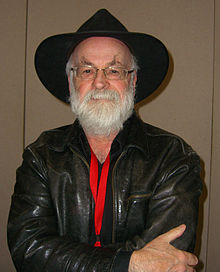
Terry Pratchett

Terry Pratchett

Sir Terry Pratchett. If you’ve been reading this blog, you already know I’m in sackcloth and ashes over Pratchett’s untimely demise from Alzheimer’s earlier this year. If not, or if you’re a glutton for punishment, you can read my tribute to Sir Terry or my review of his last Discworld book, The Shepherd’s Crown.


L.A. Meyer. Louis Meyer authored the young adult “Bloody Jack” series. I have actually never “read” one of these, but I own all of them as audiobooks. This is because the narrator for all of them, Katherine Kellgren, is absolutely brilliant. She perfectly captures the heroine’s Cockney cockiness, her bounce, optimism, kindness, and impulsiveness. Bloody

L.A. Meyer Photo Credit: Bangor Daily News

L.A. Meyer
Photo Credit: Bangor Daily News

Jack starts life in the late 18th century as Mary Jacqueline Faber, daughter of a respectable couple fallen on hard times. Her parents die and she is coldly ejected into the streets of London at age 8. She falls in with a gang of street children, and after observing that life in the streets was a short-term proposition for most kids, she disguises herself as a boy and signs on as a cabin boy with a naval ship. Her ensuing adventures are grand and hilarious to boot. Kellgren does an amazing range of male and female voices and accents. The only one she just can’t do is Scots. Fortunately, there’s only one significant Scottish character, and he’s only in the first few books.

Meyer created a memorable, lovable, and downright addictive character in Jacky Faber. The other major characters are also well delineated and engaging. He manages to sneak in a good bit of history in the process of entertaining us.

L.A. Meyer died in 2014 from Hodgkin’s lymphoma. But he finished his series before he set sail into the great beyond. I’m listening to the final book now with a mixture of enjoyment and sadness that this is the last I’ll see of Bloody Jack.

The Bloody Jack series in chronological order:

  • Bloody Jack: Being an Account of the Curious Adventures of Mary “Jacky” Faber, Ship’s Boy (2002)
  • The Curse of the Blue Tattoo: Being an Account of the Misadventures of Jacky Faber, Midshipman and Fine Lady (2004)
  • Under the Jolly Roger: Being an Account of the Further Nautical Adventures of Jacky Faber (2005)
  • In the Belly of the Bloodhound: Being an Account of a Particularly Peculiar Adventure in the Life of Jacky Faber (2006)
  • Mississippi Jack: Being an Account of the Further Waterborne Adventures of Jacky Faber, Midshipman, Fine Lady, and the Lily of the West (2007)
  • My Bonny Light Horseman: Being an Account of the Further Adventures of Jacky Faber, in Love and War (2008)
  • Rapture of the Deep: Being an Account of the Further Adventures of Jacky Faber, Soldier, Sailor, Mermaid, Spy (2009)
  • The Wake of the Lorelei Lee: Being an Account of the Adventures of Jacky Faber, on her Way to Botany Bay (2010)
  • The Mark of the Golden Dragon: Being an Account of the Further Adventures of Jacky Faber, Jewel of the East, Vexation of the West, and Pearl of the South China Sea (2011)
  • Viva Jacquelina! Being an Account of the Further Adventures of Jacky Faber Over the Hills and Far Away (2012)
  • Boston Jacky: Being an Account of the Further Adventures of Jacky Faber, Taking Care of Business (2013)
  • Wild Rover No More: Being the Last Recorded Account of the Life and Times of Jacky Faber (2014)

Source: Wikipedia

Elizabeth Peters

Elizabeth Peters

Elizabeth Peters. Elizabeth Peters’ real name was Barbara Mertz. She wrote mysteries under the name Elizabeth Peters and supernatural/gothics under the name Barbara Michaels. She was an Egyptologist by education and wrote books about the everyday life of ancient Egyptians under her own name. She died in 2013.

As Elizabeth Peters, she had several series, but my absolute favorite is the Amelia Peabody series. Amelia Peabody is a wealthy English spinster of Victorian times who decides to travel. Intrigued as many Victorians were with the mysteries of ancient Egypt, she winds up in Cairo, encounters a nasty, rude male archeologist and a few murders. She winds up saving the day with British aplomb, a stiff upper lip, and a sharp umbrella. Amelia tells her own stories, and her prose is delightful to anyone who has read much Victorian literature. Here are some selections of Amelia’s wisdom:

  • “Men always have some high-sounding excuse for indulging themselves.”
  • “Abstinence, as I have often observed, has a deleterious effect on disposition.”
  • “Godly persons are more vulnerable than most to the machinations of the ungodly.”
  • “I do not scruple to employ mendacity and a fictitious appearance of female incompetence when the occasion demands it.”

Source: http://ameliapeabody.com/fromamelia.htm

Amelia waxes positively purple over her husband, Emerson, and there are references to his “sapphirine eyes” and “manly physique” that are clearly intended for us to giggle over.

The characters in this series age and change over time. The stories are informed by the geopolitical realities of each era, as Amelia moves from Britain’s Age of Empire to the wars and disruptions of the early 20th century. Here are the Amelia Peabody books in chronological order:

  • Crocodile on the Sandbank
  • The Curse of the Pharaohs
  • The Mummy Case
  • Lion in the Valley
  • Deeds of the Disturber
  • The Last Camel Died at Noon
  • The Snake, the Crocodile, and the Dog
  • The Hippopotamus Pool
  • Seeing a Large Cat
  • The Ape Who Guards the Balance
  • Guardian of the Horizon
  • A River in the Sky
  • The Falcon at the Portal
  • The Painted Queen

Source: Wikipedia

The author knew an enormous amount about ancient Egypt and the history of Egyptology, and this background made the books fascinating on yet another level beyond the delights of the characters and the murder mystery plots.

In all honesty, not every book in the series is brilliant, but I never cared. Spending time with Amelia was worth a little disappointment once in a while.

Mary Stewart Photo Credit: Australian Consolidated Press

Mary Stewart
Photo Credit: Australian Consolidated Press

Mary Stewart. To tell you the truth, I only just looked her up to see if she were still among us—and she is not. She died in 2014 at the age of 97. Born Mary Florence Elinor Rainbow (Yes! Really!), she authored a number of thrillers with romantic subplots that made them perhaps more appealing to women than to men. Her POV character was always female. My mother and I started reading these in the 1960s and thoroughly enjoyed them. I have never liked romances, but the intelligence and eruditeness of Stewart’s writing engaged me. A few from this era that I particularly enjoyed are “Madam, Will You Talk?,” “The Moonspinners,” “This Rough Magic,” and “The Ivy Tree.”

Then she jumped genres in 1973 with the publication of the “The Crystal Cave,” the first book of what became her “Merlin Trilogy,” beautifully written and researched historical fantasies. “The Crystal Cave” was followed by “The Hollow Hills” and “The Last Enchantment.” Having always been an Arthurian enthusiast, I devoured them. Related books include “The Wicked Day” and “The Prince and the Pilgrim.” The trilogy made her an internationally famous best-selling author and she won many awards and honors for it.

So then, as far as I can tell, she went on to write little romances about rose-covered cottages in the forest and whatnot. I have read these but don’t recommend them.

Bryce Courtnay

Bryce Courtnay

Bryce Courtnay. Bryce Courtnay was a South African advertising executive who emigrated to Australia and decided to write a book. “The Power of One,” was published in 1989, and Courtnay quickly became one of Australia’s best-selling authors. He died in 2012 of gastric cancer.

Courtnay primarily wrote historical fiction, mostly set in Australia, New Zealand and South Africa, though his last novel, “Jack of Diamonds,” was set in the U.S. and Canada. He seems to catch the feel and taste of each era and locale he writes about. His stories can contain pretty dark material, but somehow you feel that it comes right in the end—mostly, anyway. His characters feel like real people, even the most bizarre ones. In “Brother Fish,” he has a German immigrant housewife living on a New Jersey farm during WWII who poisons her lumpish husband and takes a young lover­—and you completely sympathize.

Among Courtnay’s best is his “Potato Factory” trilogy, in which he follows the fictionalized family of the real-life model for Dickens’ Fagin, Ikey Solomon. “The Potato Factory” takes place in Victorian times as Ikey and his horrible bawd of a wife are deported to the prison colony of Australia. “Tommo & Hawk” follows the lives of Ikey’s adopted sons. “Solomon’s Song” takes the family into the WWI generation. Each book is dense, rich, complex and a treat to the senses as Courtney makes his stories come alive. There is something for everyone: action, tragedy, revenge, mystery, murder, love, beauty, friendship and horror.

Well, that’s it for dead authors—for now, anyway. I just wanted to say a thank you to these writers for taking me to places I have never been to meet people only they have imagined. They have given me so much enjoyment over the years, and perhaps as long as people read their work, they will never truly die.




I Will Be Speaking at the Los Gatos Literary Fair August 22

I will be making a short presentation at the Los Gatos, CA Literary Fair, Saturday, August 22. The Fair is from 12 noon to 3:00 p.m. I will also be signing copies of “The Obsidian Mirror.” I’d love to see you there if you happen to be in the neighborhood!

2015 LG Lit Fair flyer

Things I Will Miss (or Not) about Spain

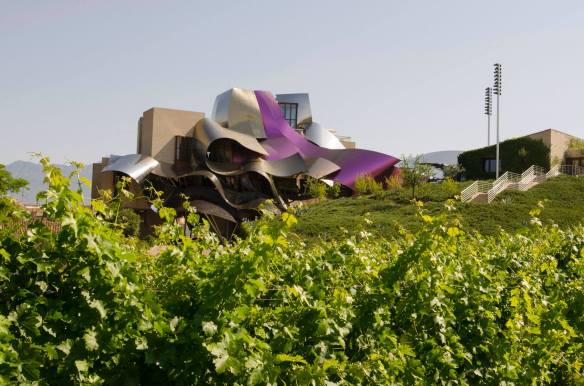
Marquis de Riscal winery, designed by Frank Gehry

Marquis de Riscal winery, designed by Frank Gehry

Things I Will Miss:

The food. You can get delicious food almost everywhere in Spain, often for little money. It’s heavy on fat, so it tends to be rich and satisfying. Even little holes in the wall offer yummy stuff, freshly prepared. Before I move on, I have to mention a very special restaurant, La Tertulia, in Barcelona. We ate there on the recommendation of our hotel, and it was only a short walk away. We ate outside in a charming patio. By this time, we were getting tired of meat and ordered several dishes of vegetables. All were simply delicious–and so was the menu. I took a few shots of it to treasure, as the English translations of the Spanish descriptions were adorable:

  • Mejillones con ajo y perejil al vino turbio: “Mussels, garlic & parsley to the turbid wine”
  • Paellas: “Cooked by 30% with sea water broth with healthy clams & truly sea”
  • Caldereta de arroz con bogavante: “Lobster soggy”
  • Costillar de Iberico a baja temperatura con grasa de barbacoa: “Iberian ribs low temperature with greasy smoky barbecue”

We ordered some Spanish brandy after the meal. The waiter poured us two enormous servings. There was a finger or so of brandy left in the bottle, so he shrugged and told us to finish it off, leaving the bottle on the table. Tipping is not common in Spain, but this guy got a nice one.

The people. Almost everyone we encountered was helpful and friendly–sometimes extraordinarily so. They worked hard to understand my execrable Spanish. Complete strangers rushed to help if we were having difficulties. Lovely people.

The art and architecture. Spain appears to be a country that values art, and it shows. Although I have traveled to many countries and toured many beautiful buildings, I don’t think I have ever been as gobstopped by architectural beauty before–especially the Alhambra, La Mesquita, the Guggenheim, and La Sagrada Familia. I do not expect to see anything, ever, that surpasses La Sagrada Familia.

Western light, La Sagrada Familia

Western light, La Sagrada Familia

The wine. As with the food, you can get good wine very cheaply everywhere. Pay a couple more Euros, and you can get GREAT wines.

What I Will Not Miss:

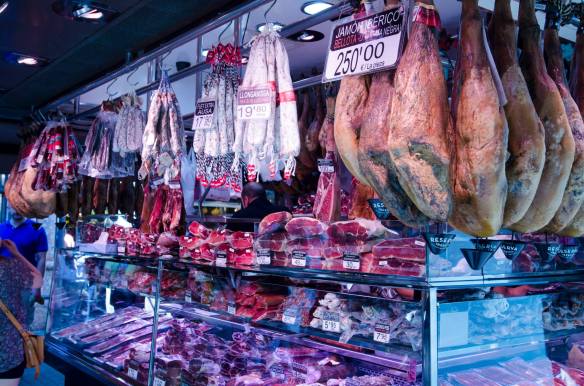
The food. Yes, I know I said I would miss it, but there is a downside. There’s jamon in everything, just about. I know Spain is famous for its jamon, and there are pig’s hindquarters hanging in every restaurant, but I can take it or leave it. When it comes to cured meats (except for bacon, and then it has to be cooked crisp), I can pretty much leave it. Spanish food is very meat-oriented, so if you are eating in restaurants all the time, you might not wind up with enough vegetables in your diet. I once received a platter containing a quarter of an entire lamb that boasted a single asparagus stalk. Also, the food is high-fat, which is delicious at first, but I became rather sated with it. Despite the reputation for tapas being small dishes, even when I ordered medio raciones (half portions), sometimes we received huge platters and basins of food that put American restaurants to shame for serving size. Just too much food.

jamon

Smoking. More people smoke in Spain than in my native California (though I cannot speak for other parts of the U.S.). Being former smokers, Tom and I loathe the smell–I think it’s something your brain does to help you stay clean. People no longer smoke inside restaurants, but they can smoke in the outdoor eating areas. Nothing ruins a pleasant meal in the open air more than cigaret smoke. And the ground everywhere is littered with butts. Gross.

The Weird Reservation Thing: Several times when Tom and I arrived at a more or less upscale restaurant without reservations, we were turned away–even though there were plenty of available tables. In one case, there was not another soul in the entire restaurant. I don’t get it.

That’s all she wrote, folks! I appreciate all the “Likes” and comments I’ve gotten on my trip blog. It’s back to work on the next novel, and I’ll try to think of something interesting to say soon.

Scrambling To Get It All In: The Last Day

Our last day in Spain finally arrived. We decided to get some breakfast and head down to La Rambla, a long mall that leads down to the harbor. Traffic goes by on either side of a pedestrian mall, with booths and kiosks in the middle and shops on either side of the traffic lanes (where shops are usually located, actually). We were warned that this was a prime area for pickpockets. so we were on the alert.

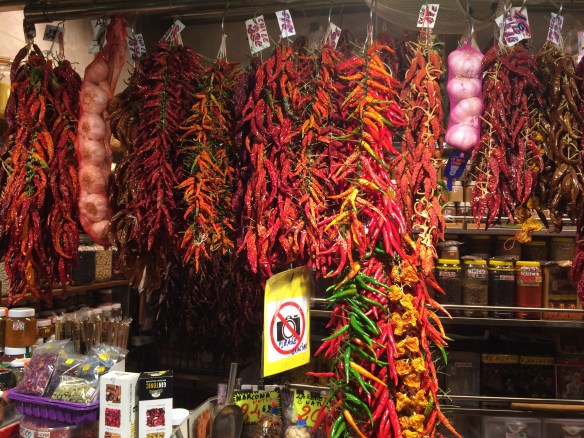
There were tons of people walking la Rambla. Most of the kiosks were selling the same old stuff we had seen everywhere else in Spain–cheap “Flamenco” shawls, a Spanish dancer doll (the exact same one in every city), t-shirts–augmented by Barcelona-specific stuff like Gaudi-inspired plates and keychains. Then we came to the open-air market, La Boqueria. This was a feast for the senses, and if we had not already had breakfast, we would have bought something delicious here. The stalls were piled high with fresh fish and shellfish; eggs of all kinds, from emu to ostrich to quail; the obligatory stalls with pig haunches hanging and cured meats on display; every sort of nut you could imagine; dried and fresh chilis; sweets; exotic fruits; piles of tripe, lambs’ heads, kidneys and other offal meats; spices, teas and coffees. it was overwhelming and beautiful.

Dried chilis

Dried chilis


Offal meats

Offal meats


Shellfish

Shellfish


Every sort of egg

Every sort of egg


Seafood

Seafood


After this feast for the eyes, we continued down La Rambla, stopping just before the harbor to photograph the living statues. There was Don Quixote, a person dressed like a Salvador Dali painting, a Remington cowboy statue (probably the most boring, despite his dramatic pose), a demon (entertaining), a “bronze statue” of Galileo, and several more.

An entertaining demon

An entertaining demon


Dali lady. Not sure the person inside the costume was actually a lady, but no matter.

Dali lady


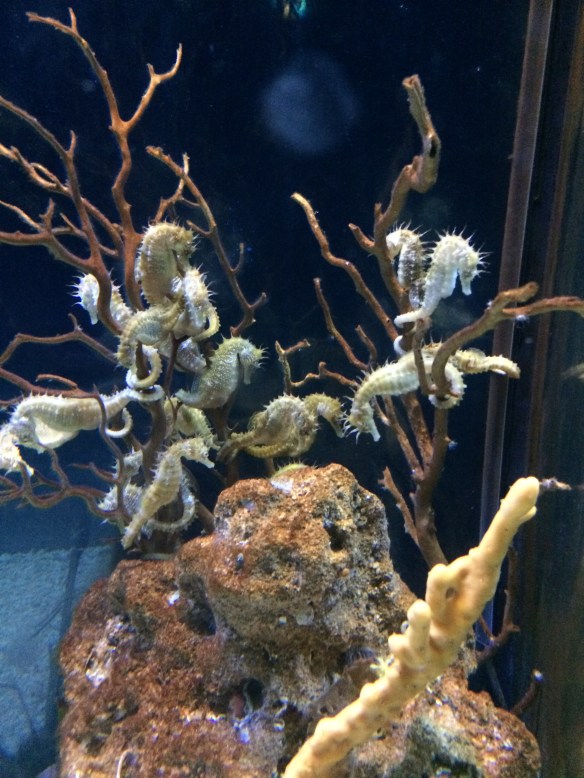
By that time it was hot, and we were reasonably near the Barcelona Aquarium, so we went there for a few hours. For people whose local fish museum is the Monterey Bay Aquarium, the Barcelona Aquarium cannot measure up, but I did see some interesting fish I hadn’t seen before. Unfortunately, labeling was kind of random. You’d see a label above one tank, with no sign of the supposed denizen, then see the same fish in another tank that had no such fish identified as being there. Nonetheless, it was a pleasant couple of hours out of the heat. I do think someone tried to pick my purse in the aquarium. I was waiting in line to buy mineral water and carelessly left the zipper open, displaying credit cards and cash. I saw a hand creep across the ledge in front of me, heading toward my purse. As soon as I clocked the hand, it suddenly became very interested in the surface of the ledge, which had nothing on it but crumbs. I zipped the bag.

Seahorses in Barcelona Aquarium

Seahorses in Barcelona Aquarium


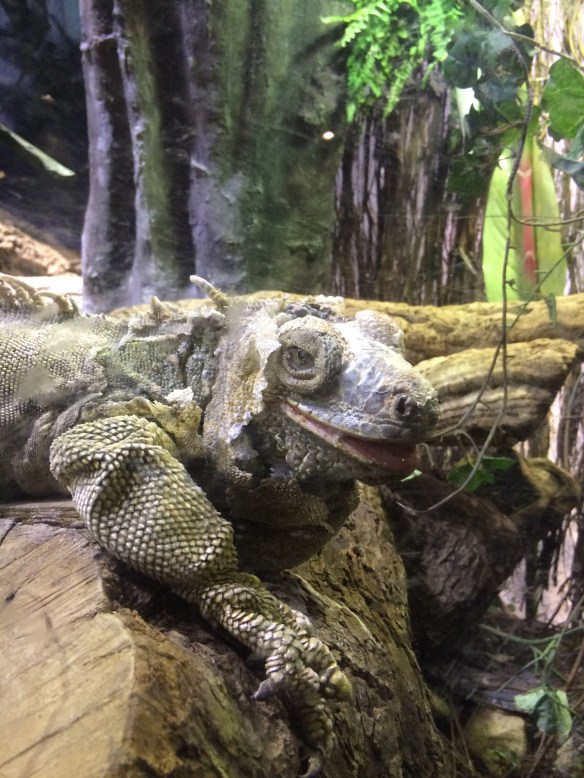
This iguana had such a pleasant expression that I just had to photograph him. Or her.

This iguana had such a pleasant expression that I just had to photograph him. Or her.


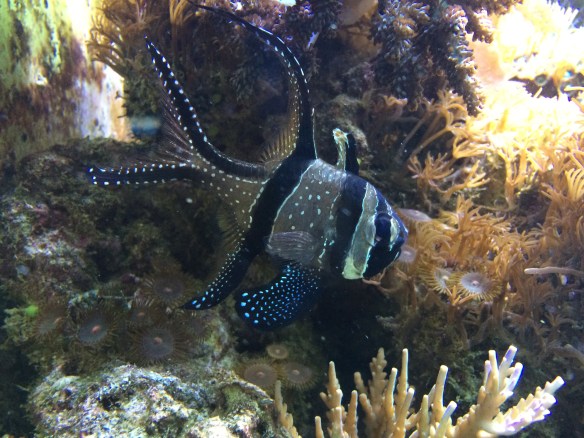
I don't know what this fish is due to random labeling, but I liked it.

I don’t know what this fish is due to random labeling, but I liked it.


In the afternoon, we went to Parc Guel. Gaudi had a house there (designed by someone else), and he designed a beautiful installation in the park that would look very familiar had we actually gone in. We already had tickets to see his house and we wandered around the free area of the park, which is also very Gaudi-esque, but not the iconic installation everybody was lined up to pay for. When we went through his house, I was astonished to find out that despite the over-the-top ornateness and whimsy of his work, Gaudi lived a very austere and simple life. His furnishings were simple and sparse. He cared nothing for clothes or material things for himself. A remarkable contrast.

The area of Parc Guel we did not go in, showing more of Gaudi's amazing work.

The area of Parc Guel we did not go in, showing more of Gaudi’s amazing work.


Kids playing with giant bubbles in Parc Guel

Kids playing with giant bubbles in Parc Guel


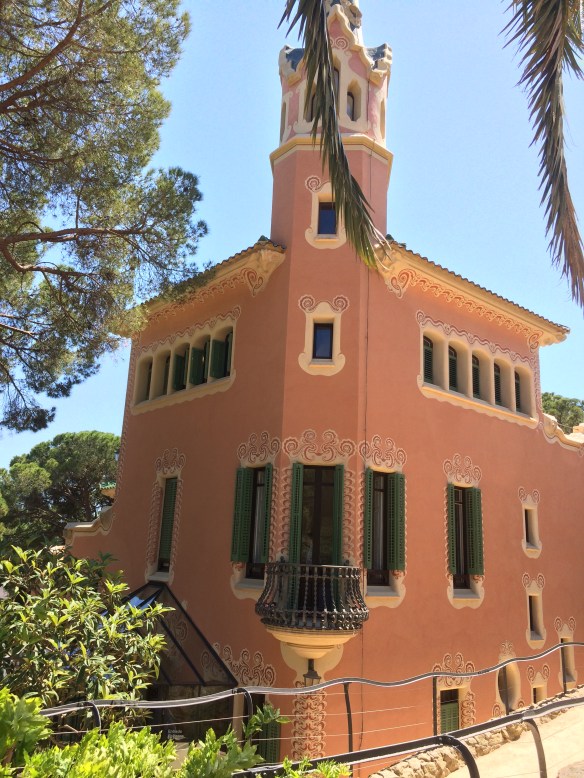
Gaudi's house in Parc Guel

Gaudi’s house in Parc Guel


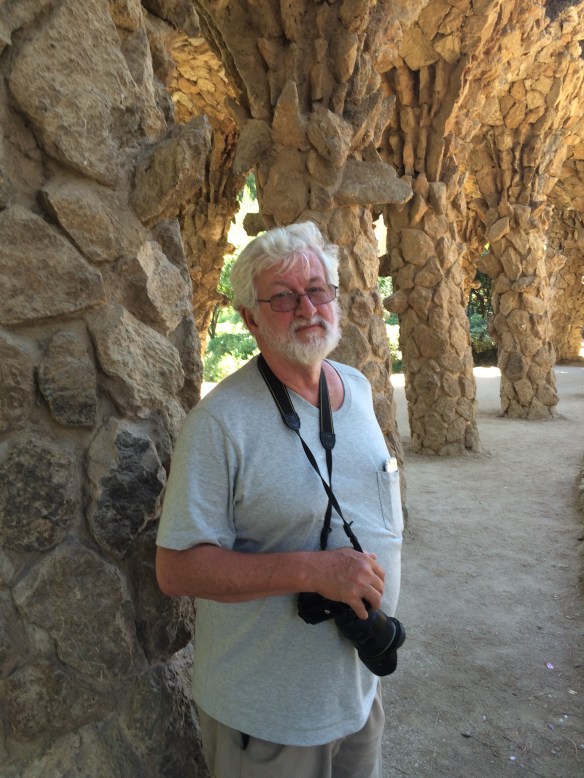
Tom standing under a Gaudi-designed bridge in Parc Guel

Tom standing under a Gaudi-designed bridge in Parc Guel


We left without paying to go into the most interesting part of the park, which I kind of regret.

We had an early dinner at a boring restaurant where a large group of people (maybe 100 or so) were playing Scrabble (in Catalan? At least they’d have a ready use for all those X’s!), and so to bed.

Adios, Spain. We had a wonderful time!

More soon about a menu that made me laugh and things I will miss/not miss so much about Spain.

Sand Castles in Spain

When I was a child, we used to go to the beach for a few weeks every summer. One of our favorite activities was making “drip castles” out of wet sand. We’d grab a bucket of sand and water and carefully let the wet sand drip from our fingertips, making fantastic shapes and spires. The challenge was to see how elaborate you could make your castle, and how tall your spires could reach before collapsing.

In art history, my first take on seeing a photo of Barcelona’as La Sagrada Familia (Sacred Family) cathedral, designed by Antoni Gaudi, was “Drip castle!” I never blew it on the tests, either–the mnemonic was fixed forever. Apparently I am not the only one to see this resemblance, because when I searched for images of drip castles on Google, I found some photos of La Sagrada Familia as well:

Drip castle on the left; La Sagrada Familia on the right. I'm just saying.

Drip castle on the left; La Sagrada Familia on the right. I’m just saying.


The cathedral isn’t finished and won’t be for a decade or more, although it was begun in 1882. Up close, the exterior no longer looks like wet sand. The facade in the photo above (the Nativity Facade) is the one most photographed, I believe, and close up, all those furbelows resolve themselves into exquisitely crafted details. There are the obligatory religious figures, of course, but there are also twining vines, chickens, roses, standard Gothic features like columns that somehow turn into tentacles, rabbits, turtles and trees. It is naturistically sculpted, elaborate, whimsical and ebullient.

This turtle is one of two that hold up pillars, one on either side of what is now the main door. Kind of a metaphor for how mankind treats animals, though I'm sure this was not the intention.

This turtle is one of two that hold up pillars, one on either side of what is now the main door. Kind of a metaphor for how mankind treats animals, though I’m sure this was not the intention.


Rooster and hens detail from the Glory Facade

Rooster and hens detail from the Glory Facade


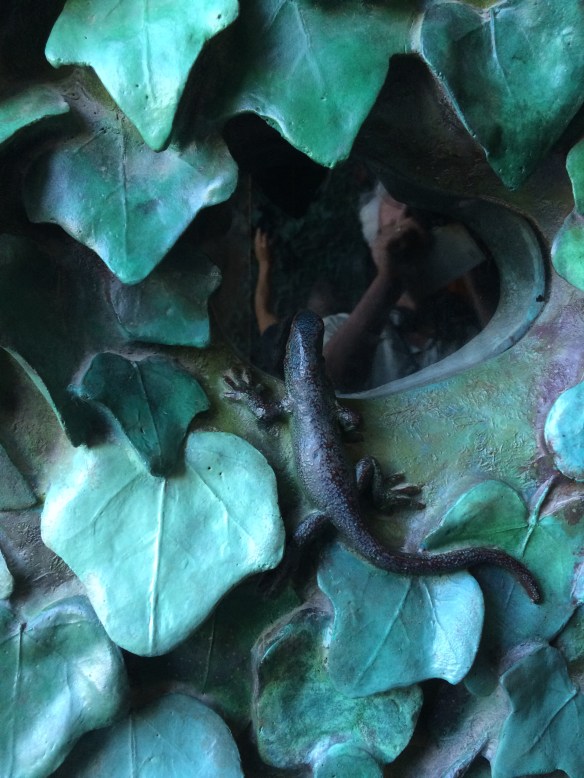
This little lizard is one of many creatures peering out from the bronze leaves that completely cover the main door

This little lizard is one of many creatures peering out from the bronze leaves that completely cover the main door. He is peering through a small glass pane. The reflection in the pane is Tom taking a picture of it.


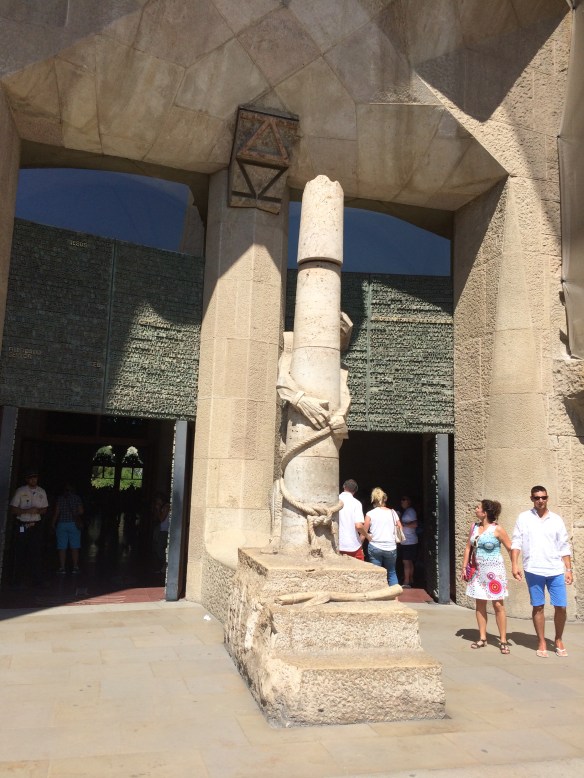
The other facades differ greatly in style. The Passion Facade, which depicts the end of Christ’s life from the Last Supper to the crucifixion, is sculpted in an austere, unelaborated and grimly modern style. some of it couldn’t be photographed because of ongoing construction.

The Passion Facade. The pillars are intended to resemble bones.

The Passion Facade. The slanted pillars are intended to resemble bones.


Kiss of Judas, Passion Facade

Kiss of Judas, Passion Facade. There’s a cryptogram square to the left, but I haven’t researched its meaning yet.


The Loneliness of Christ, Passion Facade

The Loneliness of Christ, Passion Facade


As you can see, this facade was executed in an entirely different style, and it was as deliberate as the Gothic-reminiscent naturalistic style of the Nativity Facade. There are other facades, still under construction, that are more modern still.

I took three art history courses (yes, once it was because I couldn’t pass chemistry, but the other times, it was because I WANTED to!), and not once did I see a photograph of the interior. As gob-stoppingly gorgeous as the exterior is, the interior surpasses it by several orders of magnitude. I have never seen anything like it. It comes close to being unbelievable, as though someone a 100 years ago had had the ability to use CGI to create something impossible and improbably beautiful.

Unfortunately, I have to close up shop tonight and continue tomorrow (or sometime soon), because we are catching a flight to go home. I want to give the interior of La Sagrada Familia the time and attention it deserves, so buenos noches for now, and I will be back as soon as possible.

Goggling the Guggenheim and Getting Crunched

The nearest chiropractors are in Bilbao, an hour and a half drive from where we are staying in Ezcaray. Having had some not-so-good experiences with chiropractors, I was reluctant to see someone I didn’t know, but my rib was giving me a lot of pain so i gritted my teeth, called one (she spoke English very well–bonus points!), and made an appointment.

We hadn’t planned on visiting Bilbao, but my appointment was in the afternoon, so that meant we could spend the rest of the day at the spectacular Guggenheim Museum. The museum had a Jeff Koons exhibition going on. My previous exposure to Koons had been a vast white ceramic sculpture of Michael Jackson and his chimpanzee Bubbles. The white ceramic had highlights in gold, making it look like those awful figurines your Aunt Gertrude loved to collect.

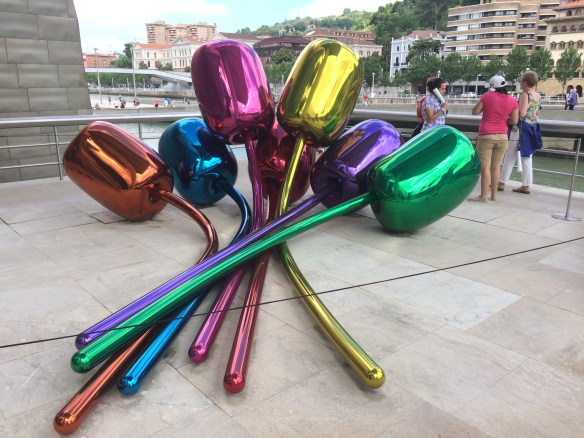
As it turned out, I thought the exhibit was interesting and fun. My favorite was “Puppy,” a towering sculpture completely covered in living flowers that sits in front of the museum, followed by “Tulips,” also outdoors. There were several other artists represented, of course, including someone who does “fog sculptures,” and a “fire sculptor” (which we didn’t get to see because it only comes on after dark).

This view of the Guggenheim from the street shows how huge "Puppy" is

This view of the Guggenheim from the street shows how huge “Puppy” is


"Tulips" by Jeff Koons. This looks very light and insubstantial, but it's quite large--and made of steel.

“Tulips” by Jeff Koons. This looks very light and insubstantial, but it’s quite large–and made of steel.

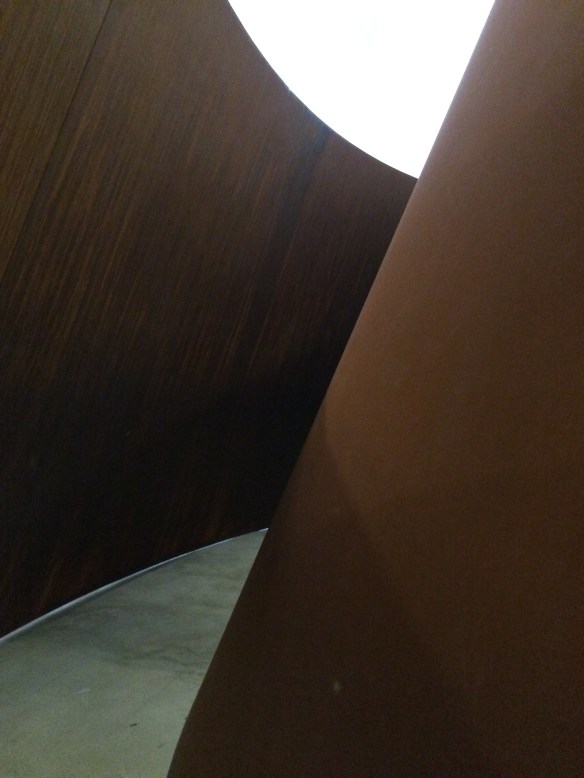
Another installation i thought noteworthy was a gigantic ( mean VAST, enormous beyond belief) series of curving steel sculptures by Richard Serra. The title had something to do with the impermanence of time.You’re supposed to walk inside them, and it is a very disorienting experience. Sometimes, it felt like walking down one of the tiny, winding streets of Seville, but a Seville painted by Magritte–ancient and deserted, where there should be people. I actually got disoriented and started walking back through the exhibition, thinking I was going in the opposite direction. Sometimes the visual juxtaposition of the curving, rusted steel walls and the gallery itself looked like abstract paintings to me. (See the picture below.)

I saw the chiropractor, a diminutive woman who had lived and worked in the San francisco Bay Area. She put my rib back where it belonged (ayiyiyiyiyi!!!!) and charged me about one-third what my regular chiro does. I’m sore but feeling much better now.

Here’s the photos. Gotta go work on my next novel. I’m thinking about killing off one of my characters, BTW. (Channelling G.R.R.M.?)

"Puppy" by Jeff Koons. Loved this!

“Puppy” by Jeff Koons. Loved this!


Closeup of "Puppy"

Closeup of “Puppy”


Inside a Richard Serra sculpture. Yes, you are supposed to walk inside.

Inside a Richard Serra sculpture. Yes, you are supposed to walk inside.


Spider sculpture at the Guggenheim. I didn't see who the artist was. Barbarian that I am.

Spider sculpture at the Guggenheim. I didn’t see who the artist was. Barbarian that I am.


After visiting the chiropractor, we retired to this cool old bar in Bilbao for much needed copas de vino tinto.

After visiting the chiropractor, we retired to this cool old bar in Bilbao for much needed copas de vino tinto.


Tom in Bilbao bar.

Tom in Bilbao bar.

More Art, No Palaces

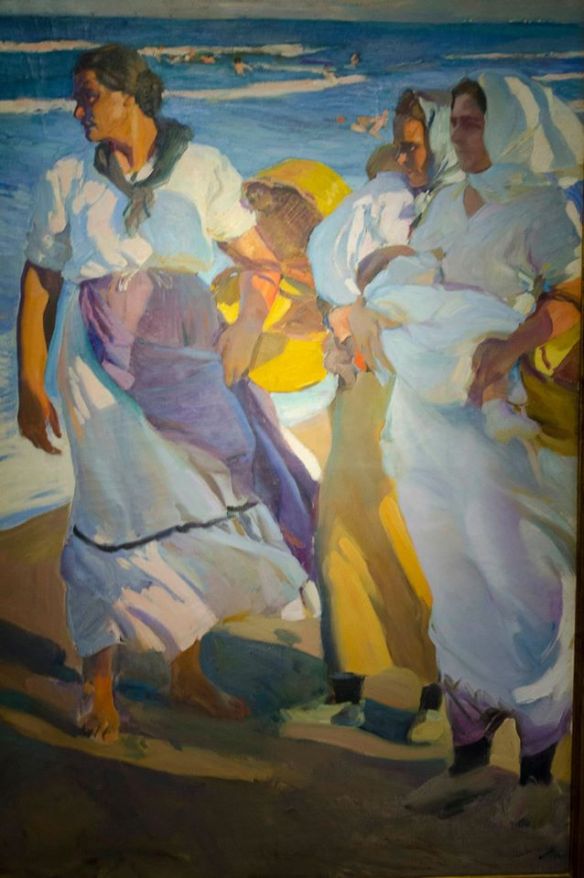
Our second full day in Madrid was all art, all day, yet again. We  went to the Sorolla Museum first. Sorolla was a Spanish Impressionist painter, and the museum is located in his house (well, it used to be his house). Our friend Meg McComb recommended it, and as she is never wrong about these things, we went on faith even though we were both unfamiliar with the artist’s work. We’re glad we did. He was an amazing painter, and I enjoyed his work enormously.

“Mujeres del Mar” by Sorolla

But perhaps the most interesting thing about the museum is the context in which the work is displayed: his home. He had it built once he became successful as a painter, and from the looks of it, he did very well indeed. As in many Spanish homes, it has a shady garden with fountains and flowers and tiled walkways. Inside, the rooms are light and harmonious. The family’s furniture and keepsakes are on display. He obviously adored his wife and three children, as paintings of them are everywhere. It gave me the feeling of a life of contentment and balance, filled with family joy and enjoyment. Many artists lived lives of poverty and desperation, or even chaos and madness, but Sorolla proves that it is possible to be both an artist and a happy person.

Bottle Glass Window, Sorolla Museum

Bottle Glass Window, Sorolla Museum

Whew. That’s a relief. Then we went on the Reina Sophia Museum, which is Madrid’s museum of modern art. Tom wanted to see “Guernica” by Picasso in particular. Guernica is enormous, filling a gigantic wall with its expressive agony. I tried to see the painting as contemporaries must have seen it–something unprecedented and revolutionary. Sadly, I failed. I’m afraid when it comes to modern art, I am kind of a barbarian. I don’t mean to say I dislike all modern art, but the art of the early 20th century, so new, experimental, exciting and fresh to many, leaves me pretty cold. Cubism, abstract expressionism, Dada, mechanistic surrealism, etc. etc.–meh. Picasso does nothing for me. Rothko pisses me off. But I love Dali. They had some of his early work, when he was doing cubism. I have no idea whether it is considered good cubism or not; I can’t tell. But I love his later works in their meticulous rendering of the impossible. The Reina Sophia has several of these paintings, and I enjoyed them. I also enjoyed Dali’s artistic posing, his ridiculous mustache, and his pretentiousness. It was all so–I don’t know–endearing. He appeared on the Dick Cavett Show many years ago. Dali was going on and on about some nonsense, and Cavett leaned over and wriggled his fingers at the artist and said, “Boogie  boogie!” That has been my response to artistic pretentiousness ever since. (I love Dick Cavett, too.)

“Memory of the Woman Child” by Dali

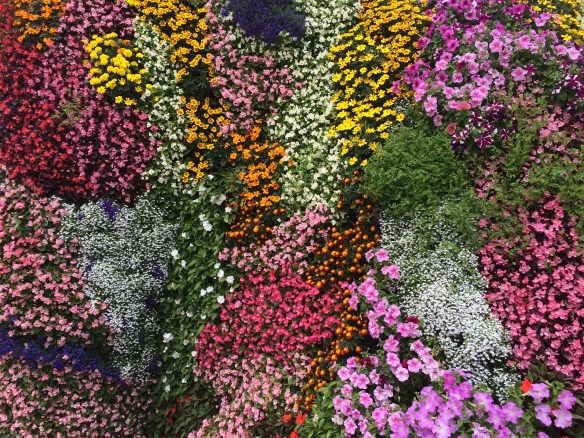
Living wall

We passed this living wall in Madrid several times. It seems like a great idea for cities. It cools the environment and refreshes the eye. Plus, oxygen.

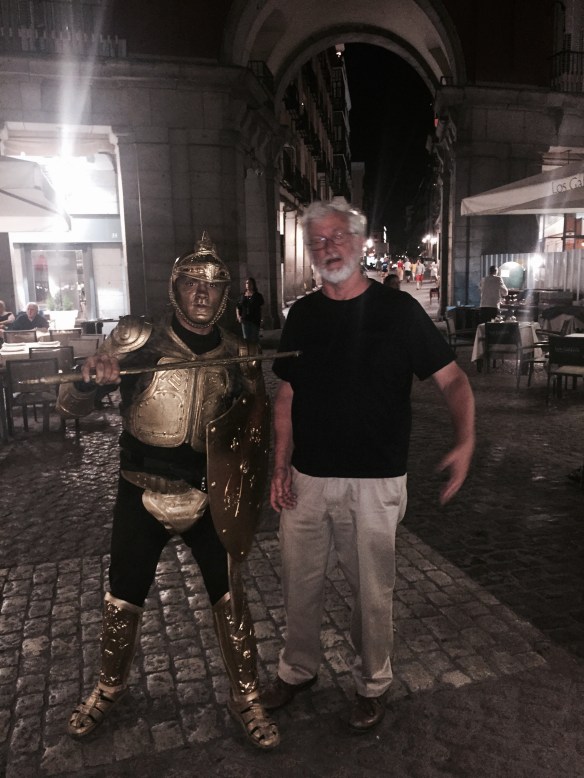
We had dinner at a restaurant called D’Fabula, and it was pretty fabulous. We walked there as my feet seemed to have toughened up a bit. It was still pretty hot, even at night, so we ate inside. Everything was delicious except for the cheesecake I ordered for dessert. It came with a scoop of the most intense and wonderful vanilla ice cream I’ve ever tasted, but the cheesecake itself might have been from Denny’s. The waiter asked me about it and I told him what I thought. He went away and came back with two scoops of the fabulous ice cream, which Tom and I enjoyed together. On the way back, we took a different route and wandered through plazas full of people eating and drinking. There was music, and several of those people you see in Europe who dress up as robots or Don Quixote or knights or whatever and hope you’ll give them money. I think Madrid is a very fun place–for people who go to bed later than we do. Even so, we have rarely gotten to bed before midnight.

Tom being attacked by

Tom being attacked by “conquistadore.” El Conquistadore didn’t like his tip.

Yesterday we had breakfast, did a small amount of shopping, then left Madrid. I say that as though it were easy, but it wasn’t. Tom walked to the parking lot down the street from the hotel–which I was delighted to leave–and couldn’t get the machine there to accept his ticket. Until he asked two Spanish gentleman to help, and then the machine was happy to accept the ticket, but would not accept his EU50 bill. I was waiting at the hotel with the luggage, so he came back and explained he needed to get some change. He had to walk nearly to the Prado before he found someone to break the bill, then came back and we both walked to the garage. So that all took an hour or more. Then our GPS system directed us all over Madrid, down byways and odd little streets, until we finally found ourselves on the road to our next destination, Ezcaray, in the Rioja wine country. The landscape changed very gradually from the flat, red-earth plains of the south to the limestone soil and mountains of the north. We went from olive groves and chaperral to vineyards, forests and green meadows. Ezcaray lies in a deep valley, approached by a steep, winding road that switchbacks down a mountainside. Tom drove white-knuckled all the way. Being brave doesn’t mean you are never scared.

Echaurren, our hotel in Ezcaray

Echaurren, our hotel in Ezcaray

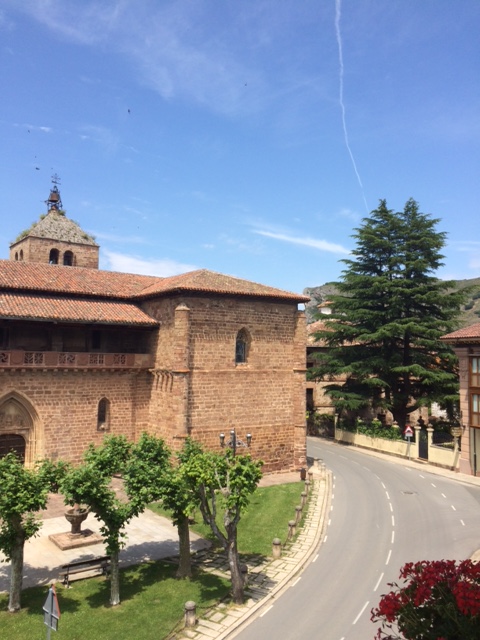
We are staying at Echaurren, a Relais et Chateaux hotel with four restaurants that make it a gastronomic destination. It is housed in a building with an ancient stone exterior, and a very modern and sleek interior. We have a king-size bed. After the muggy postage-stamp-sized bed in Madrid, it feels like sleeping on a football field–only presumably more comfortable. The room looks out on an ancient church with swallows swooping around it. The room has every comfort possible, at least every comfort I could ask for, and I love it.

The view from our room

The view from our room

The only fly in my happy ointment is that when I fell in the parking garage, I dislocated a rib, and it is painful. The nearest chiropractor is in Bilbao, an hour and a half drive from Ezcaray. However, Bilbao has the Guggenheim Museum, which is supposed to be worthwhile for the architecture alone, so I made an appointment for tomorrow and we will kill two birds with one drive. In the meantime, Spain has excellent painkillers, so I am not doing too badly, though I am perhaps a tad fuzzy-brained. Tom assures me that I am, actually.

Bosch and Rubens and Goya, Oh, My!

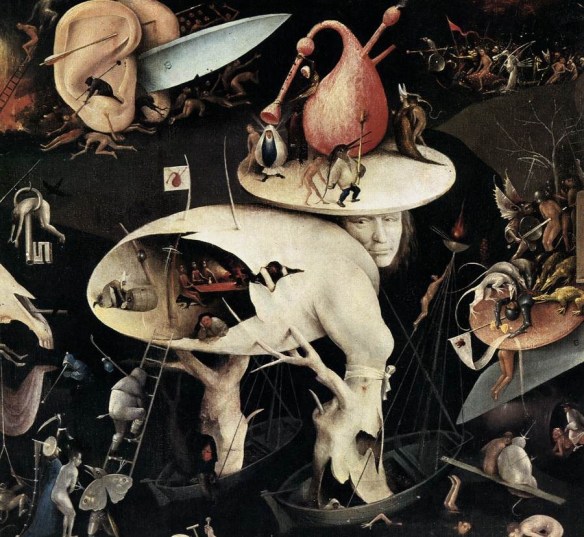
Today was all art, all day. We first visited the Prado. I had one destination in mind: Hieronymus Bosch’s “Garden of Earthly Delights” triptych. I have been fascinated with this work since I was a child. My mom had “Jansen’s History of Art” at home, and I used to leaf through it frequently. Bosch’s triptych was endlessly fascinating, and if you are familiar with the work, you know why. As a child, I found it confusing, fascinating, beautiful, ugly, perverse, opaque, scary, astonishing, and just plain weird. I have always wanted to see this painting (or paintings, technically, as there are three panels) in person–and now I have done so.

"Garden of Earthly Delights" triptych by Hieronymous Bosch

“Garden of Earthly Delights” triptych by Hieronymous Bosch

The colors are as bright and fresh as though it had been painted yesterday. The level of detail is breathtaking–it almost feels as though you could use a microscope on it and see not brush strokes, but further levels of texture and precise rendering.

Detail of "Hell"

Detail of “Hell”

As for the subject matter, I have read that to Bosch’s contemporaries, this work would have been perfectly clear, its symbols well-understood and its messages obvious. I’m not so sure. He depicts pink crystal structures floating in water, strange organic shapes that could be fruits made of bones, but with legs and faces, monsters that make the demons of Medieval paintings look like pussycats, and people doing things to each other so creative in their erotic or sadistic inventiveness that it would make the Marquis de Sade blanche.

"Earthly Delights" detail

“Earthly Delights” detail


These reproductions don’t begin to capture the brightness of the colors or the clarity of the painting. There is a monster with a human face in the “Hell” panel that some have speculated is a self-portrait. The recorded guide said it is a portrayal of the devil. If so, it’s very atypical for the period, which tended to depict the devil as monstrously as possible. It is a calm, handsome face that observes the chaos and horror surrounding it with unearthly serenity. I have no idea if it is Bosch or not, but it is definitely striking.

To Bosch or not to Bosch?

To Bosch or not to Bosch?


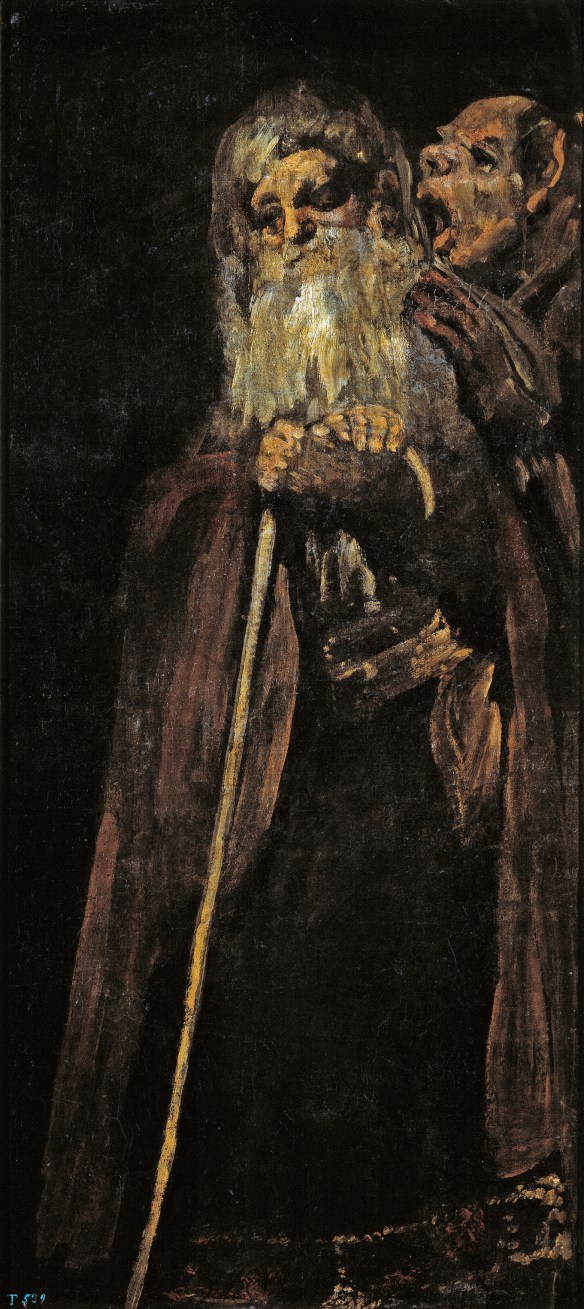
Really, if my feet didn’t hurt so much, I could have stood there all day staring at this painting. But my feet did hurt, and there were rooms and rooms of Velasquez, Rubens, and Goya to see as well. Goya, in particular. He’s one of the few painters who shifted back and forth between almost Flemish attention to detail and the loose, evocative brushwork of Impressionism (long before there were any Impressionists).

Goya in full-on court painter mode with "The Family of Carlos IV." Very fine, detailed brushwork.

Goya in full-on court painter mode with “The Family of Carlos IV.” Very fine, detailed brushwork.


Goya in Impressionist mode. Hard to believe it's the same painter.

Goya in Impressionist mode. Hard to believe it’s the same painter.


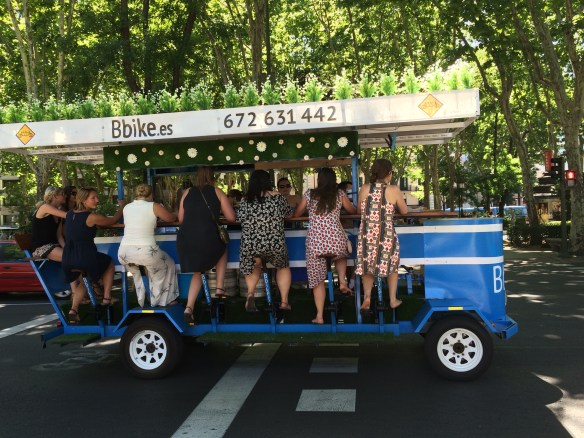
After the Prado, we took a break and had some lunch in a nearby restaurant.On the way, we saw this:

The Beer Bike

The Beer Bi


Actually, we saw several of them, all filled with people laughing loudly, pedaling madly and holding up traffic. It’s the Bbike, described thusly: “Bbike is a Beer Bike, a multi-tandem bike for up to 18 people with a built-in beer tap in which you’ll be able to enjoy Madrid in an original, different and fun way.” Can you even imagine such a thing in a U.S. city? Me neither.

After lunch, we went on to the Thyssen Museum. We were there a bit late, and so didn’t see everything by any means. There were a lot of painters I had never heard of before, which was kind of embarrassing, but then, I never held myself out as an art expert. I have to say, I was delighted when they closed the museum. My feet were killing me.

The lacy decoration behind Tom is composed of oversized white Spanish combs that completely covered the ceiling of the restaurant where we ate lunch.

The lacy decoration behind Tom is composed of oversized white Spanish combs that completely covered the ceiling of the restaurant where we ate lunch.

We rested for a bit and then went to dinner at a restaurant called Veridiana. I refused to walk the half a mile to the restaurant, and I don’t feel bad about it at all. The food was great and our waiter looked like President Obama. I mentioned this and he said he gets that a lot, but that he is a happier person than Mr. Obama. I believe him.

The Mosque with a Cathedral Inside–Or Is It the Other Way Around?

We arrived in Cordoba after an easy drive from Sevilla (it was easy for me because Tom was driving). Our parador sits above the city in a pleasant neighborhood, and overlooks the entire city. Even more important, it has an elevator, which I greeted with cries of joy. Our quarters consist of four rooms–bedroom, sitting room, dressing room, bathroom and a large, sit-able balcony. It may not be as romantico as the parador at the Alhambra, but it is lovely, and there is a pool, which I took immediate advantage of. I enjoyed floating in the cool water, watching the birds drink. There were swallows, which drink on the wing, doves, and little yellow birds that look like goldfinches. There was no one else in the large pool, and the surrounding gardens are full of palms trees, hibiscus and orange trees. Paradise. The lifeguard speaks French, but not English, and I speak French but not Spanish. Between the two of us, we managed to miscommunicate in three languages.

The view of Cordoba from our balcony

The view of Cordoba from our balcony


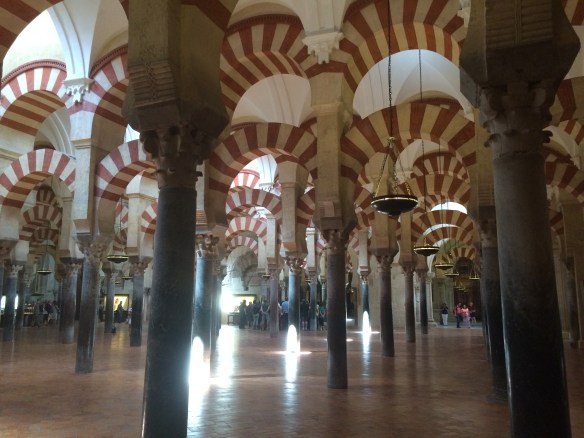
Today (our first full day here), we visited La Mezquita, the Great Mosque of Cordoba, which has been turned into a Catholic church. La Mezquita is one of the buildings I studied in art history, so it looked weirdly familiar, as though I had been there before. It has an odd history. It started as a Visigoth church. When the Moors came in the 700’s, the sultan bought the Visigoth church from the Christians, knocked it down and built a mosque. The mosque was added onto until the expulsion of the Moors. The Christians had the good sense not to tear down this incredibly graceful and beautiful building, but they did plonk down a gaudy sanctuary, altarpiece, and choir in the middle of it and appropriated the side niches as chapels.

The result is a mishmash of styles that mingle awkwardly together, like neighbors who get together to socialize only on Fourth of July weekend.

There was far too much detail to capture on camera, especially my iPhone camera, and some of the interesting things were behind glass or wrought-iron screens. but I will let La Mezquita speak for itself.

The famous striped arches made of stone ad brick.

The famous striped arches made of stone ad brick.


Ceiling, La Mezquita, Cordoba

The ceiling above the Christian sanctuary in the mosque.


Christianity meets Islam in the ceiling

Christianity meets Islam in the ceiling


High altar, La Mezquita, Cordoba

High altar, La Mezquita, Cordoba


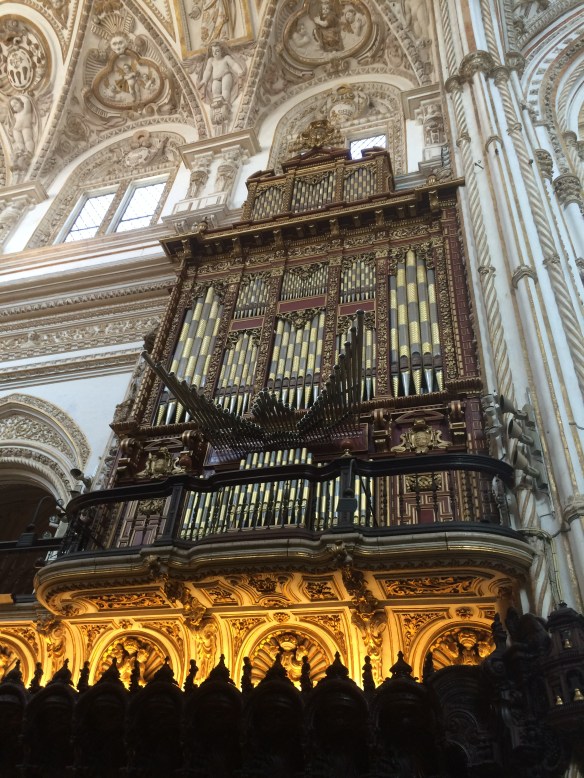
Pipe organ in the choir section, La Mezquita, Cordoba. A matching organ sits on the wall opposite. The position of the pipes is very unusual.

Pipe organ in the choir section, La Mezquita, Cordoba. A matching organ sits on the wall opposite. The position of the pipes is very unusual.


_DSC0152

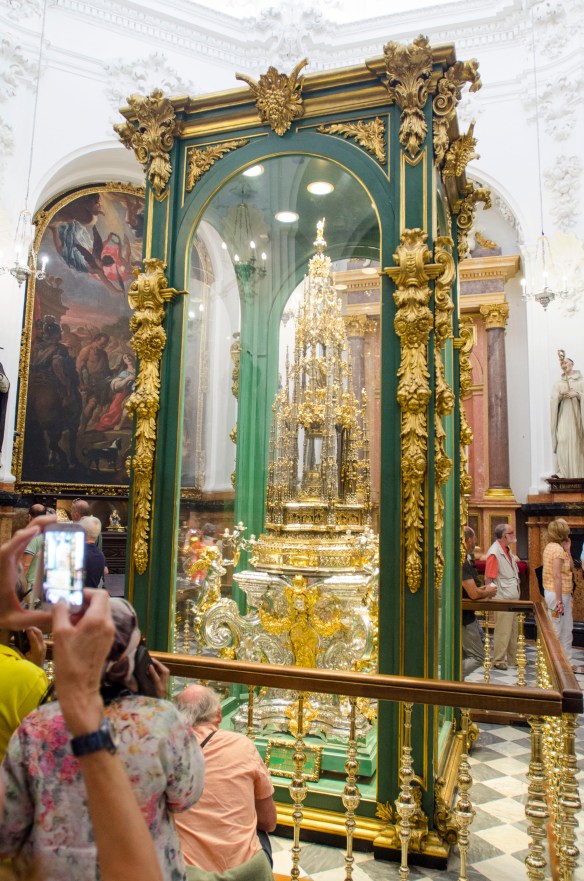
This thing is called a monstrance. I don’t know what it is used for, but it is solid gold. (OK, there’s some silver in the base section. Tom insists I be accurate in my reporting!) It is in the treasury of the cathedral/mosque, Cordoba.


I should mention something about Spain, apropos of nothing. All the historical places we have visited have had benches or chairs here and there so people can sit and rest their feet and appreciate their surroundings. I deeply appreciate this–more and more every year. I remember after touring the Louvre many years ago, we were beneath the big I.M. Pei pyramid. I was dying on my feet, and sat down on the floor, as there was nothing–not even a low wall–in sight. A security guard immediately came over and told me in French that it was not permitted to sit there. I asked why and got the most Gallic shrug ever seen. Later, walking around Paris, I sat somewhere random and got told to move along again. I began to feel like a vagrant, and my feet were miserable. Spain has the right idea.

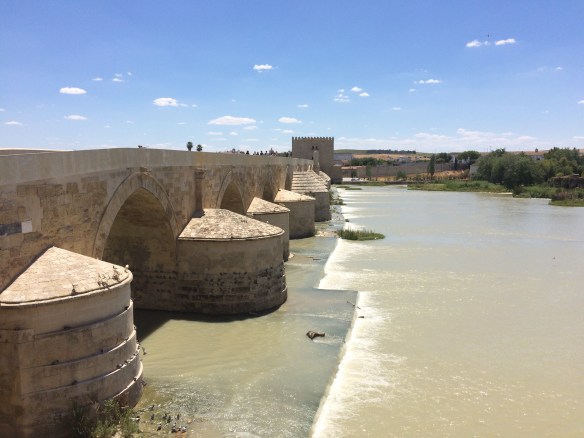
After viewing the mosque, we went in search of the Museum of Al-Andalus Life, that is, the culture of the Moors. This is housed in an ancient Moorish defensive tower that is reached via a bridge across the Quadalquivir River.

View from the Roman bridge across the Guadalquivir River toward the Museum of Al-Andal Life

View from the Roman bridge across the Guadalquivir River toward the Museum of Al-Andal Life. The museum is in the square building at the end of the bridge.


At the end of the bridge, some enterprising people had set up a large stall selling hats and cold water. Did I mention it’s in the mid-eighties today? Not horrible, but we both bought hats to keep the sun off our faces. We went to the museum, but they were closing for siesta in a half hour, so we stopped at a cafe, which, judging by the clientele, is a local fave. I had a beer, which to my nearest and dearest will indicate just how warm I was. Also tapas–of course!–as it was mid-afternoon.

View of the Old Town (Barrio Judica) from the Roman Bridge

View of the Old Town (Barrio Judica) from the Roman Bridge

We decided to backtrack across the bridge and go to the archeological museum. This was open, and we managed to get through prehistory, the Romans, and the Moors before this museum also closed. By this time, it was pretty hot, so we took a taxi back to the Parador, and I, for one, am going swimming!

My beloved in the center courtyard of La  Mesquita

My beloved in the center courtyard of La Mezquita