Imaginary Friends Versus Imaginary Sparkles


Rainbow of lights

When I was little, I wanted an imaginary friend. I had a Little Golden Book about a lamb who had an imaginary friend, and I thought this would be very handy when I was stuck playing by myself. But try as I might, I never did develop a convincing invisible companion.

My daughter and son both had imaginary friends. Kerry, around the age of three, had a husband named Jonah and 10 kids, most of whom were named Stinky, but one was named Salty. They lived in San Francisco for a while, then they moved to San Jose and Jonah opened a sandwich shop. Jonah suffered an unfortunate death from pneumonia when Kerry developed a crush on a three-year-old named Brian. At the age of two, Sean had Dahlilly. Dahlilly was a very tall angel with orange wings and hair and blue eyes. His favorite food was Chicken McNuggets. Dahlilly eventually turned into a Tyrannosaurus Rex, and disappeared soon after, presumably due to personality disorder.

I may not have had an imaginary friend, but I did have imaginary sparkles. Like many kids, I was afraid of the dark, so I kept my door open halfway so that the hall light would dispel the monsters. When the sparkles began I was about six years old. I was lying in bed when I noticed some sort of dust drifting slowly and gently through the half-open bedroom door and spreading throughout my darkened room. In the light from the hallway, they looked like dust motes in a sunbeam. As these motes floated into the darker areas of my room, they looked like infinitesimal points of colored light. Soon, my room was filled with tiny sparkles swimming lazily around my room on unseen currents of air. They were as silent as the stars.

I was alarmed. I had never seen this before, I had never heard anyone talk about anything like this, and I was seriously frightened. I ran downstairs to see my parents, who, predictably, told me I had been having a nightmare.

It was not a nightmare; I had been wide awake. But even at the tender age of six, I intuitively knew that insisting otherwise was a waste of my time. So I trudged back upstairs to my bedroom to face whatever fate awaited me, and was relieved to find that the sparkles had disappeared.

As soon as I went to bed and turned out the light, they drifted in again, tumbling in slow motion and twinkling like incredibly tiny Christmas tree lights—thousands upon thousands of them filling my entire room. That night, I hid my head under the covers, which was my best and only defense against the unknown.

The sparkles came back every night after that. I decided they were benign and friendly things. Maybe it was fairy dust, or the sand that the sandman brought. Or perhaps the sparkles were fairies themselves. I didn’t understand what they were, but I grew to welcome them and looked forward to seeing them every night. The cloud of little lights felt like a magical protection. I never mentioned them to my parents again. I think I casually asked one or two friends if they saw sparkles at night to see if I was the only one. I was the only one.

My parents sent me to boarding school when I was 14. I wondered if the sparkles would follow me to the school. They didn’t. When I came home for Thanksgiving, no sparkles drifted into my room, that night or any other.

I missed them. Perhaps I had outgrown my need for their magical defense. Perhaps it was a function of change in a growing brain. I don’t know.

I suppose the sparkles were a recurring hallucination. Perhaps they were a way to cope with growing up in a difficult family situation. However imaginary they may have been, they were real to me, a mystical defense, a security blanket, a pretty light show that soothed me to sleep.

I still wish the sparkles would come back. They were better than any old imaginary friend.


Releasing Cranberry Sauce into the Wild

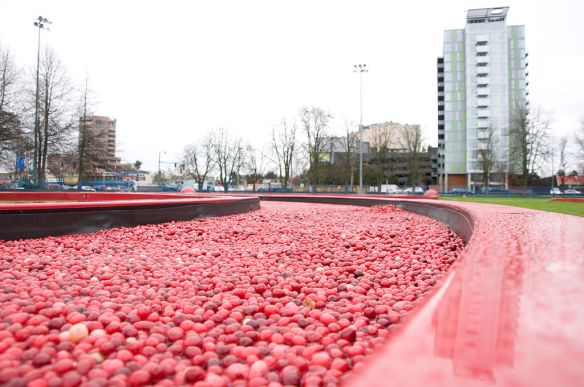
This is a picture of cranberries filling a fountain in Vancouver, Canada, BC. No, I haven't the faintest idea.

This is a picture of cranberries filling a fountain in Vancouver, Canada, BC. No, I haven’t the faintest idea.

Well, here it is November again. At exactly midnight on Hallowe’en night, a giant cosmic switch clicks somewhere in the universe, and the retail locations that have been playing “Monster Mash” and “Thriller” immediately begin broadcasting Christmas carols. Down come the bats and cats, and up go the twinkly lights and Santas.

Somehow Thanksgiving, sandwiched between Hallowe’en and Christmas, has become the loser in the cold weather holiday popularity contest. There aren’t a lot of Thanksgiving songs. (I remember “We Gather Together” from long-ago church services, but that’s a hymn, and doesn’t enjoy the bouncy appeal of “Frosty the Snowman,” for example.) We may have our little Thanksgiving traditions (turkey, Aunt Letty’s sweet potato pudding with miniature marshmallows, football), but nothing like the avalanche of rituals, gifts, goodies and decorations that make the Christmas season so stressful—I mean, fun.

But I’m thinking about Thanksgiving now. Back in the day when I was helping my mother prepare Thanksgiving dinner, it was quite an elaborate occasion. My mother got out her white linen tablecloth, spread it over a pad on top of the dining room table, and ironed it in situ. She would ask me to create a centerpiece for the table. We usually had dried gourds and Indian corn squirreled away for this purpose, to which I added colorful fall leaves. (If I could find any by that time. We had a shortage of colorful fall leaves in Southern California.)

Then I set the table with my mother’s best flatware, laying soft, white damask napkins at each place. All the good serving pieces came out, and the carving knife and fork were laid at the head of the table for my father.

I had various duties in the kitchen as well—basting the turkey and so forth. One of my duties (or my sister’s) was to put cranberry sauce in a serving bowl. Cranberry sauce at my house came out of a can. The first time I was assigned this awesome responsibility, I carefully opened the can at both ends and ooshed the red jelly into my mother’s silver serving bowl, where it sat jiggling, perfectly retaining the form of the inside of the can. I popped a spoon in with it and bore it toward the table.

My mother stopped me. “Chop it up a little bit so that it doesn’t look like it just came out of a can,” she said. I dutifully stirred up the jelly until no trace of can could be seen, but I was puzzled. Everyone knew that cranberry sauce came out of a can, so why try to pretend that it didn’t?

I hated that cranberry sauce. I never ate it as a kid. I continued to loathe it as an adult, but I wondered if cranberry sauce made from fresh berries might be better? Many years ago, I heard Susan Stamberg talking on NPR about her mother-in-law’s Thanksgiving cranberry sauce. It sounded easy, and Ms. Stamberg seemed to like it, so I copied down the recipe and made it for Thanksgiving that year.

“Mrs. Stamberg’s Cranberry Sauce” turned out to be absolutely delicious. I will admit it is a rather alarming shade of Pepto-Bismol pink, but don’t let that put you off. It is sweet—but not too sweet—tart, and refreshing. It’s made with fresh cranberries and is simple to prepare.

The only problem is that my family refuses to eat it. They all think of cranberry sauce as the red jelly stuff that comes out of a can, and are dead-set against anything that calls itself cranberry sauce. I made a batch at Thanksgiving for a few years, but no one but me ever ate any of it and I had to throw the rest out, which seemed wasteful. So I stopped making it.

I have decided to release the recipe back into the wild, in the hopes that someone out there will try it and like it. You can find the recipe online by Googling “Mrs. Stamberg’s Cranberry Sauce,” but here it is:

Mrs. Stamberg’s Cranberry Sauce (thanks to Susan Stamberg)

Ingredients

2 cups fresh cranberries

1 small onion

½ cup sugar

¾ cup sour cream

2 tablespoons horseradish

Grind berries and onion together in the food processor. Add remaining ingredients and blend to a pleasing consistency.

That’s it! Five minutes to the best cranberry sauce you will ever taste. Mrs. Stamberg and I say so. Have a Happy Thanksgiving!

The Dead Authors Society

A disturbing number of my favorite authors have died recently, and it’s bugging me. I’m talking about the kind of writer whose prose delights you, for whatever reason. Maybe reading a certain author’s work feels like sinking into a warm bath, comforting and deep. Or thrills you with action. Or galvanizes you into action. Or makes you feel as though you are traveling through faerie realms. You own all of their books and re-read them from time to time, just for the pleasure of the visit.

I decided to share some of my favorite deceased writers with you. If our tastes are similar, maybe you’ll like them, too. A caveat: Not all of these authors are great prose artists. But they all have a special, um, je ne sais quois.
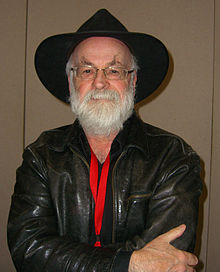
Terry Pratchett

Terry Pratchett

Sir Terry Pratchett. If you’ve been reading this blog, you already know I’m in sackcloth and ashes over Pratchett’s untimely demise from Alzheimer’s earlier this year. If not, or if you’re a glutton for punishment, you can read my tribute to Sir Terry or my review of his last Discworld book, The Shepherd’s Crown.


L.A. Meyer. Louis Meyer authored the young adult “Bloody Jack” series. I have actually never “read” one of these, but I own all of them as audiobooks. This is because the narrator for all of them, Katherine Kellgren, is absolutely brilliant. She perfectly captures the heroine’s Cockney cockiness, her bounce, optimism, kindness, and impulsiveness. Bloody

L.A. Meyer Photo Credit: Bangor Daily News

L.A. Meyer
Photo Credit: Bangor Daily News

Jack starts life in the late 18th century as Mary Jacqueline Faber, daughter of a respectable couple fallen on hard times. Her parents die and she is coldly ejected into the streets of London at age 8. She falls in with a gang of street children, and after observing that life in the streets was a short-term proposition for most kids, she disguises herself as a boy and signs on as a cabin boy with a naval ship. Her ensuing adventures are grand and hilarious to boot. Kellgren does an amazing range of male and female voices and accents. The only one she just can’t do is Scots. Fortunately, there’s only one significant Scottish character, and he’s only in the first few books.

Meyer created a memorable, lovable, and downright addictive character in Jacky Faber. The other major characters are also well delineated and engaging. He manages to sneak in a good bit of history in the process of entertaining us.

L.A. Meyer died in 2014 from Hodgkin’s lymphoma. But he finished his series before he set sail into the great beyond. I’m listening to the final book now with a mixture of enjoyment and sadness that this is the last I’ll see of Bloody Jack.

The Bloody Jack series in chronological order:

  • Bloody Jack: Being an Account of the Curious Adventures of Mary “Jacky” Faber, Ship’s Boy (2002)
  • The Curse of the Blue Tattoo: Being an Account of the Misadventures of Jacky Faber, Midshipman and Fine Lady (2004)
  • Under the Jolly Roger: Being an Account of the Further Nautical Adventures of Jacky Faber (2005)
  • In the Belly of the Bloodhound: Being an Account of a Particularly Peculiar Adventure in the Life of Jacky Faber (2006)
  • Mississippi Jack: Being an Account of the Further Waterborne Adventures of Jacky Faber, Midshipman, Fine Lady, and the Lily of the West (2007)
  • My Bonny Light Horseman: Being an Account of the Further Adventures of Jacky Faber, in Love and War (2008)
  • Rapture of the Deep: Being an Account of the Further Adventures of Jacky Faber, Soldier, Sailor, Mermaid, Spy (2009)
  • The Wake of the Lorelei Lee: Being an Account of the Adventures of Jacky Faber, on her Way to Botany Bay (2010)
  • The Mark of the Golden Dragon: Being an Account of the Further Adventures of Jacky Faber, Jewel of the East, Vexation of the West, and Pearl of the South China Sea (2011)
  • Viva Jacquelina! Being an Account of the Further Adventures of Jacky Faber Over the Hills and Far Away (2012)
  • Boston Jacky: Being an Account of the Further Adventures of Jacky Faber, Taking Care of Business (2013)
  • Wild Rover No More: Being the Last Recorded Account of the Life and Times of Jacky Faber (2014)

Source: Wikipedia

Elizabeth Peters

Elizabeth Peters

Elizabeth Peters. Elizabeth Peters’ real name was Barbara Mertz. She wrote mysteries under the name Elizabeth Peters and supernatural/gothics under the name Barbara Michaels. She was an Egyptologist by education and wrote books about the everyday life of ancient Egyptians under her own name. She died in 2013.

As Elizabeth Peters, she had several series, but my absolute favorite is the Amelia Peabody series. Amelia Peabody is a wealthy English spinster of Victorian times who decides to travel. Intrigued as many Victorians were with the mysteries of ancient Egypt, she winds up in Cairo, encounters a nasty, rude male archeologist and a few murders. She winds up saving the day with British aplomb, a stiff upper lip, and a sharp umbrella. Amelia tells her own stories, and her prose is delightful to anyone who has read much Victorian literature. Here are some selections of Amelia’s wisdom:

  • “Men always have some high-sounding excuse for indulging themselves.”
  • “Abstinence, as I have often observed, has a deleterious effect on disposition.”
  • “Godly persons are more vulnerable than most to the machinations of the ungodly.”
  • “I do not scruple to employ mendacity and a fictitious appearance of female incompetence when the occasion demands it.”

Source: http://ameliapeabody.com/fromamelia.htm

Amelia waxes positively purple over her husband, Emerson, and there are references to his “sapphirine eyes” and “manly physique” that are clearly intended for us to giggle over.

The characters in this series age and change over time. The stories are informed by the geopolitical realities of each era, as Amelia moves from Britain’s Age of Empire to the wars and disruptions of the early 20th century. Here are the Amelia Peabody books in chronological order:

  • Crocodile on the Sandbank
  • The Curse of the Pharaohs
  • The Mummy Case
  • Lion in the Valley
  • Deeds of the Disturber
  • The Last Camel Died at Noon
  • The Snake, the Crocodile, and the Dog
  • The Hippopotamus Pool
  • Seeing a Large Cat
  • The Ape Who Guards the Balance
  • Guardian of the Horizon
  • A River in the Sky
  • The Falcon at the Portal
  • The Painted Queen

Source: Wikipedia

The author knew an enormous amount about ancient Egypt and the history of Egyptology, and this background made the books fascinating on yet another level beyond the delights of the characters and the murder mystery plots.

In all honesty, not every book in the series is brilliant, but I never cared. Spending time with Amelia was worth a little disappointment once in a while.

Mary Stewart Photo Credit: Australian Consolidated Press

Mary Stewart
Photo Credit: Australian Consolidated Press

Mary Stewart. To tell you the truth, I only just looked her up to see if she were still among us—and she is not. She died in 2014 at the age of 97. Born Mary Florence Elinor Rainbow (Yes! Really!), she authored a number of thrillers with romantic subplots that made them perhaps more appealing to women than to men. Her POV character was always female. My mother and I started reading these in the 1960s and thoroughly enjoyed them. I have never liked romances, but the intelligence and eruditeness of Stewart’s writing engaged me. A few from this era that I particularly enjoyed are “Madam, Will You Talk?,” “The Moonspinners,” “This Rough Magic,” and “The Ivy Tree.”

Then she jumped genres in 1973 with the publication of the “The Crystal Cave,” the first book of what became her “Merlin Trilogy,” beautifully written and researched historical fantasies. “The Crystal Cave” was followed by “The Hollow Hills” and “The Last Enchantment.” Having always been an Arthurian enthusiast, I devoured them. Related books include “The Wicked Day” and “The Prince and the Pilgrim.” The trilogy made her an internationally famous best-selling author and she won many awards and honors for it.

So then, as far as I can tell, she went on to write little romances about rose-covered cottages in the forest and whatnot. I have read these but don’t recommend them.

Bryce Courtnay

Bryce Courtnay

Bryce Courtnay. Bryce Courtnay was a South African advertising executive who emigrated to Australia and decided to write a book. “The Power of One,” was published in 1989, and Courtnay quickly became one of Australia’s best-selling authors. He died in 2012 of gastric cancer.

Courtnay primarily wrote historical fiction, mostly set in Australia, New Zealand and South Africa, though his last novel, “Jack of Diamonds,” was set in the U.S. and Canada. He seems to catch the feel and taste of each era and locale he writes about. His stories can contain pretty dark material, but somehow you feel that it comes right in the end—mostly, anyway. His characters feel like real people, even the most bizarre ones. In “Brother Fish,” he has a German immigrant housewife living on a New Jersey farm during WWII who poisons her lumpish husband and takes a young lover­—and you completely sympathize.

Among Courtnay’s best is his “Potato Factory” trilogy, in which he follows the fictionalized family of the real-life model for Dickens’ Fagin, Ikey Solomon. “The Potato Factory” takes place in Victorian times as Ikey and his horrible bawd of a wife are deported to the prison colony of Australia. “Tommo & Hawk” follows the lives of Ikey’s adopted sons. “Solomon’s Song” takes the family into the WWI generation. Each book is dense, rich, complex and a treat to the senses as Courtney makes his stories come alive. There is something for everyone: action, tragedy, revenge, mystery, murder, love, beauty, friendship and horror.

Well, that’s it for dead authors—for now, anyway. I just wanted to say a thank you to these writers for taking me to places I have never been to meet people only they have imagined. They have given me so much enjoyment over the years, and perhaps as long as people read their work, they will never truly die.




Book Review: “The Shepherd’s Crown” by Terry Pratchett

shepherds crown

Yesterday I finished Terry Pratchett’s last book, “The Shepherd’s Crown.”

[Pause to wipe unexplained moisture from eyes.]

First, I’m glad it was a Discworld story. I have enjoyed everything Pratchett has written on his own or in collaboration with someone else. But­—as with most of his readers, I suspect­—I adore Discworld. I adore its cast of thousands, many of whom have become old friends. I adore Discworld’s manic buffoonery, it’s defiance of science in favor of its own wacked magic, the humor and humanity of its inhabitants (many of whom are not actually human).

Second, I’m glad it was a Tiffany Aching story. The first Aching novel I read was “A Hat Full of Sky.” I didn’t realize it took place in Discworld. It seemed to exist in the wide spaces of the High Chalk, covered by an expanse of endless blue sky and connected to nothing else. I fell in love with Tiffany. And I enjoyed the stories of the other witches enormously. I loved the idea of witching as a profession. I loved that witches served the needs of their community, not for gain, but because somebody had to do it. I loved that they didn’t often use magic in the performance of their duties, but usually applied common sense, deep insight into the foibles of humanity, and—not infrequently—threats. You don’t have to actually turn someone into a toad if they truly, deeply believe that you will if they get so much as a hair out of line. I loved the tension between the tough old witches like Granny Weatherwax and Nanny Ogg and the New Age witches with their tinkly amulets and sparkly dresses.

By the way, I am embarrassed that after reading all those books, it wasn’t until last night that I realized why Nanny Ogg was named Nanny Ogg. {Blush}

As world-building goes, Discworld is a shining, if unachievable example to other fantasy writers. It is so detailed and internally consistent that during the time I was immersed in a Discworld story, I believed in a flat world resting on the back of a giant turtle floating in space. I believed that Death was a kindly, inexorable presence in a black robe who SPOKE IN CAPITALS and rode a white horse named Binky. I believed that there was a City Watch consisting of a werewolf, a female dwarf, a troll, something called Nobby Nobbs, and the uncrowned King of Ankh-Morepork, headed by Commander Samuel Vimes. I believed, and if that isn’t magic, what is?

I had to look up the shepherd’s crown of the title. Shepherd’s crowns are fossilized sea urchins commonly found in the chalk downs of England. They have five ridges that meet in the center of the fossil, looking somewhat like the star on some species of sand dollar (a closely related animal). Apparently, the ridges looked like a crown to someone, if not to me. Back in the day, these fossils were thought to be magical charms against evil. In this story, a shepherd’s crown is passed down through the Aching family to Granny Aching, and finally to Tiffany. Because Tiffany belongs to the Chalk, the little fossil becomes a powerful talisman in her last fight against an invasion of evil elves from Fairyland. (Those who have read “Lords and Ladies” will remember that in Pratchett’s universe, elves are beautiful, glamorous, powerful—and the cruelest, nastiest creatures imaginable.)

The story is about what happens when people band together to fight a just cause. Traditional adversaries become allies. Strong becomes stronger. And Tiffany truly comes into herself as a witch. Beyond that, I’m not giving out any spoilers.

Is “The Shepherd’s Crown” Pratchett’s best Discworld novel? No, not in my opinion. However, I am absolutely certain it is the finest novel in any language or genre written by a man dying of a vicious form of Alzheimer’s Disease. I am certain he had lots of help here, but it is Pratchett’s voice and spirit that shine throughout the tale. It is his last love letter to humanity, and his last admonition to us to behave like witches—practical, wise, kind when called for and tough when not, taking up the burden of service because it is the right thing to do. “The Shepherd’s Crown” sums up what Terry Pratchett has been trying to tell us all along: “Do the right thing.”

Time for a snack. I’m going to have a rat on a stick, how about you?

I Will Be Speaking at the Los Gatos Literary Fair August 22

I will be making a short presentation at the Los Gatos, CA Literary Fair, Saturday, August 22. The Fair is from 12 noon to 3:00 p.m. I will also be signing copies of “The Obsidian Mirror.” I’d love to see you there if you happen to be in the neighborhood!

2015 LG Lit Fair flyer

Losing Esther: An Inadequate Tribute

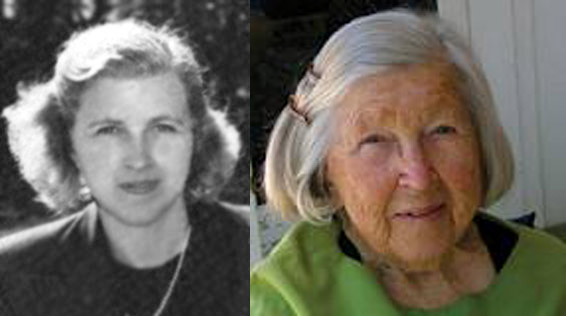
Esther Marie Isaacson

Esther Marie Isaacson

This past weekend, my husband and I traveled to Lompoc, California to attend a memorial service for one of the best women I have ever known, Esther Isaacson.

Esther was the wife of a cattle rancher, Baine Isaacson, and she worked hard all her life. She had a grip like a stevedore from all the physical work she did—forking hay off trucks for cows, digging her garden, putting in fence posts, etc. She and her husband raised three boys on their ranch, called El Chorro, “The Stream.” She had simple tastes. Her clothes were usually blue and white, she wore blue tennies most of the time, and sometimes she sported a little silk scarf at her throat. She didn’t care much about possessions, and for the last 15 years or so of her life, she tried to give them all away. The only things she collected were bells. She had jingle bells, cowbells, reindeer bells, every sort of bells. They hung on the little patio outside the front door and in her tiny breakfast nook, strung on leather straps and woven belts. Getting in and out of the nook always occasioned a good jingle or two.

Esther was my refuge. My first memory of her was when I was six years old, visiting the ranch with my family for the first time. She and Baine radiated kindness, caring and love. She sent me out to play on the ranch with her youngest son, Bob, who was perhaps eight or nine at the time. Bob was as sunny, sweet and kind as his parents. He showed me the boys’ clubhouse—a signal honor—and we caught frogs in the creek, climbed the hills, and chased the cows. One of the best days of my little life.

When I was older and my heart was broken, I came to Esther and she took me in. She never asked questions, just let me stay with her in her ranch house on the hill. I roamed all day on the ranch and in the evening helped her cook. We shopped, sat by the fire, washed dishes, and played cards while I struggled with my aching heart and damaged self-esteem. Her acceptance, quiet presence and love sustained me, and I returned to my life with a renewed sense of strength and self-respect. In truth, I have never been the same since. (My epiphany also had a lot to do with a certain coyote that lived on the ranch, but that is a different story.)

Esther Marie Ibbetson was born in 1912 in Solvang, California. Solvang was founded as a “colony” for Danish ex-patriots, a town where they could speak their own language and teach Danish to their children, eat Danish foods, sing Danish songs, folkdance, and perpetuate their culture. In the earlier days, there were no cars and few roads. Her father was a carpenter, but they lived in a one-room house with a canvas slung down the middle to separate the living quarters from his office. Esther said it was a case of the cobbler’s children—her father was so busy with other people’s houses he had no time to work on his own. However, she noted that houses were often built by the community for newcomers, and the expenses were worked out later.

My mother and Esther traveled a lot together after Baine died. They went to Mexico, Greece, Spain, New Zealand, Guatemala, Fiji, Australia, and many other places, and came home giggling together like schoolgirls. Losing my mother was a great blow to Esther, who often mentioned her with longing for their free-roaming travels.

I won’t say that Esther was amazingly progressive for a woman of her generation, because she was just amazingly progressive, period. She was not religious at all. She loved the land, and practiced her own brand of recycling and conservation long before it became mainstream. She was one of the few girls in her community who went to college, and she married late (for the era) because she didn’t want to stop working. She deplored prejudice, ideology and narrow thinking, and read and thought deeply her entire life.

Esther loved wildflowers—including weeds—and she loved her garden of native plants. She called it her “moon garden,” because it didn’t resemble a typical garden. (A casual visitor might think it was “just” weeds.) She thought planting invasive exotics like English ivy was deplorable when we had so many lovely, drought-resistant plants native to California. Walking on the ranch with her was always a lesson in the local flora and fauna—there was nothing about the land she loved so much that she did not know.

She was 102 years old when she died, and she was more than ready. She lost her husband, her youngest son, two daughters-in-law and many friends before she died herself. She told my sister that “Getting old is so boring!” and my husband (sometime during her 90’s) that “No one should have to live this long.” She didn’t die of any illness. Her heart was fine, and so was her blood pressure and pulse. She just wound down like an old clock and stopped ticking.

So I am not sad for Esther, who was prepared and ready for death. I am sad for myself, because this kind, loving, multifaceted woman is gone from me. The world has lost a treasure, but I know that every human being she touched is the better for that contact. I only hope to carry forward that gift in my own life to give to others.

Goodbye, Esther. I will always love you dearly. Thank you for your kindness and love. Thank you for offering my heart a safe place in this dangerous world.

* * * *

My thanks to the many people who spoke at Esther’s memorial for reminding me of many things I might otherwise have forgotten. Special thanks to Sally Isaacson for putting together and editing Esther’s notes about her childhood and making them available to us.

Things I Will Miss (or Not) about Spain

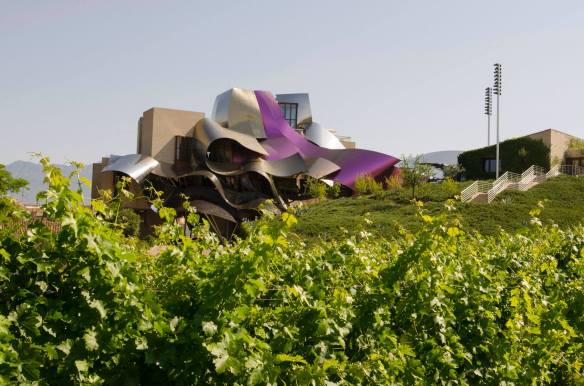
Marquis de Riscal winery, designed by Frank Gehry

Marquis de Riscal winery, designed by Frank Gehry

Things I Will Miss:

The food. You can get delicious food almost everywhere in Spain, often for little money. It’s heavy on fat, so it tends to be rich and satisfying. Even little holes in the wall offer yummy stuff, freshly prepared. Before I move on, I have to mention a very special restaurant, La Tertulia, in Barcelona. We ate there on the recommendation of our hotel, and it was only a short walk away. We ate outside in a charming patio. By this time, we were getting tired of meat and ordered several dishes of vegetables. All were simply delicious–and so was the menu. I took a few shots of it to treasure, as the English translations of the Spanish descriptions were adorable:

  • Mejillones con ajo y perejil al vino turbio: “Mussels, garlic & parsley to the turbid wine”
  • Paellas: “Cooked by 30% with sea water broth with healthy clams & truly sea”
  • Caldereta de arroz con bogavante: “Lobster soggy”
  • Costillar de Iberico a baja temperatura con grasa de barbacoa: “Iberian ribs low temperature with greasy smoky barbecue”

We ordered some Spanish brandy after the meal. The waiter poured us two enormous servings. There was a finger or so of brandy left in the bottle, so he shrugged and told us to finish it off, leaving the bottle on the table. Tipping is not common in Spain, but this guy got a nice one.

The people. Almost everyone we encountered was helpful and friendly–sometimes extraordinarily so. They worked hard to understand my execrable Spanish. Complete strangers rushed to help if we were having difficulties. Lovely people.

The art and architecture. Spain appears to be a country that values art, and it shows. Although I have traveled to many countries and toured many beautiful buildings, I don’t think I have ever been as gobstopped by architectural beauty before–especially the Alhambra, La Mesquita, the Guggenheim, and La Sagrada Familia. I do not expect to see anything, ever, that surpasses La Sagrada Familia.

Western light, La Sagrada Familia

Western light, La Sagrada Familia

The wine. As with the food, you can get good wine very cheaply everywhere. Pay a couple more Euros, and you can get GREAT wines.

What I Will Not Miss:

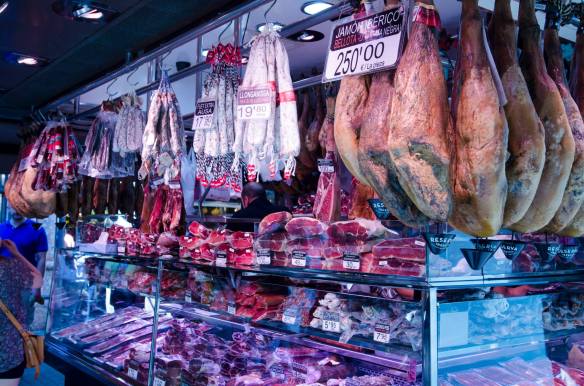
The food. Yes, I know I said I would miss it, but there is a downside. There’s jamon in everything, just about. I know Spain is famous for its jamon, and there are pig’s hindquarters hanging in every restaurant, but I can take it or leave it. When it comes to cured meats (except for bacon, and then it has to be cooked crisp), I can pretty much leave it. Spanish food is very meat-oriented, so if you are eating in restaurants all the time, you might not wind up with enough vegetables in your diet. I once received a platter containing a quarter of an entire lamb that boasted a single asparagus stalk. Also, the food is high-fat, which is delicious at first, but I became rather sated with it. Despite the reputation for tapas being small dishes, even when I ordered medio raciones (half portions), sometimes we received huge platters and basins of food that put American restaurants to shame for serving size. Just too much food.

jamon

Smoking. More people smoke in Spain than in my native California (though I cannot speak for other parts of the U.S.). Being former smokers, Tom and I loathe the smell–I think it’s something your brain does to help you stay clean. People no longer smoke inside restaurants, but they can smoke in the outdoor eating areas. Nothing ruins a pleasant meal in the open air more than cigaret smoke. And the ground everywhere is littered with butts. Gross.

The Weird Reservation Thing: Several times when Tom and I arrived at a more or less upscale restaurant without reservations, we were turned away–even though there were plenty of available tables. In one case, there was not another soul in the entire restaurant. I don’t get it.

That’s all she wrote, folks! I appreciate all the “Likes” and comments I’ve gotten on my trip blog. It’s back to work on the next novel, and I’ll try to think of something interesting to say soon.

Scrambling To Get It All In: The Last Day

Our last day in Spain finally arrived. We decided to get some breakfast and head down to La Rambla, a long mall that leads down to the harbor. Traffic goes by on either side of a pedestrian mall, with booths and kiosks in the middle and shops on either side of the traffic lanes (where shops are usually located, actually). We were warned that this was a prime area for pickpockets. so we were on the alert.

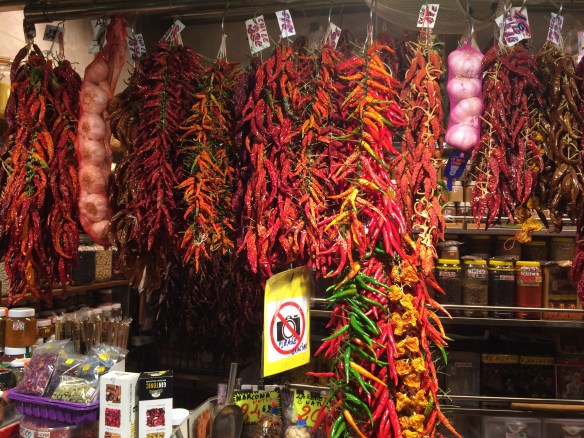
There were tons of people walking la Rambla. Most of the kiosks were selling the same old stuff we had seen everywhere else in Spain–cheap “Flamenco” shawls, a Spanish dancer doll (the exact same one in every city), t-shirts–augmented by Barcelona-specific stuff like Gaudi-inspired plates and keychains. Then we came to the open-air market, La Boqueria. This was a feast for the senses, and if we had not already had breakfast, we would have bought something delicious here. The stalls were piled high with fresh fish and shellfish; eggs of all kinds, from emu to ostrich to quail; the obligatory stalls with pig haunches hanging and cured meats on display; every sort of nut you could imagine; dried and fresh chilis; sweets; exotic fruits; piles of tripe, lambs’ heads, kidneys and other offal meats; spices, teas and coffees. it was overwhelming and beautiful.

Dried chilis

Dried chilis


Offal meats

Offal meats


Shellfish

Shellfish


Every sort of egg

Every sort of egg


Seafood

Seafood


After this feast for the eyes, we continued down La Rambla, stopping just before the harbor to photograph the living statues. There was Don Quixote, a person dressed like a Salvador Dali painting, a Remington cowboy statue (probably the most boring, despite his dramatic pose), a demon (entertaining), a “bronze statue” of Galileo, and several more.

An entertaining demon

An entertaining demon


Dali lady. Not sure the person inside the costume was actually a lady, but no matter.

Dali lady


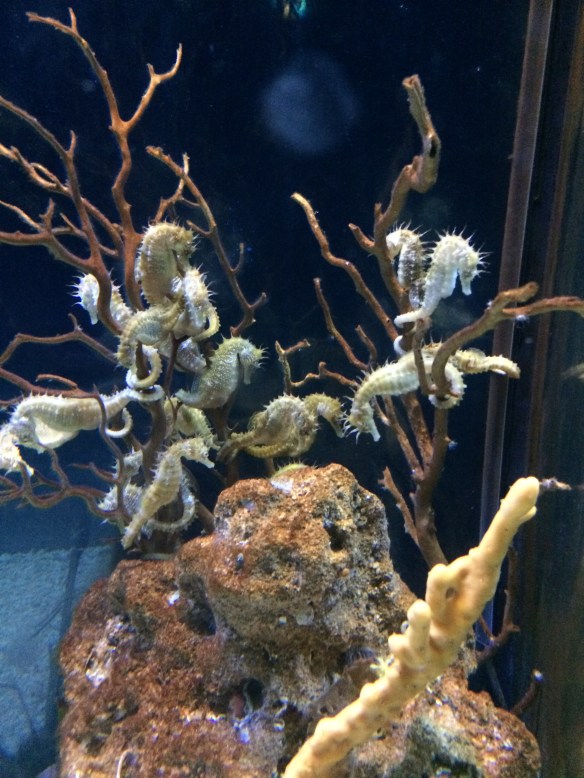
By that time it was hot, and we were reasonably near the Barcelona Aquarium, so we went there for a few hours. For people whose local fish museum is the Monterey Bay Aquarium, the Barcelona Aquarium cannot measure up, but I did see some interesting fish I hadn’t seen before. Unfortunately, labeling was kind of random. You’d see a label above one tank, with no sign of the supposed denizen, then see the same fish in another tank that had no such fish identified as being there. Nonetheless, it was a pleasant couple of hours out of the heat. I do think someone tried to pick my purse in the aquarium. I was waiting in line to buy mineral water and carelessly left the zipper open, displaying credit cards and cash. I saw a hand creep across the ledge in front of me, heading toward my purse. As soon as I clocked the hand, it suddenly became very interested in the surface of the ledge, which had nothing on it but crumbs. I zipped the bag.

Seahorses in Barcelona Aquarium

Seahorses in Barcelona Aquarium


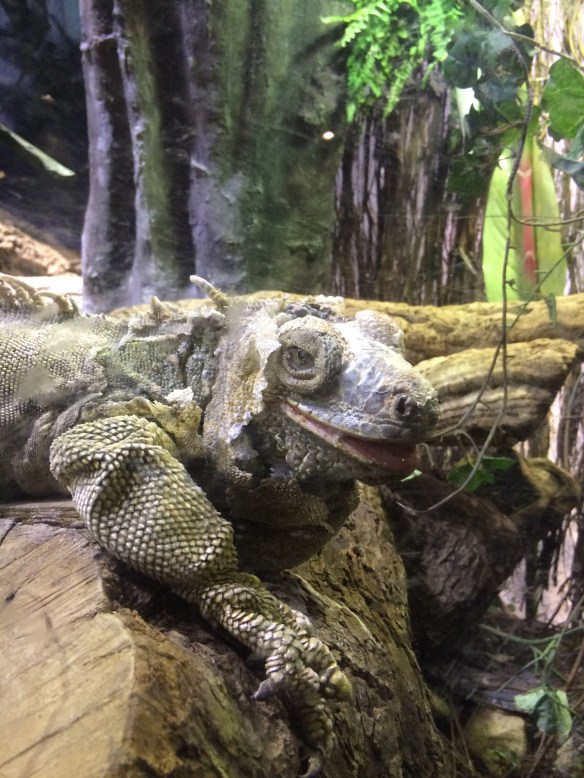
This iguana had such a pleasant expression that I just had to photograph him. Or her.

This iguana had such a pleasant expression that I just had to photograph him. Or her.


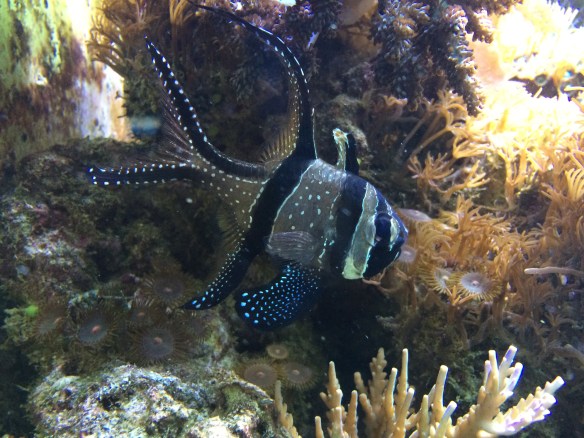
I don't know what this fish is due to random labeling, but I liked it.

I don’t know what this fish is due to random labeling, but I liked it.


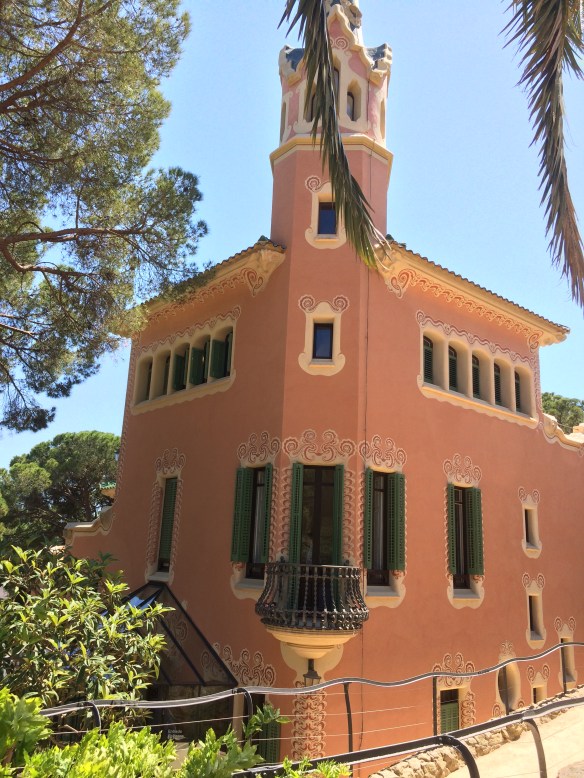
In the afternoon, we went to Parc Guel. Gaudi had a house there (designed by someone else), and he designed a beautiful installation in the park that would look very familiar had we actually gone in. We already had tickets to see his house and we wandered around the free area of the park, which is also very Gaudi-esque, but not the iconic installation everybody was lined up to pay for. When we went through his house, I was astonished to find out that despite the over-the-top ornateness and whimsy of his work, Gaudi lived a very austere and simple life. His furnishings were simple and sparse. He cared nothing for clothes or material things for himself. A remarkable contrast.

The area of Parc Guel we did not go in, showing more of Gaudi's amazing work.

The area of Parc Guel we did not go in, showing more of Gaudi’s amazing work.


Kids playing with giant bubbles in Parc Guel

Kids playing with giant bubbles in Parc Guel


Gaudi's house in Parc Guel

Gaudi’s house in Parc Guel


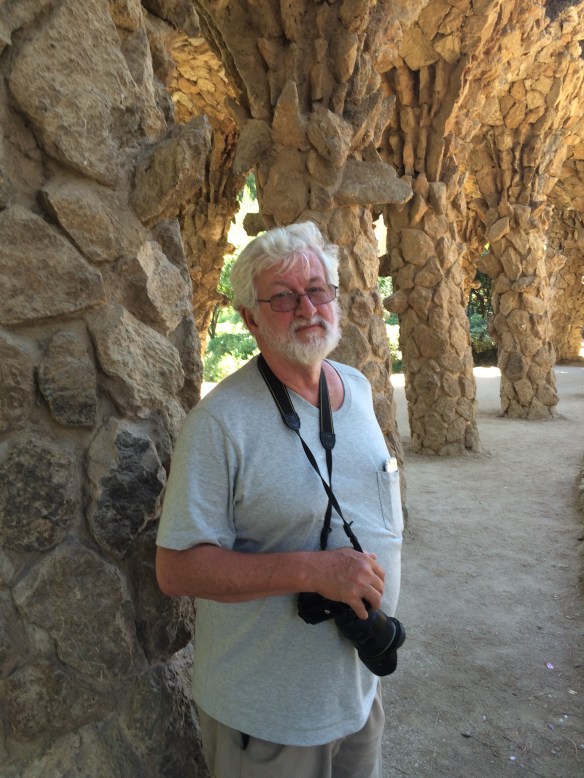
Tom standing under a Gaudi-designed bridge in Parc Guel

Tom standing under a Gaudi-designed bridge in Parc Guel


We left without paying to go into the most interesting part of the park, which I kind of regret.

We had an early dinner at a boring restaurant where a large group of people (maybe 100 or so) were playing Scrabble (in Catalan? At least they’d have a ready use for all those X’s!), and so to bed.

Adios, Spain. We had a wonderful time!

More soon about a menu that made me laugh and things I will miss/not miss so much about Spain.

Inside the Light: La Sagrada Familia

Tom and I arrived home safely after a very long travel day. After decompressing a little (we went to see “the Book of Mormon” on our first night back), I now feel ready to tackle the inside of La Sagrada Familia, Antoni Gaudi’s masterpiece in Barcelona. As it happens, this post is a lot shorter than I thought it would be because–embarrassingly, for a writer–words failed me.

While the exterior is amazing, intricate and fascinating, the inside is simply indescribable. I can’t imagine why none of the art history courses I took ever showed a photo of the interior. I’m not going to provide the statistics on how big it is, because the numbers could not possibly begin to inform as to the size, scope and vastness of this space.

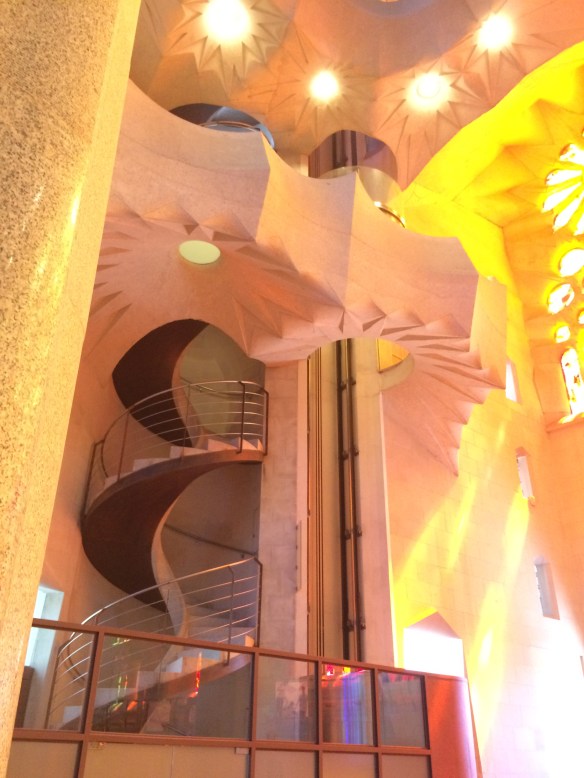
The east side of the nave has stained glass windows in blues and greens, while the west side windows are in oranges, yellows and reds. We were there in the afternoon, so the light was pouring through the west windows. The stained glass is laid in abstract patterns, not representational images, but the effect of the light was magical. It lit the cathedral in a way that cannot be described with words, and the photos don’t do it justice. The light is both ethereal and dynamic, with an energy that is alive and uplifting. I would like to see the east side in the morning to experience the effect of the light streaming through the cool-colored windows.

Light from the west windows, La Sagrada Familia

Light from the west windows, La Sagrada Familia


Interior, lit by west windows, La Sagrada Familia

Interior, lit by west windows, La Sagrada Familia


Standing o the west side of the nave, looking east, La Sagrada Familia

Standing on the west side of the nave, looking east, La Sagrada Familia


Western light, La Sagrada Familia

Western light, La Sagrada Familia


Stairs to the choir loft near the sanctuary, La Sagrada Familia

Stairs to the choir loft near the sanctuary, La Sagrada Familia


Even the organ pipes are transformed by the light

Even the organ pipes are transformed by the light


While the stonework and other elements are amazing and  impressive, for me, the experience was all about the light. I have lots of other photos, and I’d be glad to post them if anyone is interested, but I don’t think I can really say much more about it. The interior of La Sagrada Familia is a miracle of light that so encompassed and raised my spirit that the other details became unimportant. Finis.


Sand Castles in Spain

When I was a child, we used to go to the beach for a few weeks every summer. One of our favorite activities was making “drip castles” out of wet sand. We’d grab a bucket of sand and water and carefully let the wet sand drip from our fingertips, making fantastic shapes and spires. The challenge was to see how elaborate you could make your castle, and how tall your spires could reach before collapsing.

In art history, my first take on seeing a photo of Barcelona’as La Sagrada Familia (Sacred Family) cathedral, designed by Antoni Gaudi, was “Drip castle!” I never blew it on the tests, either–the mnemonic was fixed forever. Apparently I am not the only one to see this resemblance, because when I searched for images of drip castles on Google, I found some photos of La Sagrada Familia as well:

Drip castle on the left; La Sagrada Familia on the right. I'm just saying.

Drip castle on the left; La Sagrada Familia on the right. I’m just saying.


The cathedral isn’t finished and won’t be for a decade or more, although it was begun in 1882. Up close, the exterior no longer looks like wet sand. The facade in the photo above (the Nativity Facade) is the one most photographed, I believe, and close up, all those furbelows resolve themselves into exquisitely crafted details. There are the obligatory religious figures, of course, but there are also twining vines, chickens, roses, standard Gothic features like columns that somehow turn into tentacles, rabbits, turtles and trees. It is naturistically sculpted, elaborate, whimsical and ebullient.

This turtle is one of two that hold up pillars, one on either side of what is now the main door. Kind of a metaphor for how mankind treats animals, though I'm sure this was not the intention.

This turtle is one of two that hold up pillars, one on either side of what is now the main door. Kind of a metaphor for how mankind treats animals, though I’m sure this was not the intention.


Rooster and hens detail from the Glory Facade

Rooster and hens detail from the Glory Facade


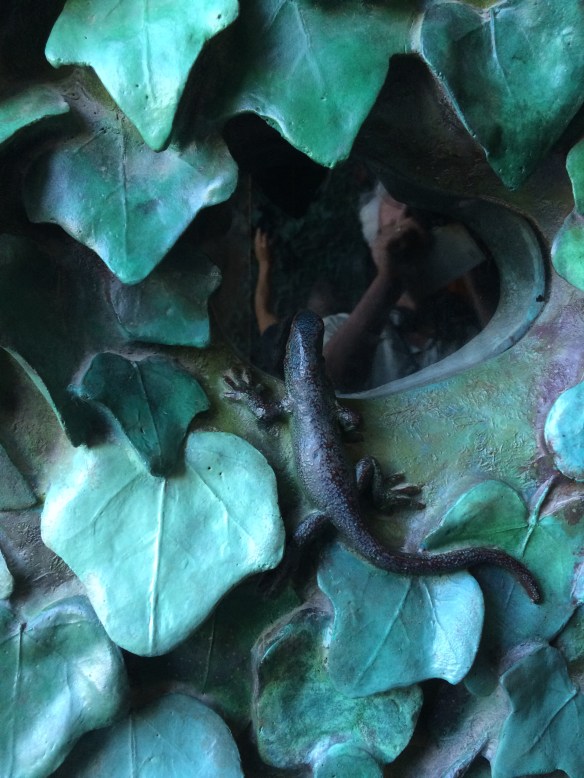
This little lizard is one of many creatures peering out from the bronze leaves that completely cover the main door

This little lizard is one of many creatures peering out from the bronze leaves that completely cover the main door. He is peering through a small glass pane. The reflection in the pane is Tom taking a picture of it.


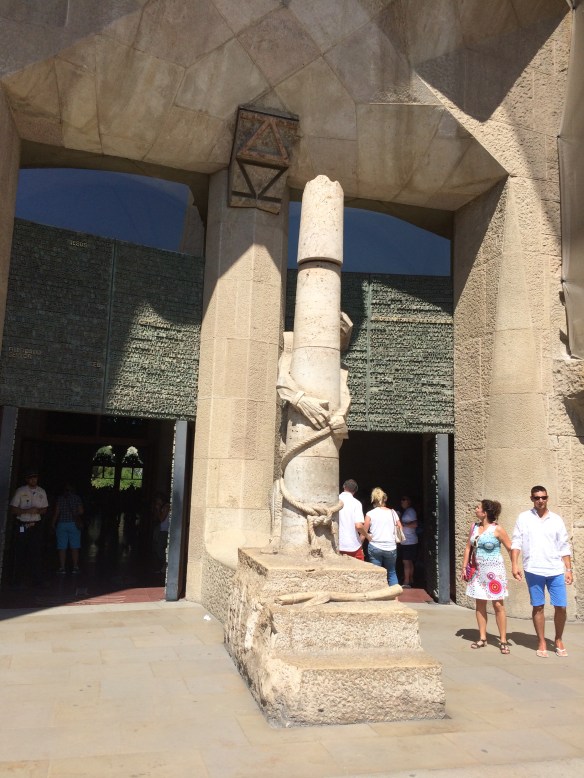
The other facades differ greatly in style. The Passion Facade, which depicts the end of Christ’s life from the Last Supper to the crucifixion, is sculpted in an austere, unelaborated and grimly modern style. some of it couldn’t be photographed because of ongoing construction.

The Passion Facade. The pillars are intended to resemble bones.

The Passion Facade. The slanted pillars are intended to resemble bones.


Kiss of Judas, Passion Facade

Kiss of Judas, Passion Facade. There’s a cryptogram square to the left, but I haven’t researched its meaning yet.


The Loneliness of Christ, Passion Facade

The Loneliness of Christ, Passion Facade


As you can see, this facade was executed in an entirely different style, and it was as deliberate as the Gothic-reminiscent naturalistic style of the Nativity Facade. There are other facades, still under construction, that are more modern still.

I took three art history courses (yes, once it was because I couldn’t pass chemistry, but the other times, it was because I WANTED to!), and not once did I see a photograph of the interior. As gob-stoppingly gorgeous as the exterior is, the interior surpasses it by several orders of magnitude. I have never seen anything like it. It comes close to being unbelievable, as though someone a 100 years ago had had the ability to use CGI to create something impossible and improbably beautiful.

Unfortunately, I have to close up shop tonight and continue tomorrow (or sometime soon), because we are catching a flight to go home. I want to give the interior of La Sagrada Familia the time and attention it deserves, so buenos noches for now, and I will be back as soon as possible.