My Interview with Ryan Attard (aka “the bad boy of AEC Stellar Publishing”)

Ryan Attard, the author of the “Legacy” fantasy series (“Birthright” is the latest in the series and can be found on Amazon at http://amzn.to/1lWWfHt) interviewed me, and you can hear the podcast at http://ryanattard.com/. Warning: it’s long.

Ryan Attard

Ryan Attard

If you enjoy urban fantasy and you’re especially intrigued by anime, Eastern traditions and martial arts, Attard is just the man for you. His protagonist in the series, Erik, is a wizard with genetically inherited magic–who can’t use his magic. He has a snarky cat-demon as a familiar, his current apprentice is a flame-haired succubus, and he fights with a magical sword called Djinn. What more could you want?

I’ll be interviewing Ryan in the near future. I found out that he owns swords himself, and will run through fight scenes with a similarly-equipped friend to assure verisimilitude in his fight scenes. He’s also a martial arts practitioner and he lives on the island republic of Malta. Ryan should be a fascinating interview, and I’m looking forward to persuading him to stop writing long enough to talk with me.

A Walk on the Beach. With Sooty Shearwaters and the Cement Boat.

Our son-in-law, Mike, went camping overnight with Lilah (our granddaughter) and some family friends. This is a traditional trip for the dads and girls, and they camp at New Brighton Beach, which is quite close to us. Tom and I decided to walk down the beach to say hello, but found they were tired and packing up to come home.

But we saw some amazing things on the walk. We have, against all logic, a cement boat here. That is, it once was a boat. Now it is a wrecked remnant of a boat, used by pelicans and other seabirds as a roost and nesting area above deck, and the interior (broken open long ago by waves and storms) has been populated by a rich array of sea life.

The cement boat has a history (and yes, it once did float on the water, despite being made of concrete). It was built as a tanker toward the end of WWI, and christened “S.S. Palo Alto,” but never saw service. It was purchased by an entertainment company and towed to Seacliff Beach in 1929. It was grounded a few yards offshore, and they built a pier out to it. For a brief time, it was a tourist amusement with a swimming pool, dances, refreshments, and all the other accoutrements of a seaside tourist trap. After two years, the entertainment company went bankrupt and the boat was abandoned. She cracked open amidships, but was used by the locals as a fishing pier.

Today, the pier still runs out to the boat, but there is a wide gap between the end of the pier and the boat. There is a barrier at the end of the pier, apparently to prevent people from attempting to leap the gap. The pier is still used for fishing, but the S.S. Palo Alto is basically a tiny manmade island, a bird refuge, and a synthetic reef.

Cement Boat1

The black fuzzy-looking stuff beyond the boat is thousands of birds.

And, lest this sound romantic, it stinks to high heaven of bird shit. It is one of the most highly-polluted beaches in Northern California, thanks to the birds, but this doesn’t seem to deter campers and picnickers one bit, even though I personally find the stench gagulous.

But we had to walk past the concrete boat today, and as we headed down the beach, tens of thousands of sooty shearwaters appeared and began to settle on the water to feed. Sooty shearwaters, which look like dirty seagulls, are migratory. They nest in New Zealand, but migrate around the Pacific, spending much of the summer in Northern California. In New Zealand, they are often referred to as “muttonbirds,” which is indicative of what the NZ settlers did with them. The Maori still harvest about 250,000 sooty shearwaters every year for food, oils, and fat. Yet many thousands (of shearwaters, not Maori) still wind up in Northern California every summer, where the natives prefer virtually anything over fricaseed seabird.

The shearwaters were joined by the pelicans, gulls, dolphins and seals, all of which followed the unseen school of fish back and forth along the coast, gobbling as fast as possible. All in all, it wasn’t a good day to be an anchovie.


Listen to Chapter 1 of “The Obsidian Mirror” and Come to the Book Signing

Chaco #1

Chaco #1

This is it–my first podcast! I am reading Chapter One of “The Obsidian Mirror,” due out from AEC Stellar Publishing on June 27.

I will be hosting a launch party for the book at Kepler’s Books in Menlo Park, California on June 28 at 2:00 pm. I’ll be reading a portion of Chapter One and signing books. Come on down! Wine and munchies provided. (Leave a comment here to let me know if you’re coming. I’d hate to run out of food.)

Intergenerational Living…with a Newborn Baby


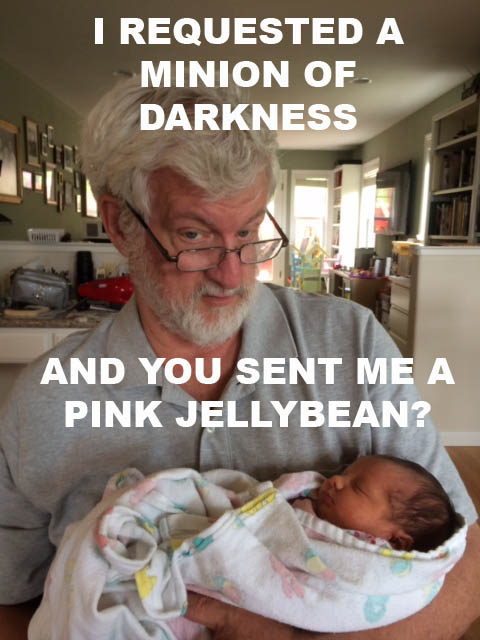
Daddo Jedssamyn MINION


I’ve written posts in the past about the fact that I live in an intergenerational living situation (see “An Experiment in Intergenerational Living,” and “Intergenerational Living: The Experiment Continues”). My husband and I sold our house last June and our daughter and her husband sold their house in July. We bought a house together in a new community. With Kerry and Mike came our granddaughter Lilah, 4, and two geriatric Japanese chins. (Chins are small, fluffy dogs with bulging eyes, squashed-in noses and a gremlin-like ability to find trouble anywhere, anytime.) Tom and I brought with us a third geriatric dog (large mutt) and a small black cat.

Now we have a new addition to the family: Jessamyn, one week old today. Jessamyn arrived a couple of weeks early because Kerry developed pre-eclampsia and what with one thing and another, had a caesarian delivery. (Getting the baby out is the only treatment for pre-eclampsia, which is the beginning of kidney failure and results in death if untreated.) So we were all a bit surprised by Jessamyn’s early debut, including Jessamyn.

All newborns are unbelievably tiny and fragile-looking, and Jessamyn is no exception. So far, she has been fairly easy. She sleeps, eats and poops. The only time I’ve heard her cry is when her diaper is changed or when she’s hungry. Lilah is delighted with her and tries hard to be helpful by fetching things for her mother. She is fascinated by Jessamyn’s tiny nose, which she touches very gently. Marley (#1 geriatric chin) wants to cuddle. The other animals have noted Jessamyn’s presence, but are keeping their distance.

Tom loves to hold the baby. He will hold her literally for hours. The photo above isn’t really fair—but I couldn’t resist, given the expression I caught on his face.

So another life has joined the family, and I wonder what she will be like. Will she dance through the house singing off-key, like her big sister? Will she like to draw? Will she love words? Will she want to be a poet, or an engineer? Jessamyn is physically here, but I don’t know who she is yet. It’s odd, feeling all this love for someone I don’t even know. I look at her little face, and she owns me, just like her big sister Lilah owns me. I am theirs for as long as I’m alive.


Lost in the Fog at FogCon

Lost in the Fog

I attended FogCon a couple of weeks ago. I had only attended one other con, and that was several years ago when I went to WorldCon in San Jose, CA. WorldCon was huge, taking up much of the McEnry Convention Center. There were lots of cosplay people dressed as Galadriel or Romulans or as people/creatures/characters I didn’t even recognize. And I met Terry Pratchett.

Yes, I know I said I was going to talk about FogCon, but I have to stop and talk about my encounter with Mr. Pratchett, who is one of my VERY EXTREMELY MOST FAVORITE fantasy authors.

You see, I met Connie Willis first. I was in the vendors’ hall when I happened to glimpse her nametag. Connie Willis is also a favorite author, so I introduced myself—and proceeded to commit every rabid-fan sin it is possible to commit in attempting to praise her work. Even as I heard the vapid words burbling out of my mouth, I knew I was doomed. The expression of pain on Ms. Willis’ face only confirmed my gauche blundering. I attempted to extricate myself by saying, “Well, I’m starting to drool on you, so I guess I’d better go now.” Ms. Willis nodded mute agreement, and I slunk away with my tail between my legs, feeling like a complete moron.

I was standing at a vendor’s stall wondering if it is possible to actually die of embarrassment when a tidy gentleman with a gray beard and a black fedora walked up. I thought he looked familiar, but when the vendor called him “Mr. Pratchett,” my suspicions were confirmed. He stood right next to me as the vendor handed him a CD and said, “I’ve been saving this for you, but I was afraid I might come across as a rabid fan.” (Like me, I thought.)

Pratchett took the CD and said, “I adore rabid fans!”

I turned to him and said, “Well, then, would you mind if I drooled on your shoulder?”

Pratchett responded, “Not at all—but would you mind drooling on this shoulder”—he patted his right shoulder—“as the other one is already rather damp?”

Instantly, the oppressive cloud of feeling foolish lifted and disappeared. I will never forget how Terry Pratchett’s humor and kindness brightened my day and turned my embarrassment into laughter. (Not that I mean to say Connie Willis made me feel bad. I made myself feel bad. I should’ve kept my mouth shut.)

Okay, back to FogCon, which is a very different con. I thought the topics appeared geared more to writers than to fans (“How To Create a Magical System” is one example), but there were probably more fans than writers. The sessions were a combination of panel discussion and group discussion. I introduced myself to several people, and sometimes got into conversations, but most people seemed to be there with groups of like-minded friends, and they were more interested in hanging with their posses than mingling. No one was rude or even cold; I just never clicked with anyone. I asked several people why they came to FogCon, and the answers were all along the lines of “I enjoy the discussions. The topics are so interesting.” Perhaps other cons are not as participative? I don’t know yet.

I managed to miss all the good parties because I didn’t know about the con suite. I handed out a few cards about “The Obsidian Mirror,” but no one expressed much interest. I finally just left a stack on the literature table. When I tried to talk about the book to a bookseller (from whom I was purchasing three books at the time), he just looked bored and pointedly set the card aside without a word.

By the time the “Non-Awards Banquet” rolled around on Saturday night, I was kind of done. There was a party afterwards, but I was tired and didn’t feel like trying to push myself onto more indifferent people.

I’ve done a lot of successful networking in my time, but I felt like a complete tyro at FogCon. I suspect that I am on a learning curve here. I went to the con to learn more about how cons work, and from that perspective, I was successful. I think I need to attend more cons and pick up on the culture (which I think differs from con to con, based on my limited experience). If I continue to attend, I’ll probably get to know others who go to cons and vice versa. Who knows? Maybe someday I’ll have my very own posse.

I Took My Skull Back to the Place It Came From (Almost)

When I turned six years old, my grandfather gave me a present. It wasn’t wrapped, as I recall, but just placed in a plain cardboard box. As it happened, it was my favorite gift that year: a genuine human skull.

My grandfather, Frank W. Moore, was an adventurous man. In the earlier days of the 20th century, he helled around California in a Model T, driving across the desert before there was such a thing as “off-road” driving. He had a sailboat called “Amy H” in which he explored the California coast and offshore islands. (My grandmother was not named Amy H. I think the boat came with the name and he never got around to changing it.) In those days, California was underpopulated and he had the freedom to go pretty much wherever he wanted to do whatever he felt like. One of the things he liked to do was go out with his buddy, Dr. Walter B. Power, and cut down billboards.

On one occasion in 1917, he landed on San Nicholas Island, later made famous by writer Scott O’Dell as “The Island of the Blue Dolphins.” On or near the beach, he saw a white dome poking up out of the sand. He uncovered it and found a skull with half of its lower mandible. The teeth (those that were left) were ground down quite smooth as a result of the inhabitants’ diet of shellfish which contained a lot of sand. My grandfather took the skull home, where it became an object of envy for my mother, who had ambitions of becoming an archeologist (and eventually did). Mom named it Yorick after the skull in “Hamlet.”

In those days, there was no Native American Repatriation Act, aimed at restoring the remains of Native Americans to their tribes and homelands. The battle of Wounded Knee was a mere 27 years in the past when my grandfather found the skull, and the term “Native American” hadn’t yet been coined. Indians, in short, were not highly regarded by the mainstream culture back then. No one thought twice about my grandfather taking Yorick from his resting place on San Nicholas Island.

In 1917, there were no inhabitants on the island. The Nicoleños (or Ghalas-at) had been almost exterminated by Russian fur-trappers. In 1835, the padres of the California mission system moved five of the six remaining inhabitants to the mainland. The one who stayed, Juana Maria, became known as “The Lone Woman.” She lived there, utterly alone, until her removal from the island in 1853. She died not long after.

My mother thought the skull was that of a young male in his 20’s, pointing to the supra-orbital ridges and cranial sutures, and we continued to refer to it as Yorick. Sensibilities toward Native Americans hadn’t improved too much by the time my childhood rolled around, so I happily took Yorick to show-and-tell sessions at school–and I have to tell you, he never failed to make a hit appearance. No one could top me when it came to show-and-tell; imagine following my human skull with your toy cap gun (also a perfectly acceptable show-and-tell item in the 1950’s).

I took as much care of Yorick as a small child might be expected to do, but one day, something heavy fell on him as he rested in my off-duty Easter basket. My mother undertook to glue him back together–and while she was engaged in this project, the chipmunk I had taken home for the weekend from my third grade classroom escaped in the family room and took up residence in the couch. Mom thought this would be a good way to start a book: “While I was glueing my daughter’s skull back together, the chipmunk got loose.” I thought this had promise, but she never did write the book.

When my own children were in elementary school, I let them take Yorick to their show-and-tell sessions. He was as much a hit as ever, but I heard back from one teacher that Yorick was an inappropriate show-and-tell subject. She mentioned the Native American Repatriation Act, and I realized with something of a shock that Yorick was, of course, subject to that law. That ended Yorick’s career in show-and-tell.

I suppose I should have realized earlier that Yorick had been a human being whose remains had been wrested from his native land in an insensitive and chauvinistic manner. But Yorick had been a fixture in my life, and I hadn’t really thought of him as such. He spent the next couple of decades in a cardboard box. Out of sight, out of mind.

When I finished “The Obsidian Mirror” and began to look for a publisher, I remembered my unfulfilled obligation. My novel is based on New World legends, myths, and folk tales, and I recognized my enormous debt to the Native Americans and their many cultures. I thought if I got published–by a real publisher, not self-published–the finest way to celebrate this would be to repatriate Yorick to whichever Native American tribe now held the responsibility for those long-dead people of San Nicholas Island. I thought the Chumash were the most likely, as they are the tribe that lives around Santa Barbara now. I pledged to Yorick and the Powers That Be that I would repatriate Yorick if my book were picked up by a publisher. (I planned to self-publish if I failed to find a publisher, but I didn’t even contemplate what I would do with Yorick in that case.)

Well, AEC Stellar Publishing is bringing out “The Obsidian Mirror” sometime this summer. So I had a promise to keep.

To be honest, I had never before investigated where San Nicholas Island was, precisely, or what had become of it. I had assumed, as the island is considered part of the Channel Islands group, it had been rid of its introduced species like rats and goats and made into a nature preserve like Anacapa. A group of us sat in our living room this past holiday season and did some research. Some of us (not me) were voluble in proposing that we hire a fishing boat and go out to San Nicholas to rebury Yorick ourselves.

It turned out that San Nicholas Island is considerably south of the other Channel Islands (except for Santa Catalina and San Clemente), and sits perhaps 100 miles out to sea from the Southern California coast.
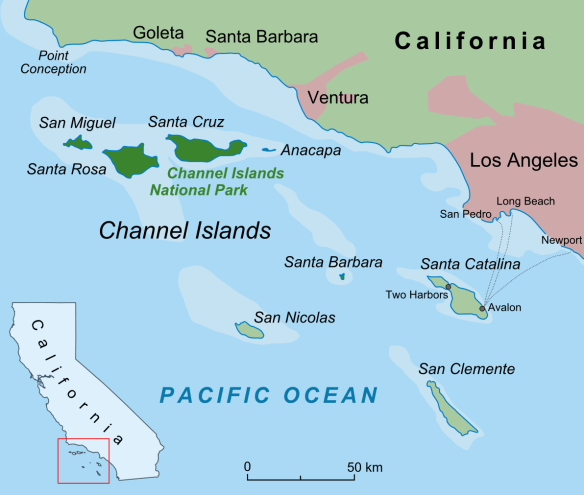
The Channel Islands

The Channel Islands

It also turned out that the island is under the jurisdiction of the United States Navy, which uses it for weapons research. The occupants of a fishing boat that attempted to land would probably be arrested. Some of the group still wanted to do it. “We’ll just tell them we’re old and we got lost,” said my friend Meg. Nope. Nope. Nope. Not going there. I reserve my feckless adventuring for my fiction writing.

I contacted my cousin Sally, who lives near Santa Barbara. Sally suggested contacting Dr. John Johnson, an anthropologist specializing in the Channel Island Indians. Dr. Johnson, a very kind and knowledgeable man, explained that there was an investigation underway to try to determine who (if any) were the legitimate descendants of the Nicoleños. And the organization in charge of the investigation? The U.S. Navy. I don’t have a whole lot of faith that the U.S. Navy feels any urgency about resolving this problem, but according to Dr. Johnson, there isn’t any alternative. Repatriated remains go to the Santa Barbara Museum of Natural History, where Dr. Johnson works. He assured me that there is a special area where these remains are kept until they can be interred in an appropriate manner and place. Yorick would stay in the museum until the Navy decided where he belonged.

Well, Santa Barbara was at least closer to San Nicholas Island than Yorick has been in more than half a century. I made an appointment with Dr. Johnson to turn Yorick over.

When my husband and I went to Santa Barbara, Dr. Johnson spent some time examining the skull, then said, “I think what we have here is actually Yoricka.” He believes that the skull was that of an older woman, not a young man, and showed us why he thought so. (Sorry, Mom. I think he’s right.) He asked me details about my grandfather and mother and I filled out some paperwork. Then it was time to say goodbye. On the way out of the museum, my husband turned to me and asked, “Feeling a little sad?”

I said, “Yes.” I wish I had taken a picture of Yorick before we left. After all, he–she–was a member of my family for 97 years. I wish I had known who you really were, Yorika. I hope you find your way back to your Island of the Blue Dolphins.

Everything Old Is New Again

This post is appropros of nothing at all. My husband, Tom, sends me emails with links to everything he thinks I will find interesting on the Internet. (Yes, this is a HUGE amount of stuff!)

One day, he sent me a link to “Creative and Innovative Packaging,” http://www.toxel.com/design/2014/01/09/creative-and-innovative-packaging/. Amid all the clever design ideas I found this photo for a brilliant new way to package that old standby, the match:

Matches Designed by Fitzsu

Matches Designed by Fitzsu


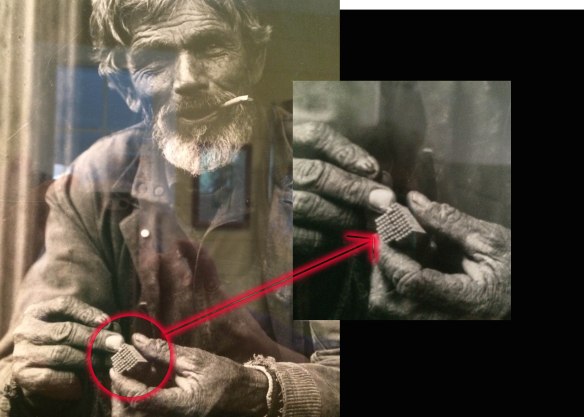
Clever, yes? Except that I possess a photograph taken sometime in the 1920’s by my great-uncle Lawrence Moore, of a ranch hand named Nacho at Muleshoe Ranch in Arizona, preparing to light his hand-rolled cigarette:

Nacho's matches.

Nacho’s matches.

Hmmm. Guess that hot new match design is…really old. Or–this could be PROOF of time travel!!!! Just like all those old photos of movie stars and war heroes using cell phones…except that Nacho’s matches happened to be real.

OK. Enough frivolity for today.

The Final Concept (Cover Art)

Well, the publisher has approved final cover art for “The Obsidian Mirror.” As you can see below, not too different from the last one. We still don’t have the blurbs, publisher’s logo, etc., but that’s out of my hands for now. I like this one!

Cover Art 2b

The Coyote Didn’t Cut It

Sometimes I have to shake myself to see if I am dreaming. I am fulfilling a lifelong ambition: writing and publishing a novel. It has been a daydream so long that I had given up on it—until I actually wrote a book.

But now, I am listed as an author on the publisher’s website. I am working on the graphics. I am working on the marketing. I should be working on final-editing the manuscript, but haven’t quite gotten there yet. (Tomorrow. I promise!) Sometimes I wonder if this is real, or just an extended daydream—but then my publisher asks me to do something else, and I’m sure these tasks were not part of my original roseate dream, so I am becoming more convinced that this will really happen.

And then I go back to being amazed.

Well, anyway, here’s a mockup of my latest cover design, front, back and spine. I haven’t gotten feedback from the publisher yet, but I kind of like it. But no man/coyote graphic. <Sniff><Sob> I am very attached to the shape-changing coyote, but he just isn’t working out too well as a cover. I am sure I’ll continue to use him, but perhaps not on the book cover. If you were kind enough to weigh in on the graphic, thanks. I agree with the majority that the original one is the best.

Cover Art 2a

How’s This Coyote? I’d Really Like Your Opinion.

Many of you were kind enough to comment on three different versions of Chaco: my supernatural character who can appear either as a ridiculously beautiful young man, or as a coyote. (But not just any coyote; he is Coyotl the Trickster).

My publisher had asked for a somewhat lighter feel to the image because the tone of the book overall is light. Chaco is (usually) a cheerful guy.

The vote was overwhelmingly in favor of my original, Chaco #1, with 10 votes, #2 got three votes, and #3 got two votes. I also favor the original.

However, my friend Erica Chase asked, “Is there a happier looking coyote?” I thought this was nothing short of brilliant (typical of Erica). So I went looking for a coyote whose expression was less threatening and more upbeat. And then tried to match the coyote with an image of a young man that more or less matched (or was at least complementary to) the coyote’s expression. The image below is the result, and if you would be so obliging, I’d like to know if you think this is an improvement. Or not. (To see the three images I posted for comment, please go to https://obsidianmirrorblog.wordpress.com/2013/12/13/vote-for-your-favorite-coyote/)

New Coyote/Chaco

New Coyote/Chaco