Rothenburg is distinguished from our other visits by being located well-inland, on a nice high point that was easier to defend. It was also distinguished because it was never bombed during WWII, sparing the historic buildings—they have not been meticulously recreated, as we saw in so many places, but beautifully preserved.
We traveled to Rothenburg via bus. (The bus driver is always the same. He travels from location to location with the bus, and I bet he beats us every time.) We traveled along what is called the Romantic Highway through lush pastoral land. We saw fields of sugar beets, cow corn (hard feed corn that they use for ethanol), wheat, mustard, and many crops I couldn’t identify.
A wheat filed along the Romantic Highway. The clouds here are gorgeous.
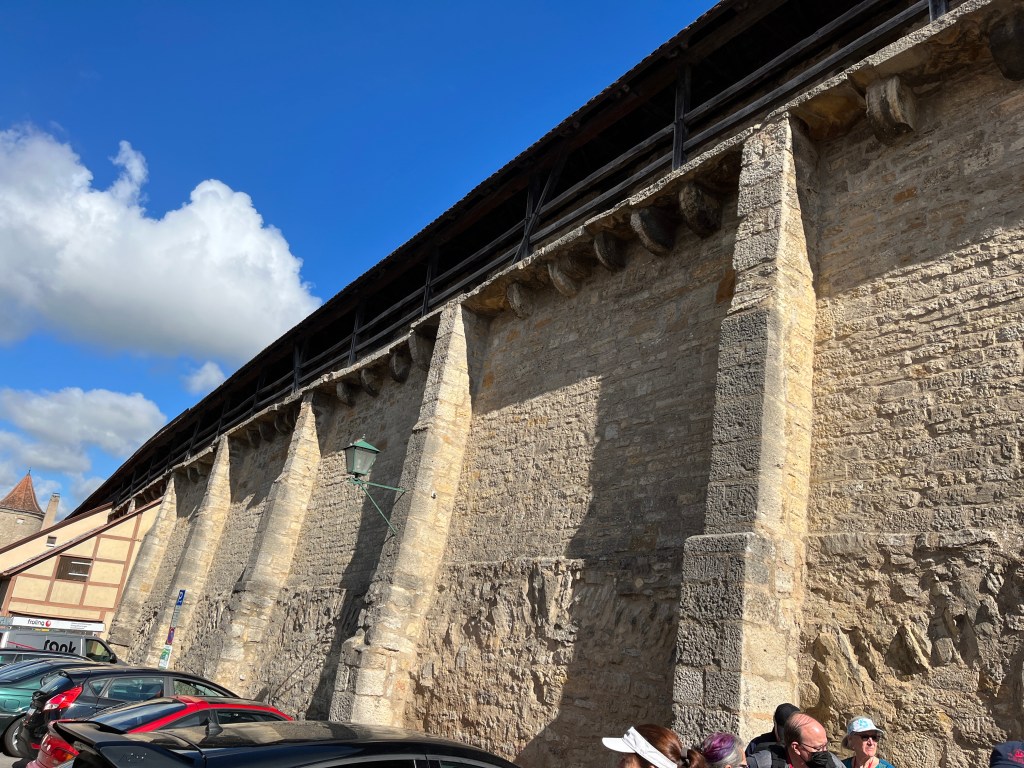
We wound our way through tiny villages until we came at last to the ramparts of Rothenburg, which completely enclose the town, as they did in Medieval times and earlier.
The Medieval ramparts of Rothenburg. The ramparts have a roof and 6ou can walk all around the town under it. Tom and I didn’t do that part of the tour.
Rothenburg is extremely quaint and charming, with elaborate half-timbered houses, an old cathedral, many town wells, and narrow, cobbled streets. It is also a tourist attraction, and not just for foreign visitors. The language I heard spoken most frequently by the visitors walking by was German.
Town gate, looking toward the town from the site of the original castle.
Our guide, Harry, also added to my understanding of the stumblestones. He emphasized they are not only to commemorate the Jews, but anyone who was murdered by the Nazis, including Romany (Gypsies), the mentally retarded, people with disabilities, gays, and anyone else the Nazis deemed unworthy to live. Lesson taken. Odd that they are called stumblestones, as they are actually brass plaques that are far flatter and less likely to cause a stumble than the cobbles surrounding them.
There are storks nesting on the rooftops here—the first I have seen! Just like in the fairytales.
A real, live stork. Sadly, I only got this shot of his or her butt as he or she bent to feed the babies.
He took us by the Museum of Crime, which is evidently the largest museum anywhere dedicated to the subject of crime and punishment. It is also called the torture museum. Nuh-uh.
It is probably extremely expensive to live in Rothenburg. There are very strict laws regarding the appearance of the buildings. All the roofs are required to be covered with red clay “beaver tail” tiles. All the windows must have wooden frames. Skylights are verboten. However, I did notice glass tiles the same shape and size as the ceramic beavertail tiles on several buildings, obviously letting light through to the upper stories. So people, as always, find workarounds.
A gorgeous house in Rothenburg. You can see the beavertail tiles.
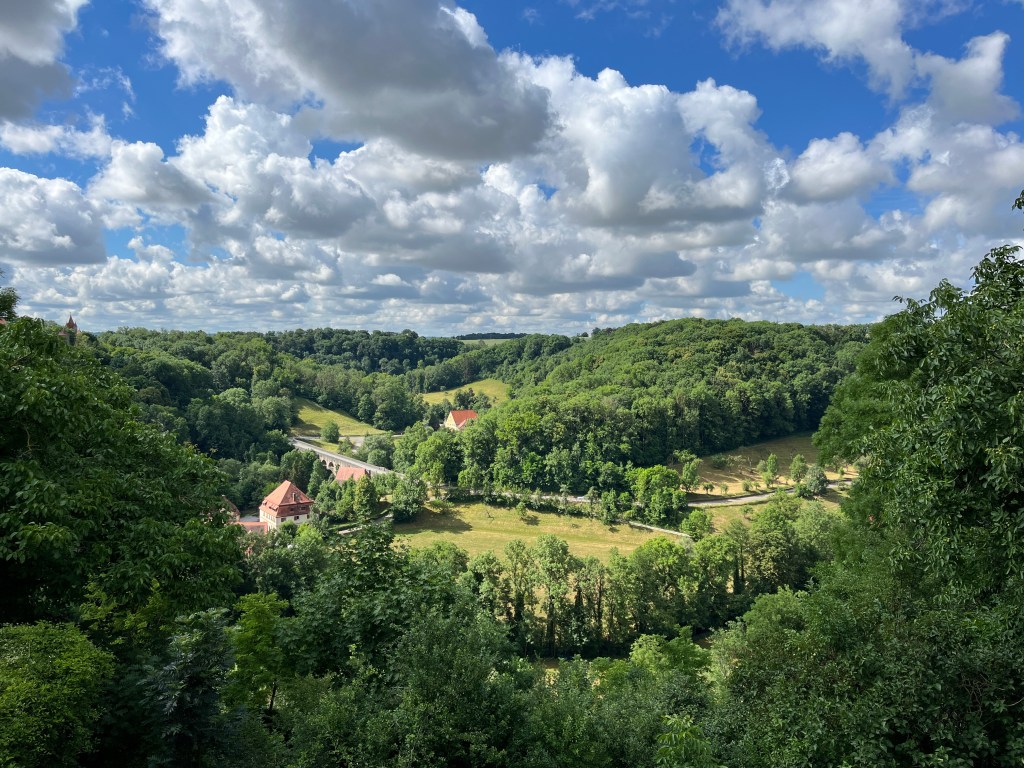
The first castle/fortification in Rothenberg was built around 1100 C.E. on a spur of rock that projects above the surrounding lush valley of the Tauber River. Little remains of the original structure but a small chapel. The former castle is now a pretty garden that command views of the Tauber River valley and orchards below. Mature trees provide much-appreciated shade, and there is a lavender garden, a small fountain, flowers, and stone benches where you can sit and admire the spectacular view. We saw a pair of storks flying overhead, but by the time I got my camera phone out, they had flown away.
A fountain in the garden that now reigns over the site of the original castle. Very peaceful, and the goldfish in the picture seemed suspended motionless in time.One of the many spectacular views from the garden.
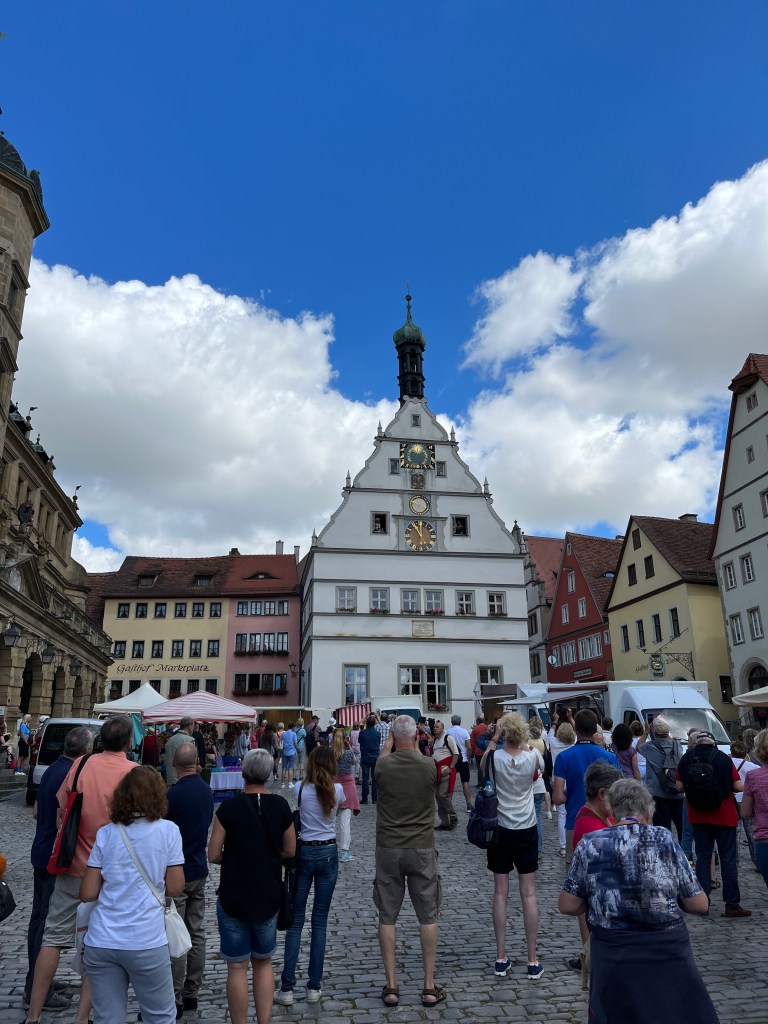
We actually had free time in Rothenburg to wander around guideless, shop, and sample the local cuisine. Tom and I stopped at a bakery for water, and I purchased a “snowball,” which is a large sphere of what appears to be curls of cookie dough held together by various things in different flavors. I selected a dark chocolate snowball—I guess the snow was dirty. It was absolutely delicious, with a crisp, light texture and not too sweet. We devoured it. We visited the castle-turned-garden next, then wandered back to the marktplatz in the town center. The Rathaus, or city hall, in the center has a tall clock tower. When the clock rings the hour, two windows open to either side and automated figures appear, drink beer from steins while the bells chime, then retire behind the windows again.
The clock tower. Everyone pauses on the hour to watch the automatons drink their beer.
We met up with our friends in the marktplatz and decided to try to find a restaurant for lunch that Harry the guide suggested. We did not find it, but we did happen upon a sandwich restaurant that served Mexican Jarritos, Cubano sandwiches, and other exotic fare of the New World. It was not what we were looking for, but we needed to stop for lunch and several men outside the establishment assured us the sandwiches were good. They were VERY good! We ate outside on the cobbles under umbrellas as children dashed in and out of the restaurant. It was a family establishment. The chef was from Puerto Rico, and his wife, a German, handled the front of the restaurant. I think the family lived in the same building, and their kids played on the sidewalk.
I broke away from the group to do some gift shopping and found things for four on my list. This was a godsend—there is usually no time to shop. Being a tourist Mecca, there were many unusual shops and interesting merchandise. And the famous Christmas store was in Rothenburg—as well as every other town we have visited. Linda caved in and bought a large bag full of Christmas cheer.
You just can’t get away from the famous Christmas store.
On the way back, the bus took the super highway instead of the Romantic Highway. In addition to the fields full of growing things, we also saw large fields of solar panels. Germany also uses wind power, but they shut down all their nuclear reactors after Fukushima—a move that with the Russian invasion of Ukraine and subsequent sanctions, proved to be a mistake.
We docked at Würzburg, where there is a royal palace that rivals Versailles. I was feeling a bit worn down, not having slept well the night before. I also realized I was getting a bit snappish, which is a sign I am tired, and it isn’t very nice for other people. So I stayed on board, blogging and reading a trashy novel.
Tom contacted me from the town when they returned from admiring what sounds like a truly amazing palace, complete with Tiepolo frescoed ceilings and amazing three-dimensional plaster work. I did not regret my choice. All palaces are different—and they are all weirdly alike, the obscene excrescences of a previous generation’s multi-billionaires who spent their money indulging their lust for self-aggrandizement and power instead of, say, feeding people. Their only redeeming value is their patronage of the arts, and I am glad these monstrous monuments to ego are now available for the commoners to enjoy.
So I walked as instructed to a large bridge, met Tom, and met up with our friends. Würzburg is a modern city with many older buildings and an huge cathedral. For how I feel about huge cathedrals, please see my remarks on palaces. However, this cathedral was rather interesting. The bones of the building are Romanesque, with Roman arches built in alternating red and white stones, giving it that distinctive look. Inside, the bones are clean, but the apse has been elaborate statues of popes and saints facing the austere columns. Many of the windows must have been shattered during WWII, and have been replaced with clear glass in modern designs. Two altars to either side of the sanctuary feature overwrought and gilded altar displays in the baroque style. Interspersed between the more Renaissance and Baroque works are several modern statues. The sanctuary light is housed in an abstract, towering sculpture.
Smaller chapels to either side feature gothic arches and what looks like original stained glass. And at the foot of the main aisle stands a monumental menorah. It is an altogether unique cathedral that reflects the ages it has endured.
And that is all I really remember of Würzburg—except for a delicious tomato and cheese sandwich in a perfectly delicious roll baked with many different seeds and saffron. The bread in Europe is not just something to hold your sandwich together, it adds to the pleasure of the meal.
So I will share some photos I think are interesting that I haven’t shared before. Enjoy.
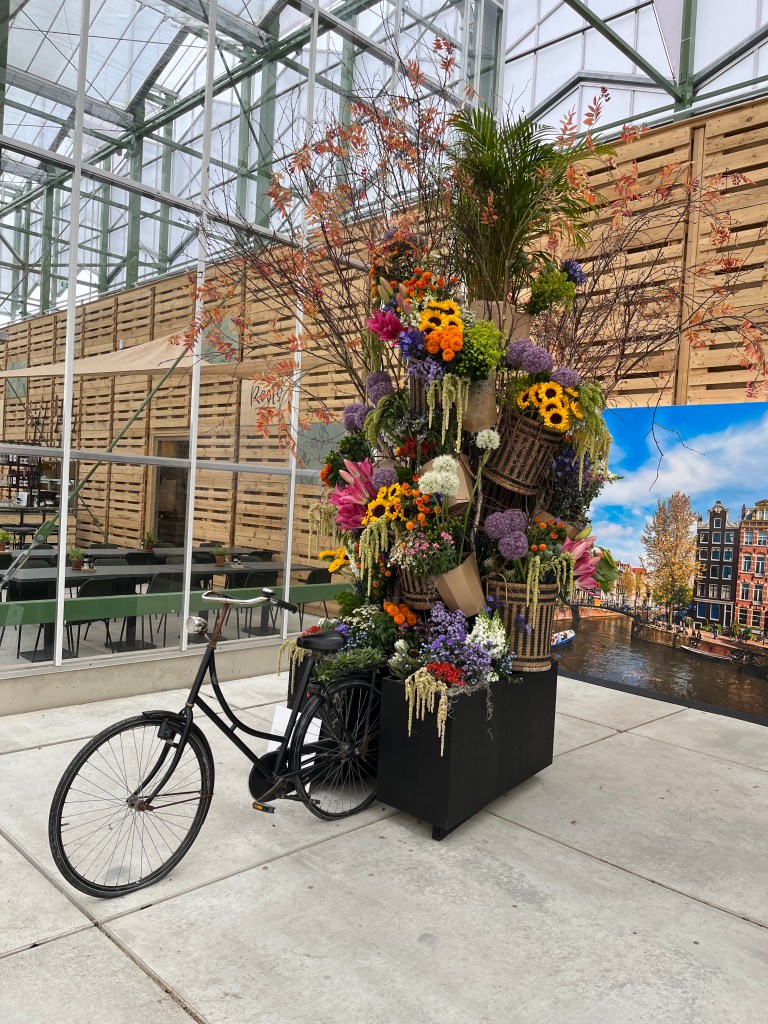
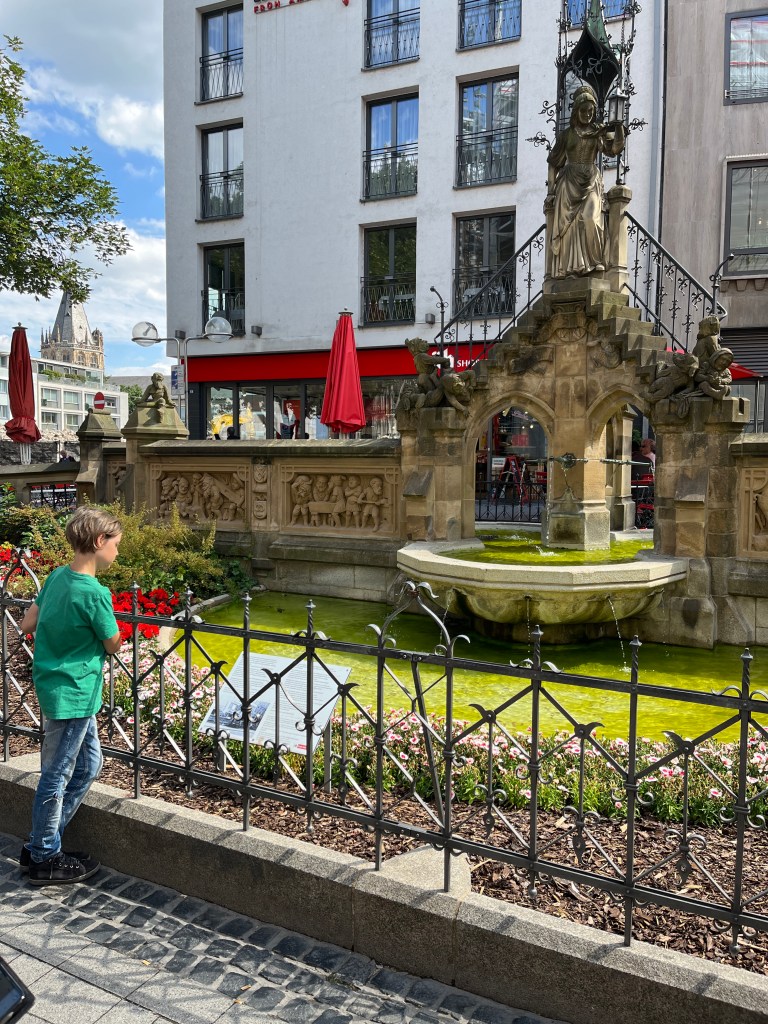
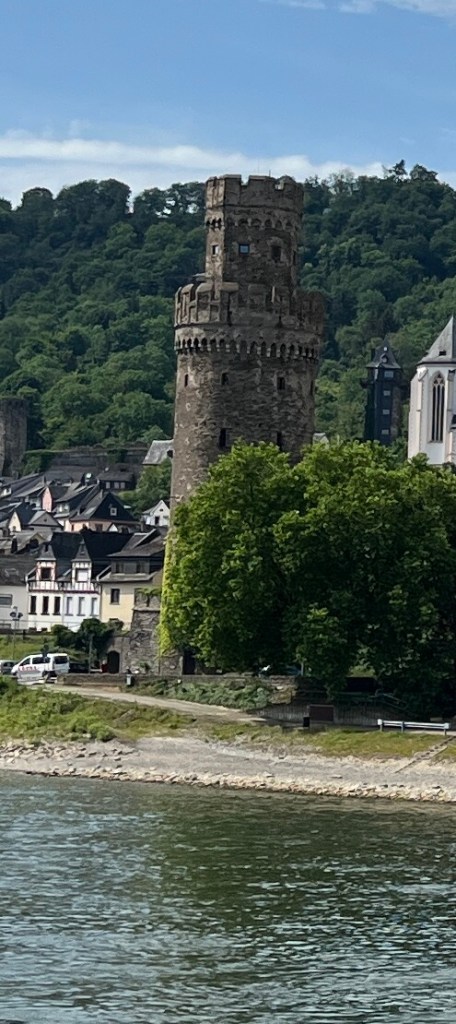
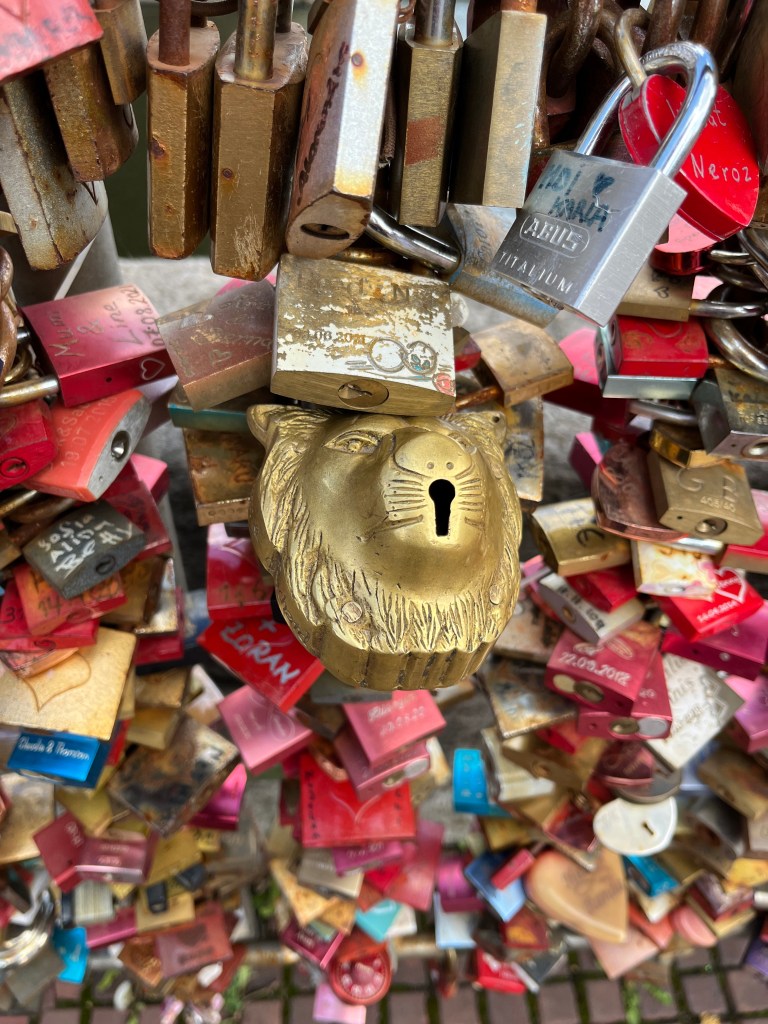
Woven nsragon feom the T@iland exhibition at the Floriade.Floriade exhibit.Lovelocks on a bridge in Cologne. The idea is the lovers turn the key in the lock to secure undying love and then throw the key in the river below. The river must be crowded with keys. I have no idea how much these things must weigh.Interior shot, Cologne Cathedral.Gigantic hilltop fort in Würzburg, the capital of Lower Franconia. Which is actually upper Bavaria. Red sandstone carving on the side of an old house in Rothenburg. It says, “Fool, do not gossip about the ladies and gentlemen.”There are wildflowers everywhere. I love the red poppies. These were in the Netherlands.The “Dwarf Well” in Cologne. It depicts a fairy tale very similar to the shoemaker and the elves. The well in each town closest to the church was considered to have the purest water. This well is outside the cathedral, but I wouldn’t recommend drinking from it.One of the many hilltop castles along the Rhine.
This morning, we were moored at Wertheim, a village on the Main that had not been destroyed in WWII and still has its 16th Century buildings intact. The temperature was supposed to be in the high 80s, which sounded dreadful, but wasn’t too bad. For one thing, the town was right there, a few minutes’ walk from the river. For another, the excursion was shorter. For another, there was always shade somewhere, and there were an abundance of chairs for the footsore—something other towns were distinctly short of.
There was an enormous castle on the hill above the town—second only to Heidelberg in size according to our guide, Elke. There were two guides, but I gravitated to Elke because she was wearing a pretty dirndl. Why not? I learned later that her “real” job is as a nurse, and she does guiding as a refreshing change.
The leaning tower of Wertheim. We resisted any urge to pose with it as though we were holding it up.
There was a strange leaning tower at the entrance to the town. It had once been part of the town ramparts, but stands by itself now. The lower half was built of stone with 7-foot-thick walls, and this is the leaning part. The top, a later addition, attempted to correct the leaning. it was once called “the hall of fear” because it was used as a jail. The interior was cramped because of the thick walls. It was completely dark, cold, and damp. They would lower prisoners into the tower on a rope, and that was that, I guess.
The old town is very quaint, with narrow, tall, half-timbered buildings. The bakery was built in the 1600s and is still a bakery. The baker is the 13th generation of bakers. He gave us a pretzel demonstration as part of the excursion . More on that later. It seemed many of the buildings still serve their original purposes, judging by the symbols on the fronts of the buildings. It’s a very pretty place, with flower boxes and cafes, and ancient buildings.
There are still remnants of the old town ramparts. This gate to the old town is now part of a hotel.
Elke gave us a brief history of the town, including the sending of Jews to concentration camps. One of the houses now memorializes the Jews, and is decorated with suns, stars, the Star of David, a cross, and the word shalom. In the cobbles in front of the house are some brass stumblestones with the names of the residents. Elke told us that in 1972, the town’s mayor tracked down as many of the surviving Jewish residents as he could and invited them back for a reconciliation ceremony and apology from what was done to them.
The memorial to Wertheim’s vanished Jewish population.The “stumblestones” memorializing the Jews who lived in the house above.
The town’s church started as a Catholic Church, but was later converted to Lutheran. Because it was the only church in town, Catholic residents also attended, and they and the the Lutherans had separate entrances for a while until it became just Lutheran again, presumably because there weren’t enough Catholics left.
Outside a striking blue and white half-timbered house stands a fairly appalling— but large—bright blue plastic statue of a dwarf, intended to symbolize the optimism of Wertheim. Um, OK.
The optimistic, if ugly, dwarf statue in front of the beautiful blue and White House where glassmakers lived. Maybe they still do—there’s a glass blower’s shop a few yards away.Two houses in Wertheim leaning toward each other like old friends.My beloved.
One group went off to walk in the vineyards while the rest of us wandered around town. Then we met up by bus for a wine tasting and pretzel making demonstration. The wine tasting was more like four large glasses of different wines. I liked the sparkling wine and the Riesling the best.
The baker of 13 generations gave a pretzel demonstration. He had a lot of mildly naughty jokes—quite the fellow. If anyone asked a question he liked, they were gifted with many pretzels. I asked why they were dipped in lye before being salted and baked. He said he asked his father, who had asked his father, and no one knew. Then he said he discovered that 200 years ago, a pretzel accidentally fell into a cleaning bucket with lye water in it, and the baker used it anyway. It turned out crisp, brown, and different from the others and has been the custom ever since. I am not sure I believe this tale, but I got four enormous pretzels for asking. We headed back to the boat full of wine and pretzels and ate lunch as the boat took off again.
At the winery, which has a long and complicated German name that I didn’t record. On the left, in the white coat, our merry pretzel-maker. On the left in the pretty dirndl, our guide, Elke.Me with my prize pretzels for asking about why food might be dipped in poison to make it delicious.
Back at the River Duchess, Captain Ronny gave a presentation on nautical matters, starting with how he became a captain. I found his story really different and fascinating. He was born on a cargo boat that his parents operated out of Rotterdam. At the age of five, he attended floating kindergartens that were set up for the children of such maritime families. But he had to attend boarding schools as an older child. At the age of 16 he returned home (his parents had a larger cargo boat by that time) and worked with his parents until he attended navigational school. After graduating, he worked on different cargo ships but basically had no social life until he married a Swedish woman and moved to Sweden to start a family.
He started a ship maintenance businessin Sweden, but apparently neither the business nor the marriage prospered, so he went back to cargo boats, first hauling fuels, then chemicals. One day he was docked somewhere and the cargo exploded while he was in the wheelhouse. He took this as a sign to do something different, and started working for Uniworld. It took him some time to learn how to maneuver the river boats because instead of the standard propellers and tiller, they have propellers and bow thrusters, which allow for the precise navigation that makes for a trip that doesn’t spill the guests’ drinks. It is a very smooth trip, I must say.
He also presented a lot of info about the River Duchess (where he has worked for seven years). I will skip over the tonnage and draft and so forth. From the appearance of the boat, we thought it was pretty new, but it was built in 2003. Turns out they spend the winter months refurbishing the boat, which accounts for its pristine appearance. Uniworld didn’t lay off any staff during the pandemic, accounting for very low turnover. Respect!
Susan’s birthday dinner. Lovely food and wine! The best company.Alex (left, in the butler gear) and Todor, the dining room manager, served our private dinner.
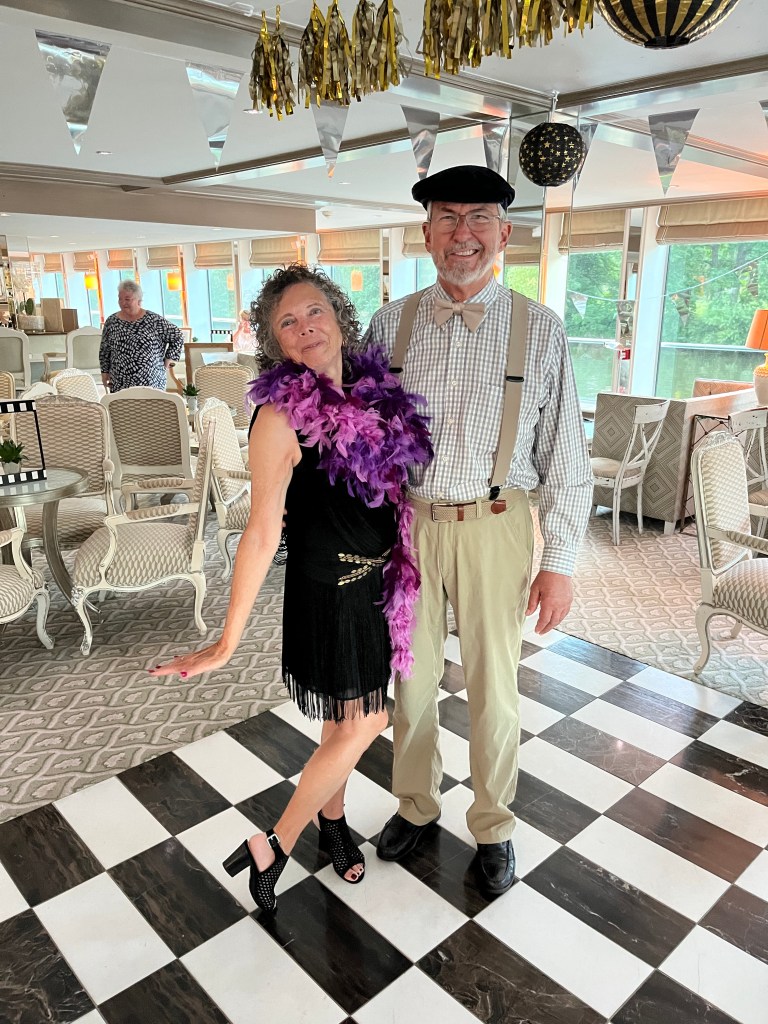
This evening, we had a private dinner for Susan’s birthday, and I wish I could have eaten it all, but I couldn’t. There’s a Roaring Twenties party in the lounge tonight, and Susan and David dressed for it. Don’t they look wonderful?
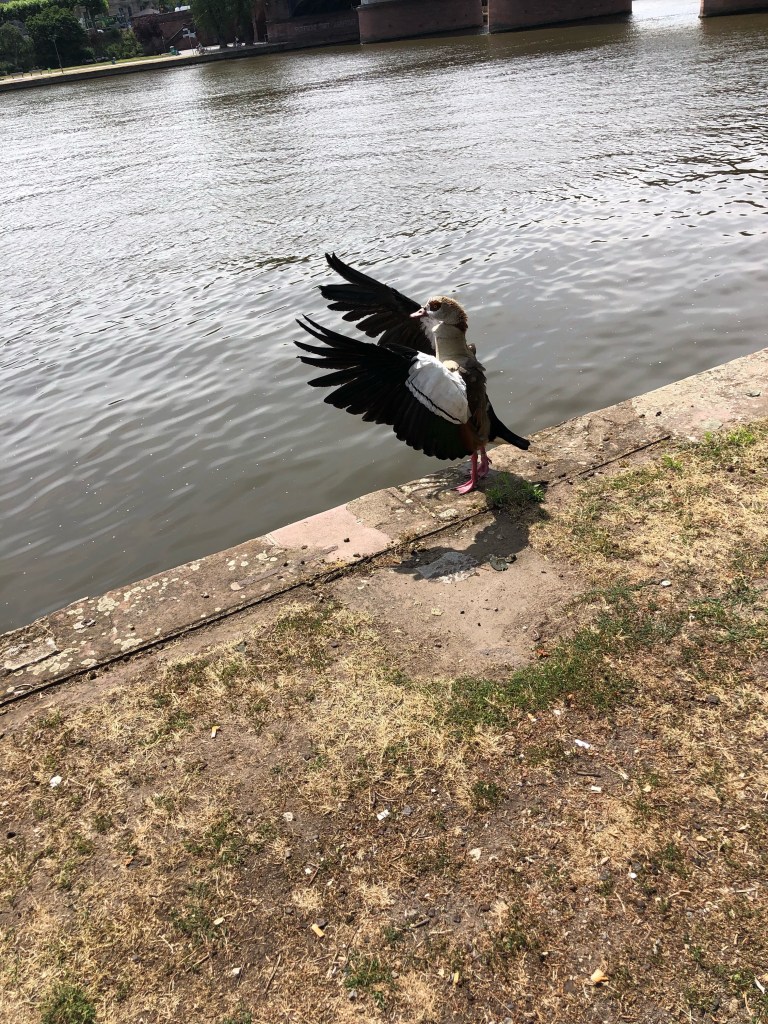
When we awoke today, we were in Frankfort, and traveling on the Main River ( pronounced “mine”). This morning at breakfast, we were observing some sort of waterfowl that lives in abundance by the side of the river. We couldn’t decide if they were ducks or geese. They seemed too big to be ducks, but their necks weren’t as long as the Canada geese we are accustomed to seeing, and they are on the small side for geese. After we returned, I compared some photos Tom took to an online cache of German waterfowl and solved the mystery. They are greylag geese, a species I have read about but never seen before. They seem largely unperturbed by humans.
Graylag goose, apparently conducting an invisible orchestra.
The majority of the passengers opted for a tour of Heidelberg Castle, which involved an hour-long bus ride. I am looking forward to hearing about their adventures, but Tom and I opted for a walking tour of Frankfort. All of us were elderly and in terrible shape except for Tom, who viewed the excursion as barely a short walk.
It was 80 degrees or so, but Tom tells me he barely broke a sweat. Annoying, of course, but I am glad he’s in such good shape. I left my hiking sticks behind and I was glad I did. I had no problem with the terrain, and they are such a nuisance. When I use them, if I want to take a photo, I have to put the sticks aside, find my phone, take the picture (assuming whatever it wasI wanted to photograph is still there by that time), replace the phone, pick up the sticks, and hope I haven’t tangled the earphone cord that attaches to the receiver we wear so we can hear the guide. But I was extremely glad I used them yesterday in hilly Rudesheim!
Our guide, whose name sounded like Shannon, so I will call her Shannon, took us along the river front for a while, explaining the history. Then we visited the old town. Apparently, all the ancient half-timbered buildings were flattened during WWII, with the exception of a single house. The others were lovingly restored and look exactly the same, but presumably with better plumbing.
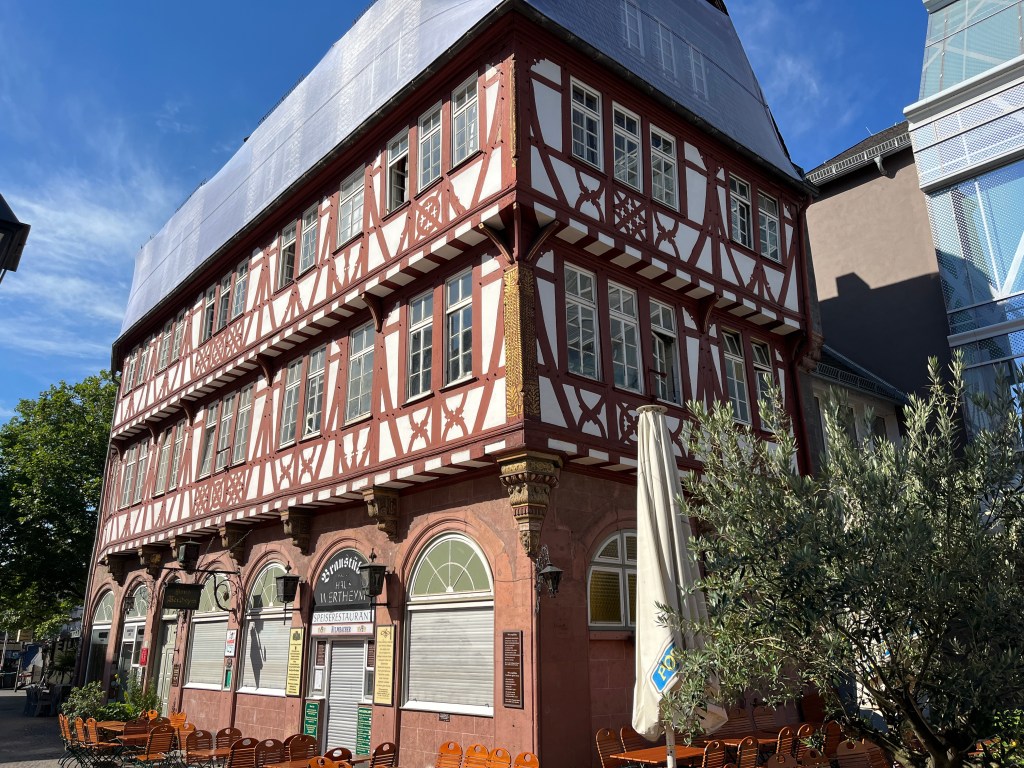
The sole remaining original half-timbered house in Frankfurt’s old town.Shannon told us a rather confusing story about its role in WWII, involving tanks in this building, tunnels underneath the street, and rich people escaping from the other houses on the square, but I found the story somewhat dubious.
Shannon took us to a place that served the local specialty—frankfurter sausages, of course, with potatoes and green sauce. I liked the green sauce, which uses local herbs that differ depending on where you are. The frankfurter tasted exactly like a hot dog to me, despite Shannon’s protestations that they were much more flavorful and juicier. Not impressed.
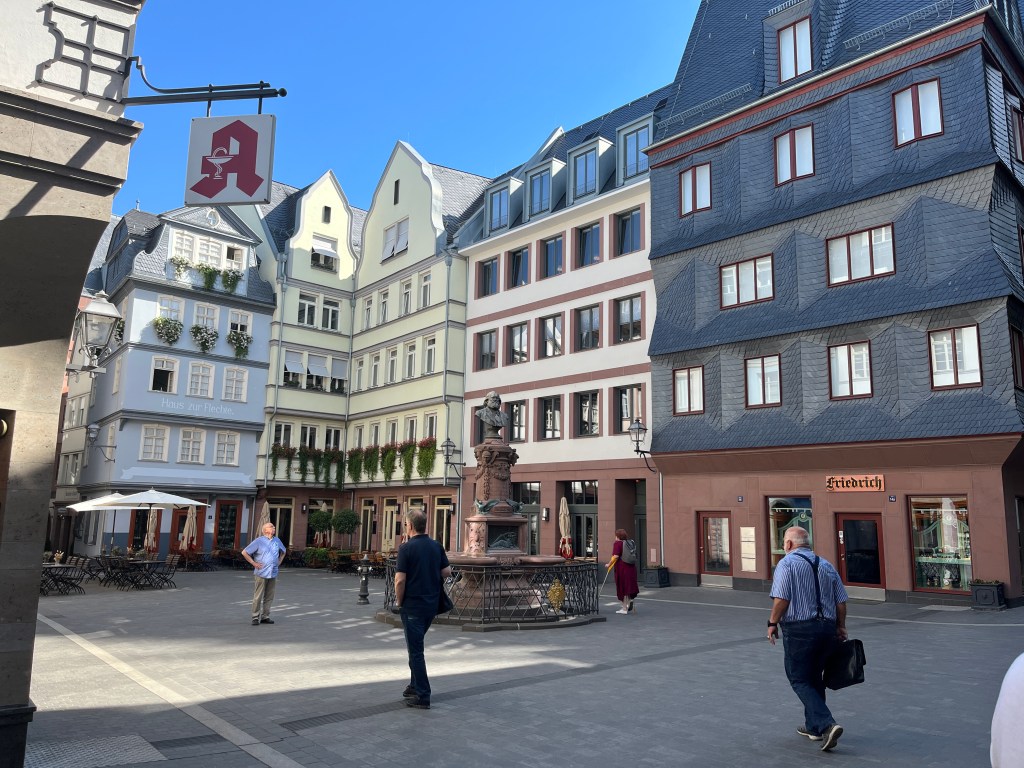
I love the way they fit the slate tiles together. It looks like dragon skin.The square where we ate frankfurters.
We ate on a square that included the Streuwelpeter (Slovenly Peter) Museum and store. Streuwelpeter was an illustrated book written during the 19th Century to instruct and entertain children. Shannon says they still teach this and it tells children how to behave properly. I have read it, and it includes:
• A story about a little boy who sucked his thumbs until the great, long-legged scissor-man came and cut them off.
• A story about a boy who ate too many sweets, went out in the rain and melted.
• A story about a little girl who played with matches and burned herself up, making her two kittens weep.
• A story about a little boy who was always looking up at the sky and fell into the water and drowned.
You get the idea. Shannon seemed to feel these were instructive and positive guidelines for the children of today.
However, she was most solicitous of her ancient followers and allowed us time to sit and rest, for which I was grateful. Tom, of course, did not take advantage of these rest breaks.
After a few more visits to quaint things our guide liked, she bade us farewell and several of us visited a nearby toilet. Half a Euro to pee.
Then Tom and I took off to find an ATM and a SIM card. It turned out that the phone store didn’t take credit cards, unlike every other store in Europe, so it was a good thing we found the ATM first. Tom is happy with his new, strong connectivity. My goal was to visit the Steiff store I spotted back at the square where we sampled the frankfurters. I wanted to buy a tiny mouse I saw at the famous Christmas store in Rudesheim. I had faint hope that it would be less expensive, and sure enough, it was the exact same price. But I bought it for our new little granddaughter Mirabel. Because.
Shannon was upset because the construction spoiled the beauty of the old square. We still enjoyed it.
Then we went back to the boat, had lovely broiled salmon for lunch, and we are sitting in the lounge watching the boat go through a lock. It’s a lengthy process, and I have never seen it before. We have gone through locks on this trip, but I am usually sound asleep.
Tonight, we are celebrating Susan’s birthday with a private dinner in the Captain’s dining room. (He doesn’t actually eat there, of course.) I hope it will be a very special occasion!
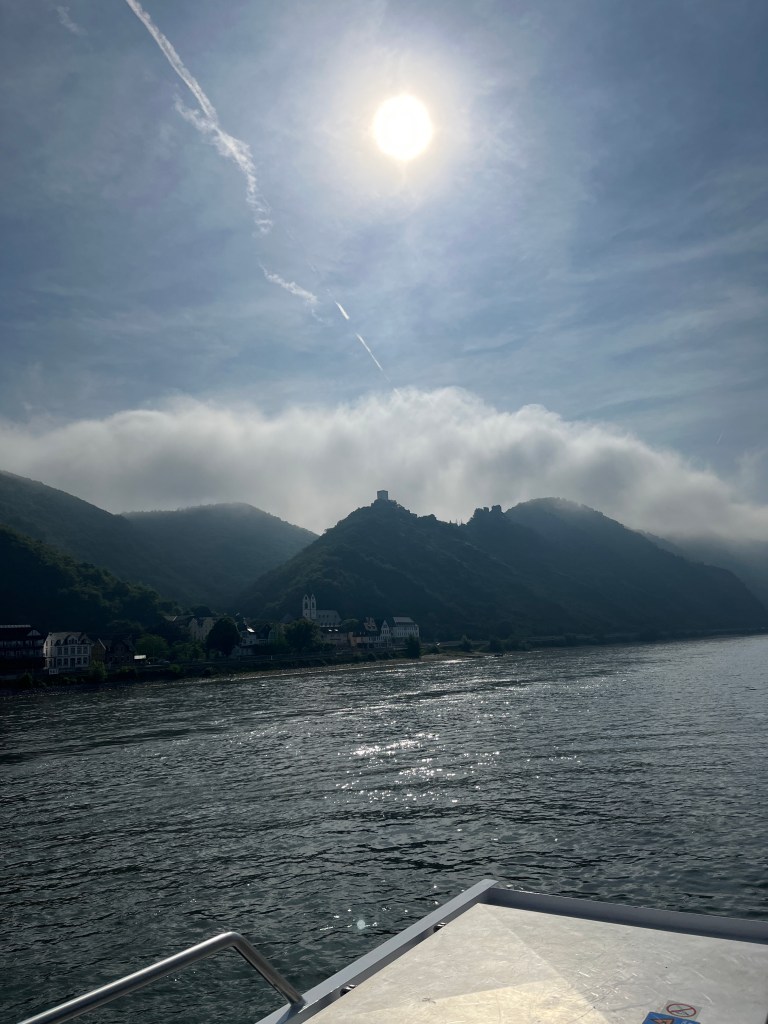
There are two castles in this photo. Can you find them?
This morning, we woke to the picturesque Rhine Valley, dotted with ancient castles that look like movie sets or etchings from some other century. It was cold on the sun deck, but we didn’t want to miss the beauty of this area.
A castle on the Rhine. It looks well-restored and lived in.
The sandy shores and flatter lands of yesterday have given way to rocks and steep cliffs. In many places, vineyards cling to the cliff sides at an angle that defies belief. The vineyards are all worked by hand and I do not know how they do it. Vineyard work is hard enough on level ground. We were told that the Rhîne reflects light onto the vines,which increases their sweetness. The wine is the famous Riesling produced here. Beer is less favored than wine in this region. We passed by tiny town after tiny town, most with half-timbered buildings, a castle or two, and churches ringing the hour—we could hear the bells clearly from the boat.
Alex, our butler, performed a sabering ceremony. He took a pretty but dull saber and uncorked it by swiftly hitting the rim of the bottle with it. The cork had been tied to his wrist so that it didn’t fly into the river. Then we all had champagne and watched the castles go by. Many were ruined, but some have been at least partially restored. Apparently, there was a Bavarian king whose hobby was collecting and restoring medieval castles. Nice hobby if you can afford it.
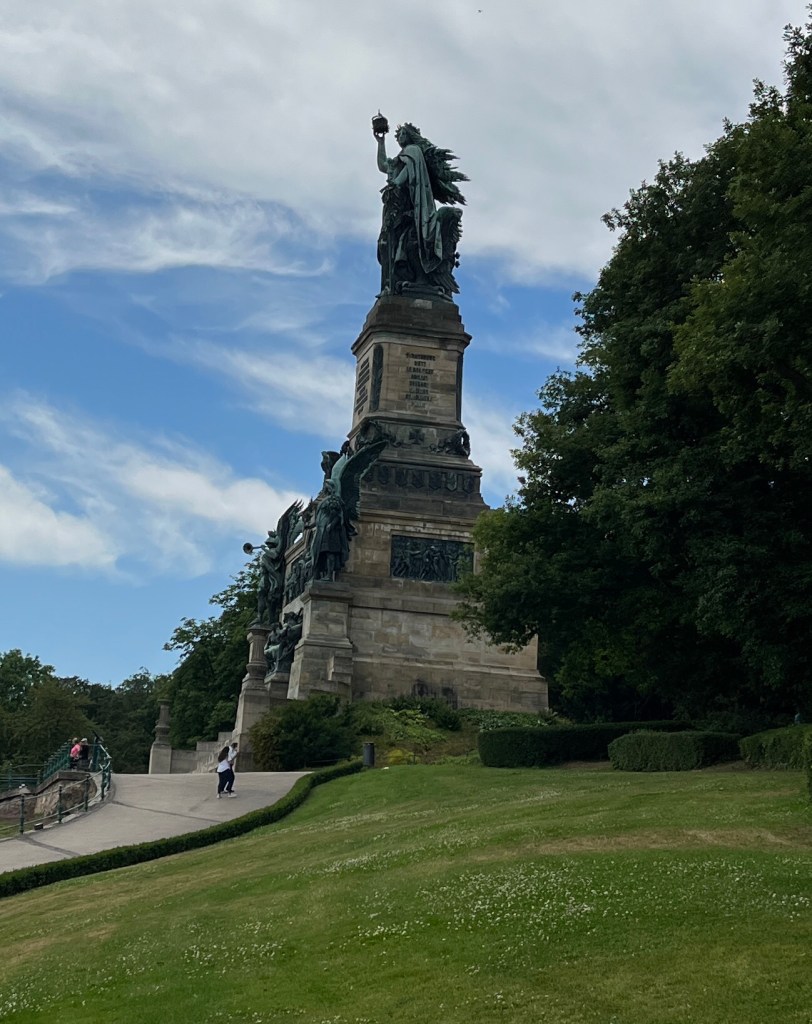
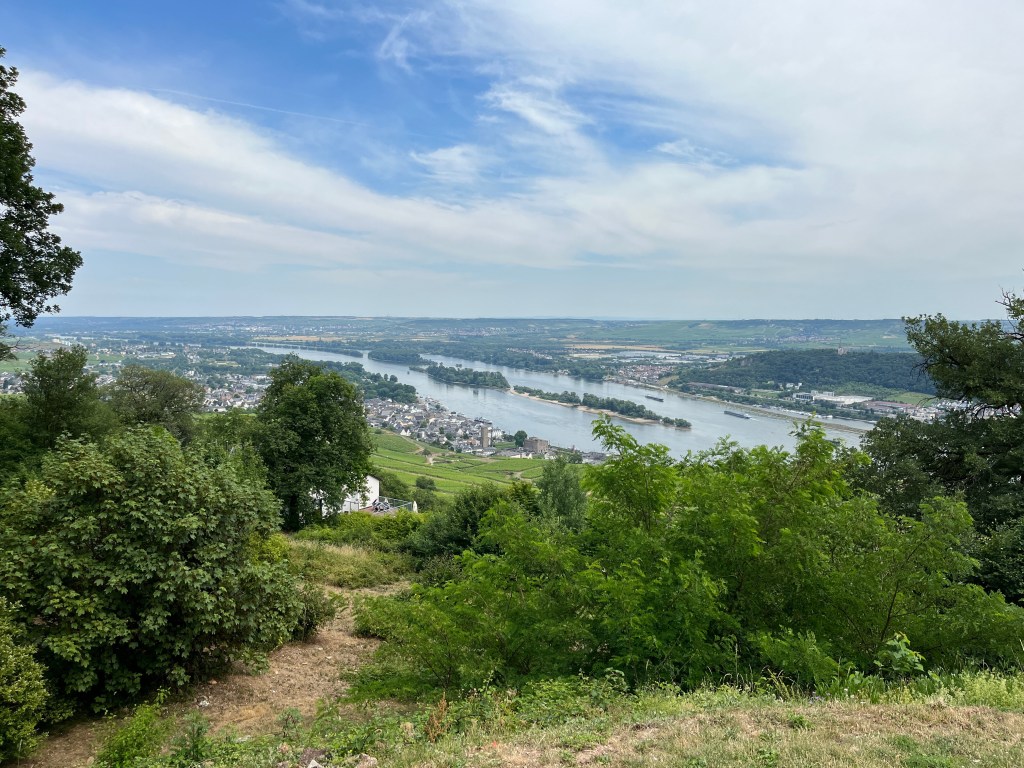
Our destination today was Rudesheim, a small town that had been half destroyed by accident during WWII. They rebuilt the ruined church from the rubble, replicating the original exactly. In the US, it would have been bulldozed and a modern church would have been built in its stead. Rudesheim has some cute, narrow, cobbled streets, wine gardens, a famous Christmas shop, and a lot of tourist traps. We took a cable car (or suspended gondola) up to the Niederwald Monument above the town. Tom elected to walk, but he wasn’t waiting for us this time. It took him another ten minutes or so after we arrived. The monument has amazing views of the river valley and the vineyards that march up the hills in back of town. The monument itself is a typical piece of nationalistic art celebrating the unification of Germany after the Franco-Prussian War.
Niederwald Monument.The view from the Niederwald Monument. The island or sandbanks in the river are bird sanctuaries.Cute half-timbered building in Rudesheim.
In the river below, we could see long sand banks with trees growing on them. These are now bird sanctuaries. They are a fair distance from the boat, but I could see a lot of birds from our stateroom. The swans were big enough that I could identify them.
I can’t get rid of this photo so you get to enjoy it twice.
As Tom began walking back from the monument, the rest of us took the cable car down. It was a quiet, peaceful experience, passing over the vineyards. We went into the famous Christmas store, but as we already have more Christmas decorations than we actually put up and the prices were astronomical, I opted to go back to the boat. On the way, I found an inexpensive, warm wrap to supplement my wardrobe, which was entirely inadequate for the chilly mornings around here. Now watch it never get cold again on this trip!
Tom’s route up from the town to the monument through the vineyards.
Sailing out of Amsterdam along a canal, once we left the city, the countryside looked exactly like Dutch landscape paintings. The canals are lined with poplar trees. Beyond the trees, there were rich pastures with happy-looking cows and sheep, and small towns with pretty houses.
Before long, we entered the Rhine River through a lock. The artificial banks disappeared to be replaced by sandy beaches, most of which were unoccupied in the bright evening light. Mile upon mile of empty beaches, punctuated occasionally by a small town. I did see one fellow fishing from the beach, and later spotted a family picnicking on the sand.
We sailed all night. This is a lovely way to travel. The boat is quiet and remarkably stable. The slight rocking is soothing, and I slept through the night without waking.
In the morning, we were in Germany. No muss. No fuss. No dragging my bags across an airport. No customs or lines to wait in. No security demanding that we take our shoes off.
We had no excursions until we reached our destination for today, Cologne (Köln). So breakfast was leisurely. I went to the lounge afterwards and was greeted by Tobor (yes, that is his name) with a cup of hot chocolate with brandy in it. This seemed very civilized, so I accepted it. The buffet for breakfast and lunch offers everything anyone could possibly want, and then some, all well-prepared—even the steam table dishes. But you can get custom omelets and eggs.
We watched them dock the boat in Cologne—a lengthy process. The sailors didn’t wear gloves to handle the long cables and ropes involved. They must have palms of steel by this time.
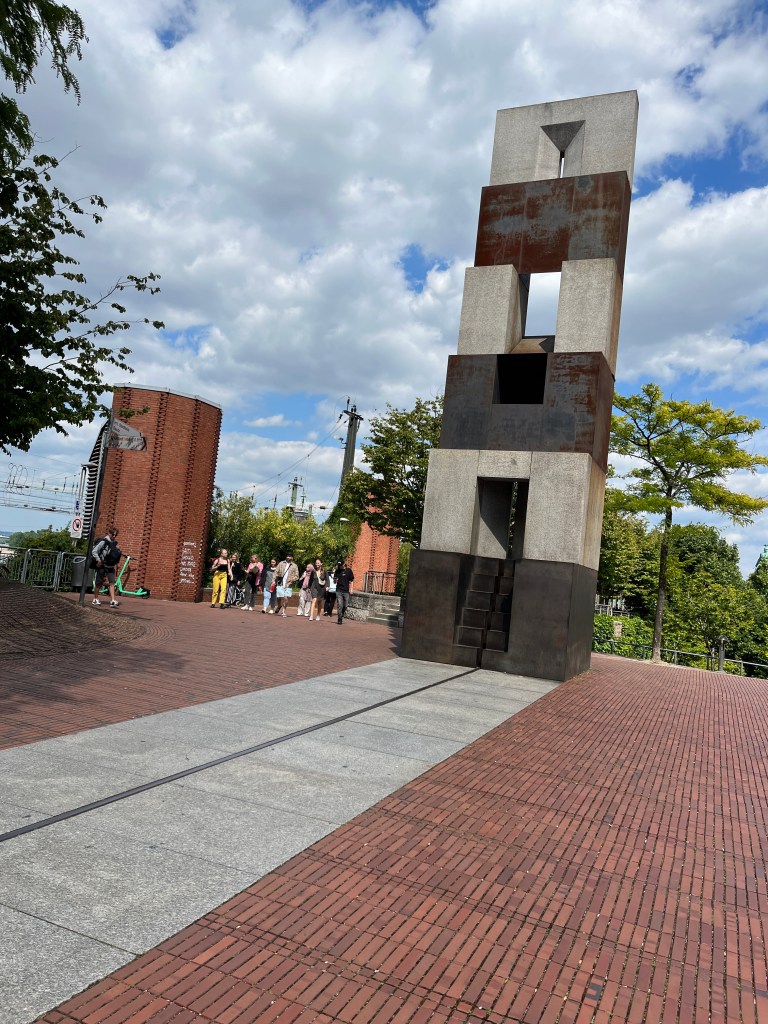
Our guide, who was quite funny, walked us to the cathedral, talking about the local history, the beer, the town’s rivalry with Dusseldorf, the local goodies, etc. He spent far more time talking about how the town recognizes its role in the Holocaust and the demise of the town’s Jewish population. There are brass markers called stumblestones fixed in the street outside houses where on e lived people who were taken away by the Nazis, with the names of the deceased. The brick plaza outside and above the philharmonic hall is paved with 6 million bricks in remembrance of the Jews, and through it runs a single rail headed east, the direction of the concentration camps, which ends at a sculpture of a smokestack. They have guards to keep people from walking over the bricks during performances because the architect designed it such that people in the hall below can hear footsteps above—because the dead can still hear us. I am impressed that Germany doesn’t whitewash its past, but instead has tried to remind us so that it will never happen again.
The plaza of 6 million bricks of remembrance.
The cathedral at Cologne is amazing. It was built of white limestone. Industrial pollution has chemically changed it so that it appears covered in soot. Our guide explained that it cannot be cleaned. They have stonemasons working full time replicating every inch in new white limestone to replace the old. Some parts gleam white in contrast to the filthy-looking old stone. I am amazed that they are doing this, and I think being a stonemason here is a job guaranteed for life.
The rail leading to the east and the smokestacks of the concentration camps.
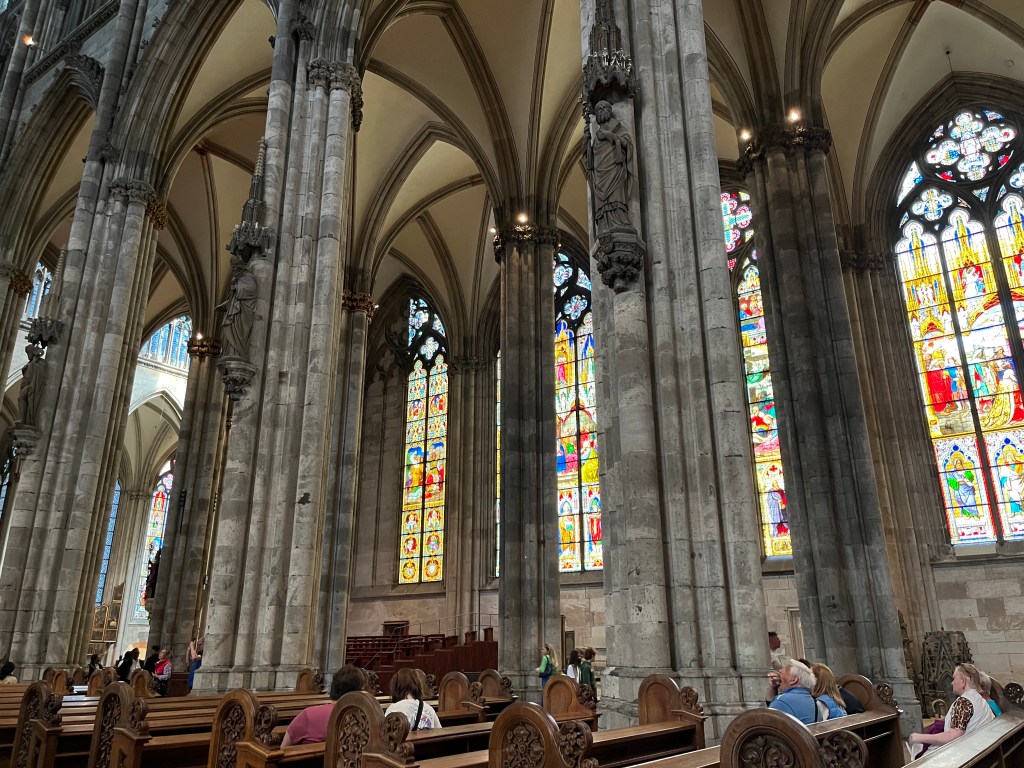
The carvings and traceries of the cathedral are breathtakingly delicate and intricate. You could look at it for a lifetime and never run out of something new to see. Taking photos was kind of useless—there is too much to see and most of it too far away to photograph with a phone camera. The interior is classically gothic, with soaring arches and brilliant stained glass windows.
Cathedral of Cologne main aisle.Cologne Cathedral stained glass.
We were in the area once occupied by the ancient Romans. Unfortunately the Roman-Germanic museum was closed, but you can look through a window and see a gorgeous, perfectly preserved Roman mosaic tile floor that was discovered during WWII and hidden until the end of the war. There is a portion of Roman road preserved nearby that you can walk on. Sort of like walking on a stony riverbed—very rough. I skipped it, being somewhat unsteady.
Cologne Cathedral. You can see the lighter new stonework in places. It’s still pretty sooty overall.
We also saw the bridge with the famous love-locks. Thousands of padlocks of every size and description have been fastened by couples to cement their undying devotion. (I hear this doesn’t always work.) Some of the locks are painted with the lovers’ names, many are engraved. Some of the locks are very unusual. I saw two rusty, heart-shaped locks and a golden lion’s head with a keyhole for a mouth. I could have spent a lot more time looking at locks.
Love-locks.
After visiting the cathedral, we went for some local beer, called Kölsch. Due to confusion, we ended up at a very touristy bar called Aloha. The beer was mediocre, so Susan and David went to find something better. The rest of us tried to go to the Chocolate Museum, which was closed for a private event. (😢) So back to our home away from home. There was a concert after dinner which the others said was quite good, but I wanted some quiet time. At 10:00 the boat set off again and I fell asleep to the almost imperceptible rocking to a night filled with adventurous dreams.
This is the day! The day we actually move from the hotel to the boat. Or ship. We keep going back and forth—some of us insist that a ship can carry boats, but a boat can’t carry a ship. None of us are maritime experts, so I’m not sure.
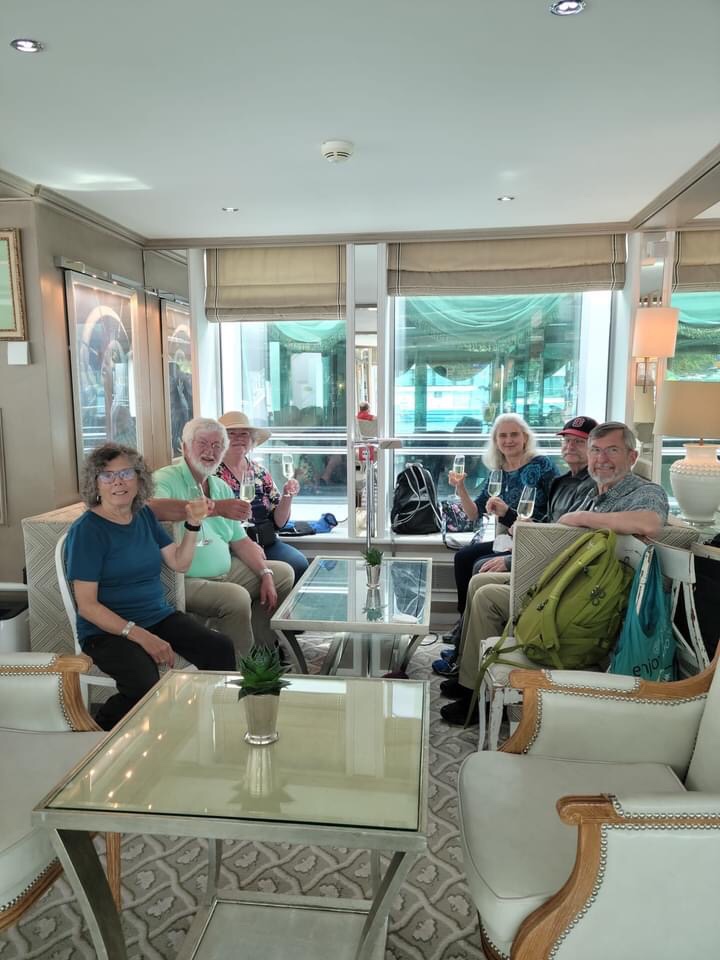
Anyway, the main point of the day is checking out of the Conscious and checking into the River Duchess, a Uniworld tour boat/ship. Which is about all we got done today. We arrived at the docks, which we passed yesterday on the canal tour. River Duchess is a long, low ship (or boat), fairly new looking. I wasn’t sure what to expect, but it met or exceeded every expectation. The staff is lovely. They greeted us and took us to the lounge and gave us champagne. There are mirrored surfaces everywhere, which I suppose makes the spaces look larger. (But I really don’t want to see the view of my backside looming unexpectedly at me. Too unnerving.)
Our party I. The lounge of the River Duchess. With champagne.
After a bit, they herded us into the restaurant for a buffet lunch. The dining room is at the stern of the boat/ship, with windows everywhere providing a panoramic view. We sat for a long time, eating and watching the busy boat traffic—river cruise ships, coal barges, pleasure boats, ferries, and other maritime vehicles made for a lively scene. Eventually, the staterooms were ready.
Random shot from the sun deck because I am having trouble uploading pictures. This is on the Rhine.
I have to tell you, we have never done this before. Not only have we never taken a cruise of any kind, we usually scrimp a little on accommodations. I guess they were seriously underbooked, because they offered us the opportunity to bid on a better stateroom. Tom made a lowball bid and secured a suite— the ritziest accommodation on the boat (or ship). It comes with a butler! Complimentary everything! More space! It has a marble bathroom, a large window that opens, king bed, drinks bar, live orchids, dressing table, etc, etc. I love it. The shower is a good size, which I did not expect.
Our butler’s name is Alexandru. (Call me Alex.) Alex is from Bucharest, Romania, as many of the crew are. He reassured us multiple times that we did not have to pay for laundry services (I wasn’t worried about it). He wears full butler regalia, tailcoat, vest and all. He is much better dressed than we will be at any time on this trip. Seems like a pleasant young man. We can call him if we need something—at any time, I gather, but I am sure we won’t be ringing him at 3 am to make us sandwiches.
The others walked back to the old town. I stayed to unpack. Also, my poor toe could use a break. I am wondering if I will be able to wear my sandals again on this trip. I hope so, because I only have one other pair of shoes with me.
A word about Amsterdam and its canals. They have hundreds of them, lined with trees, which makes the city parklike and beautiful. We learned that fresh water continually flushes through from the River Ij (pronounced “aye”), which means “”water.” This keeps the water clean, and indeed, we saw people swimming and fishing in the canals and the port. I investigated and found that the canals are literally teeming with more than 20 species of freshwater fish, so the water must indeed be clean. It also means that Amsterdam does not reek from filthy water, as does Venice. These are people who thoroughly understand water management, and we have a lot to learn from them as the world’s water levels rise from climate change.
Tom and I woke early and went for a walk in Westerpark. It’s a lovely park, a combination of landscaped and wild areas in the middle of the city. OK, not the middle, but close to the docks where we will be embarking on the “River Duchess,” our home away from home for the next three weeks. They were cleaning the wading pond that had produced so many happy childrens’ screams the day before. We saw great blue herons, mourning doves, and a number of birds I didn’t recognize.
This statue of a court dress stands in the middle of a small pond in Westerpark. The lady has evidentially strayed elsewhere.
We returned to the hotel and sat down to order breakfast via Q-code. Our coffee came almost immediately, but not our friends. Or the food. Eventually, Linda texted us. They had decided to sit in the roped-off area for some reason. And the staff had decided to serve them there. So we joined them. Their breakfasts arrived. Ours did not. Tom went to see why not, and apparently the order never went through. No worries—it arrived shortly after Tom inquired.
We had decided to visit the Reichsmuseum today. The Reichsmuseum has the same issues as the Louvre—it is so huge, you would need days to really do it justice. It has a huge collection of Dutch Masters, including Rembrandt’s “Night Watch,” which we had seen on our first visit to Amsterdam. It was a bit of a shock to walk into that gallery. An enormous crowd was gathered in front of the “Night Watch.” I remembered from our first visit that we had been one of a few gathered to gawk at it, and we stayed a long time with no interruptions. Then I remembered we had come here in February, which probably explains the difference. It isn’t Rembrandt’s most fascinating work, in my opinion, so I skirted the rapt crowd to focus on other works.
And I got to revisit some faves—Frans Hals, Jan Steen, Vermeer, and others, and discovered a new favorite, Judith Leyster, who had the same qualities I so admire in the others—capturing the personality of real people, distinct personalities, on canvas. I will have to further explore Leyster’s work.
One of Judith Leyster’s genre paintings. If it is in the Reichsmuseum, I didn’t see it, but it has all the qualities I love in the Dutch genre paintings.
We wandered through more galleries, and I began to skip over the things that didn’t interest me in favor of the ones that did—there’s just too much to see! Eventually, we dragged aching feet to the cafe and had some lunch. David ordered bitterballen, which I had never tasted before. Bitterballen (which I think means battered balls) consist of a stew rendered down until the gravy is very thick, frozen, battered, and deep fried. Very yummy. Very heavy. I had boar sausage with picked onions and bread.
Susan had arranged for a canal tour. The departure point was supposed to be very close to the museum. This proved to be true, but they told us it was the wrong place for our tickets. Then they kindly put us on a tour departing from that location, complete with wine and goodies, even though we hadn’t paid for them. Great customer service. The canal tour was interesting, and you get a short lesson in Amsterdam’s history, albeit through the recorded voices of a couple who argued coyly with each other. I know know what the Zeiderzee is—the southern sea that was closed off from the ocean at some point, protecting Amsterdam from tidal surges that tended to flood the residents’ houses from time to time. It was pretty crowded on that tour boat, but that’s what we get for coming during the tourist season. Horrifyingly, as we passed under a low bridge, someone on the bridge threw a half-full can of Amstel Beer through the open top and hit Linda’s head, soaking her clothes in beer. Somehow, I didn’t expect hat kind of behavior here. Fortunately, Linda was not badly hurt.
After the canal tour, we walked to the Reichst Restaurant (not the museum cafe), but we didn’t have reservations so they turned us down. We wound up back at the Conscious Hotel, where the food was very good, if not spectacular. This is a town where reservations are really required most places.
I tried to watch the third Jan. 6 hearings, but Judge Michael Luttig, who was one of the witnesses, spoke SO slowly, with so many long pauses between phrases, that by the time he finished a sentence I had forgotten what he was talking about. It drove me nuts and I realized I was probably tired, so I went to bed.
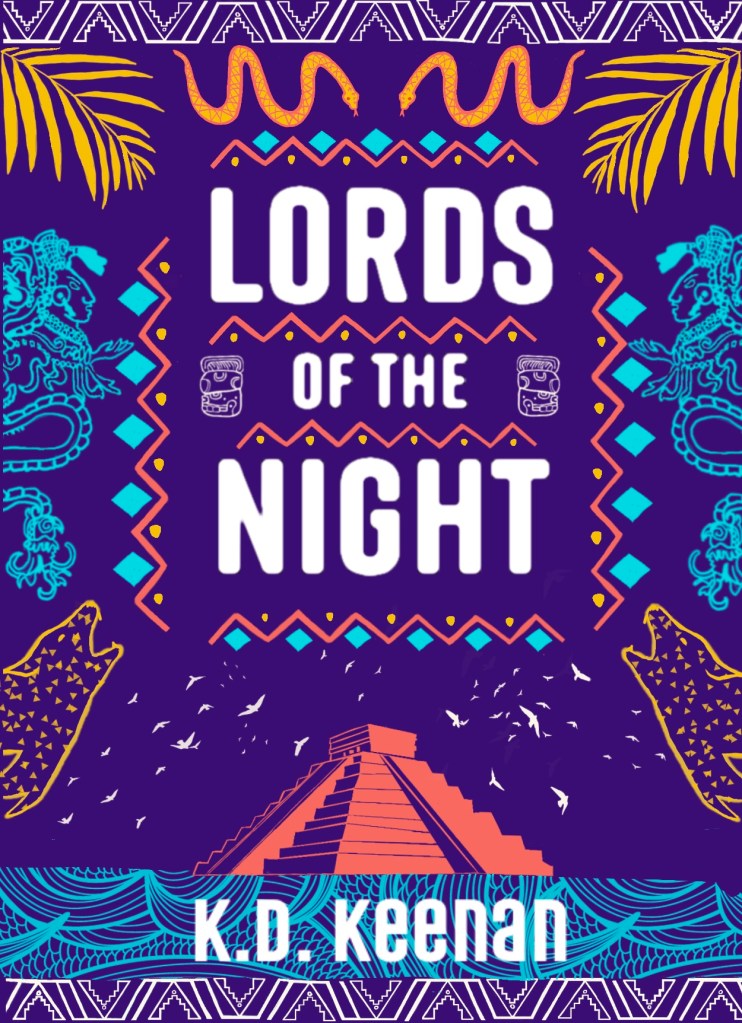
The following is the entirety of Chapter 1 from “Lords of the Night,” now available at Amazon.com:
“Who do you think you are, Chaco? A drill sergeant?” Sierra snarled. She slipped off the greased bowling ball, dropping the dishes she had been balancing on the end of a broomstick. The dishes shattered on the tile floor of her kitchen. She picked her way through the shards in oily bare feet, muttering, and seized a glass of water, gulping it as she wiped away the sweat pouring down her face and neck.
“I warned you this would be hard,” said Chaco. He passed a hand over the ruined dishes and they disappeared. He cocked his head at her, amber eyes steady.
“Yeah, you did,” Sierra responded. “But what the hell does standing on a greased bowling ball and destroying crockery have to do with becoming a sorceress? I’m not applying to Cirque du Soleil for a job.”
“Take a break,” Chaco replied peaceably, but his equanimity did not soothe her.
“I AM taking a break,” Sierra shot back. “Are you going to answer my question?”
Chaco lowered his lithe body into a chair, raking fingers through his dark hair. “As I told you when we started, the training is mental, spiritual, and physical. This is part of the physical training. A magic worker will often find him—or her—self in physically dangerous situations. You need to be strong, very strong, and your balance, aim, and precision must be honed to the highest degree. Think of yourself as an Olympic athlete…”
Sierra glanced down at her body, clad in shorts and tank top. She had been toned and on the slender side when she and Chaco had begun her training. Now she saw muscle definition in her thighs, where before they had merely been strong and well-shaped. The training was definitely making a difference. But god, she was working hard! And she hated it.
“I don’t get it,” she said, still cross. She knew Chaco was only doing his best to help, but at the moment, she didn’t care. “You never exercise. You never practice. Sure, you noodle around with trying new magics once in a while, but I’ve never seen you balancing on a greasy bowling ball. Do you do it when I’m not around or something?”
Sensing that Sierra was easing up a bit, Chaco laughed. “I’m a demigod. I don’t have to practice. When you become a demigod—or full-on goddess—you won’t have to practice either.”
“What? What are you talking about?”
“Well, you can’t expect to become a goddess overnight. You have to work at it. Like becoming Miss Universe or something.”
“Are you telling me that I’ll become a goddess if I continue the training?”
“Oh, no. There are no guarantees. Once you complete the training, there are still the traditional trials and tribulations.”
“I don’t want to be a goddess, Chaco. Your training sucks and I’m done.” Sierra put down her glass and stalked away, leaving Chaco in the kitchen, smiling to himself.
#
One year previously, Sierra had inherited a comfortable sum of money and a house from her fiancé, Clancy Forrester. There was only one problem; she suspected Clancy wasn’t actually dead. No body had been found and her friend Rose, who had witnessed Clancy’s fall from the side of a boat, said Clancy had never hit the water. If he had, he would have died, as the water was boiling from an undersea volcanic eruption.
The inheritance bothered her conscience, but she rationalized that if Clancy were alive somewhere, she would need the money to find him. She quit her job as communications executive with the Clear Days Foundation—a job she loved—to have the time to search for him. She thought Clancy would forgive her for selling his house and spending his money when and if she ever found him. And she knew she needed training to fully harness the powers that would enable her to find Clancy and rescue him from . . . whatever he needed to be rescued from. Unfortunately, she didn’t know what he needed to be rescued from. In point of fact, she also didn’t know when he needed to be rescued, but she and her friends were working on that.
While she was figuring out what she needed to do to find Clancy, she sold her own modest townhouse in Mountain View, California as well as Clancy’s highly sought-after ranch house in Sunnyvale. She added those proceeds to the three million dollars Clancy had left her in investments and began looking for a house where she could train in privacy. Her friend Rose, a Native American shaman, had suggested purchasing a remote cabin.
“You’re going to need privacy—real privacy—and alone time now,” Rose had said. “This training is serious business and you need to concentrate. And you don’t need nosy neighbors.” Sierra bought a cabin in a redwood forest in the Santa Cruz Mountains, which was remote enough to satisfy her friend.
However, Rose had refused to train Sierra herself. “You’ve already gone beyond me in strength,” Rose had said. “There’s really nothing more I can teach you.”
Sierra also asked her friend Mama Labadie to train her. Mama Labadie was a Voudún houngan whose ability to communicate with her loa—or at least with the loa called Madame Ézilée—had come in handy many times during Sierra’s earlier adventures. “No, uh-uh, and absolutely not,” was the houngan’s response. “You’re already scary strong. You should ask Madam Ézilée, not me. She might be strong enough to teach you before you get somebody killed.”
Kaylee, Sierra’s former work colleague and now a fast friend, was a Voudún practitioner, but claimed absolutely no occult powers. “I’ve been watching you,” Kaylee told her when Sierra groused a bit about Mama and Rose’s refusals to train her. “You’re powerful. You’ve gone wa-a-ay beyond Mama and Rose. They were right to turn you down. Sugar, you need to find someone who’s got more oomph than you do.”
#
One evening, as Sierra was unwrapping china mugs in her new kitchen and putting them on shelves, she complained to Chaco, “They’ve been telling me forever that I need to exercise my powers. That I need to train. But when I ask now? No dice. Mama and Rose won’t help me. Kaylee says she can’t help me. I don’t get it—they like Clancy. They want to get him back. I mean . . . don’t they?”
Chaco, his hands full of packing materials, took a moment to answer. “Of course they like him,” he finally said, swiping raven-black hair away from his face. “They probably liked Clancy more than he liked them.”
Sierra had to admit this was likely true, even if she didn’t like the past tense. Clancy had never been entirely comfortable around the “Three Weird Sisters,” as he called her three closest female friends. “Okay, but still. Wouldn’t you think they would help me to find him?”
Chaco put down a salt and pepper shaker set and sat in one of the kitchen chairs. “Do you want to have a serious conversation about this, or are you just bitching?”
Sierra set two mugs in a cupboard and sat down opposite Chaco. “I want a serious conversation. Tell me.”
“Let me make an analogy. Let’s say you’re a golfer, and you want to improve your game, maybe even play competitively. Do you go to your golfing buddy for training? The one who plays worse than you?”
“Well, obviously no. I take your point. But how am I going to find a teacher who’s better than me, if I’ve somehow gotten so strong?”
Chaco sat quietly, regarding her with his amber eyes. His expressive lips were slightly curved, his body relaxed and boneless-looking in the wooden chair. Like his alternate form, a coyote, he had the gift of seeming at home wherever he was. He continued to gaze at her in silence.
“You mean . . . you?” she finally asked.
“Who else is there?”
And that was that. She began her training in magic to find and rescue Clancy, wherever and whenever he might be. Chaco moved into Sierra’s second bedroom (she didn’t ask where he had been living before) to dedicate his time to her training. She expected that his residency would result in a renewed interest in getting her into his bed, but to her surprise he treated her as a comrade-in-arms with none of his usual sly suggestions. She found herself staring from time to time at Chaco’s face, with its long, chiseled planes, his golden eyes, his nicely muscled…and then she would flush with guilt at the thought of Clancy. Clancy, who would not be lost if it weren’t for his love for Sierra. But having Chaco around was convenient, and he was behaving himself, so the arrangement made sense.
Chaco had concentrated first on her powers, her mana. In the beginning, Sierra had envisioned her mana as colored flames, erratic and difficult to control. Gradually, she had come to see her powers as brightly colored ribbons twining in space, of every color she knew and some she didn’t. Chaco was able to visualize along with her. “There, right there,” he’d say. “That bright pink one? That’s for healing. Wrap it around your sore knee and see what happens.”
In the next moment, Sierra blinked at him in surprise. “The pain is gone!”
“You can heal other people, too. Try it the next time you see someone limping or with a bandage.”
“Won’t that be kind of obvious?”
“How would they know?” he asked reasonably. “You don’t have to wave a magic wand or recite a spell. They can’t see your mana—only you can. And me, of course.”
Sierra rather enjoyed the mana-strengthening sessions. She no longer endured sprained muscles or headaches. The gold ribbons were for battle. The silver ones were for moving things, the black ones were for…Sierra didn’t know what the black ones were for. They weren’t actually black, as they shifted between deepest indigo, bottle green, copper, and . . . something else . . . as she watched them.
“Chaco, what are the black ribbons for?” she inquired one day as she and Chaco took a break by the little creek that ran near her cabin.
“Black ribbons?”
“Yeah, like this,” and she called the black ribbons up, letting them twist and coil in her mind’s eye, glittering slowly.
“No!” Chaco yelled. He shook her and the twining black ribbons vanished.
“What the hell?”” Sierra scrambled to her feet and glared at him. “What’d you do that for?”
Chaco remained seated, gazing at her seriously. “Sorry. I didn’t mean to scare you. Those … black ribbons. Don’t use them. That is not mana that you can control. If you try, the mana will control you.”
“Then why do I have it?”
Chaco just shook his head. “I suppose we all have something like that inside. Something uncontrollable and dark. Just don’t use dark mana.” He rose in one smooth motion, then effected a dizzying transformation. His face elongated like melting wax, and as Sierra watched, his body hunched, arms and legs growing crooked and furry. Within a few heartbeats, a large, handsomely furred coyote stood next to her. He turned and trotted away into the shadows between the redwoods. Sierra watched him go, a hundred questions unanswered.
#
While she was training, Sierra tried to determine where Clancy had gone, specifically. The loa had indicated in their usual infuriatingly vague way that Clancy was alive and in the Yucatan Peninsula, but had then become tight-lipped and uncommunicative. The Yucatan constituted 76,300 square miles, which was impossibly large to search. Of even greater concern was the question of when. If Clancy had been whisked off to the Mayan Riviera, or even to a remote jungle, surely, he would have been found by now. Unless he’s dead, whispered a sombre voice in Sierra’s mind.
“Are we certain Clancy didn’t die when he went over the side of the boat?” she asked Rose and Kaylee, not for the first time. Kaylee hadn’t been in Moloka’i when Clancy disappeared, but Rose had been present.
“No, he never went into the water,” said Rose, patiently. “I don’t want to get too graphic here, but do you remember what happened to all those sharks and other fish?”
Sierra shuddered. She remembered the pale, poached bodies of tiger sharks, boiled to death by the wrath of Pele beneath the sea.
“Yes, I do, and Clancy wasn’t among them. But I feel like I’m grasping at straws here. We have nothing to go on but your amulet. Why did you give it to Clancy, by the way? He didn’t—doesn’t—believe in things like that.”
“Once in a while, I ‘see’ a darkness hanging around a person. It usually means they’re about to die, whether by accident or suicide. I saw this darkness around Clancy shortly before we went out to the wind farm where he went over the side of our boat. My amulet is powerfully protective, so I asked Clancy to wear it. When I handed it to him it was in a little leather medicine bag, but he took the amulet out and wore it around his neck, under his shirt. Probably so people wouldn’t see it, is my guess.”
“Do you know anything about the amulet? Where it was made? When it was made?” asked Kaylee.
“I know it was made in the Yucatan Peninsula during Mayan times, because it represents a scroll serpent or spirit snake, which was peculiar to the region. It represents Kukulcan, the feathered serpent, with an ancestor spirit emerging from its mouth. I don’t know anything more about it,” concluded Rose.
“Wait a minute,” said Kaylee. “I thought Quetzalcoatl was the feathered serpent?”
Rose smiled. “Yep. He was—is. He was the plumed serpent of the Aztecs. But Kukulcan came first, with the Maya. If you encounter him again you could ask, but I suspect they are the same Avatar, viewed through different lenses.”
The women thought for several minutes, each pursuing the question of how the amulet might help them locate Clancy. Rose said, “You know, a few years ago I took pictures of all the Native American artifacts that I’ve collected, just in case I needed them for insurance. I must have photographed the amulet, too. The pictures are on a flash drive that I put in my safety deposit box. Maybe the photo will show us some detail that I’ve forgotten.”
A quick trip to the bank, and the flash drive was inserted into Rose’s computer, Sierra and Kaylee hanging impatiently over her shoulder. She located the right files and brought up two photographs of a green stone carving, an elaborately curlicued serpent figure. Rose pointed out the figure of the ancestor spirit emerging from the creature’s mouth.
“What’s this other one?” asked Kaylee, pointing at the second photo. At first, it looked like a reverse image of the first, then Sierra realized it depicted the back of the intricately carved amulet.
“Rose, there’s something carved on the back! What does it say?” Sierra asked, pointing to the screen.
Rose peered at the image. She shook her head. “I have no idea.”
People sometimes ask me how I get ideas for my books. The short answer is: I don’t. I think people sometimes envision authors sitting at their elaborately carved Renaissance desk, complete with quill pen, and an exclamation point appears with a brand-new, amazing idea for a story! Eureka!
Maybe that’s how it works for some authors, I don’t know. The way it works for me is that I decide what part of the world I want a story to take place in, and then I go to that place. I let the place tell me the story. If that sounds mystical or authorish, it isn’t. It’s just how it works for me.
The first book of my trilogy, “The Obsidian Mirror,” took place mostly in Silicon Valley because that’s where I was living and working at the time. I understood the high tech industries, so my protagonist, Sierra, was a high tech public relations person (as I had been, many moons ago). The idea for the basis of the story came from my familiarity with the semiconductor industry and the ubiquity of integrated circuits around the world.
The second novel, “Fire in the Ocean,” had its origins in a Hawai‘ian vacation on the island of Oahu. I decided I wanted to set a novel in Hawai’i. Once home, I began planning a research trip the way I thought an author ought to—I contacted the Bishop Museum, the leading museum of Polynesian culture in the world. I contacted the University of Hawaii Dept. of Hawaiian Studies (or some such). I made reservations to go to Oahu to meet with these knowledgeable people.
Crickets. No one ever responded to my requests. So I decided that the story would be set on Moloka‘i, because that is the island of sorcery, according to the ancient Hawai’ians, which made it extremely attractive to a fantasy writer (that would be me). I also wanted to visit my friend in Captain Cook on the Big Island, because I hoped he would introduce me to some local people who could tell me about myths and legends. I changed all the reservations, abandoning the idea of speaking to the academic experts in Oahu.
At this point in my journey, I didn’t have a story. I knew i would be using my protagonist Sierra, and probably her friend, Coyotl the Trickster, but there were several other characters involved, and I wasn’t sure how I would be using them: Clancy, Rose, Mama Labadie—and especially Fred.
So my husband Tom and I jetted off to the Big Island. My friend was not available to meet for a few days, so Tom and I found ways to entertain ourselves—snorkeling, sampling the local goods like honey and macadamia nuts and coffee. We tried the local Captain Cook grocery store for wine, but the selection was unappealing, so we made a trip to Costco in Kona. While standing in line, I noticed an enormous refrigerator nearby, full of leis. I have always wanted a maile leaf lei. They are made as garlands rather than necklaces, and they often use only the pleasantly vanilla-scented leaves, not flowers. Sure enough Costco had them, and I took my prize back to Captain Cook.
I wore the lei the next day on a visit to Volcano National Park. Kilawea, Pele’s home volcano, was erupting, so I decided to sacrifice my lei to Pele, Goddess of Fire, and ask for her blessing on my work (which I hadn’t started because no story yet). To my disappointment, they wouldn’t let us anywhere near the actual flowing lava, but we were able to approach the rim of the caldera. It was clear this was the right place because there were other offering leis hanging in a tiny tree next to the railing, as well as on the railing itself. I held up my lei, asked for Pele’s blessing and whanged it right into the little tree, where it was securely caught in the branches. Then we turned around and started to walk away, but I wanted a photo of my lei hanging in the tree, so we went back after only a few steps.
Flinging my maile lei into the tree at the rim of the Kilawea cauldera.
My lei had vanished. All the other leis were still there. It was absolutely still without a breath of wind. We looked all around the ground under the tree. No maile leaf lei to be seen. With that incident, the story began to take shape in my head, with Pele taking an important role.
When I started thinking about “Lords of the Night” (I didn’t have a title at this point, by the way), I decided to write a historical fantasy—even though my characters were 21st century people. Why? I think it was the challenge. And I wanted to learn more about the ancient Maya. My mother helped to excavate several Mayan ruins in Yucatan and Guatemala, back when most of those great cities were still covered in jungle, and there were no roads to the excavation sites. So in addition to reading intensively about the Maya, their history, arts, mathematics, science, and culture, I set up a trip to the Yucatan Peninsula. (Actually, Tom does all the actual trip planning, based on what I want to see. He is wonderful that way!)
The ruins of a palace at Calakmul
I was blissfully untroubled by the problem of getting my 21st century characters back to the 5th century. This is fantasy! I can just make it up! As a writer, I adore that freedom. Why do you think I don’t write science fiction?
I also cleverly invited a couple to go along with us. Clod, the male half of the couple, was born and lived as a young person in Mexico City, with vacations in the Yucatan, which is where his father was raised. Linda studied Spanish in school. I speak Spanish like a first-year student with a strangely good accent (thanks to my Spanish-speaking mother). Tom has never studied Spanish. See how I did that?
The story began to take shape for me when we visited the ruins of Calakmul, which lie within the borders of a large biological reserve on the Guatemalan border. Calakmul had been my primary destination, though we did visit Tulum, Uxmal, and a few other archeological sites. I don’t know why Calakmul drew me so strongly. My mother didn’t excavate there, and I had never heard of it before beginning research for this trip. I had seen photos, and the city has a temple that rivals Egypt’s Great Pyramid for size. Plus, it is located in the middle of a jungle, far from the well-trod tourist trails. Intriguing, no?
There is only one hotel within the borders of the biological reserve. If you want to visit Calakmul, you more or less have to stay at Hotel Puerta Calakmul, because the hotel, deep in the jungle, is still 60 kilometers or so from the ruins, along an unpaved road. When you get to the drop-off place for the ruins, you still have to walk a kilometer to arrive at the actual city.
At the base of one of the temples in Calakmul.
All of which made my visit to Calakmul everything I could have hoped for. As we walked along, I picked our guide’s brain about Mayan folk tales and we saw peacock-gorgeous oscillated turkeys, and monkeys, and javelinas. The ruins themselves were pleasantly shaded, with very few other people around. It was nothing like the wait-in-line-in-the-tropical-sun-with-a-million-other-tourists experience of the more popular sites. The temples, all of which have not yet been excavated, are impressive. In its time, Calakmul was one of the most powerful cities of the ancient Mayan world, and its name was Ox Té Tuun. Ox Té Tuun is central to “Lords of the Night,” and as I strolled along its broad avenues I developed the character of Ix Mol, a young Mayan girl from Ox Té Tuun with a very big problem who enlivens the pages of “Lords of the Night.”
More Calakmul.
All of which is a long-winded way of saying that place is central to my process as a writer. I have no idea why, but there’s nothing like a good trip to someplace far, far away to stimulate my creative juices.























 obsidianmirrorblog