Lost in the Fog at FogCon

Lost in the Fog

I attended FogCon a couple of weeks ago. I had only attended one other con, and that was several years ago when I went to WorldCon in San Jose, CA. WorldCon was huge, taking up much of the McEnry Convention Center. There were lots of cosplay people dressed as Galadriel or Romulans or as people/creatures/characters I didn’t even recognize. And I met Terry Pratchett.

Yes, I know I said I was going to talk about FogCon, but I have to stop and talk about my encounter with Mr. Pratchett, who is one of my VERY EXTREMELY MOST FAVORITE fantasy authors.

You see, I met Connie Willis first. I was in the vendors’ hall when I happened to glimpse her nametag. Connie Willis is also a favorite author, so I introduced myself—and proceeded to commit every rabid-fan sin it is possible to commit in attempting to praise her work. Even as I heard the vapid words burbling out of my mouth, I knew I was doomed. The expression of pain on Ms. Willis’ face only confirmed my gauche blundering. I attempted to extricate myself by saying, “Well, I’m starting to drool on you, so I guess I’d better go now.” Ms. Willis nodded mute agreement, and I slunk away with my tail between my legs, feeling like a complete moron.

I was standing at a vendor’s stall wondering if it is possible to actually die of embarrassment when a tidy gentleman with a gray beard and a black fedora walked up. I thought he looked familiar, but when the vendor called him “Mr. Pratchett,” my suspicions were confirmed. He stood right next to me as the vendor handed him a CD and said, “I’ve been saving this for you, but I was afraid I might come across as a rabid fan.” (Like me, I thought.)

Pratchett took the CD and said, “I adore rabid fans!”

I turned to him and said, “Well, then, would you mind if I drooled on your shoulder?”

Pratchett responded, “Not at all—but would you mind drooling on this shoulder”—he patted his right shoulder—“as the other one is already rather damp?”

Instantly, the oppressive cloud of feeling foolish lifted and disappeared. I will never forget how Terry Pratchett’s humor and kindness brightened my day and turned my embarrassment into laughter. (Not that I mean to say Connie Willis made me feel bad. I made myself feel bad. I should’ve kept my mouth shut.)

Okay, back to FogCon, which is a very different con. I thought the topics appeared geared more to writers than to fans (“How To Create a Magical System” is one example), but there were probably more fans than writers. The sessions were a combination of panel discussion and group discussion. I introduced myself to several people, and sometimes got into conversations, but most people seemed to be there with groups of like-minded friends, and they were more interested in hanging with their posses than mingling. No one was rude or even cold; I just never clicked with anyone. I asked several people why they came to FogCon, and the answers were all along the lines of “I enjoy the discussions. The topics are so interesting.” Perhaps other cons are not as participative? I don’t know yet.

I managed to miss all the good parties because I didn’t know about the con suite. I handed out a few cards about “The Obsidian Mirror,” but no one expressed much interest. I finally just left a stack on the literature table. When I tried to talk about the book to a bookseller (from whom I was purchasing three books at the time), he just looked bored and pointedly set the card aside without a word.

By the time the “Non-Awards Banquet” rolled around on Saturday night, I was kind of done. There was a party afterwards, but I was tired and didn’t feel like trying to push myself onto more indifferent people.

I’ve done a lot of successful networking in my time, but I felt like a complete tyro at FogCon. I suspect that I am on a learning curve here. I went to the con to learn more about how cons work, and from that perspective, I was successful. I think I need to attend more cons and pick up on the culture (which I think differs from con to con, based on my limited experience). If I continue to attend, I’ll probably get to know others who go to cons and vice versa. Who knows? Maybe someday I’ll have my very own posse.
I Took My Skull Back to the Place It Came From (Almost)

When I turned six years old, my grandfather gave me a present. It wasn’t wrapped, as I recall, but just placed in a plain cardboard box. As it happened, it was my favorite gift that year: a genuine human skull.

My grandfather, Frank W. Moore, was an adventurous man. In the earlier days of the 20th century, he helled around California in a Model T, driving across the desert before there was such a thing as “off-road” driving. He had a sailboat called “Amy H” in which he explored the California coast and offshore islands. (My grandmother was not named Amy H. I think the boat came with the name and he never got around to changing it.) In those days, California was underpopulated and he had the freedom to go pretty much wherever he wanted to do whatever he felt like. One of the things he liked to do was go out with his buddy, Dr. Walter B. Power, and cut down billboards.

On one occasion in 1917, he landed on San Nicholas Island, later made famous by writer Scott O’Dell as “The Island of the Blue Dolphins.” On or near the beach, he saw a white dome poking up out of the sand. He uncovered it and found a skull with half of its lower mandible. The teeth (those that were left) were ground down quite smooth as a result of the inhabitants’ diet of shellfish which contained a lot of sand. My grandfather took the skull home, where it became an object of envy for my mother, who had ambitions of becoming an archeologist (and eventually did). Mom named it Yorick after the skull in “Hamlet.”

In those days, there was no Native American Repatriation Act, aimed at restoring the remains of Native Americans to their tribes and homelands. The battle of Wounded Knee was a mere 27 years in the past when my grandfather found the skull, and the term “Native American” hadn’t yet been coined. Indians, in short, were not highly regarded by the mainstream culture back then. No one thought twice about my grandfather taking Yorick from his resting place on San Nicholas Island.

In 1917, there were no inhabitants on the island. The Nicoleños (or Ghalas-at) had been almost exterminated by Russian fur-trappers. In 1835, the padres of the California mission system moved five of the six remaining inhabitants to the mainland. The one who stayed, Juana Maria, became known as “The Lone Woman.” She lived there, utterly alone, until her removal from the island in 1853. She died not long after.

My mother thought the skull was that of a young male in his 20’s, pointing to the supra-orbital ridges and cranial sutures, and we continued to refer to it as Yorick. Sensibilities toward Native Americans hadn’t improved too much by the time my childhood rolled around, so I happily took Yorick to show-and-tell sessions at school–and I have to tell you, he never failed to make a hit appearance. No one could top me when it came to show-and-tell; imagine following my human skull with your toy cap gun (also a perfectly acceptable show-and-tell item in the 1950’s).

I took as much care of Yorick as a small child might be expected to do, but one day, something heavy fell on him as he rested in my off-duty Easter basket. My mother undertook to glue him back together–and while she was engaged in this project, the chipmunk I had taken home for the weekend from my third grade classroom escaped in the family room and took up residence in the couch. Mom thought this would be a good way to start a book: “While I was glueing my daughter’s skull back together, the chipmunk got loose.” I thought this had promise, but she never did write the book.

When my own children were in elementary school, I let them take Yorick to their show-and-tell sessions. He was as much a hit as ever, but I heard back from one teacher that Yorick was an inappropriate show-and-tell subject. She mentioned the Native American Repatriation Act, and I realized with something of a shock that Yorick was, of course, subject to that law. That ended Yorick’s career in show-and-tell.

I suppose I should have realized earlier that Yorick had been a human being whose remains had been wrested from his native land in an insensitive and chauvinistic manner. But Yorick had been a fixture in my life, and I hadn’t really thought of him as such. He spent the next couple of decades in a cardboard box. Out of sight, out of mind.

When I finished “The Obsidian Mirror” and began to look for a publisher, I remembered my unfulfilled obligation. My novel is based on New World legends, myths, and folk tales, and I recognized my enormous debt to the Native Americans and their many cultures. I thought if I got published–by a real publisher, not self-published–the finest way to celebrate this would be to repatriate Yorick to whichever Native American tribe now held the responsibility for those long-dead people of San Nicholas Island. I thought the Chumash were the most likely, as they are the tribe that lives around Santa Barbara now. I pledged to Yorick and the Powers That Be that I would repatriate Yorick if my book were picked up by a publisher. (I planned to self-publish if I failed to find a publisher, but I didn’t even contemplate what I would do with Yorick in that case.)

Well, AEC Stellar Publishing is bringing out “The Obsidian Mirror” sometime this summer. So I had a promise to keep.

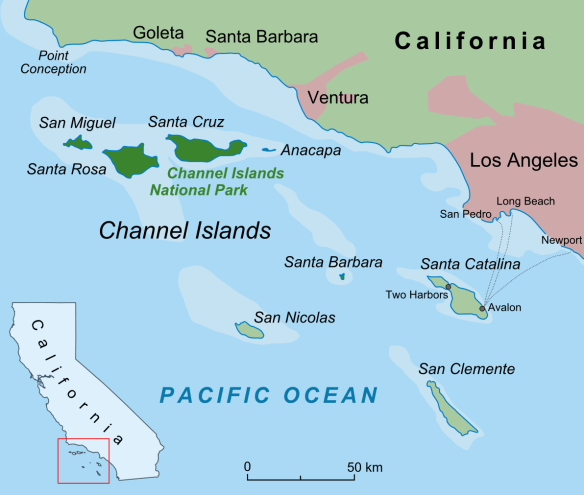
To be honest, I had never before investigated where San Nicholas Island was, precisely, or what had become of it. I had assumed, as the island is considered part of the Channel Islands group, it had been rid of its introduced species like rats and goats and made into a nature preserve like Anacapa. A group of us sat in our living room this past holiday season and did some research. Some of us (not me) were voluble in proposing that we hire a fishing boat and go out to San Nicholas to rebury Yorick ourselves.

It turned out that San Nicholas Island is considerably south of the other Channel Islands (except for Santa Catalina and San Clemente), and sits perhaps 100 miles out to sea from the Southern California coast.

The Channel Islands

The Channel Islands

It also turned out that the island is under the jurisdiction of the United States Navy, which uses it for weapons research. The occupants of a fishing boat that attempted to land would probably be arrested. Some of the group still wanted to do it. “We’ll just tell them we’re old and we got lost,” said my friend Meg. Nope. Nope. Nope. Not going there. I reserve my feckless adventuring for my fiction writing.

I contacted my cousin Sally, who lives near Santa Barbara. Sally suggested contacting Dr. John Johnson, an anthropologist specializing in the Channel Island Indians. Dr. Johnson, a very kind and knowledgeable man, explained that there was an investigation underway to try to determine who (if any) were the legitimate descendants of the Nicoleños. And the organization in charge of the investigation? The U.S. Navy. I don’t have a whole lot of faith that the U.S. Navy feels any urgency about resolving this problem, but according to Dr. Johnson, there isn’t any alternative. Repatriated remains go to the Santa Barbara Museum of Natural History, where Dr. Johnson works. He assured me that there is a special area where these remains are kept until they can be interred in an appropriate manner and place. Yorick would stay in the museum until the Navy decided where he belonged.

Well, Santa Barbara was at least closer to San Nicholas Island than Yorick has been in more than half a century. I made an appointment with Dr. Johnson to turn Yorick over.

When my husband and I went to Santa Barbara, Dr. Johnson spent some time examining the skull, then said, “I think what we have here is actually Yoricka.” He believes that the skull was that of an older woman, not a young man, and showed us why he thought so. (Sorry, Mom. I think he’s right.) He asked me details about my grandfather and mother and I filled out some paperwork. Then it was time to say goodbye. On the way out of the museum, my husband turned to me and asked, “Feeling a little sad?”

I said, “Yes.” I wish I had taken a picture of Yorick before we left. After all, he–she–was a member of my family for 97 years. I wish I had known who you really were, Yorika. I hope you find your way back to your Island of the Blue Dolphins.

The Final Concept (Cover Art)

Well, the publisher has approved final cover art for “The Obsidian Mirror.” As you can see below, not too different from the last one. We still don’t have the blurbs, publisher’s logo, etc., but that’s out of my hands for now. I like this one!

Cover Art 2b

The Coyote Didn’t Cut It

Sometimes I have to shake myself to see if I am dreaming. I am fulfilling a lifelong ambition: writing and publishing a novel. It has been a daydream so long that I had given up on it—until I actually wrote a book.

But now, I am listed as an author on the publisher’s website. I am working on the graphics. I am working on the marketing. I should be working on final-editing the manuscript, but haven’t quite gotten there yet. (Tomorrow. I promise!) Sometimes I wonder if this is real, or just an extended daydream—but then my publisher asks me to do something else, and I’m sure these tasks were not part of my original roseate dream, so I am becoming more convinced that this will really happen.

And then I go back to being amazed.

Well, anyway, here’s a mockup of my latest cover design, front, back and spine. I haven’t gotten feedback from the publisher yet, but I kind of like it. But no man/coyote graphic. <Sniff><Sob> I am very attached to the shape-changing coyote, but he just isn’t working out too well as a cover. I am sure I’ll continue to use him, but perhaps not on the book cover. If you were kind enough to weigh in on the graphic, thanks. I agree with the majority that the original one is the best.

Cover Art 2a

How’s This Coyote? I’d Really Like Your Opinion.

Many of you were kind enough to comment on three different versions of Chaco: my supernatural character who can appear either as a ridiculously beautiful young man, or as a coyote. (But not just any coyote; he is Coyotl the Trickster).

My publisher had asked for a somewhat lighter feel to the image because the tone of the book overall is light. Chaco is (usually) a cheerful guy.

The vote was overwhelmingly in favor of my original, Chaco #1, with 10 votes, #2 got three votes, and #3 got two votes. I also favor the original.

However, my friend Erica Chase asked, “Is there a happier looking coyote?” I thought this was nothing short of brilliant (typical of Erica). So I went looking for a coyote whose expression was less threatening and more upbeat. And then tried to match the coyote with an image of a young man that more or less matched (or was at least complementary to) the coyote’s expression. The image below is the result, and if you would be so obliging, I’d like to know if you think this is an improvement. Or not. (To see the three images I posted for comment, please go to https://obsidianmirrorblog.wordpress.com/2013/12/13/vote-for-your-favorite-coyote/)

New Coyote/Chaco

New Coyote/Chaco

Vote for Your Favorite Coyote!

I sent last week’s cover art to my publisher. One of his comments was: “…the book itself also felt a bit more light hearted than the dark cover with the serious boy (who was definitely not so serious in my mind, as I read anyway).”

The man (Chaco) changing into a coyote is central to my story. Chaco is Coyotl, the trickster folk hero of many Native American cultures. He can shift back and forth at will, and this comes in handy several times during the story. So I’d really like to use the image of the shape-shifting man-coyote. But my publisher is right: the tone of the book is on the lighter side.

I picked out a few more handsome latino men from iStock.com, where there is a plethora of such men on sale for very little money, and created two alternatives to my original. I present them here for your deliberation: which is the best Chaco: #1, #2, or #3?

I eagerly await your judgement!

Chaco #1

Chaco #1

Chaco #2

Chaco #2

Chaco #3

Chaco #3

Tell Me What You Think. Please?

I’ve gone back and forth a couple of times with the publisher, AEC Stellar, and I think we’ve probably arrived at an agreement.

So now I get to do something fun: design my own cover art. AEC Stellar has people who will do this, but from my standpoint, one of the advantages of working with a small company is that they are willing to let me do my own cover design if I want (and it meets their standards). I realize that most people wouldn’t think this was fun, but I also paint in oils and design jewelry and I’m pretty good at Photoshop. You can purchase excellent photography and illustrations from an online stock provider for very reasonable prices and manipulate these images in Photoshop. I did a lot of this when I was working on marketing materials for Cisco, and I enjoy it.

Here’s my first concept. Do you like it? Dislike it? I’d love to know.

Obsidian Mirror cover3

The Contract

ContractThe book contract arrived. It seemed pretty straightforward to me, but I’ve never laid eyes on a book contract before, so what do I know? I followed the advice of my book consultant and shelled out some bucks to have someone knowledgeable review it.

I recognized that the contract was unusual. The publisher is unusual. It required some shared expenses. Having talked with the publisher, I was aware of this, and given that the author gets 50% of the net (as compared to maybe 12% from standard publishers), that didn’t seem unfair to me, especially as this is a new, startup publisher.

The reviewer sent the contract back with many, many comments. I looked at them all carefully. There were a few that I didn’t agree with, but some of the others seemed more than reasonable. For example, the contract specified that all rights to the work in other media such as TV, movies, audiobook, etc. would belong to the publisher. Now, the likelihood of my little novel being made into a movie is remote, but I didn’t see why I should give up the rights to my own work, even so. So I marked up the contract accordingly and returned it to the publisher with a polite note indicating that everything was up for discussion.

That was yesterday. No response so far. Of course, I reasoned, he needs time to look it over. I took my time, after all. But still. Is he pissed off? Insulted? Did he even see it yet? Am I stressing unnecessarily? Or is this an indication of thunderclouds on the horizon? Should I stop thinking about it? Should I call?

Or maybe I’ll just go for a walk on the beach and forget about it.

Die, Vampire, Die!

No VampiresFor the record, I’m still trying to get my novel, “The Obsidian Mirror,” published through conventional channels. Yes, I know all about how respectable self-publishing has become in the digital age. That’s my Plan B. But I would like to get it published conventionally if I can swing it.

So far, no joy. And I have a theory about why this is so. (Other than that my book is no good. I’ve read it and it’s great! No, seriously, it’s a fun, fast read, which is what I usually want from a book myself. And it’s well written, too, she noted modestly.)

So bear with me here for a moment while I tell you a story.

Long, long ago, when dinosaurs roamed the earth and poodles ran wild and free, I wrote a children’s novel called “The Singer and the Song.” It was about a city-dwelling girl who found she could pass from her world to another, magical world. As I recall, there was a talking cat involved. I wrote it for a graduate class in children’s literature in lieu of writing another essay on something like “Christian Influences in C.S. Lewis’ ‘The Chronicles of Narnia,’” or something else equally boring and trite. My professor loved it and so did my Mom. My mother had always supported my writing and she thought this one had a lot of potential, so she paid for me to take it to the William Morris Agency in New York City. William Morris charged $100 to review and evaluate the manuscript. (Mom and I didn’t know any better.)

I think I kept the letter from the agency, but I am between houses right now, and everything is in storage so I can’t give an exact quote. But the general gist of it was that children today (Remember the dinosaurs? That day.) aren’t interested in magic and talking animals. They want realistic, gritty urban tales that reflect their own lives.

So take that, J.K. Rowling! No one’s interested in your silly little stories about magic and talking animals, okay?

I may have been all of 21 years old, but even then I knew William Morris Agency was full of shit. The marketing fashion of the time happened to be gritty urban tales, but fashion and marketing have never influenced what children like to read about. Which in many, if not most cases, definitely includes magic—with talking animals if possible.

Nonetheless, I was embarking on a more or less adult life by that time, which meant earning a living, and I put my poor novel away. I thought I might read it to my kids some day, but I don’t believe I ever did.

Fast-forward to our dinosaur-free present. “The Obsidian Mirror” features magic and at least one talking animal, who isn’t really an animal, but an avatar of Coyotl, the Trickster of Native American legend. (My personal tastes have changed some, but not that much.) Various American myths, legends and traditions come into it in a manner that I haven’t seen elsewhere—which could be good or bad, depending on your personal viewpoint. Apparently, the editors and agents who have seen the synopsis so far aren’t intrigued.

Now for my theory. I think agents and publishers weren’t intrigued because what I wrote about isn’t currently fashionable in fantasy fiction. I don’t have to tell you what is currently fashionable, but I will anyway: vampires, zombies and werewolves.

I used to like a good vampire story as much as the next person. Bram Stoker: fabulous. Anne Rice: new twist on an old tale (at least at first). But then they came fast and furious: “Buffy,”  “Twilight,” the Sookie Stackhouse series, “Dark Vampire Knight” series, “The Vampire Coalition” series, and so on ad nauseum. I thought the genre had burned itself out (or been buried with a stake through its black heart) with the advent of “Abraham Lincoln: Vampire Hunter,” but no! Hollywood made a movie out of it.

I suppose I’m not making any friends with this, but c’mon, people. Aren’t you just the teensiest, tiniest bit bored with vampires yet?

But this isn’t sour grapes, honest. I’m just dealing with a marketing trend. All marketing trends die—at least, theoretically they do. Vampire stories, like their deathless subjects, show every sign of living forever, sucking the lifeblood out of other fantasy genres.

I’ll wait a bit longer, then it’s on to Plan B, I guess. Where’s the garlic?

So You Think You’re a Reader?

by Lin Kristensen

by Lin Kristensen

The BBC believes most people will have read only six of the 100 books listed below. How do your reading habits stack up?

Instructions: Copy the note below and paste it into Word (or whatever). Look at the list and put an ‘x’ next to those you have read. Post on FB or your blog and brag about it. The x’s in the list below are for the ones I have read.

[x ] Pride and Prejudice – Jane Austen
[x ] The Lord of the Rings – JRR Tolkien
[x ] Jane Eyre – Charlotte Bronte
[x] Harry Potter series – JK Rowling
[x ] To Kill a Mockingbird – Harper Lee
[x] The Bible
[x] Wuthering Heights – Emily Bronte
[x ] Nineteen Eighty Four – George Orwell
[x] His Dark Materials – Philip Pullman
[x ]Great Expectations – Charles Dickens
[x ] Little Women – Louisa M Alcott
[x ] Tess of the D’Urbervilles – Thomas Hardy
[x ] Catch 22 – Joseph Heller
[x ] Complete Works of Shakespeare
[x ] Rebecca – Daphne Du Maurier
[x ] The Hobbit – JRR Tolkien
[ ] Birdsong – Sebastian Faulk
[x ] Catcher in the Rye – JD Salinger
[x] The Time Traveler’s Wife – Audrey Niffenegger
[ ] Middlemarch – George Eliot
[x ] Gone With The Wind – Margaret Mitchell
[x ] The Great Gatsby – F Scott Fitzgerald
[x] Bleak House – Charles Dickens
[x] War and Peace – Leo Tolstoy
[x] The Hitch Hiker’s Guide to the Galaxy – Douglas Adams
[x] Crime and Punishment – Fyodor Dostoyevsky
[x] Grapes of Wrath – John Steinbeck
[x] Alice in Wonderland – Lewis Carroll
[x] The Wind in the Willows – Kenneth Grahame
[x] Anna Karenina – Leo Tolstoy
[x] David Copperfield – Charles Dickens
[x] Chronicles of Narnia – CS Lewis
[x] Emma – Jane Austen
[x] Persuasion – Jane Austen
[x] The Lion, The Witch and The Wardrobe – CS Lewis
[x] The Kite Runner – Khaled Hosseini
[x] Captain Corelli’s Mandolin – Louis De Bernieres
[x] Memoirs of a Geisha – Arthur Golden
[x ] Winnie the Pooh – AA Milne
[x ] Animal Farm – George Orwell
[x] The Da Vinci Code – Dan Brown
[x] One Hundred Years of Solitude – Gabriel Garcia Marquez
[x] A Prayer for Owen Meaney – John Irving
[x] The Woman in White – Wilkie Collins
[x] Anne of Green Gables – LM Montgomery
[x] Far From The Madding Crowd – Thomas Hardy
[x] The Handmaid’s Tale – Margaret Atwood
[x] Lord of the Flies – William Golding
[ ] Atonement – Ian McEwan
[x ] Life of Pi – Yann Martel
[x ]Dune – Frank Herbert
[x] Cold Comfort Farm – Stella Gibbons
[x] Sense and Sensibility – Jane Austen
[x] A Suitable Boy – Vikram Seth
[ ] The Shadow of the Wind – Carlos Ruiz Zafon
[x] A Tale Of Two Cities – Charles Dickens
[x ] Brave New World – Aldous Huxley
[x] The Curious Incident of the Dog in the Night – Mark Haddon
[x] Love In The Time Of Cholera – Gabriel Garcia Marquez
[x] Of Mice and Men – John Steinbeck
[x] Lolita – Vladimir Nabokov
[ ] The Secret History – Donna Tartt
[Couldn’t finish] The Lovely Bones – Alice Sebold
[x] Count of Monte Cristo – Alexandre Dumas
[x] On The Road – Jack Kerouac
[ ] Jude the Obscure – Thomas Hardy
[x] Bridget Jones’s Diary – Helen Fielding
[ ] Midnight’s Children – Salman Rushdie
[x] Moby Dick – Herman Melville
[x] Oliver Twist – Charles Dickens
[x] Dracula – Bram Stoker
[x] The Secret Garden – Frances Hodgson Burnett
[ ]Notes From A Small Island – Bill Bryson
[ ] Ulysses – James Joyce
[ ] The Inferno – Dante
[ ] Swallows and Amazons – Arthur Ransome
[ ] Germinal – Emile Zola
[x] Vanity Fair – William Makepeace Thackeray
[ ] Possession – AS Byatt
[x] A Christmas Carol – Charles Dickens
[reading now] Cloud Atlas – David Mitchell
[x] The Color Purple – Alice Walker
[ ] The Remains of the Day – Kazuo Ishiguro
[x] Madame Bovary – Gustave Flaubert
[ ] A Fine Balance – Rohinton Mistry
[x] Charlotte’s Web – EB White
[x] The Five People You Meet In Heaven – Mitch Albom
[x] Adventures of Sherlock Holmes – Sir Arthur Conan Doyle
[ ] The Faraway Tree Collection – Enid Blyton
[x] Heart of Darkness – Joseph Conrad
[x] The Little Prince – Antoine De Saint-Exupery
[ ] The Wasp Factory – Iain Banks
[x] Watership Down – Richard Adams
[x] A Confederacy of Dunces – John Kennedy Toole
[x] A Town Like Alice – Nevil Shute
[x] The Three Musketeers – Alexandre Dumas
[x] Hamlet – William Shakespeare
[x ] Charlie and the Chocolate Factory – Roald Dahl
[x] Les Miserables – Victor Hugo