My Spanish Vacation in Bed

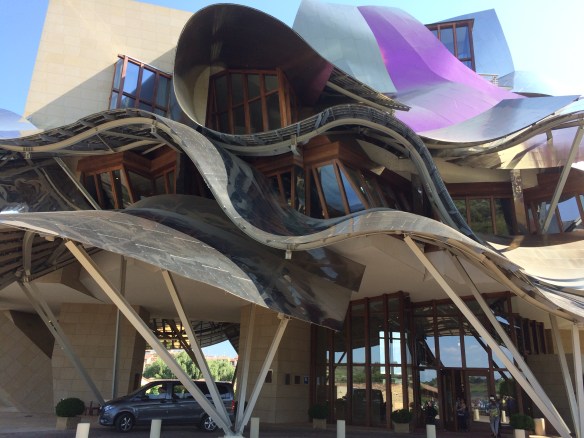
Frank Gehry's astonishing building at the Marques de Riscal Winery

Frank Gehry’s astonishing building at the Marques de Riscal Winery

Well, no, not all of it. But the day after we went to see the Guggenheim and I got crunched by the quieropractica in Bilbao, Tom and I had a down day. We woke up, had breakfast, and then I settled down to work on my novel. I practically fell asleep over my computer at ten o’clock in the morning, and Tom was in the same state. So we retired to our football-field-sized and comfortable bed and snored for a few hours.

When we awoke, I went back to work on my book and Tom went out to explore the surrounding area. I reread and edited and pondered, and came up with a brilliant solution to a plot problem, but didn’t write anything new. I suppose that’s some progress. Tom explored some surrounding villages and took photos. When he got back, we walked around town. We didn’t want to go back to the restaurant in the hotel; we had eaten there three times and couldn’t face it again, though it was very good. So we went to another hotel and ate there. I think we were the only people who ate there that night, and for good reason. The outdoor patio was pretty, though, and we could watch the swallows–las golondrinas–swooping around overhead, catching gnats and flies. I cheered them on.
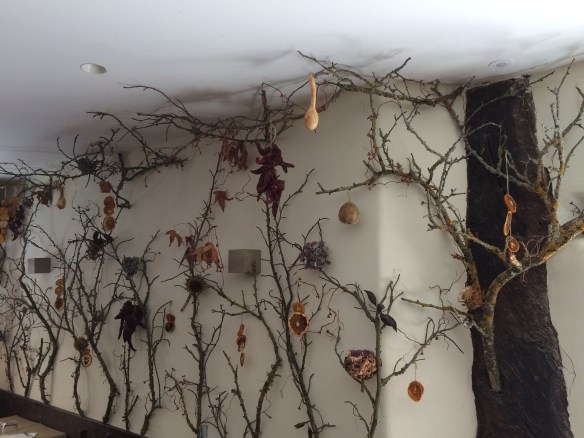
An interesting decoration made of grapevines, dried fruit and flowers in a cafe in Ezcaray

An interesting decoration made of grapevines, dried fruit and flowers in a cafe in Ezcaray

Every night since our arrival, we had been hearing a church bell ringing at 7:30 pm, 7:45, then again at 8:00. It wasn’t the bells in the church across the street, which rings the hours and half-hours. This bell sounded different, and it was rung in a different manner. So we asked around, first in the restaurant where we were eating. No one had any idea. We went back to our hotel and asked the guy behind the tapas bar. No idea, but he gave us two free glasses of wine to compensate for his ignorance, so that was OK. Then we asked the concierge, who asked around and then told us the bell rang for the 8 pm mass at another church in town. I was astonished. Who would’ve thought that in Spain, no one would know that the bells were ringing for mass? I guess the times, they have a-changed.

So it was early to bed, and we awoke refreshed and ready for more adventures. This was the day for wineries. Unlike in the U.S., in Spain if you want to visit a winery, you have to make an appointment. When you get there, you have to take a tour of the winery–you can’t just walk in and taste.

Our first stop was Marques de Riscal. This has been a winery since 1858, but when you see the spectacular Frank Gehry building rising up from the vineyards around El Ciego, it is an entirely modern and astonishing sight. (Frank Gehry also designed the Guggenheim Museum in Bilbao, which is a sculptural work of art in its own right.) The winery produces something like eight million bottles of wine a year–mostly reds. The winery tour was interesting, as it included both the new parts (a lot of very highly automated equipment) and the old–like the cage where the 100-to-150-year-old bottles are kept for special events.

Old wine cellar at Marques de Riscal

Old wine cellar at Marques de Riscal


Surprise!

Surprise!

Once the tour ended, they gave us quite a lot of excellent wine. I will be looking for Marques de Riscal when we get back to California!

Gehry Building

View from the vineyards at Marques de Riscal winery

The Frank Gehry building houses a hotel and a 2-star Michelin restaurant. We decided to eat there later. Tom wanted to take pictures of another winery, Ysios, which also has a spectacularly designed building–although they told Tom that they didn’t have any tours in English. When we got there, it looked like they didn’t have any tours at all (it was completely deserted), but the building is fascinating. Tom calls it “pixelated.” It’s supposed to blend into the landscape. IMHO: not.
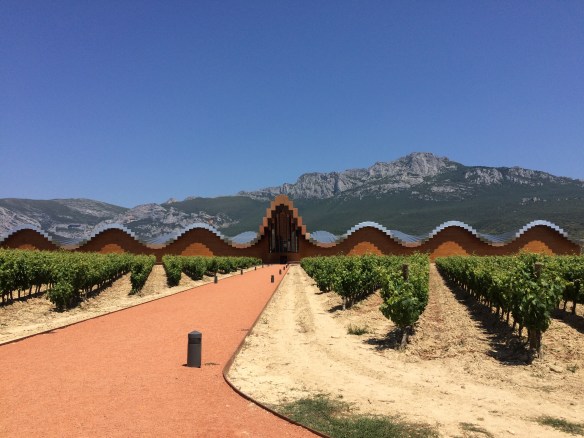
Ysios Winery. If they had had a tour, I would be able to tell you who the architect was.

Ysios Winery. If they had had a tour, I would be able to tell you who the architect was.

We returned to Marques de Riscal and went up to the restaurant. The concierge downstairs had called ahead to let them know we were coming. When we walked in, we were greeted politely by two people who clearly didn’t expect us. Their foreheads were wrinkled with deep concern: did we have reservations? There were perhaps 50 tables there, and not one of them was occupied at that hour. However, someone who did know the score rescued us, and we sat down to the most exquisite meal we have had in Spain so far. It was delicious, but above and beyond that, it was entertaining. Example: we were served an amuse bouche, consisting of a shallow dish with fog pouring out of it and dark brown “sticks” poking up out of the fog. The waitress said it was vine twigs from the vineyard prepared for our delectation. Then she hung around watching. We nibbled on them, and they were yummy. Then she told us it was actually cheese sticks. I said, “I totally believed you!’ She was pleased.
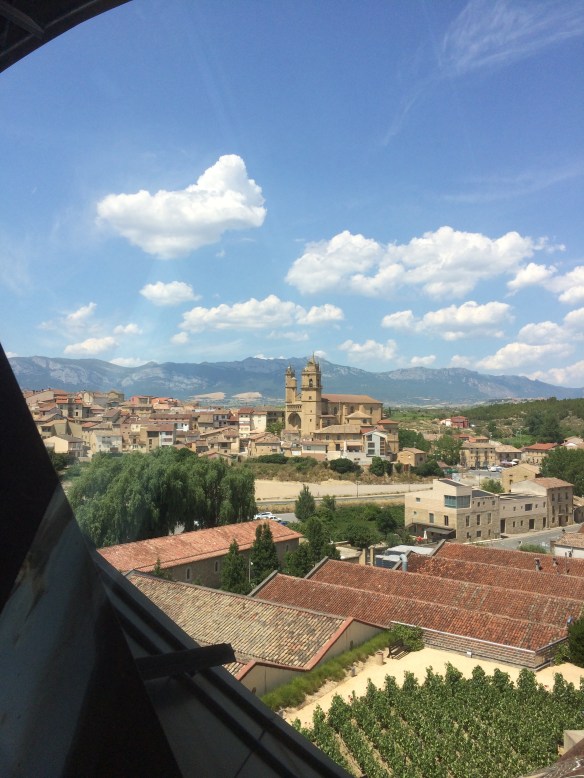
The town of El Ciego as seen from the restaurant at Marques de Riscal. Viewing the old from the very new.


Everything else was presented with the same whimsey and artistry. We lingered for a long time, peering out through the Frank Gehry swirls of titanium, then we left and sat in the breezy patio downstairs until it was time for our next winery tour.

Which was in La Guardia, a tiny, medieval, fortified hilltop town. You can’t actually drive through the town–it’s strictly pedestrian–though you can drive up to it. Being clueless, we had no idea where to park or where the winery might be. Tom finally parked next to an old church (probably illegally, but no one bothered us)–and set off on foot to ask questions. We knew we were within yards of the winery, but had no idea how to find it. The first few people he asked didn’t know either, but one person grabbed the winemaker and he came out and showed Tom where to go and told him where to park.

Detail of old fountain at La Guardia

Detail of old fountain at La Guardia


The winery is called Bodegas Carlos San Pedro Perez de Vinaspre. It is as sharp a contrast to Marques de Riscal as possible. The family has lived there and made wine for centuries in “caves” excavated underneath their house. The winemaker told us that every house in La Guardia has these cellars under their houses, originally dug to preserve food in their cool, dark recesses, and to hide in when there were wars, which apparently happened all the time. Sometimes La Guardia was part of the Kingdom of Navarre, sometimes the Kingdom of Castile. I suspect the residents didn’t care much, so long as the soldiers left them alone. Once things settled down, they realized they had the ideal conditions for wine storage, and most of the residents make their own wine, though not everyone sells it.

Cave of Bodega Carlos San Pedro Perez de Vinaspre, directly under the family's house

Cave of Bodega Carlos San Pedro Perez de Vinaspre, directly under the family’s house

First, he insisted on showing us a video about the wine-making process, which we sat through politely. (I told him that Tom used to make wine, but apparently this did not exempt us.) Then he took us down into the cellar. Definitely old school. Ancient stones dripping with mold. Casks dripping with mold–in one case, the mold looked like some sea creature was trying to engulf the cask it was growing on. I put my hand on the wall, and it came away smeared with wet, black mold. Then we tasted the wines–superb. When we toured Burgundy several years ago, some of the winemakers told us that the mold added to the quality of the wine, so maybe they had something there. (Shudder.)

Mold creature growing out of a barrel at Bodega Carlos San Pedro Perez de Vinaspre

Mold creature growing out of a barrel at Bodega Carlos San Pedro Perez de Vinaspre

The town was in the midst of a festival in honor of San Juan, La Guardia’s patron saint, so the tiny streets were thronged with merrymakers–bands, dancers, people in traditional costume, others in costumes not so traditional. That was a treat, even if it meant that finding parking was difficult.
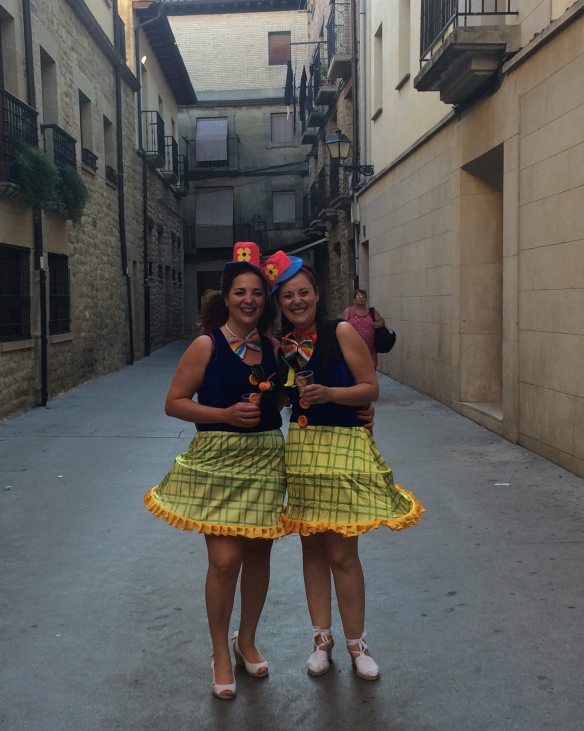
Festive ladies at the Festival of San Juan, La Guardia

Festive ladies at the Festival of San Juan, La Guardia

A most satisfying day. We ate at the tapas bar at Echaurren (our hotel) that night and met the chef–who, we discovered is also the chef at the restaurant at Marques de Riscal. He normally works in Echaurren’s restaurant gastronomique, but it, like most of the other top-rated restaurants in the area, was closed for vacation. I guess June is the slow season in La Rioja.

The next morning we departed for Barcelona, traveling through increasingly barren and desertlike terrain. At one point we crossed the Greenwich Meridian line. There was a modernistic arc across the freeway in an otherwise desolate landscape to mark the spot.

Tom stopped for a break at a rest area. There were a few shelters with picnic tables. We were sitting at one of these when a Spanish couple drove under the few trees for the shade, got out and asked if they could share our table. I said sure, and they hauled out a huge cured sausage of some sort and offered us some. I declined, being kind of tired of cured meats by this time, but the Spanish for the most part have been so kind and friendly.

We stopped in Zaragoza for lunch because there was a highly rated restaurant there. We parked the car in a perilous alley (because it was so narrow you had to fold in your side-view mirrors to avoid losing them) and walked to the restaurant. It was locked, though the hours indicated it should be open. I rang the bell, and it was answered by a server who–surprise!–asked if we had reservations. There were many tables, all completely devoid of patrons, but she told us they could not serve us. Because no reservations. (You would think we would learn from these experiences, but we didn’t, and ran into the same issue in Barcelona.)

So we wound up eating at “Smurf2 Cafeteria,” which was every bit as good as you might imagine, and went in search of our car, which we had a little trouble finding. Fortunately, given the heat, we only made two exploratory ventures before re-discovering it, and then we were on our way.

We stopped for gas at a place in the middle of nowhere. Literally–it was just a gas station. No town or anything. To our surprise, the gas tank cover wouldn’t open, though it had done so without difficulty every other time. The lady tending the station tried to help. Other people tried to help. We couldn’t budge it. Tom called the rental company, and they said they had to talk to their mechanic and they’d call back.

I went in to try to explain to the attendant what was going on. She didn’t understand my inept Spanish and called her son, who spoke some English. He asked me if he could drive out to help us! I thanked him for his kindness, but declined. I told his mother over and over how nice they were, how kind her son was. She understood that part.

The rental company called back to tell us that when it got very hot (which it was), the gas tank cover sometimes wouldn’t open. Good to know, but it seems like an impractical design in a hot country like Spain. The car had been sitting in the shade for a while by this time, and Tom tried the cover again. It opened without protest, we gassed up, and were on our way again.

Our hotel in Barcelona, Gran Derby, is lovely–much nicer than we expected. It even has a bathtub big enough for two–though we won’t be sharing–a sitting room with a bullhide for a rug (poor toro), and a bedroom. The shower–Tom said he wished he had taken photos of all the showers we have used. Each one has had strangely shaped controls–squares, sticks, cylinders–and each has had its own system of turning on and off, controlling temperature, etc. This one has square knobs and the drain is a slit in the flooring that runs all around the shower–haven’t seen that before. But the shower flooring is mercifully non-skid, though the bathroom tiling is made of highly polished brown marble that would be a perfect skating surface for someone with wet feet.
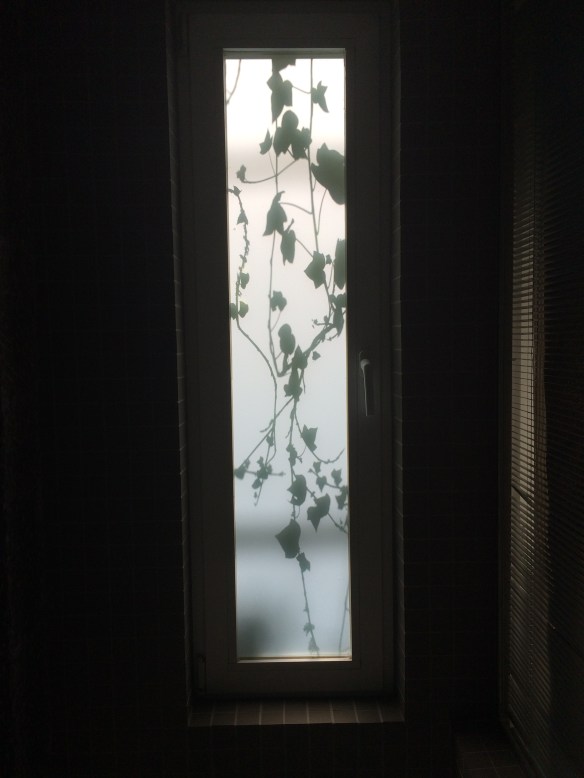
Window in our bathroom at the Gran Derby Hotel in Barcelona. Just thought it was pretty.

Window in our bathroom at the Gran Derby Hotel in Barcelona. Just thought it was pretty.

We selected a seafood restaurant right on the beach for dinner, Can Majo. When we got there, we were told that because we didn’t have reservations, they might be able to squeeze us in at 10 pm. (We are very slow learners.) So we made a reservation for 10 o’clock, had a snack at a seaside bar, and then walked down to the water. I dipped my feet in the water; my first-ever contact with the Mediterranean. I have hopes it won’t be my last.

At ten, they permitted us in the restaurant. We ordered paella, which is their specialty. Service was slow, which was fine as it gave us time to people-watch. I noticed a group of three people as they came into the outdoor seating area where we were. There were two model-thin women, gorgeous in that exotic Mediterranean manner, with long. black hair and smooth, brown skin and huge eyes. They were dressed beautifully and they were accompanied by a pit-bull and a man who might have been the model for the dog. I spent time making up stories about who they were and why these two beautiful women were having dinner with this ugly man. Then the two women seated at the table next to us squeaked and pointed. One of them said “Cucaracha, is that the word?” As I was looking for the offending insect, the ladies I had been making up stories about shrieked and dropped their cigarettes as the bug scuttled under their table. It proved to be a bonding experience with our neighbors and we struck up a conversation. They were from the Netherlands, spoke perfect English, and were having a girl’s weekend away. We had a long and pleasant discussion, ate the excellent paella, then headed back to the hotel.

I think it was about 1 am when we got to bed. This may be normal for the Barcelonans, but it’s kind of exhausting for me. Of course, I had had no siesta–I really should spend more time in bed.
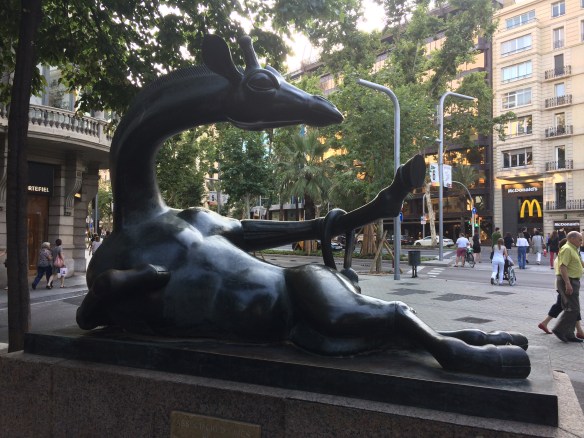
Sexy giraffe sculpture in Barcelona. For some reason.

Sexy giraffe sculpture in Barcelona. For some reason.
Velasquez Paints Peter Dinklage (Or Not.)

A few more thoughts on art in the Prado:

There’s a copy of the Mona Lisa by Leonardo Da Vinci in the Prado. It was definitely painted under Leonardo’s supervision, if not by the Master himself. If you have been disappointed by the Mona Lisa that hangs in the Louvre, I strongly suggest seeing this if you get the chance. The one in the Louvre has a yellowy-green cast; this one does not, and has clear, fresh colors. The Louvre version has severe cracking in the paint and warping of the underlying poplar wood; this one was painted on more expensive and durable walnut and is in excellent condition. The Mona Lisa in the Louvre is sequestered in an acrylic box and is usually surrounded by a horde of tourists who are not at all interested in allowing you to get a closer view; the Prado version hangs unimpeded and ignored. You can walk right up and examine it as closely as you wish. This is the Mona Lisa as it must have looked 500 years ago.

I wanted to see Velasquez paintings. The great thing about Velasquez is the faces–he’s one of those artists who are able to paint the soul and personality of the subject. There was one entire room with nothing but paintings of the jesters of King Philip IV and his court. One of the paintings was of a dwarf who looked very like Peter Dinklage, down to the “Don’t fuck with me” look in his eyes.

"Sebastien de Mora" by Velasquez

“Sebastien de Mora” by Velasquez. Or a very early portrait of Peter Dinklage.


This is an allegorical painting called "The Triumph of Bacchus." Bacchus is highly idealized, but if you look at the other faces, they are very real, with great personality.

This is an allegorical painting called “The Triumph of Bacchus.” Bacchus is highly idealized, but if you look at the other faces, they are very real, with great personality.


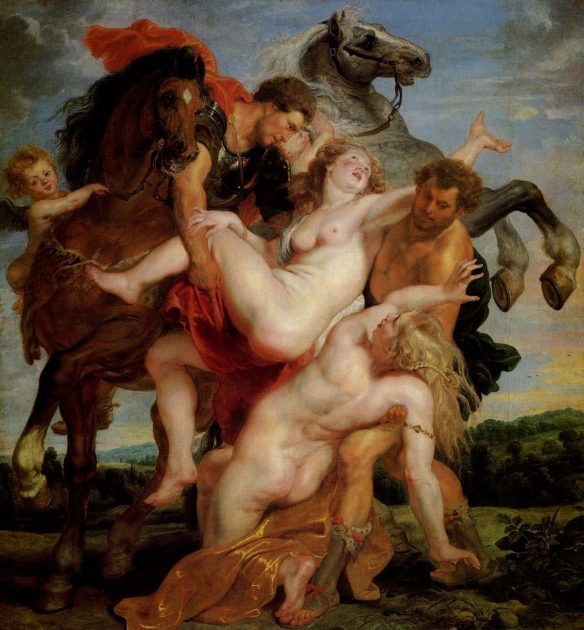
The Prado also has a number of Rubens, whom I’ve always enjoyed. First, because of his exuberance; he doesn’t just paint a horse, he paints a drama composed of glossy, bunched muscles, rolling eyes, and streaming, flossy mane and tail. (Frankly, his horses are a lot better than Velasquez’s. One or two of V’s horses looked biologically impossible.) His compositions are full of life and motion–even when the subjects themselves aren’t actually doing much. And then there’s the acres of glowing, pink flesh. The man loved ladies, and he hated to skimp on avoirdupois. The more, the better–that was Rubens. He would have adored me.

This one--I think it's the rape of the Sabine women--illustrates both my points about Rubens: horses and women. Leafing through Jansen's History of Art as a child, I used to wonder  how on earth those men were able to pick up the women.

This one–Rape of the Daughters of Leucippus by Castor and Pollux–illustrates both my points about Rubens: horses and women. Leafing through Jansen’s History of Art as a child, I I thought those guys must have been INCREDIBLY strong.


Okay, enough about art.

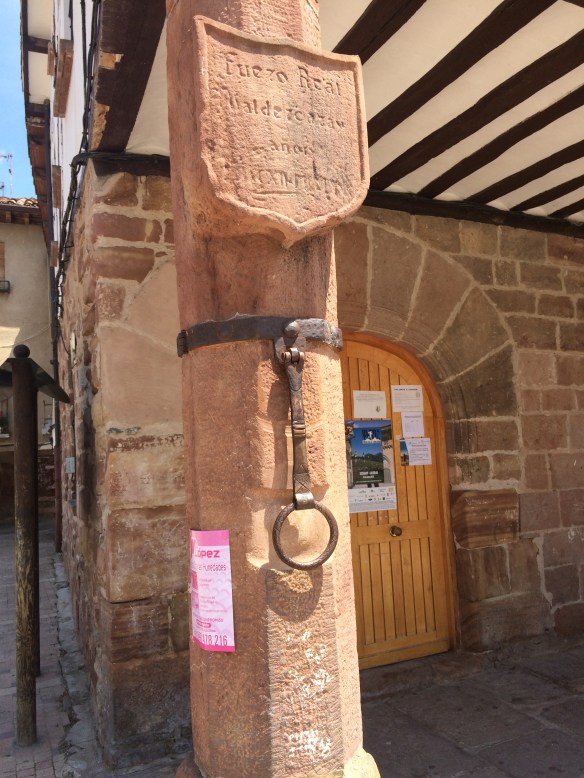
Ezcaray, where we currently are, is a village of 2,000 residents. The village also has 12 hotels and more restaurants than you would think possible in such a small place. Apparently, there has been continuous human habitation here since the Neolithic Age, followed by Romans, Visigoths, Moors, etc. Over lunch today, we had a discussion with a family about the area–they come every year. The father is from La Rioja (the region we are in), the mother is Brazilian and they live in Brazil. She told us about a ring set into a pillar on the square. The tradition was that if a bandit, Moor, or other outcast could make it through the town (with people throwing fruits and vegetables at them) and grasp the ring, they were granted sanctuary and could settle here. Whether apocryphal or not, here is the ring. It would look more impressive without the pink flyer pasted onto the pillar:

The Ring of Sanctuary. I may use that for a book title some day--it has a nice ring to it.

The Ring of Sanctuary. I may use that for a book title some day–it has a nice ring to it.


It rained the evening we arrived, and it was pleasant to watch the rain fall against the backdrop of the ancient church across the way. The temperature has been in the 70’s–a nice contrast to the heat of Madrid. The town is peaceful and tiny, bordered by small rivers and sheltered by the steep valley walls. So good to be here, after so many cities.

Although all the art, culture and history tends to be concentrated in cities, I just don’t like them. There are too many people, too many cars, too much noise–just too much of everything. My idea of a nightmare vacation is New York City. Cities just kind of oppress me in some way. I like being in the country or in small towns, closer to nature.

Our first day, we just walked around the town, taking pictures. We stopped to eat at a little bistro. It was quiet and relaxing after all the sightseeing. I am happy to be here.

The view from our hotel room in Ezcaray

The view from our hotel room in Ezcaray


A pretty little fountain in a square in Ezcaray. People sit here to read.

A pretty little fountain in a square in Ezcaray. People sit here to read.

The Mosque with a Cathedral Inside–Or Is It the Other Way Around?

We arrived in Cordoba after an easy drive from Sevilla (it was easy for me because Tom was driving). Our parador sits above the city in a pleasant neighborhood, and overlooks the entire city. Even more important, it has an elevator, which I greeted with cries of joy. Our quarters consist of four rooms–bedroom, sitting room, dressing room, bathroom and a large, sit-able balcony. It may not be as romantico as the parador at the Alhambra, but it is lovely, and there is a pool, which I took immediate advantage of. I enjoyed floating in the cool water, watching the birds drink. There were swallows, which drink on the wing, doves, and little yellow birds that look like goldfinches. There was no one else in the large pool, and the surrounding gardens are full of palms trees, hibiscus and orange trees. Paradise. The lifeguard speaks French, but not English, and I speak French but not Spanish. Between the two of us, we managed to miscommunicate in three languages.

The view of Cordoba from our balcony

The view of Cordoba from our balcony


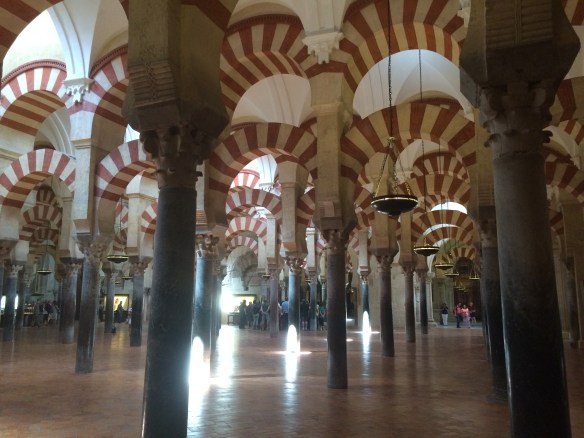
Today (our first full day here), we visited La Mezquita, the Great Mosque of Cordoba, which has been turned into a Catholic church. La Mezquita is one of the buildings I studied in art history, so it looked weirdly familiar, as though I had been there before. It has an odd history. It started as a Visigoth church. When the Moors came in the 700’s, the sultan bought the Visigoth church from the Christians, knocked it down and built a mosque. The mosque was added onto until the expulsion of the Moors. The Christians had the good sense not to tear down this incredibly graceful and beautiful building, but they did plonk down a gaudy sanctuary, altarpiece, and choir in the middle of it and appropriated the side niches as chapels.

The result is a mishmash of styles that mingle awkwardly together, like neighbors who get together to socialize only on Fourth of July weekend.

There was far too much detail to capture on camera, especially my iPhone camera, and some of the interesting things were behind glass or wrought-iron screens. but I will let La Mezquita speak for itself.

The famous striped arches made of stone ad brick.

The famous striped arches made of stone ad brick.


Ceiling, La Mezquita, Cordoba

The ceiling above the Christian sanctuary in the mosque.


Christianity meets Islam in the ceiling

Christianity meets Islam in the ceiling


High altar, La Mezquita, Cordoba

High altar, La Mezquita, Cordoba


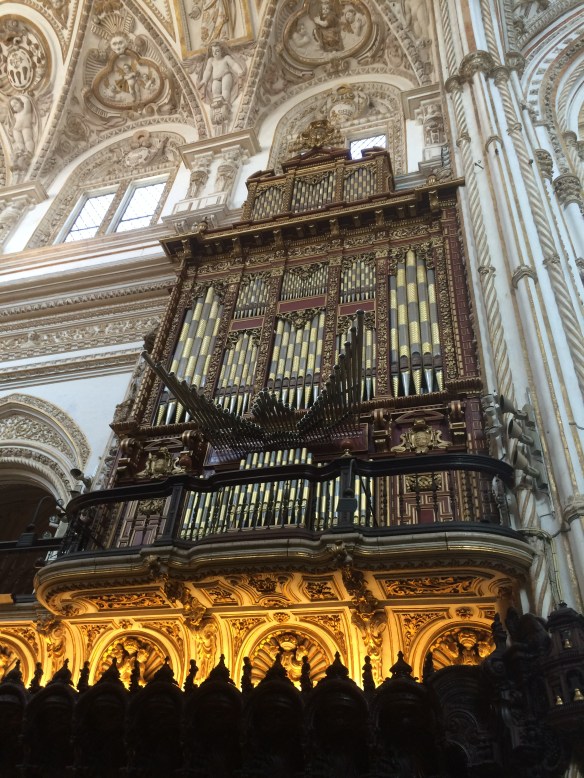
Pipe organ in the choir section, La Mezquita, Cordoba. A matching organ sits on the wall opposite. The position of the pipes is very unusual.

Pipe organ in the choir section, La Mezquita, Cordoba. A matching organ sits on the wall opposite. The position of the pipes is very unusual.


_DSC0152

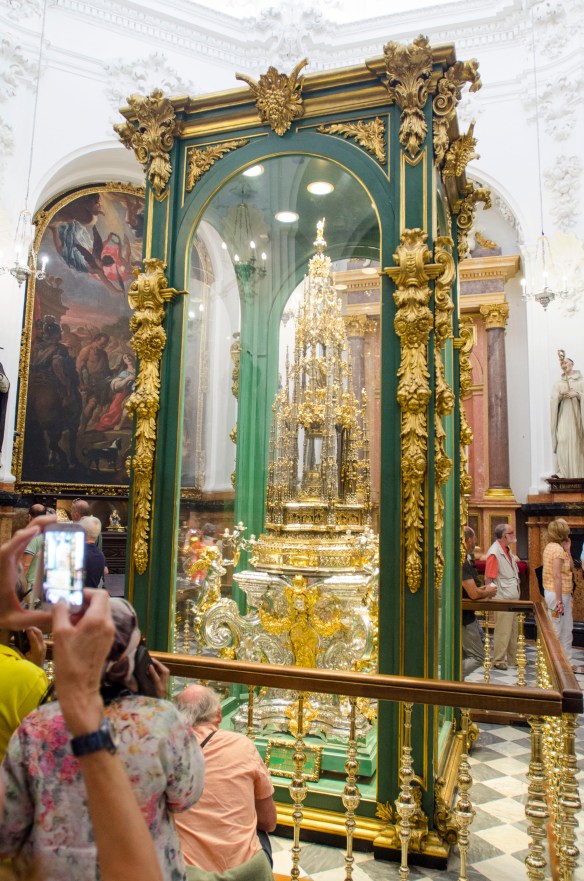
This thing is called a monstrance. I don’t know what it is used for, but it is solid gold. (OK, there’s some silver in the base section. Tom insists I be accurate in my reporting!) It is in the treasury of the cathedral/mosque, Cordoba.


I should mention something about Spain, apropos of nothing. All the historical places we have visited have had benches or chairs here and there so people can sit and rest their feet and appreciate their surroundings. I deeply appreciate this–more and more every year. I remember after touring the Louvre many years ago, we were beneath the big I.M. Pei pyramid. I was dying on my feet, and sat down on the floor, as there was nothing–not even a low wall–in sight. A security guard immediately came over and told me in French that it was not permitted to sit there. I asked why and got the most Gallic shrug ever seen. Later, walking around Paris, I sat somewhere random and got told to move along again. I began to feel like a vagrant, and my feet were miserable. Spain has the right idea.

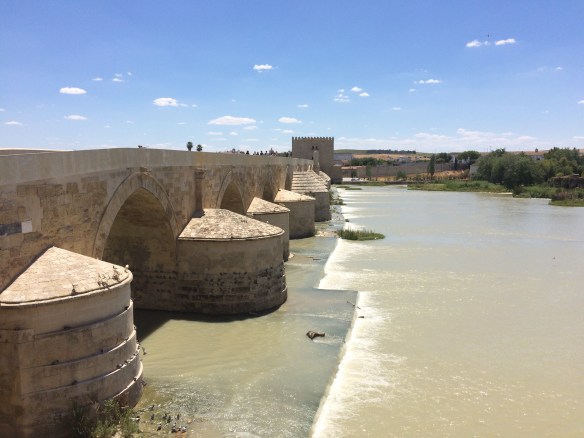
After viewing the mosque, we went in search of the Museum of Al-Andalus Life, that is, the culture of the Moors. This is housed in an ancient Moorish defensive tower that is reached via a bridge across the Quadalquivir River.

View from the Roman bridge across the Guadalquivir River toward the Museum of Al-Andal Life

View from the Roman bridge across the Guadalquivir River toward the Museum of Al-Andal Life. The museum is in the square building at the end of the bridge.


At the end of the bridge, some enterprising people had set up a large stall selling hats and cold water. Did I mention it’s in the mid-eighties today? Not horrible, but we both bought hats to keep the sun off our faces. We went to the museum, but they were closing for siesta in a half hour, so we stopped at a cafe, which, judging by the clientele, is a local fave. I had a beer, which to my nearest and dearest will indicate just how warm I was. Also tapas–of course!–as it was mid-afternoon.

View of the Old Town (Barrio Judica) from the Roman Bridge

View of the Old Town (Barrio Judica) from the Roman Bridge

We decided to backtrack across the bridge and go to the archeological museum. This was open, and we managed to get through prehistory, the Romans, and the Moors before this museum also closed. By this time, it was pretty hot, so we took a taxi back to the Parador, and I, for one, am going swimming!

My beloved in the center courtyard of La  Mesquita

My beloved in the center courtyard of La Mezquita


Walking in Sevilla and Getting Damned Tired of It. (Walking, Not Sevilla.)

We’re in Cordoba now, having spent three nights in Sevilla, during which I was too tired to post anything.

I slept quite late the first full day, which was a Sunday, so there wan’t much open in any case. We walked around, took some pictures, got rained on, had some tapas and tried to get oriented.

One of Sevilla's tiny streets in the old Jewish Quarter

One of Sevilla’s tiny streets in the old Jewish Quarter

We actually didn’t do much in Seville except for walk. Our hotel was reasonably near the Alcazar and the cathedral–but we never made it inside the cathedral. We spent a lot of time walking through the narrow, winding streets of the old Jewish Quarter (pre-expulsion). The houses are four stories high, and in some places I could almost touch the houses to either side of the street with outstretched arms. Cars can access some (but not all) of these cobbled streets, and when a car came along, we stepped into a doorway or onto the narrow sidewalk, if there was one. In addition to negotiating the Medieval and Renaissance walking surfaces, we had to keep a sharp eye (and nose) out for horse and dog poop. There are a lot of horses and lovely carriages in the old city that tourists can hire for merely exorbitant prices.

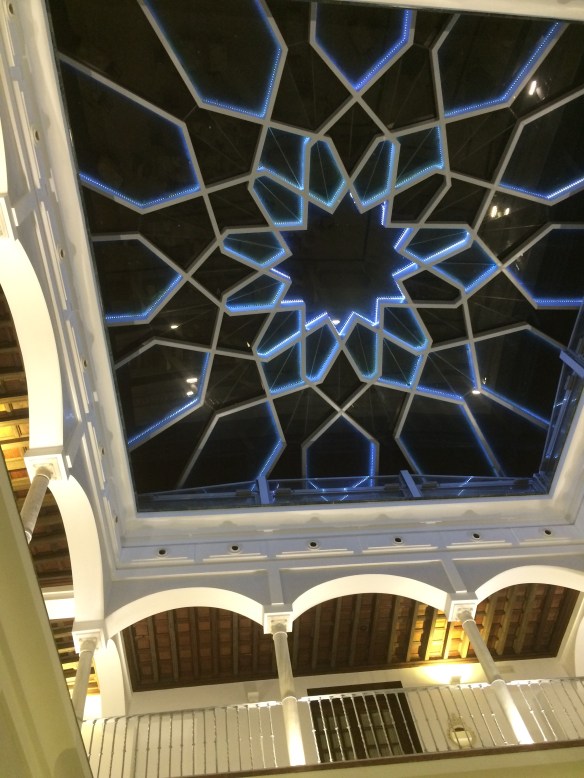
While walking, we passed by an interesting-looking restaurant, Sagardi. It had a small foyer for tapas, and a restaurant in a large, enclosed atrium. We checked out the menu and decided to come back when we were hungry. We had dinner there, and it was every bit as wonderful as we had hoped. We vowed to return for tapas another time.

Atrium roof, Sagardi restuarant

Atrium roof, Sagardi restuarant

Magnificent old tree in central Sevilla

Magnificent old tree in central Sevilla

The hotel we stayed in, La Casa de Maestro Boutique, was an old house on one of the non-car-accessible streets, but we did get a parking spot nearby. The hotel has oodles of charm, but the room was small and the shower miniscule. Once in the shower, if I dropped my shampoo (inevitable, as there was very little place to put anything), it was nearly impossible to pick it up. However, the room was clean and the bed was comfortable, and that counts for a lot.

Driving in this part of Seville is madness for a tourist, so we walked to the Alcazar the second morning. Flamenco is very big in Sevilla, and there are stores selling very high-quality Flamenco-related goods such as fans, silk shawls, dresses, castenets, etc. (You can also get el cheapo versions of these in gift stores). My sister wanted a Spanish shawl, so I went into one of these upscale stores to find one. While there, I saw the most gorgeous shawl I have ever seen in my entire life, or hope to. I have extremely good (read “expensive”) tastes: it was the equivalent of $1500 US. It was love at first sight, but it will have to be a long-distance relationship.

Lusting in my heart for this shawl. Wouldn't this be a lovely Christmas present for me? I thought so, too.

Lusting in my heart for this shawl. All hand-embroidered in silk. Wouldn’t this be a lovely Christmas present for me? I thought so, too.

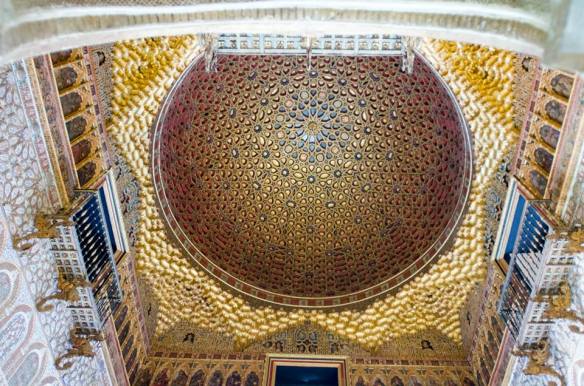
The Alcazar of Seville was build by King Pedro the Just or Pedro the Cruel, depending on whether you were one of the people (the Just) or an aristo or member of the clergy (the Cruel). Pedro really liked the Moorish style or architecture and ornamentation, and used it throughout his palace. It is fronted by a 12th-century gate, very rustic and antique-looking, considering the elegance lying just beyond. You walk into a vast plaza, flanked on three sides by different buildings. One is Pedro’s palace, one was the house of someone else important–the mayor of Seville?–done in a more traditional Spanish style, and one is another wing of the palace built by a later monarch who very much disapproved of Pedro’s taste in architecture, because it is a thoroughly Italianate Renaissance building. So it’s a rather odd mishmash. Pedro’s palace is rich in lacy Moorish stonework (even bearing the name of Allah in this most Christian palace), brilliant tile work, Moorish arches, carved, painted and gilded ceilings, and fountains. One room, the Ambassadors Hall, is completely tiled up to the ceiling, three stories up.

The Alcazar, showing Pedro's palace to the left, and the important person's house to the right.

The Alcazar, showing Pedro’s palace to the left, and the important person’s house to the right.


Ceiling of the Ambassadors Hall, the Alcazar Seville

Ceiling of the Ambassadors Hall, the Alcazar Seville


Hall of Ambassadors, Alcazar, Seville

The Alcazar is the residence of Spain’s current king and queen when in Sevilla, but we had an impression that they don’t stay here much. Hard to imagine they would want to stay at a place that is overrun with tourists all the time. We bought tickets for the private royal chambers, which are upstairs, but I’d be willing to bet they have other, much more private chambers there for their actual use. These rooms reminded me of other palaces in other places, with many oil paintings of ladies in voluminous dresses and men in tight white pants, crystal chandeliers, gilded clocks, etc., etc.

Reflecting pool, the Alcazar

Reflecting pool, the Alcazar

There are many lovely courtyards, reflecting pools and fountains throughout the palace, and the whole is surrounded by yet more gardens. It’s a gorgeous place, but I have to admit I was not as thrilled as I should have been because my feet hurt. A lot. I disappointed myself in my unwillingness to do more exploring, but there we have it. We found the cafeteria and had some wine and split a sandwich, then left. We found a horse and carriage next to the cathedral and got a ride back to the hotel, which I thoroughly enjoyed, largely because I wasn’t walking, but I do enjoy the clip-clop of horses and yes, the way they smell.

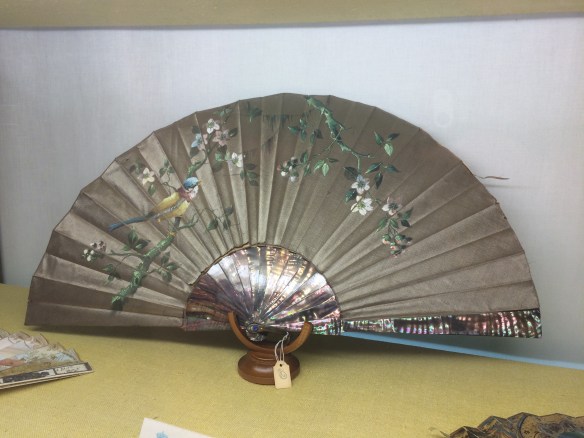
Gorgeous antique fan on display at the Alcazar

Gorgeous antique fan on display at the Alcazar

Later, we walked to Sagardi for tapas and wine. The tapas were delicious, but we decided to find another tapas place–it’s what people do in Sevilla. While wending our way through the tiny streets trying to find another tapas bar (a specific one; there were plenty of tapas bars. It made me wonder if anyone cooks at home in Sevilla.), I realized I had a blister. A quick trip to the pharmacy solved that problem, and we eventually found our tapas place, situated on a plaza across from City Hall. We had more excellent tapas, but by this time, we were both full. We did stop on the way back to the hotel for small ice creams, but this hardly counts. I feel like we should have gone to the cathedral–it’s the largest in Spain (that means very, very large)–but couldn’t work up enough enthusiasm.

Then it was early (for Spain) to bed, with Cordoba awaiting the next day. I mean, after we pick up our laundry, that is.


The Sublime and Then There’s Peeing in the Parking Lot

This is the first long-haul trip I’ve been on in a long time that I didn’t just about die from jet lag. Tom and I landed in Madrid in the morning and napped for a few hours in the hotel before heading out for what passes for an early dinner in Spain at 9:00pm. (Tom is in heaven. Nine o’clock dinners and lunch at 4 pm.) We went to bed at about 11 and woke at 6 am. I felt wonderful, and we were now attuned to the Spanish timetable. Absolute magic, especially since the trip lasted approximately 20+ hours in all, and I was awake for the entire time. plus travel to and from airports, because I don’t sleep on airplanes. Please don’t send me your sleep remedy–I’ve tried them all. This time I drank three glasses of wine and took two Xanax and DID NOT GO TO SLEEP. (Also please do not send me warnings about mixing pills and alcohol. I normally would not, but I was desperate–and yet I still didn’t conk out.) It’s been this way since I started flying at the age of two. I am not anxious about flying or tense during a flight. I just Do. Not. Sleep. It’s a major frustration, and sometimes leads to up to three vacation days just recovering from jet lag.

But this morning I was bright eyed and bushy tailed. We rented a car and Tom headed to Granada with no maps or GPs and got us there without any problem. Andalucia reminds me a lot of California, except instead of miles and miles of grape vines, there are kilometers and kilometers of olive trees.

We are staying at the Parador de Granada, which is actually inside the Alhambra Palace complex. We had a bit of trouble figuring out where to go and how to get there without buying a ticket to the palace (we are getting these through the parador). So we parked in one of the paid lots, which is a long way from the parador. As we were walking, we saw a woman sitting sideways in the open driver’s seat of her car with her legs spread wide, peeing on the asphalt. Well, they say travel broadens the mind, and that certainly was a completely new sight in my experience.

Our bedroom at the Parador de Granada

Our bedroom at the Parador de Granada


The parador is gorgeous, and everything here is amazing. There are nightingales singing in the trees! We couldn’t be happier with the room(s) (yeah, it’s pretty swank, but Tom tells me not to get used to it), and tomorrow we tour the palace.

Sparkling wine and yummy treats awaited us in our sitting room at the parador

Sparkling wine and yummy treats awaited us in our sitting room at the parador


Cool archway in the parador. The paving is made of different colored pebbles in intricate patterns.

Cool archway in the parador. The paving is made of different colored pebbles in intricate patterns, but it’s hard to see in this photo.


Oh, and I have been able to navigate in Spanish and make myself understood, which thrills me because I never studied it. I probably owe this to my mother, who was bilingual English/Spanish, but who for some reason wanted me to take French. (French speakers in California are extremely thin on the ground.) Thanks, Mom! Your blessings continue to enrich my life.

Race Is Dead. Racism Is Alive and Well.

Diverse group of kids outside.

With the spate of recent police killings of blacks and the resultant urban riots, race has bullied its way to the forefront of American consciousness yet again. Along with the rest of you, I have read the various postings and news stories—and been horrified by the nasty, cruel, bigoted comments that follow.

What astounds me is that people still think race is a thing. With DNA science and technology, it has been proven beyond any shadow of a doubt that the concept of race is completely, utterly false. There is no such thing as race.

Let that sink in: there is no such thing as race.

According to the National Human Genome Research Institute of the National Institutes of Health, “All human beings are 99.9 percent identical in their genetic makeup.” The remaining 0.1% difference accounts for diversity in skin tone, eye color and shape, and thousands of other variations between one individual and another. It has also been shown that every human being on Earth can trace his or her DNA ancestry back to Ethiopia of about 150,000 years ago. We are ALL out of Africa, every last one of us.

This means that a bushman in the Kalahari Desert, an office worker of European descent in New York and a factory worker in Taiwan are almost literally brothers. All that hatred, violence, fear, injustice, and bloodshed is over a 0.1% difference between us that takes place in structures so small we can’t see them without a scanning electron microscope.

Racism has apparently been with us as long as there have been hominids. Jane Goodall observed young male chimpanzees band together to hunt and bludgeon to death chimps of a different social group (a phenomenon that caused her a great deal of disillusionment and sorrow). There is some archeological evidence that homo sapiens may have caused the demise of other early hominids such as Neanderthals and Denisovans. Maybe we shouldn’t be surprised—after all, human DNA differs from chimpanzee DNA by only 1.2% (http://humanorigins.si.edu/evidence/genetics). That makes us cousins, if not brothers.

So here we are, thousands upon thousands of years later, still beating each other up for being different. During the 19th Century, (white) anthropologists and others tried to deploy science to support race theory. “Scientists” measured skulls and defined “racial” characteristics to prove that there were different races of men. Of course, they had already decided—scientifically, of course!—that Adam and Eve were white, making the white race the “original” and the peak of creation. Falling short of the white measurement stick, all other races were deemed inferior. All kinds of ludicrous models were set up to “prove” this, spawning horrors like eugenics, genocide and the Nazi Holocaust.

In the clear light of DNA science, all these antique constructions were blown away like the dark and ugly cobwebs they were. Unfortunately, much of the world does not seem to have received the message. Although the concept of “race” is utterly false, racism is very real.

I read recently (sorry, can’t remember where) that racism today is really tribalism—“Us” versus “Them”—and that race has little to do with it. That may be true, but if you ask a white bigot about why he hates blacks, you’ll hear a lot of claptrap about the differences between the “races.”

There’s also nonsense coming from the side of the oppressed, probably in natural retaliation for the crimes of racism. For instance, I have read that there is no such thing as reverse racism. The idea is that if you are not a member of an oppressed minority, you cannot be victimized by racism; racism can be directed only from the empowered toward the powerless. C’mon, guys. That’s just justifying racism under a new euphemism. It’s a made-up notion with no more basis in fact than “blacks aren’t intelligent enough to go to college.” Human beings have a tragic penchant for attacking “The Other,” and what color you are makes no difference.

My granddaughters are of “mixed” DNA. We know from DNA tests of their parents that they have genes inherited from almost every group on Earth. (There must be some interesting stories back there!) They are beautiful, tender, loving, and they have no idea at all that there is a concept called ”race.”

I want these children to grow up in a world where “race” is viewed as a hideous artifact of a long-dead age. There is no such thing as race. There are only human beings in their infinite and interesting variety. Help me get the word out.

The Last Day on Molokai and a Return to Halawa Valley

Tom really is a hero. He agreed to drive the steep, winding, one-lane road back to Halawa Valley so that we could visit the beach there and maybe hike to the waterfalls. He surprised me–and this is after 43 years of marriage.

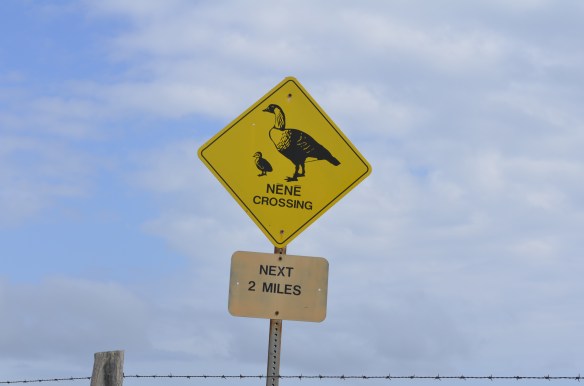
The drive was spectacular, and we stopped to take photos of things we remembered, but hadn’t stopped for the first time because of unfamiliarity with the road. For instance, there’s this sign:

Nene crossing sign.

Nene crossing sign.

Nene (pronounced nay-nay) are the native Hawaiian geese, and they are endangered. Sadly, we didn’t see any geese, just the sign. We also saw this, which we think is a roadside memorial, but it’s a bit different than the usual. In addition to the sun made of white coral, there were offerings:

Roadside memorial.

Roadside memorial.

There was no one waiting at the bottom of the road this time. We parked and walked down the dirt road to the beach. There is a river flowing into the sea here, and it’s  picturesque:

River at Halawa Valley.

River at Halawa Valley.


Beach at Halawa Valley.

Beach at Halawa Valley.


We picked our way along the beach, and I saw what I expected; lots of small pieces of plastic in the sand, white and blue, black and gray, yellow and red–the detritus of the Great Pacific Garbage Patch, collecting on this remote beach. I began picking up the larger pieces and putting them in my pocket. by the time we left, both pockets were bulging, and my arms were full of still larger chunks, bottles, and a small section of plastic fence. Tom gently makes fun of my plastic policing, but I regard it as the little that I can do to make it better. Worth nothing in the face of the magnitude of the problem, I agree. And many of the pieces were so small as to be impossible to retrieve, reminding me of “Rumplestiltskin,” where the poor girl has to count all the grains of sand or spin straw into gold.

Some of my plastic finds. Pockets are bulging with smaller bits.

Some of my plastic finds. Pockets are bulging with smaller bits.

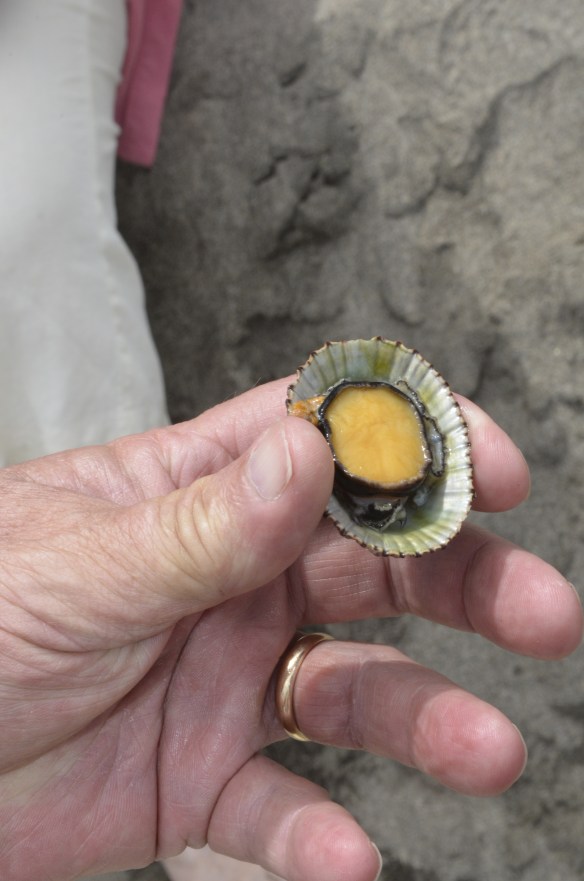
A Hawaiian family was picnicking on the beach. A young woman named Noni (noh-nee, means “beautiful”) was sitting on the sand, while her sister, husband and nephew were on the rocky point under the cliffs, fishing. We chatted for a while, and then her husband came back with a net bag full of ‘opihi (oh-pee-hee, limpets). We asked what they were going to do with them, and he said they were best barbecued, but could be eaten right out of the shell. Did we want to try one?

Yes, we did. He had lost his knife while prying ‘opihi off the rocks, but he used one limpet shell to dislodge the resident of another shell, and offered us some. They were rubbery, and the primary taste was a mild saltiness, but I’m sure they are delicious barbecued. This inside of the shell had a lovely iridescence, tinged with green. I washed mine out and brought it home with me.

Snack time!

Snack time!

We asked about the hike to the falls. Noni said it was really difficult, and she hadn’t done it in 20 years, so we decided to give it a miss. (Later, I learned that it takes two hours just to get there. I probably made the right decision.) After dumping my collected plastic in the trash bins provided, we got into our car and drove slowly back, taking pictures as we went.

Rainforest stream.

Rainforest stream.

Once we were back in two-lane country again, we stopped to take a picture of this:

Chicken condos.

Chicken condos.

I called it “chicken condos,” as they appear to be individual shelters for chickens or roosters. As I was taking the picture, a pack of dogs ran up to the fence and barked their heads off. A very large Hawaiian came down the drive, looking rather menacing. I waved and said I was just taking a picture of his chickens. He didn’t smile, but waved more or less amicably and went back down the drive. My guess is that he’s raising fighting cocks, which is abhorrent, but I don’t know.

The only real proof we saw that there are deer on Moloka'i.

The only real proof we saw that there are deer on Moloka’i.

We also stopped at a grove of coconut palms, right outside of Kaunakakai. This used to be a much larger grove called “the Queen’s Grove,” because it was planted for the wife of King Kamehameha V. It’s right by the beach, and the trees must be 100 feet tall, each with a cluster of coconuts clinging to the top under its fronds. There are piles of coconuts on the ground, both fresh, green ones and old, hairy ones. The top of my head began to feel peculiarly vulnerable as I imagined what a coconut would do to it after a drop of 100 feet, so I left.

The Queen's Grove.

The Queen’s Grove.

Then back to the condo. I was very behind in my journaling, so spent most of the late afternoon writing, listening to the waves crashing on the rocks nearby, and enjoying the trade winds. When we went to bed, another three-inch centipede was occupying the hallway upstairs, and I gave him the same treatment I gave Jesse the Centipede a few nights ago–a beating with my flip-flop. Neither centipede put up a fight, making me think they were unwell to begin with.

And so the journey came to an end, as all journeys must do–which is the beginning of another journey for me; writing a new novel. The entire experience was amazing. People were so helpful and kind, so willing to bring me into their lives a little bit. It was extremely touching, and I will never forget the experiences I had here. As a parting wave, here are the signs that greet new arrivals to Moloka’i, and bid departing travellers farewell:

Aloha!

Aloha!


Moloka’i Nuts, Coffee and Sorcerers

Day 11: Moloka’i

We were supposed to meet Auntie Opu’ulani today at 9 am, so we set our alarm. This turned out to be unnecessary, but as we were getting ready to go, We got a call on the condo phone from Auntie saying she had to babysit her grandchildren that day. (I still don’t know how she figured out the number–remember my iPhone was sacrificed to the sea gods.) She’s pretty jammed for the rest of the time she will be here because of the upcoming Makahiki Festival.

Makahiki is the ancient Hawaiian new year festival. It used to be four months long. It was a time when many of the repressive kapu were lifted, and there were athletic competitions, hula, games, feasts, and fun. Today it is a week long, and a celebration of Hawaiian culture. I am kicking myself that we are leaving just as Makahiki begins, but I probably wouldn’t have been able to do what I needed to do here because everyone would have been too busy.

So I offered to treat her to dinner, and we agreed to meet at Paddler’s Inn at 7 pm. That left the day wide open, so we decided to explore. First, we drove to Purdy’s Macadamia Farm, the only mac grower on Molokai. This consists of 50 trees that were planted 90 years ago on five acres. The entrance to the farm has this sign, homemade and similar to other signs you see on the island:

Asking the tourists to go with the flow on Moloka'i.

Asking the tourists to go with the flow on Moloka’i.

As we walked down the road, we were greeted by a small, skinny black cat. I miss my kitty, so I stopped to pet it. It turned out there were several other small cats, employed on the farm to kill rats, who eat the nuts.


We arrived in the middle of a tour. There was a wooden trough set up with whole mac nuts. There were holders made out out of old rubber tires and hammers to crack the nuts on pieces of stone in the trough. This is, of course, not how they are commercially processed. Mac nuts have a thick outer husk. The guy in charge of the tour bit into a husk and removed it to demonstrate. Then they have a very hard inner shell. If you whang them with a hammer, you can get at the nut meat inside. This was being directed by a short, fit Hawaiian with an attitude. He was the first Molokaiian we have met who was not pleasant, and the feeling we both got from him was open disdain.

Mac nut cracking station.

Mac nut cracking station.

After the nutcracking exercise, we tasted roasted and salted nuts (all natural, no other chemicals like the preservatives in canned or packaged nuts. Nothing added but sea salt, according to our surly host.), then got to taste raw coconut dipped in macadamia flower honey, which is not made on the farm. That was delicious and different. As this was going on, I noticed a dark, raffish-looking fellow with gold chains who was looking on, extracting raw coconut from a shell and throwing pieces for the cats to eat. The cats all scrambled for this coconut as though it were Li’l Friskies.

The grove of nut trees was immaculate. They don’t pick the nuts; when the nuts are ripe, they fall to the ground and they are harvested daily. The ground was absolutely bare between the trees except for a few piles of leaves that had been collected. Like coffee, mac trees have flowers and nuts in every stage of development at the same time.

After the mac nut farm, we drove to nearby Kualapu’u, which is where Coffees of Hawaii is. I wandered into the gift store intending to buy some coffees and spied the raffish cat-feeder. He was leaning casually against the counter, talking to the clerk.

“You look familiar,” I said. He looked surprised, then said, “You were at Purdy’s just now, weren’t you?”

I agreed this was so and commented that the host there was the only unfriendly person we had encountered here. He said he brought tours over from Maui on the ferry, and he always told them that the guy worked with nuts all his life, and so of course, he was a little nuts himself. Clearly a stock comment that he used all the time. He also said the man didn’t like it when you played with his cats, because they had jobs to do. I didn’t ask how our crabby host felt about feeding his cats coconut.

Tom went to the coffee bar and ordered two Mocha Mamas, the speciality of the house. This was sort of a coffee smoothie, with Molokai coffee, chocolate, ice cream, and whipped cream. Hardly any calories at all. It was delicious, but I couldn’t finish it.

On the way out of town (which takes about 60 seconds), I spied a gift store tucked into the Kualapu’u Business Park. Tom patiently parked the car and I went in. I had nosed around in several gift stores, but no joy. Either the stuff was complete junk, or it was truly original, handmade, beautiful, and hideously expensive.

To my surprise, this place had lovely things, reasonably priced. I saw this necklace, the octopus carved of mother-of-pearl, with jade beads on a beautifully knotted cord:

My new octopus.

My new octopus.

It was reasonably priced, so I bought it, along with some pretty mother-of-pearl earrings that, if anything, were underpriced. I very much wanted a large, carved turtle for my bathroom wall, but my suitcase is already perilously close to getting charged for being overweight, so the turtle remained where he was.

A side note: the octopus (he’e in Hawaiian, pronounced hay-ay) is associated with the sea god Kanaloa because the octopus is slippery, sly and sneaky (though sometimes it is the squid, not the octopus that is associated). Kanaloa is kind of like Satan. He created all the stinging, poisonous creatures that plague the people. He presents himself as beneficial sometimes, but will trick you. He rebelled against the chief god, Kane, and was forced to descend to the underworld, where he is known as Milu. (Sound familiar?)

Personally, I like octopi, and think they are fascinating. You wouldn’t expect a mollusk to have much of a brain, and most don’t, but octopi are smart. Look at this video:

Given how dependent the ancient Hawaiians were on the ocean for food, and how much time they spent in it surfing, swimming and sailing, you wouldn’t think the ocean god would be a Satan-equivalent. But the ocean, too, can be deceptive, changeable, dangerous and cruel, so I guess it makes sense.

After that, we returned to Paniolo Hale. I wrote the rest of the afternoon, and then  we drove into Kaunakakai to the Paddlers Inn. This is a hopping’ place at night, and we had trouble finding parking. I went into the restaurant and looked around. A band was playing Hawaiian music in the corner. The room was filled, and the waitress said because we didn’t have reservations, and there was a large group of tourists that had to be fed, we would have to wait. I asked her if she knew Auntie Opu’ulani, and she shook her head. I saw the waitress who had served us before, an older woman, and asked her. She said yes, she knew Auntie, and pointed to a woman sitting at a side table. I went to introduce myself.

Auntie Opu’ulani is a woman of about my age with dark, curly hair frosted with silver, and a wide, friendly face. She greeted me warmly, and then I set about trying to solve the seating problem. I had noticed when we came in that the bar was completely empty, and I asked our helpful waitress if we could get served in the bar. That suited me much better, anyway–it was quieter, so we could talk and actually hear each other. She said of course we could, so Tom and I and Auntie retired to the bar.

Auntie Opu'ulani.

Auntie Opu’ulani.

I asked Auntie Opu’ulani about mo’olelo. She asked how I intended to use them. I said my motivation in learning them was to better understand Hawaiian culture. I did not intend to retell them, but rather to have them inform my story. Tom chimed in with a description of “The Obsidian Mirror,” and explained how that related to what I was doing on Molokai.

She said she had learned the chants from her grandparents. She had been the 6th of 12 children, and her mother was ill when she was born, so her grandparents adopted her–very much in the old Hawaiian way. She said they had been born in the 1890’s. They were very strict, but loving. They believed that one’s possessions should be cared for, and that nothing was to be treated casually, as people do today. She loved them dearly, and they taught her the proper way to be Hawaiian, as well as the old chants. Auntie said the chants unique to Molokai had never been written down before, but that was her task now that she was retired.

Auntie Opu’ulani is a retired teacher. She teaches the Hawaiian language, although she was reluctant to do so at first. She said it all had to do with her name. I said I thought Opu’ulani meant “Heavenly House,” as Jeanine had told me, but she said no. It meant the tip of the incoming wave before it has broken–or the tip of the tooth of a sperm whale (highly valued). She used to be teased at school because the other children said pu’u meant she had a fat stomach (remember my lesson from Leimana at the fishpond?). She was unhappy, and asked her grandmother why she had been named that (traditionally, grandparents named the children, trying to give them a name that would signify their character). Her grandmother just looked at her and said, “Someday, you will understand the meaning of your name,” and that was that. Years later, she realized that her role was to help perpetuate the Hawaiian language and culture. She has published two books in Hawaiian, with the assistance of Jeanine. (I must find out more about Jeanine!) Auntie said Hawaiian was taught at a very simple level to small children–and then at a very complex level to older kids. There was a gap, and she bridged it with a textbook and a novel aimed at middle-schoolers. So she has been the tip of the wave, bringing back the culture to other Molokaiians. My interpretation; as I have mentioned, Hawaiian is highly metaphorical.)

I asked about menehune, and she told me that her grandfather had seen one. He was walking in the high country and stopped to rest in the shade, but someone kept throwing nuts at him. He saw two small feet dangling from a branch, then a tiny man jumped down and ran into the brush. The menehune was warning her grandfather not to rest there. I asked if they were still around, and she said yes. There are plenty of places in the back country where they live. Menehune work closely with pohaku (poh-hah-koo, rocks), to build things like fishponds. By this, I think she means the rocks contribute as much a part of the work as the menehune.

She said there are many things in the chants that actually exist. Her son, who loved to hike, once found a spring in the high country that flowed out of the rock, then disappeared back into it again–something described in one of the chants. He filled bottles with this water and brought it home. When Opu’ulani drank it, she thought he had added something to it because it was so sweet, but her son said no, that was just the way it tasted.

Auntie believes the Ali’i, (ah-lee-ee, the upper class/nobility of ancient Hawaiian society) came originally from the Americas. (There is a generally accepted theory that they came from Tahiti. The mo’olelo refer to the original Ali’i coming from “Kahiki-nui,” or “great Tahiti.” However, DNA testing of any group of people is far from complete, and there have been some very surprising finds. for instance, DNA analysis of extremely ancient human remains found in Peru show direct a relationship with both the Ainu of Japan and with Australian Aborigines. So I wasn’t about to argue.) Her own ancestors came from Maui, she said, but when they got here, there were many uhane ino (oo-hahn-ay ee-no, bad spirits) who possessed peoples’ bodies, and the people had to get rid of them with prayer and fasting to live here.

I told her the story of the doomed lovers that Leimana had told me, and asked what it had to do with the big turtle rock in the channel. She told me, but that is part of her mo’olelo, so I can’t repeat it. I said the story of the two lovers sounded like it really happened, and she said that it did. She agreed with me that it sounded like something two teenagers might do. I also asked about the heiau on Molokai. I had read that Molokai was known for its powerful sorcerers, and they had built this enormous heiau on the Maui-facing side of the island to intimidate potential invaders from that island. It was a place of much human sacrifice, and there is the story of a kahuna (priest) who lost seven sons to this practice.

Auntie Opu’ulani confirmed the heiau as a place of sorcery. She used to take people from other islands on tours there (it is on private property and you have to get permission to visit). One day, she was guiding a group of kupuna (elders) from Maui. She and another lady sat down on some rocks to rest. Suddenly, the other lady jumped up and went directly back to the bus. Opu’ulani later found out that the lady felt that the rock was “trying to enter her.” She said the heiau was a bad place because of the human sacrifice, and if we visited, not to sit on the stones.

Auntie Opu’ulani was exactly the person I had wanted to meet. Educated, dedicated to her culture, and a believer. I decided to tell her my experience with the lei at Kilauea. When I described turning around to find the lei gone, she nodded quietly and said, “Pele accepted it.” I asked her to read the manuscript for the book I am working on (once I actually have a manuscript), and I offered to pay her for it. She said she would be glad to. As we prepared to leave, I asked if I might contribute to her work, remembering what Jeanine told me about offering money, but Auntie would not accept it. Of course, I offered to send her “The Obsidian Mirror” as a way of saying thank you, and this she accepted.

What a beautiful, gentle woman. I am so lucky to have met her!

But I don’t think we’ll be going to the heiau.

A Return to Molokai’s Fishponds, a 2,000 Foot Vista, and a Phallic Rock

Day 10: Moloka’i

I awoke about 6:00 am, as I have been doing for a while. It was still dark. I went downstairs to make some excellent Moloka’i-grown coffee, then began writing, trying to catch up on our adventures with Leimana. We didn’t have to be at the fishpond until noon, so there was plenty of time to write, for once.

The drive to the fishpond is about an hour. There aren’t a lot of roads on Moloka’i, and no stop lights at all. The pace of life here is relaxed, and people are patient. Vehicles always stop if you are trying to cross the road. When you pass someone on the road, you wave whether you know them or not. People always say hi when they encounter you (or aloha). When you ask for directions or information, they drop everything to attend to you. It’s very like New Zealand in that respect. Not that the people of the other Hawaiian Islands are unfriendly or rude; there’s just a lot more “aloha” on Moloka’i. (Aloha means hello and goodbye, but it also means “love.”)

We arrived a little after noon. Leimana, in malo and fishhook necklace, was at the pond waiting for us. His first lesson was a lot of Hawaiian words. I did not retain all of them, but I did get a few questions answered.

I didn’t ask these questions; Leimana never answered a direct question with a direct answer. But he inadvertently defined the difference between “mauka” and “mauna,” both of which I understood to mean mountain. As it turns out, mauna, as in Mauna Loa, the volcano, means big mountain. Mauka (as in the common usage “mauka-side,” or toward the mountains), means smaller mountain. Then there were words for successively smaller hills and mounds, which I don’t remember. Except for pu’u, meaning a small hill, but this is used for other things, as we shall see.

Leimana was writing these words in the sand with a stick. He has lovely, clear sandwriting, like a schoolteacher.

Leimana's chalkboard.

Leimana’s chalkboard.

I also had been wondering what a pi-pi-pi looked like. Pi-pi-pi means “small-small-small.” In Hawaiian, when a word is repeated, it creates an emphasis. So pi-pi-pi means extremely small. I knew they were a small mollusk that people ate. Leimana had a number of of these clinging to the walls of the fishpond. They are small black sea snails. (I told you I was nuts about shells.)

I asked about the clusters of coconuts at the fish gate. He gave me a rambling answer about coconuts symbolizing food, therefore home, therefore hospitality. I am beginning to understand that Hawaiian is a highly metaphorical language. All languages have metaphors (I think), but in Hawaiian, you might talk about the fishpond as a pu’u, small hill, because it is rounded, and because you might also call someone’s prominent belly pu’u, and the fishpond also fills the belly. Someone like me might easily misunderstand, but to a Hawaiian, it would be obvious.

Leimana demonstrates the way to place rocks for a fishpond. He says hula builds up the right muscles for this.

Leimana demonstrates the way to place rocks for a fishpond. He says hula builds up the right muscles for this.

Which means I have no hope of actually learning Hawaiian. Which is probably OK. I have promised myself for years now that the next language I learn will be Spanish, which is a much better choice in California.

Leimana also showed us some hula moves and explained what they mean. Hula that men perform is quite different from the gentle swaying of women’s hula. His movements were decisive, abrupt, masculine, conveying the blowing of wind, rough water, paddling a canoe, fighting–but nonetheless graceful. He said hula made him strong, so he could lift the rocks when repairing the fishpond. He also said hula was originally performed only by men. I asked when women started hula, but he told me to ask Auntie Opu’ulani. Another direct question successfully deflected.

Somehow, we got on the subject of the Pacific gyre, which is actually one of the reasons I’m in Hawaii. Leimana didn’t seem to know what that was, so I took his stick and illustrated how the currents in the Pacific form a gyre, an immense circular river in the sea. In this gyre, plastic has accumulated over the years from dumping, people leaving junk on beaches all over the Pacific, maritime accidents, carelessness, etc. This is all swirling around in the gyre, which is often referred to as the Great Pacific Garbage Patch. Wikipedia says of its size, “Estimates of size range from 700,000 square kilometres (270,000 sq mi) (about the size of Texas) to more than 15,000,000 square kilometres (5,800,000 sq mi) (0.41% to 8.1% of the size of the Pacific Ocean), or in some media reports, up to ‘twice the size of the continental United States'”.[20]

When I first heard about this, I thought, “Someone could probably make money by scooping up the plastic and recycling it, and that would help clean it up.”

But there’s a catch. The plastic in the gyre has been broken up into tiny particles, some microscopic. It’s not as if someone can just scoop up the water bottles and sand buckets. And there are tons and tons of this stuff out there.

This enormous pile of particularized plastics is leaching chemicals into the water that are ingested or absorbed by sea life of all sorts, which means that it is coming back to us in the form of sea food. Fish and birds ingest particles, thinking they are food, which kills them.

And Hawaii is smack dab in the middle of this. There’s so much plastic out there that accretions of plastic, coral and rocks have started washing up on the once-pristine shores of the Hawaiian Islands. These have their own name, “plastiglomerates.” Kamilo Beach on the Big Island is littered with tons of garbage from the gyre because of the currents there.

I told Leimana that I wanted to use my next book to help educate people about the gyre and the  tons of plastic in the ocean.

Leimana was horrified. “What can I do?” he asked.

“Don’t use plastic,” I replied, but there’s really nothing he can do. It will take an enormous effort and a lot of ingenuity to solve this problem. People are working on it–that’s the good news. The bad news is that we use plastic in increasing amounts all the time. It’s handy, cheap, and incredibly useful, and many people can’t afford alternatives. Check out the price of a nice wooden table and chairs for your toddler and then compare that to the price of a L’il Tykes set made of plastic. Price-wise, plastic wins every time.

Explaining the Great Pacific Garbage Patch.

Explaining the Great Pacific Garbage Patch.

Leimana pointed out a large rock, standing by itself in the ocean. He called it a honu (turtle). I figured there must be a mo’olelo there, and asked about it. Leimana told me about the tragic love between a woman from Kaulapapa (the peninsula where the leper colony was and is, but this was long before), and a man from the other side of Moloka’i. They each got in a canoe and tried to meet in the middle, but the sea was too rough and they wound up drowning. He never mentioned the role that the turtle rock played in this. (I found out later from someone else, but I can’t tell you. More on that in another post.)

During the course of the conversation, we discovered that the fishpond belongs to a “rich lady.” Apparently she is fine with Leimana living there–indeed, there are other ancient fishponds quite nearby, and it is clear that he has restored, maintained and improved the pond he uses, so why would she not? He doesn’t get paid to teach the children or the groups that come through to learn from him (although donations are cheerfully accepted). He gets a bit of money from the government, and otherwise lives on fishing, taro farming, eggs from a relative that keeps chickens, and so forth. It seems to me that he is more than repaying whatever he is given by preserving his culture and teaching it to others.

The hale (traditional Hawaiian house) Leimana built at the fishpond. He has plans to thatch it.

The hale (traditional Hawaiian house) Leimana built at the fishpond. He has plans to thatch it.

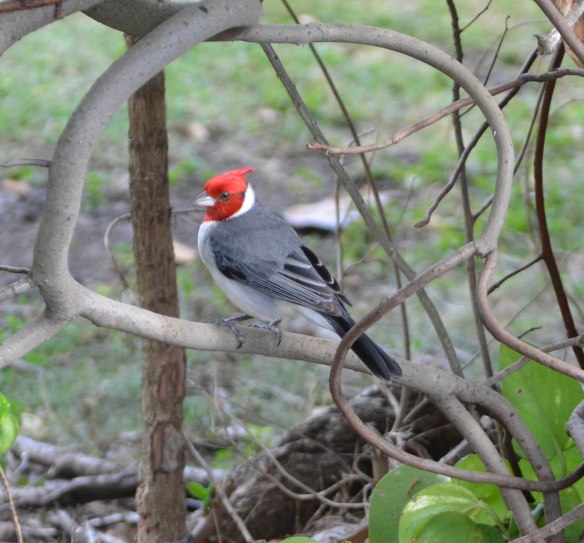
We finally parted. He offered to treat us to lunch, but I was afraid he meant to spend money on us, so declined. It was long past lunchtime, so we drove to a little grocery along the highway that had a food counter. It’s definitely a local hangout, called Goods ‘n Grinds. They offered deer burgers, the first I’ve seen so far, and we have tried pretty much every restaurant on the island by now. Though half the menu on offer was burgers, they were out of burgers that day. The special of the day was beef tostadas, and we each got one. We sat at a picnic table in the shade and ate our tostadas. The young lava-lava wearer of Halawa Valley drove up in a truck and we exchanged aloha. We also saw these gorgeous birds:

Crested  cardinal.

Crested cardinal.

They look like cardinals wearing woodpecker costumes. They are, in fact, crested cardinals. I tempted them closer by throwing some tostada shell crumbs on the ground, which were also appreciated by the ubiquitous blue doves.

I wanted to see the forest park where the trail to Kalaupapa begins. We had no intention of hiking the trail, for reasons already stated, but I knew it was a forested upland area, and very different from the scrubby grasslands of the area where most of the island’s population lives. The road seems to climb gradually, but goes to about 2,000 feet above sea level, where it ends in Palau State Park. It ends for a good reason–the next step is 2,000 feet straight down.

There is an overlook at the top of the pala from which you can see Kalaupapa. It’s like being in an airplane, and you must be able to see a 100 miles or more out to sea.

Tom's view of Kaulapapa.

Tom’s view of Kaulapapa.

This is one of those things Tom doesn’t like (though that may be an understatement). I was fine with it because there was a nice, substantial rock wall separating me from the drop. Tom sat with his back against a large tree, across the path that skirted the wall and declined to come any closer. I admired the view and took pictures.

My view of Kaulapapa.

My view of Kaulapapa.

We walked back to the parking lot through the pines. The pines are unusual, with soft needles fully a foot long, giving them a “Cousin It” appearance for those who remember “The Addams Family.” I had earlier seen some coil baskets made of these needles in a gift store. I have seen pine needle baskets before and admired them, but these needles must have been particularly well-suited to basketry. The two baskets in the otherwise junky gift store were very well made and decorated with small shells. The one about the size of a hummingbird’s nest was priced at $100, so it was safe from me.

It was also cool in the forest–so cool it made me wish I had worn warmer clothes (not that I have warm clothes with me.) As a matter of fact, it has never been uncomfortably warm and is often downright cool, especially at night.

Then we went to look at the other attraction up here. It was indicated by a sign that read, “Phallic Rock.” This trail, unlike the concrete path to the edge of the pali, was unimproved and rather rough. I regretted not having changed from flip-flops into walking shoes, but managed OK. Tom, believing we were getting near the pali again, decided to wait for me on the trail, but I went to the end.

Yup, it was kind of phallic all right:

Phallic rock.

Phallic rock.

Someone had left an offering in a bowl in the rock, carved either by man or nature. The rock is sacred to the Hawaiian people, who viewed sexual mana as powerful and beautiful. Ku, the chief god, also means “erect,” in every sense of the word, including standing tall agains aggression or oppression. I often see offerings left at heiau or other sacred places.

Offering at phallic rock.

Offering at phallic rock.

However, some asshole named Jesse carved his name into this rock. I can only imagine what his punishment will be. Probably he’ll be doomed to live his entire life as a stupid person, with all rights and privileges thereto. If I had my way, the centipede I mashed the other night was named Jesse.

The rock was nowhere near the edge of the pali. I picked my way carefully down the rough trail, but Tom wasn’t interested. Tom was interested in descending to lower, flatter ground.

Then we drove back into the metropolis of Kaunakakai to get some groceries, then back to the condo. We were actually too tired to cook again and made do with cheese and crackers. I was even too tired to write!

The Precipitous Drive to Halawa Valley and Two Kupuna

Day 9: Moloka’i

In the morning I called Auntie Opu’ulani. If you recall, this is one of the people Janine, the helpful lady at the airport, had recommended I talk to. I got through to Auntie and we made arrangements to meet on Wednesday.

Then I called a boat tour place and made reservations to snorkel on Thursday. I cannot be on a tropical island and not snorkel; it would be unnatural. Molokai has a long, shallow reef surrounding it. You can get to the reef from the shore, but the snorkeling is better further out. So they say, anyway. I’ll let you know.

I had decided not to look up some of the other people Janine recommended, including Uncle Pilipo, who is a kupuna (elder) who knew a great deal about mo’olelo Moloka’i old tales of Moloka’i). This was mainly because I didn’t have Uncle Pilipo’s contact info, but also because I felt I was making good progress and didn’t want to get greedy.

Feeling pleased with these arrangements, we started up the road, heading for Halawa (hah-lava) Valley, looking for the ancient fishpond along the way. We saw a fishpond, but no sign that anyone lived nearby, so kept on going.

It became more lush as we went along, the dry, red-earth grassy areas giving way to thick stands of trees and broad-leaved tropical undergrowth. The road hugged the coast, and in places, there was little between us and the water except for rocks. Not long after the fishpond, the road became one lane, sometimes with room for another car to squeak by–and sometimes not. The road started to climb, and we began to see vistas of the ocean far beneath. We could clearly see the island of Maui across the channel.

I mentioned that Tom and I are acrophobic. But we differ in our reactions. I don’t mind hiking trails with steep drop-offs or driving roads with same. I don’t like climbing ladders, being on roofs, walking over transparent supports (you’ll never get me out on those glass platforms over the Grand Canyon), or actually being on the edge of a high cliff with no barrier between me and a five-second drop to eternity. Tom doesn’t like any of that, but he would rather drive if he is on a cliff road. He drives white-knuckled and sweating bullets, though.

So I enjoyed the drive, and Tom didn’t. He really is a hero sometimes.

There are people living out here, and even farms. The residences were scattered, but there was this tiny church along the way:

Tiny church on the road to Halawa Valley.

Tiny church on the road to Halawa Valley.

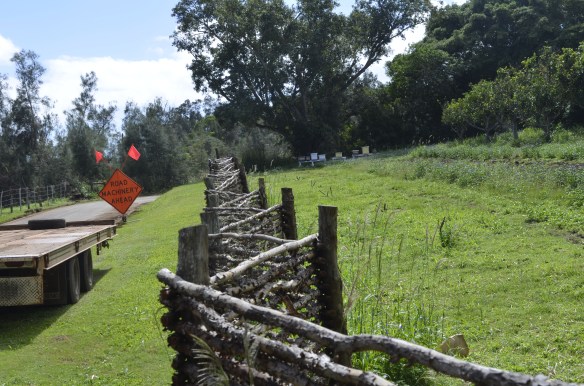
We passed this beautiful zigzag pole fence:

Zig-zag pole fence.

Zig-zag pole fence.


As we approached the descent into Halawa Valley, we could see two waterfalls pouring hundreds of feet down into the valley. I tried to take photos, but they were too far away. Finally, we got to to the valley floor, a rainforest jungle. There was a sort of public park building there, and then there was a dirt road to the beach.

Tom by now was quite ready to turn around and depart as fast as possible. There were three Hawai’ans sitting to one side of the road on a low rock wall. The one on the left was a heavyset fellow of middle age. The young man on the right was dressed in a short lava-lava (I don’t know what the Hawaiian word is; it’s a sort of kilt arrangement made of patterned cotton cloth), a shell necklace on a braided cord, and nothing else. The gentleman in the middle was elderly. (That means older than me. I figure he is about 76.) He wore unremarkable clothes and a faded baseball cap. He was very thin and his face under the brim of his cap was weathered. Neither Tom nor I can remember exactly what was said. I know we exchanged aloha, and I think they asked us why we were there. I responded that I was looking for mo’olelo Moloka’i.

The men to left and right looked at the man in the middle, and simultaneously said, “This is the guy you want to talk to.”

I leapt out of the car and walked up to the older man. He was shaking his head, so I said, “Come on, Uncle, please tell me some stories.” (Remember, “uncle” is respectful when speaking to someone  older or wiser than oneself. The Hawaiians have great respect for their kupunas, unlike the typical American, who sees them as old and in the way. I’m liking Hawaii better every year.) The gentleman replied that he didn’t just tell stories, I needed to make an appointment. He insisted on  this several times. I took this as a message that he took what he did extremely seriously, and he wasn’t sure that I did.

I didn’t press him, but told him I was meeting with Auntie Opu’ulani on Wednesday and snorkeling on Thursday, and leaving on Saturday, and in any case, my husband would not drive back down that road. At this point, the heavyset guy offered to drive me, which I thought was incredibly kind.

The kupuna finally asked why I wanted to know these stories. I told him I was a writer, and wanted to set my next novel in Hawaii. He asked what my last novel was about, and I tried to tell him. I found it amazingly difficult to summarize a 350-page novel, especially as I had no idea what his background was. He had as much trouble pronouncing Quetzalcoatl and Necocyaotl as I do with many Hawaiian words.

I have found that when I tell people I want to hear their stories, they are cautious. Once I say I am a writer, they open up. I am not sure why this is so.

He talked to me for quite a while about good and evil. He said everyone has capacity for both, and we each must choose which way to go. He also talked about not giving over your power to another person. He waxed so philosophical that after a while, I asked him if he was a kahuna.

“People don’t understand what kahuna means,” he told me severely. “Kahuna is an educated person. My grandfather told me we are all kahuna, just not everybody knows it. There are good kahuna and bad kahuna. You understand?”

I said I did. I hope I did. Mostly, I kept my mouth shut, and he kept talking. He often spoke in Hawaiian, which sounded to me like water running over smooth stones. Beautiful. He eventually stopped talking in abstract terms and began to tell me a story. He told it in the first person, as though he were the young boy in the tale. Seeing my puzzled expression, he said, “Now I am telling mo’olelo, you understand.” Here is the story, as much as I can recall, because I was listening, not taking notes. I have retold it, so it is in the third person:

A young boy was born in Halawa Valley, the youngest of seven siblings. He was chosen to be the cultural teacher (teacher is not the word he used, but it is close) in his family, the one who would preserve the ‘ohana’s cultural wisdom (‘ohana means family). He was not allowed to swim in the sea or go to the waterfall like his brothers and sisters and he was unhappy and thought this was unfair. One day his grandfather told him they were going to the waterfall, which is called mo’o-ula (red lizard) because a mo’o lives there. (Mo’o are mythical lizards. They were huge, and no actual beast of this sort has ever lived in the Hawaiian Islands. Some mo’o were kindly toward people–some not.) If you threw in a ti (pronounced tee) leaf in the pool beneath the fall and it sank, you were not allowed to swim in the pool because that meant the mo’o was in the pool. The boy wanted to know why they were visiting the pool, but his grandfather told him not to ask questions.

There were ti bushes that had been planted by the people all along the path, so the boy broke a leaf off as they walked. When they got to the pool under the falls, the grandfather broke off a big clump of ti leaves, fastened it to a stone, and tossed it in. “One ti leaf is not enough,” he told his grandson. The ti leaves floated around this way and that, then sank. This meant the boy could not swim because the mo’o was using the pool and anything could happen to him.

Then the kupuna began to relate things from his own life. He told me that when he was a boy, his grandfather told him that the beach at Halawa Bay was the burial ground of his ancestors. He asked a lot of questions, but his grandfather told him not to ask questions and took him to the beach (sound familiar?). The boy said he could see no graves. When the tsunami of 1946 washed out the beach, he saw the bones scattered all over the beach, uncovered by the ocean, and knew his grandfather was right.

His grandfather also took him to the falls and told him the mapmakers had made a mistake (again, no questions allowed). They called the falls red chicken falls (moa-ula) instead of mo’o-ula (red lizard). The grandfather pointed up to the falls and said, “Do you see a red chicken?” The boy did not. Then a mist came in, and his grandfather told him it was the spirits of his ancestors. When the mist cleared, the grandfather pointed again to the  top of the falls. “Look again, what do you see?” He looked again, and saw the head of a huge lizard peering over the edge.

He then told me that he had told archeologists where to find ancient remains of firepits and fishponds. The scientists dated the fishpond at 650 AD, the oldest yet found in Hawaii. It is believed that Halawa Valley is the oldest continually occupied site in the islands. I haven’t checked this, but it seems probable, if what he told me is true–and why not?

The kupuna had told us that he would need to leave soon, as he was taking his haole (pronounced how-lee, means Caucasian) son to the airport. After some time, a young, blond man came walking down the road and my kupuna told me he had to go.

I asked him what his name was.

“Uncle Pilipo,” he replied.

I stared at him. “You’re Pilipo?” I stammered. “Janine Rossa told me to find you.”

“Well, you found me!” he replied, climbed into a truck, said “Aloha,” and drove away.

Uncle Pilipo. I don't know who that woman is, but I'm starting a diet as soon as we get back.

Uncle Pilipo. I don’t know who that woman is, but I’m starting a diet as soon as we get back.

OK, there’s only 8,000 people on this island. But I was completely gob-stopped. Of all the people who might have been waiting by the roadside at a place we arbitrarily decided to visit, how likely is it that it was one of the three people I had been told to see?

While I am being woo-woo, I noticed that on the Big Island, when I told people about my experience in Kilauwea, they were quietly accepting. Here, they are skeptical, which is interesting, because Moloka’i is supposed to be the island where the magic still exists. Perhaps Pele has been gone too long from Moloka’i for people to pay much heed to her. I think most Hawaiians here are Catholic, judging by the number of Catholic churches, which, given Father Damien’s popularity, is not surprising. I don’t think they want to talk about the old gods much.

So Tom and I started back up the narrow, winding road, Tom not being interested in going to the beach or to the falls. (I was, but I understood his need to get back to nice, flat land as quickly as possible. He had sacrificed enough already.) I missed a lot of fine scenery on the way back because I was frantically typing Pilipo’s stories into my iPad. I had taken no notes at the time because I was trying to concentrate 100% on what he was saying. (It also seemed like a bad idea to ask questions given his stories.)

As we passed the ancient fishpond, I spied something that looked like an old Hawaiian hale, or house, near the pond, and some sort of palm-thatched structures tucked under the trees. There was a young woman talking to the passenger of a car that had pulled off the road. I got Tom to stop (we were at sea-level again, so no problem), and told the woman I was looking for Ray Naki.

“You found him,” she said. She pointed at a thatched structure under the trees. “He’s over there.”

I walked in as though I knew what I was doing (Tom was parking). There was a Hawaiian about my age with shoulder-length gray, curly hair, wearing a traditional loincloth (malo), a large bone fishhook like the New Zealanders make, hanging from a thick, braided cord, a bemused expression, and nothing else.

Lei-mana blowing a conch shell horn.

Lei-mana blowing a conch shell horn.

I said, “Your niece April in Captain Cook said I should look you up.”

He looked at me blankly. “Who?”

Ulp. “Are you Ray Naki?”

“Yes, that’s me. Who did you say?”

“April, April Qina. That’s her married name.”

He pondered that for a minute, then his face cleared. “Ah, ‘Apilela. That’s her name!” (‘Apelela is April in Hawaiian.)

He wanted to know why Apelela said I should see him, but I couldn’t tell him because April never told me. I just blindly did as she had suggested. I honestly never questioned why, to tell the truth, and had no particular expectations, which has been my modus operandi on this trip. I certainly was not expecting a loincloth-clad man living in a thatched hut.

Lei-mana.

Lei-mana.

Tom came in from the road, and Ray pulled three eyeshades hand-woven of palm fronds from a supporting branch of the lanai, donning one himself and offering the others to us. We put them on as directed and he invited us to sit at the picnic table.

I should describe the place before going further. The fishpond is enormous, maybe two or three hundred yards across, constructed of low lava rock walls that begin high up the beach and extend into the calm waters quite a way, making the pond more or less circular. The walls are frosted with pieces of white coral. There is a “gate” where fish can swim in or out. On either side of this gap, there are bamboo poles with clusters of coconuts. There is a similar structure on the inland side of the pond, standing in the sand. A small, white power boat floating on the waters of the pond was anchored to the shore by three rocks.

When I walked into this establishment, I was greeted by a pack of medium-sized, short-haired, golden-brown dogs, many with ridged fur down their spines. There were also a couple of vaguely chihuahua-looking dogs, though they were the same color as the others.

Dogs

They greeted me by licking my hands and crowding around my knees. I wondered if they were related to the “poi dogs” the ancient Hawaiians used for food. I looked this up and found that the poi dog is extinct. The Hawaiians fed them on poi, the mashed and cooked root of the taro plant, which is used as a condiment here and is pretty much pure starch. So the poi dogs didn’t chew tough food and their skulls became deformed through muscle disuse, becoming flattened. They were described as fat, stupid and slow. Often when a child was born, he was given a poi dog. If the child died in infancy, the dog was killed and buried with it. If the child survived infancy, the dog’s teeth were pulled and fashioned into a protective necklace for the child. So the poi dogs are probably better off extinct, poor things.

There was a frame for a traditional hale, but it was unthatched at present. The kitchen–a camp stove and picnic table–was set up under a thatched lanai (and by “lanai,” I mean nothing fancier than a shelter). There was an old international cargo container with doors cut into it next to the lanai, apparently to provide protection from rain and wind. The lanai was hung with fishing nets and other paraphernalia. (But Ray has a cell phone. He likes to play the unsophisticated “native,” I think, but he is a sharp old fox.)

A couple of small children, including a fat baby in diapers, were wandering around. They were some of Ray’s five grandchildren. He lives with his wife, daughter and son, grandchildren, and I don’t know who else. The two-year-old went down to the fishpond with me and dragged away the stones that secured the boat anchor. I think he wanted to show off the anchor to me. His grandfather roared at him in Hawaiian, and I didn’t need a translation.

Ray’s Hawaiian name is Lei-mana, the powerful lei, so I will call him that. He is the brown of medium-roast coffee beans, big-bellied, but firm. Because of his attire, I was also able to observe that he has firm, smooth buttocks.

Lei-mana used to be a construction worker, but gave it up to pursue a more or less traditional lifestyle at the fishpond. He fishes the pond and his ‘ohana has a taro patch at Halawa Valley. He teaches school children about how their ancestors lived–also hula and the Hawaiian language. I gathered that in addition to school field trips, he has visitors from other areas of Polynesia, like New Zealand. A Maori from New Zealand gave him the fishhook necklace he was wearing.

Conversation with Lei-mana was somewhat awkward. He has a way of falling into silence for a while, then coming at you with questions. Yet he frequently did not answer my questions, greeting them with thoughtful silence. Then he would start talking about something unrelated. As it was a disjointed method of talking and I wasn’t taking notes, I have noted most of what I remember already.

I gave Lei-mana April’s phone number and took his address so that I could send him a copy of “The Obsidian Mirror” (I have made this offer to anyone who has helped me on this trip). I also offered him some money (as I did Uncle Pilipo), because Janine advised me to do so.

“Don’t think they will be offended,” she told me. “They won’t be.” So far, utterly true.

Lei-mana asked if we wanted to return the next day and learn what he teaches. We agreed to come back at noon the following day. I leaned forward to kiss his cheek as Janine had instructed me, and then Lei-mana said, “Here is the old Hawaiian way to kiss, nose to nose and forehead to forehead,” and proceeded to do just that. We removed our palm shades, but Lei-mana insisted they were gifts, so we took them.

Tom, me, and Lei-mana.

Tom, me, and Lei-mana.

I was a bit overwhelmed at this point. We stopped for a very late lunch at Paddler’s Inn. We ordered the day’s special, Chinese chicken salad, which bore no resemblance to any dish by that name we had ever eaten previously, and I had another excellent daiquiri. Then we stopped in town for dinner makings and went home. I wrote furiously all through lunch, then started writing again when we got back to Paniolo Hale. We ate leftovers for dinner because we were tired, and then I wrote some more until about 10:30 pm. I was making lots of mistakes by that time, though I had only journaled through Uncle Pilipo, so I joined Tom in the enormous humid marshmallow of a bed and dropped into a sound sleep.