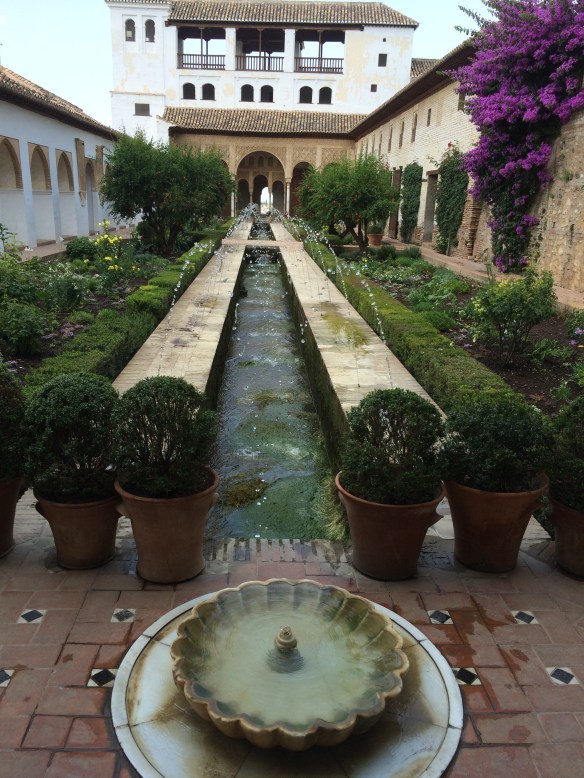
The Mosque with a Cathedral Inside–Or Is It the Other Way Around?

We arrived in Cordoba after an easy drive from Sevilla (it was easy for me because Tom was driving). Our parador sits above the city in a pleasant neighborhood, and overlooks the entire city. Even more important, it has an elevator, which I greeted with cries of joy. Our quarters consist of four rooms–bedroom, sitting room, dressing room, bathroom and a large, sit-able balcony. It may not be as romantico as the parador at the Alhambra, but it is lovely, and there is a pool, which I took immediate advantage of. I enjoyed floating in the cool water, watching the birds drink. There were swallows, which drink on the wing, doves, and little yellow birds that look like goldfinches. There was no one else in the large pool, and the surrounding gardens are full of palms trees, hibiscus and orange trees. Paradise. The lifeguard speaks French, but not English, and I speak French but not Spanish. Between the two of us, we managed to miscommunicate in three languages.

The view of Cordoba from our balcony

The view of Cordoba from our balcony


Today (our first full day here), we visited La Mezquita, the Great Mosque of Cordoba, which has been turned into a Catholic church. La Mezquita is one of the buildings I studied in art history, so it looked weirdly familiar, as though I had been there before. It has an odd history. It started as a Visigoth church. When the Moors came in the 700’s, the sultan bought the Visigoth church from the Christians, knocked it down and built a mosque. The mosque was added onto until the expulsion of the Moors. The Christians had the good sense not to tear down this incredibly graceful and beautiful building, but they did plonk down a gaudy sanctuary, altarpiece, and choir in the middle of it and appropriated the side niches as chapels.

The result is a mishmash of styles that mingle awkwardly together, like neighbors who get together to socialize only on Fourth of July weekend.

There was far too much detail to capture on camera, especially my iPhone camera, and some of the interesting things were behind glass or wrought-iron screens. but I will let La Mezquita speak for itself.
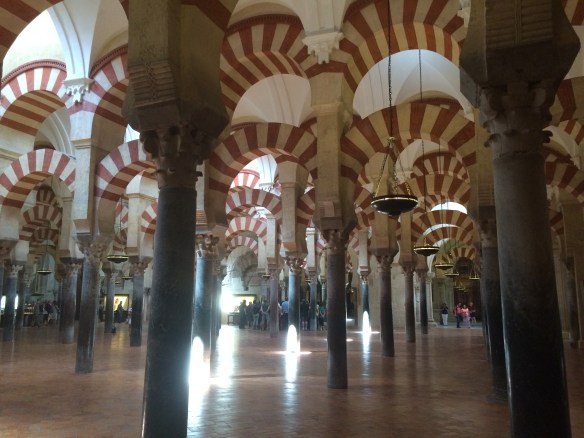
The famous striped arches made of stone ad brick.

The famous striped arches made of stone ad brick.


Ceiling, La Mezquita, Cordoba

The ceiling above the Christian sanctuary in the mosque.


Christianity meets Islam in the ceiling

Christianity meets Islam in the ceiling


High altar, La Mezquita, Cordoba
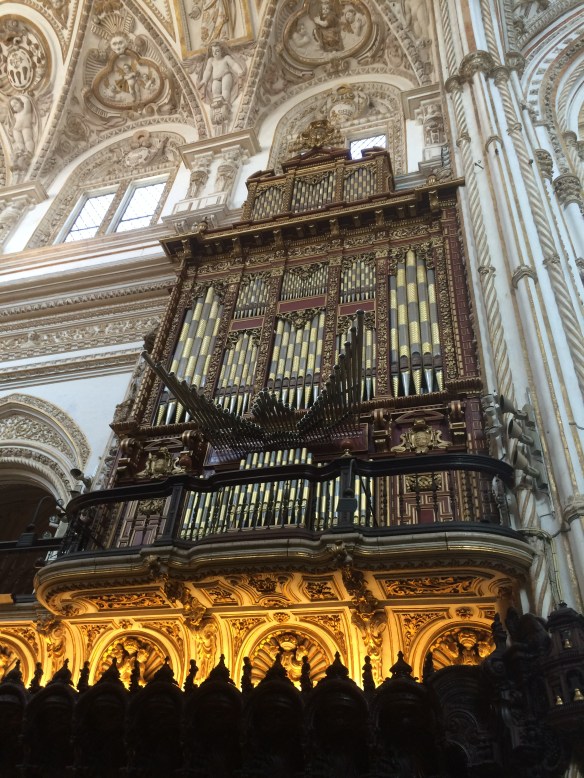
High altar, La Mezquita, Cordoba


Pipe organ in the choir section, La Mezquita, Cordoba. A matching organ sits on the wall opposite. The position of the pipes is very unusual.
Pipe organ in the choir section, La Mezquita, Cordoba. A matching organ sits on the wall opposite. The position of the pipes is very unusual.


_DSC0152

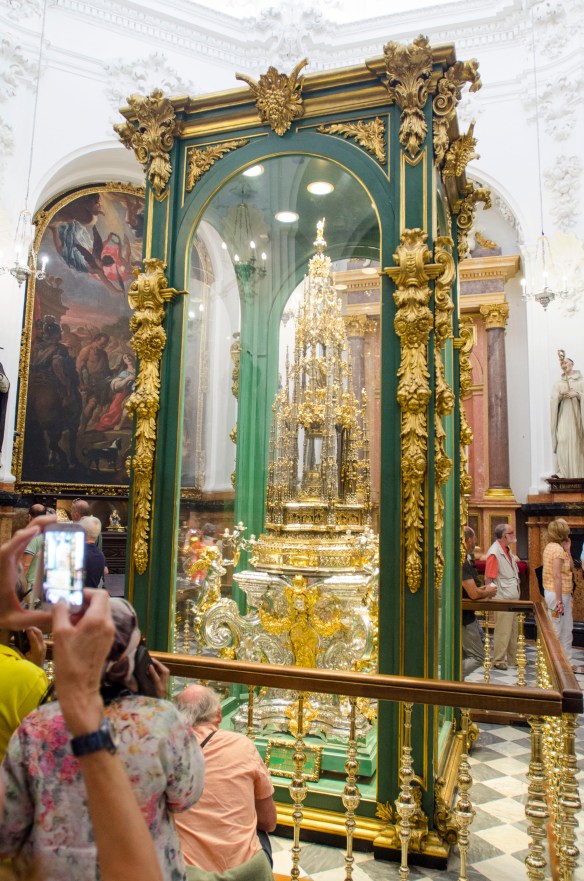
This thing is called a monstrance. I don’t know what it is used for, but it is solid gold. (OK, there’s some silver in the base section. Tom insists I be accurate in my reporting!) It is in the treasury of the cathedral/mosque, Cordoba.


I should mention something about Spain, apropos of nothing. All the historical places we have visited have had benches or chairs here and there so people can sit and rest their feet and appreciate their surroundings. I deeply appreciate this–more and more every year. I remember after touring the Louvre many years ago, we were beneath the big I.M. Pei pyramid. I was dying on my feet, and sat down on the floor, as there was nothing–not even a low wall–in sight. A security guard immediately came over and told me in French that it was not permitted to sit there. I asked why and got the most Gallic shrug ever seen. Later, walking around Paris, I sat somewhere random and got told to move along again. I began to feel like a vagrant, and my feet were miserable. Spain has the right idea.

After viewing the mosque, we went in search of the Museum of Al-Andalus Life, that is, the culture of the Moors. This is housed in an ancient Moorish defensive tower that is reached via a bridge across the Quadalquivir River.
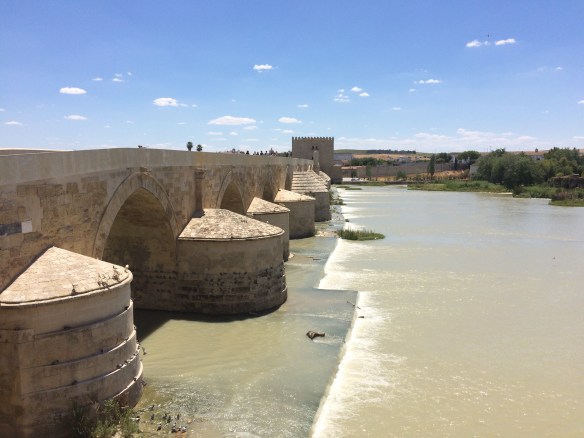
View from the Roman bridge across the Guadalquivir River toward the Museum of Al-Andal Life

View from the Roman bridge across the Guadalquivir River toward the Museum of Al-Andal Life. The museum is in the square building at the end of the bridge.


At the end of the bridge, some enterprising people had set up a large stall selling hats and cold water. Did I mention it’s in the mid-eighties today? Not horrible, but we both bought hats to keep the sun off our faces. We went to the museum, but they were closing for siesta in a half hour, so we stopped at a cafe, which, judging by the clientele, is a local fave. I had a beer, which to my nearest and dearest will indicate just how warm I was. Also tapas–of course!–as it was mid-afternoon.

View of the Old Town (Barrio Judica) from the Roman Bridge

View of the Old Town (Barrio Judica) from the Roman Bridge

We decided to backtrack across the bridge and go to the archeological museum. This was open, and we managed to get through prehistory, the Romans, and the Moors before this museum also closed. By this time, it was pretty hot, so we took a taxi back to the Parador, and I, for one, am going swimming!

My beloved in the center courtyard of La  Mesquita

My beloved in the center courtyard of La Mezquita


Walking in Sevilla and Getting Damned Tired of It. (Walking, Not Sevilla.)

We’re in Cordoba now, having spent three nights in Sevilla, during which I was too tired to post anything.

I slept quite late the first full day, which was a Sunday, so there wan’t much open in any case. We walked around, took some pictures, got rained on, had some tapas and tried to get oriented.

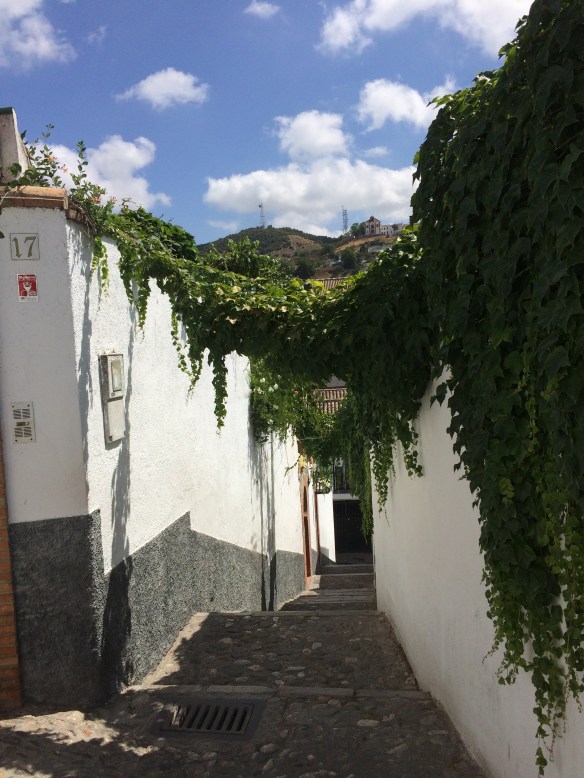
One of Sevilla's tiny streets in the old Jewish Quarter

One of Sevilla’s tiny streets in the old Jewish Quarter

We actually didn’t do much in Seville except for walk. Our hotel was reasonably near the Alcazar and the cathedral–but we never made it inside the cathedral. We spent a lot of time walking through the narrow, winding streets of the old Jewish Quarter (pre-expulsion). The houses are four stories high, and in some places I could almost touch the houses to either side of the street with outstretched arms. Cars can access some (but not all) of these cobbled streets, and when a car came along, we stepped into a doorway or onto the narrow sidewalk, if there was one. In addition to negotiating the Medieval and Renaissance walking surfaces, we had to keep a sharp eye (and nose) out for horse and dog poop. There are a lot of horses and lovely carriages in the old city that tourists can hire for merely exorbitant prices.

While walking, we passed by an interesting-looking restaurant, Sagardi. It had a small foyer for tapas, and a restaurant in a large, enclosed atrium. We checked out the menu and decided to come back when we were hungry. We had dinner there, and it was every bit as wonderful as we had hoped. We vowed to return for tapas another time.

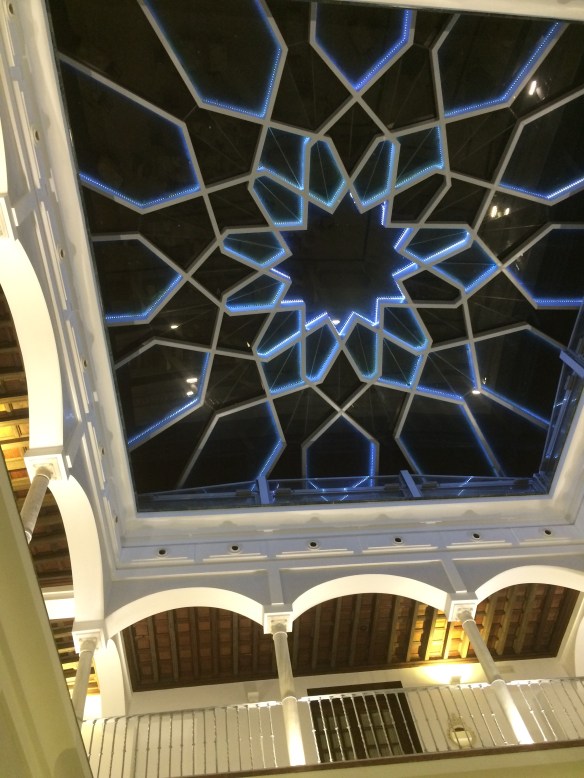
Atrium roof, Sagardi restuarant

Atrium roof, Sagardi restuarant

Magnificent old tree in central Sevilla

Magnificent old tree in central Sevilla

The hotel we stayed in, La Casa de Maestro Boutique, was an old house on one of the non-car-accessible streets, but we did get a parking spot nearby. The hotel has oodles of charm, but the room was small and the shower miniscule. Once in the shower, if I dropped my shampoo (inevitable, as there was very little place to put anything), it was nearly impossible to pick it up. However, the room was clean and the bed was comfortable, and that counts for a lot.

Driving in this part of Seville is madness for a tourist, so we walked to the Alcazar the second morning. Flamenco is very big in Sevilla, and there are stores selling very high-quality Flamenco-related goods such as fans, silk shawls, dresses, castenets, etc. (You can also get el cheapo versions of these in gift stores). My sister wanted a Spanish shawl, so I went into one of these upscale stores to find one. While there, I saw the most gorgeous shawl I have ever seen in my entire life, or hope to. I have extremely good (read “expensive”) tastes: it was the equivalent of $1500 US. It was love at first sight, but it will have to be a long-distance relationship.

Lusting in my heart for this shawl. Wouldn't this be a lovely Christmas present for me? I thought so, too.

Lusting in my heart for this shawl. All hand-embroidered in silk. Wouldn’t this be a lovely Christmas present for me? I thought so, too.

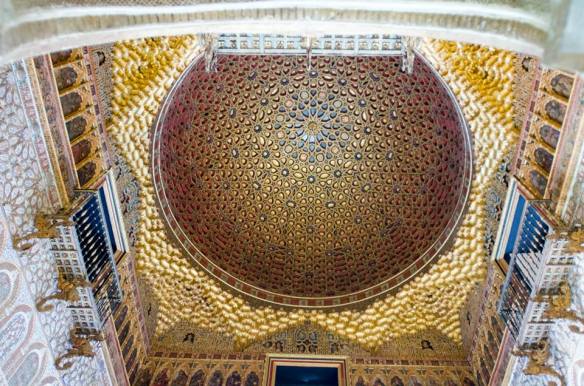
The Alcazar of Seville was build by King Pedro the Just or Pedro the Cruel, depending on whether you were one of the people (the Just) or an aristo or member of the clergy (the Cruel). Pedro really liked the Moorish style or architecture and ornamentation, and used it throughout his palace. It is fronted by a 12th-century gate, very rustic and antique-looking, considering the elegance lying just beyond. You walk into a vast plaza, flanked on three sides by different buildings. One is Pedro’s palace, one was the house of someone else important–the mayor of Seville?–done in a more traditional Spanish style, and one is another wing of the palace built by a later monarch who very much disapproved of Pedro’s taste in architecture, because it is a thoroughly Italianate Renaissance building. So it’s a rather odd mishmash. Pedro’s palace is rich in lacy Moorish stonework (even bearing the name of Allah in this most Christian palace), brilliant tile work, Moorish arches, carved, painted and gilded ceilings, and fountains. One room, the Ambassadors Hall, is completely tiled up to the ceiling, three stories up.

The Alcazar, showing Pedro's palace to the left, and the important person's house to the right.

The Alcazar, showing Pedro’s palace to the left, and the important person’s house to the right.


Ceiling of the Ambassadors Hall, the Alcazar Seville

Ceiling of the Ambassadors Hall, the Alcazar Seville


Hall of Ambassadors, Alcazar, Seville

The Alcazar is the residence of Spain’s current king and queen when in Sevilla, but we had an impression that they don’t stay here much. Hard to imagine they would want to stay at a place that is overrun with tourists all the time. We bought tickets for the private royal chambers, which are upstairs, but I’d be willing to bet they have other, much more private chambers there for their actual use. These rooms reminded me of other palaces in other places, with many oil paintings of ladies in voluminous dresses and men in tight white pants, crystal chandeliers, gilded clocks, etc., etc.

Reflecting pool, the Alcazar

Reflecting pool, the Alcazar

There are many lovely courtyards, reflecting pools and fountains throughout the palace, and the whole is surrounded by yet more gardens. It’s a gorgeous place, but I have to admit I was not as thrilled as I should have been because my feet hurt. A lot. I disappointed myself in my unwillingness to do more exploring, but there we have it. We found the cafeteria and had some wine and split a sandwich, then left. We found a horse and carriage next to the cathedral and got a ride back to the hotel, which I thoroughly enjoyed, largely because I wasn’t walking, but I do enjoy the clip-clop of horses and yes, the way they smell.

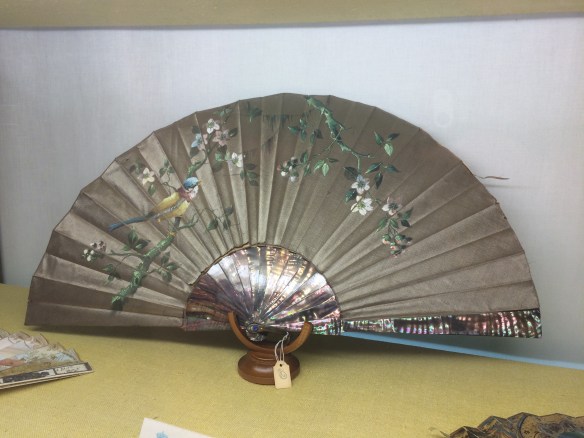
Gorgeous antique fan on display at the Alcazar

Gorgeous antique fan on display at the Alcazar

Later, we walked to Sagardi for tapas and wine. The tapas were delicious, but we decided to find another tapas place–it’s what people do in Sevilla. While wending our way through the tiny streets trying to find another tapas bar (a specific one; there were plenty of tapas bars. It made me wonder if anyone cooks at home in Sevilla.), I realized I had a blister. A quick trip to the pharmacy solved that problem, and we eventually found our tapas place, situated on a plaza across from City Hall. We had more excellent tapas, but by this time, we were both full. We did stop on the way back to the hotel for small ice creams, but this hardly counts. I feel like we should have gone to the cathedral–it’s the largest in Spain (that means very, very large)–but couldn’t work up enough enthusiasm.

Then it was early (for Spain) to bed, with Cordoba awaiting the next day. I mean, after we pick up our laundry, that is.


The Spanish Fitness Regimen for Old Ladies

I have begun to suspect that Tom planned this trip to Spain as a means of whipping me into shape (I admit this is needed, but still). Yesterday we said farewell to lovely Granada and headed toward Seville. It turned out to be oh, so much more than merely a travel day. I may never recover, in fact.

Actually, the first part was entirely my fault. I asked if we could visit Ronda on the way. Ronda is not a female friend, but one of the “White Towns” of Spain’s Andelucia hill country. (Apparently sometime a long time ago, white was the de rigeur color for houses here, and it hasn’t changed since.) The town is bisected by a deep gorge and is very picturesque.

Then Tom mentioned that near Ronda, there was a cave with prehistoric paintings in it, la Cueva Pileta. Well, that cinched it as far as I was concerned (innocent that I was).

We found Ronda without difficulty and headed toward a part of town our guide assured us was more for locals, parked with difficulty and tried to find a restaurant (as recommended by the book). The first place turned us away for reasons unknown (my Spanish isn’t very good, so I wasn’t sure what his excuse was). The second place was so full of people I thought I might become agoraphobic if we tried to eat there. The third place said they had a large party coming in, but as we were leaving, they called us back and set up a small table for us.

Musicians Ronda

Bagpipe band in Ronda

While we were waiting for food, the party arrived, complete with bagpipers and drummers, sounding very Celtic. This makes sense for Northern Spain, as the Celts in ancient times went through there as a stopover on the way to Ireland, as Tom, the man of 100% Irish extraction, pointed out. It turned out that the large party was indeed a group of people from Northern Spain. We enjoyed the music (most of the musicians were in full traditional outfits) and the lunch, which consisted of fried padrone peppers, local snails in their stripy shells (yum!) and cured chorizo. Oh, and some local red wine.

We tried calling the cave a couple of times, but no one answered. We decided to go there anyway and come back to Ronda if it was closed. The cave belongs to the family of the farmer who originally found it, and it is operated by the family, not the government, so it has somewhat irregular hours.

We traveled up into the craggy hills along windy roads, passing through more White Towns. We finally came to the end of the road, or nearly so. There is a small sign and a parking area, but otherwise nothing but an extremely steep flight of stone steps heading up through the chaperral. I left my purse in the car, as I didn’t want to accidentally bump any formations with it (I’ve been in a few caves before, and they frown on this).

Stairs Pileta

Stairs to the Cueva Pileta. Trust me, this was just the beginning of a very long climb.

The stairs went up. And up. And up. In addition to being steep, the steps were of varying depths, and there is a lot of loose scree making it hazardous. At the top, there is a hole in a rock face, and we went in. The young lady inside would not take a credit card or American cash, and the only Spanish cash we had was down, down, down at the car in the purse I had so thoughtfully left behind. To my immense relief, she agreed to come down to the car with us after the tour to get her money.

The cave is beautiful even without the cave paintings, with impressive stalactites, stalagmites, draperies, and sparkling crystal formations. Some of the formations were dark with prehistoric smoke, some tinted with cobalt and other minerals. I have never before seen any cave paintings (though I have seen prehistoric pictographs in California and Hawaii). They have a freshness and energy that looks modern, and it is exciting to think I was looking at the handiwork of someone who lived and died perhaps 30,000 years ago. How they managed to negotiate the cave with only torches is astonishing enough; I had trouble even with the rock steps, steel handrails and clutching Tom the whole way.

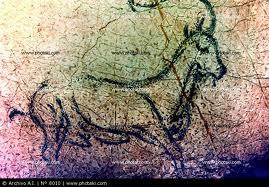
Horse in Cueva Pileta

Horse in Cueva Pileta

Because, you see, there were no lights. They give you a feeble little lantern to hold when you come in. This lantern completely blinded me until I figured out how to block the light coming toward me and direct it only at the ground. The guide had a good light that she used to help us, but I am increasingly night blind, and found the whole thing nerve-wracking in the extreme. Add to that a LOT of uneven stairs and very slippery footing. The guide book said to bring something warm because the cave was cold, but I sweated gallons. By the end of the tour, my hair was streaming with sweat and my glasses were steamed up as though I had been in a Turkish bath.

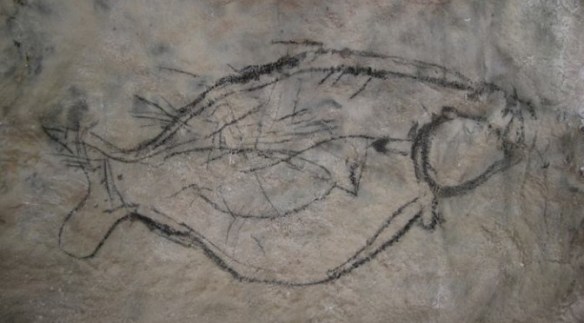
And I wouldn’t have missed it for the world. The paintings are amazing. There is a very rare depiction of a fish, quite large, and inside it, you can see another fish. There were paintings of horses, bison, goats and deer, beautifully rendered and informing us what these ancient animals looked like with a few perfectly placed lines and shading. There are strange scratchings, straight lines and bars. The guide said it was to count full moons. Other scratches she said were depictions of vulvas, a symbol of fertility. Maybe, but you can see the same thing in any men’s bathroom. I don’t think adolescent males have changed that much over the millenia. It hardly matters whether these paintings and markings bear deep religious significance or were merely the exercise of horniness and creative expression; they are the only messages we have from our early ancestors.

Fish in Cueva Pilete. Note the fish inside the fish.

Fish in Cueva Pilete. Note the fish inside the fish.

Goat pileta

Goat in Cueva Pileta

Once we emerged from the cave, there was of course, the descent down the rocky hillside to the car. Once we paid our patient guide, we took off in search of the road to Seville–but first, some water. Our GPS system (which was finally speaking English instead of Spanish, thanks to Tom, although the English voice cannot pronounce Spanish place names) wanted to direct us down tiny roads through the mountains. We knew there was a nice highway not too far distant and ignored her. On the way to the highway, we stopped at a little hillside bar for agua minerale. The people there seemed very excited to meet Americans, and several friendly people stopped by to say hello, which was very cheering.

On the road to Seville, I started falling asleep. I don’t sleep in cars any better than I do on airplanes, and kept jerking awake. Exhaustion dragged at me like water-soaked clothing on a drowning man, and by the time we reached our hotel, I was a zombie.

The hotel is a charming four-story building that was once the residence of Flamenco guitarist maestro Nino Ricardo. Our room is on the second floor, which means up three narrow flights of steep stairs, dragging suitcases because there is no elevator. Although the concierge took my big bag, I was still feeling more than exhausted to begin with, so this did not refresh me.

The living room at the Casa de Maestro has this depiction (sculpture?) resembling the strings and sound hole of a guitar. The "strings" reach from the four-story ceiling to the floor.

The living room at the Casa de Maestro has a decoration resembling the strings and sound hole of a guitar. The “strings” reach from the four-story ceiling to the floor.

We went out for tapas at a recommended bar and sat outside on the sidewalk, watching the people streaming by us. The food was delicious–scrambled eggs with black rice, calamari and crayfish, salmon in some yummy sauce, jamon Iberico and something else we can’t remember because we were both tired.

Then back to the hotel, where I completely lost it. All I’m going to say about this dark episode is that Tom is a saint. Once I got to bed I lost consciousness for about 10 hours and awoke refreshed with all evil spirits completely exorcised.

Granada by Day, the Alhambra by Night

2015-06-12 12.45.34

Yesterday, our big activity was revisiting the Nazaries Palace at night. Tom wanted to get some night shots, and had brought his massive carbon-fiber tripod all the way from California for just such an opportunity.

A side note: I planned quite carefully for this trip. We had been told it would be sweltering hot in Spain at this time of year–some people even asked why we were going now instead of in the fall. So I selected thin, lightweight, cool clothes. I did not bring a jacket. I left many things at home out of consideration for airline weight limitations, figuring if I really needed something, I could probably buy it here. As a consequence, I had lots of room in my suitcase, which I happily anticipated filling at least partially with gifts for loved ones. Tom saw the possibilities at once, and solved my extra space problem by shoving his tripod into MY suitcase. Greater love hath no woman.

Incidentally, it has been quite pleasant weather. Yesterday was a trifle cool, in fact.

Our ticket to the palace was for 10 pm, so we had an entire day and evening to spend exploring Granada. Our tour bible on this trip has been “Rick Steve’s Spain,” and so far, it’s been reliable (as well as entertaining). We decided to start with the Alcazar, the ruined fort next to the Nazaries Palace, because Rick Steves said it was free. Apparently, “free” means “available,” because they wanted a ticket. So we decided to explore the Alcaizin, the old Moorish quarter. After the perilous car trip into the old town the night before, Tom was no way going to drive, so we caught a cab. (By the way, among many interesting and odd vignettes that I don’t have time to record, on our way back through the narrow, twisty passages that night, we came upon an elderly woman carefully washing the cobblestones outside her door. She had to step back into the doorway to allow the car room to pass, and glared at us as we drove over her nice, clean cobbles.)

The cab dropped us off at Iglesias San Nicholas, an old church now under restoration. The Plaza San Nicholas has a wonderful view of the city and the Alhambra. There was a band of gypsies (I mean a musical band composed of gypsies, not an entire tribe) playing and singing there for tips, and a gypsy selling leather jewelry. The band–well, let’s just say they were no Gypsy Kings. The leather jewelry seller had a surefire technique, though. He had the most adorable tiny puppy with him, running around and greeting tourists.

2015-06-12 11.56.20


The  Great Mosque of Granada has this tiny, half-hidden door around the side for women only.

The Great Mosque of Granada has this tiny, half-hidden door around the side for women only.

We wandered downhill along the cobbled streets, taking pictures of this and that until we came to a pedestrian street lined on both sides with tiny shops, with colorful merchandise displayed outside. It looked like my mental image of a souk, or traditional Arab/Moorish market. Colored glass Moorish lanterns, gorgeous fabrics, tooled leather goods, scarves, hookahs, the lot, were displayed on the street. I explored one shop that had  steep steps down from the street level. On the way out, I stumbled as I emerged onto the street. Two men rushed forward, hands outstretched to catch me, dear, foolish creatures, but I recovered, panting, “Gracias! Gracias!”

I popped into several shops, but didn’t buy anything. Some of the things I really liked were just too big and/or heavy, like Moorish lamps and gorgeous tiles and pottery with jewel-like patterns resembling the tiles we saw in the palace. A lot of the shops had the same stuff, store after store, so we walked on down into the Old Town and found a tapas bar in a hotel near Plaza Nueva. We ordered three tapas dishes to share at the bar, then went to sit in an enclosed patio that had obviously at one time been an open-air courtyard of a house. I thought tapas were supposed to be small dishes, but these were HUGE. They were also very rich and not shy about fat. We had been starving, but could not possibly finish these enormous plates of food. Which were absolutely delicious, by the way.

The next stop was to find a phone store where Tom could purchase another SIM card, having run through the data allowance of the first one he bought within 24 hours (the man is a power user.). The stores were closed for siesta, so we made our way to the cathedral to se the Royal Chapel where King Ferdinand and Queen Isabella are interred. On the way, we saw an amazing display of swords in a store window, reminding us of the Iron Throne in “Game of Thrones.” We went in, and I found some very satisfactory gifts. Not swords.

2015-06-12 14.43.40

Gorgeous window display for an ice cream store. Unfortunately, we were practically waddling with tapas, and had no room for more.

Gorgeous window display for an ice cream store. Unfortunately, we were practically waddling with tapas, and had no room for more.

The Royal Chapel is part of the cathedral, but don’t let the term “chapel” deceive you; it’s enormous and boasts its own side chapels. It is also extremely Spanish: lots of wrought iron and gold leaf. There are two huge marble tombs in front of the elaborately tiered high altar. Ferdinand and Isabella, who are revered here as the founders of modern Spain, have the lower monument, while Philip the Fair and Juana the Mad enjoy the higher place of honor for some reason. (Apparently Philip the Fair was quite the playboy, and drove Juana the Mad mad with his infidelities.) The monuments show the individuals in question resting on catafalques, robed and crowned. Their faces are supposed to be very accurate renditions from death masks.

I was walking around these massive massive tombs and nearly fell into the crypt. There was a steep flight of stairs that just opened up in the floor of the chapel and led down to a glass door where you could view the uncharacteristically plain coffins of the people depicted above.

The high altar started at the ceiling with a 3-D sculpture of God, then fell in golden tiers to the altar itself. Each tier had niches with various scenes from the New Testament depicted as realistically painted sculpture. St. John the Baptist was particularly gruesome; you could see all the anatomical details of his severed neck.

Tom and I agreed we both liked the Moorish style a lot better. Then we disagreed about whether or not the chapel  was stylistically influenced by Moorish art. (I was for, Tom against.) Then off to buy a SIM card at a phone company called MoviStar, a transaction that took approximately forever and required showing both passport and driver’s license. I was expecting them to ask for a blood sample.

After a late afternoon siesta and a small dinner, we duly arrived at the palace at 10 pm, only to find that Tom was not allowed to use the carbon-fiber tripod he had brought. We were allowed to carry it, though. Guess who carried it? As I said, greater love hath no woman.

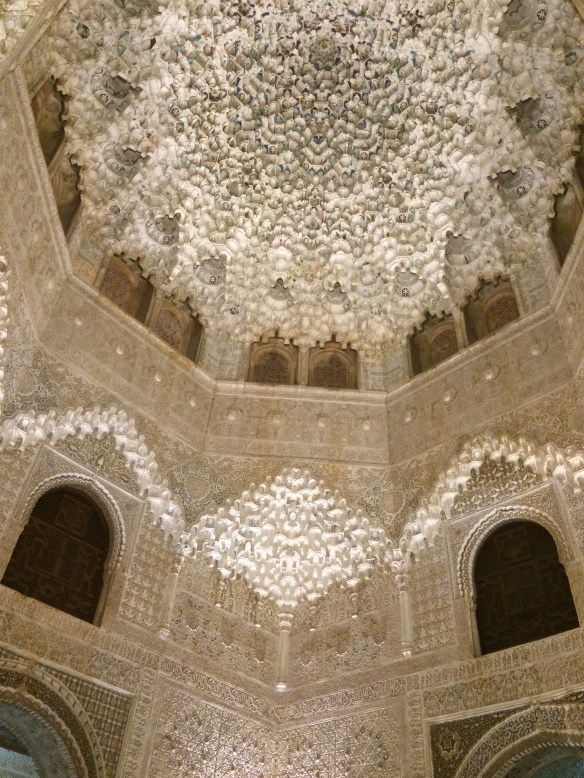
By night, the palace has an even more mysterious beauty. I noticed different things about it, and sometimes didn’t even recognize rooms I had previously been through by day. There were fewer tourists and it was sometimes easier for Tom to get shots than before. I will share some of his photos later; my iPhone camera wasn’t up to the challenge, though I got a couple of nice photos. Some of the rooms look as though you are in a cube of stone lace, delicate and insubstantial–though these walls of lace haven’t stirred in almost a thousand years.

Ceiling detail of Nazaries Palace at night

Ceiling detail of Nazaries Palace at night

2015-06-12 23.15.12

Ceiling, Room of the Kings, Nazaries Palace at night

Long before I was ready to leave, the guards shooed us out and closed the palace. We happened to be in my favorite room at the time. It is a tripartite chamber off the Lion Courtyard. The center of the room has a fountain, and the ceiling spirals up and up, in exuberant fountains and sprays like frozen waterfalls, accented here and there by the ancient remnants of gold leaf and blue and red paint. The two side chambers were for dining, and their ceilings, while lower, were just as spectacular. What I really wanted to do was to lie on the floor and gaze up at the ceiling for a while, maybe three or four hours, but no, they shooed us out into the night.

My beloved in the Alcaizin

My beloved in the Alcaizin

Stairs, Stairs, Stairs, and–Oh My God!–More Stairs

Interior court, Charles V palace

Interior court, Charles V palace

So today’s theme was stairs. I am no stranger to stairs. Our house has 32 steps from the driveway to the front door, and then another flight of stairs if you want to get to the second floor.

But my house stairs to the Alhambra is as Barbie’s Dream House to Versailles. This place has staircases everywhere, and not an elevator in sight. Our room is romantically located in a small square tower overlooking the gardens. It isn’t next to, above or below anyone else’s room. It can only be reached by four flights of stairs and an additional steep staircase to the bedroom. We traverse this mountain several times a day–and if we want to go to the restaurant, there’s yet another flight.

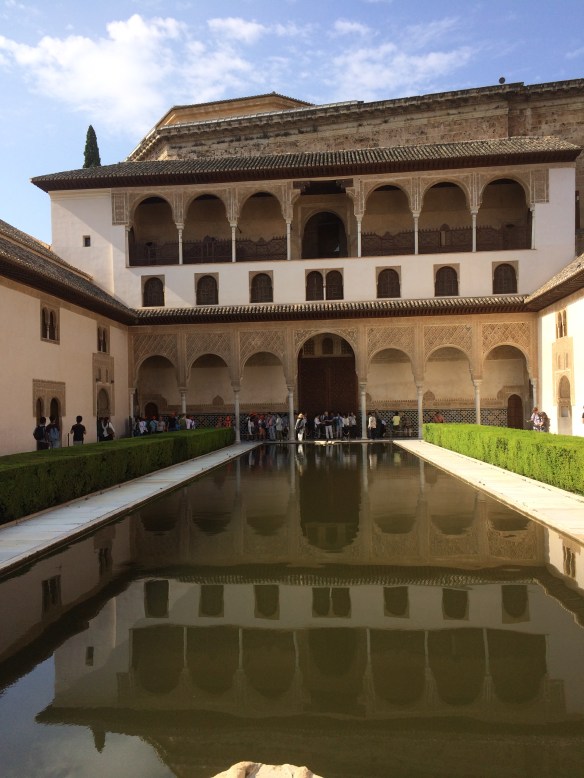
Reflecting pool, Nazaries Palace

Reflecting pool, Nazaries Palace

Another note about stairs here; the steps are higher than I am accustomed to. That seems odd to me. Presumably back in the day, people were shorter. I am tall and have long legs, but I ascend carefully because the steps are so high I am afraid of tripping.

We visited the  Nazaries Palace at the Alhambra today. We had a little time to kill first, so we went into the Charles V palace, which houses an art museum–up a steep flight of the slipperiest marble steps I have ever encountered. Coming down, even Tom was clinging to the railing and complaining about feeling old.

Window overlooking a courtyard, Nazaries Palace

Window overlooking a courtyard, Nazaries Palace

The palace itself had so many stairways I couldn’t count them. However, the beauty of the place is so magical that I barely noticed. There is delicate, intricate stone bas-relief carving everywhere, so fine it looks like lace, transcending the solidity and weight of the material. Inlaid tile murals in geometric patterns, like jewels. Tall, slender columns, reflecting pools, fountains, trees, flowers, vistas of the town through stone traceries. There are places in the ceilings where you can see that the carvings were once brilliantly colored and accented with gold leaf–it must have engendered deep awe and amazement in its heyday. It still does today.

2015-06-11 10.33.13

Ceiling detail, Nazaries Palace. You can see it was once painted.

2015-06-11 10.29.59

2015-06-11 10.21.37


After taking a brief rest, we decided to visit the Generalife, another palace with tiered gardens–and even more stairs. The path to the Generalife led past ruined Moorish palaces where the walls are now just stacks of bricks, sometimes faced with stone. Then through the first tier of gardens, overlooking the Nazaries Palace at the Alhambra. The Generalife palace is not in as good a condition as the Nazaries Palace, but still boasts some stone traceries, and there is running water everywhere, flowing down canals and channels–in one place, it runs down the balustrades of a long. long staircase that ascends to the top of the hill. The gardens are gorgeous and well-tended, and the peaceful sound of running water is soothing to the ear. Everywhere around the Alhambra complex, clouds of sharp-winged swallows swoop in and out of holes in the ancient walls where the mortar has fallen away, tending to their babies.

2015-06-11 13.44.59

2015-06-11 14.01.39


I couldn’t help thinking that the swallows have always been here, raising their families, as the Moors came and went, as the Spanish royals came and went, as the tourists come and go–and they will be here long after.

The restaurant at the parador is OK, but not inspired, so we decided to get wine and tapas at the Hotel America, just a few hundred feet away. The hotel has an open-air patio, and we sat in a shady corner. There was netting overhead, but it was covered with vines and detritus. The sparrows are numerous and aggressive. They clustered directly overhead, shuffling and muttering, and we sat in a near-continuous rain of sparrow poop and dried leaves, which we picked out of each other’s hair. You might well ask, “Why didn’t we just move?” The answer is that everyone there was having more or less the same problem, so there was no point. The food was good, but I do not believe we will be returning. I had to wash my clothes and travel purse when we returned to our room. We had rather more wine than we had originally intended, but what the hey, we were on foot. I found the five flights of stairs to the bedroom a bit of a trial, though.

After a short four-hour nap, we drove into the town for dinner. We were about half an hour late because the streets in the old town are so narrow and windy. Plus, our GPS app was even more confused than we were. We finally found the general neighborhood and parked in a parking garage that said “Parking Publico Libre”–but it wasn’t. The parking garage was even more harrowing than the streets, but we finally found a spot and (eventually) the restaurant, La Bottilleria. The food was excellent and so was the wine. So was the service, for that matter–not something you can count on here. We found our way back to the parking garage and Tom valiantly tried to drive out of it and got stuck. He went to find the attendant to help (a most unusual move on Tom’s part), and the helpful attendant rescued us. Then we just had to negotiate the tiny, winding streets back to the Parador, and up the four flights to our room. (I haven’t made it to the bedroom yet. One. More. Flight. To. Go.)

I may not lose weight on this trip, but I sure as hell will be gaining muscle tone.

The Sublime and Then There’s Peeing in the Parking Lot

This is the first long-haul trip I’ve been on in a long time that I didn’t just about die from jet lag. Tom and I landed in Madrid in the morning and napped for a few hours in the hotel before heading out for what passes for an early dinner in Spain at 9:00pm. (Tom is in heaven. Nine o’clock dinners and lunch at 4 pm.) We went to bed at about 11 and woke at 6 am. I felt wonderful, and we were now attuned to the Spanish timetable. Absolute magic, especially since the trip lasted approximately 20+ hours in all, and I was awake for the entire time. plus travel to and from airports, because I don’t sleep on airplanes. Please don’t send me your sleep remedy–I’ve tried them all. This time I drank three glasses of wine and took two Xanax and DID NOT GO TO SLEEP. (Also please do not send me warnings about mixing pills and alcohol. I normally would not, but I was desperate–and yet I still didn’t conk out.) It’s been this way since I started flying at the age of two. I am not anxious about flying or tense during a flight. I just Do. Not. Sleep. It’s a major frustration, and sometimes leads to up to three vacation days just recovering from jet lag.

But this morning I was bright eyed and bushy tailed. We rented a car and Tom headed to Granada with no maps or GPs and got us there without any problem. Andalucia reminds me a lot of California, except instead of miles and miles of grape vines, there are kilometers and kilometers of olive trees.

We are staying at the Parador de Granada, which is actually inside the Alhambra Palace complex. We had a bit of trouble figuring out where to go and how to get there without buying a ticket to the palace (we are getting these through the parador). So we parked in one of the paid lots, which is a long way from the parador. As we were walking, we saw a woman sitting sideways in the open driver’s seat of her car with her legs spread wide, peeing on the asphalt. Well, they say travel broadens the mind, and that certainly was a completely new sight in my experience.

Our bedroom at the Parador de Granada

Our bedroom at the Parador de Granada


The parador is gorgeous, and everything here is amazing. There are nightingales singing in the trees! We couldn’t be happier with the room(s) (yeah, it’s pretty swank, but Tom tells me not to get used to it), and tomorrow we tour the palace.

Sparkling wine and yummy treats awaited us in our sitting room at the parador

Sparkling wine and yummy treats awaited us in our sitting room at the parador


Cool archway in the parador. The paving is made of different colored pebbles in intricate patterns.

Cool archway in the parador. The paving is made of different colored pebbles in intricate patterns, but it’s hard to see in this photo.


Oh, and I have been able to navigate in Spanish and make myself understood, which thrills me because I never studied it. I probably owe this to my mother, who was bilingual English/Spanish, but who for some reason wanted me to take French. (French speakers in California are extremely thin on the ground.) Thanks, Mom! Your blessings continue to enrich my life.

Aloha from Spain!

Spanish wave

Sorry! That was jet lag speaking. I have been immersed for a few months in writing the sequel to “The Obsidian Mirror,” which is set in Hawai’i. I meant, of course, “Hola from Spain!”

I won’t be blogging in the same kind of detail that I blogged my trip to Hawai’i last January. This is a vacation, not a research trip. And, in the faint possibility you might be concerned that I won’t get the sequel done, I am taking nearly a week in one place, the Rioja region, to work on the next novel. Did I mention that the Rioja region is home to some of Spain’s finest red wines? Naturally, that had nothing to do with my choice of locations in which to work on the book. No, indeed.

So hasta la vista, mis amigos. (Practicing!) I’ll be back with odds and ends as Tom and I wend our way across Spain.


Race Is Dead. Racism Is Alive and Well.

Diverse group of kids outside.

With the spate of recent police killings of blacks and the resultant urban riots, race has bullied its way to the forefront of American consciousness yet again. Along with the rest of you, I have read the various postings and news stories—and been horrified by the nasty, cruel, bigoted comments that follow.

What astounds me is that people still think race is a thing. With DNA science and technology, it has been proven beyond any shadow of a doubt that the concept of race is completely, utterly false. There is no such thing as race.

Let that sink in: there is no such thing as race.

According to the National Human Genome Research Institute of the National Institutes of Health, “All human beings are 99.9 percent identical in their genetic makeup.” The remaining 0.1% difference accounts for diversity in skin tone, eye color and shape, and thousands of other variations between one individual and another. It has also been shown that every human being on Earth can trace his or her DNA ancestry back to Ethiopia of about 150,000 years ago. We are ALL out of Africa, every last one of us.

This means that a bushman in the Kalahari Desert, an office worker of European descent in New York and a factory worker in Taiwan are almost literally brothers. All that hatred, violence, fear, injustice, and bloodshed is over a 0.1% difference between us that takes place in structures so small we can’t see them without a scanning electron microscope.

Racism has apparently been with us as long as there have been hominids. Jane Goodall observed young male chimpanzees band together to hunt and bludgeon to death chimps of a different social group (a phenomenon that caused her a great deal of disillusionment and sorrow). There is some archeological evidence that homo sapiens may have caused the demise of other early hominids such as Neanderthals and Denisovans. Maybe we shouldn’t be surprised—after all, human DNA differs from chimpanzee DNA by only 1.2% (http://humanorigins.si.edu/evidence/genetics). That makes us cousins, if not brothers.

So here we are, thousands upon thousands of years later, still beating each other up for being different. During the 19th Century, (white) anthropologists and others tried to deploy science to support race theory. “Scientists” measured skulls and defined “racial” characteristics to prove that there were different races of men. Of course, they had already decided—scientifically, of course!—that Adam and Eve were white, making the white race the “original” and the peak of creation. Falling short of the white measurement stick, all other races were deemed inferior. All kinds of ludicrous models were set up to “prove” this, spawning horrors like eugenics, genocide and the Nazi Holocaust.

In the clear light of DNA science, all these antique constructions were blown away like the dark and ugly cobwebs they were. Unfortunately, much of the world does not seem to have received the message. Although the concept of “race” is utterly false, racism is very real.

I read recently (sorry, can’t remember where) that racism today is really tribalism—“Us” versus “Them”—and that race has little to do with it. That may be true, but if you ask a white bigot about why he hates blacks, you’ll hear a lot of claptrap about the differences between the “races.”

There’s also nonsense coming from the side of the oppressed, probably in natural retaliation for the crimes of racism. For instance, I have read that there is no such thing as reverse racism. The idea is that if you are not a member of an oppressed minority, you cannot be victimized by racism; racism can be directed only from the empowered toward the powerless. C’mon, guys. That’s just justifying racism under a new euphemism. It’s a made-up notion with no more basis in fact than “blacks aren’t intelligent enough to go to college.” Human beings have a tragic penchant for attacking “The Other,” and what color you are makes no difference.

My granddaughters are of “mixed” DNA. We know from DNA tests of their parents that they have genes inherited from almost every group on Earth. (There must be some interesting stories back there!) They are beautiful, tender, loving, and they have no idea at all that there is a concept called ”race.”

I want these children to grow up in a world where “race” is viewed as a hideous artifact of a long-dead age. There is no such thing as race. There are only human beings in their infinite and interesting variety. Help me get the word out.

Diversion Books Announces Re-publication of “The Obsidian Mirror”

New Cover


FOR IMMEDIATE RELEASE

DIVERSIONBOOKS

seth@diversionbooks.com

DIVERSION BOOKS RESCUES THE OBSIDIAN MIRROR, RELEASES NEW VERSION OF FANTASY NOVEL

May 15, 2015—Diversion Books today released The Obsidian Mirror, an inventive high tech-meets-Aztec fantasy novel by Silicon Valley public relations veteran K.D. Keenan, marking the second time the novel has been issued in less than a year.

Diversion Books, which publishes a number of classic fantasy authors—including Ursula K. Le Guin, M.K. Wren and Henry Kuttner—scooped up the title after its original publisher, AEC Stellar Publishing, went out of business.  “The Obsidian Mirror is a terrifically fun read,” said acquiring editor Laura Duane. “It recalls the wit and invention of Douglas Adams, and fits perfectly with many of our other fantasy titles.”

The Obsidian Mirror tells the story of Sierra Carter, an out-of-work PR executive who receives a call from Quetzalcoatl, the plumed serpent god of the Aztecs, and discovers that her former firm’s semiconductors are a means of spreading a deadly evil around the world.  Powering these nasty vibes is Necocyaotl, Aztec god of death and destruction, who has placed his essence in every device, causing people to place their self-interest and selfish desires above all else.

Carter, with the help of some paranormal pals—Chaco, a handsome young man when he isn’t being a coyote; Fred, the mannegishi with the ability to disappear at will; and Rose, a Native American shaman—learns how to develop her inner powers. She’ll need them, because Necocyaotl’s team is playing for keeps, and the evil god brings an ice demon, dark spirits, and assorted monsters into the game to bolster his more human henchmen.

The Obsidian Mirror is available as an eBook from Diversion Books, Amazon, Apple’s store, Barnes & Noble, Kobo, and Google Books.

ABOUT DIVERSION BOOKS:

Founded in 2010, Diversion Books has emerged as a premier digital publishing house, partnering with top literary agencies, media companies, and authors to build a rapidly -growing catalog across a range of genres. With its cutting-edge marketing and versatility in the changing landscape, Diversion proudly publishes top-tier authors old and new, building the next generation publishing company, one great book at a time.

FOR MEDIA QUESTIONS, PLEASE CONTACT:

Seth Kaufman, Sales & Media Strategist

seth@diversionbooks.com


Cover Reveal for “The Obsidian Mirror” (Redux)

I am delighted to announce that Diversion Books has come up with a splendid new cover for the republished version of “The Obsidian Mirror”! It has a lot of the feel of the original, with a lot more sophistication and glamor. LeNew Covert me know what you think: