Lost in the Fog at FogCon

Lost in the Fog

I attended FogCon a couple of weeks ago. I had only attended one other con, and that was several years ago when I went to WorldCon in San Jose, CA. WorldCon was huge, taking up much of the McEnry Convention Center. There were lots of cosplay people dressed as Galadriel or Romulans or as people/creatures/characters I didn’t even recognize. And I met Terry Pratchett.

Yes, I know I said I was going to talk about FogCon, but I have to stop and talk about my encounter with Mr. Pratchett, who is one of my VERY EXTREMELY MOST FAVORITE fantasy authors.

You see, I met Connie Willis first. I was in the vendors’ hall when I happened to glimpse her nametag. Connie Willis is also a favorite author, so I introduced myself—and proceeded to commit every rabid-fan sin it is possible to commit in attempting to praise her work. Even as I heard the vapid words burbling out of my mouth, I knew I was doomed. The expression of pain on Ms. Willis’ face only confirmed my gauche blundering. I attempted to extricate myself by saying, “Well, I’m starting to drool on you, so I guess I’d better go now.” Ms. Willis nodded mute agreement, and I slunk away with my tail between my legs, feeling like a complete moron.

I was standing at a vendor’s stall wondering if it is possible to actually die of embarrassment when a tidy gentleman with a gray beard and a black fedora walked up. I thought he looked familiar, but when the vendor called him “Mr. Pratchett,” my suspicions were confirmed. He stood right next to me as the vendor handed him a CD and said, “I’ve been saving this for you, but I was afraid I might come across as a rabid fan.” (Like me, I thought.)

Pratchett took the CD and said, “I adore rabid fans!”

I turned to him and said, “Well, then, would you mind if I drooled on your shoulder?”

Pratchett responded, “Not at all—but would you mind drooling on this shoulder”—he patted his right shoulder—“as the other one is already rather damp?”

Instantly, the oppressive cloud of feeling foolish lifted and disappeared. I will never forget how Terry Pratchett’s humor and kindness brightened my day and turned my embarrassment into laughter. (Not that I mean to say Connie Willis made me feel bad. I made myself feel bad. I should’ve kept my mouth shut.)

Okay, back to FogCon, which is a very different con. I thought the topics appeared geared more to writers than to fans (“How To Create a Magical System” is one example), but there were probably more fans than writers. The sessions were a combination of panel discussion and group discussion. I introduced myself to several people, and sometimes got into conversations, but most people seemed to be there with groups of like-minded friends, and they were more interested in hanging with their posses than mingling. No one was rude or even cold; I just never clicked with anyone. I asked several people why they came to FogCon, and the answers were all along the lines of “I enjoy the discussions. The topics are so interesting.” Perhaps other cons are not as participative? I don’t know yet.

I managed to miss all the good parties because I didn’t know about the con suite. I handed out a few cards about “The Obsidian Mirror,” but no one expressed much interest. I finally just left a stack on the literature table. When I tried to talk about the book to a bookseller (from whom I was purchasing three books at the time), he just looked bored and pointedly set the card aside without a word.

By the time the “Non-Awards Banquet” rolled around on Saturday night, I was kind of done. There was a party afterwards, but I was tired and didn’t feel like trying to push myself onto more indifferent people.

I’ve done a lot of successful networking in my time, but I felt like a complete tyro at FogCon. I suspect that I am on a learning curve here. I went to the con to learn more about how cons work, and from that perspective, I was successful. I think I need to attend more cons and pick up on the culture (which I think differs from con to con, based on my limited experience). If I continue to attend, I’ll probably get to know others who go to cons and vice versa. Who knows? Maybe someday I’ll have my very own posse.
I Took My Skull Back to the Place It Came From (Almost)

When I turned six years old, my grandfather gave me a present. It wasn’t wrapped, as I recall, but just placed in a plain cardboard box. As it happened, it was my favorite gift that year: a genuine human skull.

My grandfather, Frank W. Moore, was an adventurous man. In the earlier days of the 20th century, he helled around California in a Model T, driving across the desert before there was such a thing as “off-road” driving. He had a sailboat called “Amy H” in which he explored the California coast and offshore islands. (My grandmother was not named Amy H. I think the boat came with the name and he never got around to changing it.) In those days, California was underpopulated and he had the freedom to go pretty much wherever he wanted to do whatever he felt like. One of the things he liked to do was go out with his buddy, Dr. Walter B. Power, and cut down billboards.

On one occasion in 1917, he landed on San Nicholas Island, later made famous by writer Scott O’Dell as “The Island of the Blue Dolphins.” On or near the beach, he saw a white dome poking up out of the sand. He uncovered it and found a skull with half of its lower mandible. The teeth (those that were left) were ground down quite smooth as a result of the inhabitants’ diet of shellfish which contained a lot of sand. My grandfather took the skull home, where it became an object of envy for my mother, who had ambitions of becoming an archeologist (and eventually did). Mom named it Yorick after the skull in “Hamlet.”

In those days, there was no Native American Repatriation Act, aimed at restoring the remains of Native Americans to their tribes and homelands. The battle of Wounded Knee was a mere 27 years in the past when my grandfather found the skull, and the term “Native American” hadn’t yet been coined. Indians, in short, were not highly regarded by the mainstream culture back then. No one thought twice about my grandfather taking Yorick from his resting place on San Nicholas Island.

In 1917, there were no inhabitants on the island. The Nicoleños (or Ghalas-at) had been almost exterminated by Russian fur-trappers. In 1835, the padres of the California mission system moved five of the six remaining inhabitants to the mainland. The one who stayed, Juana Maria, became known as “The Lone Woman.” She lived there, utterly alone, until her removal from the island in 1853. She died not long after.

My mother thought the skull was that of a young male in his 20’s, pointing to the supra-orbital ridges and cranial sutures, and we continued to refer to it as Yorick. Sensibilities toward Native Americans hadn’t improved too much by the time my childhood rolled around, so I happily took Yorick to show-and-tell sessions at school–and I have to tell you, he never failed to make a hit appearance. No one could top me when it came to show-and-tell; imagine following my human skull with your toy cap gun (also a perfectly acceptable show-and-tell item in the 1950’s).

I took as much care of Yorick as a small child might be expected to do, but one day, something heavy fell on him as he rested in my off-duty Easter basket. My mother undertook to glue him back together–and while she was engaged in this project, the chipmunk I had taken home for the weekend from my third grade classroom escaped in the family room and took up residence in the couch. Mom thought this would be a good way to start a book: “While I was glueing my daughter’s skull back together, the chipmunk got loose.” I thought this had promise, but she never did write the book.

When my own children were in elementary school, I let them take Yorick to their show-and-tell sessions. He was as much a hit as ever, but I heard back from one teacher that Yorick was an inappropriate show-and-tell subject. She mentioned the Native American Repatriation Act, and I realized with something of a shock that Yorick was, of course, subject to that law. That ended Yorick’s career in show-and-tell.

I suppose I should have realized earlier that Yorick had been a human being whose remains had been wrested from his native land in an insensitive and chauvinistic manner. But Yorick had been a fixture in my life, and I hadn’t really thought of him as such. He spent the next couple of decades in a cardboard box. Out of sight, out of mind.

When I finished “The Obsidian Mirror” and began to look for a publisher, I remembered my unfulfilled obligation. My novel is based on New World legends, myths, and folk tales, and I recognized my enormous debt to the Native Americans and their many cultures. I thought if I got published–by a real publisher, not self-published–the finest way to celebrate this would be to repatriate Yorick to whichever Native American tribe now held the responsibility for those long-dead people of San Nicholas Island. I thought the Chumash were the most likely, as they are the tribe that lives around Santa Barbara now. I pledged to Yorick and the Powers That Be that I would repatriate Yorick if my book were picked up by a publisher. (I planned to self-publish if I failed to find a publisher, but I didn’t even contemplate what I would do with Yorick in that case.)

Well, AEC Stellar Publishing is bringing out “The Obsidian Mirror” sometime this summer. So I had a promise to keep.

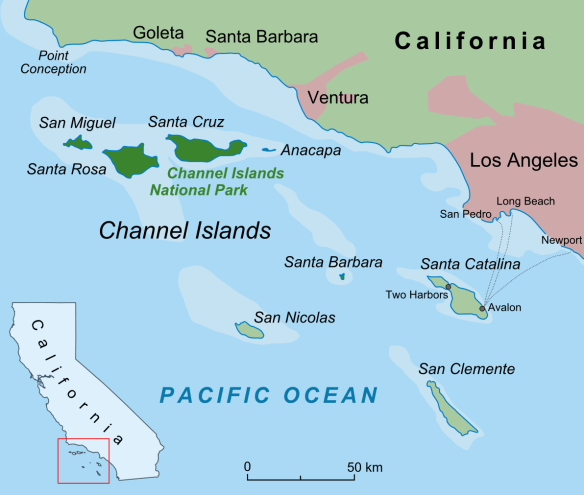
To be honest, I had never before investigated where San Nicholas Island was, precisely, or what had become of it. I had assumed, as the island is considered part of the Channel Islands group, it had been rid of its introduced species like rats and goats and made into a nature preserve like Anacapa. A group of us sat in our living room this past holiday season and did some research. Some of us (not me) were voluble in proposing that we hire a fishing boat and go out to San Nicholas to rebury Yorick ourselves.

It turned out that San Nicholas Island is considerably south of the other Channel Islands (except for Santa Catalina and San Clemente), and sits perhaps 100 miles out to sea from the Southern California coast.

The Channel Islands

The Channel Islands

It also turned out that the island is under the jurisdiction of the United States Navy, which uses it for weapons research. The occupants of a fishing boat that attempted to land would probably be arrested. Some of the group still wanted to do it. “We’ll just tell them we’re old and we got lost,” said my friend Meg. Nope. Nope. Nope. Not going there. I reserve my feckless adventuring for my fiction writing.

I contacted my cousin Sally, who lives near Santa Barbara. Sally suggested contacting Dr. John Johnson, an anthropologist specializing in the Channel Island Indians. Dr. Johnson, a very kind and knowledgeable man, explained that there was an investigation underway to try to determine who (if any) were the legitimate descendants of the Nicoleños. And the organization in charge of the investigation? The U.S. Navy. I don’t have a whole lot of faith that the U.S. Navy feels any urgency about resolving this problem, but according to Dr. Johnson, there isn’t any alternative. Repatriated remains go to the Santa Barbara Museum of Natural History, where Dr. Johnson works. He assured me that there is a special area where these remains are kept until they can be interred in an appropriate manner and place. Yorick would stay in the museum until the Navy decided where he belonged.

Well, Santa Barbara was at least closer to San Nicholas Island than Yorick has been in more than half a century. I made an appointment with Dr. Johnson to turn Yorick over.

When my husband and I went to Santa Barbara, Dr. Johnson spent some time examining the skull, then said, “I think what we have here is actually Yoricka.” He believes that the skull was that of an older woman, not a young man, and showed us why he thought so. (Sorry, Mom. I think he’s right.) He asked me details about my grandfather and mother and I filled out some paperwork. Then it was time to say goodbye. On the way out of the museum, my husband turned to me and asked, “Feeling a little sad?”

I said, “Yes.” I wish I had taken a picture of Yorick before we left. After all, he–she–was a member of my family for 97 years. I wish I had known who you really were, Yorika. I hope you find your way back to your Island of the Blue Dolphins.

Everything Old Is New Again

This post is appropros of nothing at all. My husband, Tom, sends me emails with links to everything he thinks I will find interesting on the Internet. (Yes, this is a HUGE amount of stuff!)

One day, he sent me a link to “Creative and Innovative Packaging,” http://www.toxel.com/design/2014/01/09/creative-and-innovative-packaging/. Amid all the clever design ideas I found this photo for a brilliant new way to package that old standby, the match:

Matches Designed by Fitzsu

Matches Designed by Fitzsu


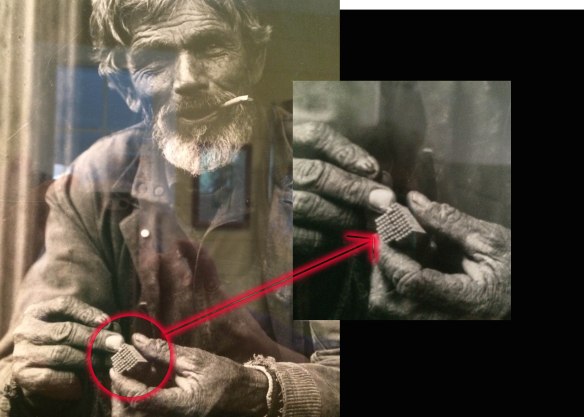
Clever, yes? Except that I possess a photograph taken sometime in the 1920’s by my great-uncle Lawrence Moore, of a ranch hand named Nacho at Muleshoe Ranch in Arizona, preparing to light his hand-rolled cigarette:

Nacho's matches.

Nacho’s matches.

Hmmm. Guess that hot new match design is…really old. Or–this could be PROOF of time travel!!!! Just like all those old photos of movie stars and war heroes using cell phones…except that Nacho’s matches happened to be real.

OK. Enough frivolity for today.

My Obamacare Horror Story

HiRes

We have met Obamacare, and I’m here to tell you about our ghastly experience.

When I was working full time for a large corporation, health insurance for my husband and me cost about $120 a month. The deductibles were low, and everything was covered, from dental to vision to psychiatric care.  Plus, the company had its own on-site clinic, which was cheaper and more convenient than going to a private clinic or physician.

When the firm ran into problems, I was offered early retirement. The early retirement program was generous, and included 18 months on COBRA at a cost of about $1200 a month. This was a 10X increase, but the coverage was still great.

Of course, 18 months passed like no time at all, and we were faced with the necessity of finding health insurance on our own. My husband and I were working out of our house as freelancers–he as a website developer, I as a writer. At the time we were both 62 years old, so Medicare wasn’t an option yet. I set about trying to find private health insurance. After reciting the brief list of medications we take, I was met with complete rejection and indifference on every side. (Pre-Obamacare, remember, insurance companies could turn down anyone they wanted on the basis of pre-existing conditions. So if you needed health insurance, obviously they would not want to cover you.)

Finally, I connected with a wonderful insurance broker who gave us several options for obtaining private insurance. The one that made the most sense was for us to start a business partnership. As a business, the insurance companies would not turn us down for pre-existing conditions.

So that is what we did. And we got insurance. For $1200 a month, our deductible was $4000 a year. Prescriptions were not covered. No dental or vision coverage. Given how infrequently we visit doctors, we never met the deductible, but at least we knew if something horrible happened, we had coverage. As for dental, it seemed cheaper to pay for bi-annual cleanings out of pocket than to spend the extra money it cost to get dental insurance at something like $120 a month in addition to the basic health coverage.

Then Obamacare struck. It appeared that under the new rules, husband-and-wife businesses were excluded, so again, I hit the insurance-buying trail. On the advice of the same amazing broker, I went to coveredcalifornia.com. I evaluated the plans, selected one that would cost about $600 a month, and filled out an application to see if we qualified for a subsidy.

I waited and waited. Then I went back to the site. I could find no way to track the progress of my application. I knew that Covered California had received it because I mailed it with return receipt requested. After cruising around the site fruitlessly for a while, it went down for maintenance. I called them. The woman who took my call said that yes, we did qualify for a subsidy. And as I couldn’t see all the options on the site because it was down, she mentioned a plan that would provide the basic coverage we were receiving, but with no deductibles and the addition of coverage for prescriptions. There were small co-pays for doctor’s visits and medication. There was no dental or vision care because these were not included under Obamacare. And I would not be able to keep my primary physician, who is a woman worth her weight in rubies and diamonds.

But our premium would be $4.00 per month. For covering both of us.

Yes, you read that right: four dollars a month to cover two adults. Suddenly, I was not at all concerned about losing my primary physician. I forgave coverdcalifornia.com for being hard to deal with. I was no longer irritated with Obamacare for excluding husband-and-wife businesses.

The one thing I did not forgive was the insurance companies for being such jerks in the first place.

The Final Concept (Cover Art)

Well, the publisher has approved final cover art for “The Obsidian Mirror.” As you can see below, not too different from the last one. We still don’t have the blurbs, publisher’s logo, etc., but that’s out of my hands for now. I like this one!

Cover Art 2b

The Coyote Didn’t Cut It

Sometimes I have to shake myself to see if I am dreaming. I am fulfilling a lifelong ambition: writing and publishing a novel. It has been a daydream so long that I had given up on it—until I actually wrote a book.

But now, I am listed as an author on the publisher’s website. I am working on the graphics. I am working on the marketing. I should be working on final-editing the manuscript, but haven’t quite gotten there yet. (Tomorrow. I promise!) Sometimes I wonder if this is real, or just an extended daydream—but then my publisher asks me to do something else, and I’m sure these tasks were not part of my original roseate dream, so I am becoming more convinced that this will really happen.

And then I go back to being amazed.

Well, anyway, here’s a mockup of my latest cover design, front, back and spine. I haven’t gotten feedback from the publisher yet, but I kind of like it. But no man/coyote graphic. <Sniff><Sob> I am very attached to the shape-changing coyote, but he just isn’t working out too well as a cover. I am sure I’ll continue to use him, but perhaps not on the book cover. If you were kind enough to weigh in on the graphic, thanks. I agree with the majority that the original one is the best.

Cover Art 2a

How’s This Coyote? I’d Really Like Your Opinion.

Many of you were kind enough to comment on three different versions of Chaco: my supernatural character who can appear either as a ridiculously beautiful young man, or as a coyote. (But not just any coyote; he is Coyotl the Trickster).

My publisher had asked for a somewhat lighter feel to the image because the tone of the book overall is light. Chaco is (usually) a cheerful guy.

The vote was overwhelmingly in favor of my original, Chaco #1, with 10 votes, #2 got three votes, and #3 got two votes. I also favor the original.

However, my friend Erica Chase asked, “Is there a happier looking coyote?” I thought this was nothing short of brilliant (typical of Erica). So I went looking for a coyote whose expression was less threatening and more upbeat. And then tried to match the coyote with an image of a young man that more or less matched (or was at least complementary to) the coyote’s expression. The image below is the result, and if you would be so obliging, I’d like to know if you think this is an improvement. Or not. (To see the three images I posted for comment, please go to https://obsidianmirrorblog.wordpress.com/2013/12/13/vote-for-your-favorite-coyote/)

New Coyote/Chaco

New Coyote/Chaco

Vote for Your Favorite Coyote!

I sent last week’s cover art to my publisher. One of his comments was: “…the book itself also felt a bit more light hearted than the dark cover with the serious boy (who was definitely not so serious in my mind, as I read anyway).”

The man (Chaco) changing into a coyote is central to my story. Chaco is Coyotl, the trickster folk hero of many Native American cultures. He can shift back and forth at will, and this comes in handy several times during the story. So I’d really like to use the image of the shape-shifting man-coyote. But my publisher is right: the tone of the book is on the lighter side.

I picked out a few more handsome latino men from iStock.com, where there is a plethora of such men on sale for very little money, and created two alternatives to my original. I present them here for your deliberation: which is the best Chaco: #1, #2, or #3?

I eagerly await your judgement!

Chaco #1

Chaco #1

Chaco #2

Chaco #2

Chaco #3

Chaco #3

Tell Me What You Think. Please?

I’ve gone back and forth a couple of times with the publisher, AEC Stellar, and I think we’ve probably arrived at an agreement.

So now I get to do something fun: design my own cover art. AEC Stellar has people who will do this, but from my standpoint, one of the advantages of working with a small company is that they are willing to let me do my own cover design if I want (and it meets their standards). I realize that most people wouldn’t think this was fun, but I also paint in oils and design jewelry and I’m pretty good at Photoshop. You can purchase excellent photography and illustrations from an online stock provider for very reasonable prices and manipulate these images in Photoshop. I did a lot of this when I was working on marketing materials for Cisco, and I enjoy it.

Here’s my first concept. Do you like it? Dislike it? I’d love to know.

Obsidian Mirror cover3

The Contract

ContractThe book contract arrived. It seemed pretty straightforward to me, but I’ve never laid eyes on a book contract before, so what do I know? I followed the advice of my book consultant and shelled out some bucks to have someone knowledgeable review it.

I recognized that the contract was unusual. The publisher is unusual. It required some shared expenses. Having talked with the publisher, I was aware of this, and given that the author gets 50% of the net (as compared to maybe 12% from standard publishers), that didn’t seem unfair to me, especially as this is a new, startup publisher.

The reviewer sent the contract back with many, many comments. I looked at them all carefully. There were a few that I didn’t agree with, but some of the others seemed more than reasonable. For example, the contract specified that all rights to the work in other media such as TV, movies, audiobook, etc. would belong to the publisher. Now, the likelihood of my little novel being made into a movie is remote, but I didn’t see why I should give up the rights to my own work, even so. So I marked up the contract accordingly and returned it to the publisher with a polite note indicating that everything was up for discussion.

That was yesterday. No response so far. Of course, I reasoned, he needs time to look it over. I took my time, after all. But still. Is he pissed off? Insulted? Did he even see it yet? Am I stressing unnecessarily? Or is this an indication of thunderclouds on the horizon? Should I stop thinking about it? Should I call?

Or maybe I’ll just go for a walk on the beach and forget about it.