Day 4: The Old Friend Comes Through and Things Become Brighter

_DSC0051

Day 4: Kona

I awoke early with snorkeling on my mind. We each grabbed a banana and a croissant, put swimsuits on and headed out to Two-Step beach.

“Beach” is actually a euphemism. It is a lava rock outcropping with a light dusting of sand here and there. As we made our way to the water’s edge, I guess we looked like newbies, because we received a lot of kindly advice from others about how to get in and out of the water.

This was well-received. Two-Step earned its name because there is an area where two shelves of lava form steps into the water. You can see the fish swimming below the steps even before getting in. We were given these rules:

-People exiting the water have right of way. They are likely tired, and it isn’t enormously easy to get out.

-Let the water take you out. Let the water bring you in.

-If you want to help people exiting the water, take their equipment for them, but do not offer them a hand. It’s too likely that they will accidentally pull you into the water.

I approached the water cautiously because getting slammed against the lava rock would probably be a bad idea. I wet my fins in the water and put them on, stuck my mask and snorkel on my head like a peculiar hair band, and eased carefully out. No problems. I began to snorkel as soon as Tom made his way in.

The water clarity was good, and there were plenty of fish–different types of butterfly fish, mostly millet seed, long nose, and raccoon. We also saw lots of bright-yellow tangs, a few bright-yellow trumpetfish, pufferfish, lots of black dragon triggerfish, wrasses, and my fave: the humuhumu-nukunuku-apu’a’a. This means “little fish with a snout like a pig,” and is Hawaii’s state fish. I can actually pronounce it flawlessly. We also saw a gorgeous blue parrotfish.

Memories to cherish: swimming into a cloud of black dragon triggerfish. They weren’t exactly schooling, more like hanging around together. In Hawaiian, these are called humuhumu-ele’ele. They are (as you might imagine) black, but they have neon-blue racing stripes edging their dorsal and ventral fins, and are quite lovely. Closer to shore, we saw a school of small white-silver fish with yellow tails that I have not yet been able to identify. They were clumped into several small groups, each side-by-side with the others and facing the same direction like marching soldiers. There were probably five or six little groups, not schooling, just hovering. Black dragon surgeonfish and a damselfish seemed to be herding them, though this was probably not the case.

We headed in after a bit. Both of us were cramping. I don’t know if this was because we haven’t swum with fins for more than a year, or because we don’t get enough exercise in general (sadly probable), or because of the rather weighty bananas we had for breakfast (I did get indigestion). We reached the two steps. I was much more cautious getting out, taking off my fins and flinging them onto the lava, then my mask (gently laid on the top step). I let the waves push me onto the first step, then carefully climbed out onto my knees, which I would never normally do because I have damaged them too many times. And thus to safety. As I was pulling myself out, I noticed a tiny starfish in a crack, round and flat like a pancake, with many small, rayed legs. I will try to find out what this was, because I’ve never seen one before.

We headed back to Camp Aloha. I took a swim in the pool, then showered, feeling refreshed. As I was relaxing, Ken called and asked if we would like to have lunch? Would I! We agreed to meet at Teshima’s at 12:30.  That left us just enough time to see an optometrist to get Tom’s glasses fixed. He had dropped his glasses, swiftly retrieved them before they hit the concrete–and bent the frame, causing a lens to fall out. We went to Eye Land Vision (get it?). The nice lady there fixed his glasses at no charge and even let us use the restroom.

We found Teshima’s and arrived right on time (probably unnecessary, as Ken would be operating on island time). The restaurant is Japanese-ish, with tempura and sashimi, but no sushi. They also offer hamburgers and other standard fare. We surveyed the menu and drank green tea while waiting. Before long, I saw a Ken-like hat sail past the window, and sure enough, there he was, followed by his wife, Margie. I hadn’t met Margie before, and really enjoyed making her acquaintance.

I asked a lot of questions. Not that many people make such a drastic change in their lives. Apparently Margie’s health was the spur that drove them to move from Chicago to Hawaii. (It wouldn’t have taken much for me to follow suit, if I lived in Chicago.) Ken quit journalism and bought a Kona coffee plantation.

“If anyone tells you they’re making money growing coffee here, they’re lying,” he told us. The plantations in the area (some grow macadamias, some coffee, some fruit trees, some a mix) tend to average 5 acres or so. But it was Ken’s health that forced him to sell his coffee farm. Margie told us he has a photographic memory, so absolutely everything he has ever read or seen is indelibly lodged in his brain. I suppose that is true of all of us, but Ken can actually access all that data. He rapidly became a recognized expert in sustainable agriculture. I suppose his eidetic memory is also responsible for his fluency in Japanese.

After chatting over lunch, he told us to follow him to his friend’s barber shop. His friend Bob owns a barbershop in Captain Cook called “Shear Magic.”  Ken told me that Bob had tons of stories about ghosts and spirits.

Shear Magic is located in a building off the main highway, a tiny shop towards the back. Ken introduced me to Bob, a cheerful, diminutive man with one missing tooth, and I explained why I wanted to hear his stories. There was a woman about my age waiting to get her hair trimmed, but she sat down in the barber chair and told Bob to go right ahead and talk while he was cutting. She occasionally chimed in with her own experiences, which was wonderful.

Bob is not ethnic Hawaiian. He is ethnic Japanese and married to a Vietnamese woman. But he told me that he reveres Pele, the volcano goddess, as do many here. He said that his wife’s family came to visit and they went to Volcanoes National Park. Out of the trunk of the car came crystal glasses, food and wine, which they arranged as an offering. He offered to call Pele for them, and they were delighted. As Bob explained, in Vietnam they revere a “lady goddess,” and they saw Pele as her Hawaiian equivalent.

Bob also reveres Kuan Yin, the goddess of mercy. He got a statuette of Kuan Yin and set it up in his bedroom, but the Vietnamese side of the family objected. They told him the goddess does not want to see him naked or making love, so he moved her to another room. (Hawaiian goddesses would probably want to join in. The ancient Hawaiians approved of sex and were unashamed of it.)

Ken in particular asked Bob to tell me about the night marchers. Bob said the night marchers were the spirits of the old Hawaiians. Every island was divided in those days into pie-shaped wedges called ahupua’a. The people lived near the sea, but had trails up into the hills of their ahupua’a to cultivate taro and awa (kava, which is an intoxicant). The night marchers follow their ancient paths to and from the taro patches. The woman in the chair piped up and said her house was right on one of those trails, and she had planted ti plants at the front and back doors as a signal that they were welcome to come through, although she has never heard or seen them. Bob has heard the night marchers many times.

He told me that he has been warned by spirits often not to go certain places. One time, he was fishing with a friend on a ledge by the ocean. A shadow woman appeared, far to his left and stayed there for several minutes, then disappeared. Then his friend exclaimed that a spirit whose face was covered by her long, white hair had appeared several yards to the right. They packed up their gear and left.

I asked if he had experience of any other such appearances, and he said that he has seen bright lights at night, small lights that flew right past him looking like tiny comets. This interested me because I had only the day before read about these in Martha Beckwith’s “Hawaian Mythology”:

“The fetcher as a streak of light may have a long history in Hawaii, since Ka-ili (The snatcher), described by Ellis in 1825 as a god seen at evening ‘flying about in the form of a comet,’ is the name of Liloa’s war god bequeathed to his favorite son Umi, who eventually seized the rule from his less able and less devout brother.”

Then his customer pitched in, saying that she had seen mysterious lights in trees and even on the side of a building at night. She said they were small and looked convex. When she tried to touch one, it disappeared. She also mentioned hearing Bob play the ukulele and sing earlier in the day, and suggested that we get him to display his talents for us.

The customer, now shorn, departed, and there were no people waiting, so we continued to talk. Bob never really ran out of stories. He told me that he came to Hawaii from Oahu, and immediately felt he had come home. He believes he is a reincarnated warrior, one of the Ali’i (ruling class) who were killed at “The End of the World” (the extreme southernmost tip of land in Hawaii) by the army of King Kamehameha I around 1790. So he is Hawaiian in his heart, if not in his genes.

I begged him to play the ukulele and sing. He resisted, but finally gave in and sang two songs.  He has a beautiful voice. The first was in Hawaiian and the second in English–it was about the old Hawaiians and mentioned the area we were in–Napo’opo’o and Hanaunau. Both songs were lovely. We applauded, and I said because he had shared his art with me, I wanted to share my art with him and would send him a copy of “The Obsidian Mirror” when I returned home.

Bob said he was studying to be a healer and described sensations he had felt during healings. He said when it worked, it felt like warm syrup pouring out of him. His teacher told him that was God working through him. I said I would pay him for a healing, but he replied that he did not take money for this. He agreed to do a healing on my knee, which I injured some time ago. He instructed me to close my eyes and relax, doing some deep breathing, then to envision golden light around my knee. We sat quietly for a while, then he said he hoped it would help. I don’t know, but my knee has felt pretty good since.
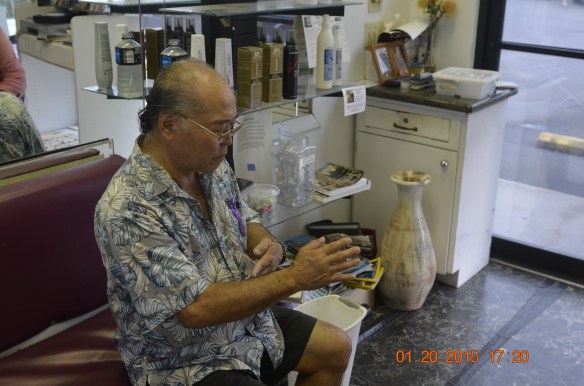
Bob healing my knee.

Bob healing my knee.

Go ahead. Say “placebo effect.” I don’t care.

Bob had another customer waiting by this time, so we left (I with a book by his healing teacher under one arm as Bob’s gift). Ken (who had left earlier) asked us to stop by his new farm, so we set off to find it. It turned out to be right off the highway, down a tiny road so rough it looked like a lava bed at first. It was easy to see he was in the midst of clearing brush, and he had a fire burning the brush, making ash to enrich the soil. He showed us a house on the property where he and Margie intend to start a B&B some day. It looks tiny from the front, but is actually pretty big. There’s a huge room in the back where he will teach food preservation classes. A busy and ambitious man. I haven’t the energy he does, and we must be about the same age.

We said farewell to Ken and headed down the highway. We stopped at Greenwell Farms, which is a Kona coffee farm. It has been in the Greenwell family for 150 years. It’s one of the largest in the area, and processes coffee for a lot of the smaller growers who can’t afford the space and equipment that it takes to process coffee. A nice woman named Caroline gave us a tour of the groves and some of the processing areas. As you may know, coffee is highly labor-intensive because the coffee bushes have “cherries” at different stages of ripening at the same time on the same tree. At Greenwell, they pick each tree at least three times as the cherries ripen. Then they are dumped into water for a quality test. It struck me a bit like witch-dunking; if the cherries sink, they are good. If they float, they are bad.

Then the cherries are put through a machine that removes the red outer skin. Recently, they have discovered that the skin is full of antioxidants, so now they make it into a health drink called Kona Red. (Didn’t try it.) The beans, two to a cherry, are covered with a sugary, slick substance that has to be removed before drying, so they ferment the beans for a while before they go into drying sheds. At Greenwell, they sun-dry them. Then they are graded according to size and roasted.

Baby pineapple growing at Greenwell Farms.

Baby pineapple growing at Greenwell Farms.

You may have heard of “peaberry” coffee. I never knew what that meant, but Caroline explained it. Occasionally, a coffee cherry has only one bean instead of two. The single bean curls around itself and makes a pea-shape that is richer in flavor than usual, though smaller. These are rarer, thus more expensive.

After learning all this, and discovering that the average coffee farmer in Kona has only about 5 acres, I no longer resented the very high price for Kona coffee–which, all said and done, is absolutely wonderful if you like coffee. I bought some coffee at the farm for the folks back home–and found that they had decaf Kona, which I have never seen before. Oh, and some chocolate covered macadamia nuts. I won’t tell you what the bill came to.

On to the Greenwell (yep, same family) Botanical Garden, which we wanted to see, but more to the point, Ken had recommended a friend who works there as a source of information about Hawaiian mythology. The garden had just closed but Ken’s friend was there. He was very pleasant, but said he knew more about plants than mythology, which makes sense, given where he works. So we proceeded back to Camp Aloha just before sunset. I fixed an omelet, using some of the leftover salad fixings and a lovely fat avocado grown on the farm here.

Tom went to bed early, but I stayed up journaling (Yikes! Getting behind!). It had been raining softly all evening, so the stars were a no-show. I fell into bed and slept like a pepe (baby), feeling MUCH happier.

Next up: an encounter with Pele, the volcano goddess. Yes. Really.
Day 3: In Which I Begin To Wonder If I Am Wasting My Time

We awoke early to the sound of many roosters trying to outdo one another. I cut up a pineapple (very proud of my expertise in picking a ripe, juicy one, though the juice spilled all over the lanai floor), and had pineapple, Cuban red bananas and yogurt. Plus croissants. Then I began working on my blog, with the usual frustration of trying to use the WordPress app on my iPad. I wound up using Tom’s computer again. I will be taking my Macbook Air on any future trips. It’s just too hard using the half-assed social media apps on the iPad.

We headed out to explore a little. First we went to Keleakakua Bay Park. This is at the end of a one-lane road. There’s a nice area for picnics, but the waterfront is not beach, but lava. The water was rough, and no one was swimming.

As we exited the car, I noticed that a woman was loading things into the car next to ours, which happened to be a Volt. I stopped and asked her how she liked it (loved it) and the conversation ranged very far indeed. Gabriela is from Germany but lives with her husband in the Puna area of the Big Island (lush, with grasslands and rainforest). She firmly believes that 9/11 was planned and executed by a shadow government of the United States and that Muslim extremists had nothing to do with it. I could not agree, largely because I can’t see the motivation. Then she told us about an amazing kahuna (holy person, priest) who had done wonders for her. A kahuna is just the sort of person I would like to meet, so I asked her for her email so I could send her a message and she could give me the contact info for the kahuna. I did this when we got back to Camp Aloha, but I suspect she may not respond. After all, I am just a crazy lady she met at the park.

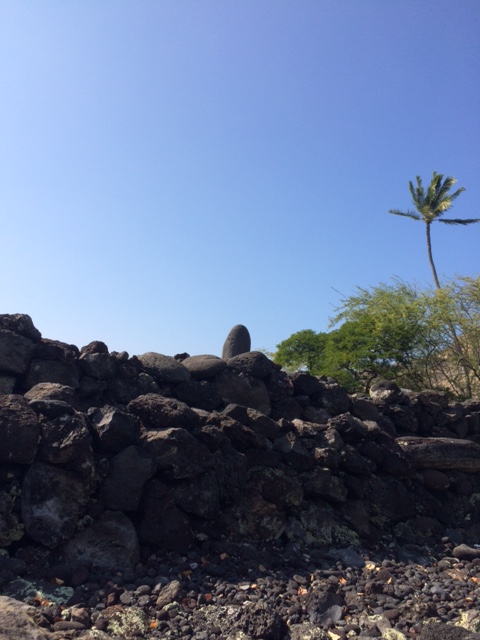
There is an ancient restored heiau (temple, pronounced hay-ee-ow) right on the water. These are all constructed of rough-cut lava chunks that, amazingly, make nice, straight walls and platforms. There was absolutely no information about why the heiau was there or to which of the 40,000 Hawaiian gods it was dedicated. (No, I am not exaggerating the number of gods.) The only sign said “Kapu” (taboo, or forbidden.) I spotted a smooth, elongated oval stone at the apex of the heiau and tried to find a good place to take a picture without violating kapu. The area was obviously once a larger complex of buildings and platforms, and it is littered with rough boulders and bits and pieces of lava. I tripped over a tree root trying to get closer. I was largely undamaged, bar slight scrapes and bruises–but my iPhone screen was badly scratched by the lava. Grrrrr. But I got my photo.

The Ku stone is that rounded stone at the top. This was considered to be a satisfactory image of the god, and was itself kapu, or sacred.

The Ku stone is that rounded stone at the top. This was considered to be a satisfactory image of the god, and was itself kapu, or sacred.


Heiau walls and platform from the front.

Heiau walls and platform from the front.

The oval stone, by the by, is probably a Ku stone. Ku was one of the top gods in the Hawaiian pantheon. As the name of the bay has “ku” in it, it’s safe to assume the ehiau was dedicated to Ku. He had a lot of responsibilities, but his major one was war. He was the god to whom most human sacrifices were made. I am not fond of Ku.

Then we went to a bee and honey museum, run by Big Island Bees. They offered a free honey tasting, so why not? They had a nice little hive you could look at through glass, some odd but interesting sculptures made out of beeswax, beekeeping paraphernalia, and of course, an assortment of stuff to purchase. We tried the honeys, and I decided I liked the ohia blossom best. I bought a small jar of ohia blossom honey and an assortment for the folks back home.

Then we set off to find Two-Step Beach, which is a good local snorkeling spot. (I adore snorkeling. I really do.) we didn’t intend to snorkel right away, we just wanted to find it so we could go back in the morning when the water tends to be calmer and clearer.

We knew it was near Pu’uhonua o Honaunau National Historical Park. This is a wonderful place that Tom and I visited many years ago. It means “the place of refuge,” and ancient Hawaiians who had violated kapu could find safety there (the penalty for violating kapu was usually death.) There is a heiau and fishponds, and it is a peaceful and spiritual place. I hope we have time to visit again, but this time I was focused on finding the snorkeling beach.

We drove up into the steep hillside again, then down into Honaunau to ask where Two-Step was. Right next door, as it happens. Having determined this, we headed down the road, not quite knowing where we were going. We drove through rocky, brushy terrain for a while before coming to a residential area that began to look strangely familiar. And then we found ourselves at a dead end. In Keleakakua Bay Park. Okay. At least we now knew where we were.

Heading up the hill again, I asked Tom to take me to the Painted Church. It is on Painted Church Road, which is also the road where our B&B is. Tom declined to go in. As a former Catholic, he is unenthusiastic about churches.

Painted Church is a tiny Catholic church perched high above the bay. It is clearly Victorian, replete with gingerbread exterior. Below the church is an old graveyard, and I couldn’t help thinking it would be a wonderful place to be buried, except that I probably wouldn’t appreciate the gob-stopping view at that point.

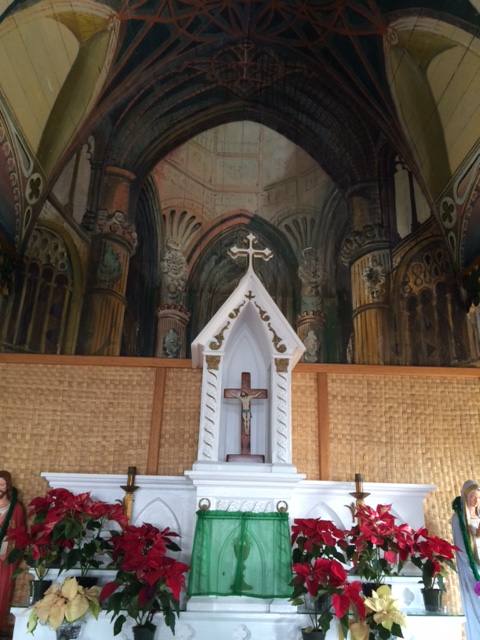
Inside, this little church was painted with murals on the walls and bright patterns on the spindly columns. Some of the murals are depictions of Biblical scenes. But around the altar, the paintings are trompe l’oeil paintings of grand Italianate arches and columns, expanding the visual interior. The arched ceiling was painted in dawn colors with fanciful palm leaves. It was lovely. I was touched to see a stand outside stocked with trinkets, unstaffed, with an “honor system” receptacle for money. This is pretty common for fruit stands here, but not for trinket stands.

Altar at Painted Church. The apparently extended space behind is a mural.

Altar at Painted Church. The apparently extended space behind is a mural.


The Painted Church ceiling. Wear your love like heaven.

The Painted Church ceiling. Wear your love like heaven.


Having surveyed the best of the local wine selection when we first arrived (Californians tend to be picky about wine because we have easy access to so many awesome wines. Europeans, please be aware that what you get in Europe from California is generally plonk.), we decided to head to a Costco north of the town of Kona. Indeed, the wine selection was fairly good. On our way to check out, I noticed a refrigerator full of leis (not a normal Costco offering). I have always wanted a maile leaf lei, but they are hard to find. Maile (pronounced like Miley Cyrus) is a vine, and its leaves are sweetly fragrant. When you see Hawaiian dancers or performers with a leafy garland (not a necklace-like circle) draped over the shoulders, that is maile. So I told Tom I’d be right back as he took his place in line. Sure enough, they had maile leis! So I bought one and wore it back to Camp Aloha, enjoying the soft, woodsy perfume. Maile leis are perhaps not as pretty as flower leis, but they smell wonderful.

I should probably explain why we came to Captain Cook in the first place. As in “The Obsidian Mirror,” I will set the sequel in today’s world, but draw upon ancient traditions. I felt I should understand how modern people of Hawaiian ancestry feel about the traditions of their forebears. I had only the barest of story outlines, but thought that talking to real people would get me further than just reading books. (But believe me, I have also been reading a lot of books about Hawaiian history, traditions and mythology.)

I first tried to get in touch with my former chiropractor, Kalani. Kalani and I once had a conversation about eating shark. He said he never ate it, and when I asked why, he told me that his grandmother had once said to him, “You no go eat shark, shark no go eat you.” That stuck with me, and as he is the only ethnic Hawaiian I knew, I thought perhaps he could help. However, Kalani has apparently vanished off the face of the Earth. I searched the Internet for him, but all trails led nowhere.

Then I contacted a former coworker who, though ethnically Japanese, grew up in Honolulu. Alas, he said he wasn’t close to any ethic Hawaiians.

Frustrated, I thought to contact Ken. I knew Ken from my early days working in public relations. He was a reporter who sometimes covered high tech. I had only met him in person once, and that was more than 30 years ago, but we had stayed in touch in a casual way over the years. Many years ago, Ken had bagged reporting, moved to Captain Cook, and started a Kona coffee farm. Then he became ill and couldn’t farm, so he became an expert in sustainable agriculture, working as a teacher and consultant all over, especially in Asia. He is fluent in written and spoken Japanese and just generally an interesting guy.

So I emailed Ken and asked him if he knew any Hawaiians who would be willing to speak with me. He did, and was willing to make introductions, so that is why we came to Captain Cook. However, Ken had just bought a new farm (having overcome his health problems to some extent), and by the time we got here, he was overwhelmed with clearing land, dealing with irrigation problems, and was just generally busy. So I have not met with him or his Hawaiian friends, though we have exchanged phone calls and emails.

I also figured, gee, the guy met me once, 30+ years ago. He may not be at all sure I am a person he wants to expose his friends to–and I don’t blame him. It’s amazing he agreed to do this at all. But I came 5,000 miles to do this. Am I asking too much? Am I even doing something intelligent or marginally sane? Why did I do this? Will Ken see me, or will his busy life and better judgement take precedence? This began to weigh on me, about midday.

Tom and I returned to Camp Aloha in the evening. I greeted Casey and offered some of our trove of wine from Costco, but he said he was doing his GET (general excise tax), and had to work. Normally genial, he sounded grumpy, which was reasonable under the circumstances, but I felt even glummer than before.

Tom cooked the monchong fillets we had bought the previous day. They were scrumptious. We played a couple of rounds of Russian Bank and we each won one round. Then to bed, but I was unhappy. I felt after three days I had accomplished nothing toward my purpose in being here, and time was running out. I was also coughing a lot–I think the “vog” was getting to me. I tossed and turned for quite a while. Tom wanted to know if he could help, but of course there was nothing he could do.

But stay tuned! The fourth day turned out much better!

Day 2 of My Journey to My Next Novel

Day 2: Kona

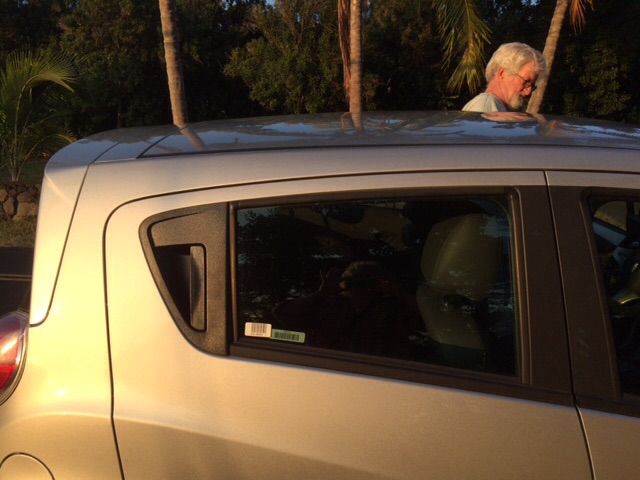
In case you didn’t believe me about the hidden location of the rear door handles on our rental Chevy Crapmobile, I have included this. Do you see the handle?

Door handles are cunningly concealed on the awesome Chevy Crapmobile.

Door handles are cunningly concealed on the awesome Chevy Crapmobile.

Our second day here was a “down day.” We awoke rather late. I took a shower and then went to our outdoor kitchen on the lanai to make breakfast. Casey, whom we hadn’t yet met, came by to see how we were doing. He explained that he hadn’t yet purchased my requested decaf coffee.

“Decaf is kind of heretical in Kona,” he explained. “But I’ll put on a disguise and find some for you.” I said he could forget about it, figuring that I was in Hawaii, so how bad could my blood pressure get? I fixed myself a 6-cup pot of Kona coffee and drank all of it, and I am still alive.

Casey has long, white hair and a long, white beard. He told us that they were living in Seattle and had visited Captain Cook on vacation. They asked themselves why they weren’t living in Captain Cook and couldn’t come up with a good explanation so they moved here. He later delivered the decaf, but by that time I had decided to go with the local custom and drink full-bore.

There were a few issues at first with regard to breakfast. Our hosts had thoughtfully provided eggs and sausage (this is a B&B, but obviously we are expected to cook our B ourselves), so I chopped some sausage and scrambled eggs in a bowl before discovering that the camp stove wouldn’t light. Tom, brilliant man that he is, discovered the location of the gas tanks (they weren’t obvious) and turned the gas on, so that was all right. I could not find sugar for my coffee, but Joan found us some later. (I used brown sugar from the fridge, which worked fine.) I toasted some croissants, made Tom some tea, and we had a lovely breakfast. Joan reappeared so that I could ask vital questions such as does Hawaii have ants (yes) and where the recycling bin was (if it was a snake it woulda bit me).

After breakfast, Tom and I sat at the table, each absorbed in our work. I wrote yesterday’s blog post and cursed at various apps for not working the way I wanted them to. Tom–I’m not sure what he was trying to do, but I think he was working. I kept interrupting him with my app problems and he kept patiently solving them. This is why we have been married for 43 years. We didn’t have apps or iPads or iPhones–or come to think of it, personal computers–back in the day, but the principle is the same.

I should explain that I am trying to do everything on an iPad. I have a laptop, but just didn’t want to haul it around and have to demonstrate to TSA that I am not a terrorist. (Inclusion of this word will probably interest the NSA. Have fun, NSA. It’s only money.) I am finding that an iPad, which I normally use for reading books, searching the Internet and following Facebook, has certain limitations when you’re trying to manage a bunch of social media streams. In fact, it’s crazy-making.

Now that I’ve mentioned the NSA, it reminds me that when I opened my suitcase after our flight yesterday, a sandwich bag of nutritional supplements that I had packed first (and was thus at the bottom of my suitcase) was now on top of my clothes and had been opened. There was no note from TSA to say my luggage had been searched, not that they always leave billet doux when they search. Or it may have been an airline employee looking for free drugs. If so, I hope my calcium tablets gave him a sweet high. The whole thing was disturbing, in either case.

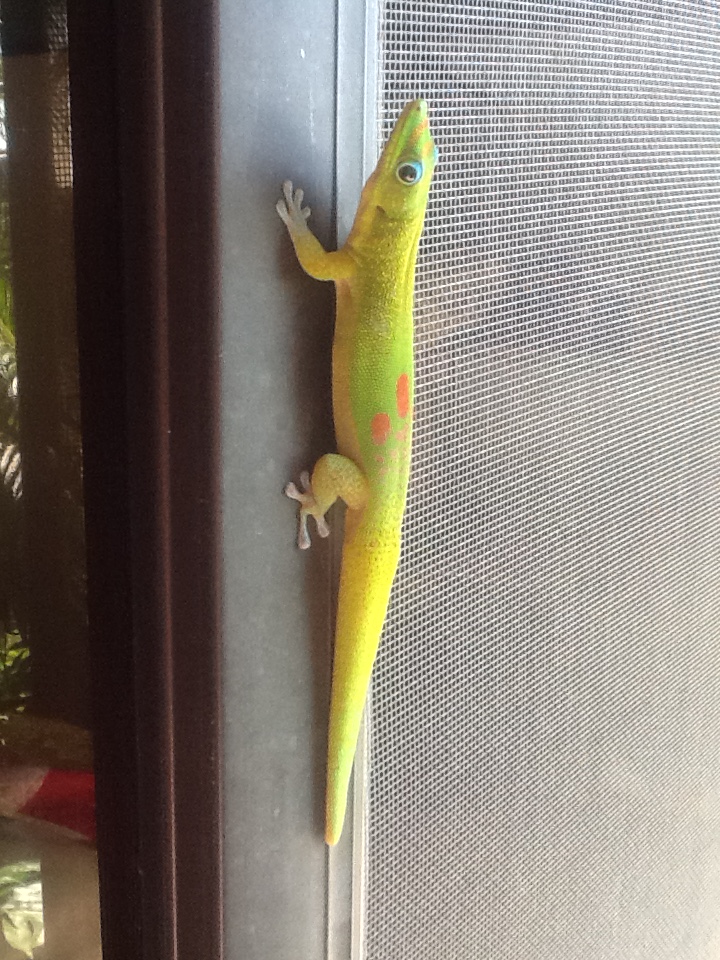
So the morning flew by before we knew it. As I made my way back to our rooms, I saw a gorgeous gecko right outside our bedroom. He obligingly posed for this picture:

He knows he's beautiful. Or she.

He knows he’s beautiful. Or she.

Then Tom reappeared, having washed the dishes. He needed to rinse his hair and T-shirt because a gecko (not the one outside our bedroom) had, um, eliminated over Tom’s head and hit his hair and shirt. So apparently geckos have a lot in common with seagulls.

Speaking of which, did you know that there are no seagulls in Hawaii? That seems almost impossible, but it really speaks to the geographical isolation of the islands. Not that I miss the seagulls, mind you. Instead, they have little blue doves, adorable little blue doves that make a satisfying jungle-y sound.

We finally finished our self-appointed tasks and headed out. By this time we both were thinking about lunch, and it was mid-afternoon. We first went to a the Oshima Store where our hosts told us we could purchase various items we had neglected to bring. Our GPS systems told us all sorts of nonsense. Finally, I glimpsed some Hawaiians walking by the highway. Tom stopped the car and I leaped out and pursued them. They kindly stopped and I asked them where Oshima’s was. They told me and sure enough, there it was. Oshima’s is a genuine general store; they carry a bit of this, a bit of that, heavy on fishing tackle, light on organization. So it took a while to find everything, but we finally paid and left.

Then we decided to get lunch at Da Poke Shack. Poke (pronounced POH-kay) is chunks of raw ahi (sushi-grade tuna) with spices and usually lime juice and coconut milk over rice. It is absolutely delicious. Tom and I had it the first time on a motu (little island) in Moorea. Our guide prepared it on the beach and it was nectar of the gods. At Da Poke Shack, they had a wider selection of sauces and grains, but it was late in the afternoon, so we had a limited choice–some of which disappeared while we waited. Tom got sesame poke and spicy garlic poke over brown rice and I got the spicy garlic and “Pele’s Kiss” poke over brown rice, both with edamame (steamed soybean pods). Pele is the Hawaiian goddess of fire and volcanoes, so it is fortunate that I enjoy spicy food, because there wasn’t a lot of choice–by this time it was 4:30 pm, and we were the last customers because Da Poke Shack had literally run out of food.

We stopped by the Choice Mart to pick up some dinner fixings. We saw these rambutans and couldn’t resist buying some. I’ll report on how they taste later. I like that they look like Klingon food.

Rambutans--or Klingon food.

Rambutans–or Klingon food.

We purchased two monchong filets that we would never see in a store at home (and according to the label, aren’t that common here, either) and some salad fixings. Several times, I was tempted by something like asparagus, only to find that it was in the neighborhood of $11 per pound. Anything that has to be flown in is hideously expensive.

On the way back we were astonished to see a flock of wild turkeys. One of the males walked right up to the Crapmobile and began a mating display. The Crapmobile was cruelly unmoved. Different species, I guess–though “turkey” would be a good descriptor for the car.

We got back just before sunset. I put the food away and then we both decided that we were still full of poke and didn’t want dinner. We sat on the lanai with our wine and played cards. Joan came out with a red banana she called a Cuban red. Later, she reappeared with sliced Cuban red on a plate. It was starchy but flavorful, with a faint citrusy tang. Still later, she offered us some champagne, which we accepted with delight. She served it in the prettiest glasses, tall flutes etched with a bamboo pattern. I guess she likes us if she’s giving us bananas and champagne.

Interestingly, we have never seen Joan and Casey at the same time. My writer’s brain began working on a story about a Hawaiian kupua (shape changer). Then I made it stop. One story at a time, brain!

The First Day of My Journey to My Next Novel

The view. OMG, The view!

The view. OMG, The view!

As promised, I have gone to Hawaii to research my next novel. I usually journal when I travel because it helps me to retain the memories of my trip, but this time, I have decided to share my journal with you. This is a bit scary for me–maybe some of you will think I’m just farting around over here because to be honest, I’m not entirely sure what I am looking for. Yes, I have a list of things I want to do or find out about, but I also am hoping that I will find something that I didn’t know I was looking for.

If that sounds kind of mystical or arty-farty, sorry. But that’s what I’m doing. I hope you enjoy my journal anyway.

Day 1: San Jose to Kona

After several days of trying to prepare for our trip, the day finally came. I felt underprepared in a way, despite all my lists and fretting. And it did turn out that I forgot a few things, but I figured I could find them in Hawaii–they’d just be more expensive.

We took Hawaiian Air from San Jose. We had the usual cattle-class seats, except that my legroom was cut in half by some reinforcement under the seat in front of me, so I was more uncomfortable than usual. I am 5’10”, so leg room is always an issue for me. Tom took the window seat because he enjoys it. So do I, but I think he enjoys it more, so I make a point of letting him have it. In this case, there would be nothing to see for 5,000 miles except water anyway…

Breakfast was promised, but it turned out to be 6 small and geometrically precise slices of underripe melon, cheese and crackers, and a chocolate-covered macadamia nut candy. Later we got a rum punch with very little rum, hence no punch, served with a bag of Maui onion-flavored chips. I admit that these chips are a particular weakness of mine, but they didn’t make up for the fact that we were both feeling the need for an actual meal by this time, not having eaten since dinner the night before.

I read the inflight magazine, hoping to discover something interesting to see or do. The most interesting article was about Hawaiian native palms. I don’t know about you, but I had always assumed that the palm trees I saw in Hawaii–especially the coconut palms–were mostly native, but it turns out not to be so. There are several subspecies of loulu palm (Pritchardia) that are native, and all are endangered through people, rats, goats and pigs. The large seeds take a year to mature, making them vulnerable to rats, who eat the unripe seeds. When they are ripe, people like them–if they can find them, which is unlikely. The islands were once forested with loulu palms, but they now exist in the wild only in a few places that cannot be reached by people, rats, pigs or goats, which leaves very few places indeed. Coconut palms were brought here by the Polynesians who peopled Hawaii, not by the usual method of floating safely across the sea in their hard shells. Another article I read said that it was difficult for people to get them here in a plantable condition. We tend to forget in this day of air travel how very isolated the Hawaiian Islands really are. It’s astonishing that people ever found them in the days before satellites and airplanes.

Which reminds me of my surprise and disappointment as a child, when I discovered that there were really no undiscovered lands left in the world. I was very fond of books like “The Pearl Lagoon” (Charles Nordhoff) and “The Lost World” (Sir Arthur Conan Doyle), where the protagonists discovered new places, or at least explored little-known places. I desperately wanted to have adventures like that, and the notion that there were no more unknowns was devastating. Of course, I later discovered that there are still plenty of unknowns, and unlimited adventures of the mind and spirit. Not to mention space, where I am definitely not going to go. Ever. But I can imagine it, which is probably much better for someone my age.

We landed in Honolulu (where I removed my fleece jacket) and walked about a mile (I am exaggerating only slightly) to the gate to catch our connection to Kona on the Big Island of Hawaii. This is a very short hop and soon we were landing in the midst of a field of broken black lava. The runway was smooth enough, but although the eruption that laid down the lava here happened a very long time ago, it is still a bleak and almost alien landscape, black, rough rocks with a few brave grasses struggling to eke out a near-waterless existence on the stone.

We collected our bags at tiny Kona airport and caught the shuttle to the rental place. The whole airport operation is so minuscule that it’s easy and quick to do things that might take an hour or more in an urban airport. I had rented the cheapest possible car, which turned out to be a white Chevy Crapmobile. I might have rejected it if I had known it was going to be a Chevy. My parents generously gave me a Chevy Caprice when I graduated from college. Tom and I quickly re-dubbed it the “Chevy Crapice.” I think it was possessed by evil spirits, because it had a crafty habit of waiting to break down until the absolute worst possible moment. Think I’m exaggerating? Try in the middle of a tollbooth on I-90 going into Chicago. In the middle of Lincoln Park in Chicago, the stalking ground of the infamous Lincoln Park Pirates, a towing firm that would tow you even if parked legally and would relent only if offered a healthy bribe. Bits and pieces of it would fall off or stop working even when it was still technically running, which was ruinous to two young students/recent graduates with no money. I still remember my joy when we finally bought a new car (the first Honda car in the US; it had a motorcycle engine), and watched a tow truck haul the Crapice out of our lives forever.

Our rental Crapmobile presented a challenge from the beginning. First, we couldn’t fit my suitcase into its dainty little luggage compartment. I suggested lowering the back seats. There was a mechanism for doing so, but there was no way to lower them completely without removing the back seat bench. And it appeared to be a two-door with no way to put a person in the back seat, much less my enormous suitcase. (In my defense, I selected this case so that I could put our snorkel equipment in it as well as my clothes, etc.) Finally we discovered door handles cleverly concealed in the trim (they looked like vents and were in a strange location at the top rear corners of the doors), got all our luggage in and headed south.

Tom and I both thought there has been a lot of development since we were last here. The first time, I recall that there were “graffiti” messages spelled out against the black lava with chunks of white coral. We didn’t see any of these yesterday. The road seemed wider and there were more houses and other buildings north of the town of Kona.

We headed for Captain Cook along the Mamalahoa Highway. Captain Cook is sort of a long spot along the highway, perched more than 1,000 feet above the ocean. We turned off the highway as instructed and began a winding, narrow approach along the cliffs makai-side (kai meaning the ocean. Hawaiians talk about directions as makai, toward the sea, or mauka, meaning toward the mountains). The steep sides of this descent feature small plantations and a breathtaking view of Keleakakua Bay far below.

We eventually came to our destination, Camp Aloha. The driveway was a severe uphill climb that seriously challenged our Chevy Crapmobile, but we made it. At the top of the drive we found a large outbuilding with lots of mysterious machinery in it. There were trees everywhere. Not a person in sight. We got out and began peering around. Eventually one of our hosts, Joan, came out of the house, which was well concealed behind trees and bushes, and greeted us. Joan and her husband, Casey, have five acres here where they grow macadamias, bananas, papayas and avocados. I asked Joan where they sell their produce, and it all goes to a local grocery store.

Joan showed us around. I had thought we would be in a separate cottage, but we are actually in a wing of their house. The house itself is a one-story bungalow about 30 years, ramshackle and exhibiting a great deal of deferred maintenance. But the view. Oh, the view. The house overlooks Keleakakua Bay, a thousand feet below, and miles out to sea. There are palms and flowering trees all around, and a soft breeze blows all the time. Mynah birds swarm in the trees, as do golden finches, Chinese white-eyes and many others.

We have a bedroom, bathroom and sitting room with a small patio outside. Our kitchen is on the covered lanai overlooking the pool and the mesmerizing view. I now know why it is called “Camp Aloha”; the cooking is over a camp stove or barbecue. There is also a fridge, which our hosts stocked with a variety of foods, a microwave, toaster oven, plastic sink and most of the essential amenities.

After unpacking, we headed into town for some necessities like good wine. We went to dinner at the Manago Hotel, which is an ancient building on the highway. It’s clearly a local hangout. The tables are chrome and Formica, circa 1950s. There are two menus, one for drinks and one for food, posted on the walls. The drinks on offer are a few low-quality California reds, more selection in beers, plus soda, coffee, tea. I ordered a Longboard Lager, which was good, even though I don’t usually drink beer. The food menu had some interesting local fish, plus pork chops and steak. Having read that the pork chops were a specialty of the house, that’s what I ordered, while Tom had the steak–an unusual choice for him. They brought sticky rice, potato-macaroni salad (which was surprisingly good), sprouts and steamed vegetables, which we devoured (our last real meal had been 24 hours previously). Then the meat arrived–enormous portions that neither of us could finish. The meat was fine, but I wouldn’t go with it again. I prefer fish and this is, after all, an island!

We headed home with our wine, opened it and watched part of “Despicable Me,” having missed about 30 minutes of it. Normally, I hate watching a movie after it has started, but last night I didn’t care. Then to bed,and quickly to sleep. The temperature was cool, like a summer evening at home on the Monterey Bay.

Some time in the middle of the night, Tom woke me up by saying, “The stars are amazing!” In my sleep-drugged state, my brain had two responses: “I want to see that!” And simultaneously, “I don’t want to get out of bed.” So I stayed in bed until my bladder had its way with me. After visiting the bathroom, I stepped outside onto the buzz-cut grass and stared. And stared. And stared. And stared.

It was a moonless night, and the stars blazed with so much light I could see the objects around me. The stars were bright right down to the horizon. The North Star flamed overhead, the brightest object in the sky. And the stars glittered and pulsed as though alive. I was tempted to lie down on one of the chaise lounges and stare for an hour or two, but it was cool and I wanted to avoid mosquitoes, so I eventually went back inside, overawed by such unearthly beauty.

It made me realize how much we have sacrificed for our conveniences–the electricity that lights our nighttime. We have lost the beauty and mystery of the stars, the truly spiritual experience of seeing them blaze in the dark like bright promises of a life to come.

I’m just glad I can go places where I can still see the stars as my ancestors saw them. As the ancient Hawaiians-to-be saw these beacons as they steered their tiny and inadequate rafts across the uncharted Pacific. But I will never have the intimacy with the night sky that our ancestors had. To them, each of these gems was an old friend with a story to tell and directions to give. That experience is not mine to have. But I can still rejoice in their beauty, even if I can never understand them.

As the Old Year Dies, My Publisher Goes with It

RIP, AEC Stellar Publishing

RIP, AEC Stellar Publishing

Well, I had a lot of plans for the New Year, including researching and writing a sequel to “The Obsidian Mirror.” That much hasn’t changed. What has changed is that my publisher, AEC Stellar Publishing, is no longer in existence. The publishing rights have reverted to me, and I am once again on the prowl for a publisher and/or a literary agent.

Wow. That was a real surprise. I hadn’t ever considered that AEC Stellar would not be the publisher of my next book. They took me on as a newbie author and gave me a lot of support. It was a small outfit, but they did as much as they could. And they had an unprecedented deal in the publishing industry: authors got 50% of the profits on their books. As a matter of fact, I just got my first royalty check, which was rather exciting, if small.

AEC didn’t go under because it was losing money, either. It was the brainchild of Ray Vogel, the owner, who wanted to create an authors’ community that would nurture and support new writers. And that’s just what they did. Unfortunately, Ray also has a fulltime job and two adorable little girls, and could no longer continue with the enormous demands on his time and energy. I was kind of amazed at everything he was doing, and I completely understand why he needed to get out from under.

So I and several other AEC authors are sadly contemplating our next steps. Amber Skye Forbes has three publishers in mind for her YA series, “When Stars Die.” Ryan Attard—author of the “Legacy” series and “The Pandora Chronicles—wants us to band together and start our own imprint. That’s an exciting—and terrifying—idea. It’s hard for me to imagine taking on more than I already have, and yet the idea is kind of thrilling. I don’t know what the others are thinking, but I suppose I’ll find out as things develop.

I don’t know if this is true or not, but they say that the Chinese ideogram for “crisis” is the same as for “opportunity.” Maybe I’ll find a publisher with more resources. Maybe I’ll get an agent who can negotiate better deals. Maybe I’ll do something enormously challenging and quite possibly stupid, like starting a publishing company. As the old year winds down and a new year begins, I am certain of only one thing: I don’t know what’s to come.

Thanks for Voting Me One of the “50 Great Writers You Should Be Reading”

2014-winner300dpi

Well, the results are in, and I am officially a winner of the “50 Great Writers You Should Be Reading,” a contest sponsored by The Authors Show. The results are determined by public vote–and enough of you voted for me to get me into the winner’s circle! My sincere thanks for taking the trouble to vote for me; I am truly grateful.

Now–on to the next book!

Writing the Sequel: Embarking on a Spirit Journey

"Under the Cliffs of Molokai" by D. Howard Hitchcock

“Under the Cliffs of Molokai” by D. Howard Hitchcock

I deliberately spent the past six months promoting “The Obsidian Mirror.” I curtailed most of my other activities to give myself time to launch my first book properly. I did not start writing the sequel, though I have thought about it a great deal.

Well, “The Obsidian Mirror” is launched, and the time has come to start working on the next novel. During a vacation last year in Oahu I came up with some really fun things that could happen to my characters if they traveled to Hawai’i—although it won’t be as much fun for them as it will be for me. I knew I needed to ground the story in Hawai’ian mythology and tradition. I’ve been to several of the Hawai’ian islands and I have read a fair amount about the Hawai’ians’ ancient culture and mythology. But there is far more that I do not know, so I felt the need to do more research.

In my previous visits to the islands I have been a tourist. I was there for the snorkeling, the beautiful beaches, the fresh-from-the-ocean fish, and the relaxing natural beauty of Hawai’i. This time, it’s different; I want to know more about modern Hawai’ian culture—the culture of the people of Hawai’ian descent—but I also want to know how modern ethnic Hawai’ians relate to the culture and beliefs of their ancestors. To do this, I need to have some meaningful conversations with ethnic Hawai’ians. I am not going to learn this from a book.

I began by trying to track down my former chiropractor, an ethnic Hawai’ian and an excellent practitioner. Kalani has apparently vanished off the face of the earth. Short of hiring a private eye, I am not going to find him. I asked a friend of mine with connections in Hawai’i if she could introduce me to people there. She tried, but the person she introduced me to via email was always too busy to talk, and finally stopped responding altogether.

Then I asked a friend who lives in Hawaii for help. He is not ethnic Hawai’ian, but having lived on the Big Island for many years, he knows many. We actually have met in person only once. He was a technology journalist while I was working in high tech public relations. We’ve stayed in touch as he moved to Hawaii to grow coffee and eventually became an expert in sustainable agricultural practices. Despite the fact that he hasn’t seen me in person for probably 30 years (!!!) he agreed to introduce me to some of his friends and acquaintances on the Big Island. I am still amazed at his generosity and trust.

At the same time I was seeking personal contacts in the islands, I did what a good researcher does; I tried to get in touch with experts at The Bishop Museum, which is recognized as the world’s best museum of Polynesian culture. I never heard back from any of my attempts to communicate by email or phone.

But I did have a commitment from my Big Island friend, so it was starting to get real. I spent a weekend setting up a week on the Big Island, going from there to Oahu, where the Bishop Museum and the University of Hawaii reside. I set it all up—places to stay, rental cars, airplane flights. I arranged eight days in Oahu, reasoning that if worst came to worst, I could always just pay the entrance fee to the Bishop Museum and then find a docent of Hawai’ian descent who might be willing to help me.

Then I started reading a book called “The Sacred Power of Huna,” by Rima A. Morrell, Ph.D. I was actually looking for books on Hawai’ian mythology and folk tales, but I had never heard of Huna, so I bought it on a whim. According to Morrell, Huna is the original Hawai’ian spiritual practice, developed before the introduction of things like the kapu system and human sacrifice, which she says was imposed on the islands by Samoan invaders around the 14th century. Huna is deeply intertwined with hula and with the Hawai’ian language. Its purpose is to help individuals to increase the light in the world—literally and metaphysically. The author—who did her Ph.D. in Hawai’ian shamanism at University College London after getting her masters and undergraduate degrees from Cambridge—firmly states that magic is REAL, and gives several examples from her personal experience. She also states that Hawai’ians on other islands suspect that Molokai—the island of fewest tourists and greatest percentage of ethnic Hawai’ians other than Ni’ihau—is where magic is still being made. How could a fantasy writer resist?

I put the book down at this point. Molokai. Why had I not thought about Molokai? I have often wondered about it. It’s described as the “Aloha Island,” the friendliest. And it’s called the last remnant of Old Hawai’i, with no high-rise buildings and not a lot of tourists, despite having beautiful white sand beaches, forested uplands, and its own share of snorkeling spots and other tropical delights. I had a strong feeling I should go to Molokai, but thought, “I can’t, because I’ve already made arrangements for Oahu. It’ll cost too much money to change now.”

So I went about my business for a few days, but I couldn’t shake the feeling that I needed to go to Molokai. I don’t really know much about the island. I certainly don’t know anybody there. But it called to me. So I gritted my teeth and made all the changes and paid the extra money to Hawai’ian Airlines to change the reservations.

I have abandoned all my reasonable and rational plans to talk to experts at the museum or the university. I am embarking on what I see as a spirit journey. I don’t know what I will do when I get there. I don’t know what questions to ask. I don’t know what I will discover or whom I will meet. I don’t know how I am going to get what I need to write the next novel. I run the risk of not finding out anything at all. I am taking a leap of faith that my inner guide is taking me to the right place to do what I need to do and learn what I need to know.

At the very least, I will have spent two weeks in one of the most beautiful places on earth.

POSTSCRIPT

Immediately upon posting this piece–I mean, literally within a minute or two–I happened upon a FB page called “Huna Is Not Hawaiian.” Startled, I spent quite a while reading the page and following up on many of its links to longer pieces.

It appears that, indeed, Huna is NOT Hawai’ian, but a new-age overlay on Hawai’ian spirituality. The “Huna Is Not Hawaiian” page views it as a commercialized appropriation of Hawai’an culture.

I thought I should mention this, but it doesn’t impact what I am doing. My purpose in visiting Hawai’i and Molokai in particular is not to study Huna or become Hawai’ian by some strange magic. My purpose is to learn what there is for me to learn to write my next book.

Yes, I still view it as a spirit quest and have abandoned my usual rational methodology in favor of letting what happens happen. I have found in the past that letting things unfold naturally is sometimes a more effective way to reach a goal than systematically striving.

Did the book on Huna change what I planned to do? Absolutely. It reminded me that I had always wanted to visit Molokai, and that of all the islands, Molokai may be the one closest to Old Hawai’i. I still feel excited and confident that I made the right decision–for me. There is something for me there.

But I am under no illusion that a couple of weeks in Hawai’i will do more than enrich my store of experience and knowledge and, hopefully, stoke the joy and impetus of creating a new story. If I’m lucky, I won’t get sunburned.

Please Vote for Me for the “50 Great Writers You Should Be Reading”

Authors Show finalist

Thanks to David Prosser, a fellow writer/blogger who is as kind as a summer day is long, the link for final voting is http://questionpro.com/t/AJhWsZRq7r.

Again, “50 Great Writers You Should Be Reading” is a contest sponsored by The Authors Show. My sincerest gratitude to you for voting for me. As a new author, it’s an up-hill climb to get recognition, but this sort of thing really helps.

I’m a Finalist in “50 Great Writers You Should Be Reading”

Authors Show finalistI just found out that I’m a finalist in The Authors Show’s contest, “50 Great Writers You Should Be Reading.” Apparently, there is another round of voting, but The Authors Show kindly sent me a graphic to show that I am a finalist.

Humble thanks to all who voted for me–or rather, for “The Obsidian Mirror.” It’s the work that counts. And because I am pushy, would you please vote for me in the final round? I’ll let everyone in the world know as soon as they give me a link!

Thanks to all who have read “The Obsidian Mirror,” whether or not you voted or reviewed or whatever. A work of art only lives when it is experienced, whether read, viewed, or heard. I am grateful to all of you for granting my story its life in this world.

New Coverage of “The Obsidian Mirror” from Local Newspaper

Below is a clipping from my local paper, the Watsonville Register-Pajaronian from an interview with me about “The Obsidian Mirror.” In case you’re wondering after you read this if I really decided “at the age of eight” to pursue public relations as a career–I didn’t. I even know what public relations was at that point (and I’m sure I wouldn’t have chosen to pursue it then, although later it made some sort of weird sense).

Kathy Register Pajoroian2