Vote for Your Favorite Coyote!

I sent last week’s cover art to my publisher. One of his comments was: “…the book itself also felt a bit more light hearted than the dark cover with the serious boy (who was definitely not so serious in my mind, as I read anyway).”

The man (Chaco) changing into a coyote is central to my story. Chaco is Coyotl, the trickster folk hero of many Native American cultures. He can shift back and forth at will, and this comes in handy several times during the story. So I’d really like to use the image of the shape-shifting man-coyote. But my publisher is right: the tone of the book is on the lighter side.

I picked out a few more handsome latino men from iStock.com, where there is a plethora of such men on sale for very little money, and created two alternatives to my original. I present them here for your deliberation: which is the best Chaco: #1, #2, or #3?

I eagerly await your judgement!

Chaco #1

Chaco #1

Chaco #2

Chaco #2

Chaco #3

Chaco #3

Tell Me What You Think. Please?

I’ve gone back and forth a couple of times with the publisher, AEC Stellar, and I think we’ve probably arrived at an agreement.

So now I get to do something fun: design my own cover art. AEC Stellar has people who will do this, but from my standpoint, one of the advantages of working with a small company is that they are willing to let me do my own cover design if I want (and it meets their standards). I realize that most people wouldn’t think this was fun, but I also paint in oils and design jewelry and I’m pretty good at Photoshop. You can purchase excellent photography and illustrations from an online stock provider for very reasonable prices and manipulate these images in Photoshop. I did a lot of this when I was working on marketing materials for Cisco, and I enjoy it.

Here’s my first concept. Do you like it? Dislike it? I’d love to know.

Obsidian Mirror cover3

The Contract

ContractThe book contract arrived. It seemed pretty straightforward to me, but I’ve never laid eyes on a book contract before, so what do I know? I followed the advice of my book consultant and shelled out some bucks to have someone knowledgeable review it.

I recognized that the contract was unusual. The publisher is unusual. It required some shared expenses. Having talked with the publisher, I was aware of this, and given that the author gets 50% of the net (as compared to maybe 12% from standard publishers), that didn’t seem unfair to me, especially as this is a new, startup publisher.

The reviewer sent the contract back with many, many comments. I looked at them all carefully. There were a few that I didn’t agree with, but some of the others seemed more than reasonable. For example, the contract specified that all rights to the work in other media such as TV, movies, audiobook, etc. would belong to the publisher. Now, the likelihood of my little novel being made into a movie is remote, but I didn’t see why I should give up the rights to my own work, even so. So I marked up the contract accordingly and returned it to the publisher with a polite note indicating that everything was up for discussion.

That was yesterday. No response so far. Of course, I reasoned, he needs time to look it over. I took my time, after all. But still. Is he pissed off? Insulted? Did he even see it yet? Am I stressing unnecessarily? Or is this an indication of thunderclouds on the horizon? Should I stop thinking about it? Should I call?

Or maybe I’ll just go for a walk on the beach and forget about it.

They Want To Talk Contract. OHMYGODOHMYGODOHMYGOD!!!!!

Fireworks GroupOkay, I’m hoping that I write and publish so many books that I will become jaded. But right now, I am so excited I can hardly see straight. So if this blog post is incoherent and sounds as though I were abusing some mind-altering substance, this is why:

AEC Stellar Publishing got back to me about “The Obsidian Mirror,” and they want to talk contract. Here is what Ray Vogel (surely the most luminously intelligent and talented man alive) of AEC Stellar said: “I did think it was very well written. The characters were unique and complex, and the story was a fun adventure that I could see appealing to just about any age.”

Which is precisely what I was going for. Thank you, Mr, Vogel. Thank you, AEC Stellar Publishing. Thank you, World. Thanks to all of you who have been with me on this journey and given me your positive energy and good wishes. Thank you.

Did I Find a Publisher? And More Dolphins.

Last week, I was reading “The Barsetshire Diaries,” a blog about retired life in an English village by Lord David Prosser. (Is he really a lord? I have no idea, but he is certainly a noble man!) Lord D. published an interview with Sorin Suciu, the author of a humorous fantasy novel called “The Scriptlings.” Sorin mentioned he was with a new publisher with “an author-oriented business model and a heart of gold,” AEC Stellar Publishing.

Humorous fantasy? I stopped reading and went to AEC Stellar’s website, where I queried “The Obsidian Mirror” online. “Obsidian” isn’t written as a humor piece, but it does have a lot of humor in the writing—my way of sweetening the underlying theme of ecological threat and conservation.

The next day, to my astonishment, I received a request for the first chapter.

The day after that, I received a request for the entire manuscript and an analysis of my writing. Though disappointed by my score in “Writing Craft” (80.9%), the verbiage did say, “You appear to have a good grasp of the craft of writing… Your style of writing is likely to be well received by readers.” My score in “Marketability” of 88.6% made up for it. (“We believe your book is likely to succeed in today’s marketplace.”)

So now I am waiting on pins, needles and tenterhooks to hear back. I was told it would be three or four weeks, which seems lightening fast, considering that my submission to Harper Voyager in October of 2012 only just came back with a rejection notice. Apparently, the rejection was conveyed on the back of an unusually pokey snail.

Please wish me well. And many thanks to the inimitable Lord David and Sorin Suciu.

* * *

On a completely new topic, my daughter, my husband and I took advantage of a rare afternoon when we were all free to go for a walk on our favorite beach. It’s October, and the midweek population of beach-goers was negligible, despite the golden, warm weather and sunny skies.

It was low tide, assuring a flat, firm walking surface by the water’s edge and lots of flotsam to peer at. The small crabs are all gone. I suppose they have their season, spawn, and die, for there are many tiny, empty carapaces scattered about on the sand.

Dolphins surfing. Photo by BabyNuke.

Dolphins surfing. Photo by BabyNuke.

 We walked for a mile and a half or so before turning back. Almost immediately, we began to see dolphins (or porpi) swimming just beyond the breakers. They rolled and splashed, and a baby broke joyously up from the waves, curved in a graceful arc and disappeared again.  We began to see dolphins surfing in the waves—something I had heard about but never seen for myself. As a wave rose up, the sun shone through, making it look like green glass. Inside the breaking wave, silhouetted against the light, we could see dolphins surfing along the curve and subsiding again as the wave foamed onto the shore. Then we began to see dolphins leaping out of the water, launching their entire bodies into the air, diving, then doing it again and again like enormous skipping stones.

Some days just make you glad to be alive.

Whales and Dolphins and Seals, Oh, My!

Yesterday afternoon, my husband, Tom, and I went for a walk on the beach. This is something we do frequently, now that we are living by the ocean. Actually, we live on the shores of Monterrey Bay in Northern California. For those of you unfamiliar with NorCal, it is not a hot, palm-tree-fringed coast. The Japanese current comes down from Alaska, and the waters are cold. Most of the summer, fog covers the coast in the morning, pulls out for a bit in the afternoon, and pours its chilly self back onto the land in the late afternoon or evening. When it’s 100ºF inland, it might get up as high as 80ºF here on the coast. Mostly, summer temperatures are in the 60s or 70s.

But yesterday afternoon, it was warm and the fog hung far out on the water. The sky was cloudless. I spent some time tipping crabs. There are hundreds of small crabs that thrive in the wave zone. They often get tipped upside down by the receding water and wave their eight legs in the air frantically, trying to right themselves. If another wave doesn’t come along to right them, they eventually give up and pose upside down, legs rigidly extended. If the tide is going out they are sometimes eaten by seagulls or just die from exposure. I have a hard time resisting their little flailing legs and I tip them back upright to give them a fighting chance. Yes, I know they’ve been getting tipped upside down for millions of years. Still.

I love shells of all sorts, and collect them whenever I am visiting a beachy place. The shells in our area tend to be a bit drab and there isn’t a lot of variety, but

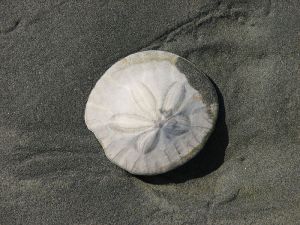
Sand_dollar_testI look for sand dollars. They wash ashore frequently in this area. When alive or recently deceased, their shells are purple. I check to see if they are alive, which isn’t easy to determine, but if they still have their hair-like legs on the undersides of their shells, I pitch them back in the water. (I make it a point never to take a live shell. I never buy shells, because these are harvested live to assure they are unbroken and unblemished.) If the sand dollars have lost their legs and the “velvet” that coats the outside, they are truly dead and I pick them up if unbroken. The shells are quite fragile, so finding an unbroken sand dollar isn’t unusual, but it is the exception. I’ve been placing the shells to bleach in the sun on my front porch. They range in size from about one inch across to three or four inches.

The water was full of life—and not just surfers and screaming children. There was a huge pod of dolphins roiling the waters, their dark backs and fins rolling smoothly out of the waves like synchronized swimmers—which I suppose they are. There must have been a hundred or more of these beasts just offshore. A small seal or three poked their heads out of the waves. They come in quite close to swimmers, and they sometimes get quite a reaction from people who aren’t expecting a largish animal to surface right next to them.

And then we saw the whales. Further afield, perhaps a half a mile from shore, great spouts of water appeared above the waves. Like geysers, the spouts rose high in the air and lasted for a fairly long time. Several times, I saw whales breaching, leaping out of the water and falling back with a mighty gout of water rising as they hit the surface. I was told by one passerby that humpbacked whales had been spotted in the bay, but today I heard that blue whales were out there yesterday as well. They were too far away for me to tell which we were seeing.

People all along the beach were stopped, standing on the sand and shading their eyes as they stared out to sea. Everyone was smiling, pointing, talking to strangers. People were rejoicing in the sight of the whales as though they had just seen angels.

It was, in a word, magical.

Experiment in Intergenerational Living: The Gummy Bees

It has been a long time since Tom and I lived with a preschooler. Lilah, the preschooler in question, is four. She sailed through the twos without becoming terrible, skipped through the threes without becoming awful—and then hit the Frightful Fours.

Her former response to being thwarted was to assume a deeply saddened and affronted expression, rather like Mother Theresa confronted by, say, Lady Gaga. Then she would turn her back on everyone like an anchorite abandoning a wicked world. She did all this in perfect silence, which I thought was a dramatic underscore to her soul-gnawing sorrow at being denied Goldfish crackers for lunch.

Now if Lilah is thwarted, she will frequently throw herself to the floor with a scream. She will begin pounding the unoffending floor with her heels or fist, punctuating this with more shrieks. This is usually in response to being asked to eat something (healthy) or being told she can’t eat something (unhealthy), but there are many other triggers.

This bothers her parents a lot, but it doesn’t perturb Tom or me very much. She’s kind of a piker compared with her Mom or her Uncle Sean, although they went through it earlier than Lilah. It does raise the question of discipline, though. As Tom and I are sometimes the only adults around, permitting her parents to carry on their work lives, we are sometimes on the spot when it comes to applying corrective action. And disciplining someone else’s child is a sensitive matter. She might be our granddaughter, but she isn’t our child.

When Kerry and Mike are present, they get to do the disciplining. Tom and I are merely interested observers who need earplugs. When they are not here, we have relied on the Grandparent Card a lot, but who knows how long that will last? Counting to three (very slowly) usually works. Once in a while, a short timeout helps. So far, so good, but one of these days, Lilah is going to pitch a complete hissy fit on us, and we’re going to have to deal. The only advantage we have is that it really just doesn’t bother us. Raising her mother toughened us up a lot.


A Gummy Bee

A Gummy Bee

Now, what about those gummy bees? This is one of the great things about living with a grandchild—getting to hear a completely new set of wonderful mispronunciations. Her mother used to call flowerpots “flower pants,” which I always thought was brilliant. Her uncle used to go to “pretty school,” until Kerry finally scorned him into saying “preschool.” (Too bad.) Lilah has gummy bees: “I gummy bee a builder when I grow up.” “I gummy bee happy to see Auntie Cara.” I envision all these little gummy bees flying around her as she dances her way through life. They are all different pastel colors, and they have little smiles on their cute little gummy bee faces.

Because most of the time, Lilah is a delight. She has the most beautiful, sunny smile. She sings to herself as she plays, lining up her toys in the upstairs hall to “teach them school” or read them a story. She laughs readily and cuddles when she’s tired. She loves animals and art and playing games with Nana.

She can scream all she wants. She’s still my darling.

Intergenerational Living: The Experiment Continues

Inca and Her Mom

Inca and Her Mom

It’s the dog days of summer, and apparently all the literary agents are on vacation. So nothing is happening on the book front. That’s my excuse for now. However, much is happening on the living front, in the house by the sea where my husband Tom and I (both 63) now live with our daughter, Kerry (32), son-in-law Mike (36) and granddaughter Lilah (4).

It’s now been about two months since we all moved in together. At first, with boxes everywhere and the furniture all in the wrong rooms, and double the tools and food needed to stock and run a kitchen, things were a bit uncomfortable. After the first week, Mike returned to work, and the rest of us kind of lost interest in having to unpack even one more box.

Tom had a brilliant idea. He suggested that we put all the boxes and furniture we didn’t know what to do with in one room—the living room—and concentrate on making the rest of the rooms workable. This helped enormously. We were no longer tripping over boxes. The rest of the house began to settle down to more-or-less normal living.

But of course, the boxes did not unpack themselves. Last weekend, we bravely faced the room of boxes and began to unpack. Empty boxes began to pile up on the porch once more. We didn’t get through the entire room, but did make progress. We can now see the fireplace in the living room—Kerry had actually forgotten that we have a fireplace.

The people have been getting along well. No fights and no hard feelings, as far as I can tell. Everyone seems pretty happy. Mike is the one with the hardest situation as he has a longer commute to his job, and works the late shift, so he often arrives home when everyone else has gone to bed. He bought a commuter car to save on gas, which also helped his driving experience as he was navigating a winding mountain highway with an enormous truck. The smaller car handles better on the curves in addition to guzzling less gas.

The pets are having a somewhat more difficult time dealing with the blended family situation. We have Gigi, a 65-pound lab-shepherd mix with a saintly disposition, and Inca, a small black (formerly feral) cat who thinks Gigi is her Mom. Kerry has Hendrix and Marley, 15-pound Japanese Chins. Chins, in case you don’t know, are fluffy little dogs with squashed-in faces and bulging eyes. Marley has an overbite that makes him look aggressive, but he isn’t. Hendrix has a mop of wild hair and skewed eyes. He often has the tip of his tongue protruding as well, so the total effect is one of psychopathy—not too far from the mark. Hendrix appears to think he can take Gigi down, which apart from being delusional, is annoying. He will bite Gigi’s heels or try to take her gigantic toys away from her. Gigi, peaceable but insisting on her rights, retaliates, often by squashing him flat. Much growling and tussling ensues because Hendrix, far from being deterred by being squashed, keeps on coming. Adults scream at them, and Lilah runs away crying.

Inca, being a cat, hated being moved. Worse, we moved her twice—once into our friend’s home, and a month or so later, into our new home. She has settled down well, and is now trying to escape from the house. She’s gotten out twice, and apparently the local wildlife is terrifying, because she doesn’t seem to be enjoying her outings. There are a couple of known tough cats in the neighborhood as well as skunks, raccoons, possums and other assorted beasties. Inca may have once been feral, but I don’t think she was very good at it, and she appears to be better suited to lounging around the house and kissing dogs.

She’s an indoor cat, partly because I promised to keep her indoors when I adopted her, partly because indoor cats stay cleaner and healthier, and partly because she is black and what some people do to black cats is horrible. (Black cats are also harder to find adoptive homes for, so the next time you think about adopting, remember that black is beautiful.)

Being fond of dogs, Inca has been making overtures to the Chins. She tried to kiss Marley yesterday and he snapped at her, which may set cat-Chin relations back for months. She got out of the house again, but was back within a couple of hours, wailing and fluffed-up with terror.

So the non-humans are having a harder time than the humans in making this enormous adjustment. Hurray for the humans!

An Experiment in Intergenerational Living: Part 1

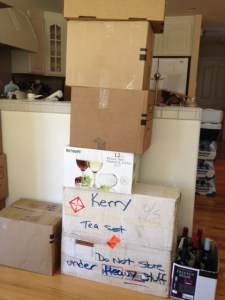
Read the instructions on the bottom box!

Nuthin’ happenin’ on the book publishing front right now, but there’s a lot going on in my life, which is why I haven’t posted anything for nearly a month.

We moved. But it wasn’t the usual sort of move. My husband and I moved to begin an experiment in intergenerational living—not a new concept, but not one that has been popular in American life for many decades. It has become a stigma for kids to move back in with your parents—even a sign of failure.

My husband and I grew up in a nuclear family: Dad, Mom, and kids. Grandparents lived elsewhere. We were lucky in that our grandparents lived more or less in the same towns that we did, so we got to know them fairly well. Our own kids grew up remotely from their grandparents—my husband’s family lived 3,000 miles away and my family lived about 500 miles away. The kids never got to know their grandparents well.

Then our daughter and son-in-law had a baby. We wanted to be more involved than our grandparents had been with us, and certainly more involved than our own parents had been as grandparents. (We didn’t blame them for their lack of involvement. It’s hard to be involved with someone who lives so far away from you. They did their best.)

Right after our granddaughter was born, her parents purchased a house. They moved in with us temporarily while the new house was rehabilitated from the squatter’s den it was to the cute family home it became. Coincidentally, at the same time, our son and his future wife needed a place to stay for a while (turned out to be two years), and our daughter-in-law’s mother came to stay for a while as well, so it was a very full house.

And we loved it. It was a lot of fun having young folks and a baby around. My husband and I wondered if it made sense to talk to the kids about doing it full-time, seriously.

As it happened, our daughter suggested it first. She and her husband did not need financial help; it was matter of wanting to be closer as a family. In particular, she wanted us to be close to her children. This triggered a number of discussions between all parties. Our son and daughter-in-law opted out with no hurt feelings on any side, but our daughter and son-in-law became quite committed to the concept, as did we.

Nothing happened but talk until the housing market resurrected. Our first plan was to renovate our guest cottage and make it a bit larger. This would be where my husband and I would live, sharing the downstairs common areas of the main house with our daughter’s family. The county planning commission said no. We could build an entirely new structure, but we couldn’t make the existing structure larger. Then we came up with a renovation plan for the house that would allow for separate living quarters, feeling that we all needed some private space.

Then we went looking for funding for the remodel. The banks wouldn’t lend us money. We had assets that the banks wouldn’t consider, but we hadn’t had paychecks for a while as we were working for a high-tech startup for equity. (That’s another story, and no regrets.) The only remaining options were to forget the whole thing, or for us to sell our house. The proceeds from our house would enable us to purchase another house on a cash basis. We would then allow our daughter and son-in-law to invest in the new house and become co-owners. I don’t know about you, but the words “mortgage-free” ring in my ears like celestial music. We don’t need no stinkin’ banks!

Once we decided to go for it, it happened so fast it took our breath away. We sold our house “as-is,” before it officially went on the market. We moved in with a good friend, intending to take as long as a year to look around or build a new house. But the first time we went out to look at neighborhoods in the seaside town where we all wanted to live, we found the perfect house. We made a lowball offer that was accepted without a counter, and within two months of making the decision to sell our house, we were moving to a new town.

Trying to cram two households’ worth of personal possessions into one house has been and continues to be a challenge. I said the house was perfect; well, it could use a few more rooms, I suppose. The three-car garage is full to bursting, and we have no idea what we are going to do with all these BOOKS!

But the intergenerational thing is going well. We are making cooperative decisions where called for, and butting out of things that don’t concern us. The young marrieds have built-in babysitting for date nights, and we have built-in pet sitting for trips. Our economic situation on all sides is improved (although the younger parents still need to sell their house). All the pets have settled in sufficiently to start making trouble. The cabbage-rose wallpaper in our bathroom and bedroom is gone. The kitchen is set up and working and we are all glorying in the wonder of double ovens, a gas stove and many, many cupboards and drawers. (Did I mention how much I hate putting shelf paper in? I spent five days doing nothing else.)

Through it all, we have been buoyed by the sweeping view of the ocean, the clean air, the breezy, light-filled rooms, the hot tub and the happiness of being a close-knit family. I think it’s gonna be good.


Die, Vampire, Die!

No VampiresFor the record, I’m still trying to get my novel, “The Obsidian Mirror,” published through conventional channels. Yes, I know all about how respectable self-publishing has become in the digital age. That’s my Plan B. But I would like to get it published conventionally if I can swing it.

So far, no joy. And I have a theory about why this is so. (Other than that my book is no good. I’ve read it and it’s great! No, seriously, it’s a fun, fast read, which is what I usually want from a book myself. And it’s well written, too, she noted modestly.)

So bear with me here for a moment while I tell you a story.

Long, long ago, when dinosaurs roamed the earth and poodles ran wild and free, I wrote a children’s novel called “The Singer and the Song.” It was about a city-dwelling girl who found she could pass from her world to another, magical world. As I recall, there was a talking cat involved. I wrote it for a graduate class in children’s literature in lieu of writing another essay on something like “Christian Influences in C.S. Lewis’ ‘The Chronicles of Narnia,’” or something else equally boring and trite. My professor loved it and so did my Mom. My mother had always supported my writing and she thought this one had a lot of potential, so she paid for me to take it to the William Morris Agency in New York City. William Morris charged $100 to review and evaluate the manuscript. (Mom and I didn’t know any better.)

I think I kept the letter from the agency, but I am between houses right now, and everything is in storage so I can’t give an exact quote. But the general gist of it was that children today (Remember the dinosaurs? That day.) aren’t interested in magic and talking animals. They want realistic, gritty urban tales that reflect their own lives.

So take that, J.K. Rowling! No one’s interested in your silly little stories about magic and talking animals, okay?

I may have been all of 21 years old, but even then I knew William Morris Agency was full of shit. The marketing fashion of the time happened to be gritty urban tales, but fashion and marketing have never influenced what children like to read about. Which in many, if not most cases, definitely includes magic—with talking animals if possible.

Nonetheless, I was embarking on a more or less adult life by that time, which meant earning a living, and I put my poor novel away. I thought I might read it to my kids some day, but I don’t believe I ever did.

Fast-forward to our dinosaur-free present. “The Obsidian Mirror” features magic and at least one talking animal, who isn’t really an animal, but an avatar of Coyotl, the Trickster of Native American legend. (My personal tastes have changed some, but not that much.) Various American myths, legends and traditions come into it in a manner that I haven’t seen elsewhere—which could be good or bad, depending on your personal viewpoint. Apparently, the editors and agents who have seen the synopsis so far aren’t intrigued.

Now for my theory. I think agents and publishers weren’t intrigued because what I wrote about isn’t currently fashionable in fantasy fiction. I don’t have to tell you what is currently fashionable, but I will anyway: vampires, zombies and werewolves.

I used to like a good vampire story as much as the next person. Bram Stoker: fabulous. Anne Rice: new twist on an old tale (at least at first). But then they came fast and furious: “Buffy,”  “Twilight,” the Sookie Stackhouse series, “Dark Vampire Knight” series, “The Vampire Coalition” series, and so on ad nauseum. I thought the genre had burned itself out (or been buried with a stake through its black heart) with the advent of “Abraham Lincoln: Vampire Hunter,” but no! Hollywood made a movie out of it.

I suppose I’m not making any friends with this, but c’mon, people. Aren’t you just the teensiest, tiniest bit bored with vampires yet?

But this isn’t sour grapes, honest. I’m just dealing with a marketing trend. All marketing trends die—at least, theoretically they do. Vampire stories, like their deathless subjects, show every sign of living forever, sucking the lifeblood out of other fantasy genres.

I’ll wait a bit longer, then it’s on to Plan B, I guess. Where’s the garlic?