Costa Rica, Days 16 & 17: the lost hours

I am going to draw a curtain of discretion over day 16. We spent the day pleasantly enough at our gorgeous hotel. It ended with a midnight doctor’s visit, a 6-inch hypodermic to my butt, a bag full of helpful anti-diarrheal drugs, and getting to bed at 3 am. However, I checked the side effects of the medication I was prescribed in Tamarindo, and the leading one (which Dr. Piloto never mentioned) was “severe, ongoing diarrhea.” The food and water here are safe!!! Pura Vida! (Pure Life. You hear it everywhere here, as a greeting, an exclamation, an affirmation of love of country. It is also imprinted on almost every bit of tourist tat available.)

Day 17 was an improvement, but I did not leave the premises. This is an amazingly beautiful hotel, but it is not for the disabled. The way from the reception area to our room involves many steep stairs made of cement coated with volcanic rock that will skin you alive if you fall. Interspersed among the staircases are ramps and bridges, some steep enough. I am using my hiking sticks, both for stability and to spare my bone-on-bone knee, and it is quite an athletic outing for me every time we go to the pool or restaurant. I have sussed the best way to the restaurant, the one that involves fewer staircases but more ramps. There are no other ways to get around. No shortcuts. No elevators.

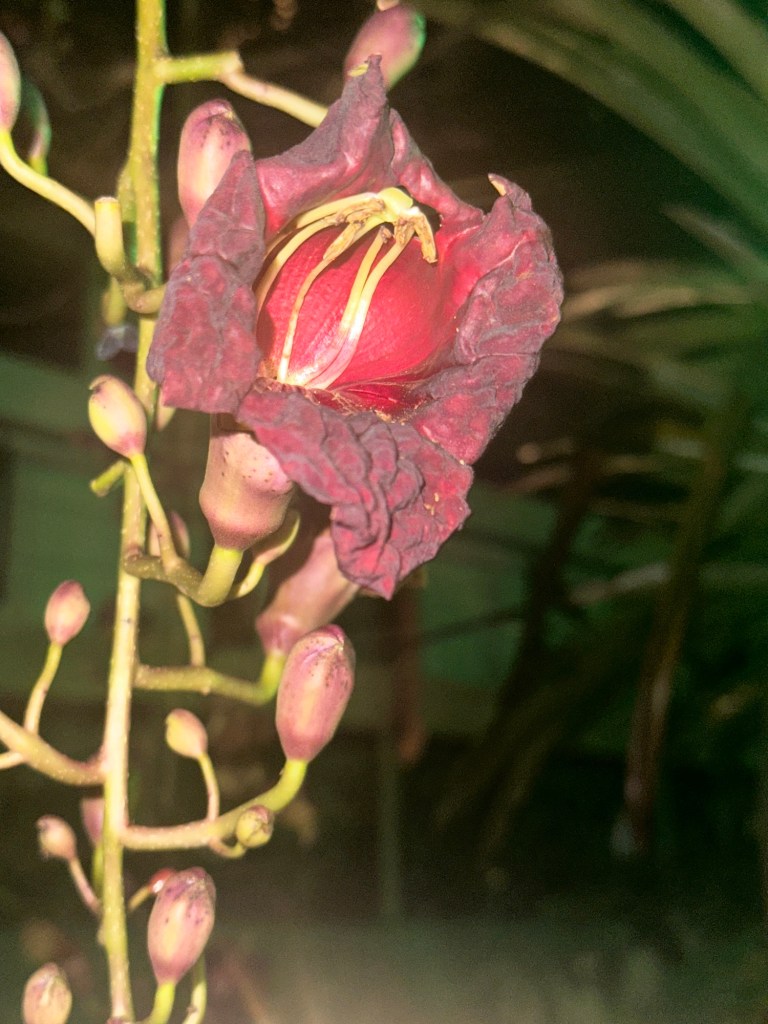
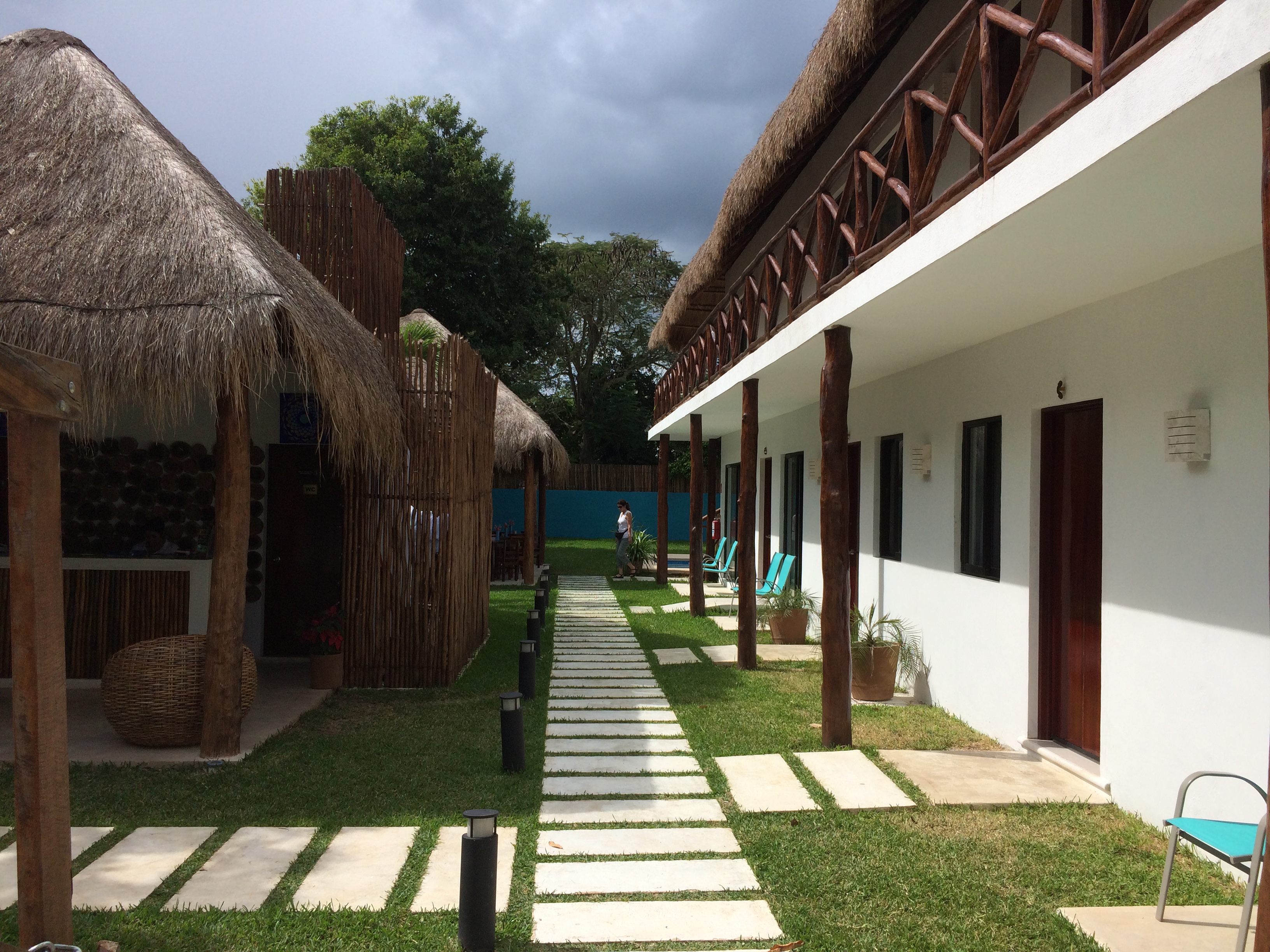
Once you have conquered the stairs and ramps, our room is reached by a bridge overhung with some gorgeous, weird, carnivorous-looking flowers. In the evening, they open, and you can see tiny bees and wasps having a field day in them.

We have decided we like one of the two restaurants here best, TicoRico. It isn’t their fanciest restaurant, but the food is creative and yummy. However, it is apparently cursed.

We were highly amused by this, but then we are easily amused.

You’d expect wonderful fruit in a tropical country, but it is exceptionally good here. They grow seeded watermelon, which is so much more flavorful than the seedless junk from the supermarket. (I wish I knew how to get it at home. We have the wrong climate to grow it). The pineapple is exquisite, and even the papaya is OK, which is a huge concession from me.

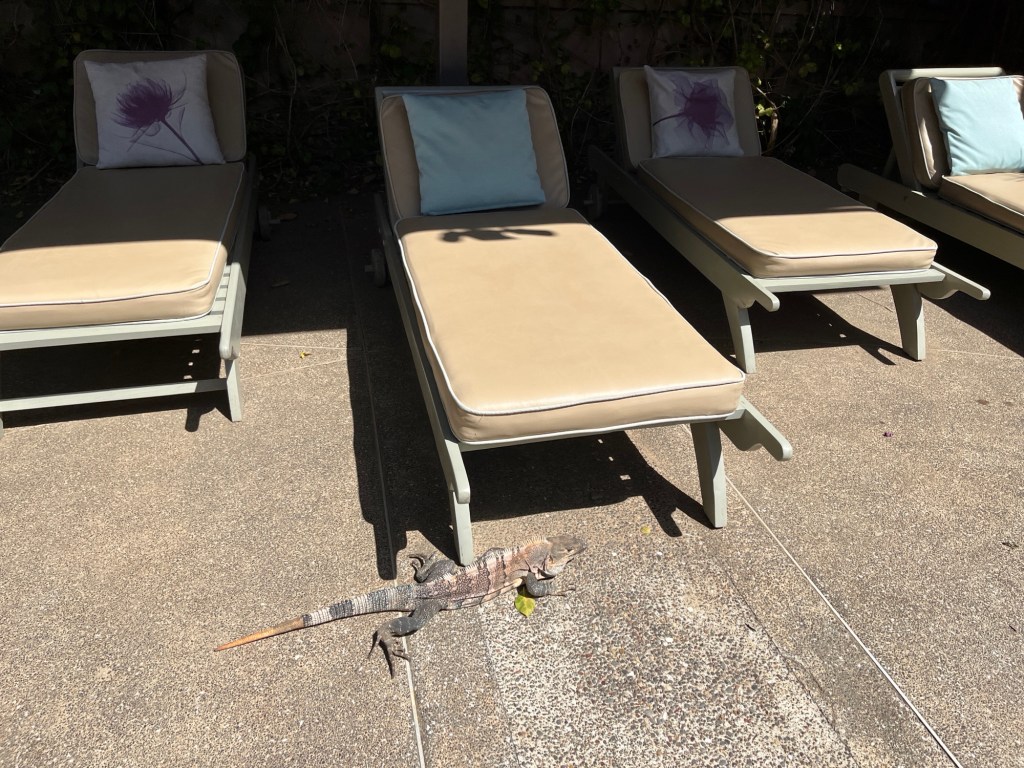
We saw a scarlet macaw in the morning. It is a very large bird, and in flight, trails its tail behind it like a bird of paradise. At lunch, we were visited by Pancho, an iguana that comes into the restaurant to pick up dropped goodies.

Pancho the restaurant cleaner. My foot for scale.

We spent the day quietly, reading and writing. Tom went for a long walk in the afternoon and I went to the pool. Yesterday, the pool bar was full of young, local people, a group of friends. They were drunk and very happy. I had a long conversation in broken English and Spanish with a young lady named Fiorella—she is 21 and she wants to go to New York and Los Angeles and speak many languages and wear beautiful dresses and be glamorous. I wished her luck, sincerely. I hope she lives her dreams.

There are two pools here. One is for families, and is smaller. It has a nice water slide for the kiddos. It also has a pool bar for the adults. The larger pool, with a waterfall, hot tub and another pool bar, is adults-only. How smart is that?!

Today, the pool bar was full of elderly Americans, just like us. (The younger set was at the other pool with their happy, shrieking children.) Some of them had very interesting stories and had lived all over the world. It got dark as gorgeous clouds pulled in, looking as though they had been painted by Tiepolo with sunset gold and pink. We finished our drinks at the pool bar and went to dinner. The day came to an end without any doctors or unnecessary unpleasantness.

Costa Rica, Day 15: you haven’t lived until you are standing in a very public restroom in a foreign country, unclothed from the waist down, washing out your beshitted shorts

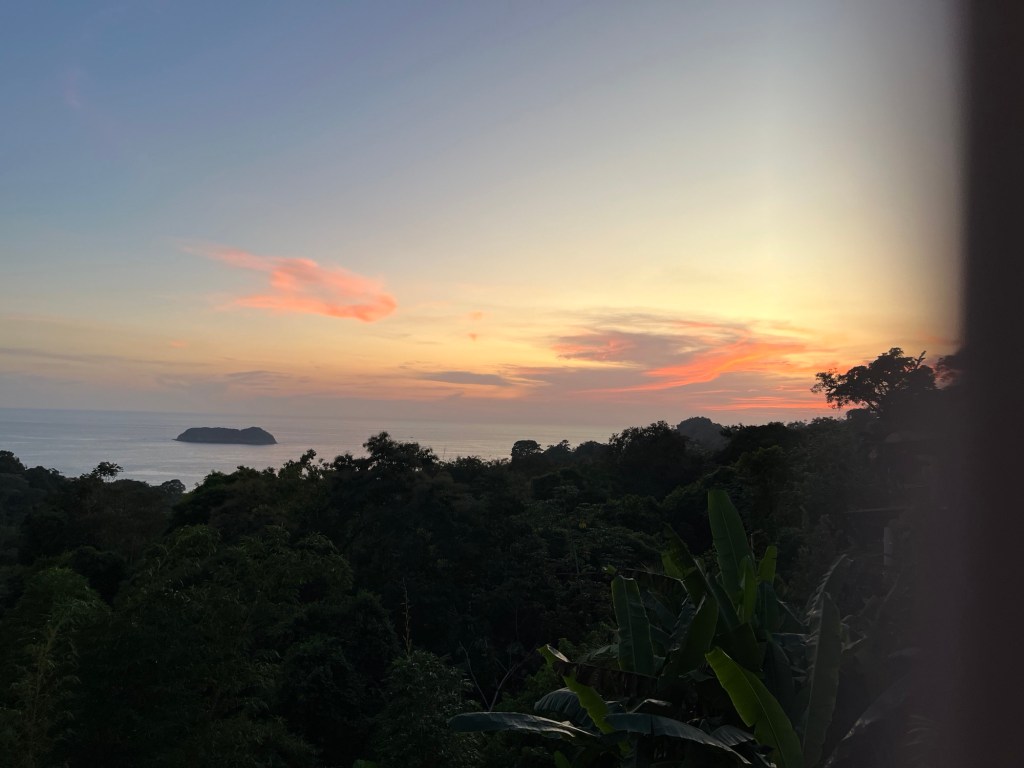
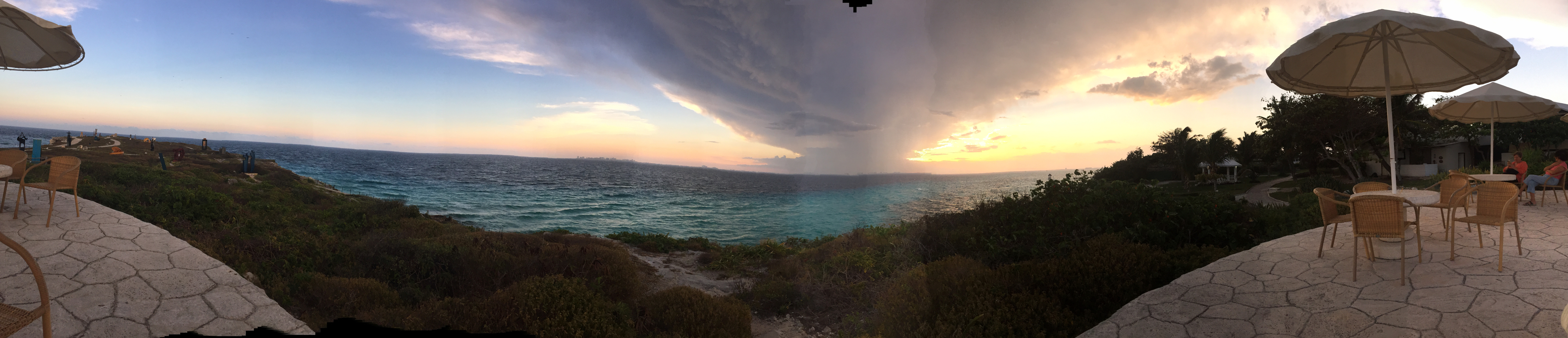
Sunset view from our room at Si, Como No hotel.

And I got to do it twice! We departed Tamarindo with a van and driver, named Johnny. The drive takes about five hours from Tamarindo to the Manuel Antonio area. About an hour later, I realized that my treacherous gut was betraying me again. Johnny stopped at a McDonald’s which had the advantage of being super clean and a bit private.

But it was too late. I tossed the underwear as irredeemable. There was a sink in the bathroom cubicle, so I texted Tom to bring me clean undies and shorts. I washed out my shorts. Then, with nothing covering me but a longish shirt, I went to the bathroom entrance and got the clean clothes from Tom. I laid out the wet shorts to dry in the back of the van and dug out the Imodium, hoping it would work fast.

We stopped to pick up Johnny’s wife, Juanita, at a large bus depot. I urgently sped into the huge, brightly lit, tiled women’s bathroom—and slipped on the slick tiles and fell. I need not tell you what a hard fall produced in my nether regions. I should have brought my walking sticks, but—you know—I was in a hurry.

A number of small, concerned Tico (Costa Rican) ladies helped haul me to my feet, and I limped off, muttering “Muchos gracias, muchos, muchos gracias.” Another pair of undies gone. I’m down three now, and I only brought enough for one week, thinking to launder as we went.

This time, there was no private sink. I ventured into the glaring light of the public bathroom with nothing on below the waist, and washed my shorts. I texted Tom, who appeared at the entrance—at this point, I was visible to the public at large—with my wet shorts from my earlier adventure and no underwear. I was just grateful to cover my ass and didn’t care if the shorts were wet. I congratulated myself on wearing a long shirt that covered most of my problems.

And to top it off, I threw a rib out. I hope you will forgive me if I don’t have much to say about this day. It was not a good day. I am confronting my physical limitations, and not very happy about them. I took more Imodium, which seemed to solve the immediate problem. (BTW, Tom has not suffered any gastric problems at all. I believe the food and water here are safe—I just have a gut that resists any change to its biome.)

I did manage to wish Juanita a happy birthday in Spanish (Johnny told us it was her birthday), and I am proud of my presence of mind, which was more than a little discombobulated by this time. Johnny and Juanita were very cute together in the front of the van, holding hands and giggling. They seemed very fond of each other.

And we made it to this beautiful hotel, Si, Como No. It meets all of Tom’s expectations—tiers of rooms spilling down a jungle-clad hillside with exotic flowers, scarlet macaws, and phlegmatic lizards. Our room overlooks the ocean and is absolutely gorgeous. Tom kindly brought me a double scotch, which was so extremely helpful.

We had a very nice dinner in the hotel restaurant. I had fish tacos, which came on homemade corn tortillas. I have noticed that they do not add much, if any, salt to food here—I sort of expect hot countries to add salt, but not here. With a little salt and sauce picante, the tacos were a delight.

Costa Rica, Day 13: A country drive to a coffee plantation and almuerzo con comida typica

We got up early to take an hour and a half drive to a coffee plantation. Our hotel hostess provided fresh fruit and other things for breakfast, knowing we would have to leave before the hotel served breakfast.

Our driver was a cheerful gentleman named Roger, who pronounced his name in the Anglo fashion. We asked about it, never having met a Roger in a Spanish-speaking country. He then pronounced it RRRho-hair, explaining that a lot of visitors did not know how to roll their r’s. Still strikes me as an unusual name in this part of the world.

We made our way out of busy, bustling Tamarindo and were soon in open country, dominated by grazing cattle and horses, and dotted with tiny pueblos. Each, as Roger pointed out, had its own church, soccer field and bar. Larger towns might have two or three bars. It is drier here than in La Fortuna, but still lush. Gorgeous plants that I see at home as expensive indoor plants are weeds here.

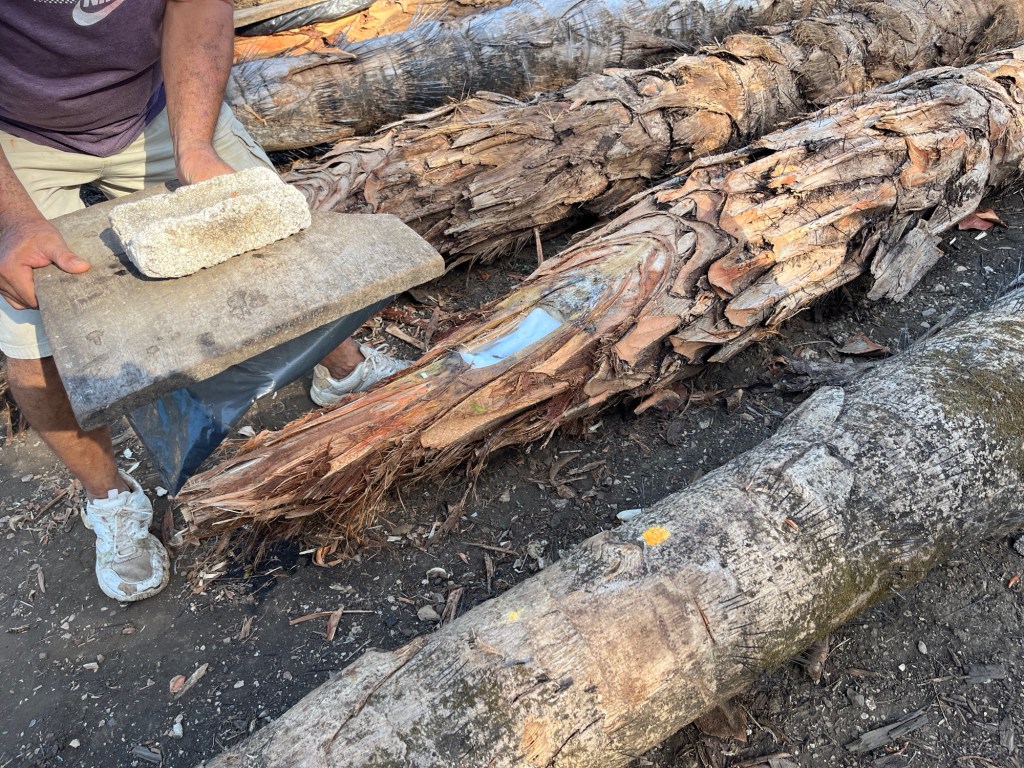
Roger suggested that we stop at a coyol producer. Coyol is a wine made from a particular species of palm tree. The cut trunk is laid flat, and a rectangular well is cut at the end that would normally be supporting the leaves. The sap collects in the cut and is harvested daily. The pre-fermented sap is sweet. It ferments within hours. Interestingly, Wikipedia says, “The wine is purportedly unique in that it causes inebriation not primarily by its alcohol content, but through enzymatic action triggered when one drinks it and then receives significant sun exposure.” Not hard to do here.

The coyol maker removed the protective covering to show us the fresh sap collecting in the palm log. They offered is a taste of coyol that had been harvested 24 hours earlier—the strong stuff, which we accepted. It wasn’t awful, but it will not be my favorite tipple.

We gained a bit of altitude and finally arrived at Coffee Dirià. Several other tourists were already there. They handed us a small cup of coffee, which smelled delicious, but I can no longer drink coffee black, nor do I enjoy it without the modifying elements of milk and sweetening. I am certain it embodied all the taste subtleties that our guide, Dennis (another weirdly Anglo name) described.

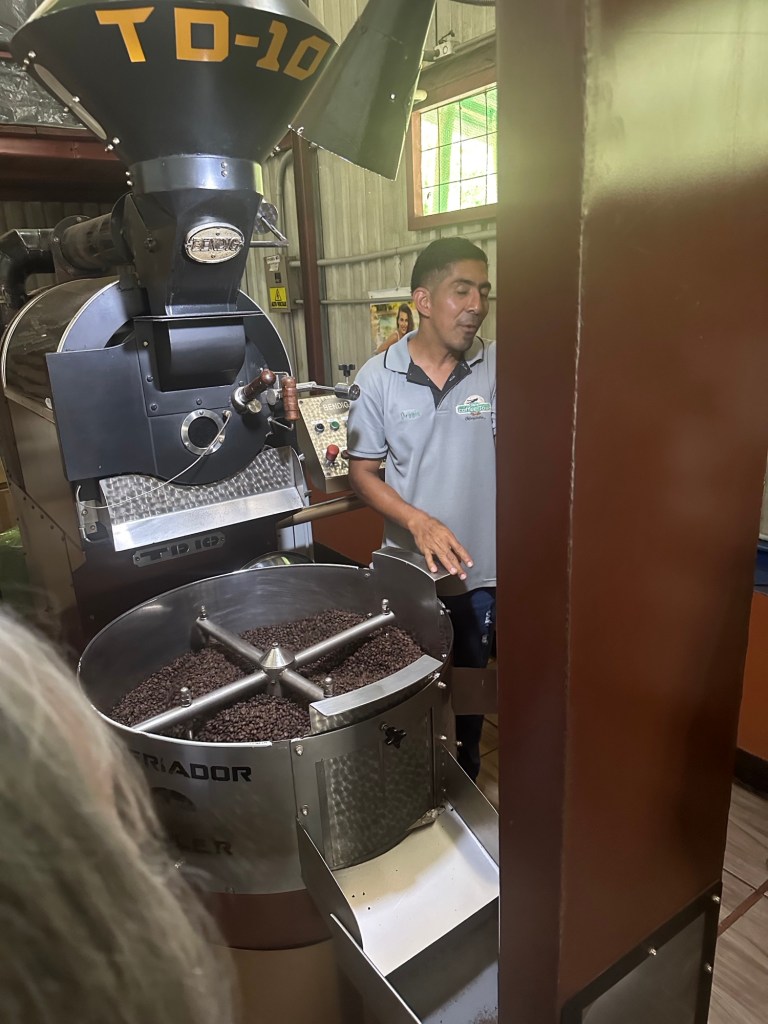
Dennis took us all through the plant and described the process in tremendous detail. I have probably already forgotten much of it, it here’s what I remember:

Dennis showing us the coffee roaster.

The coffee is harvested by hand. It cannot be done by machine because the beans on the same plant ripen at different times. Also, the coffee flowers, which can appear on the coffee plant along with ripe and unripe beans, are quite small and delicate, and they would be destroyed if machinery were used. The flowers resemble jasmine in size and fragrance, though the scent is lighter.

Only the bright red berries are premium quality and fetch the highest price. A mixed lot of picked berries—red, yellow, green—will not fetch a lot of money for the worker (not that they are particularly well-paid even if they get nothing but premium berries.)

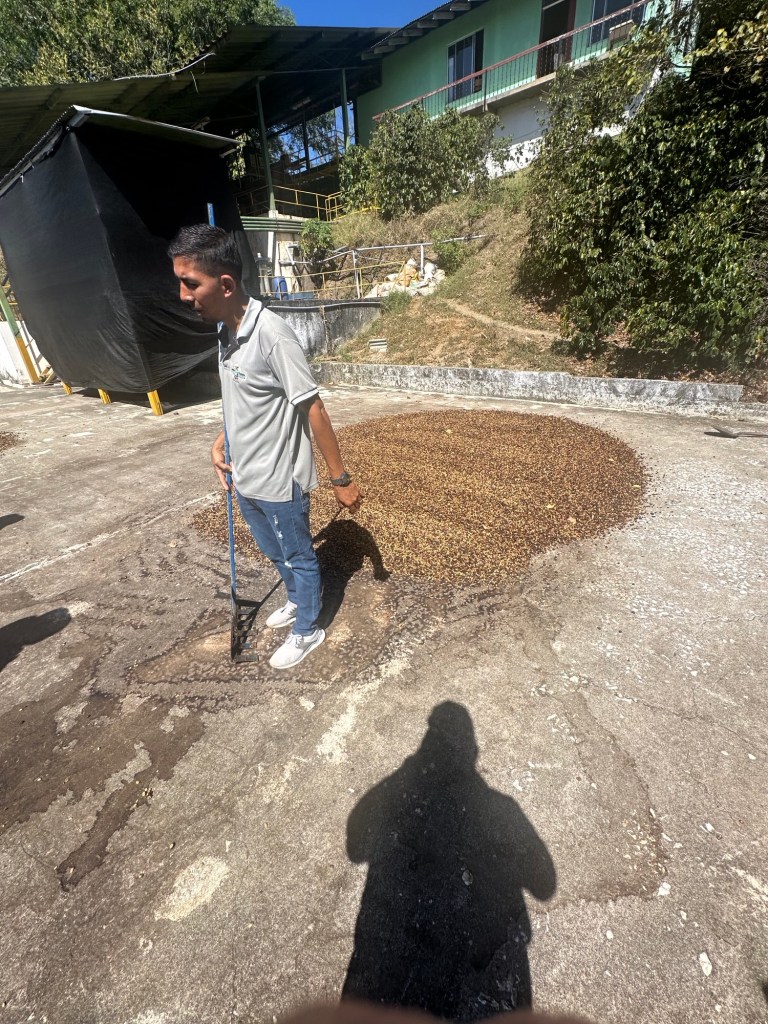
Dennis is standing to one side of premium coffee berries set to dry. The best way to dry them is in the sun, which takes longer than machine drying.

The coffee berry has three “skins.” First, the outer layer, which is the consistency of a very tough grape skin. Then a layer of sweet jelly, similar in looks and taste to the white goo inside a cacao bean. Inside that, there are either two beans or one coffee bean. The singles are the most highly prized, more intense in flavor but smaller in size. These beans have a final “silver” skin that must be removed before roasting.

I’m skipping over the drying, fermenting, roasting, etc. that most of us know about. I was most interested in how they have approached farming coffee organically, without pesticides, and used every part of coffee bean by-products.

Instead of using pesticides, they spray the plants with a tea made of oregano, basil, chilis, and other things. This helps, but there is a weevil that made its way down from Brazil that still manages to infect some of the beans, laying eggs in them. The weevils hatch out and set up housekeeping by eating the house. Dennis selected a bean with a tiny hole and ejected the weevil to show us. It was tiny.

The harvested coffee beans are submerged in water. The good beans sink, and the weevily beans float. The bad beans are submerged for 24 hours in water, which drowns the weevils. The now-unoccupied weevil houses are dried and used for things that are coffee-flavored, like instant coffee. Remember this when you sip that next cup of Nescafé.

The external skin is left on the beans during fermentation and drying, then removed and used for animal feed. The silver skins are dried and turned into paper. The flowers are sometimes used for perfume and skin care products. There are more uses for different parts of the beans, but this is what I recall. Very impressive, IMHO.

We bought some of the plantation’s highest-quality beans, called Black Honey. They had actual honey made from the bees that pollinate the coffee flowers. It was an unusual flavor and delicious, but I didn’t want to carry a heavy glass jar of glutinous sticky stuff in my suitcase. 😢

So then Roger and the Keenans were on the road back to Tamarindo. Roger gave us beers. I am not a beer drinker, but my Mom always said a cold beer on a really hot day hots the spot, and she was right.

We stopped in Villareál, a small town not far from Tamarindo. We were promised lunch at Roger’s favorite soda. A soda is a small, usually family-owned restaurant where you can get local food—la comida typica. The soda in question, Soda y Masqueria Marcel, has its own Facebook page.

Roger had ordered while we were on the road. We all had casada, which is the classic mid-day meal here. It consists of a protein (I and Roger had fish, Tom had chicken), salad with lots of raw veggies, rice and black beans, and plaintains, which in this case were cut into long strips and deep-fried until light and crisp. It struck me as a well-balanced, nutritious meal, and it was delicious.

A word about Costa Rican food in general. It is safe to eat raw vegetables here. I got the squits once, but I always get the squits when I travel outside the US—even in pristine Iceland. Tom has been fine. The tap water is also safe. The food is not at all spicy, though sauce picante is available on request. The food at our hotel at La Fortuna tended to the bland and uninteresting, but we have had really good food in Tamarindo, although you do have to go a bit further abroad if you want la comida typica.

I took my now-habitual siesta in the afternoon and Tom walked in the suffocating heat. (Note that he is the healthy one.) For dinner, we returned to the Falafel Bar because it was really exceptionally good middle eastern food.

This is the hotel’s cat. I don’t know it’s name or gender, but it follows us whenever we emerge from our room. But it does not wish to be petted.
Another hotel guest. He also does not wish to be petted.

Costa Rica, Day 12

I am still laughing at myself, 24 hours after it happened. We were on the way back from Dr. Piloto’s office. I had trouble getting into the taxi van because the first step is quite high, and the van was parked at an angle that made it even higher. My walking sticks signal to most people that I am not terribly agile right now. There were other people in the taxi, and when the driver pulled away. I thought he was leaving. But instead, he reparked the van to make it easier for me to get in and offered me the shotgun seat. I was grateful, but when I tried to tell him my knee required surgery, I misspelled surgery in my translation app and told him that “My knee requires sugar (azucar).” I KNOW the word azucar but said it anyway. He was such a kind man that he did not burst out laughing, which he was certainly entitled to do! He seemed to get it, but I’ve been breaking out in little burst of laughter ever since.

Today we took an estuary tour by boat through the mangrove swamps. We had to leave before our hotel served breakfast, so we walked into town. Most restaurants were closed, but we found a breakfast place and had fruit, avocado toast, yogurt, and coffee. Perfect.

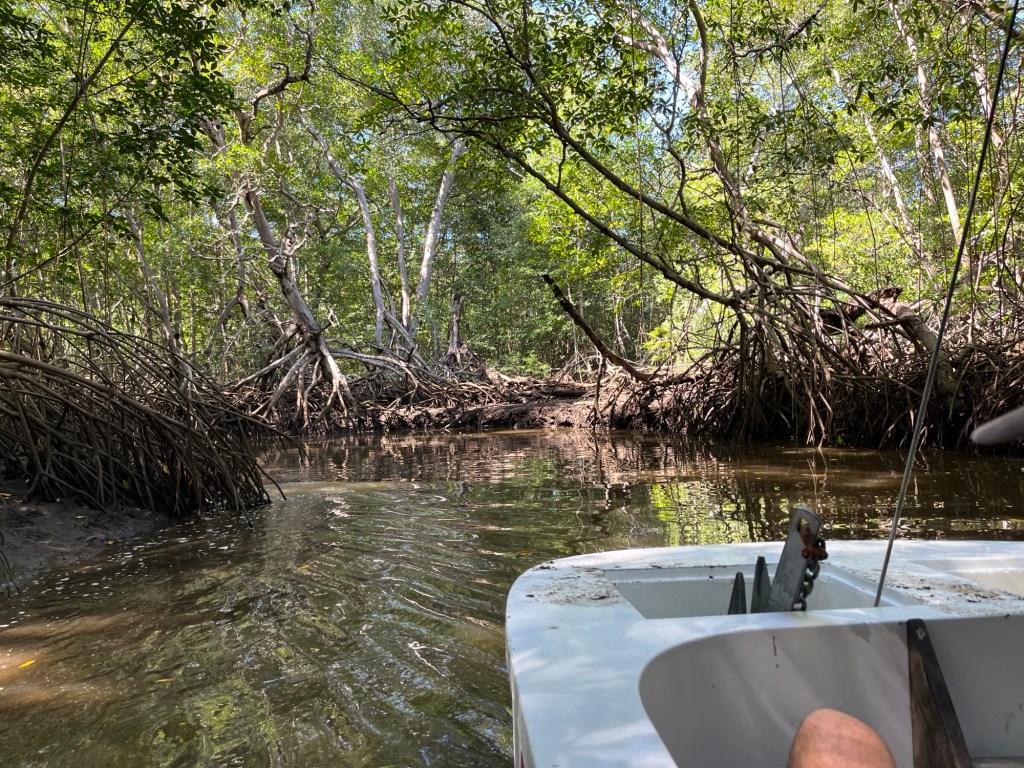
The estuary tour was via a small boat with a canopy, powered by an outboard motor. The guide pointed out several different varieties of mangroves ( I had no idea), and my favorite was the “gentleman mangrove.” Our guide didn’t really know why it was called that.

Gentleman mangroves.

It was very low tide, and the boat got hung up on sandbars several times. This did not worry the men in charge of the boat; they always got us safely sailing again. At the beginning of our tour, the mangrove roots were high out of the water, and they looked like fingers reaching for the tide. By the time we returned, they were underwater again.

We wandered down some very narrow channels. Then we had to wander out again before getting stuck.

We saw a good variety of birds. They don’t have toucans, or macaws (none of which I have seen yet), but we did see:

Yellow-crowned night heron

White ibis (not my photo)

We didn’t get photos of most of them because they were too far away, but we also saw:

Green-backed heron

Little blue heron, adult and juvenile

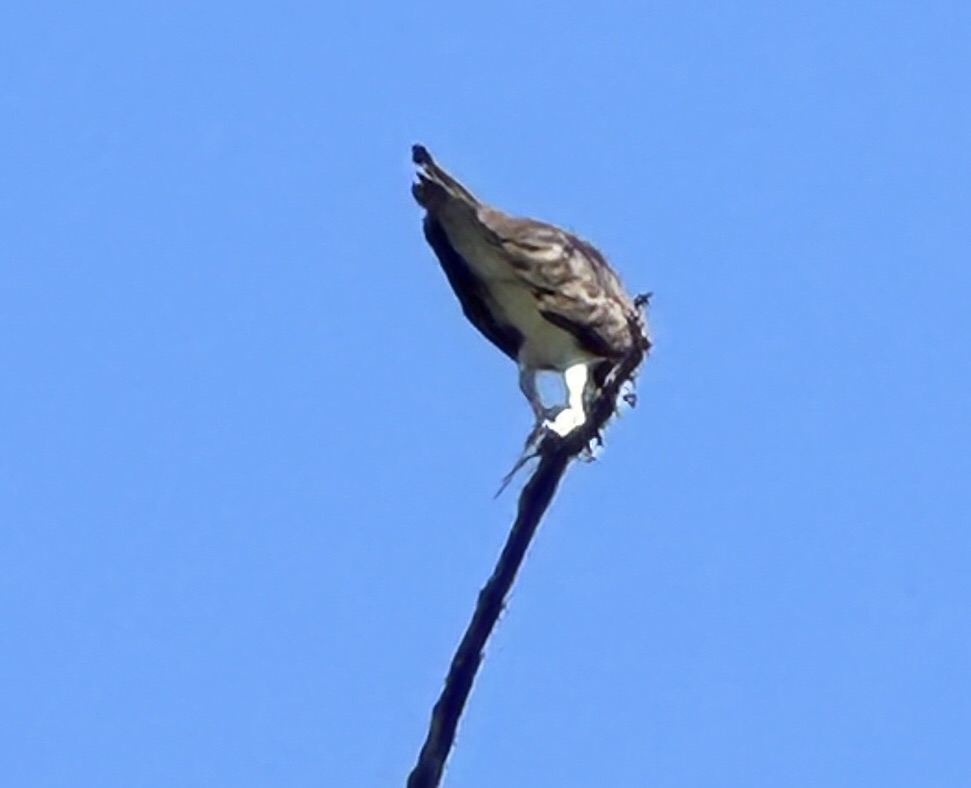
Osprey, sitting in a tree and lunching on a silvery fish

Common black hawk

Great blue heron

Whimbrels

Willets ( migratory birds that look identical to the ones on our beach at Aptos, CA)

Sandpipers (also migratory)

Kingfishers

Mangrove hummingbird

Black-throat trogon (maybe)

About midway along, they served us fresh-cut pineapple, which was refreshing. I guess someone threw extra pineapple onto the beach, because on the way back, there was a very happy and very large iguana chowing down on it.

Happy iguana eating pineapple. What a find for him or her!

We also saw several baby crocodiles in the water. None of them more more than two years old. Sadly, none of the croc videos wants to load.

The guides anchored the boat next to a muddy bank with mangrove roots sticking out of it and invited us to climb up so we could go see howler monkeys. I and my bum knee and torn rotator cuff opted to stay in the boat, much to their surprise, but I was happy with my decision.

At one point, there were howler monkeys in the trees right next to the water, so I got to see them anyway. One of the other boats had a guide who could imitate the howler call and got a rather lackadaisical response from the male troupe leader. You know, it was hot.

Howler monkey.

Costa Rica, Days 9, 10, and 11

On Day 9, we said farewell to the Royal Corin Spa, where they treated us like royalty. We filled out a survey, and we did not rate everything 100%. The food, in particular, was hit-or-miss. To our surprise, they wanted to ask us in person what was not perfectly to our satisfaction. A first, and I was impressed. We rated everything else very highly.

We hired a car and driver to get to Tamarindo—far cheaper than renting a car alone here. Misa spoke very good English. We saw a couple of coatis near the road, begging, but otherwise, the wildlife kept pretty much out of sight. The scenery gradually changed from lush cloud forest to dry chaparral as we came down out of the mountains and got closer to the coast.

We discussed the party atmosphere of Tamarindo. Misa said it was crazy this time of year, and it is. He also called it “TamaGringo,” which is accurate.

The Tamarindo Bay Boutique Hotel is a nice place, but it cannot compete with the luxury of the Royal Corin. Our room is large, with a huge dressing room, a bathroom, and a small kitchen. Very clean and comfortable.

Tamarindo is HOT, which my lizard husband loves. Me, not so much, and there is a howling, burning wind to boot. An American who is staying here said that going to the beach is an excellent exfoliant.

I am hurting rather badly, not from any expected source, like my bone-on-bone knee. I seem to have torn my rotary cuff, and it is not getting better. I may have to see a doctor as the pain is intense.

I saw a squirrel here within the first few minutes of arrival. I didn’t photograph it because he was too qui k for me, it there’s what he looked like.

Costa Rican squirrel.

We managed to eat at a restaurant that was only blasting rock music, and didn’t feature fire eaters or live bands, Green Papaya. They serve only tacos. I had shrimp tacos, and they were lovely and fresh.

On Day 10, we ran around taking care of laundry, buying food for lunches, etc. We discovered that in Costa Rica, pharmacists can administer cortisone shots. Filled with hope, we went to the local pharmacy, but they didn’t have the right kind of cortisone, so I will have to see a doctor.

I am sorry to say I spent the rest of the day in bed. We had dinner at a restaurant called the Falafel Bar. We weren’t especially in the mood for Middle Eastern food, but it came highly recommended. It was truly excellent food. We chatted with the couple next to us—Americans, of course. Turns out the husband, John, has had just about all of his major joints replaced—truly the bionic man. He seems fit and active, so there is hope! (This is what old people talk about all the time. I now understand the fascination.)

Early to bed, No photos. Sorry.

Day 11 started with getting a doctor’s appointment for 11 am. I have rarely been more thrilled with getting a doctor’s appointment. The owner or manager here is Marie, and she has been very helpful.

It is still very hot and very windy.

Doctor Piloto was a nice man maybe a few years younger than us. He said he could not do a shoulder injection because he wasn’t an orthopedic doctor. The nearest orthopedist is in Liberia, a city some 46 km from here. But he did offer me some anti-inflammatories and steroid pills, yay. There was a pharmacist right door, so that was easily taken care of.

While we were waiting for a taxi, we chatted with another American couple who were waiting for the doctor. They plan to move here next year. He can work remotely and she is retired. They are looking to get away from the stress, politics, and racism of the US. They mentioned seeing a very large snake in the road that acted quite aggressively. I found a photo of the very scary terciopelo (fer-de-lance), which is one of the deadliest and most aggressive snakes in the world. They agreed it was the snake they saw. I am hoping not to see one.

We waited for about an hour for the taxi back to the hotel. The medic who manned the front desk of Dr. Piloto’s tiny office invited us to stay inside in the air conditioning, and called the taxi company several times. So very kind.

We returned to Tamarindo Bay Boutique Hotel and ate some things we had picked up at the local supermercado (but not until I eagerly downed Dr. Piloto’s prescriptions). Then for the second day in a row, I flopped down and had a siesta. I am not a napper, but I do not do well with either heat or pain, so I guess my body was trying to tell me something.

In the evening, we went to a nearby restaurant called La Oveja Surf House, which means “the sheep surf house,” which makes no sense at all. The food was delicious, and we took our leftovers back to the hotel for lunch the next day.

Sorry this post wasn’t more exciting. ☹️

Farewell to the Isle of Women

The Caribbean shore of Isla Mujeres, with embellishment.


This morning, I was determined to do some beachcombing. Everyone says there is sea glass here. But first we had breakfast at Lola Valentina, where the staff now knows us and the food is good. They have a small army of cats in the restaurant, black and white, orange tabby, and cream. They aren’t feral, exactly, but they aren’t pets. I suspect they are there not to cage crumbs from the tourists, but to keep the rodent and cucaracha populations under control.

Then we took No. 8., our putt-putt cart, over to the north shore. It is rocky all along the Caribbean side. There are no beaches and the currents are too strong for swimming. The waves are small, just a constant slap-slap-slap against the rough rocks.

Sadly, what we mostly found was plastic garbage. We did find some sea glass, but nothing that a sea glass enthusiast would get excited about. Mostly of the broken beer bottle variety but there were a few nice pieces. And we found a sad, dead cow fish. But mostly plastic garbage, which you see everywhere on this island. Every day, I saw people finish food and just walk away, leaving their refuse on the street.

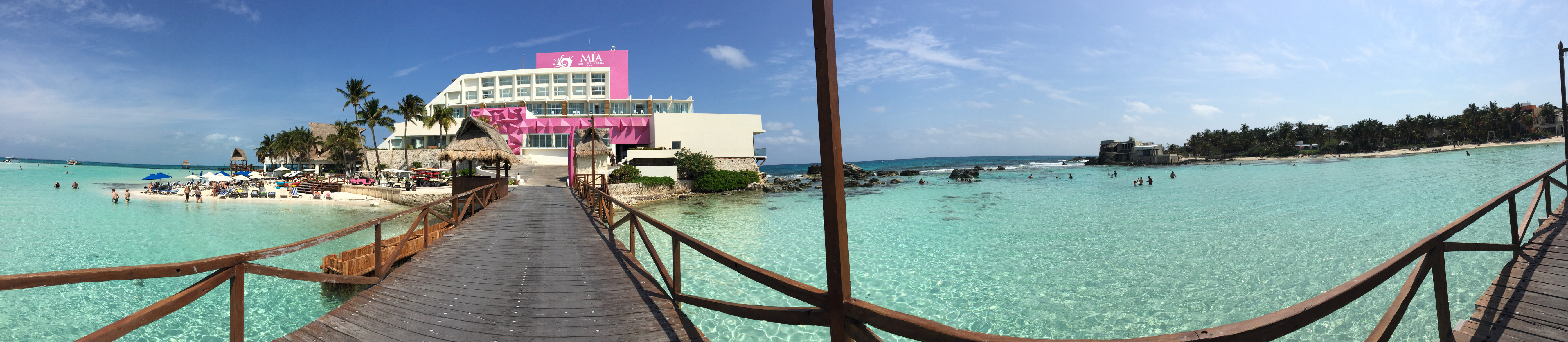
The bridge to Mia Reef


After that, we went to Mia Reef, which is a resort built, natch, on top of a reef. As a consequence, the reef is now dead. It is reached by a narrow wooden bridge across a beautiful turquoise inlet. For a fee, non-residents can get all the food and drink they want (including alcohol), and hang out on the beach or at the pool. There is still reef, accessible from the beach, and the water is quite shallow all the way out to it. We didn’t snorkel because it was windy, but one man who was snorkeling said there was a lot to see. We swam in the aqua water and lazed on a swinging mattress under a palapa, looking out on the Caribbean. Mia Reef would be an ideal place to take kids because the water is crystalline, shallow and calm. Once older kids are used to the water, the reef would be an excellent introduction to snorkeling. The resort is elegant and clean, there’s a kids’ club, and the staff is attentive even to day trippers such as ourselves. The food was acceptable, the drinks not overly alcoholic, if you know what I mean.

We walked out on a long pier. There were two people snorkeling, and they said they saw a lot of fish. I decided not to try because of the wind and because we were scheduled for a snorkeling tour the next day, but I later regretted my decision to give it a pass.

As the following day was our next-to-last day on the island, we checked the flight times and discovered that we weren’t going to make our flight if we stayed on the island for the last day we were booked. We would have to go back to the Marriott Courtyard at the airport, which meant we had to check out the afternoon prior to our flight instead of staying on Isla. This was the same day we had scheduled the snorkeling tour, which bothered me because once you’re on one of these tours, you don’t just decide it’s gone on too long; you’re there for the duration. We had to turn in No. 8 by 4 pm and make sure we caught the ferry to the mainland in time. So I cancelled the trip again.

* * * *

We’d already seen most of the things there are to see on this small island. There were only two things left, so we decided to do them.

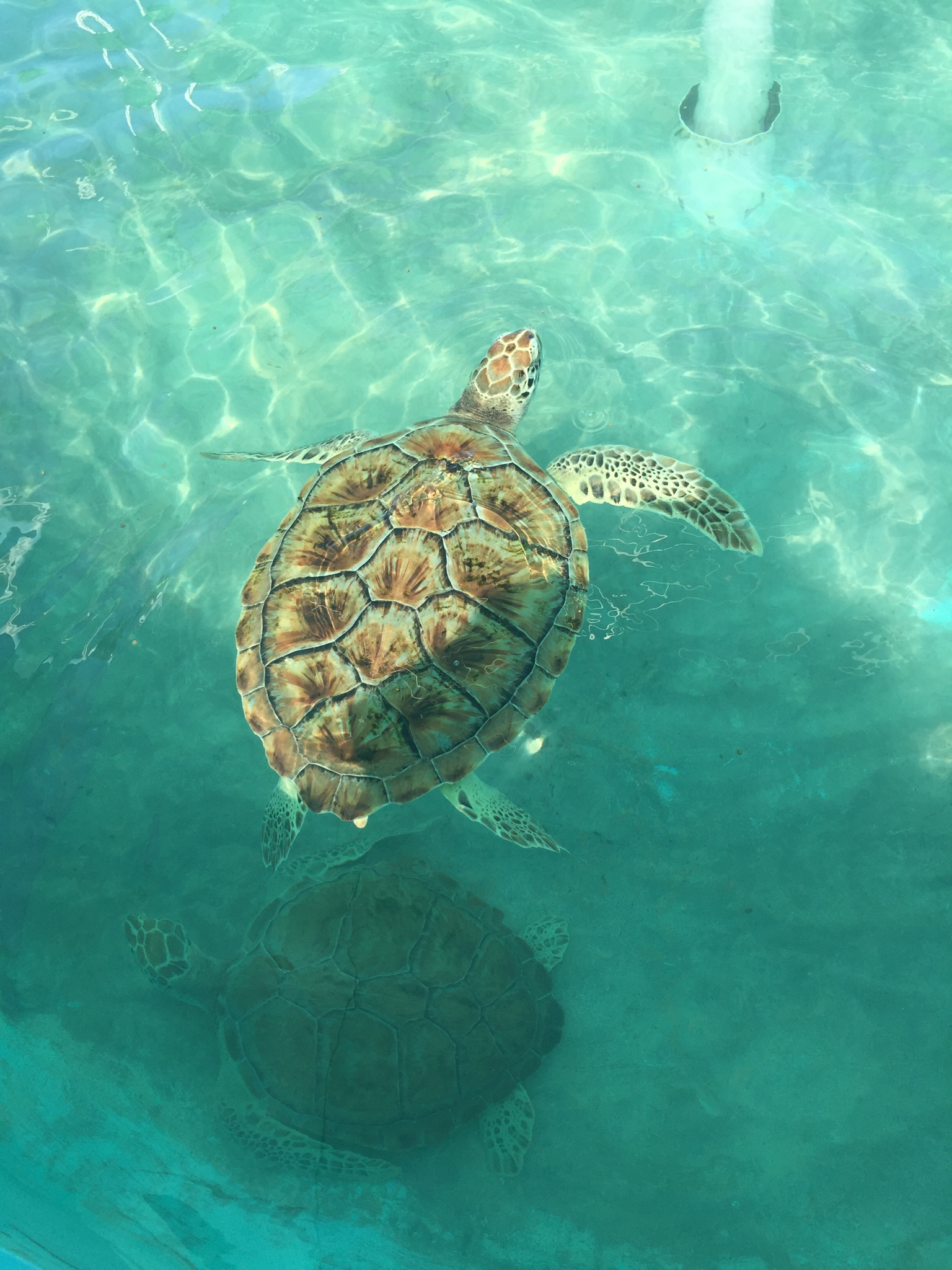
Green sea turtle at the Tortugranja

We started at Garrifon Reef Park to do some snorkeling. It was more expensive than Mia Reef, but it is a kind of family playground with zip lines over the water, snorkeling, kayaking, a shallow, wandering pool with waterfalls and grottoes, beaches, restaurants and bars. Food, drinks and all activities were included in the price of admission.

Tom and I went snorkeling, but it was a disappointment to me. They make you wear a life jacket, which annoys me because it makes it hard to swim. The reef is dead, but they won’t let you snorkel over it anyway. We saw some fish and I saw a stingray. Tom saw a very large fish that he thought at first was a barracuda, but it was too chunky for that. He’d recognize a shark, so we never figured it out. My snorkel mask, which is one of the new kind that have a non-fogging bubble and built-in snorkel, was apparently too large, and I had to snorkel with my mouth hanging open to prevent water from entering. There was a line of people waiting at the steps to get into the water, and none of them would budge to let us out. A kindly man eventually took my equipment to allow me to climb out, which was nice of him.

We had the cafeteria food they were serving for lunch, accompanied by a non-stop stream of pretty-much-non-alcoholic margueritas that we didn’t ask for, which was fine. Sort of like lime slurpees, but better. Again, this would be a terrific place to bring kids. I’m just spoiled because I have snorkeled in places like Hawaii and Tahiti, where the reefs are alive and the ocean life abundant. I think I’m done trying to snorkel in the Caribbean. I’ve snorkeled in Antigua (actually OK at the time; early 70s), Jamaica and now Isla Mujeres, and most of the reefs I’ve seen are dead.

This was our last night on the island, so we made reservations for the fancy restaurant at Villa Rolandi. I had a filet mignon with bearnaise sauce that was as tender as chicken (I mean well-prepared chicken) and flavor to die for. It’s a great place, but at $400US a night it’s pretty pricey, even if all meals and drinks and activities are inclusive.

The following day we had breakfast at Mango Cafe–poblano pepper stuffed with bacon, eggs, onions and cheese, breaded and deep-fried. OK not healthy, but I’m on vacation dammit. We’ve pretty much done everything there is to do here, so we visited the Tortugranja, a rescue and breeding facility for sea turtles. They provide a safe place to lay and hatch the eggs, then release the babies. They have tanks with some older turtles being rehabbed, and there are some very large specimens in a pen in the ocean. You can walk along a pier to see them. They sell bags of turtle chow at the entrance.

There’s a large pen that extends into the ocean containing several large turtles. I think they are mature adults that for whatever reason will not survive in the wild. When you throw turtle chow in the large pen the turtles get some of it, but there is an army of assorted seagulls above and another one of little fish below that eagerly gobble up much of the food.

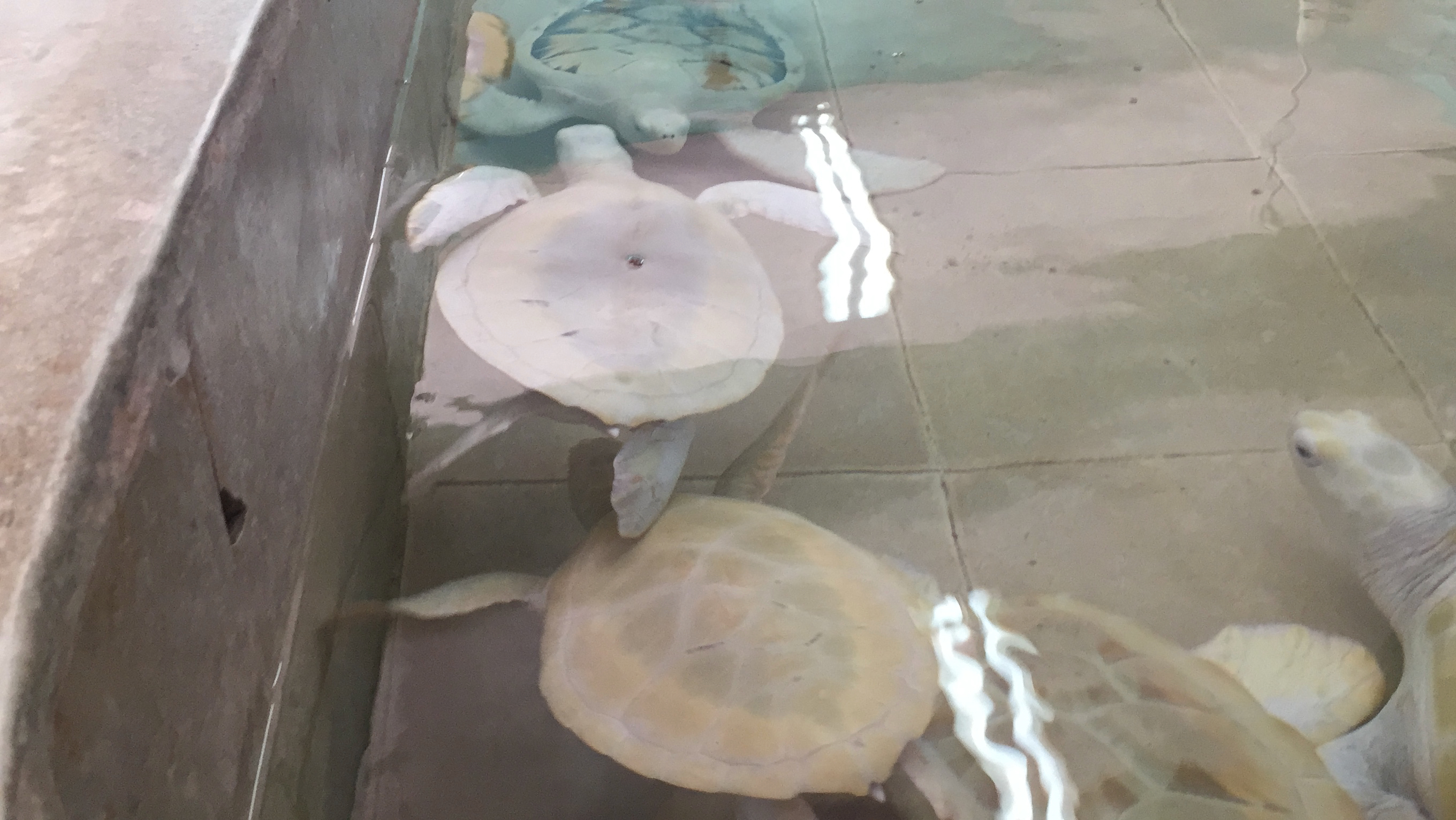
Albino sea turtles


They had several albino turtles–one tank had nothing but albinos–and had green, hawksbill and loggerhead turtles there. Sea turtles are threatened for several reasons. One is because they are so darned delicious. People everywhere catch and eat them and their eggs despite the fact they are endangered. Another is because many of their hatching beaches have disappeared, taken over by development and humans who enjoy the beach environment. Another is because given their diminished numbers, the natural predation on the babies cuts seriously into their surviving numbers. Baby turtles must crawl from their nests in the sand to the ocean, all the while being attacked by birds. Once in the water, the babies are an easy snack for fish and more birds.

After the Tortugranja, we were pretty much done with Isla. We went into town, bought some gifts, had lunch and turned in No. 8. Then it was time to pack and catch the ferry to the mainland. On the taxi ride from Puerto Juarez, the ferry port on the mainland, the driver told me he had saved up to take his family to DisneyWorld in Florida, spending $750US for visas. The visas were cancelled by the P45 administration, no explanations offered. I apologized for my country, embarrassed. This was the first time anyone in Mexico raised the subject; of course they rely on tourism, but I also think they gave us, as individuals, the benefit of the doubt. Plus, the Mexican people are for the most part friendly, kind and polite. Many times, someone stopped unasked and helped me with something–a dropped item, a suitcase, or helped me over rough ground. On the ferry, which was crowded, a man gave me his seat with his family despite my protests. The Mexicans absolutely do not deserve the cold shoulder they are getting from my country.

I was pleased throughout our trip to note that there were as many Mexicans as other nationalities on vacation in the places we went, enjoying the sights and experiences of their country. (Calakmul was an exception. Most people there were American or European. It’s a kind of remote place, after all, and not someplace you’d take kids.) I have visited Mexico a few times before and didn’t see this previously. I am hopeful this means the middle class is growing in Mexico, and more people have the leisure and money that we have taken for granted here for many decades. I believe there were more Mexican tourists in Isla Mujeres than Americans.

At some point during the trip, Linda asked me if I had enough material for the next novel. I am beginning to work on a story line, but I would say no, I do not. I came back from Moloka‘i two years ago seething with ideas and enthusiasm to start writing. I’m not there yet with this one. I think it will be a slow burn. This one has to be the best one, because after that, I am saying farewell to Sierra and Chaco, Clancy, Fred, Rose, Kaylee and Mama Labadie. Three books are enough.

Next research trip: Iceland, but not for a while. I still have to launch “Fire in the Ocean” and write the third book in the series. But I’m thinking about it!

Here are some photos, included in no particular order, but I like them for one reason or another and they didn’t fit into my narrative:

A typical Mayan arch at Uxmal


Clod and friend.

Church at Valladolid.

Beautiful bas-relief at Uxmal.

Our guide Roberto, standing in front of an arched tunnel at Becan. Air funneled through this tunnel and it was as good as air conditioning in the heat and humidity of southern Yucatan.

Another captain’s tomb at Isla Mujeres. You can see the ship’s wheels in cement in the surrounding fence What you can’t see as well is the model of a ship in the glass case at the front.

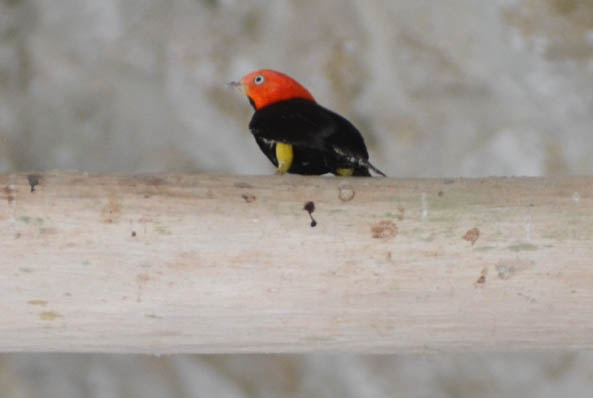
Red-capped manikin, a rare sighting! At Chicaana.

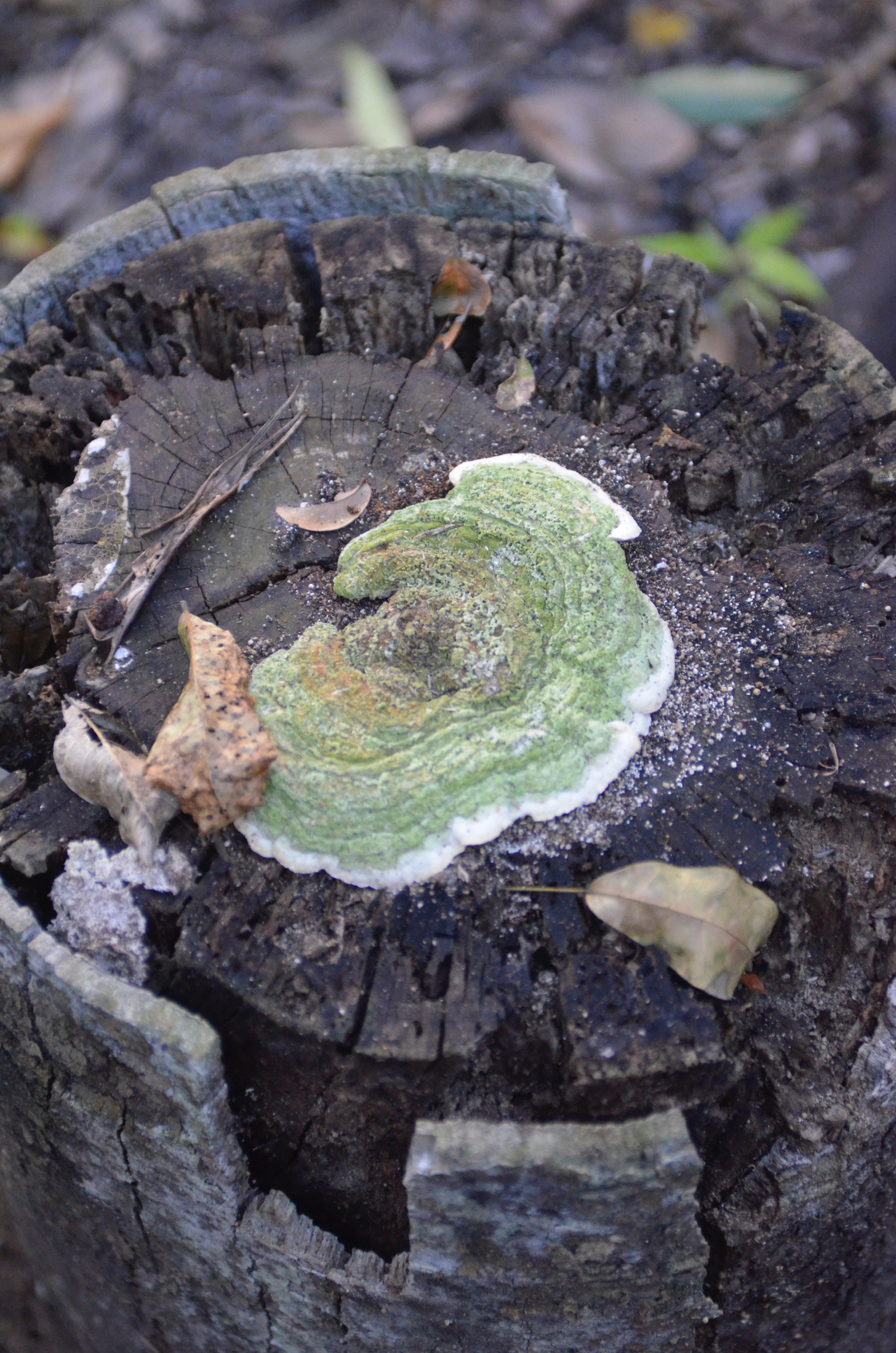
Just a nice green fungus at Calakmul

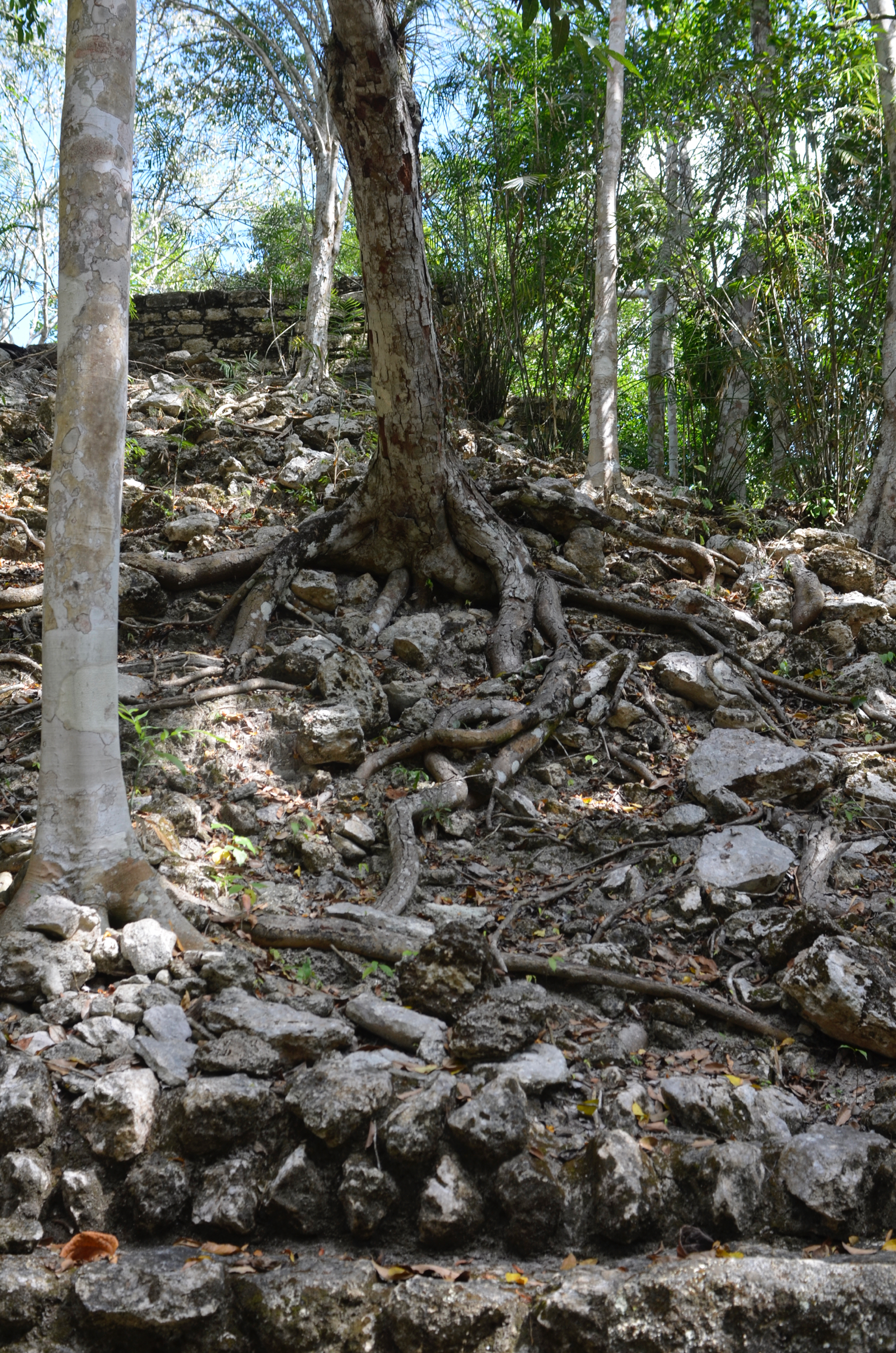
Strangler figs (isn’t that a wonderfully ominous name?) growing on an unexcavated building in Calakmul.

Hotel Calakmul. This is what the jungle looks like in southern Yucatan–more like the Adirondacks.

Save

Save

The Most Cheerful Graveyard in the World

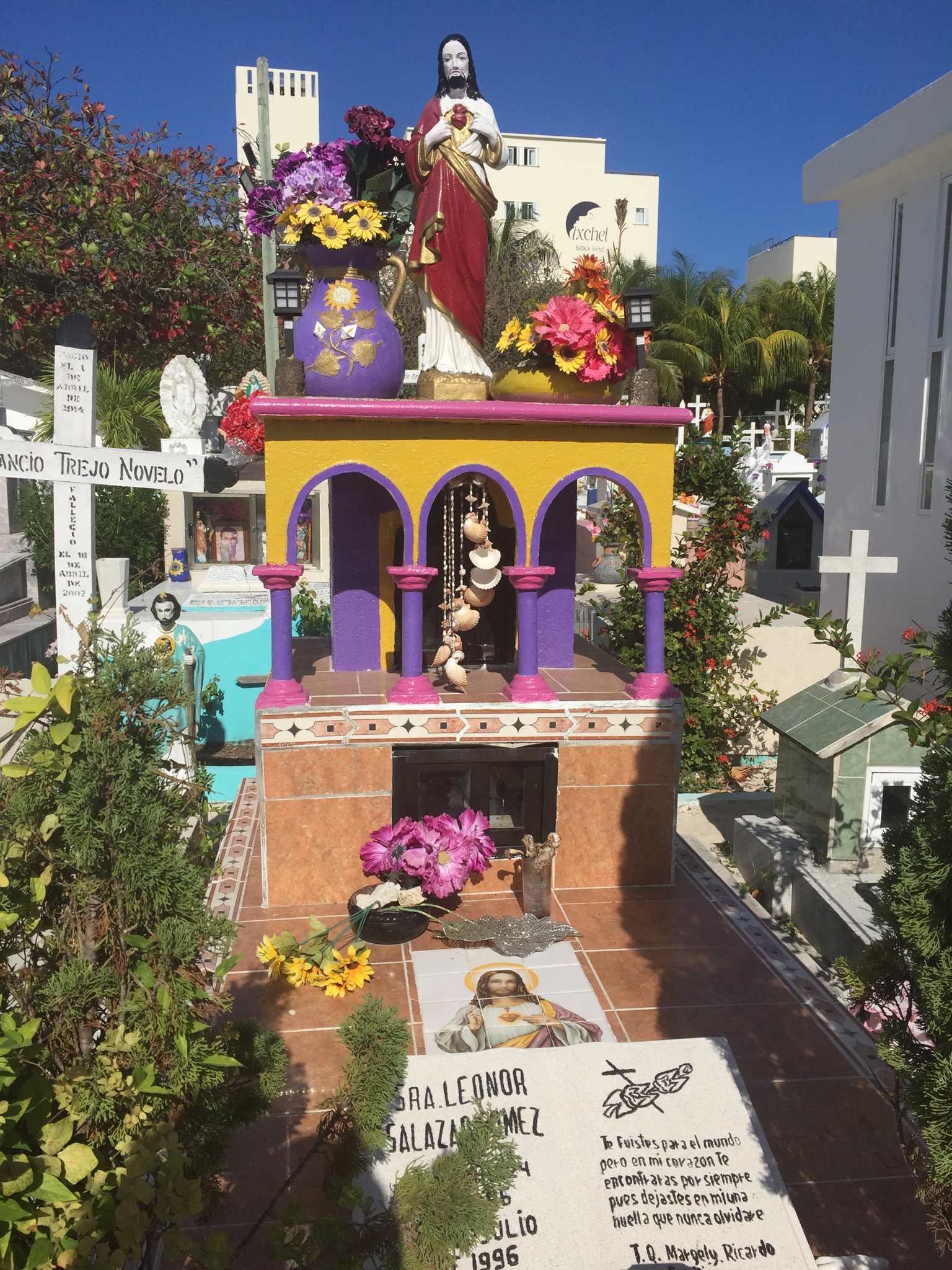
One of the more colorful tombs in the Isla Mujeres graveyard.

After a restless night (me, not Tom), we wished each other happy Valentine’s Day and got into the cart to drive to town. I was much less freaked out this time. Breakfast was the first order of business, then we needed to get the cart gassed up and the wheel fixed. The rental place was right in the middle of a shopping area filled with tiendas offering artisanal crafts and touristy tchachkis, and I wondered why Francisco had not brought us here. Who knows, but I spent a couple of hours going through the shops looking for gifts. I saw all kinds of cool stuff, and a whole lot of crap, but I had no desire to haul heavy woodcarvings or painted (and fragile) pottery home, so I was primarily looking for small, non-breakable, lightweight things.

I asked around for sea glass jewelry, as that is our daughter’s passionate hobby. I only found one shop that had it, and it consisted of monumentally ugly, poorly worn pieces set clumsily in huge, heavy silver collars. I finally did find a few pieces of delicate, beautifully designed jewelry in one store, but nothing with sea glass. I think based on what I got, that she will forgive me.

Great little jewelry store, but look at their “open” sign.

Tom, as always, followed me around while I shopped without the slightest impatience, bless the man. Once I concluded the hunt, we picked up the cart–but we got a new one with no wobbly wheel and much more get-up-and-go than the original. We called it No. 8, as that was the number painted on the side. No suspension, but a huge improvement nonetheless, as it no longer wobbled and had a bit more get-up-and-go. We went to a beach where someone had told us you can find sea glass and found a lovely little swimming area, but no sea glass. I suspect that the sea glass here is of the broken beer bottle variety, anyway, but I’ll keep looking.

We came back to the hotel. I was somewhat disturbed to find a squashed, three-inch cockroach lying by the bedside table, still waving its legs. I wasn’t disturbed by the cucaracha so much–it’s the tropics, after all–as the fact that we hadn’t squashed it and the maid hadn’t done the room yet. I sent it to Xibalba (the Mayan realm of the dead) down the toilet and mopped up the mess. Nothing was missing or amiss, so oh, well. It’s not as if I brought my diamond tiara with me. We returned to the Cubano restaurant for more excellent guacamole and a ceviche to die for, with octopus and conch in it.

And then we did nothing. Just nothing. Until about 8:30 pm, which is about a half an hour before most of the local restaurants close. We weren’t starving, so we went to Chedraui down the street, which is sort of a supermarket combined with Costco—you can get everything from mopeds and washing machines to fountain drinks, dried hibiscus flowers and fish. We got some cheese, crackers, wine and snacks and went back to the hotel for a modest repast, using our kitchen for the first time.

* * * *

We set our alarm for the next morning, as we were scheduled for a snorkeling tour at 10 am. However, the weather was projected to be quite windy, followed the next day by rain. Windy conditions are poor snorkeling conditions, so we rescheduled for after the rain.

As that was our big expedition today, we had to make new plans. We had breakfast at Lola Valentina, where we had eaten the day before, and the staff recognized us, which is always nice. I didn’t feel like a heavy breakfast and had fruit and yogurt. Then we visited the cemetery.

I adore cemeteries. The older, the better. This cemetery features the self-carved gravestone of Juan Menaca, although apparently he was buried in Merida. I wanted to find his stone, but the cemetery was sufficient on its own to delight me. The majority of the tombs are created by hand, each one different, and each one a very personal tribute to the departed, which is what I love about such places. Mexicans have a very personal relationship with their dead. Everyone knows about Dia del los Muertes, Halloween, where families picnic among the tombs and catch up their dead relatives on the doings of the past year. They share food and drink with their departed loved ones and have a lively family party.

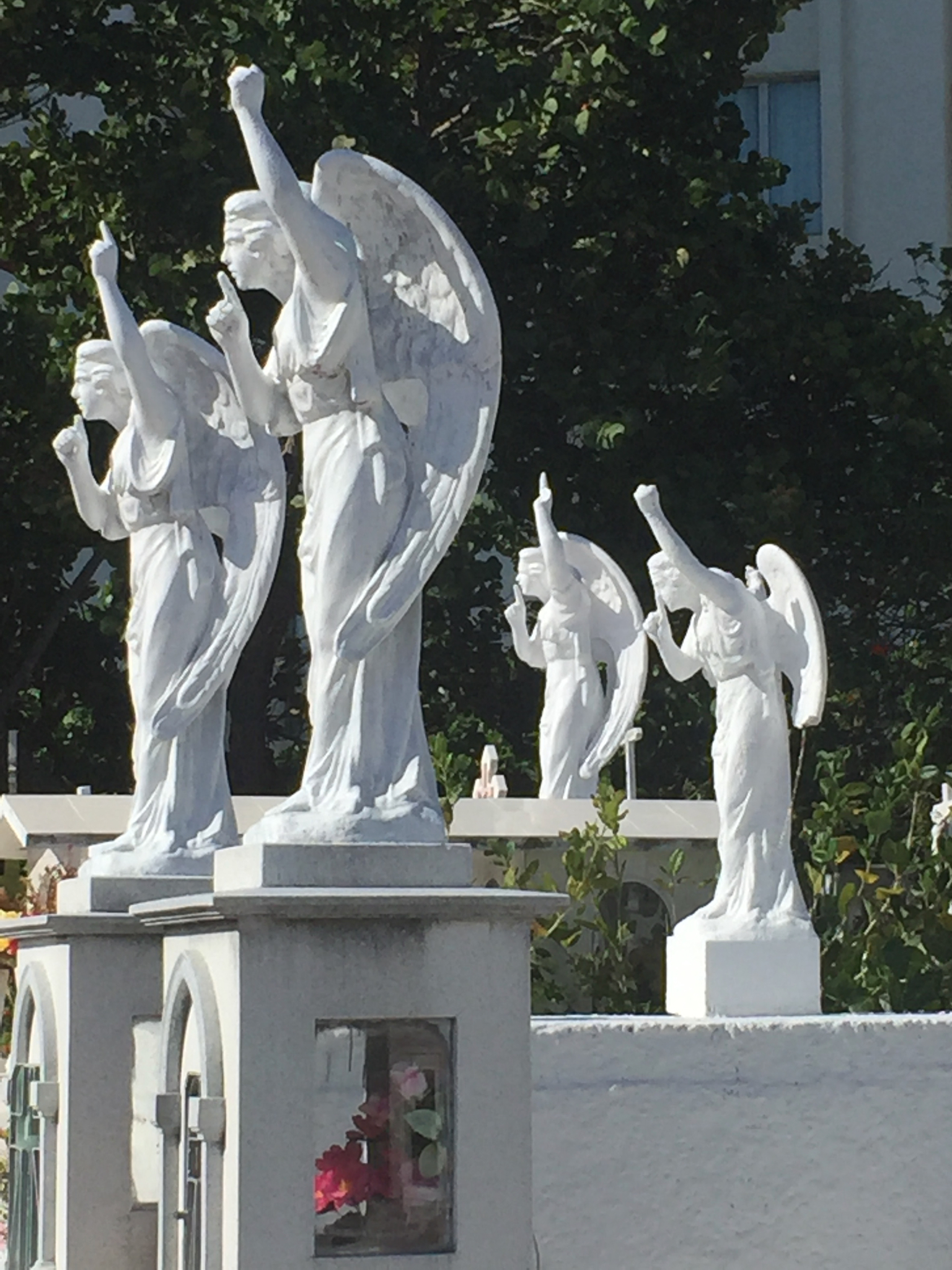
Most of the tombs in the Isla Mujeres graveyard were designed like little two-story houses. The top story was often enclosed by glass and protected with miniature wrought-iron grills like most Mexican houses. These enclosures were often locked with padlocks, though in some cases the closure was a simple wooden latch. Inside were offerings of liquor, plastic and real flowers, little Madonna statues and angels, candles, and other things. One fancy tomb had an entire bottle of sparkling wine. Many of the structures are electrified–I’d like to see it at night. The monuments come in all sorts of designs. While most looked like little houses, one looked like a Roman temple, and there were many other variations. No two were alike, although there were several identical angel statues, each holding an index finger to her lips, the other index finger pointed heavenwards. It had the effect of a bunch of very bossy librarians.

“How many times do we have to tell you to BE QUIET???”

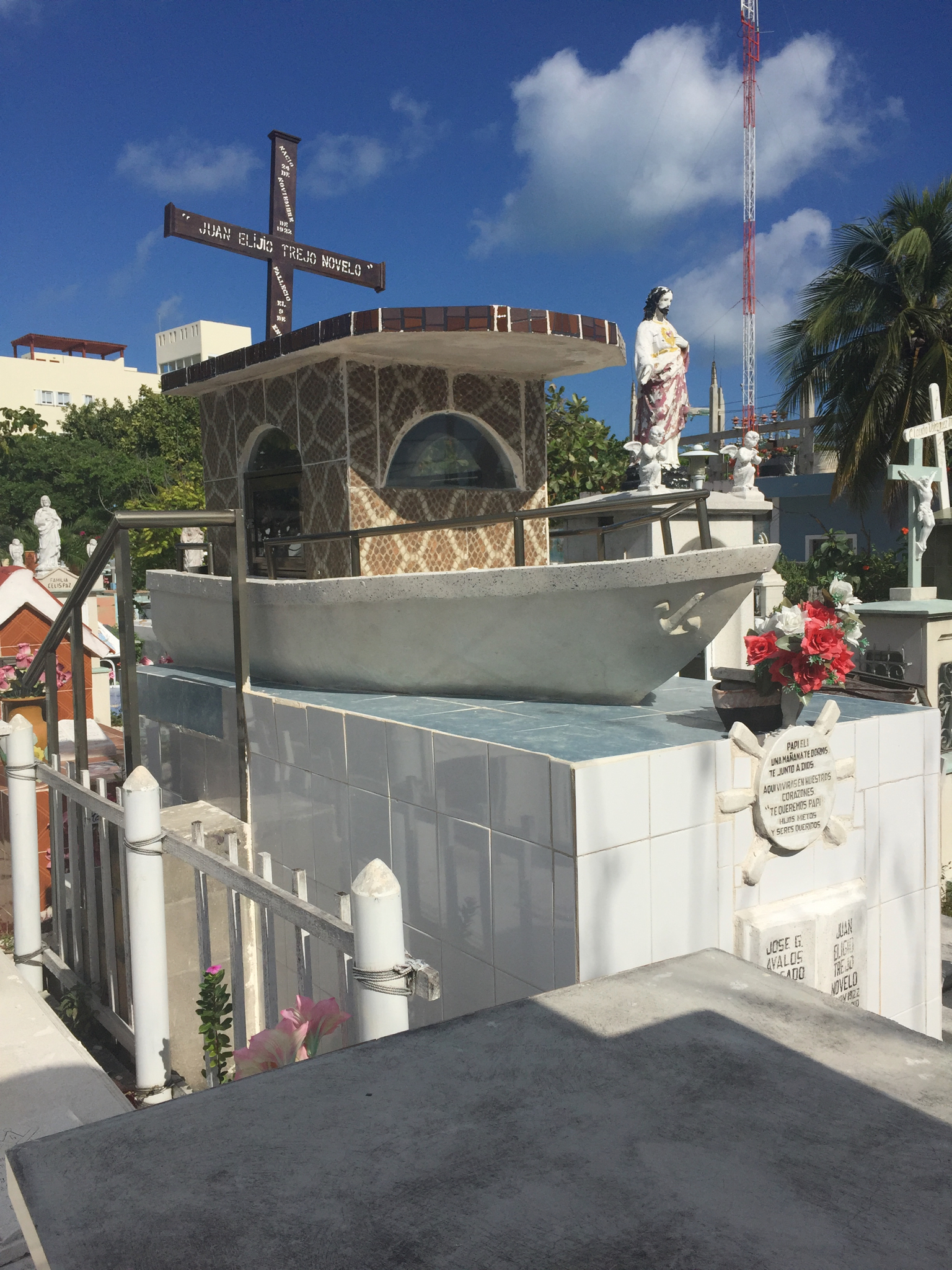
Some of the tombs were crudely fashioned, others were elaborate. One looked like a suburban house, complete with artificial turf lawn. Another was fashioned in the shape of a ship–several were dedicated to sea captains, which makes sense on an island. One of the captains’ tombs had a railing composed of concrete ship’s wheels and a model ship resting in a large glass case in front. I assume it was a model of the captain’s own ship, or perhaps something he created. One structure that was made to look like a cottage was painted white with twining roses painted around the door. Several were covered in ceramic or marble tiles. The larger and taller monuments had built-in steps along the side. At first I thought perhaps these were for the deceased’s spirit to reach the offerings, but I soon realized the steps were there to allow the living to reach the little offering houses and replace the contents.

This captain still sails his boat.

Sadly, hurricanes and time have damaged many of these momento morii. The sandy ground is littered with broken marble, glass tiles, shattered bottles and glasses, and so forth. But you can sense the care and love with which these tombs are created and­—as much as possible—maintained.

We did not find Juan Menaca’s gravestone. Disappointing, but even I finally gave up. We ran a few errands and had a nice lunch and did some shopping. We did finally discover the “fiesta artisanal,” and there were some very beautiful items, some different than in the surrounding sea of tiendas, but I didn’t buy anything.

Some tombs were modest, others elaborate, but each one was different.


This one had its own lawn and a fence around the yard.

The afternoons here tend to be sweltering, even though there is always a breeze. I thought it would’ve been a nice day to swim at Playa Norte, but we stayed in out of the heat instead. Toward sunset, I thought we should go to Punta Sur and watch the sun set. Traveling south in No. 8, I saw a dog enjoying the evening breeze. This would not have been unusual except that he was lying on top of the peaked roof of a portico that stretched out in front of a house. I still wish I had gotten a photo.

When we got to Punta Sur, the facilities were closed for a wedding, but we did sit out and watch the dramatic clouds as the sun set and the storm began to gather. Frigate birds, looking like a flock of pterodactyls, hung on the wind far above us, not fishing, not doing anything, as far as we could tell. Perhaps it is enough to be able to suspend oneself above the sea like a hang-glider, taking in the gold-edged clouds, the towers of Cancun, the little rocky island below, and the darkening waters.

Sunset from Punta Sur.

Save

Save

Mrs. Toad’s Wild Ride

The view from the Cuban restaurant on Isla Mujeres.

The view from the Cuban restaurant on Isla Mujeres.


By the time we woke up in the Marriott Courtyard at the Cancun Airport, Clod and Linda were winging their way home. We ate a leisurely breakfast, turned in the car and caught a cab to the Isla Mujeres ferry. The ferry terminal was a zoo. Being a Sunday, people were taking day trips to the island and people were lined up with kids and bags.

The island is visible from the mainland, separated by brilliant, brilliant turquoise water interspersed with purple and indigo where the water is deeper. It was a brief journey and when we landed at Isla Mujeres, it was a bit overwhelming. The ferry slip is right downtown, and the place was full of people, dogs, motorcycles, taxis, and many, many golf carts. You aren’t allowed to bring your car, and people get around in rented carts, mopeds or taxis–or on foot.

Cancun in the distance, across the blue, blue water.

Cancun in the distance, across the blue, blue water.

Every golf cart in the place was rented, so we took a taxi to our hotel, which was thankfully a good distance from the noisy central area. Chac Chi Suites is a small hotel, two stories built around a central area with a little pool. We have a nice kitchen area with table, which is kind of too bad, as they provide no utensils with which to cook an actual meal–not even a coffee maker. It’s a bit basic other than that, but the room is clean and there is an outside patio area overlooking a small street. We are across from a walled elementary school, and the next day, we could hear the kids at play. (A nice sound!)

Once we got settled, we headed down that street, around the corner, to Sergio’s, a Cuban restaurant, and had beer and the most wonderful guacamole, followed by yummy broiled shrimp cooked with lime and garlic. To get to the restaurant, you walk into what looks like someone’s yard, then just persevere through some non-restaurant-appearing areas until you emerge into a rickety, palm-thatched structure over the water. Sergio’s turned out to be a popular stop for boats, which just moored to the side and let the passengers off. But it didn’t seem touristy at all, the people were friendly and the food was cheap and delicious. And, other than walking to dinner at GreenVerde, that was our day.

The next day we walked a little further to Mango Cafe for an enormous and delicious breakfast. Our rented golf cart wouldn’t be ready for hours, so we hired a taxi to take us around the island to get our bearings. Isla is a long, skinny island, oriented north-south. There are several large lagoons, some fresh, some not, and these are occupied by crocodiles, but crocodile incidents appear to be vanishingly rare. Of course, you are advised not to swim in the lagoons.

First, we went to Punta Sur (South Point). At the extreme tip of the island, there is a tiny temple to Ixchel, the most important goddess in the Mayan pantheon. Ixchel, often portrayed with a water jar or a snake headdress, is the goddess of childbirth, medicine, rainbows, fertility, and possibly the moon. As with many other cultures, she is associated with a triad of goddesses, maiden, mother and crone, Ixchel being the crone and represented in ancient times as a fierce old woman with jaguar ears.
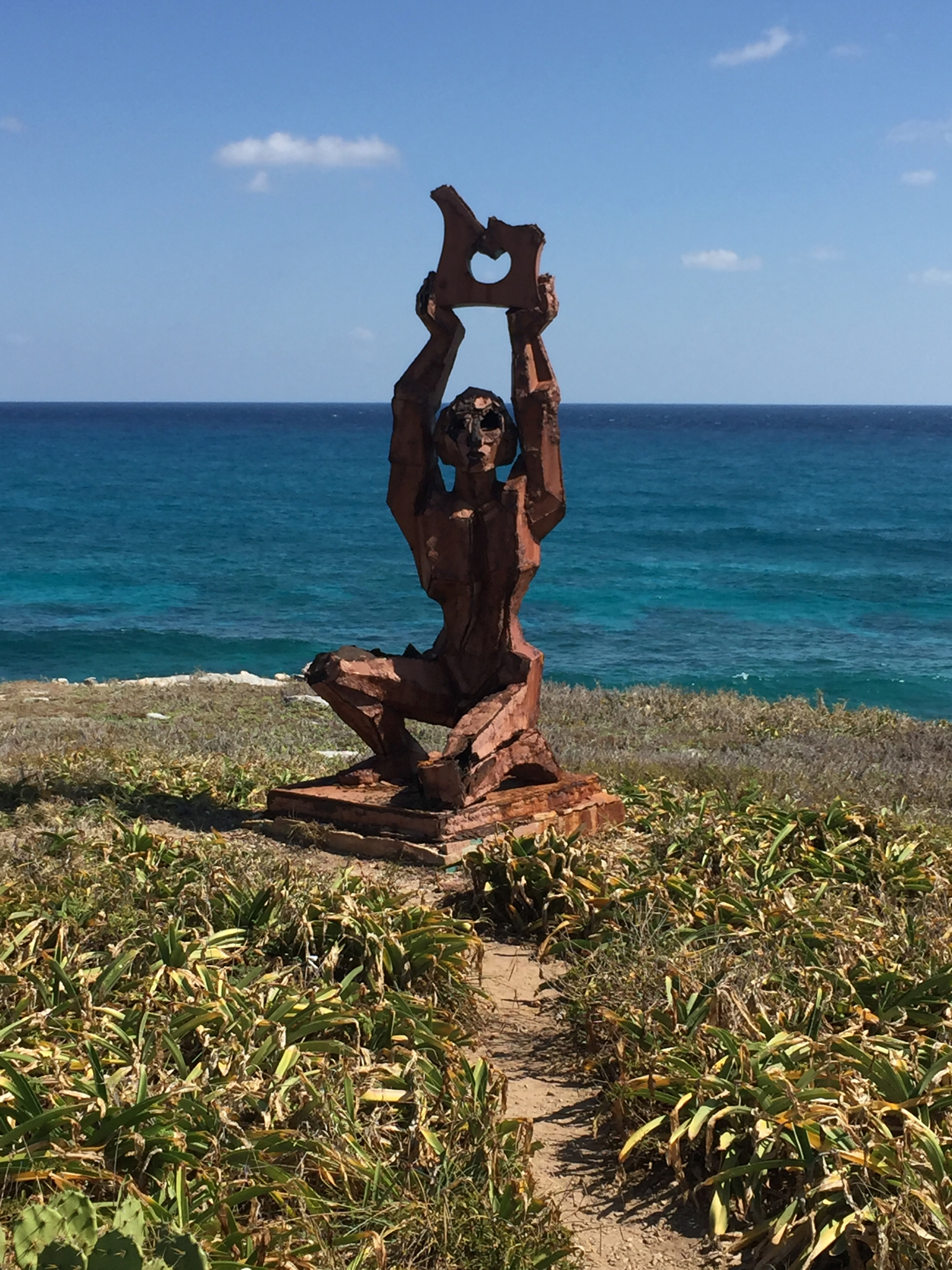
The path to the temple winds through a sculpture garden, with the ocean to either side.

The path to the temple winds through a sculpture garden, with the ocean to either side.

“During Lent of 1517 Francisco Hernandez de Cordova sailed from Cuba with three ships to procure slaves for the mines… (others say he sailed to discover new lands). He landed on the Isla de las Mujeres, to which he gave this name because the idols he found there, of the goddesses of the country, “Ixchel” and her daughters and daughter-in-law’s “Ixchebeliax”, “Ixhunie”, “Ixhunieta”, only vestured from the girdle down, and having the breast uncovered after the manner of the Indians. The building was of stone, such as to astonished them, and they found certain objects of gold which they took.”

—Excerpt from “Yucatan, Before and After the Conquest” written in 1566 by Friar Diego de Landa.

The temple is sadly battered by time and hurricanes. A century ago, it was more or less intact, but today it is a broken tooth at the end of a white path that winds through a sculpture garden. Walking down this path, the rough waters of the Caribbean dash against the rocky western shore of the island as the gentle waters of the sound rock against the east. Cancun is clearly visible on the distant shore.

On the left, the temple of Ixchel on Isla Mujeres today. On the right, what it looked like 100 years ago. Hurricanes have taken their toll over the past century.

On the left, the temple of Ixchel on Isla Mujeres today. On the right, what it looked like 100 years ago. Hurricanes have taken their toll over the past century.


The structure was used as a lighthouse. Its second floor had openings, and a fire was burned inside, allowing the light to shine out to sea. It is possible it was just a lighthouse after all, and the temple itself is at a different site.

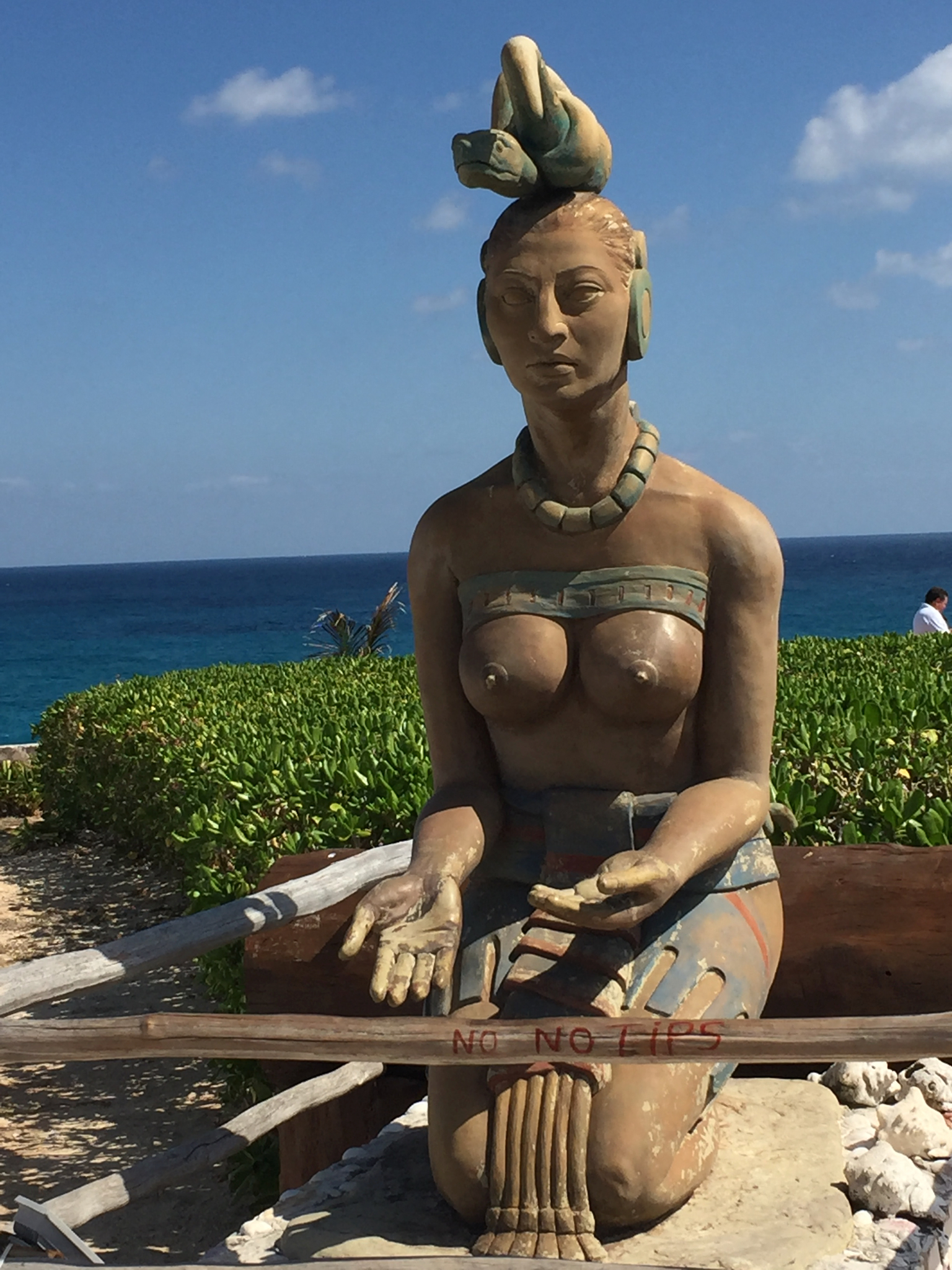
There are an abundance of iguanas sunning themselves around the rocks on the point. Several modern statues have been erected of Ixchel and an enormous green iguana near the restaurants close to the point. Ixchel is represented as a ripe young woman with a coiled snake on her head.
img_2755

A modern representation of Ixchel. In ancient time she was represented by a fierce old woman with jaguar ears. The odd hat is a snake, representing great power.

Next we drove to Hacienda Mundaca. Fermin Anonio Mundaca y Marecheaga was a slaver, and some say a pirate who made a fortune selling Mayan slaves to Cuba. He retired to Isla and built a—for the time—splendid two-story house surrounded by gardens. Much of this he did in hopes of winning the heart of a local maiden, Martiniana (Prisca) Gomez Pantoja, known as La Triguena (the brunette, which may not have distinguished her much, actually). She was a tall, green-eyed beauty, and Mundaca was hopelessly in love with her. He dedicated much of his house and grounds to her, hoping she would marry him, but she married a much younger man (Mundaca was about 35 years older than she). Heartbroken, he slid into madness and died. He carved his own gravestone, which can be seen in the graveyard at the north end, but as he died in Merida, he is not actually buried in the Isla Mujeres graveyard.

Stairs to the upper story of the Hacienda Mendaca. SO glad they don't make stairs like this today.

Stairs to the upper story of the Hacienda Mendaca. SO glad they don’t make stairs like this today.

The estate looks as though someone in the past tried to restore it a bit and add things like caged animals as attractions. The cages are now empty. The house is in ruins, but you can see the two downstairs rooms. Visiting the upstairs would be taking your life in your hands. The staircase from the ground floor to the second floor is more a ladder than a staircase, and I am sure the upper story is unsafe. There are a few photos with labels in Spanish in the downstairs area. Ruins of several outbuildings surround the house at a distance. If you follow a dirt path into the woods, you will come to an eerily deserted garden, surrounding a well at the center. The circular area around the well is delineated with stone and concrete low walls, creating four pie-wedges of masonry. Each pie-wedge has areas for plantings and a seat where one can contemplate the beauty of the vanished garden. Mendaca carved some of the stones, calling himself a ship’s captain and a pilot, not a slaver or a pirate. A few plants struggle on, notably a bougainvillea blooming its meager little heart out. It is a deserted, peaceful and very melancholy place, especially considering it’s creator’s sad story. The incurious would never find this garden, as it is well concealed by the woods.

The well at the center of the forgotten garden.
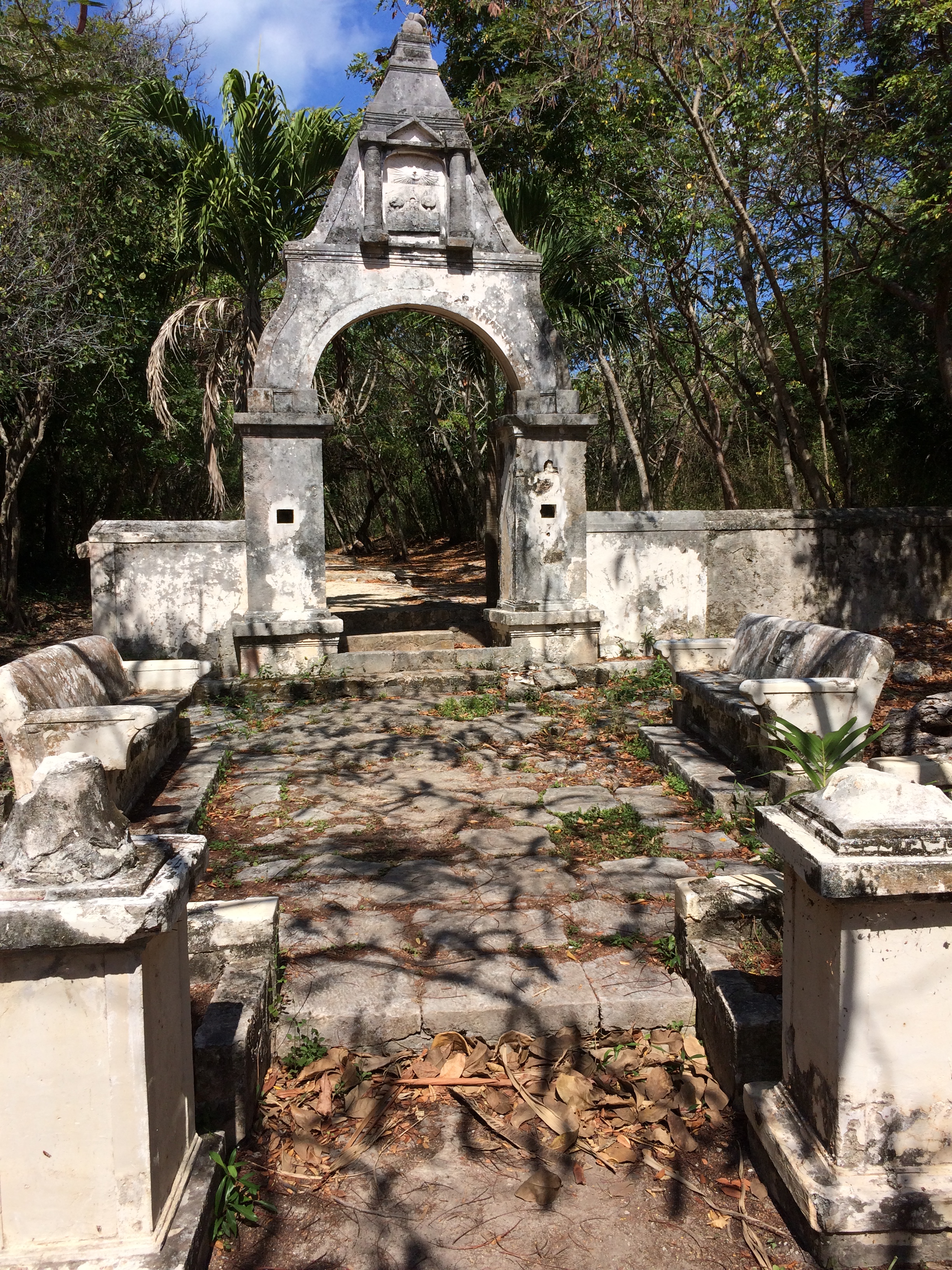
The well at the center of the forgotten garden.

The forgotten garden at Hacienda Mendaca.

The forgotten garden at Hacienda Mendaca.


Closer to the house, but a safe distance from it, is a large pond with rushes and water lilies growing in it. It also has a resident crocodile or two, but we didn’t see any. Unlike the rest of the estate, however, the stone wall around the pond looks in very good repair.

Then we embarked on a wild goose chase. A poster in the hotel office advertised an artisan craft fair on the esplanade. I wanted to see it and asked the driver, Francisco, to take us there. He obligingly took us to some shop at the north of the island, but that was obviously not the fair, so we drove back to the hotel, and I asked Francisco to go in and look at it. He then took us to the site in question, where there was no craft fair in sight. Well, no worries. On to Playa Norte, the top-rated beach on the island, for a cold beer and a gander. We weren’t going in the water, but it looked very inviting. It’s shallow, with a white sand bottom out quite far. The water is that heart-melting turquoise, and the sand is as soft and fine as sugar. By this time, we had driven all around the island, and felt well oriented.

We went back to the hotel and found that our golf cart was ready. Tom went to pick it up. Later that night we decided to go to a recommended restaurant called Villa Rolandi. We got into the golf cart, and thus commenced Mrs. Toad’s wild ride. I’ve never been in a golf cart before, and I felt like a turtle without its shell as we putt-putted down the busy main road in the dark, overtaken by taxis, mopeds, and other golf carts. Mexico has some of the most ferocious speed bumps I’ve ever seen, which is OK in a car, but the golf cart had absolutely no suspension, so each one was a bone-rattler. I heard my neck crack more than once as we jolted over these things, and I expected to be thrown out at any moment.

Mrs. Toad.

Mrs. Toad.

We finally arrived at Villa Rolandi, and I immediately felt grubby, underdressed and generally outclassed. We’ve been eating in pretty unpretentious places, with the exception of Hacienda Uxmal (but the quality of the food was the worst there of any place we ate). Villa Rolandi is a grand hotel with all the fixings. Nonetheless, we were ushered into the restaurant without a second glance and seated where we could hear the waves (though being night, we couldn’t see them), with an expansive view of the lights of Cancun shining across the dark sound.

The food was incredibly good. They brought us an interesting crispy flat bread with olives to start, then we had calamari and zucchini deep-fried to perfection. I ordered grilled octopus (pulpo), figuring I could not go wrong, and was not disappointed. Tom had a lovely filet mignon. I couldn’t finish the poor octopus, and followed insult to injury by having chocolate ice cream that I also couldn’t finish. We had a yummy Mexican Cabernet Sauvignon with our meal.

We got into a pleasant conversation with the couple next to us, as Tom recognized them from the hotel at Calakmul. They were from England, near Manchester. The man had at one time decided to visit every Mayan ruin in existence, and apparently had a good stab at it before giving up, but he still likes to visit the ones he missed earlier. I asked him why he wanted to do this, and the answer was because he wanted to, which is certainly a good enough reason. They were both retired educators. I explained what we were doing here, and they were kind enough to ask about “The Obsidian Mirror” and where to buy it.

On the way back, I rode in the back seat of our chariot–which also had a wobbly wheel. The speed bumps were just as vicious but somehow I felt marginally safer because there were support rails to cling to. I was awake for a long time after we finally went to bed at 11:45, and woke up many times during the night. I blame the chocolate ice cream and its theobromine. Sometimes, too much knowledge is a dangerous thing.

Because you can't have too many iguanas.

Because you can’t have too many iguanas.

Save

Save

Save

Save

Save

Day 2: Land of Sky-Blue Waters

Me and some friends at Tulum

Me and some friends at Tulum


Before leaving Tulum, we returned to the open-air market at the ruins because I wanted to get the little embroidered dresses for our granddaughters. I bought the dresses, paying too much for them, probably, and joined Tom, Clod and Linda at Starbucks. Los Volantes were at it again, and this time I got a good video.

Also present were some men dressed as Mayan warriors. Their costumes were as authentic as humanely possible, using genuine jaguar skins and quetzal feathers. The clothes were very detailed, carefully crafted and must have cost a fortune. They painted their faces and bodies exactly as you can see in the ancient murals. One of the men had an enormous albino python, which looks more yellow than white. I knew they were there for tourists to get their pictures taken posing with them, so I grabbed some cash and asked to pose with the snake. They kept telling me the snake wouldn’t bite, but I was perfectly certain that it wouldn’t bite because snake-bitten tourists don’t pay. I enjoyed the photo session and the heavy, muscular, dry and scaly presence of my cooperative co-model.
After a much-appreciated latte, we piled in the car and set out for Laguna Bacalar, heading south. We were traveling through jungle, but at first it was rather low, if extremely dense. As we made our way south, the vegetation gradually got taller. By the time we reached the lake, it was no rain forest, but definitely more along the lines of my mental image of jungle. We only stopped once, to buy some bananas at a roadside stand. We passed a village where there were probably 20 stands selling pineapple, but pineapple seemed too daunting and complicated for people without a knife or a kitchen. The bananas, each not much larger than a healthy banana slug, were consumed in about two bites. They were slightly tart, which gave them an apple-like flavor that was much more tasty than the huge, bland cultivar we get in grocery stores.

We noticed throughout our travels that when you hit speed bumps (topes), you will almost inevitably find someone selling something–usually snacks and drinks, but sometimes other things. Slowing down gives you a chance to realize you’re thirsty or hungry, I guess.

Laguna Bacalar is a freshwater lake more than 60 kilometers long, very narrow, with a white sand bottom. The water is known for its seven colors of blue. There’s not much to do here except swim and kayak, but we are staying only one night. There’s an island bird sanctuary, but you have to kayak out, and Tom has sworn off kayaking after overturning in Moss Landing harbor and losing his prescription glasses. In any case, you can’t land on the island because you will sink six feet into something that looks like sand–but isn’t. In other words—don’t try to get onto the island or you will die. On the plus side, there are no crocodiles in the lake, making it a safe swimming place. There just aren’t enough fish in the lake for crocodiles to bother with it.

Laguna Bacalar

Laguna Bacalar

We had an excellent lunch at a lakeside restaurant and lingered far too long, enjoying the cool breeze from the lake. The place was jumping, but no one tried to get us to move along. There was a dock in front of the restaurant, stretching out into the cool, blue  waters. Instead of running around the restaurant, kids were jumping into the lake. The best play area ever.

We walked back to the hotel, Azule36. I don’t know for sure, but it may be named for a nearby cenote called Cenote Azul, which is a popular swimming place. It’s a cute, tiny boutique hotel on a lot only slightly larger than a house. The neighborhood is a higgeldy-piggeldy mix of houses, a church, hotels and stores. There are only six rooms. Roosters crowed from the house next door, and as we sat under a palapa playing cards, dogs, cats and people wandered through the yard, entering from a back gate. I wondered if it was a family-run business, with the family living behind the hotel. The rooms are spare but clean and comfortable. Unlike the first place we stayed, there is soap! The beds were comfortable—actually mattresses laid on concrete platforms. I thought in a country where scorpions and snakes abound, not having a cavernous under-the-bed space is probably sensible.

Our hotel at Laguna Bacalar

Our hotel at Laguna Bacalar

We skipped dinner and went to bed at a reasonable hour. I had trouble falling asleep because I’m not used to a lot of noise at night. What with roosters crowing, doves cooing, people talking, multiple dogs barking, and traffic, it was a while before things calmed down and I slept. I’m writing this at some ungodly hour of the morning because the whole chorus started up again around 4:00 am.

Warning: This Post Contains Shameless Self-Promotion

New Cover

Recently I finished editing the first draft of “Fire in the Ocean,” the sequel to “The Obsidian Mirror.” I sent it off to my alpha readers and editor, and I can finally relax and think about something else for a while.

Such as promoting “The Obsidian Mirror.” While I was in the throes of writing the sequel, I did next to nothing about promoting my published work. A writer’s work is never done, I guess.

Why should you read “The Obsidian Mirror”? Short answer: because it’s a fun read. I read largely for entertainment. I like books that take you away and let you live someone else’s life for a while. I wrote “Obsidian” to be that kind of book: a diversion, a book I would love reading myself. It’s probably not a coincidence that the second publisher of the book is Diversion Books—they specialize in just that kind of novel.

Another reason to read “Obsidian” is because it is based on the mythologies and folklore of the Americas, which makes it a bit different. The idea occurred to me after finishing one of Robert Jordan’s “Wheel of Time” novels. I loved the book, but started wondering why so much fantasy is based on proto-European, pre-Industrial Age tropes such as elves, faeries, dragons, and caped adventurers. The Americas have thousands of mythologies, folk tales and traditions that are largely ignored by fantasy writers.

I began writing “The Obsidian Mirror” as a kind of personal experiment. Meso-American gods and Coyote the Trickster, an Inuit ice demon and a mannegishi named Fred are some of the characters. What I did not anticipate is that I would fall in love with my characters and be driven to finish the book. Having done that, I felt compelled to get it published.

I don’t have much to brag about. I’m not a best-selling author. I have won no prestigious awards for my fiction writing. But I do have one thing that gives me modest bragging rights.

I have heard authors talk about receiving hundreds of rejection slips. One writer said he had a drawer filled with 450 rejection slips for his novel. That didn’t happen with “The Obsidian Mirror.” I approached perhaps 10 publishers and/or agents before AEC Stellar agreed to publish the book. When AEC Stellar bit the dust, I approached about five publishers before Diversion Books picked it up, re-published it and agreed to publish the sequel.

So I may not have sold a million copies, but I never had any problem finding a publisher. As a matter of fact, years after I originally submitted the manuscript to their slush pile, Baen Books got back to me and said they were interested in it. The early bird gets the book, Baen.

So why am I proud of this? Because I have some independent assessments that people will enjoy reading my novel. Add to that, the several four- and five-star reviews on Amazon, and you might conclude that you would enjoy it, too. To make it super-easy for you to find the book, here it is: http://amzn.to/1MQBvkd

I did warn you.