Day 2: Land of Sky-Blue Waters

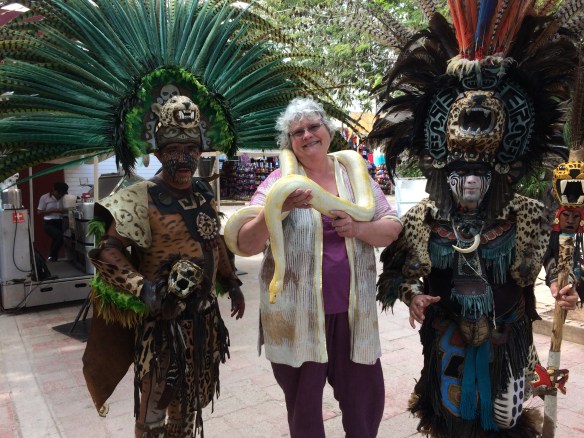
Me and some friends at Tulum

Me and some friends at Tulum


Before leaving Tulum, we returned to the open-air market at the ruins because I wanted to get the little embroidered dresses for our granddaughters. I bought the dresses, paying too much for them, probably, and joined Tom, Clod and Linda at Starbucks. Los Volantes were at it again, and this time I got a good video.

Also present were some men dressed as Mayan warriors. Their costumes were as authentic as humanely possible, using genuine jaguar skins and quetzal feathers. The clothes were very detailed, carefully crafted and must have cost a fortune. They painted their faces and bodies exactly as you can see in the ancient murals. One of the men had an enormous albino python, which looks more yellow than white. I knew they were there for tourists to get their pictures taken posing with them, so I grabbed some cash and asked to pose with the snake. They kept telling me the snake wouldn’t bite, but I was perfectly certain that it wouldn’t bite because snake-bitten tourists don’t pay. I enjoyed the photo session and the heavy, muscular, dry and scaly presence of my cooperative co-model.

After a much-appreciated latte, we piled in the car and set out for Laguna Bacalar, heading south. We were traveling through jungle, but at first it was rather low, if extremely dense. As we made our way south, the vegetation gradually got taller. By the time we reached the lake, it was no rain forest, but definitely more along the lines of my mental image of jungle. We only stopped once, to buy some bananas at a roadside stand. We passed a village where there were probably 20 stands selling pineapple, but pineapple seemed too daunting and complicated for people without a knife or a kitchen. The bananas, each not much larger than a healthy banana slug, were consumed in about two bites. They were slightly tart, which gave them an apple-like flavor that was much more tasty than the huge, bland cultivar we get in grocery stores.

We noticed throughout our travels that when you hit speed bumps (topes), you will almost inevitably find someone selling something–usually snacks and drinks, but sometimes other things. Slowing down gives you a chance to realize you’re thirsty or hungry, I guess.

Laguna Bacalar is a freshwater lake more than 60 kilometers long, very narrow, with a white sand bottom. The water is known for its seven colors of blue. There’s not much to do here except swim and kayak, but we are staying only one night. There’s an island bird sanctuary, but you have to kayak out, and Tom has sworn off kayaking after overturning in Moss Landing harbor and losing his prescription glasses. In any case, you can’t land on the island because you will sink six feet into something that looks like sand–but isn’t. In other words—don’t try to get onto the island or you will die. On the plus side, there are no crocodiles in the lake, making it a safe swimming place. There just aren’t enough fish in the lake for crocodiles to bother with it.

Laguna Bacalar

Laguna Bacalar

We had an excellent lunch at a lakeside restaurant and lingered far too long, enjoying the cool breeze from the lake. The place was jumping, but no one tried to get us to move along. There was a dock in front of the restaurant, stretching out into the cool, blue  waters. Instead of running around the restaurant, kids were jumping into the lake. The best play area ever.

We walked back to the hotel, Azule36. I don’t know for sure, but it may be named for a nearby cenote called Cenote Azul, which is a popular swimming place. It’s a cute, tiny boutique hotel on a lot only slightly larger than a house. The neighborhood is a higgeldy-piggeldy mix of houses, a church, hotels and stores. There are only six rooms. Roosters crowed from the house next door, and as we sat under a palapa playing cards, dogs, cats and people wandered through the yard, entering from a back gate. I wondered if it was a family-run business, with the family living behind the hotel. The rooms are spare but clean and comfortable. Unlike the first place we stayed, there is soap! The beds were comfortable—actually mattresses laid on concrete platforms. I thought in a country where scorpions and snakes abound, not having a cavernous under-the-bed space is probably sensible.

Our hotel at Laguna Bacalar

Our hotel at Laguna Bacalar

We skipped dinner and went to bed at a reasonable hour. I had trouble falling asleep because I’m not used to a lot of noise at night. What with roosters crowing, doves cooing, people talking, multiple dogs barking, and traffic, it was a while before things calmed down and I slept. I’m writing this at some ungodly hour of the morning because the whole chorus started up again around 4:00 am.

Yucatan: Day of the Iguanas

Mr. and Mrs. Iguana

Mr. and Mrs. Iguana

In the remote eventuality that anyone was disappointed that I haven’t been blogging about my research trip to the Yucatán Peninsula, I apologize. We were often in areas where the Internet service couldn’t handle large files, and I wanted to be able to post photos and videos, so I decided to wait.

Why Yucatán, you may ask? Well, for reasons I can’t reveal, the third book in the series that began with “The Obsidian Mirror” has to take place in Yucatán. The second book, “Fire in the Ocean,” will be out later this year from Diversion Books, and all will be explained. Well, some of it, anyway.

Day 1: Tulum

We made our way to Tulum on the Mayan Riviera without much problem. Our rental condo is located in a large tract of land not too far from the beach, called Aldea Zama. Aledea means village in Spanish and Zama is the Quiché (Mayan) word for dawn. It is also the original name for the Mayan city in the area, which is why we are here.

We ate dinner in a very good Argentinian restaurant, came back to the condo and fell into bed.

The next morning, we woke late, as it is East Coast time here, we’re from the West Coast, and we were tired. Breakfast, continuing the international theme, was crepes. We asked the waiter how far it was to walk to the ruins. He told us to walk straight down the road we were on for about four kilometers. So off we went. And continued for a long way, walking in the late morning heat and sunshine. We didn’t have a lot of water with us, and I didn’t realize it, but I was becoming dehydrated.

About three miles or so down the road there was an entrance to the beach and my husband Tom headed off across the sand, intending to walk the rest of the way on the beach. By this time, my enthusiasm had flagged, although I did appreciate the white sand, fine as sugar, and the brilliant turquoise and indigo of the ocean. Linda asked a woman how far it was, and we learned to our surprise that not only had we been directed down the wrong road, we were many miles from our destination because there was no access to the ruins from the road we were on or the beach.

We flagged down one of the passing taxis which took us to the ruins, all of us thankful we hadn’t tried to walk it. The entrance to the ruins is reached on foot or by a little tram pulled by an old tractor, and to my relief we took the tram. Before we embarked for the ruins, we saw a performance by a team of voladores. Four men climbed to the top of a 40-foot pole, playing instruments and dressed in colorful costumes. Once they reached the platform at the top of the pole, they wound ropes around the pole. Then a fifth man climbed the pole and seated himself, playing the flute as the other four men looped ropes around their legs, turned upside down, and spiraled down the pole as the ropes unwound from the pole. Wikipedia says this is a very old tradition, starting with the ancient Maya. It has deep cultural significance, and to prevent the tradition from dying out, Mexico started a school to teach children how to become voladores (females need not apply).

There is a large outdoor market around the ruins, but we went straight on without looking at the amazing array of goods, ranging from Los Luchos masks to delicately woven hammocks that looked like lace.

When we got to the ticket line, I wasn’t feeling too well, so I sat down on a bench near the front of the line. Along came a coatimundi–a relative of the raccoon that looks sort of lemur-like. She plopped herself down right among the tourists’ feet, rolled over and proceeded to give herself a bath, licking delicately at armpits and tummy. A man standing right next to her leaned down and tried to pet her. Tourists feed coatis all the time at Tulum, so assuming the man had food, the coati lunged at his fingers. Startled, the man jerked back and dropped his bottle of beer, which smashed on the stone flooring. The coati promptly began licking up the beer as the man cleaned up the glass. When last seen, the coati was cuddling in a woman’s skirt and continuing her bath, drunk and happy.

By this time, I was beginning to wonder what was wrong with me. I felt utterly drained and frankly not very interested in touring the ruins. This is completely out of character for me, as I am interested in ancient Mayan culture and had come all the way from California just to see them. But I had no energy and was beginning to feel odd; I was getting chills despite the heat and felt slightly nauseous. I rested for a while in the shade, but the water was gone. There was no place to buy water inside the ruins. I dragged myself around the ruins anyway. I probably took more photos of the iguanas at the park than the ruins. Often, they lay sunning themselves in pairs like tiny prehistoric monsters; Mr.and Mrs. Iguana taking a sunbath. There were black iguanas, green iguanas, gray iguanas, and youngsters with stripes streaking around while the adults sunned. I finally found a place to sit and look at the ocean–narrowly missing stepping on an iguana–and stayed there until the rest of the party found me. Then all I wanted to do was leave. On the walk back to the tram I developed an aura, like the kind you get when a migraine is starting. My hips hurt in a way I have never experienced before, and I felt generally horrible.

There has to be an iguana in this photo somewhere.

There has to be an iguana in this photo somewhere.

Tom got me a huge bottle of water, and after drinking a good bit of it, the aura went away. When we got to the open-air market, Linda saw a Starbucks and wanted iced tea. I noticed a vendor with adorably embroidered children’s dresses. He wanted $25 each. I wanted to get out of there and was not interested in bargaining, so I said no thanks and walked away. By the time I got out of earshot, he was down to $5 each, but I just didn’t care. This is also totally weird for me, because I adore haggling.

We took a taxi back to the condo. By the time we got back, I felt a great deal better, had a cold shower and took a nap. Lesson learned: take lots of water!

Despite getting dehydrated, I enjoyed the day. I’m looking forward to the rest of the trip, and will be much more cautious about staying hydrated.


.

Save

Save

Cultural Appropriation Is Not a Thing

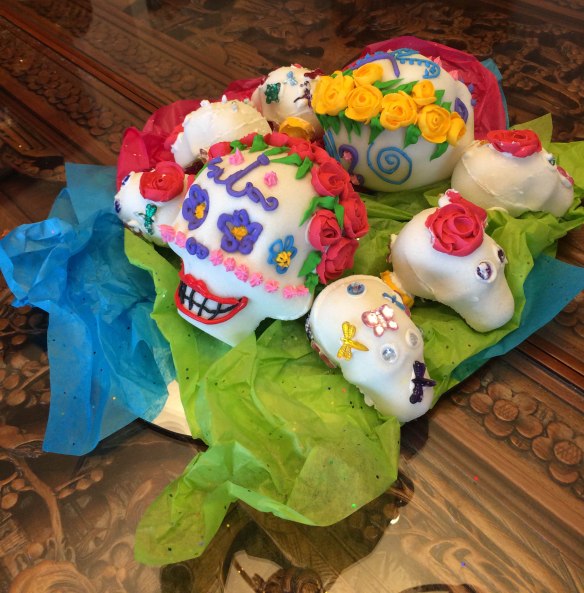
sugar-skulls2

I have long been fascinated with other cultures, open to other traditions, and drawn to the beauty of other cultures’ art and expression. It seems to me that learning about other cultures is our best hope for creating a society that is open, tolerant, and inclusive.

Then I began hearing about “cultural appropriation.” Apparently adopting or adapting from cultures other than the culture one is born into is a huge bad thing because it demeans and commercializes the other cultures in question.

Whoa. All this time, I have been tolerating green beer, drunkenness, cries of “Kiss Me, I’m Irish,” green plastic leprechaun hats, and corned beef and cabbage on St. Patrick’s Day, and I wasn’t even mildly offended. (You can travel the length and breadth of Ireland and never see corned beef and cabbage on any menu. Or on anyone’s home table, either. It’s actually something the Irish immigrants culturally appropriated from the Jewish immigrants in America. For the record, the Jews have not complained about this.)

But there’s more. How many movies, books, comics, etc. have you seen with fairies, pookah, banshees, elves, will ‘o the wisps and other culturally Irish (or Celtic) themes? A whole bunch, I bet. Do you hear Irish-American people complaining about it?

No, you do not. That’s because it doesn’t damage Irish culture for people to paint their faces green and get drunk on St. Patrick’s Day. We may laugh at the gaucherie, but that’s all.

The argument that one culture can “steal” culture from another and thereby damage it is absurd. It’s equivalent to straight conservative people claiming that gay marriage threatens the sanctity of marriage. Yeah—every one of Newt Gingrich’s three marriages was sanctified.

I recently made sugar skulls with my seven-year-old granddaughter, Lilah. Lilah is Hispanic through her father, and I thought making sugar skulls would be a wonderful way to help her celebrate her heritage. In addition to making the skulls, I told her about the Mexican tradition of Dia de los Muertos, why they make the skulls, and the lovely tradition of picnicking in the graveyard to visit with the beloved dead and share with them the events of the past year. We posted pictures of our beautiful sugar skulls on Facebook to share our handiwork.

sugar-skulls1

I was immediately accused of cultural appropriation, with a link to an article on how us gringos/gabachos are ruining the sugar skull tradition.

Well, first of all, I don’t like being called a gringa or gabacha. It was just rude, and not a very persuasive way to get white people to read the article. While I thought the article was well written and made some good points about bad behavior on the part of some white people, I still think cultural appropriation isn’t possible, like dry water.

Second, I believe that the more people know and appreciate about each other’s cultures, the better off we will all be. Discouraging friendly interest and participation on the part of “others” is just driving the wedge deeper between us all.

And above all there is art. Artists have been influenced by other cultures for thousands of years, and the synergy between cultural traditions has resulted in work of genius and beauty. What if Picasso had not been allowed to use the rhythmically angular and abstract themes of African art in his painting? Jazz and rock and roll synergize African and European ideas of music into fantastically creative new forms. And what if no one but the English were allowed to use the cadences and flowing language of Shakespeare, who has influenced every body of literature in the world? The Art Deco movement would not have existed without the early 20th century fascination with the stylized art of ancient Egypt. This is cultural synergy, not cultural appropriation, and we would all be the poorer if it didn’t go on every day of every year. Fortunately, you can’t stifle artists for very long.

I am not, of course, condoning disrespectful and boorish behavior like dressing up in a Native American headdress, making whooping noises, calling everyone “Chief,” and saying “How.” That’s ignorance and bad manners. But it is not cultural appropriation, because Native American culture has never been harmed by this. The person who is harmed is the jackass doing it.

The bushman in Africa is your brother. The Ainu woman in northern Japan is your sister. Each of us is genetically almost identical to every other human being on earth. We have everything to gain by sharing our traditions and cultures. We have everything to lose by erecting still more barriers between people.

By the way, on St Patrick’s Day, please help yourself to the green beer and shamrock cookies. I’m good with it.

Save

Frank Meets Dad: A Lie in 793 Words

Foreword

I wrote the following short-short story some time in the 90’s. I was managing a high tech public relations firm. Being a bunch of creative types, we had a writer’s club we called “The Jackhammer Society.” Once a week or so, we’d meet at lunch and share our fiction or poetry. (It was fun while it lasted–right, Laura Wigod?) I was going through some old files on my computer and re-read “Frank Meets Dad,” and found myself chuckling at it, so here it is. BTW, the story is a complete lie except that my father did once run for office, was defeated, and thus spared the world his career in politics.wildebeest-fight

Frank Meets Dad

Well, Frank threw the first punch, though it was my Dad who ended up in jail, not Sinatra.

Dad had his doubts about meeting Sinatra in the first place. This was in the late Sixties and Dad was running for political office in California. He wanted to be governor someday, and was trying to work his way up the political ranks. Dad got this invitation in the mail one day: “Mr. Frank Sinatra requests the pleasure of your attendance at a fund-raising dinner for the Republican National Committee.”

“I always liked the man’s voice. He’s a talented singer. But he’s a punk,” growled Dad, brooding over a second martini. “He’s got no business in politics. And he hangs around with the Mafia.” Dad went on for several more chapters about Mr. Sinatra’s flawed character, including injured photographers, discarded mistresses and his daughter’s singing career, which Dad thought was an example of the worst sort of nepotism.

“And he drinks too much,” Dad declared over his third or fourth martini.

But in the end, he went. He said it was because there would be important political connections at the party, but I think he went to meet Sinatra.

The party was held in Las Vegas, at The Sands. (“It would be,” said Dad. “The whole place is run by mafiosos.”) The cost was $1000 a plate, so Mom didn’t go. Dad was introduced to Sinatra after dinner as “a promising Republican candidate for the California State Legislature.” Sinatra was smoking a cigar, which he could do because it didn’t involve inhaling the smoke into his golden vocal chords. Dad had quit smoking cigarettes, and was therefore smoking a wicked little black cigarillo. Dad and Sinatra eyed each other through a blue curtain of smoke.

“Glad to meet you, Mr. Sinatra,” said Dad, extending his large, fine-boned hand. Sinatra smiled his cold smile and shook hands.

“Have a seat, Jack,” Sinatra said, waving towards a chair.

My father looked around and sat down. There were several large, dark-suited bouncer-types nearby, he noted with satisfaction. Probably Sinatra’s Mafia bodyguards.

“What’ll’ya have?” Sinatra said, snapping his fingers at the attentive waiter behind him.

“Vodka martini, twist of lemon, easy on the vermouth,” Dad said, never looking at the waiter.

“Whiskey, The Glenlivet, neat,” said Sinatra, keeping his eyes on Dad.

The Mafia-types moved in a little, so Dad stretched his considerable length out to show how relaxed he was.

Sinatra began a conversation about the state of the GOP in California, and asked what Dad was going to do about it if he won his Legislature seat in the next election. Dad started in talking about the issues –– by now he had it all down pretty smoothly. He got Sinatra interested, and soon they were arguing amiably about public education.

The topic soon changed from politics to guns and from guns to women. By the time they were both on their third shared round of drinks, they seemed like old friends. Dad was in the middle of trying to explain the fascinations of marlin fishing to Frank, when Sinatra pulled a cigar from the breast pocket of his silk suit and offered it to him.

“Don’t tell anybody. It’s Cuban,” Sinatra said, pantomiming someone looking around for government bugs.

Dad froze. “There’s no way you could get Cuban cigars without connections into Havana,” he said, and the ambient temperature dropped 100 degrees. He stood up, all six feet and five inches of him and towered over Sinatra.

“Anyone who traffics with an enemy of the government of the United States is an enemy of mine,” he declared, glaring down at Sinatra’s darkening face breathing single-malt whiskey fumes up at him.

Before the Mafia-types could move, Sinatra bounced up.

“Bastard!” he screamed. Although he was eight inches shorter, Sinatra threw a punch and connected with my father’s thin midriff. As Dad folded, the Mafia-types closed in and hustled him out of the room, where he was collected by the Las Vegas Sheriff’s Department.

They let him go the next morning. As a cop handed Dad his keys and wallet, he said, “Mr. Sinatra has generously decided not to press charges. Sir. I wouldn’t push it, if I was you. Sir.”

Dad was pretty peeved, but he wasn’t stupid. He let it drop (though we heard about it at home for the rest of his life). He ran for the Legislature and lost, and decided to quit politics. He said the system was broken. So that was that.

Oh, yes. After he lost the election, Dad took his collection of Sinatra LP’s out to the skeet range and systematically used them all for target practice. It wasn’t fair, but he shot all the Dean Martin LP’s too.


The Home of My Heart

This is me, aged maybe 12, dressed up in old-timey clothes in the front hall of 16 Campbell. I can't remember why.

This is me, aged maybe 12, dressed up in old-timey clothes in the front hall of 16 Campbell. I can’t remember why.

My daughter went online a few weeks ago to look up the house I grew up in, a house she remembers with affection. It had been sold, and there were about 20 recent photographs of the house on one of the realty sites.

I scrolled slowly through the photos online, remembering, and I suddenly realized that I loved that house—still, after many decades of living in other houses—as though it were a human being. I hadn’t realized you could love a house with such warmth and tenderness, but this was no ordinary house. I’m going to call it 16 Campbell from now on because she deserves a name, and because that is how we all refer to her. Yes, I realize I am anthropomorphizing wildly here, and I am probably also being sappily sentimental. So be it.

I remember moving into 16 Campbell at the age of four and a half. It had been built by an architect renowned in my small Southern California hometown during its Victorian heyday as a resort for East Coast families seeking relief from icy winters. My parents bought it on the G.I. Bill from an elderly widow who was running it as a boarding house for other elderly widows. It was a white, Dutch Colonial-style house, shingle-sided, two-storied, crumbling gently atop a hill like a dowager duchess who has fallen on hard times.

Few, if any improvements had been made to the house since her debutante days. Because she had been intended as a vacation home, the floors were made of pine planks instead of hardwood, and us kids, running around barefoot all day, got many a splinter in our feet. My parents eventually got hardwood installed downstairs, but upstairs it was still wear shoes or expect tears. Plaster was crumbling, there were wasps in the attic, the curtains were tattered, and the kitchen was resolutely inconvenient.

Not that we kids cared. We soon came to know every inch of that house. It sat over a rarity in California: a basement. The basement was just a hole dug into the hard red dirt with no foundation, and it was both scary and fascinating. It could be reached either by an old-fashioned storm door from the outside, or via stairs that led down from the mudroom. The basement was full of arcane things. There was an electric reducing device that consisted of a huge steel box lined inside with light bulbs. A person was supposed to sit inside this box, and I suppose the heat of all those light bulbs made him or her sweat and thus “lose weight.” We were given strict orders not to touch this device, but it was a constant temptation until my parents had it removed.

There were also many trunks full of old clothes, letters, diaries and junk. One trunk held costumes from earlier eras, including fake moustaches and dried-up vials of “spirit gum” to apply them, a beaded silk cloche with the beads dropping off, a hoop skirt, a genuine Apache woman’s dress and beaded leather moccasins. Later, much later, we discovered a Civil War folding map table down there.

But that was not what made me love 16 Campbell. It was the house itself. Not everything that happened in that house was safe or pleasant, but the house felt protective and comforting. I played in the mud against its flank like a puppy rolling against the warm furry sides of its mother. I lay in bed, watching the patterns of leaves cast against the wall by the vines over my window, feeling safe. Whether I was building grass forts in the empty back lot or creating fairy feasts and leaving them in the roots of the gnarled pepper trees, or reading in the golden light that came through the living room’s bay window in the late afternoon, I felt the house’s protective presence around me. There was no part of the house that didn’t welcome me, and there were so many places to hide and be by myself when I didn’t want to be found.

None of us siblings really wanted to sell 16 Campbell when my parents died because we all had the same attachment to the house. But we had either built lives elsewhere and/or didn’t want the expense of restoring the property, which had declined as our parents had aged. Poring over the new photos, I saw the old lady had been completely rejuvenated. Her trim had been stripped to the gleaming grain of the wood. The awkwardly modernish light fixtures installed by my parents had been replaced with period reproductions. The pool area had been gracefully incorporated into the exterior spaces. There was a pergola, looking like an original fixture of the grounds, where once there had been an ancient rose garden. There was a greenhouse and paths along the hill once completely covered with myrtle and brush. A neat white metal fence surrounded the yard, replacing the drunkenly leaning wire fence covered with Lady Banksia roses.

The old girl was looking grand indeed. She sparkled with fresh paint and wallpaper, and her hardwood floors shone. Every room was bright, clean and spacious­. Even the kitchen, cramped and badly designed despite my parents’ best efforts to update it, now looked like an Architectural Digest layout.

16 Campbell was no longer the ramshackle old house where I had grown up, but that didn’t matter. I was glad she had been loved and cared for—as glad as I would be for any human being whose health and youth had been restored. She was the home of my heart, and I will always love her.

She Finds Sea Glass by the Sea Shore

treasures

I have always been astonished to find that no matter how obscure a subject, it is covered in agonizing detail somewhere on the internet. People who get interested in something tend to obsessively compile data, and the internet gives us a place to store it where other people can benefit from their obsession.

But I was still surprised to find out that sea glass is a “thing.” Since childhood, I had always regarded sea glass as a delightful side benefit of walking on beaches; suddenly you come across a jewel lying on the sand. I’m not talking about broken beer bottles here, though many have started out this way, but the softly abraded and frosted fragments of well-worn sea glass.

This past winter, El Nino raged up and down the California coast, sending monster waves to dig sand off the beaches, exposing stones, flinging trees and driftwood up onto the beaches, and—exposing tons of sea glass. After a storm, my daughter Kerry went hunting for sea glass, and showed up hours later with an enormous bag of the stuff—white, clear, blue, aqua, brown, amber, and many shades of green. As she began sorting through it, she also began searching the internet for information. It turns out that people have written entire books on the subject, identifying and categorizing different kinds of sea glass by origin, color, composition, original usage, and on and on and on. There’s one man who is an expert in sea glass bottles, and he can tell you where they were made, by whom, and how they were used from pieces of glass.

Incredibly rare to find an intact scent bottle.

Incredibly rare to find an intact scent bottle.

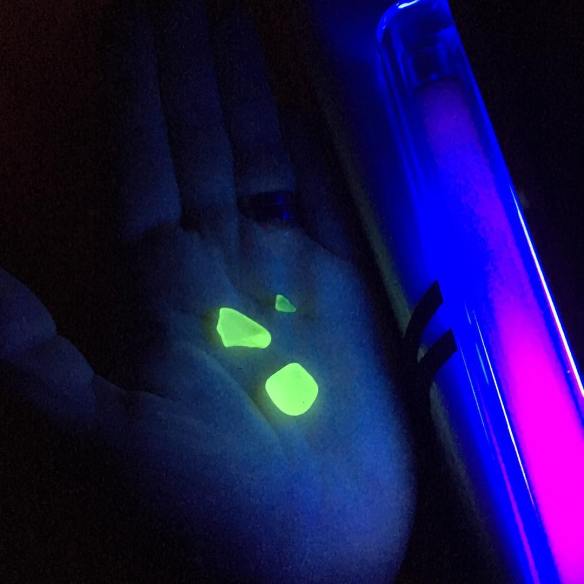
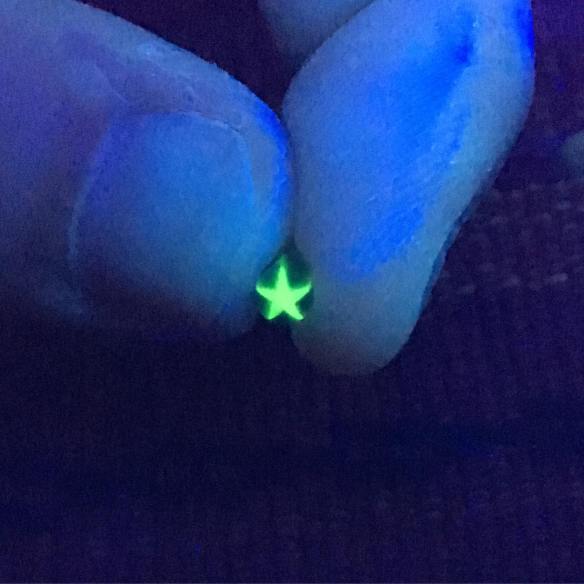
One of the most surprising things we discovered was “UV glass”; glass that contains uranium, resulting in a yellowy-green, light-catching material called “Vaseline glass.” (Not because it was used as containers for Vaseline, but because the glass has a greenish, somewhat oily look.) Under a black light, UV glass glows a brilliant and spooky green. One of the more unusual pieces my daughter found was a glass rod used in making millefiori jewelry that had a star-shaped central core made of UV glass. They stopped using uranium in glass around WWII, presumably because the element was needed for nuclear arms. Everything I’ve read about it indicates that there’s not enough uranium in UV glass to be dangerous, but I don’t think I’ll make any jewelry out of it, just the same.

UV, or "Vaseline" glass with uranium.

UV, or “Vaseline” glass with uranium.

So it turns out that collecting sea glass is a huge thing where I live. The sea glass in-crowd knows the best beaches, the best times of day, the best times of the year, the best weather, the best searching techniques. My daughter encountered another woman just before daylight on the beach, holding a flashlight on a stick to catch the reflection from the glass before the sun came up. Serious sea glassers wear wet suits and use sand crab rakes, normally used to dredge up these little crustaceans for bait, to dig up the glass in the wave zone. This can be a dangerous endeavor on the Northern California coast, which is prone to riptides and sneaker waves. This past winter, a man died at Davenport Beach, his favorite sea glass spot.

Davenport is where the hard-core crowd goes. It’s a public beach, but there is a certain cadre of sea glass seekers that act like it’s Westside Story and they’re the Sharks. I will call them Glassholes. On my first visit, I saw a man digging a large hole on the beach. I wandered over and picked up a quartz pebble he had unearthed—obviously nothing he was interested in.

“I didn’t dig that up for you,” he said. So charming.

“I didn’t imagine that you did,” I said.

“Go find your own hole!”

“It’s a public beach,” I pointed out, whereupon he roared, “Fuck you!” Such a gentleman.

Another lovely Glasshole wrote a manifesto and published it on Facebook instructing amateur “toe-dippers” to stay out of the way of the real people, stay out of the water, and a bunch of other things that I don’t think have been officially sanctioned by the California Coastal Commission.

So why are the Glassholes so hostile and aggressive? Apparently, the tiny town of Davenport (it has like, three streets) was once home to an art glass factory, which threw all  its rejects into the ocean. So it is possible to find stunning pieces of multicolored glass, rare colors and shapes in the Davenport waves. Many of the sea glassers turn these pieces into jewelry, sun-catchers, and other crafty things to sell. Does this excuse  Glassholery? By no means, but I don’t think they care what I think. (By the way, there are also some lovely and generous people who hunt for sea glass as Davenport, and I do not mean to include them in the Glasshole category.) [Post-publication note: Kerry says the glass studio is still there. The glass reached the ocean due to a flood that swept three dumpsters’ worth of art glass rejects into the sea.]

I won’t be returning to Davenport, though it has nothing to do with the Glassholes. In winter, which is the best season to find glass, so much sand has been scoured away from the beach that getting to the water requires descending a 12-foot sandstone cliff. Then, of course, you have to climb up the cliff to get out. I did it, but I’d rather not these days. I am not the agile creature I used to be. (Stop that sniggering, family!)

Sea glass millefiori rod with UV star.

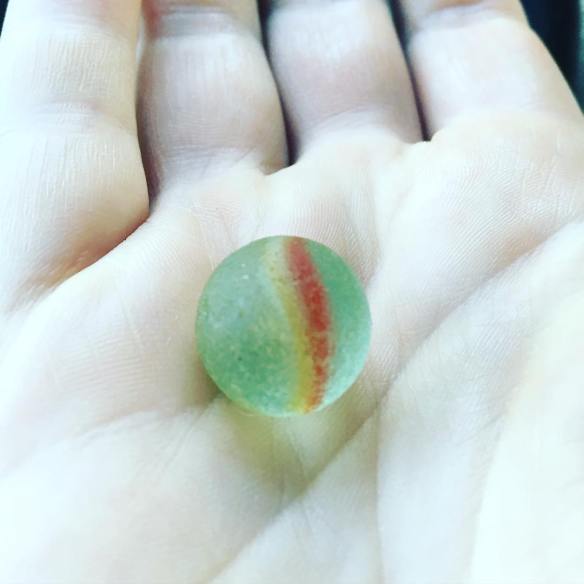
It’s fun finding a special piece like a marble. The reason there are sea glass marbles is not because children play marbles at the beach, it’s because ships used barrels of marbles as ballast, jettisoning the marbles as necessary into the ocean. I have heard of people who have found thousands of them—I have found four.

Sea marble.

Sea marble.

When looking for sea glass, I can walk for miles without noticing that I am exercising. And it’s fun to go through the day’s catch with a black light to see if it will spark that spooky green glow, like the fuel rod in the intro to “The Simpsons.” I love the feeling of triumph when I find a rare color or a particularly well-worn and perfect piece. I used to hunt for shells, but I have actually found more sea glass than whole shells on these shores. Apparently, once a shell is abandoned by its owner, the rocks just beat the shit out of it. Finding an unbroken shell of any species is cause for rejoicing.

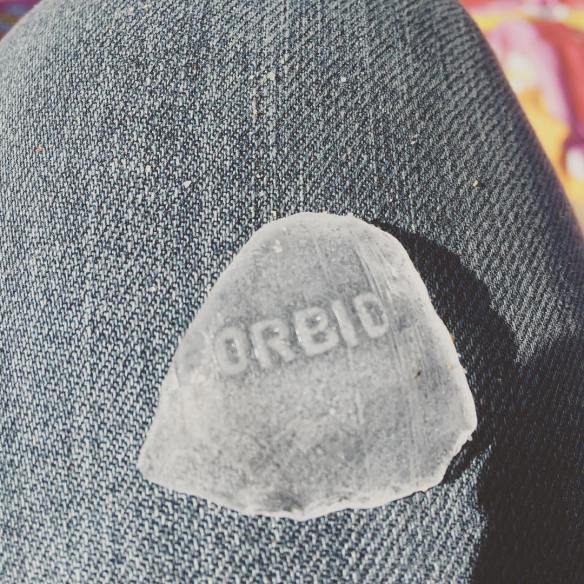
This bottle bottom says "FORBID."

This bottle bottom says “FORBID.”

At some point, when I get my jewelry workshop set up again, I will try setting my better pieces. But I will never be the avid collector my daughter has become. Many a weekend, when I am still fast asleep, Kerry is down at the beach, looking for glass. I’d rather have breakfast, so I guess I am not a true fanatic.

Photography by Kerry Keenan Gil

Meow Wolf: It’s Fucking Awesome


I had an adventure today. I visited the Meow Wolf Collective in Santa Fe, NM. I knew it was a huge experiential art installation but I had no idea what to expect. It was like a mad mashup of Disneyland, something Tim Burton might have done, Rivendell, a children’s museum, Harry Potter, the Twilight Zone, Salvadore Dali, and a Ray Bradbury story. And yet, I have fallen woefully short of describing it with any accuracy.
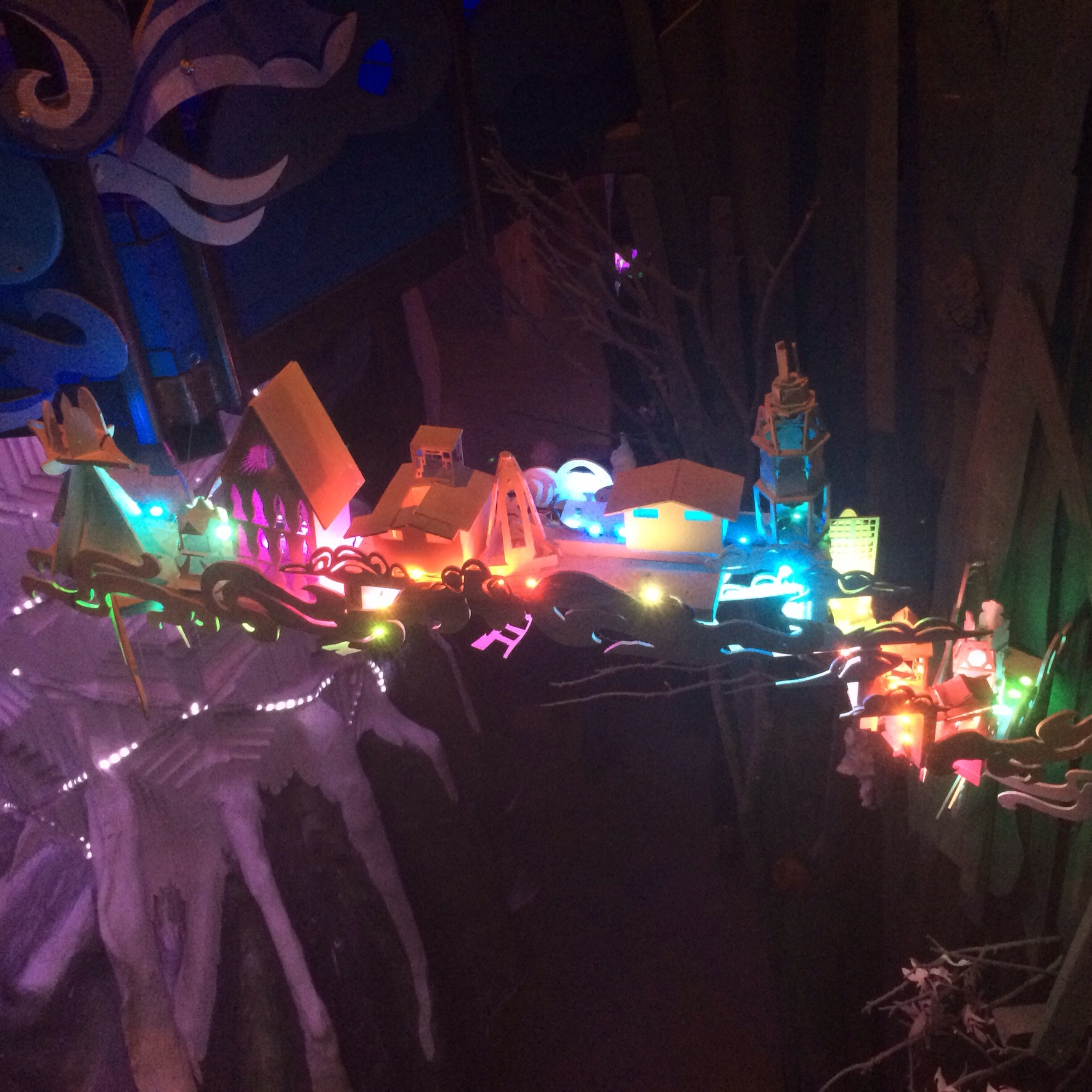
The centerpiece of the experience is a recreation of a Victorian house, but it isn’t made to look like a haunted house or anything. It’s a full-sized, two-story house contained in what used to be a bowling alley. It is surrounded by many other exhibits, but let’s start here. Inside the house, each room appears fairly normal, bar the dim lighting. But there is always something odd, weird or just strange about every room. Open the closet door in an upstairs bedroom and there is a corridor leading to a cavern adorned with stalactites and crystals with a glowing mammoth skeleton seemingly embedded in the rock. The medicine cabinet in the bathroom has glass vials full of herbs, while the prescription bottles have hilarious instructions for use. The floor tiles wave underfoot.
In one room, an artist is painting a canvas. In the kitchen, open the refrigerator door to find a passage to made-up destinations, directions to which are provided by a hologram. (Yes, you can go to these destinations.) The art on the walls is sometimes mundane, and sometimes seriously strange or even disturbing.
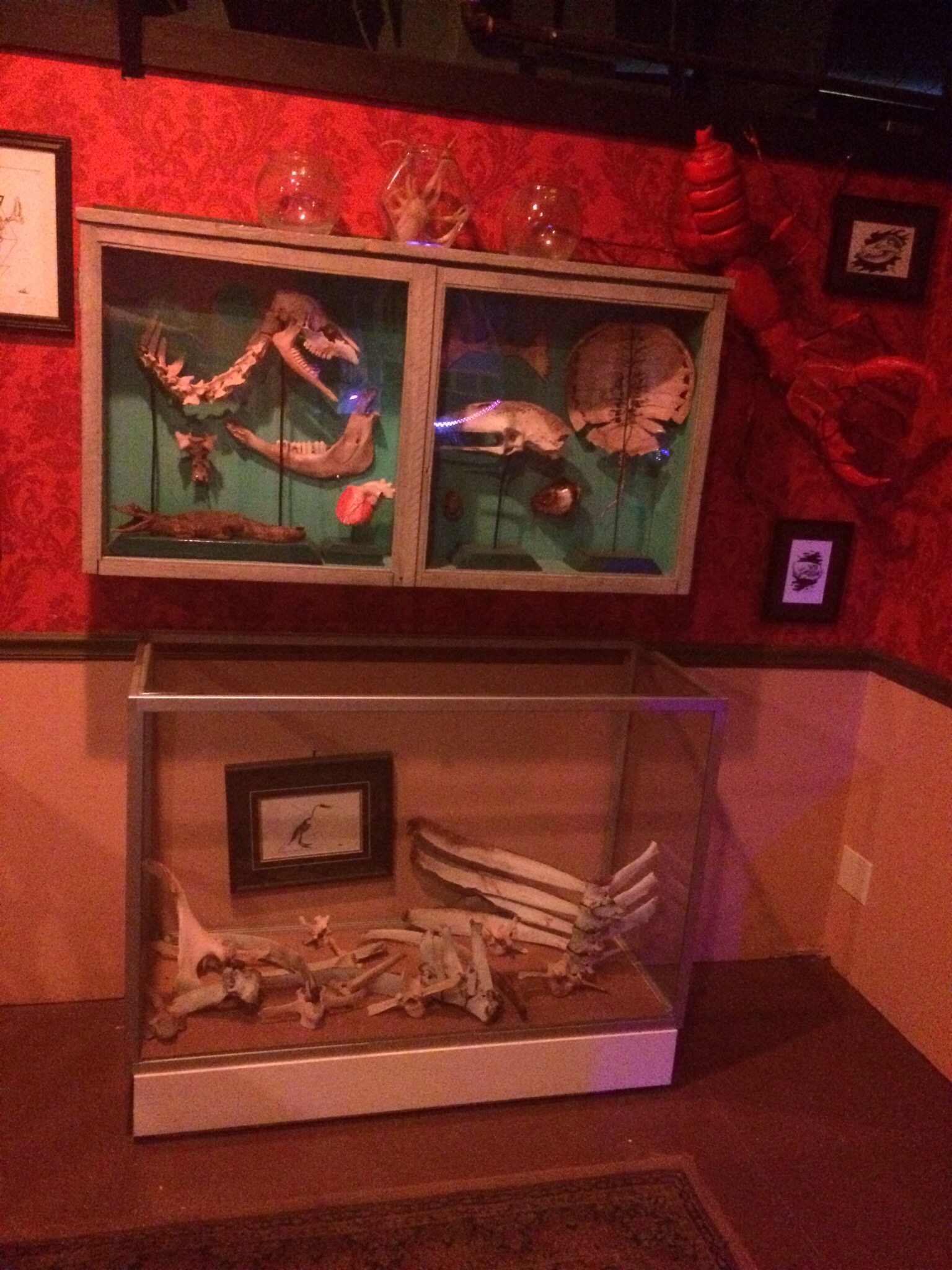
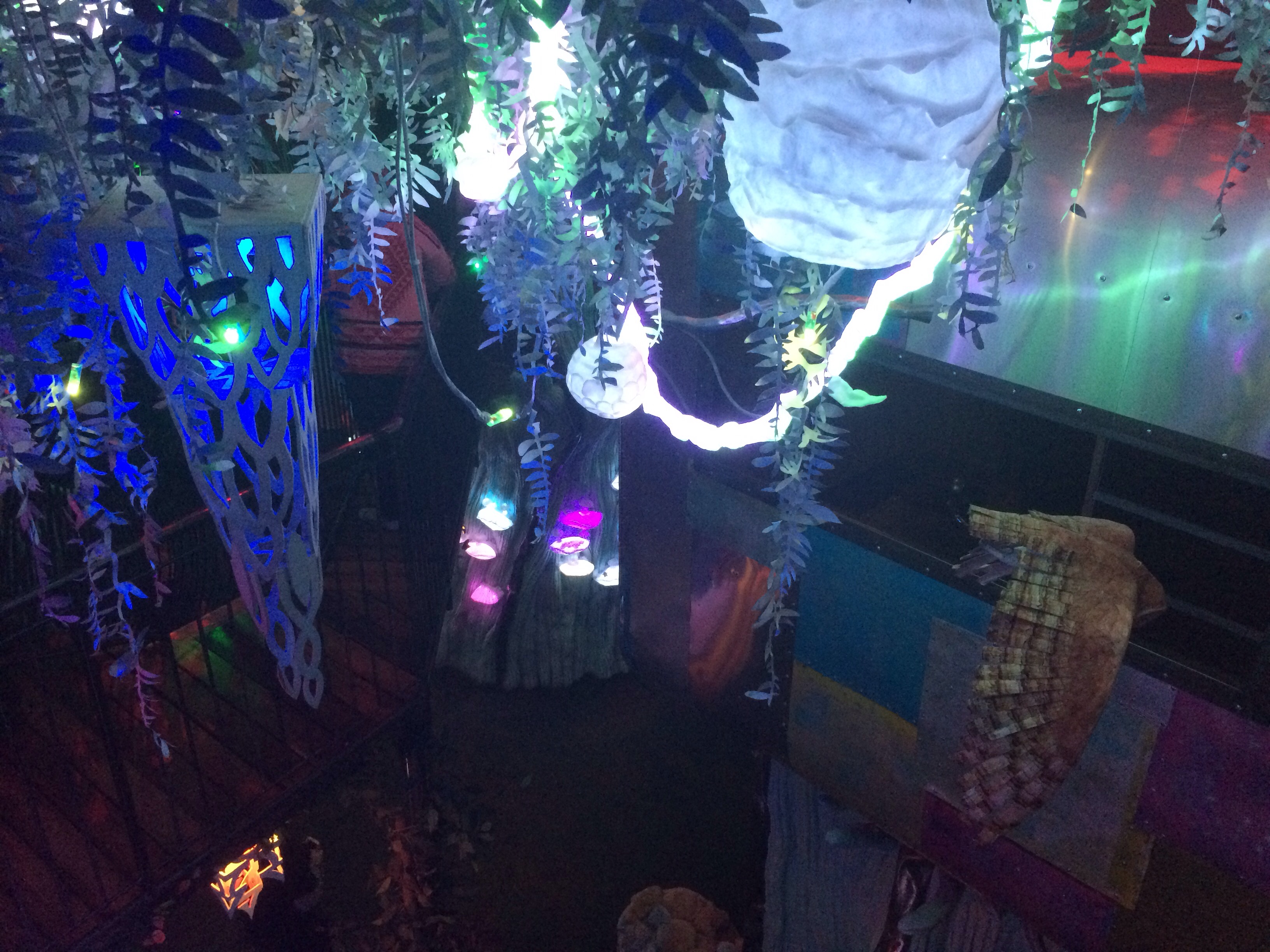
Surrounding the house are ramps and Rivendell-like vines, flowers, and glowing…things. You can walk across a bridge from the balcony of the house to a recreation of Baba Yaga’s chicken-footed cottage. There is a tunnel of video screens, a room full of crustaceans, tree fungi that glow and make drum noises when you pat them. There’s a light harp made of laser beams that plays notes when the beams are interrupted. There’s a room with a 15-foot-high rabbit with glowing eyes that reminded me of “Donny Darko.” Every surface is textured, painted, glowing, or interesting in some way.
One of the things I most appreciated about Meow Wolf was its complete lack of the sneering negativity so often expressed by modern art. The experience was positive, exciting, surprising, intriguing, and sometimes puzzling, and it made me extremely happy. Meow Wolf received seed funding from G.R.R. Martin, author of “Game of Thrones'” who lives in Santa Fe. I would love to see other such experiential art installations in other cities that have an innovative and creative spirit.
By the way, Meow Wolf is fantastic for kids. They can touch and explore and discover to their hearts’ content. There is also an art exploration area exclusively for children.
After all this specific description, I feel I have completely failed to describe Meow Wolf. Here’s some pictures–I’m sure they’ll give you a better idea. Maybe. Go there. You will not be disappointed.


Warning: This Post Contains Shameless Self-Promotion

New Cover

Recently I finished editing the first draft of “Fire in the Ocean,” the sequel to “The Obsidian Mirror.” I sent it off to my alpha readers and editor, and I can finally relax and think about something else for a while.

Such as promoting “The Obsidian Mirror.” While I was in the throes of writing the sequel, I did next to nothing about promoting my published work. A writer’s work is never done, I guess.

Why should you read “The Obsidian Mirror”? Short answer: because it’s a fun read. I read largely for entertainment. I like books that take you away and let you live someone else’s life for a while. I wrote “Obsidian” to be that kind of book: a diversion, a book I would love reading myself. It’s probably not a coincidence that the second publisher of the book is Diversion Books—they specialize in just that kind of novel.

Another reason to read “Obsidian” is because it is based on the mythologies and folklore of the Americas, which makes it a bit different. The idea occurred to me after finishing one of Robert Jordan’s “Wheel of Time” novels. I loved the book, but started wondering why so much fantasy is based on proto-European, pre-Industrial Age tropes such as elves, faeries, dragons, and caped adventurers. The Americas have thousands of mythologies, folk tales and traditions that are largely ignored by fantasy writers.

I began writing “The Obsidian Mirror” as a kind of personal experiment. Meso-American gods and Coyote the Trickster, an Inuit ice demon and a mannegishi named Fred are some of the characters. What I did not anticipate is that I would fall in love with my characters and be driven to finish the book. Having done that, I felt compelled to get it published.

I don’t have much to brag about. I’m not a best-selling author. I have won no prestigious awards for my fiction writing. But I do have one thing that gives me modest bragging rights.

I have heard authors talk about receiving hundreds of rejection slips. One writer said he had a drawer filled with 450 rejection slips for his novel. That didn’t happen with “The Obsidian Mirror.” I approached perhaps 10 publishers and/or agents before AEC Stellar agreed to publish the book. When AEC Stellar bit the dust, I approached about five publishers before Diversion Books picked it up, re-published it and agreed to publish the sequel.

So I may not have sold a million copies, but I never had any problem finding a publisher. As a matter of fact, years after I originally submitted the manuscript to their slush pile, Baen Books got back to me and said they were interested in it. The early bird gets the book, Baen.

So why am I proud of this? Because I have some independent assessments that people will enjoy reading my novel. Add to that, the several four- and five-star reviews on Amazon, and you might conclude that you would enjoy it, too. To make it super-easy for you to find the book, here it is: http://amzn.to/1MQBvkd

I did warn you.


Authors with Feet of Clay and the Wings of Angels

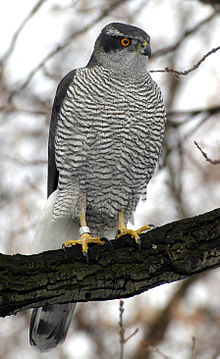
220px-Northern_Goshawk_ad_M2

This is what White meant by a “mad, marigold eye.”

Most of the books I read are fiction. I’m a writer, I love stories­—it’s natural. And while I have read much of the world’s greatest English literature (I always score well on that annual list the BBC publishes of the 100 best books in the English language), the vast majority of what I read is brain candy. Fluff. Genre books.

Mind you, I am in no way putting these books down. I read them. I pay good money for them. I like them. I write them.

But once in a while, I pick up something that breaks this pattern. Last week, I re-read “Tess of the d’Urbervilles” by Thomas Hardy, and found it lyrical, funny, and tragic all at once. (In marked contrast to my experience of reading it in high school Honors English class.) This week, I finished reading a book loaned to me by my oldest friend, “H is for Hawk” by Helen Macdonald. There was no question this was going to be an excellent book, as it is a New York Times bestseller and winner of the prestigious Samuel Johnson Prize.

However, the book was, on the surface, about training a goshawk. I probably wouldn’t have read it if my friend hadn’t said, “There’s a lot in there about T.H. White, and I know how much you like him.”

Macdonald describes T.H. White as “an unpopular author,” which shocked me, but I suppose she is right; I just have difficulty accepting that an author whose writing is so beautiful could have fallen from favor. White is the author of two of my favorite works, “The Once and Future King,” (actually five books), an epic fantasy about King Arthur, and “Mistress Masham’s Respose,” one of my childhood favorites about a lonely little girl who stumbles upon a lost colony of Lilliputians (literal Lilliputians, brought to England by Gulliver).

White’s writing is so incandescently lovely that it makes me weep. His descriptions of the English rural countryside are so evocative that as a child, I felt I knew that landscape intimately, though I had never been within five thousand miles of the place. And I remembered one powerful scene in “The Sword in the Stone” (the first of the books of “The Once and Future King), in which the young Arthur is changed by Merlin into a small hunting hawk and placed in the mews of Sir Ector’s castle. Arthur is subjected to an ordeal by the other hawks; he must stand within striking distance of Colonel Cully, a mad old goshawk, until the hawk bells are rung three times by the other birds. If he survives, he is admitted into their company. That scene is only one of many White crafted to show how Merlin educated Arthur into kingship, but it stuck with me, particularly the description of Cully’s “mad, marigold eye.”

Macdonald had read “The Goshawk,” as well as much of White’s other work, and knew more about him as a person than I did. She was obsessed with hawks and hawking from an early age, read medieval books on hawking, hung out with austringers (people who train hawks), flew them herself. She had always been intrigued by the idea of training a goshawk—maybe because White had attempted to do this himself as a young man, and failed, ultimately losing his hawk to the wild.

Different people respond to grief in different ways. When Macdonald’s beloved father died, she decided that she would acquire and train a young goshawk. Perhaps White’s account of his epic battle with his goshawk was at the bottom of it; she needed a battle to take her mind off sorrow.

Macdonald interweaves her story of acquiring and training Mabel, her goshawk, with accounts from White’s life and work. Her writing is nearly as luminous as White’s, evoking the landscape, the life of the young hawk, the tragedy of White’s life tied up with the tragedy of her father’s death.

All I can say is that the reader descends into madness with the writer and emerges with her, not unscathed. Macdonald emerges with the scars of Mabel’s talons in her flesh, but the wounds of her father’s death healed.

However, I was left with more knowledge—and less—than I wanted about T.H. White. I know that some people want to know everything there is to know about favorite authors. Not me. I much prefer to listen to the author’s voice through his or her work, and accept that as the reality the author meant for me to experience. I fell in love with many an author, only to find on reading a biography that the adored one had feet of clay and was only a weak human being after all. Like the rest of us.

For example, my mother, sister and I loved Gerald Durrell, the British author of “My Family and Other Animals” and other books detailing his love for animals and adventures as an animal collector for zoos, and later, for his own zoo on the island of Jersey. He was a funny and evocative writer and once wrote me a personal note when I sent him a letter at age 10 asking about how he became a naturalist. I was delighted to find his biography some years after his death. But when I read it, I discovered that he (like most of his talented family) was a hopeless alcoholic with a violent temper who died of liver disease. I was happier with the sunny, charming animal lover of Durrell’s books.

I had always seen White as sort of a God-like figure, someone full of age and wisdom and kindness who saw the foibles of mankind with a clear and compassionate eye. He may have been so, but he was also an alcoholic who despised himself for his homosexuality and sadism. He grew up in a family so deranged that when his mother lavished affection on her pet dogs, his father had them shot. He thought his father would shoot him some day, and his mother was cold and remote. Then, of course, they sent him to an English boarding school, where the milk of human kindness was not only spared, but completely missing.

White became a schoolmaster at another prestigious public school, but it is notable that although his sexual fantasies focused on beating adolescent boys, he never did so. He eventually fled to a cottage in the woods and decided to raise a young goshawk in the medieval manner, opening a pitched battle between man and bird. This experience informed much of his later writings, but “The Goshawk” wasn’t published until much later, because White knew how badly he had failed in training his hawk.

I am considering whether or not to read an autobiography of White. I’m not disappointed in him, more sorry that he endured so much pain. I think it’s incredibly brave that he tried so hard not to inflict pain because he knew he enjoyed doing so. I will definitely seek out and read more of White’s work. Human nature may be sad and disappointing at times, but I have never been disappointed in the writing of Terrance Hanbury White.

Oh, and I’ll also read anything else Helen Macdonald decides to write.

I Will Be Speaking at the Los Gatos Literary Fair August 22

I will be making a short presentation at the Los Gatos, CA Literary Fair, Saturday, August 22. The Fair is from 12 noon to 3:00 p.m. I will also be signing copies of “The Obsidian Mirror.” I’d love to see you there if you happen to be in the neighborhood!

2015 LG Lit Fair flyer