We arrived in Cordoba after an easy drive from Sevilla (it was easy for me because Tom was driving). Our parador sits above the city in a pleasant neighborhood, and overlooks the entire city. Even more important, it has an elevator, which I greeted with cries of joy. Our quarters consist of four rooms–bedroom, sitting room, dressing room, bathroom and a large, sit-able balcony. It may not be as romantico as the parador at the Alhambra, but it is lovely, and there is a pool, which I took immediate advantage of. I enjoyed floating in the cool water, watching the birds drink. There were swallows, which drink on the wing, doves, and little yellow birds that look like goldfinches. There was no one else in the large pool, and the surrounding gardens are full of palms trees, hibiscus and orange trees. Paradise. The lifeguard speaks French, but not English, and I speak French but not Spanish. Between the two of us, we managed to miscommunicate in three languages.
The view of Cordoba from our balcony
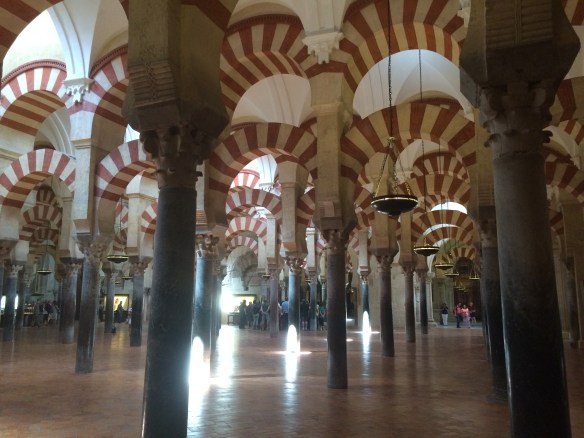
Today (our first full day here), we visited La Mezquita, the Great Mosque of Cordoba, which has been turned into a Catholic church. La Mezquita is one of the buildings I studied in art history, so it looked weirdly familiar, as though I had been there before. It has an odd history. It started as a Visigoth church. When the Moors came in the 700’s, the sultan bought the Visigoth church from the Christians, knocked it down and built a mosque. The mosque was added onto until the expulsion of the Moors. The Christians had the good sense not to tear down this incredibly graceful and beautiful building, but they did plonk down a gaudy sanctuary, altarpiece, and choir in the middle of it and appropriated the side niches as chapels.
The result is a mishmash of styles that mingle awkwardly together, like neighbors who get together to socialize only on Fourth of July weekend.
There was far too much detail to capture on camera, especially my iPhone camera, and some of the interesting things were behind glass or wrought-iron screens. but I will let La Mezquita speak for itself.
The famous striped arches made of stone ad brick.
The ceiling above the Christian sanctuary in the mosque.
Christianity meets Islam in the ceiling
High altar, La Mezquita, Cordoba
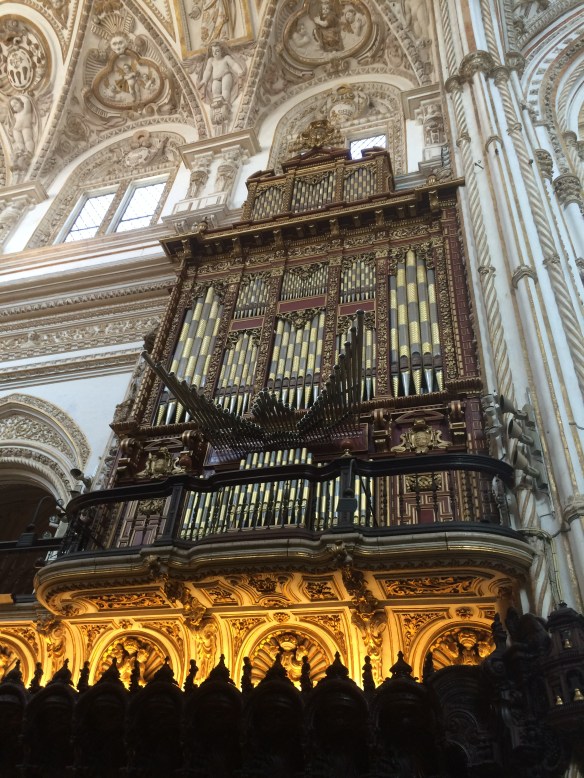
Pipe organ in the choir section, La Mezquita, Cordoba. A matching organ sits on the wall opposite. The position of the pipes is very unusual.
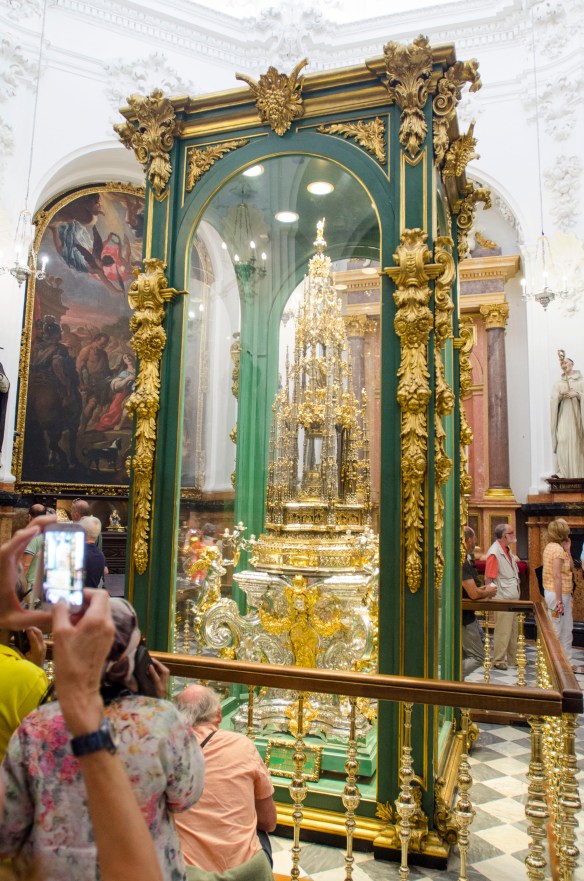
This thing is called a monstrance. I don’t know what it is used for, but it is solid gold. (OK, there’s some silver in the base section. Tom insists I be accurate in my reporting!) It is in the treasury of the cathedral/mosque, Cordoba.
I should mention something about Spain, apropos of nothing. All the historical places we have visited have had benches or chairs here and there so people can sit and rest their feet and appreciate their surroundings. I deeply appreciate this–more and more every year. I remember after touring the Louvre many years ago, we were beneath the big I.M. Pei pyramid. I was dying on my feet, and sat down on the floor, as there was nothing–not even a low wall–in sight. A security guard immediately came over and told me in French that it was not permitted to sit there. I asked why and got the most Gallic shrug ever seen. Later, walking around Paris, I sat somewhere random and got told to move along again. I began to feel like a vagrant, and my feet were miserable. Spain has the right idea.
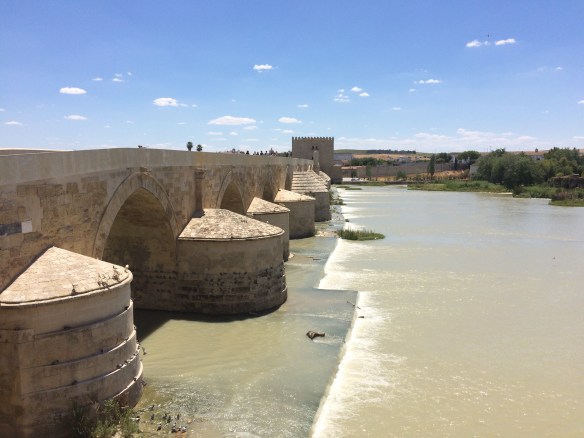
After viewing the mosque, we went in search of the Museum of Al-Andalus Life, that is, the culture of the Moors. This is housed in an ancient Moorish defensive tower that is reached via a bridge across the Quadalquivir River.
View from the Roman bridge across the Guadalquivir River toward the Museum of Al-Andal Life. The museum is in the square building at the end of the bridge.
At the end of the bridge, some enterprising people had set up a large stall selling hats and cold water. Did I mention it’s in the mid-eighties today? Not horrible, but we both bought hats to keep the sun off our faces. We went to the museum, but they were closing for siesta in a half hour, so we stopped at a cafe, which, judging by the clientele, is a local fave. I had a beer, which to my nearest and dearest will indicate just how warm I was. Also tapas–of course!–as it was mid-afternoon.
View of the Old Town (Barrio Judica) from the Roman Bridge
We decided to backtrack across the bridge and go to the archeological museum. This was open, and we managed to get through prehistory, the Romans, and the Moors before this museum also closed. By this time, it was pretty hot, so we took a taxi back to the Parador, and I, for one, am going swimming!
We’re in Cordoba now, having spent three nights in Sevilla, during which I was too tired to post anything.
I slept quite late the first full day, which was a Sunday, so there wan’t much open in any case. We walked around, took some pictures, got rained on, had some tapas and tried to get oriented.
One of Sevilla’s tiny streets in the old Jewish Quarter
We actually didn’t do much in Seville except for walk. Our hotel was reasonably near the Alcazar and the cathedral–but we never made it inside the cathedral. We spent a lot of time walking through the narrow, winding streets of the old Jewish Quarter (pre-expulsion). The houses are four stories high, and in some places I could almost touch the houses to either side of the street with outstretched arms. Cars can access some (but not all) of these cobbled streets, and when a car came along, we stepped into a doorway or onto the narrow sidewalk, if there was one. In addition to negotiating the Medieval and Renaissance walking surfaces, we had to keep a sharp eye (and nose) out for horse and dog poop. There are a lot of horses and lovely carriages in the old city that tourists can hire for merely exorbitant prices.
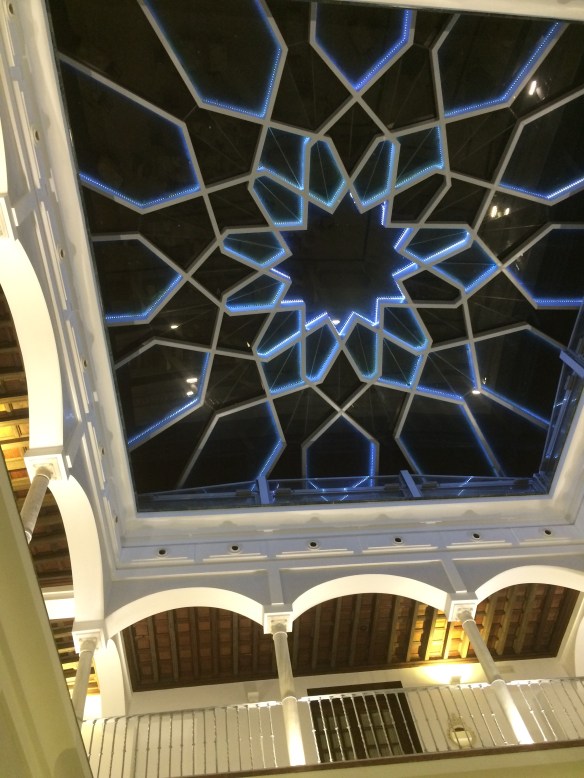
While walking, we passed by an interesting-looking restaurant, Sagardi. It had a small foyer for tapas, and a restaurant in a large, enclosed atrium. We checked out the menu and decided to come back when we were hungry. We had dinner there, and it was every bit as wonderful as we had hoped. We vowed to return for tapas another time.
Atrium roof, Sagardi restuarant
Magnificent old tree in central Sevilla
The hotel we stayed in, La Casa de Maestro Boutique, was an old house on one of the non-car-accessible streets, but we did get a parking spot nearby. The hotel has oodles of charm, but the room was small and the shower miniscule. Once in the shower, if I dropped my shampoo (inevitable, as there was very little place to put anything), it was nearly impossible to pick it up. However, the room was clean and the bed was comfortable, and that counts for a lot.
Driving in this part of Seville is madness for a tourist, so we walked to the Alcazar the second morning. Flamenco is very big in Sevilla, and there are stores selling very high-quality Flamenco-related goods such as fans, silk shawls, dresses, castenets, etc. (You can also get el cheapo versions of these in gift stores). My sister wanted a Spanish shawl, so I went into one of these upscale stores to find one. While there, I saw the most gorgeous shawl I have ever seen in my entire life, or hope to. I have extremely good (read “expensive”) tastes: it was the equivalent of $1500 US. It was love at first sight, but it will have to be a long-distance relationship.
Lusting in my heart for this shawl. All hand-embroidered in silk. Wouldn’t this be a lovely Christmas present for me? I thought so, too.
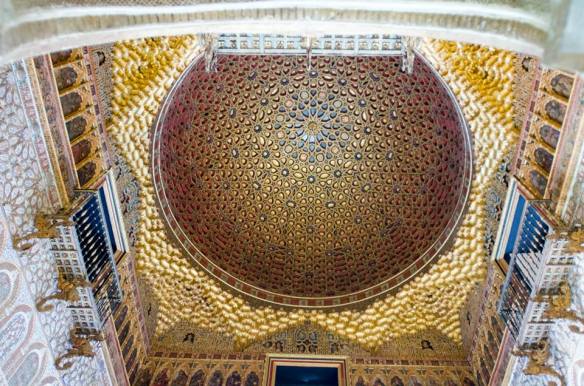
The Alcazar of Seville was build by King Pedro the Just or Pedro the Cruel, depending on whether you were one of the people (the Just) or an aristo or member of the clergy (the Cruel). Pedro really liked the Moorish style or architecture and ornamentation, and used it throughout his palace. It is fronted by a 12th-century gate, very rustic and antique-looking, considering the elegance lying just beyond. You walk into a vast plaza, flanked on three sides by different buildings. One is Pedro’s palace, one was the house of someone else important–the mayor of Seville?–done in a more traditional Spanish style, and one is another wing of the palace built by a later monarch who very much disapproved of Pedro’s taste in architecture, because it is a thoroughly Italianate Renaissance building. So it’s a rather odd mishmash. Pedro’s palace is rich in lacy Moorish stonework (even bearing the name of Allah in this most Christian palace), brilliant tile work, Moorish arches, carved, painted and gilded ceilings, and fountains. One room, the Ambassadors Hall, is completely tiled up to the ceiling, three stories up.
The Alcazar, showing Pedro’s palace to the left, and the important person’s house to the right.
Ceiling of the Ambassadors Hall, the Alcazar Seville
The Alcazar is the residence of Spain’s current king and queen when in Sevilla, but we had an impression that they don’t stay here much. Hard to imagine they would want to stay at a place that is overrun with tourists all the time. We bought tickets for the private royal chambers, which are upstairs, but I’d be willing to bet they have other, much more private chambers there for their actual use. These rooms reminded me of other palaces in other places, with many oil paintings of ladies in voluminous dresses and men in tight white pants, crystal chandeliers, gilded clocks, etc., etc.
Reflecting pool, the Alcazar
There are many lovely courtyards, reflecting pools and fountains throughout the palace, and the whole is surrounded by yet more gardens. It’s a gorgeous place, but I have to admit I was not as thrilled as I should have been because my feet hurt. A lot. I disappointed myself in my unwillingness to do more exploring, but there we have it. We found the cafeteria and had some wine and split a sandwich, then left. We found a horse and carriage next to the cathedral and got a ride back to the hotel, which I thoroughly enjoyed, largely because I wasn’t walking, but I do enjoy the clip-clop of horses and yes, the way they smell.
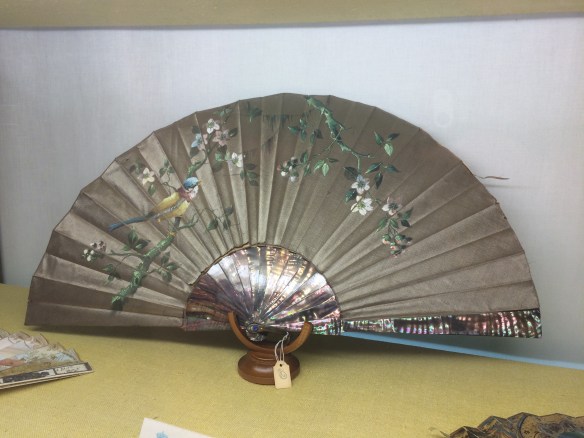
Gorgeous antique fan on display at the Alcazar
Later, we walked to Sagardi for tapas and wine. The tapas were delicious, but we decided to find another tapas place–it’s what people do in Sevilla. While wending our way through the tiny streets trying to find another tapas bar (a specific one; there were plenty of tapas bars. It made me wonder if anyone cooks at home in Sevilla.), I realized I had a blister. A quick trip to the pharmacy solved that problem, and we eventually found our tapas place, situated on a plaza across from City Hall. We had more excellent tapas, but by this time, we were both full. We did stop on the way back to the hotel for small ice creams, but this hardly counts. I feel like we should have gone to the cathedral–it’s the largest in Spain (that means very, very large)–but couldn’t work up enough enthusiasm.
Then it was early (for Spain) to bed, with Cordoba awaiting the next day. I mean, after we pick up our laundry, that is.
I have begun to suspect that Tom planned this trip to Spain as ameans of whipping me into shape (I admit this is needed, but still). Yesterday wesaid farewell to lovely Granada and headed toward Seville. It turned out to be oh, so much more than merely a travel day. I may never recover, in fact.
Actually, the first part was entirely my fault. I asked if we could visit Ronda on the way. Ronda is not a female friend, but one of the “White Towns” of Spain’s Andelucia hill country. (Apparently sometime a long time ago, white was the de rigeur color for houses here, and it hasn’t changed since.) The town is bisected by a deep gorge and is very picturesque.
Then Tom mentioned that near Ronda, there was a cave with prehistoric paintings in it, la Cueva Pileta. Well, that cinched it as far as I was concerned (innocent that I was).
We found Ronda without difficulty and headed toward a part of town our guide assured us was more for locals, parked with difficulty and tried to find a restaurant (as recommended by the book). The first place turned us away for reasons unknown (my Spanish isn’t very good, so I wasn’t sure what his excuse was). The second place was so full of people I thought I might become agoraphobic if we tried to eat there. The third place said they had a large party coming in, but as we were leaving, they called us back and set up a small table for us.
Bagpipe band in Ronda
While we were waiting for food, the party arrived, complete with bagpipers and drummers, sounding very Celtic. This makes sense for Northern Spain, as the Celts in ancient times went through there as a stopover on the way to Ireland, as Tom, the man of 100% Irish extraction, pointed out. It turned out that the large party was indeed a group of people from Northern Spain. We enjoyed the music (most of the musicians were in full traditional outfits) and the lunch, which consisted of fried padrone peppers, local snails in their stripy shells (yum!) and cured chorizo. Oh, and some local red wine.
We tried calling the cave a couple of times, but no one answered. We decided to go there anyway and come back to Ronda if it was closed. The cave belongs to the family of the farmer who originally found it, and it is operated by the family, not the government, so it has somewhat irregular hours.
We traveled up into the craggy hills along windy roads, passing through more White Towns. We finally came to the end of the road, or nearly so. There is a small sign and a parking area, but otherwise nothing but an extremely steep flight of stone steps heading up through the chaperral. I left my purse in the car, as I didn’t want to accidentally bump any formations with it (I’ve been in a few caves before, and they frown on this).
Stairs to the Cueva Pileta. Trust me, this was just the beginning of a very long climb.
The stairs went up. And up. And up. In addition to being steep, the steps were of varying depths, and there is a lot of loose scree making it hazardous. At the top, there is a hole in a rock face, and we went in. The young lady inside would not take a credit card or American cash, and the only Spanish cash we had was down, down, down at the car in the purse I had so thoughtfully left behind. To my immense relief, she agreed to come down to the car with us after the tour to get her money.
The cave is beautiful even without the cave paintings, with impressive stalactites, stalagmites, draperies, and sparkling crystal formations. Some of the formations were dark with prehistoric smoke, some tinted with cobalt and other minerals. I have never before seen any cave paintings (though I have seen prehistoric pictographs in California and Hawaii). They have a freshness and energy that looks modern, and it is exciting to think I was looking at the handiwork of someone who lived and died perhaps 30,000 years ago. How they managed to negotiate the cave with only torches is astonishing enough; I had trouble even with the rock steps, steel handrails and clutching Tom the whole way.
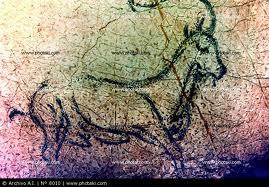
Horse in Cueva Pileta
Because, you see, there were no lights. They give you a feeble little lantern to hold when you come in. This lantern completely blinded me until I figured out how to block the light coming toward me and direct it only at the ground. The guide had a good light that she used to help us, but I am increasingly night blind, and found the whole thing nerve-wracking in the extreme. Add to that a LOT of uneven stairs and very slippery footing. The guide book said to bring something warm because the cave was cold, but I sweated gallons. By the end of the tour, my hair was streaming with sweat and my glasses were steamed up as though I had been in a Turkish bath.
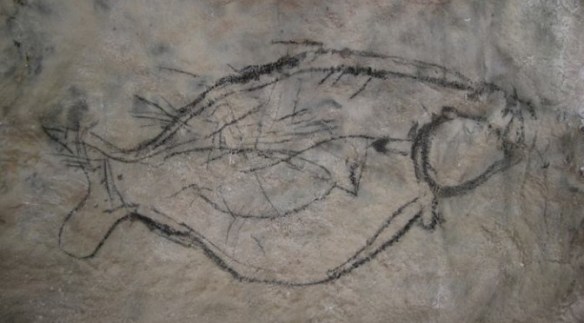
And I wouldn’t have missed it for the world. The paintings are amazing. There is a very rare depiction of a fish, quite large, and inside it, you can see another fish. There were paintings of horses, bison, goats and deer, beautifully rendered and informing us what these ancient animals looked like with a few perfectly placed lines and shading. There are strange scratchings, straight lines and bars. The guide said it was to count full moons. Other scratches she said were depictions of vulvas, a symbol of fertility. Maybe, but you can see the same thing in any men’s bathroom. I don’t think adolescent males have changed that much over the millenia. It hardly matters whether these paintings and markings bear deep religious significance or were merely the exercise of horniness and creative expression; they are the only messages we have from our early ancestors.
Fish in Cueva Pilete. Note the fish inside the fish.
Goat in Cueva Pileta
Once we emerged from the cave, there was of course, the descent down the rocky hillside to the car. Once we paid our patient guide, we took off in search of the road to Seville–but first, some water. Our GPS system (which was finally speaking English instead of Spanish, thanks to Tom, although the English voice cannot pronounce Spanish place names) wanted to direct us down tiny roads through the mountains. We knew there was a nice highway not too far distant and ignored her. On the way to the highway, we stopped at a little hillside bar for agua minerale. The people there seemed very excited to meet Americans, and several friendly people stopped by to say hello, which was very cheering.
On the road to Seville, I started falling asleep. I don’t sleep in cars any better than I do on airplanes, and kept jerking awake. Exhaustion dragged at me like water-soaked clothing on a drowning man, and by the time we reached our hotel, I was a zombie.
The hotel is a charming four-story building that was once the residence of Flamenco guitarist maestro Nino Ricardo. Our room is on the second floor, which means up three narrow flights of steep stairs, dragging suitcases because there is no elevator. Although the concierge took my big bag, I was still feeling more than exhausted to begin with, so this did not refresh me.
The living room at the Casa de Maestro has a decoration resembling the strings and sound hole of a guitar. The “strings” reach from the four-story ceiling to the floor.
We went out for tapas at a recommended bar and sat outside on the sidewalk, watching the people streaming by us. The food was delicious–scrambled eggs with black rice, calamari and crayfish, salmon in some yummy sauce, jamon Iberico and something else we can’t remember because we were both tired.
Then back to the hotel, where I completely lost it. All I’m going to say about this dark episode is that Tom is a saint. Once I got to bed I lost consciousness for about 10 hours and awoke refreshed with all evil spirits completely exorcised.
Sorry! That was jet lag speaking. I have been immersed for a few months in writing the sequel to “The Obsidian Mirror,” which is set in Hawai’i. I meant, of course, “Hola from Spain!”
I won’t be blogging in the same kind of detail that I blogged my trip to Hawai’i last January. This is a vacation, not a research trip. And, in the faint possibility you might be concerned that I won’t get the sequel done, I am taking nearly a week in one place, the Rioja region, to work on the next novel. Did I mention that the Rioja region is home to some of Spain’s finest red wines? Naturally, that had nothing to do with my choice of locations in which to work on the book. No, indeed.
So hasta la vista, mis amigos. (Practicing!) I’ll be back with odds and ends as Tom and I wend our way across Spain.
DIVERSION BOOKS RESCUES THE OBSIDIAN MIRROR, RELEASES NEW VERSION OF FANTASY NOVEL
May 15, 2015—Diversion Books today released The Obsidian Mirror, an inventive high tech-meets-Aztec fantasy novel by Silicon Valley public relations veteran K.D. Keenan, marking the second time the novel has been issued in less than a year.
Diversion Books, which publishes a number of classic fantasy authors—including Ursula K. Le Guin, M.K. Wren and Henry Kuttner—scooped up the title after its original publisher, AEC Stellar Publishing, went out of business. “The Obsidian Mirror is a terrifically fun read,” said acquiring editor Laura Duane. “It recalls the wit and invention of Douglas Adams, and fits perfectly with many of our other fantasy titles.”
The Obsidian Mirror tells the story of Sierra Carter, an out-of-work PR executive who receives a call from Quetzalcoatl, the plumed serpent god of the Aztecs, and discovers that her former firm’s semiconductors are a means of spreading a deadly evil around the world. Powering these nasty vibes is Necocyaotl, Aztec god of death and destruction, who has placed his essence in every device, causing people to place their self-interest and selfish desires above all else.
Carter, with the help of some paranormal pals—Chaco, a handsome young man when he isn’t being a coyote; Fred, the mannegishi with the ability to disappear at will; and Rose, a Native American shaman—learns how to develop her inner powers. She’ll need them, because Necocyaotl’s team is playing for keeps, and the evil god brings an ice demon, dark spirits, and assorted monsters into the game to bolster his more human henchmen.
Founded in 2010, Diversion Books has emerged as a premier digital publishing house, partnering with top literary agencies, media companies, and authors to build a rapidly -growing catalog across a range of genres. With its cutting-edge marketing and versatility in the changing landscape, Diversion proudly publishes top-tier authors old and new, building the next generation publishing company, one great book at a time.
When I first started this blog, the subtitle was “A Blog about Writing a Novel.” I thought of it as a journal documenting the process of writing my first novel and trying to get it published. Of course, at the time, I had no idea whether I would get it published (or even finished).
Well, “The Obsidian Mirror” was finished and published, and now will be republished by Diversion Books. (They are giving it a new cover as well, which should be interesting. I can’t wait.) I have a contract for the sequel from Diversion, and I have written about 20% of the first draft.
So it’s no longer a blog about writing a novel. It’s about the journey I am on as an author. I have changed the subtitle to “The Journey to Authorship.”
Now, that sounds like I will be forever journeying toward a goal, but never reaching it. That would be exactly right.
I learned a huge amount about writing a novel when I wrote “The Obsidian Mirror.” I revised it eight times. I had many people read it and comment on it, including the wonderful Gail Z. Martin, who has authored numerous fantasy novels herself.
Now I am trying to put those lessons to good use in the sequel. I am also trying out new things. For example, the antagonist in “Fire in the Ocean” (working title) is not an evil god. He’s not even evil. As a reader, I am much more interested in complex characters than cardboard cutouts, but as a writer, it’s really easy to fall into the mistake of making evil characters 100% evil, twiddling their mustachios and laughing, “BWAHAHAHAH!” (Okay, maybe not that bad, but you get the idea.) So I am trying to create a more complex character, one who is human, with human strengths and weaknesses, whose actions are not motivated by pure nastiness.
I have to admit, this is a bit scary for me, and I am proceeding with this character in baby steps. But, as in “The Obsidian Mirror,” I am still trying to understand why perfectly normal people do massively destructive things to the environment—even though they have to live the consequences along with the rest of us.
Another challenge is the setting in Hawai’i. “The Obsidian Mirror” was set in Silicon Valley, where I lived and worked for more than 30 years, so I knew it very well. I have visited Hawai’i many times and love it, but I am not as intimately familiar with it as I am with Silicon Valley. I spent eight days on Moloka’i, where much of the novel takes place, but eight days doesn’t make me an expert. Fortunately, I made some friends in Moloka’i while I was there, and I am hoping they will help to correct any inaccuracies or general idiocies I may commit.
So I am still learning and stretching my authorial wings. I am on a journey I suspect I will never complete, because I hope always to be learning more about my craft and growing as a writer. If I stop doing that, I will stop writing.
Today, I was going to write about some good news, but then the sad news arrived: Terry Pratchett died.
I have written about Pratchett before in these pages because he is one of my best-loved authors. He was a fantasy writer who was also a brilliant satirist and humorist of the highest order. Reading a new Pratchett book was for me as richly satisfying as artisan chocolate, and it lasted a good deal longer. (Plus I can go back and re-experience the books, which is hard, not to say disgusting, when chocolate is involved.)
Pratchett used his fantasy creation, the Discworld, to satirize our absurdities in this world. Nothing was off-limits for him. Personally, I think one of his finest pieces was “Monstrous Regiment,” which satirized bias against women and the absurdity of religion, which are deeply interconnected. Unlike fellow satirist and countryman Evelyn Waugh, Pratchett never indulged in invective; instead he made you laugh. And when you laugh, you become more open. And becoming open to new perspectives is how hearts and minds get changed.
There are, according to Wikipedia, 41 novels in the Discworld series. Pratchett also wrote several other novels, including “Good Omens” with the luminous Neil Gaiman, a series of children’s books, “The Long Earth” series with Stephen Baxter, and numerous handy guides to Discworld, short stories, and more. There’s a lot more to say about this man. He was awarded an O.B.E. and later knighted, so he is officially Sir Terry Pratchett. He suffered from a particularly vicious form of Alzheimer’s disease for eight years, and bore it with humor and bravery. He was deeply knowledgeable about the folklore of the British Isles, and commented to a meeting of folklorists that he viewed folklore much as a carpenter views trees. Wikipedia has an exhaustive amount of material on Pratchett and also his novels, so I won’t go into a lot of detail here–but he was a man of many parts.
I enjoy everything Pratchett wrote, but Discworld holds a special place in my heart (me and millions of others). He created a world so rich in detail, teeming with fascinating characters and creatures, that a return to Discworld was a richly enjoyable experience every time. I love his witches, especially grumpy and wise old Granny Weatherwax and Nanny Ogg, who had a lively girlhood and likes her pint or two. I love brave Captain Carrot, the 6 foot-plus dwarf who is the unacknowledged King of Ankh-Morpork, Discworld’s largest and (probably) most noisome city. And Lord Vetinari, the ultimate politician who always manages to keep things on course without too much bloodshed. And Death, who always SPEAKS IN CAPITALS (and has the last word). In Discworld, you meet hundreds of characters who are so beautifully drawn that they leave the mark of their personalities with you forever.
But the real reason I cried when I heard he had died is because he was kind to me once. I have related this before, but here it is again:
You see, I met Connie Willis first. I was in the vendors’ hall at Worldcon when it came to San Jose, CA several years ago. I happened to glimpse her nametag. Connie Willis is also a favorite author, so I introduced myself—and proceeded to commit every rabid-fan sin it is possible to commit in attempting to praise her work. Even as I heard the vapid words burbling out of my mouth, I knew I was doomed. The expression of pain on Ms. Willis’ face only confirmed my gauche blundering. I attempted to extricate myself by saying, “Well, I’m starting to drool on you, so I guess I’d better go now.” Ms. Willis nodded mute agreement, and I slunk away with my tail between my legs, feeling like a complete moron.
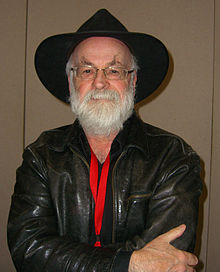
I was standing at a vendor’s stall wondering if it is possible to actually die of embarrassment when a tidy gentleman with a gray beard and a black fedora walked up. I thought he looked familiar, but when the vendor called him “Mr. Pratchett,” my suspicions were confirmed. He stood right next to me as the vendor handed him a CD, saying, “I’ve been saving this for you, but I was afraid I might come across as a rabid fan.” (Like me, I thought.)
Pratchett took the CD and said, “I adore rabid fans!”
I turned to him and said, “Well, then, would you mind if I drooled on your shoulder?”
Pratchett responded, “Not at all—but would you mind drooling on this shoulder”—he patted his right shoulder—“as the other one is already rather damp?”
Instantly, the oppressive cloud of feeling foolish lifted and disappeared. I will never forget how Terry Pratchett’s humor and kindness brightened my day and turned my embarrassment into laughter. (Not that I mean to say Connie Willis made me feel bad. I made myself feel bad. I should’ve kept my mouth shut.)
And now this kind, brilliant, prolific and amazing writer is gone. There will be no more tales of Discworld to anticipate with glee. His brilliance continues to shine in his work, which will live for a long, long time. He set a high standard for humanity. I only hope that someday we live up to it.
The last Tweet on Pratchett’s account. Fans will know who is speaking.
This was our snorkeling day, so we set our alarm. We had to be at the Kaunakakai Wharf by 6:45. We ate a quick breakfast and set out in the dark. We could see the bright lights at the tiny Molokai airport as well as the wharf as we came down the rise from the west end of the island; Molokai is only 38 miles long from the west end to the east.
I thought Tom should leave his camera in the car. It is large (especially the lenses) and heavy, and I was afraid it might get damaged or get water in it. So no pictures, but I’ll post a few photos of the kinds of fish we saw, even if they aren’t the actual fish we met.
We drove straight out onto the wharf and parked near our boat, the Coral Queen. A young Hawaiian man told us nicely not to park there or we would get a ticket. This turned out to be Gabe, the boat’s one crewman. He would take the divers down while the captain kept an eye on the snorkelers.
This was a surprise. Diving implied deep water, so I asked about it. The captain (whose name I failed to remember) said they had more than 40 different places to take people, depending on whether they had a mixed group (snorkelers and divers), or just one or the other, and of course depending on tides, currents and weather.
There were about a dozen of us. They waited a while for some latecomers who never showed, then set out along the eastern shore in the dawn light. On our way out, they pointed out a handsome white yacht moored offshore and said it was Larry Ellison’s.
The Molokaiians are very hopeful about Mr. Ellison, the fifth wealthiest man in the world, and the founder and former CEO of Oracle Corporation. As you may know, he bought the entire island of Lanai a little while ago (98% of it, anyway). The people of Lanai have been very happy with the changes he has brought to that island, and the Molokaiians are hopeful that he will buy up the now-idle holdings of the Molokai Ranch. This would certainly make a huge difference; it remains to be seen if it’s a difference the people of Molokai will like. They have a slogan here: “Don’t change Molokai, let Molokai change you.”
It was calm, quite unlike the first few days we were here. It was interesting to try to locate landmarks on shore that we had earlier seen from the road, but we never got as far as Leimana’s fishpond.
Someone asked about sharks. Gabe said they tended to see black-tipped reef sharks, white-tipped reef sharks, hammerheads, scalloped hammerheads, and tiger sharks.
Tiger shark. I mean, come on. Is this something you want to go swimming with?
I said, “I don’t mind black tips, and I have swum with them, but the others…tell me that there won’t be any sharks out there today.”
Gabe struggled with his conscience for a moment, then looked straight at me and said, “There won’t be any sharks out here today.”
Bless the boy. I am sure I would have to change my bathing suit if I saw a hammerhead. Or any other shark, for that matter.
We saw humpback whales as we chugged along. They never came very close, but we did see them spouting and breaching a little ways off.
This is a picture of a humpback whale Tom took when we went whale watching in Monterey Bay.
Eventually, we anchored (using a special anchor to avoid damaging the coral) and the captain pointed out the area the divers would explore, and further toward shore, the snorkelers’ area. As we were preparing to go in, a manta ray swam slowly next to the boat–the first I have ever seen.
As I flapped my way to the stern in my fins, a woman in a shortie wetsuit said with surprise, “No wetsuit?” I was surprised by the question. This was Hawaii, right? Who needs a wetsuit? They had them aboard the Coral Queen, but it hadn’t occurred to me to don one. I penguined onto the platform that had been lowered from the stern and fell backward into the water. It felt fine, neither warm nor especially cool. Tom joined me and we headed out.
Molokai is surrounded by a fringe reef that extends outward from the island a long way. You could walk out a mile in some places and still be in water up to your knees. We were probably a mile and a half from shore, in water that was about 12 feet deep. There were lots of fish to gawk at–schools of goatfish and convict tangs, triggerfish, butterflyfish of several varieties, birdand rainbow wrasses, pink and silver juvenile parrotfish, mature rainbow parrotfish (a blaze of different colors), and one humu-humu-nuku-nuku-a’pu’a’a. I am never quite content snorkeling until I see this dapper little fish with his colorful suit and enormously long name.
School of convict tangs. This really looks like what we saw.
Humu-humu-nuku-nuku-apu’a’a.
Longnose butterflyfish.
To my surprise, my hands began to get numb and they turned white (whiter than they usually are, that is). That had never happened before while snorkeling. I didn’t think we had been out more than a half an hour, but I told Tom I wanted to go in. He agreed and we headed back to the boat–to find that we had been out an hour and fifteen minutes, and it was time to go anyway.
It appeared that we were going to go to another spot to explore. I felt quite chilled and decided not to get back in.
I struck up a conversation with Gabe. Tom had discovered that Gabe was a third cousin to Leimana, so I mentioned this and said we had enjoyed our time with Leimana at the fishpond.
“Yeah, he’s really something, isn’t he, with his thing…” Gabe indicated the swimsuit zone.
“Malo,” I said helpfully.
“…malo, and you can see his whole butt hanging out,” said Gabe.
“Well, to give credit where credit is due,” I said, “It’s a nice butt.”
Gabe looked profoundly shocked. I guess he thought pudgy old ladies were past appreciating these things, or perhaps he had never viewed his third cousin in that light.
I went forward to sit in the sun and get warm. This felt great, and my hands got warm again. However, after a bit, I felt my Irish skin had had as much solar exposure as was wise, and went back under cover. While I was sunning, though, I saw a huge turtle swim by under the deep turquoise water. He swam slowly, balletically, and I watched him until he disappeared into the depths.
While we were waiting for the others, we chatted with the captain. He had been a “bean-counter,” his words, in Minnesota. He used to come to Hawaii on vacation, and finally realized he didn’t have to live in Minnesota.
“Why Molokai?” we asked.
“It was the last island I visited,” he said.
He bought Molokai Fish and Dive, then bought the gas station next door. (Giving us the opportunity to buy gasoline at a filling station called Fish and Dive.) We commented on the high prices in the islands. Gas in our area is now close to $2 a gallon, but in Hawaii, it is more than $4. He told us that their prices were dependent on the last tanker, and they didn’t change until the next one arrived. I noticed that Fish & Dive gas prices were identical to the one other station on Molokai, a Chevron.
The divers and snorkelers came back raving about the wonders they had seen–turtles, mantas, even a sleeping white-tipped reef shark. Someone said that the water seemed warmer at this spot, and the captain said, “Yes, it is. There are freshwater springs back at the other place that make it colder.”
I said, “It would’ve been nice of you to have mentioned that an hour ago.”
But I think staying out of the water at the second location was the right decision. After we came back, Tom and I were exhausted. We had lunch at the Kualapu’u Cookhouse, and I could hardly keep my eyes open. I had fried saimin with vegetables, which proved to also have Spam and fake crab in it. Spam, in case you aren’t aware, is a favorite here in the islands. If you are eating in an establishment frequented by locals, you will find it on the menu.
I fell asleep on the ride home, and as soon as we rinsed ourselves and our equipment, we both fell into bed and slept the sleep of the truly depleted. We awoke in the early evening, forced ourselves to cook dinner (we had purchased grass-fed beef from the Molokai Meat Cooperative), ate it, and went gratefully to bed without doing the dishes.
We were supposed to meet Auntie Opu’ulani today at 9 am, so we set our alarm. This turned out to be unnecessary, but as we were getting ready to go, We got a call on the condo phone from Auntie saying she had to babysit her grandchildren that day. (I still don’t know how she figured out the number–remember my iPhone was sacrificed to the sea gods.) She’s pretty jammed for the rest of the time she will be here because of the upcoming Makahiki Festival.
Makahiki is the ancient Hawaiian new year festival. It used to be four months long. It was a time when many of the repressive kapu were lifted, and there were athletic competitions, hula, games, feasts, and fun. Today it is a week long, and a celebration of Hawaiian culture. I am kicking myself that we are leaving just as Makahiki begins, but I probably wouldn’t have been able to do what I needed to do here because everyone would have been too busy.
So I offered to treat her to dinner, and we agreed to meet at Paddler’s Inn at 7 pm. That left the day wide open, so we decided to explore. First, we drove to Purdy’s Macadamia Farm, the only mac grower on Molokai. This consists of 50 trees that were planted 90 years ago on five acres. The entrance to the farm has this sign, homemade and similar to other signs you see on the island:
Asking the tourists to go with the flow on Moloka’i.
As we walked down the road, we were greeted by a small, skinny black cat. I miss my kitty, so I stopped to pet it. It turned out there were several other small cats, employed on the farm to kill rats, who eat the nuts.
We arrived in the middle of a tour. There was a wooden trough set up with whole mac nuts. There were holders made out out of old rubber tires and hammers to crack the nuts on pieces of stone in the trough. This is, of course, not how they are commercially processed. Mac nuts have a thick outer husk. The guy in charge of the tour bit into a husk and removed it to demonstrate. Then they have a very hard inner shell. If you whang them with a hammer, you can get at the nut meat inside. This was being directed by a short, fit Hawaiian with an attitude. He was the first Molokaiian we have met who was not pleasant, and the feeling we both got from him was open disdain.
Mac nut cracking station.
After the nutcracking exercise, we tasted roasted and salted nuts (all natural, no other chemicals like the preservatives in canned or packaged nuts. Nothing added but sea salt, according to our surly host.), then got to taste raw coconut dipped in macadamia flower honey, which is not made on the farm. That was delicious and different. As this was going on, I noticed a dark, raffish-looking fellow with gold chains who was looking on, extracting raw coconut from a shell and throwing pieces for the cats to eat. The cats all scrambled for this coconut as though it were Li’l Friskies.
The grove of nut trees was immaculate. They don’t pick the nuts; when the nuts are ripe, they fall to the ground and they are harvested daily. The ground was absolutely bare between the trees except for a few piles of leaves that had been collected. Like coffee, mac trees have flowers and nuts in every stage of development at the same time.
After the mac nut farm, we drove to nearby Kualapu’u, which is where Coffees of Hawaii is. I wandered into the gift store intending to buy some coffees and spied the raffish cat-feeder. He was leaning casually against the counter, talking to the clerk.
“You look familiar,” I said. He looked surprised, then said, “You were at Purdy’s just now, weren’t you?”
I agreed this was so and commented that the host there was the only unfriendly person we had encountered here. He said he brought tours over from Maui on the ferry, and he always told them that the guy worked with nuts all his life, and so of course, he was a little nuts himself. Clearly a stock comment that he used all the time. He also said the man didn’t like it when you played with his cats, because they had jobs to do. I didn’t ask how our crabby host felt about feeding his cats coconut.
Tom went to the coffee bar and ordered two Mocha Mamas, the speciality of the house. This was sort of a coffee smoothie, with Molokai coffee, chocolate, ice cream, and whipped cream. Hardly any calories at all. It was delicious, but I couldn’t finish it.
On the way out of town (which takes about 60 seconds), I spied a gift store tucked into the Kualapu’u Business Park. Tom patiently parked the car and I went in. I had nosed around in several gift stores, but no joy. Either the stuff was complete junk, or it was truly original, handmade, beautiful, and hideously expensive.
To my surprise, this place had lovely things, reasonably priced. I saw this necklace, the octopus carved of mother-of-pearl, with jade beads on a beautifully knotted cord:
My new octopus.
It was reasonably priced, so I bought it, along with some pretty mother-of-pearl earrings that, if anything, were underpriced. I very much wanted a large, carved turtle for my bathroom wall, but my suitcase is already perilously close to getting charged for being overweight, so the turtle remained where he was.
A side note: the octopus (he’e in Hawaiian, pronounced hay-ay) is associated with the sea god Kanaloa because the octopus is slippery, sly and sneaky (though sometimes it is the squid, not the octopus that is associated). Kanaloa is kind of like Satan. He created all the stinging, poisonous creatures that plague the people. He presents himself as beneficial sometimes, but will trick you. He rebelled against the chief god, Kane, and was forced to descend to the underworld, where he is known as Milu. (Sound familiar?)
Personally, I like octopi, and think they are fascinating. You wouldn’t expect a mollusk to have much of a brain, and most don’t, but octopi are smart. Look at this video:
Given how dependent the ancient Hawaiians were on the ocean for food, and how much time they spent in it surfing, swimming and sailing, you wouldn’t think the ocean god would be a Satan-equivalent. But the ocean, too, can be deceptive, changeable, dangerous and cruel, so I guess it makes sense.
After that, we returned to Paniolo Hale. I wrote the rest of the afternoon, and then we drove into Kaunakakai to the Paddlers Inn. This is a hopping’ place at night, and we had trouble finding parking. I went into the restaurant and looked around. A band was playing Hawaiian music in the corner. The room was filled, and the waitress said because we didn’t have reservations, and there was a large group of tourists that had to be fed, we would have to wait. I asked her if she knew Auntie Opu’ulani, and she shook her head. I saw the waitress who had served us before, an older woman, and asked her. She said yes, she knew Auntie, and pointed to a woman sitting at a side table. I went to introduce myself.
Auntie Opu’ulani is a woman of about my age with dark, curly hair frosted with silver, and a wide, friendly face. She greeted me warmly, and then I set about trying to solve the seating problem. I had noticed when we came in that the bar was completely empty, and I asked our helpful waitress if we could get served in the bar. That suited me much better, anyway–it was quieter, so we could talk and actually hear each other. She said of course we could, so Tom and I and Auntie retired to the bar.
Auntie Opu’ulani.
I asked Auntie Opu’ulani about mo’olelo. She asked how I intended to use them. I said my motivation in learning them was to better understand Hawaiian culture. I did not intend to retell them, but rather to have them inform my story. Tom chimed in with a description of “The Obsidian Mirror,” and explained how that related to what I was doing on Molokai.
She said she had learned the chants from her grandparents. She had been the 6th of 12 children, and her mother was ill when she was born, so her grandparents adopted her–very much in the old Hawaiian way. She said they had been born in the 1890’s. They were very strict, but loving. They believed that one’s possessions should be cared for, and that nothing was to be treated casually, as people do today. She loved them dearly, and they taught her the proper way to be Hawaiian, as well as the old chants. Auntie said the chants unique to Molokai had never been written down before, but that was her task now that she was retired.
Auntie Opu’ulani is a retired teacher. She teaches the Hawaiian language, although she was reluctant to do so at first. She said it all had to do with her name. I said I thought Opu’ulani meant “Heavenly House,” as Jeanine had told me, but she said no. It meant the tip of the incoming wave before it has broken–or the tip of the tooth of a sperm whale (highly valued). She used to be teased at school because the other children said pu’u meant she had a fat stomach (remember my lesson from Leimana at the fishpond?). She was unhappy, and asked her grandmother why she had been named that (traditionally, grandparents named the children, trying to give them a name that would signify their character). Her grandmother just looked at her and said, “Someday, you will understand the meaning of your name,” and that was that. Years later, she realized that her role was to help perpetuate the Hawaiian language and culture. She has published two books in Hawaiian, with the assistance of Jeanine. (I must find out more about Jeanine!) Auntie said Hawaiian was taught at a very simple level to small children–and then at a very complex level to older kids. There was a gap, and she bridged it with a textbook and a novel aimed at middle-schoolers. So she has been the tip of the wave, bringing back the culture to other Molokaiians. My interpretation; as I have mentioned, Hawaiian is highly metaphorical.)
I asked about menehune, and she told me that her grandfather had seen one. He was walking in the high country and stopped to rest in the shade, but someone kept throwing nuts at him. He saw two small feet dangling from a branch, then a tiny man jumped down and ran into the brush. The menehune was warning her grandfather not to rest there. I asked if they were still around, and she said yes. There are plenty of places in the back country where they live. Menehune work closely with pohaku (poh-hah-koo, rocks), to build things like fishponds. By this, I think she means the rocks contribute as much a part of the work as the menehune.
She said there are many things in the chants that actually exist. Her son, who loved to hike, once found a spring in the high country that flowed out of the rock, then disappeared back into it again–something described in one of the chants. He filled bottles with this water and brought it home. When Opu’ulani drank it, she thought he had added something to it because it was so sweet, but her son said no, that was just the way it tasted.
Auntie believes the Ali’i, (ah-lee-ee, the upper class/nobility of ancient Hawaiian society) came originally from the Americas. (There is a generally accepted theory that they came from Tahiti. The mo’olelo refer to the original Ali’i coming from “Kahiki-nui,” or “great Tahiti.” However, DNA testing of any group of people is far from complete, and there have been some very surprising finds. for instance, DNA analysis of extremely ancient human remains found in Peru show direct a relationship with both the Ainu of Japan and with Australian Aborigines. So I wasn’t about to argue.) Her own ancestors came from Maui, she said, but when they got here, there were many uhane ino (oo-hahn-ay ee-no, bad spirits) who possessed peoples’ bodies, and the people had to get rid of them with prayer and fasting to live here.
I told her the story of the doomed lovers that Leimana had told me, and asked what it had to do with the big turtle rock in the channel. She told me, but that is part of her mo’olelo, so I can’t repeat it. I said the story of the two lovers sounded like it really happened, and she said that it did. She agreed with me that it sounded like something two teenagers might do. I also asked about the heiau on Molokai. I had read that Molokai was known for its powerful sorcerers, and they had built this enormous heiau on the Maui-facing side of the island to intimidate potential invaders from that island. It was a place of much human sacrifice, and there is the story of a kahuna (priest) who lost seven sons to this practice.
Auntie Opu’ulani confirmed the heiau as a place of sorcery. She used to take people from other islands on tours there (it is on private property and you have to get permission to visit). One day, she was guiding a group of kupuna (elders) from Maui. She and another lady sat down on some rocks to rest. Suddenly, the other lady jumped up and went directly back to the bus. Opu’ulani later found out that the lady felt that the rock was “trying to enter her.” She said the heiau was a bad place because of the human sacrifice, and if we visited, not to sit on the stones.
Auntie Opu’ulani was exactly the person I had wanted to meet. Educated, dedicated to her culture, and a believer. I decided to tell her my experience with the lei at Kilauea. When I described turning around to find the lei gone, she nodded quietly and said, “Pele accepted it.” I asked her to read the manuscript for the book I am working on (once I actually have a manuscript), and I offered to pay her for it. She said she would be glad to. As we prepared to leave, I asked if I might contribute to her work, remembering what Jeanine told me about offering money, but Auntie would not accept it. Of course, I offered to send her “The Obsidian Mirror” as a way of saying thank you, and this she accepted.
What a beautiful, gentle woman. I am so lucky to have met her!
I awoke about 6:00 am, as I have been doing for a while. It was still dark. I went downstairs to make some excellent Moloka’i-grown coffee, then began writing, trying to catch up on our adventures with Leimana. We didn’t have to be at the fishpond until noon, so there was plenty of time to write, for once.
The drive to the fishpond is about an hour. There aren’t a lot of roads on Moloka’i, and no stop lights at all. The pace of life here is relaxed, and people are patient. Vehicles always stop if you are trying to cross the road. When you pass someone on the road, you wave whether you know them or not. People always say hi when they encounter you (or aloha). When you ask for directions or information, they drop everything to attend to you. It’s very like New Zealand in that respect. Not that the people of the other Hawaiian Islands are unfriendly or rude; there’s just a lot more “aloha” on Moloka’i. (Aloha means hello and goodbye, but it also means “love.”)
We arrived a little after noon. Leimana, in malo and fishhook necklace, was at the pond waiting for us. His first lesson was a lot of Hawaiian words. I did not retain all of them, but I did get a few questions answered.
I didn’t ask these questions; Leimana never answered a direct question with a direct answer. But he inadvertently defined the difference between “mauka” and “mauna,” both of which I understood to mean mountain. As it turns out, mauna, as in Mauna Loa, the volcano, means big mountain. Mauka (as in the common usage “mauka-side,” or toward the mountains), means smaller mountain. Then there were words for successively smaller hills and mounds, which I don’t remember. Except for pu’u, meaning a small hill, but this is used for other things, as we shall see.
Leimana was writing these words in the sand with a stick. He has lovely, clear sandwriting, like a schoolteacher.
Leimana’s chalkboard.
I also had been wondering what a pi-pi-pi looked like. Pi-pi-pi means “small-small-small.” In Hawaiian, when a word is repeated, it creates an emphasis. So pi-pi-pi means extremely small. I knew they were a small mollusk that people ate. Leimana had a number of of these clinging to the walls of the fishpond. They are small black sea snails. (I told you I was nuts about shells.)
I asked about the clusters of coconuts at the fish gate. He gave me a rambling answer about coconuts symbolizing food, therefore home, therefore hospitality. I am beginning to understand that Hawaiian is a highly metaphorical language. All languages have metaphors (I think), but in Hawaiian, you might talk about the fishpond as a pu’u, small hill, because it is rounded, and because you might also call someone’s prominent belly pu’u, and the fishpond also fills the belly. Someone like me might easily misunderstand, but to a Hawaiian, it would be obvious.
Leimana demonstrates the way to place rocks for a fishpond. He says hula builds up the right muscles for this.
Which means I have no hope of actually learning Hawaiian. Which is probably OK. I have promised myself for years now that the next language I learn will be Spanish, which is a much better choice in California.
Leimana also showed us some hula moves and explained what they mean. Hula that men perform is quite different from the gentle swaying of women’s hula. His movements were decisive, abrupt, masculine, conveying the blowing of wind, rough water, paddling a canoe, fighting–but nonetheless graceful. He said hula made him strong, so he could lift the rocks when repairing the fishpond. He also said hula was originally performed only by men. I asked when women started hula, but he told me to ask Auntie Opu’ulani. Another direct question successfully deflected.
Somehow, we got on the subject of the Pacific gyre, which is actually one of the reasons I’m in Hawaii. Leimana didn’t seem to know what that was, so I took his stick and illustrated how the currents in the Pacific form a gyre, an immense circular river in the sea. In this gyre, plastic has accumulated over the years from dumping, people leaving junk on beaches all over the Pacific, maritime accidents, carelessness, etc. This is all swirling around in the gyre, which is often referred to as the Great Pacific Garbage Patch. Wikipedia says of its size, “Estimates of size range from 700,000 square kilometres (270,000 sq mi) (about the size of Texas) to more than 15,000,000 square kilometres (5,800,000 sq mi) (0.41% to 8.1% of the size of the Pacific Ocean), or in some media reports, up to ‘twice the size of the continental United States'”.[20]
When I first heard about this, I thought, “Someone could probably make money by scooping up the plastic and recycling it, and that would help clean it up.”
But there’s a catch. The plastic in the gyre has been broken up into tiny particles, some microscopic. It’s not as if someone can just scoop up the water bottles and sand buckets. And there are tons and tons of this stuff out there.
This enormous pile of particularized plastics is leaching chemicals into the water that are ingested or absorbed by sea life of all sorts, which means that it is coming back to us in the form of sea food. Fish and birds ingest particles, thinking they are food, which kills them.
And Hawaii is smack dab in the middle of this. There’s so much plastic out there that accretions of plastic, coral and rocks have started washing up on the once-pristine shores of the Hawaiian Islands. These have their own name, “plastiglomerates.” Kamilo Beach on the Big Island is littered with tons of garbage from the gyre because of the currents there.
I told Leimana that I wanted to use my next book to help educate people about the gyre and the tons of plastic in the ocean.
Leimana was horrified. “What can I do?” he asked.
“Don’t use plastic,” I replied, but there’s really nothing he can do. It will take an enormous effort and a lot of ingenuity to solve this problem. People are working on it–that’s the good news. The bad news is that we use plastic in increasing amounts all the time. It’s handy, cheap, and incredibly useful, and many people can’t afford alternatives. Check out the price of a nice wooden table and chairs for your toddler and then compare that to the price of a L’il Tykes set made of plastic. Price-wise, plastic wins every time.
Explaining the Great Pacific Garbage Patch.
Leimana pointed out a large rock, standing by itself in the ocean. He called it a honu (turtle). I figured there must be a mo’olelo there, and asked about it. Leimana told me about the tragic love between a woman from Kaulapapa (the peninsula where the leper colony was and is, but this was long before), and a man from the other side of Moloka’i. They each got in a canoe and tried to meet in the middle, but the sea was too rough and they wound up drowning. He never mentioned the role that the turtle rock played in this. (I found out later from someone else, but I can’t tell you. More on that in another post.)
During the course of the conversation, we discovered that the fishpond belongs to a “rich lady.” Apparently she is fine with Leimana living there–indeed, there are other ancient fishponds quite nearby, and it is clear that he has restored, maintained and improved the pond he uses, so why would she not? He doesn’t get paid to teach the children or the groups that come through to learn from him (although donations are cheerfully accepted). He gets a bit of money from the government, and otherwise lives on fishing, taro farming, eggs from a relative that keeps chickens, and so forth. It seems to me that he is more than repaying whatever he is given by preserving his culture and teaching it to others.
The hale (traditional Hawaiian house) Leimana built at the fishpond. He has plans to thatch it.
We finally parted. He offered to treat us to lunch, but I was afraid he meant to spend money on us, so declined. It was long past lunchtime, so we drove to a little grocery along the highway that had a food counter. It’s definitely a local hangout, called Goods ‘n Grinds. They offered deer burgers, the first I’ve seen so far, and we have tried pretty much every restaurant on the island by now. Though half the menu on offer was burgers, they were out of burgers that day. The special of the day was beef tostadas, and we each got one. We sat at a picnic table in the shade and ate our tostadas. The young lava-lava wearer of Halawa Valley drove up in a truck and we exchanged aloha. We also saw these gorgeous birds:
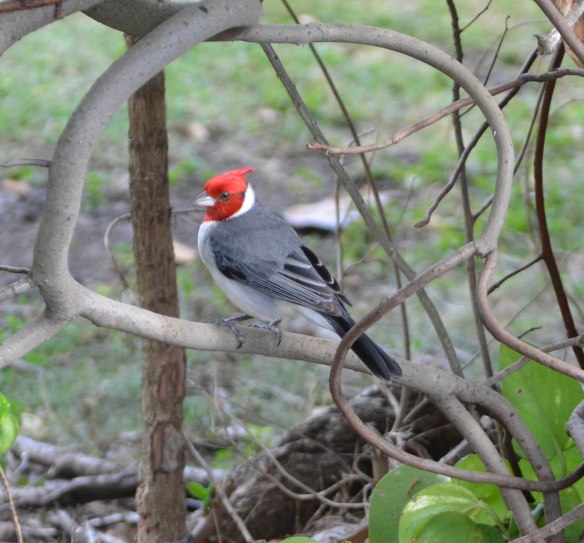
Crested cardinal.
They look like cardinals wearing woodpecker costumes. They are, in fact, crested cardinals. I tempted them closer by throwing some tostada shell crumbs on the ground, which were also appreciated by the ubiquitous blue doves.
I wanted to see the forest park where the trail to Kalaupapa begins. We had no intention of hiking the trail, for reasons already stated, but I knew it was a forested upland area, and very different from the scrubby grasslands of the area where most of the island’s population lives. The road seems to climb gradually, but goes to about 2,000 feet above sea level, where it ends in Palau State Park. It ends for a good reason–the next step is 2,000 feet straight down.
There is an overlook at the top of the pala from which you can see Kalaupapa. It’s like being in an airplane, and you must be able to see a 100 miles or more out to sea.
Tom’s view of Kaulapapa.
This is one of those things Tom doesn’t like (though that may be an understatement). I was fine with it because there was a nice, substantial rock wall separating me from the drop. Tom sat with his back against a large tree, across the path that skirted the wall and declined to come any closer. I admired the view and took pictures.
My view of Kaulapapa.
We walked back to the parking lot through the pines. The pines are unusual, with soft needles fully a foot long, giving them a “Cousin It” appearance for those who remember “The Addams Family.” I had earlier seen some coil baskets made of these needles in a gift store. I have seen pine needle baskets before and admired them, but these needles must have been particularly well-suited to basketry. The two baskets in the otherwise junky gift store were very well made and decorated with small shells. The one about the size of a hummingbird’s nest was priced at $100, so it was safe from me.
It was also cool in the forest–so cool it made me wish I had worn warmer clothes (not that I have warm clothes with me.) As a matter of fact, it has never been uncomfortably warm and is often downright cool, especially at night.
Then we went to look at the other attraction up here. It was indicated by a sign that read, “Phallic Rock.” This trail, unlike the concrete path to the edge of the pali, was unimproved and rather rough. I regretted not having changed from flip-flops into walking shoes, but managed OK. Tom, believing we were getting near the pali again, decided to wait for me on the trail, but I went to the end.
Yup, it was kind of phallic all right:
Phallic rock.
Someone had left an offering in a bowl in the rock, carved either by man or nature. The rock is sacred to the Hawaiian people, who viewed sexual mana as powerful and beautiful. Ku, the chief god, also means “erect,” in every sense of the word, including standing tall agains aggression or oppression. I often see offerings left at heiau or other sacred places.
Offering at phallic rock.
However, some asshole named Jesse carved his name into this rock. I can only imagine what his punishment will be. Probably he’ll be doomed to live his entire life as a stupid person, with all rights and privileges thereto. If I had my way, the centipede I mashed the other night was named Jesse.
The rock was nowhere near the edge of the pali. I picked my way carefully down the rough trail, but Tom wasn’t interested. Tom was interested in descending to lower, flatter ground.
Then we drove back into the metropolis of Kaunakakai to get some groceries, then back to the condo. We were actually too tired to cook again and made do with cheese and crackers. I was even too tired to write!


















 obsidianmirrorblog