Note: I am taking a break from “My Big Fat Weight Loss Campaign.” I hope to have positive progress soon, but right now I am stuck in the doldrum of dieting, despite Ozempic. Here’s something else to chew on.
I have been rewatching Star Trek: The Original Series (ST:TOS to fans), which is the first time I have viewed the series since its original airing in the 1960s. I just watched an episode called “Turnabout Intruder,” story by Gene Roddenberry and teleplay by Arthur H. Singer. It’s an episode I have no memory of. Apparently it was pre-empted by a presidential speech at the time it was supposed to air. It aired later, but I must have missed it.
Briefly, the story is that Kirk visits Camus II, responding to a distress call. Among the survivors are one of Kirk’s former girlfriends (right on brand here, but there’s a twist), Dr. Janice Lester, and a physician, Dr. Arthur Coleman. It quickly becomes apparent that Dr. Lester and Kirk did not part on friendly terms. Kirk was going off to be a starship captain. Lester also wanted to be a starship captain–but was not allowed to hold that position because of her gender. She was angry, and took it out on Kirk, who skedaddled off to the stars.
Hold on–it’s the year 225something, and WOMEN ARE NOT ALLOWED TO CAPTAIN STARSHIPS. It kind of made me sad that Roddenberry’s vision didn’t stretch to that.
Continuing with the story, Dr. Lester assaults Kirk and subjects him to an alien technology that switches their personalities or selves into the other’s body. So Kirk is now in Lester’s body and vice versa. Her claims that she is actually Kirk are dismissed as illness, but Spock does a mind-meld with her and knows the truth. Spock attempts to free “Lester,” but is caught.
Kirk (actually Lester) calls for a court-martial of Spock, with himself, Scotty and Bones as the judges. During the procedure, Kirk (in Dr. Lester’s body) is allowed to testify, and this is what Kirk says about Lester: “Most of all, she wanted to murder James Kirk, the man who once loved her. But her intense hatred of her own womanhood made life with her impossible.”
Really? Was it “her intense hatred of her own womanhood”? Or was she an ambitious person who was deeply thwarted, all because she lacked a penis?
During this show trial, Lester (in the person of Kirk) does some table pounding and red-faced shouting. Scotty and Bones meet outside the courtroom to confer. Scotty says. “I’ve seen the captain feverish, sick, drunk, delirious, terrified, overjoyed, boiling mad, but up to now, I have never seen him red-faced with hysteria.”
“Hysteria,” of course, is a dog-whistle for “like a woman.” I assume most people know that the word derives from a Latin word meaning “womb,” as the womb was believed to be the cause of it. Thus, men were considered incapable of hysteria.
At the end, Kirk and Lester are switched back by some unclear methodology. Janice Lester, back in her own body, collapses weeping in Kirk’s arms, and then in the arms of Dr. Armstrong, who has aided and abetted her all along. Armstrong takes charge of the sobbing woman and leads her away “to take care of her.”
Kirk puts the cap on it by noting, “Her life could have been as rich as any woman’s…if only…if only…”
I noticed he did not claim that her life could have been as rich as any man’s. And a woman’s life, it went without saying, is limited, and women should just accept these limitations and be happy with them.
Although I expected some misogyny/discrimination against women from TOS, this episode shocked me. As a woman born in 1950, it made me realize how far I have come in my own thinking that I could be shocked by this. There are now two generations of women who have grown up believing they are equal to men and deserve the same rights. I find this extremely encouraging.
As I mentioned at the end of my last post, I needed outside help to successfully lose weight this time. I couldn’t put on my Nikes and run a few miles. I wasn’t even supposed to walk for exercise anymore, due to one knee being bone-on-bone and the other knee threatening to go the same way.
And yet, I have never lost weight through diet alone. Exercise is half of the equation. (God, I hate exercising.) I had no idea how to exercise without making the knee worse—or what kinds of exercises I needed to be doing to prepare for surgery. Obviously, I needed to get expert help.
Okay, another thing I have avoided in the past is paying for something I think I ought to be able to do myself for free. I avoided any sport that required an investment in memberships or expensive equipment, such as golf or skiing. I hated the idea of health club membership because I thought I ought to be able to exercise on my own by walking. But health clubs are where they have exercise equipment, so I needed to join one. I signed up with the health club down the street, which I had used (infrequently) in the past. Endearingly, it is a part of the local “Toadal Fitness” group of health clubs.
Physical therapy was also on my list, but PT only goes so far. I wanted to hire a personal trainer, someone who understood which areas I needed to focus on, and who could tell me how to use the equipment and create a workout routine for me. I mentioned this to my physical therapist, who recommended two trainers who work at my health club. The trainers had undergone training at my PT’s practice on how to work with people with injuries and constraints. So I trotted down to the club and was introduced to Zach. Zach showed me around and listened to me, asked a lot of questions, and we talked.
I don’t know what your idea of a personal trainer is, but Zach wasn’t mine. I guess I thought a trainer would be a lot younger than me, nauseatingly fit, and perky. Zach is starting to push past middle age. He’s fit enough, but not the muscle-bound person I was expecting, and he has his own issues relating to age and injury, so I feel comfortable talking to him about my multiple physical shortcomings. He’s got a sense of humor, which I enjoy. He also pushes me—not hard, but enough that I make progress every time we have a session.
What are we working on? For cardio, I do the recumbent bike. When I started, I could only do a quarter of a mile before my knees became too sore to continue. I decided I would just do what I could do when I could do it. I told myself all I had to do every day was go to the club and bicycle for a quarter of a mile. That seemed easy enough, and it got me to the club. Before long, I was doing a half a mile, then three-quarters, and so on. I am at two and a half miles now.
The program I am using on the recumbent bike is a racecourse, which I carefully selected because its steepest incline is only 3%, and the incline doesn’t last long, either. Right now, I am going for mileage, not endurance. I hate hills, don’t you?
Zach works with me on the machines and weights. We started with machines that work the thighs and hips and the muscles above and below the knees. I am one of God’s Clumsy Children, and some of those machines—especially the clamshells, the ones you exercise your thighs on—are lurking deathtraps, just waiting to break bones. Zach watches me anxiously as I slowly negotiate these complex contraptions—getting in and out is the hardest part. So far, I haven’t broken me or one of the machines. I am actually getting more graceful as I get used to them. Any day now, I might try using them without Zach to watch over me like a mother hen.
I meet Zach once a week at my health club. I haven’t said much about the club, but it’s friendly, and a large percentage of the clientele has gray or white hair. It feels neighborhood. It isn’t fancy, but it has all the stuff, including a saltwater pool.
Now, what about diet? I lost a fair amount of weight in the past using Weight Watchers. I found it an easy program to follow, but I did not enjoy the meetings. I was eating unprocessed, fresh foods. The people in my meeting seemed to find the time involved in preparing fresh food unacceptable. To be fair, many of them had kids at home to feed and deal with, and I certainly could empathize with that, but the discussions weren’t centered around any of my concerns.
These days, you can purchase the WW app for your phone and not go to any of the meetings if you prefer (I do). The app allows you to look up the point value for a huge range of foods and adjust quantities. It tracks your points daily and weekly and keeps a food diary. You can create your own recipes for quickly entering meals you eat frequently. You can track your weight and the app adjusts your available points as you lose. It has lots of other features that track water consumption and exercise, and you can also look up WW recipes, but I don’t use all of its capabilities.
I was working with my doctor’s nurse practitioner, Ashzra, on all this. Ashzra questioned the Weight Watchers approach. She said I should be consuming no more than 1500 calories a day. Did WW conform to that? So for a week I tracked WW points versus calories. I was honest about it—WW counts certain things as zero points, such as fruit and fish, that still have calories. I tracked ALL the calories I consumed during that week. It turned out that using all the WW points for a given day came in at or under 1500 calories. One day, it was 1700, but I had come under the 1500 mark enough times that I was unconcerned.
So, physical therapy—check. Health club, personal trainer, and exercise program—check. Diet—check. The one element remaining was medication. The news is brimming with stories about the new weight loss drugs like Ozempic and Wegovy. The news is also full of how expensive these drugs are and how hard they are to get.
Next installment: Part 3—The New Weight-Loss Medication Merry-Go-Round
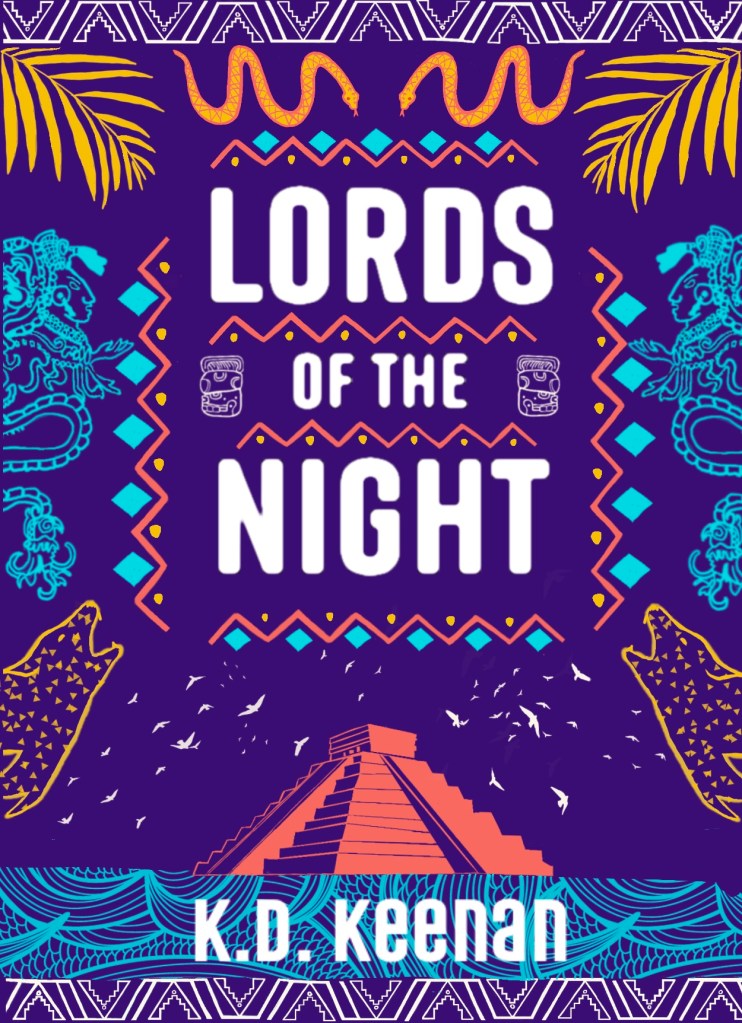
The following is the entirety of Chapter 1 from “Lords of the Night,” now available at Amazon.com:
“Who do you think you are, Chaco? A drill sergeant?” Sierra snarled. She slipped off the greased bowling ball, dropping the dishes she had been balancing on the end of a broomstick. The dishes shattered on the tile floor of her kitchen. She picked her way through the shards in oily bare feet, muttering, and seized a glass of water, gulping it as she wiped away the sweat pouring down her face and neck.
“I warned you this would be hard,” said Chaco. He passed a hand over the ruined dishes and they disappeared. He cocked his head at her, amber eyes steady.
“Yeah, you did,” Sierra responded. “But what the hell does standing on a greased bowling ball and destroying crockery have to do with becoming a sorceress? I’m not applying to Cirque du Soleil for a job.”
“Take a break,” Chaco replied peaceably, but his equanimity did not soothe her.
“I AM taking a break,” Sierra shot back. “Are you going to answer my question?”
Chaco lowered his lithe body into a chair, raking fingers through his dark hair. “As I told you when we started, the training is mental, spiritual, and physical. This is part of the physical training. A magic worker will often find him—or her—self in physically dangerous situations. You need to be strong, very strong, and your balance, aim, and precision must be honed to the highest degree. Think of yourself as an Olympic athlete…”
Sierra glanced down at her body, clad in shorts and tank top. She had been toned and on the slender side when she and Chaco had begun her training. Now she saw muscle definition in her thighs, where before they had merely been strong and well-shaped. The training was definitely making a difference. But god, she was working hard! And she hated it.
“I don’t get it,” she said, still cross. She knew Chaco was only doing his best to help, but at the moment, she didn’t care. “You never exercise. You never practice. Sure, you noodle around with trying new magics once in a while, but I’ve never seen you balancing on a greasy bowling ball. Do you do it when I’m not around or something?”
Sensing that Sierra was easing up a bit, Chaco laughed. “I’m a demigod. I don’t have to practice. When you become a demigod—or full-on goddess—you won’t have to practice either.”
“What? What are you talking about?”
“Well, you can’t expect to become a goddess overnight. You have to work at it. Like becoming Miss Universe or something.”
“Are you telling me that I’ll become a goddess if I continue the training?”
“Oh, no. There are no guarantees. Once you complete the training, there are still the traditional trials and tribulations.”
“I don’t want to be a goddess, Chaco. Your training sucks and I’m done.” Sierra put down her glass and stalked away, leaving Chaco in the kitchen, smiling to himself.
#
One year previously, Sierra had inherited a comfortable sum of money and a house from her fiancé, Clancy Forrester. There was only one problem; she suspected Clancy wasn’t actually dead. No body had been found and her friend Rose, who had witnessed Clancy’s fall from the side of a boat, said Clancy had never hit the water. If he had, he would have died, as the water was boiling from an undersea volcanic eruption.
The inheritance bothered her conscience, but she rationalized that if Clancy were alive somewhere, she would need the money to find him. She quit her job as communications executive with the Clear Days Foundation—a job she loved—to have the time to search for him. She thought Clancy would forgive her for selling his house and spending his money when and if she ever found him. And she knew she needed training to fully harness the powers that would enable her to find Clancy and rescue him from . . . whatever he needed to be rescued from. Unfortunately, she didn’t know what he needed to be rescued from. In point of fact, she also didn’t know when he needed to be rescued, but she and her friends were working on that.
While she was figuring out what she needed to do to find Clancy, she sold her own modest townhouse in Mountain View, California as well as Clancy’s highly sought-after ranch house in Sunnyvale. She added those proceeds to the three million dollars Clancy had left her in investments and began looking for a house where she could train in privacy. Her friend Rose, a Native American shaman, had suggested purchasing a remote cabin.
“You’re going to need privacy—real privacy—and alone time now,” Rose had said. “This training is serious business and you need to concentrate. And you don’t need nosy neighbors.” Sierra bought a cabin in a redwood forest in the Santa Cruz Mountains, which was remote enough to satisfy her friend.
However, Rose had refused to train Sierra herself. “You’ve already gone beyond me in strength,” Rose had said. “There’s really nothing more I can teach you.”
Sierra also asked her friend Mama Labadie to train her. Mama Labadie was a Voudún houngan whose ability to communicate with her loa—or at least with the loa called Madame Ézilée—had come in handy many times during Sierra’s earlier adventures. “No, uh-uh, and absolutely not,” was the houngan’s response. “You’re already scary strong. You should ask Madam Ézilée, not me. She might be strong enough to teach you before you get somebody killed.”
Kaylee, Sierra’s former work colleague and now a fast friend, was a Voudún practitioner, but claimed absolutely no occult powers. “I’ve been watching you,” Kaylee told her when Sierra groused a bit about Mama and Rose’s refusals to train her. “You’re powerful. You’ve gone wa-a-ay beyond Mama and Rose. They were right to turn you down. Sugar, you need to find someone who’s got more oomph than you do.”
#
One evening, as Sierra was unwrapping china mugs in her new kitchen and putting them on shelves, she complained to Chaco, “They’ve been telling me forever that I need to exercise my powers. That I need to train. But when I ask now? No dice. Mama and Rose won’t help me. Kaylee says she can’t help me. I don’t get it—they like Clancy. They want to get him back. I mean . . . don’t they?”
Chaco, his hands full of packing materials, took a moment to answer. “Of course they like him,” he finally said, swiping raven-black hair away from his face. “They probably liked Clancy more than he liked them.”
Sierra had to admit this was likely true, even if she didn’t like the past tense. Clancy had never been entirely comfortable around the “Three Weird Sisters,” as he called her three closest female friends. “Okay, but still. Wouldn’t you think they would help me to find him?”
Chaco put down a salt and pepper shaker set and sat in one of the kitchen chairs. “Do you want to have a serious conversation about this, or are you just bitching?”
Sierra set two mugs in a cupboard and sat down opposite Chaco. “I want a serious conversation. Tell me.”
“Let me make an analogy. Let’s say you’re a golfer, and you want to improve your game, maybe even play competitively. Do you go to your golfing buddy for training? The one who plays worse than you?”
“Well, obviously no. I take your point. But how am I going to find a teacher who’s better than me, if I’ve somehow gotten so strong?”
Chaco sat quietly, regarding her with his amber eyes. His expressive lips were slightly curved, his body relaxed and boneless-looking in the wooden chair. Like his alternate form, a coyote, he had the gift of seeming at home wherever he was. He continued to gaze at her in silence.
“You mean . . . you?” she finally asked.
“Who else is there?”
And that was that. She began her training in magic to find and rescue Clancy, wherever and whenever he might be. Chaco moved into Sierra’s second bedroom (she didn’t ask where he had been living before) to dedicate his time to her training. She expected that his residency would result in a renewed interest in getting her into his bed, but to her surprise he treated her as a comrade-in-arms with none of his usual sly suggestions. She found herself staring from time to time at Chaco’s face, with its long, chiseled planes, his golden eyes, his nicely muscled…and then she would flush with guilt at the thought of Clancy. Clancy, who would not be lost if it weren’t for his love for Sierra. But having Chaco around was convenient, and he was behaving himself, so the arrangement made sense.
Chaco had concentrated first on her powers, her mana. In the beginning, Sierra had envisioned her mana as colored flames, erratic and difficult to control. Gradually, she had come to see her powers as brightly colored ribbons twining in space, of every color she knew and some she didn’t. Chaco was able to visualize along with her. “There, right there,” he’d say. “That bright pink one? That’s for healing. Wrap it around your sore knee and see what happens.”
In the next moment, Sierra blinked at him in surprise. “The pain is gone!”
“You can heal other people, too. Try it the next time you see someone limping or with a bandage.”
“Won’t that be kind of obvious?”
“How would they know?” he asked reasonably. “You don’t have to wave a magic wand or recite a spell. They can’t see your mana—only you can. And me, of course.”
Sierra rather enjoyed the mana-strengthening sessions. She no longer endured sprained muscles or headaches. The gold ribbons were for battle. The silver ones were for moving things, the black ones were for…Sierra didn’t know what the black ones were for. They weren’t actually black, as they shifted between deepest indigo, bottle green, copper, and . . . something else . . . as she watched them.
“Chaco, what are the black ribbons for?” she inquired one day as she and Chaco took a break by the little creek that ran near her cabin.
“Black ribbons?”
“Yeah, like this,” and she called the black ribbons up, letting them twist and coil in her mind’s eye, glittering slowly.
“No!” Chaco yelled. He shook her and the twining black ribbons vanished.
“What the hell?”” Sierra scrambled to her feet and glared at him. “What’d you do that for?”
Chaco remained seated, gazing at her seriously. “Sorry. I didn’t mean to scare you. Those … black ribbons. Don’t use them. That is not mana that you can control. If you try, the mana will control you.”
“Then why do I have it?”
Chaco just shook his head. “I suppose we all have something like that inside. Something uncontrollable and dark. Just don’t use dark mana.” He rose in one smooth motion, then effected a dizzying transformation. His face elongated like melting wax, and as Sierra watched, his body hunched, arms and legs growing crooked and furry. Within a few heartbeats, a large, handsomely furred coyote stood next to her. He turned and trotted away into the shadows between the redwoods. Sierra watched him go, a hundred questions unanswered.
#
While she was training, Sierra tried to determine where Clancy had gone, specifically. The loa had indicated in their usual infuriatingly vague way that Clancy was alive and in the Yucatan Peninsula, but had then become tight-lipped and uncommunicative. The Yucatan constituted 76,300 square miles, which was impossibly large to search. Of even greater concern was the question of when. If Clancy had been whisked off to the Mayan Riviera, or even to a remote jungle, surely, he would have been found by now. Unless he’s dead, whispered a sombre voice in Sierra’s mind.
“Are we certain Clancy didn’t die when he went over the side of the boat?” she asked Rose and Kaylee, not for the first time. Kaylee hadn’t been in Moloka’i when Clancy disappeared, but Rose had been present.
“No, he never went into the water,” said Rose, patiently. “I don’t want to get too graphic here, but do you remember what happened to all those sharks and other fish?”
Sierra shuddered. She remembered the pale, poached bodies of tiger sharks, boiled to death by the wrath of Pele beneath the sea.
“Yes, I do, and Clancy wasn’t among them. But I feel like I’m grasping at straws here. We have nothing to go on but your amulet. Why did you give it to Clancy, by the way? He didn’t—doesn’t—believe in things like that.”
“Once in a while, I ‘see’ a darkness hanging around a person. It usually means they’re about to die, whether by accident or suicide. I saw this darkness around Clancy shortly before we went out to the wind farm where he went over the side of our boat. My amulet is powerfully protective, so I asked Clancy to wear it. When I handed it to him it was in a little leather medicine bag, but he took the amulet out and wore it around his neck, under his shirt. Probably so people wouldn’t see it, is my guess.”
“Do you know anything about the amulet? Where it was made? When it was made?” asked Kaylee.
“I know it was made in the Yucatan Peninsula during Mayan times, because it represents a scroll serpent or spirit snake, which was peculiar to the region. It represents Kukulcan, the feathered serpent, with an ancestor spirit emerging from its mouth. I don’t know anything more about it,” concluded Rose.
“Wait a minute,” said Kaylee. “I thought Quetzalcoatl was the feathered serpent?”
Rose smiled. “Yep. He was—is. He was the plumed serpent of the Aztecs. But Kukulcan came first, with the Maya. If you encounter him again you could ask, but I suspect they are the same Avatar, viewed through different lenses.”
The women thought for several minutes, each pursuing the question of how the amulet might help them locate Clancy. Rose said, “You know, a few years ago I took pictures of all the Native American artifacts that I’ve collected, just in case I needed them for insurance. I must have photographed the amulet, too. The pictures are on a flash drive that I put in my safety deposit box. Maybe the photo will show us some detail that I’ve forgotten.”
A quick trip to the bank, and the flash drive was inserted into Rose’s computer, Sierra and Kaylee hanging impatiently over her shoulder. She located the right files and brought up two photographs of a green stone carving, an elaborately curlicued serpent figure. Rose pointed out the figure of the ancestor spirit emerging from the creature’s mouth.
“What’s this other one?” asked Kaylee, pointing at the second photo. At first, it looked like a reverse image of the first, then Sierra realized it depicted the back of the intricately carved amulet.
“Rose, there’s something carved on the back! What does it say?” Sierra asked, pointing to the screen.
Rose peered at the image. She shook her head. “I have no idea.”
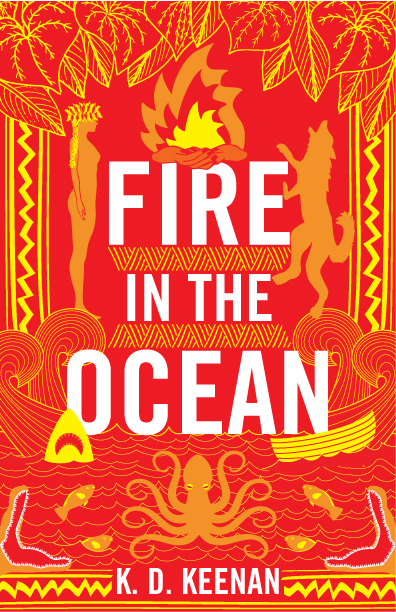
I couldn’t have done this without the help of several people who took the time and trouble to offer me advice. I was also smart enough to ask my artistic daughter, Kerry Gil, who has formal training in graphic arts, for feedback.
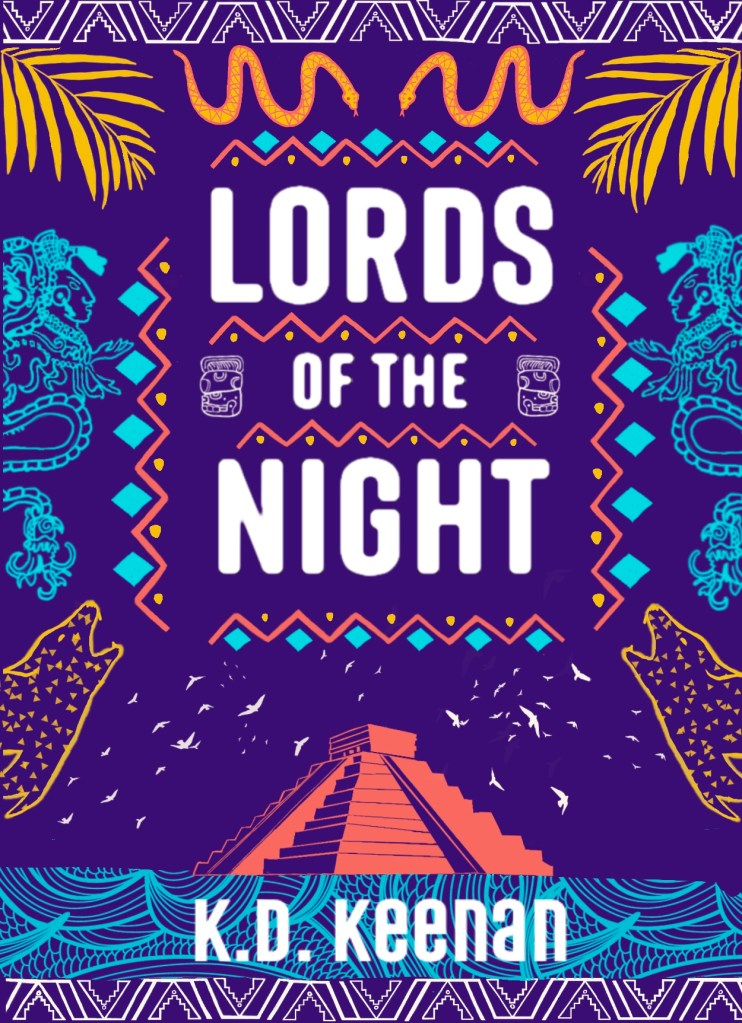
I am super pleased with the resulting cover. I probably went through eight different iterations before getting to this one. I didn’t post all of them, but I got wonderful feedback from my friends online as well as family. I suppose I have had more difficult creative challenges, but mimicking someone else’s style in a field in which my competence is minimal is one of the tougher goals I have set myself.
In particular, I am pleased that everything fits the ancient Mayan theme of the book–ocean, snakes, temple, palm fronds, Spirit Snake amulet, coyote (Chaco!). The birds flying around the temple refer to a climactic scene in the book (although it’s not the only climax, I assure you).
I hope you like the cover. I will be back soon to announce the publication of “Lords of the Night,” the final (and climactic) ending to “The Gods of the New World” trilogy.
Okay. I admit I am not the world’s most dedicated blogger. I haven’t posted since the end of my Iceland trip, sometime in July—and I was cheating, because after we left Iceland, we went to Copenhagen, then Stockholm, and had a wonderful time. Except for the heat. It was 85 to 95 degrees Fahrenheit the whole time we were there, and of course, Scandinavia doesn’t know from air conditioning. My husband, who walks six to eight miles EVERY FUCKING DAY wanted to walk everywhere. I vividly recall standing in a jeweler’s shop looking for gifts and raining sweat on the display so hard I didn’t even contemplate looking for better prices because I was so embarrassed.
The only place I recall being air conditioned was the Vasa Museum in Stockholm. It is a museum that was built around an entire 17th century ship called the Vasa that sailed for 1500 yards on her maiden voyage, then keeled over and sank. It turns out she was top-heavy and there wasn’t sufficient ballast. A great pity for the king of Sweden, who had commissioned the ship and assured she was as gaudy and painted and stuffed full of guns as a wild west whorehouse. A greater pity for the thirty people who drowned when the Vasa sank. But a benison for the rest of us, because the ship was raised nearly intact and restored so that we can marvel at her and the astounding objects and decorations that she flaunted so briefly. And the entire building was positively freezing. I loved it.
But back to blogging. Why do I blog? I blog because I hope it will help sell my novels, although I don’t talk about my novels that much. I guess I am hoping that you’ll adore my prose style and want MORE! MORE! MORE!
But I have a problem, and I suppose I’d better discuss it. I have two novels of a trilogy in paperback, ebook, audiobook, etc.: “The Obsidian Mirror” and “Fire in the Ocean.” I also have a children’s book that was self-published, but let’s leave that aside for now. Last January, I sent my publisher, Diversion Books, the draft of the third, final, and (in my opinion anyway) best book of the trilogy, “Lords of the Night.”
My publisher basically said, “Oh, did we forget to tell you? We’re focusing on non-fiction now.” Long story short, they are still making the first two books available, but nothing further, and they won’t be bringing out “Lords of the Night.”
I believe that’s called “trilogus interruptus.”
Fast forward to last week, and I attended the World Fantasy Conference In Los Angeles. I wish I could say that a publisher stepped forward and rescued my entire trilogy, all the while warbling promises of AWESOME book promotion, but that didn’t happen. I did talk to an editor at Daw, and editor at Tor, and an agent that handles fantasy, and they all said the same thing, more or less: you are so screwed.
It seems that publishers don’t like picking up series in the middle, even if they can (my publisher will give me back my publishing rights). The advice was to take “Lords of the Night” to Kindle—maybe all three books—and do my own promotion. The agent suggested that a smaller publisher might pick up the trilogy; it would be worth trying. And then I can write my next book—unrelated to the trilogy—and find an agent and a new publisher.
Interestingly, I met at least three other writers who said the same thing had happened to them. Being a novelist is so glamorous.
But I did come back newly energized. I plan to pitch a few publishers and see what happens. And I have started on a new book. It will be set in settlement-era Iceland, as the Vikings began to turn into farmers and build a new society. But there will be magic, and it will be Icelandic magic, which is different from other magical systems I am familiar with. As a consequence I am studying the Elder Futhark, which is the set of Icelandic runes used in fortune-telling in the Icelandic tradition. In this tradition, the runes themselves are magical, not just another alphabet. Each does have its own sound, which means the runes can be formed into words—but each also has its own meaning, both symbolic and literal.
For example, berkana:
As you might suspect, the sound associated with it is “B.” It means “birch.” Its more mystical meaning is “purification, fertility and birth.” This can be interpreted a number of ways, depending on where it falls in the casting, whether or not it is reversed, and its relationship to the other runes in the casting. It’s almost as complicated to learn as tarot, except that a standard tarot deck has 55 cards, while the Elder Futhark has only 24 runes. Which I guess makes it about half as complicated as tarot.
I am the rankest of amateurs and I don’t actually believe in magic, but I have been a bit awed by the runes and how accurate they tend to be. I’m looking forward to the role they will play in my new book.
For now, I will leave you with this random observation. In old Iceland, food was always an issue, and many times life depended on finding something dead washed up on the beach. One standby food was dried fish. Here’s what dried cod looks like (this one has a tag on it from the supermarket):
I suppose this could be rehydrated and cooked in a stew, though I haven’t gotten that far in my culinary research yet. But the preferred way of eating it was to break off a piece, cover it with salted butter and eat it. Icelanders still enjoy this as a snack, kind of like we eat potato chips.
I admit I did not know this when we were in Iceland, or I would have tried it. Next time.
Once upon a time, many years ago (many, MANY years ago), I was a college student at Beloit College (it’s in Wisconsin and that’s all you need to know about it). I was earning a Master’s Degree in Teaching, and one of the courses I took was Children’s Literature. Much of our grade was based on two essays the professor had assigned. Two essays that I am sure the professor had selected carefully for their learning potential, but which I thought were incredibly boring.
So without any notion of what I was really doing, I asked my prof if instead of writing two essays, I could write two children’s books instead. He agreed.
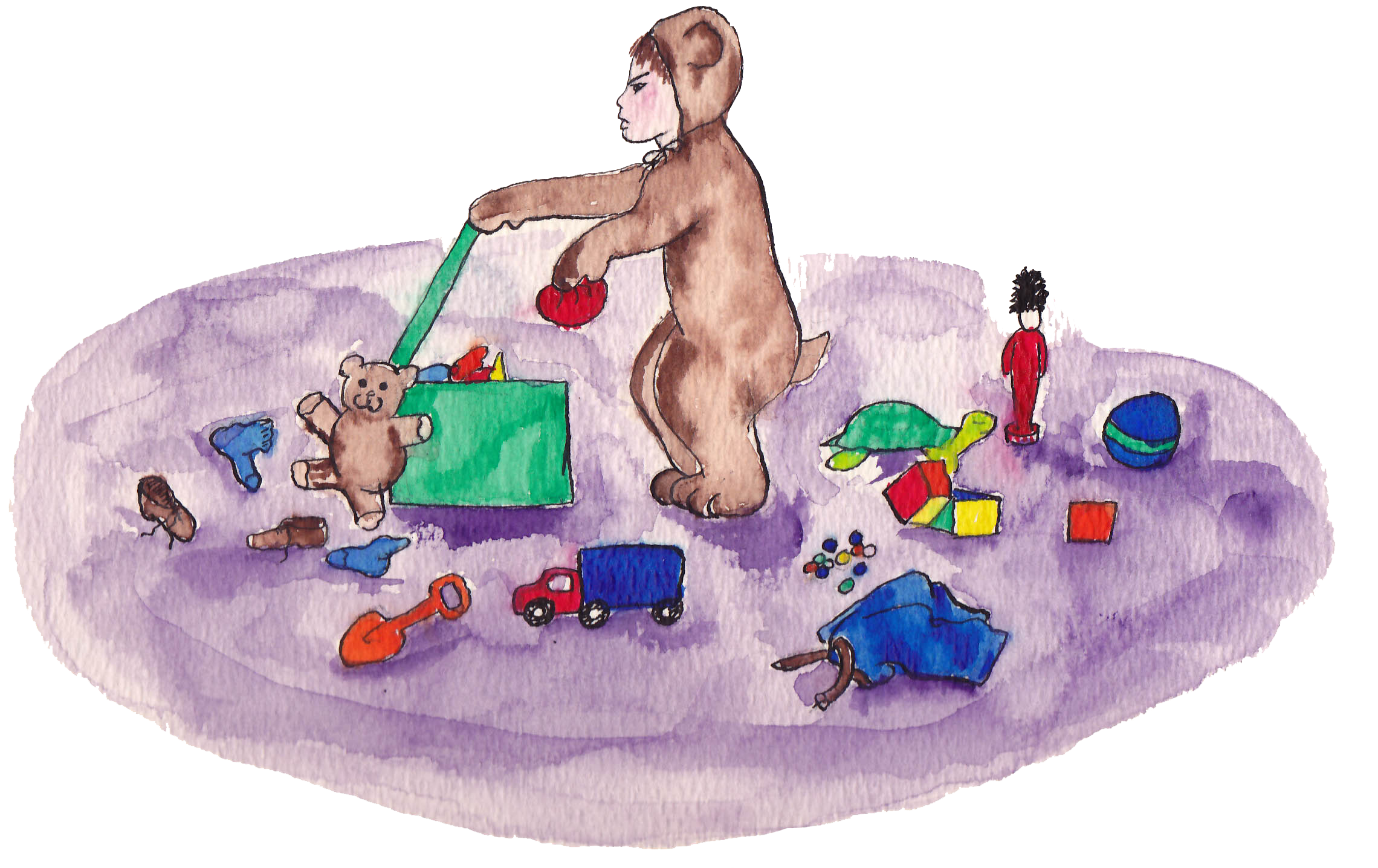
I spent the better part of the next several weeks holed up in the house trailer where my husband and I lived at the time, writing a little book called “I Am Not a Bear,” and illustrating it in pen and ink and watercolor. I painted the scenes and then pasted the typewritten text onto the watercolor paper. Lacking any sort of binding option, I punched the pages with three holes and fastened them with binder rings. It was a crude production, but the best I had to hand.
The original illustration of Paul picking up his room.
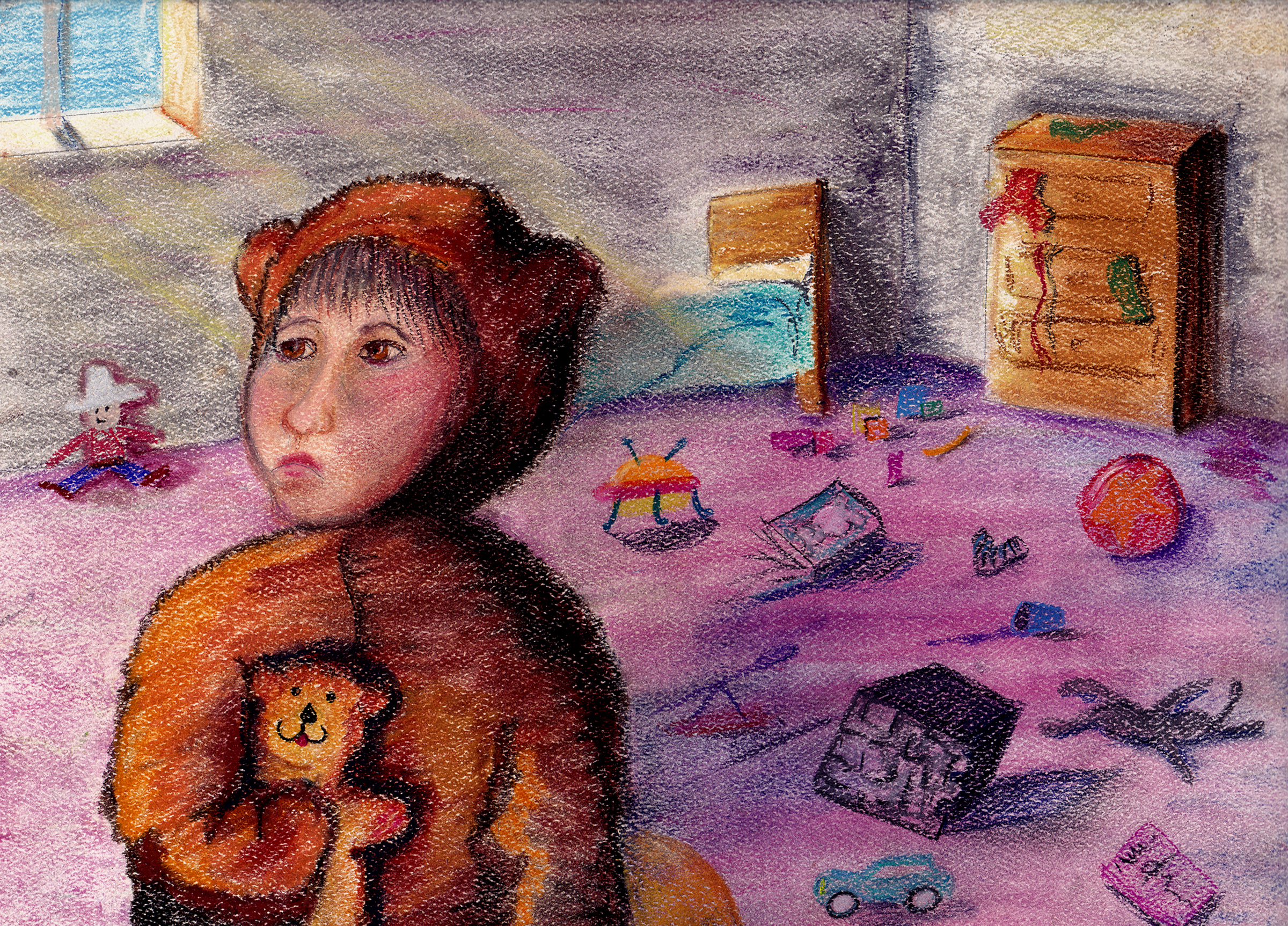
The new illustration of Paul picking up his room.
The story is about Paul, a little boy who wants to live with the bears because bears don’t have to do math, pick up their rooms, or eat oatmeal. He winds up trading places with a bear cub, Growf, who wants to live with people. Both discover there really is no place like home, but they do meet each other in the end and have a good laugh about it. It’s a simple story with a sweet message about family and home—and whether or not the grass is really greener elsewhere.
My prof liked the book and read it to his kids, who also liked it. I got an A+ in the class. End of story.
Except it wasn’t the end. I kept this opus in a file drawer for many years. When my kids hit the right age (around four years old), I pulled out my “book” and read it to them. They seemed to enjoy it, even if it didn’t become a favorite like “The Cat in the Hat.” But then, my book didn’t rhyme.
The decades passed. The grandchildren came along. I read “I Am Not a Bear” to them, too. But as I was reading it, I noticed a few things with embarrassment. It was too long and wordy for the target age. The illustrations were crude, and I had learned how to paint in oils by this time and had paintings hanging in galleries. Even more important, print-on-demand had been invented, so I could create a genuine book for my grandchildren—something they could keep if they wanted.
I rewrote the book, trying to cut verbiage and page count. Then I re-illustrated it in pastels. I wanted a soft, fuzzy look, and pastels seemed ideal. I had never used pastels before, but I didn’t let that stop me. It turned out pastels weren’t that much different from painting in oils, just…drier. Then I formatted it for lulu.com and printed a few copies for the grandchildren and sundry other kids belonging to friends and family.
I thought that was the end of this little story. But no.
I became distraught over the separation of families at the border and the imprisonment of immigrant children. I lay awake at night, agonizing over those poor kids and their families, frustrated because there was nothing I could do to help.
Then it occurred to me I could help. If I could find an appropriate organization aimed at helping immigrant families at the border, I could self-publish “I Am Not a Bear” as a bilingual English-Spanish book and donate all the proceeds to that organization to help them be more effective.
I approached only two refugee assistance organizations. The first one never replied to me. The second, the National Network for Refugee & Immigrant Rights (NNIR), responded immediately and enthusiastically that they would love to work with me on this. They have been an appreciative partner.
Just one problem. I don’t speak or write Spanish. I can find my way around a Spanish-speaking country by dint of speaking only in the present tense and waving my hands around a lot, but I didn’t even know the Spanish word for “bear cub.” (It turns out a lot of people who speak Spanish don’t know that either, which made me feel better.)
Fortunately, I have a Spanish-speaking friend who grew up in Mexico, Clod Barrera. I asked Clod if he would translate my book, for the magnificent compensation of nothing but my eternal gratitude. Clod, being a wonderful person, did so. And then I passed the translation around to a few other people to make sure all was copacetic—because I sure wouldn’t have known if there were a problem!
Finally, everything was ready to go. Except for formatting the new version of the book on lulu.com. For some reason, this took forever, and I have no intention of boring you with why, but it is finally ready to sell.
I don’t usually ask people straight out to buy my books, but I’m making an exception. If you care about the plight of children and families at the border—and know a child (around four to seven years of age) who would enjoy the book, or know of a school that could use bilingual books for young children—I’m asking you to buy “I Am Not a Bear/Yo no soy oso.” One hundred percent of the profits will be donated to the NNIR for at least two years. Here’s where to get it: http://www.lulu.com/shop/kd-keenan/i-am-not-a-bearyo-no-soy-oso/paperback/product-23979188.html
I thank you in advance. Every book that sells sends more money to help immigrants and their families.
This illustration didn’t make it into the book for purely technical reasons. but I kind of like it anyway.
I love cozy mysteries. Especially English cozies. This may be because I started with Agatha Christie—I tell a lie, it was actually Nancy Drew, so there goes that theory.
Anyway, I like the whole tea-and-crumpets thing. And I listen to a lot of audiobooks, so when someone teddibly, teddibly English narrates, like Davina Porter or Simon Vance, I feel fully immersed in jolly old Blighty.
But they have to be well plotted, too. Really, the core of a mystery is its plot. A mystery is a contract between the author and the reader. The author promises not to spring the solution to the mystery on the reader without first hinting at it or making the critical information known to the reader. The author’s skill is in disguising the information in such a way that the reader never guesses, or is at best unsure until the end. Like many mystery readers, I love to try to figure out the solution before the author reveals it—but I don’t want it to be obvious, either.
In the end, the reader has to be able either say proudly, “I figured it out, but it wasn’t easy,” or, “I should have seen that coming, but I didn’t.” Either way, it has to be a satisfactory end that explains all loose ends and does not defy the laws of reality as we know them.
A few years ago, I stumbled across G.M. Malliet’s mystery series about life in Nether Monkslip, an isolated English country village. The star is an Anglican priest, Max Tudor, an ex-M15 agent who wearied of the life of a spy and went into the god-bothering business. Being an Anglican priest, he gets to have a love life, too. The object of his affections is Rowena, the hippy-dippy owner of the village pagan/spiritual/wicca shop. I’ll just say they are a fun couple.
I adored the series, but soon read all of the existing books, so I picked up another mystery by Malliet, this time with her Detective Inspector St. Just. The first two books were not as enthralling as the Max Tudor stories, but good enough that I purchased a third, “Death at the Alma Mater.”
There are spoilers from this point forward, so please stop reading now if you intend to read “Death at the Alma Mater.”
The story takes place at the fictional St. Michael’s College of Cambridge University. The college hosts a weekend get-together for Old Boys and Girls, and they invite only the wealthiest alums because the intention is to dun them for seriously large donations. One of the guests is gorgeous and wealthy Lexy Laurent, who is famous for being famous, her ex-husband, Sir James Bellows, and his wife India, who took James away from Lexy after only three years of marriage.
It is 20 years after the graduation of these Old Boys and Girls, yet Lexy is believed to still have an obsession with Sir James. When Lexy turns up dead by the boathouse, the fun begins.
I won’t expose the entire plot, but what is supposed to have happened is that James, a writer, had published an early novel that promptly sank from view without notice. He casually gifted his then-wife, Lexy, with the rights to this novel, never thinking it would ever be worth anything. (We don’t know this detail until the exposition at the end.) Lo and behold, the novel develops a cult following and then becomes an overnight best seller years later. Movie deals are being discussed. James, knowing that Lexy will be at the reunion, asks for the rights back. Lexy, having finally reduced her passion for James to ashes, refuses. James pretends it’s no big deal, but plots her murder during the reunion at St. Mike’s.
He carries out the murder near the college boathouse before dinner. After dinner, he is seen by several people having a serious chat with Lexy in the garden. In truth, “Lexy” is a plastic blow-up doll with a Lexy wig on (she’s famous, remember?), wearing an academic robe. This is supposed to establish that Lexy was alive, though in fact she has been dead for a few hours. This gives James an alibi, as he is careful to be within sight of the other guests until the body is discovered.
This is where G.M. Malliet and I parted company. I just didn’t believe a disguised plastic blow-up doll, even if seen only from the back, could pass as a human being. And the jiggery-pokery of blowing up the doll, dressing it, moving it, making sure people saw it but that no one got close enough to see that it wasn’t Lexy, and then somehow getting it out of there without anyone seeing either him or the doll—nah. I became unwilling to suspend my disbelief. (I mean, have you SEEN one of those dolls?)
The other major point is that James killed Lexy for the rights to his book. It was never mentioned that Lexy might have a valid will leaving everything to the Orphaned Hedgehog Home or something. The ex-husband certainly would not be handed the rights back if he were not specifically granted those rights in the will. So it would have been all for nothing.
I can only recommend the St. Just series with muted enthusiasm, and “Death at the Alma Mater” not at all. However, I most heartily recommend all the Max Tudor books. They are everything English cozy mysteries should be, and satisfying reads, every one.
Mysteries are different from other genres in that the author has a specific contract with the reader. This contract says, roughly:
1. Thou shalt provide the reader with the clues needed to solve the mystery, if the reader manages to look at the clues in the right way.
2. Thou shalt not conceal the one piece of information needed to identify the criminal.
3. Thou shalt not make the criminal easy to identify because that would be no fun at all.
4. Thou shalt not invent random crap like time travel to explain how the criminal managed to pull off the crime.
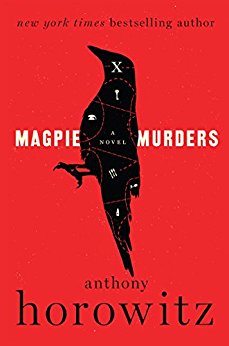
These restrictions can make mysteries rather formulaic, but great mystery writers rise above them. And occasionally, an author manages to pull off a tour de force that both respects the contract and rises above it. “Magpie Murders” by Anthony Horowitz is just that kind of mystery.
But before we get into the novel, let’s talk about the two basic genres of murder mystery: cozy and hardboiled. It’s actually more like two separate genres, because cozy readers often don’t like hardboiled mysteries, and vice versa. Agatha Christie is, of course, the great-grandmother of the cozy mystery with her English villages, eccentric detectives, crumpets and tea. Dashiell Hammett and Mickey Spillane epitomize the hardboiled mystery, with gritty, urban settings and down-at-heel, cynical detectives like Mike Hammer.
“Magpie Murders” is by definition a cozy and an English cozy at that. My favorite kind of mystery, in short. Don’t ask me why I am so enamored of vicars, fêtes and jumble sales—I just am. “But “Magpie Murders” is a cozy mystery within a cozy mystery, giving the happy reader not one but TWO mysteries to solve. The murders are unconnected except that the author of “Magpie Murders,” the book within the book, is also the victim in “Magpie Murders,” the novel.
Okay, that might have been a tad confusing so I’ll back up. The story opens with a book editor, Susan Ryeland, reading a manuscript. The manuscript, “Magpie Murders,” was written by Alan Conway, an enormously successful mystery writer and the mainstay of Susan’s employer, a small publishing firm. Susan warns the reader that the manuscript changed her life completely, and then we plunge into the story of “Magpie Murders.”
This story within a story is set in post-WWII England. An apparently accidental death occurs in Pie Hall, the residence of the local gentry, Sir Magnus Pie and his wife. But was it an accident? Small-town tongues are wagging. Then Sir Magnus is found dead in his front hall, decapitated by a sword from a nearby suit of armor. There are carloads of suspects, but nothing that makes any sense. Conway’s fictional detective, Atticus Pünt, is called in. Pünt appears to have solved the mystery—perhaps—by the time Susan Ryeland comes to the end of the manuscript. But the final chapters are missing. And then her boss gets a letter from Conway that sounds a great deal like a suicide note, and they discover he is dead, apparently having thrown himself off a high tower attached to his historic residence.
Susan begins investigating on her own because she needs to find the missing chapters—her publishing firm might not survive without bringing out Conway’s final book. She doesn’t find them, but does discover that someone has taken Conway’s notes and wiped all versions of the book on his computer. She begins to suspect that Conway was murdered. She also finds that there are several people who had excellent motives for murdering him, from his recently discarded lover to his next-door neighbor.
At this point, the reader is working on two murder mysteries, both taking place in English villages, and both involving assorted vicars, village residents, and mysterious visitors. Horowitz does a credible job of keeping the stories distinct. A lesser writer might have led the reader into an inextricable bog of confusion. I listened to the audiobook version, and splitting the narration between a man and a woman helped to keep the two stories straight. Samantha Bond narrated those portions told by Susan Ryeland, and Allan Cordune narrated the manuscript mystery. Both did an excellent job.
Eventually Susan solves the modern mystery and finds the missing pages. She nearly loses her life in the attempt, but then we get to read the end of the story-within-a-story. Both mysteries resolve satisfactorily and adhere strictly to the reader-author contract outlined above. I didn’t guess the solution to the manuscript mystery at all, and only sussed the modern mystery toward the end. Far from feeling frustrated by this, I am always happy when the author outsmarts me—as long as the author plays fair. “Magpie Murders” is one of the most enjoyable reads I’ve had in a while, and I will look for more mysteries by Anthony Horowitz.
[This post was originally published at Megan Groom’s blog, https://bit.ly/2HVe5NU.]
I don’t like grenache single-varietal wines. There’s just something about the taste. Unless it’s a well made, carefully husbanded grenache that is bold and fruit-forward, and then I love it. I think the same concept applies to any genre of fiction. The genre doesn’t matter, as long as the writing is good, the characters compelling, and the story engaging.
I am, as you may have already discerned, a fantasy author (also a wine drinker). When people ask me what I do, I tell them I write fantasy novels. This will often result in a studied effort to avoid rolling their eyes, and a polite, “I don’t read fantasy. Sorry.”
My theory is that they just haven’t discovered the fantasy writer or the type of fantasy that they like. Many people were drawn to fantasy after reading “Lord of the Rings.” I think an equal number of people were turned off by it. (Hence the parody, “Bored of the Rings.”) But there are many different types of fantasy, often bearing no resemblance to other fantasies other than being pigeonholed in the fantasy genre. Let’s take a look at some of the fantasy out there that shatters expectations and stereotypes.
The “Outlander” series by Diana Gabaldon. “Outlander” begins when a young Englishwoman, Claire, steps through a circle of standing stones in Scotland and is transported into the 18th century, where she falls in love with a braw young Scot who is not her husband. The series follows Claire and Jamie and their family through many years and adventures, switching back and forth between the present day and the historical past. Although clearly fantasy, “Outlander” is also romance, adventure, and well-researched historical fiction. It doesn’t easily fit any particular genre—but it’s labeled “fantasy.” The characters could be people you know—flawed in some ways, but worth knowing.
“In Pursuit of the Green Lion,” “A Vision of Light,” and other novels by Judith Merkle Riley. Riley’s fantasy novels are also historically based, and several reflect the author’s interest in alchemy and how it was practiced. I found these novels to be full of drama and adventure, but despite some nasty characters, they also left me feeling good in the end. Some of her stories are set in medieval times, some in the Renaissance, and the historical research is excellent. She has a lovely, subtle sense of humor as well.
Neil Gaiman is, of course, in a class by himself. Gaiman has the career I would have picked out for myself, had I been bolder and smarter. He writes short stories, poetry, novels, and screenplays as well as graphic novels. He travels all over the world dressed in a black leather jacket, black T-shirt, and black jeans, to the adoration of the masses. I could skip the all-black dude-clothes, but the rest would be nice. Gaiman’s work is extraordinarily varied. “American Gods” and “Anansi Boys” are both about Old World gods transplanted to America, and having to deal with powerful New World gods—such as Media. If you’ve been following the TV series of “American Gods,” it’s a good sample of what Gaiman does. One of my favorites in his oeuvre is a children’s book, “The Graveyard Book,” but I don’t recommend reading it to a young child. It’s about a boy who, as a toddler, escapes being murdered by a serial killer, though his family is massacred. He winds up in a graveyard, where he is cared for and raised by the ghosts that “live” there. The story gets pretty hairy at times, and I would recommend not giving it to anyone under, say, 12, and then only if they are not the nervous type. Gaiman’s other children’s books, like “Coraline” or “The Wolves in the Walls,” have a dark edge that many kids enjoy, but “The Graveyard Book” is much darker, though highly entertaining. Gaiman reads many of his own audiobooks, and he is great at it. I would listen to him reading the NYC telephone book, if it still exists.
If you think epic fantasy might appeal to you, there’s always “Game of Thrones” by George R.R. Martin. GOT is more epic than most epic fantasy ever dreams of being. His story involves hundreds of characters, all of their stories revolving around a power clash between the various kingdoms of his invented world—and a more serious threat from the supernatural, which most in his world do not believe is real. If you enjoy long, involved stories with plenty of action, adventure, blood and guts, GOT might be your cup of tea. It literally has everything—wars, intrigue, treachery, incest, romance, bravery, murder, tragedy, family issues, war, politics, magic, comedy, and, of course, dragons.
Diana Wynn Jones is someone I need to read more of. She has written several children’s stories as well as adult fantasies. She wrote “Howl’s Moving Castle,” which was made into an anime movie that has quite a cult following. Her stories take place in invented worlds where magic is a natural phenomenon, like vision or touch, and treated as such. She makes these worlds seem real while we are visiting, which is the mark of a truly good writer. If there is such a thing as a “cozy” fantasy, Jones writes them.
Fantasy writers like to talk about “creating magical systems.” If you incorporate magic into a story, you can’t have your characters solving all their problems by waving a wand or reciting a spell—that would be boring. So you have to come up with a system that has rules and limitations. The maestro of magical systems is Brandon Sanderson. One of his more memorable series is the “Mistborn” trilogy. Set in a created world, certain individuals (the “mistborn”) are born with the power to ingest different metals, each of which gives the wielder specific supernatural powers. (I can’t remember what this ability is called at the moment.) The world is threatened with unexplained phenomena, people are dying, and those in power are helpless to combat the evil. It is the mistborn that discover the source of the threat and how to combat it. It’s epic fantasy, but the heroes aren’t the guys in the tin suits this time. Sanderson’s work is so well respected that he was selected to finish Robert Jordan’s “Wheel of Time” series when the author died.
For those who enjoy fast-paced action and intrigue, you might like the work of Ryan Attard, who writes adventure fantasies full of snark and martial arts. Both are equally enjoyable. Attard is an incredibly prolific young writer who lives on the island of Malta. In the time I have known him, Ryan has pumped out something like fifteen novels, while I have produced two and a half. He is a martial arts practitioner, and can take you out with his hands, feet, or katana—your choice—and he incorporates this expertise into his work. I haven’t read all his books, but he has a devoted following. Try the “Legacy” or “Nemesis” series.
There are even humorous fantasies. The British writers Tom Holt and Terry Pratchett come to mind. I think Pratchett uses his bizarre fantasy creation, the Discworld and its assorted improbable inhabitants, to make insightful observations of our world, right here and now. I have written about Sir Terry before, I think he’s beyond brilliant as well as funny, and I’ll leave it there—other than to say I think “Monstrous Regiment” is his best work.
Tom Holt sets his fantasies in modern-day London, where there are discrete firms run by vampires and goblins, and law firms headed by werewolves. His hapless hero finds himself working for one such firm in his first book in the J.W. Wells & Co. Series, “The Portable Door.” It’s a lovely combination of the fantastic bounded only by the restrictions of the utterly mundane.
I have to mention one more humorous fantasy, “The Scriptlings,” by Sorin Suciu. Suciu is a programmer, and he envisions a magic system based on the way computers are programmed. If you’re a bit engineerish, you will find the in-jokes delicious. I am not a programmer, and I enjoyed it thoroughly.
So please. Don’t lump all fantasy novels into the bag labeled, “Books I Don’t Like.” Fantasy can be everything from high tragedy to low humor, family drama to twinkly comedy, with themes as broad and varied as any other genre. The really wonderful thing about fantasy is that there are no limits. Fantasy authors don’t have to conform to the laws of nature or science. They can go where their dreams take them, and it can be quite the journey.
So I think I’ll go read “A Natural History of Dragons,” by Marie Brennan. And while I’m at it, I think I’ll have a gorgeous glass of Denner grenache. Because Denner knows how to make great grenache. And some fantasy writers know how to craft excellent literature.
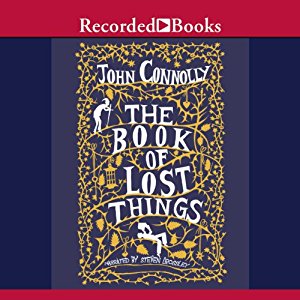
“The Book of Lost Things,” by John Connolly, is a fairy story about fairy stories—and not the kind that necessarily turn out happily ever after. More the Grimm kind, where virtue isn’t always rewarded, but evil is always savagely punished. It shows again that fairy stories are primordial, ancient, bred in the bone.
David, our protagonist, is a 10-year-old English boy who loses his beloved mother in the opening days of WWII. His father and he do as well as they can together, but then David’s father marries Rose and they have a baby boy, Georgie. None of this goes down well with David, who is grieving, angry, jealous, resentful and lonely. He also starts seeing strange things like a crooked old man lurking in his brother’s room, and begins having fits.
The one solace David finds in his new situation is the books in his room. They are fairy stories, but different from the ones he has read before—darker and more disturbing. He asks Rose about them, and she tells him they belonged to a great uncle who had loved the books, but he and a young female relative had disappeared one day and were never seen again.
One night David is awakened by his mother’s voice calling him. He knows his mother is dead, but his desire that this not be true is so powerful that he wanders into a neglected sunken garden. The voice seems to be issuing from a hole beneath a great tree there. As David hesitates, he hears the screaming of a bomber overhead, disabled, on fire, and heading right for him. He dives into the hole beneath the tree and discovers himself in a strange land as the bomber crashes through and David’s escape route is blocked. Just to let you know that the story to come will not be about sweet little creatures with butterfly wings, the pilot’s head bounces by David after the crash, blackened and bloody.
David soon discovers that a great evil is growing in this new land. A wolf army is gathering, led by the Loup, half man, half wolf. The Crooked Man is here as well, and seems to want something from David. The dangers here are genuine and they are deadly. The author doesn’t flinch at detailed descriptions of some truly grotesque and bloody deaths.
Amid the growing darkness, David also meets some good people who help him. One of them tells him to seek out the king of this land because he has “The Book of Lost Things” that will help David to return home. “The Book of Lost Things” doesn’t help him to find his home, but it does clear up the central mysteries of the story, pointing David to the truth of the Crooked Man and his agenda.
David proves he is brave, loyal, and resourceful. He discovers that not everything is what it seems, and learns to be discriminating about whom he trusts—a single misstep could be fatal. In the process, he solves the mystery of what happened to Rose’s great-uncle and his young relative, and of course realizes his mistake in rejecting Rose and Georgie. By the time David finds the way home, we feel he has earned his return many times over.
The book follows David’s life after this event. It was not a life free from pain or unhappiness, but he finds love, comfort and a purpose in life. At the end—I’ll let you read the book to find out what happens at the very end. Like a good fairy story, the end wraps everything up in a most satisfactory way.
I would have to say that ‘The Book of Lost Things” is not for the faint of heart. Although the protagonist is a child and the source material is fairy stories, it is definitely not a children’s tale. I might even hesitate to recommend it to a teenager, particularly if they were going through a Goth phase. There is a lot of violence, a pervasive sense of creeping evil, and many adult themes. I would have to say that it cleaves to the original tenor of the ancient stories, though. The old fairy tales are dark and primeval. They have nothing to do with living happily ever after or marrying the prince. They teach us to beware the evil in the dark and the forces we do not comprehend. “The Book of Lost Things” is that kind of fairy tale.







 obsidianmirrorblog