Day 7: Uxmal and the Chocolate Museum

img_2713

“House of the Nuns” at Uxmal, where no nuns ever lived.

After a peculiarly tasteless breakfast amid the imposing splendor of Hacienda Uxmal, we headed out to the ruins on foot. It really was a short walk, for once. There is a visitor’s center with shops featuring books, pottery, etc., very upscale. There was a short line for tickets, so I sat down to wait in the shade until they were purchased. While I was waiting, the gentleman sitting near me said he was a guide and could speak English. We hired him to show us the site, and I’m delighted we did. He was a Maya Indian named Dimitro.

This is the pyramid that answers with a quetzal's cry when you clap your hands in front of it.

This is the pyramid that answers with a quetzal’s cry when you clap your hands in front of it.

As we walked out to the site, I asked Dimitro what he knew of aluxes. He said they were mischievous, small beings. Some were good, some bad, but the bad ones just play tricks–they aren’t truly harmful. They will bother you at night, pulling on your ear or your clothing to prevent you from sleeping. You can stop them by putting a piece of chocolate and a glass of water on the table before you go to bed and announcing, “This is for everyone. Anyone can have it.” You will sleep in peace that night. In the morning, the chocolate and water will still be there, but they will be tasteless: the essence is what the aluxes take. (Maybe that was the problem at Hacienda Uxmal: an alux infestation.) It’s the same with the gods–they don’t consume the sacrifices physically, but partake of the essence, which is why they burned the sacrifices, whether of blood or food. I asked him if he had ever seen an alux, and he said only children and animals can see them (confirming what Roberto had told me), but they had sometimes bothered him at night or misled him in the forest.

Detail of the Temple of Chaak at Uxmal. Chaak's noses are all pointing down, which is a prayer for rain.

Detail of the Temple of Chaak at Uxmal. Chaak’s noses are all pointing down, which is a prayer for rain.

Dimitro said the Mayan view of the life and death cycle was this; when you are born, you carry with you the knowledge of your ancestors in your blood. You add to this store of wisdom in life, and in death you are consumed by the jaguar and pass through the tree of life back up to your ancestors to be reborn later with added wisdom. As you were in past lives, you will be forever. It’s a rather nice scheme for kings, priests, etc., but not so great for the slaves and peasants. I forgot to ask what if you were a great warrior, but were captured and enslaved. Do you come back as a slave or a warrior?
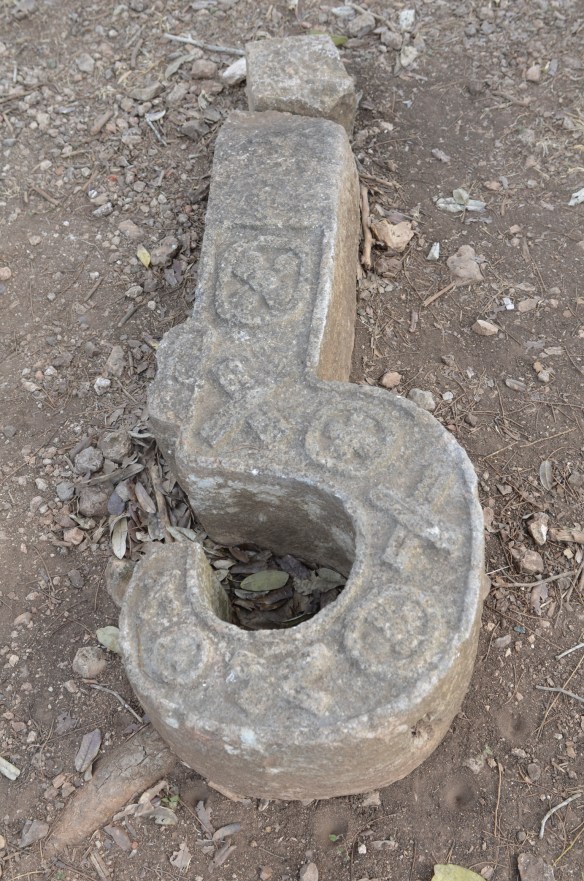
One of Chaak's noses, not yet restored to its proper place.

One of Chaak’s noses, not yet restored to its proper place.

The buildings at Uxmal are much larger than in the classical Mayan cities we saw in the south, and they are beautifully adorned with carvings. The Chaak mask is everywhere, including at the corners of the temples. Chaak has a long nose because he has the face of a caiman, a symbol of both water and the underworld. When Chaak’s nose points upward, it is a prayer for rain. When the nose points down, it is thanks for the rain.
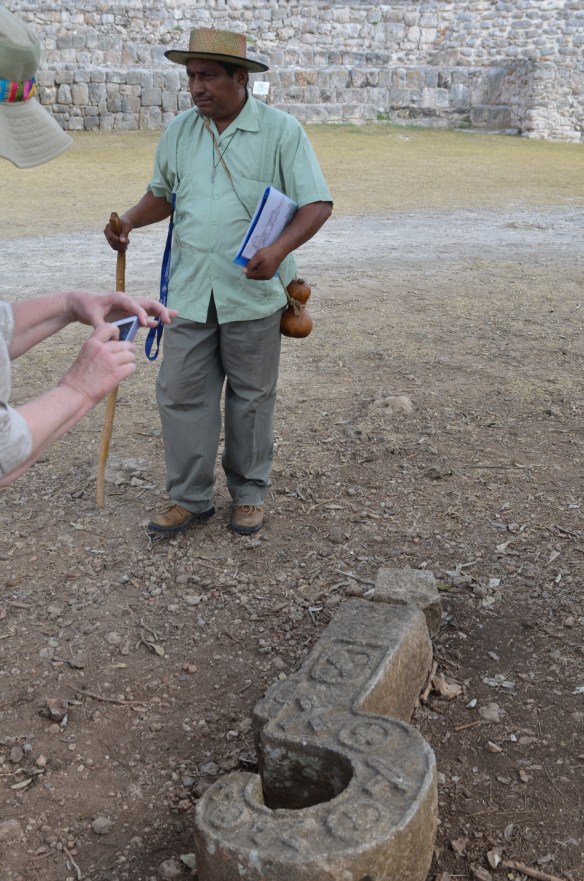
Dimitro, standing near a fallen Chaak nose.

Dimitro, standing near a fallen Chaak nose.

As we approached the first pyramid, Dimitro clapped his hands sharply together. The noise echoed off the pyramid with a high-pitched cry that he said was the cry of the quetzal bird, highly prized in ancient times for its brilliant blue-green feathers, symbolizing the sky, and now endangered. I have no idea if this sound was intentionally engineered by the builders, but it could have been. People are very clever creatures, and have built other monuments that do strange things, like track the solstices or create “whispering stones.”

The so-called House of Nuns is an enormous complex of temples and long, low buildings built around a vast rectangular courtyard. Dimitro said this had been a school, but didn’t seem to know what they might have taught there. Not priests, he said, because priestly knowledge was inherited in the blood. There were, of course, no nuns, but the building reminded the Spanish of the walled convents back home. The acoustics within this enclosure are spectacular–a priest could have addressed a crowd of hundreds from the steps of the temple and been heard clearly by everyone.
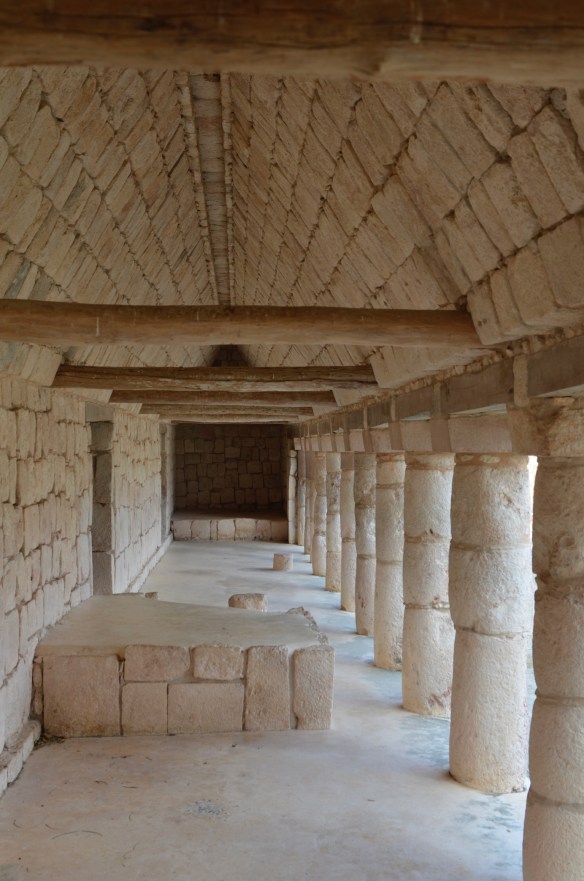
The pillars at Uxmal resemble Doric columns, but without the fluting along the sides.

The pillars at Uxmal resemble Doric columns, but without the fluting along the sides.

The stone motifs on the buildings were lovely. There were many round columns, rather like unadorned Doric columns, which we had seen at Tulum but not in the south. There were lattice-like insets, and others that looked like many half-columns arranged in rows that Dimitro said were representative of bamboo. There were no carved stele on the site. There are no cenotes in the area, but instead of the open catchments used in Calakmul, they used chultuns; jar-shaped subterranean water storage pits. The areas around the pits are angled to direct rainwater into this underground storage. This was a big improvement over the earlier method, as evaporation would have been much less.

The buildings at Uxmal are decorated with gorgeous bas-relief sculptures. You can see a plumed snake here, with a head emerging from its open mouth. This is the "spirit snake" incarnation of Kulkulcan, enabling the spirit of an ancestor to communicate with the living.

The buildings at Uxmal are decorated with gorgeous bas-relief sculptures. You can see a plumed snake here, with a head emerging from its open mouth. This is the “spirit snake” incarnation of Kulkulcan, enabling the spirit of an ancestor to communicate with the living.

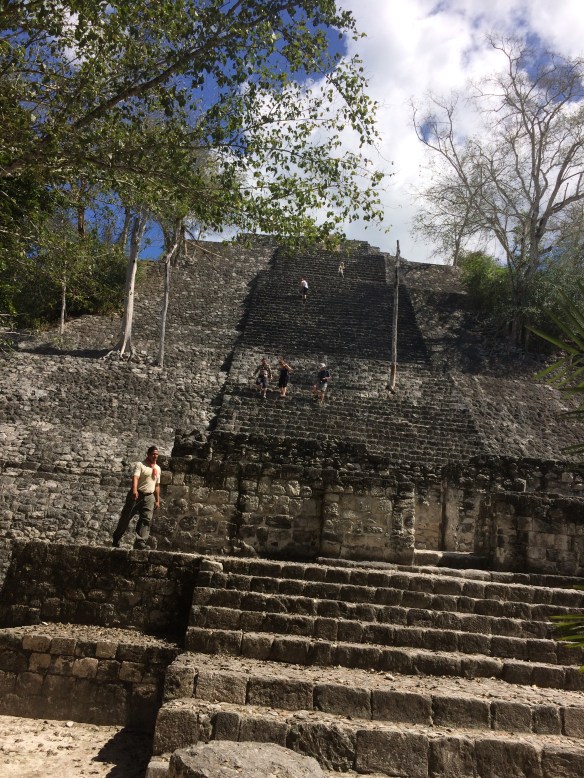
Uxmal is a pleasant place to walk around, with fewer trees than Calakmul, but still enough shade, and it was also a cooler day (not cool; cooler). We visited the ball court, slightly larger than the one at Becán, with one stone goal ring still protruding from a wall. (There never were stone rings at Becán). Then we came to the “governor’s palace,” which involved scaling a rather steep and long set of stairs. I decided to give my knee a break and sat in the shade, trying to take notes on my phone.
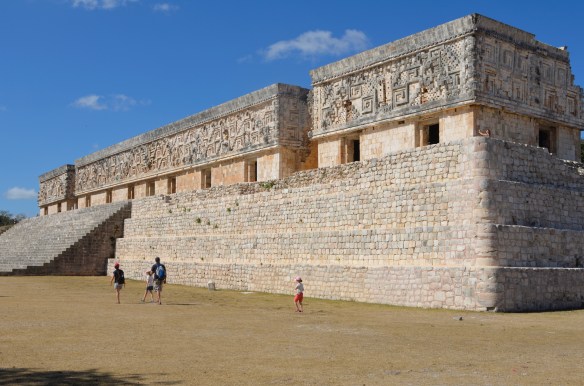
The "Governor's Palace" at Uxmal. Again, probably no governors, but it looked like a governor's palace to the Spanish.

The “Governor’s Palace” at Uxmal. Again, probably no governors, but it looked like a governor’s palace to the Spanish.

After perhaps 20 minutes, Dimitro came back alone and sat with me. He said the tour was over and the others would come find me, but he wanted to say goodbye. He asked for my hand and held it between his two hands. We both closed our eyes for a few beats. Then he touched my hand on the back and the palm. I thanked him and we talked another minute until I felt a sudden rush of coolness despite the heat. He said he had given me energy because I needed it, and said goodbye. Whether it was real or not isn’t the question; I was both touched by this and felt refreshed.

After doing a bit of obligatory shopping, I mentioned that although we had been doing well on two meals a day, this was the day I needed to eat lunch. I was getting that empty, urgent feeling that females of my family sometimes get, and it inevitably leads to HANGRY. But the suggestion was made to visit the Museo de Chocolate across the street before eating. I might have objected, wanted to avoid full-on HANGRY mode, but chocolate sounded promising.

Museo de Chocolate at Uxmal

Museo de Chocolate at Uxmal

The museum has a circular path that has several stations set up, each explaining a different aspect of chocolate. These cover in great detail the biological info about the plant, the use of chocolate by the Maya, a “Mayan chocolate ritual,” how the ordinary Maya lived, including their homes and everyday things, how they prepared chocolate (this involved a free taste), the discovery and adoption of chocolate by Europeans, the modern agriculture, modern chocolate processing, and more. There were also plants growing in the outdoor museum that were important to the ancients, such as sisal, and some spider monkeys, deer and jaguars in cages. These latter were not being kept as exhibitions so much as either being rescued and rehabilitated, or as in the case of the jaguars, sheltered because they could not survive in the wild. By the time we left, we probably knew way more about chocolate than any of us wanted to know.

There were two things worth noting. First, the “Mayan” chocolate ceremony. Several Mayans in plain cotton shifts guided us to a seating area. Waiting for us was someone who was clearly the priest, an elderly but sturdy-looking Maya who could have been the model for the human avatar of Quetzalcoatl in “The Obsidian Mirror.” I was staring at him in fascination as I sat down on the board being used as a bench for spectators Not having noticed the board was extremely narrow, I promptly fell backward onto the gravel. It wasn’t a long fall, but several well meaning Belgians and their guide rushed to my rescue, offering large, strong hands. I took their hands, but before I could get my feet under me, found myself being dragged through the gravel at a high rate of speed. I indicated I would rather do it myself, and eventually got to my feet, apologized to all and sundry for the interruption, and sat down again—very carefully. Someone handed me my phone, which will need a new case after serious gravel abrasion. But I was fine.
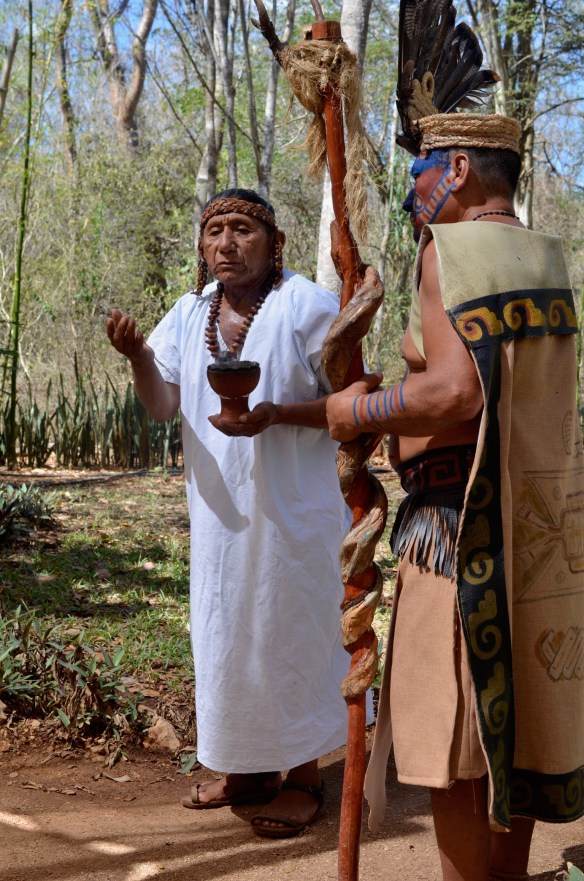
The "Mayan chocolate ceremony" at the Museo de Chocolate.

The “Mayan chocolate ceremony” at the Museo de Chocolate.

Tom described the ceremony as a cross between a Mayan ritual, the Catholic mass, and Monty Python. I suppose they studied the steles and murals to approximate it, and may even have some of the stages worked out, but in all likelihood, the actual doings are long forgotten. Still, it was a good way to show that the Maya regarded chocolate as sacred and special, hardly a casual treat.

Chocolate was prepared as a drink in those times, never eaten. The beans were fermented and ground into a paste that was mixed with coconut butter. It was combined with chilis and sometimes honey and mixed with hot water to drink. Often, the blood of sacrificial victims was added as well. (I’ll take mine straight, thanks.) Chocolate was reserved for the elite, of course, as all good things have been throughout history.

Chocolate contains a substance called theobromine, which is a stimulant and vasodilator. In high doses, it may have other effects. One of the Spanish conquistadores described an Indian consuming several cups of chocolate and then offering himself as a sacrifice. So I suppose it can amp you up a bit, especially if you believe, as this gentleman undoubtedly did, that you’re going directly to paradise.

We were given a demonstration of the preparation of the drink (sans blood) and given cups of the hot mixture to try. You could add sugar (Tsk!), chilis, achiote (a popular local spice from the annatto tree), and other flavorings if desired. I went with chili, and because I am a wimp, sugar. It was very rich and tasty. But not enough to avoid HANGRY.

As a last note on chocolate, it was the Europeans that added sugar and milk or cream to the drink (no chilis), and also discovered how to make chocolate candies. The Maya never consumed it as anything other than a drink.

I could have bought some chocolate there—there were chocolate bars and chocolate ice cream—but I didn’t want candy or ice cream, I wanted FOOD. By the time we finished up at the museo, I was ready to eat my own head. Fortunately we were near several restaurants. Unfortunately, there ensued a discussion about which restaurant to try. I turned to Tom and said, “JUST GO SOMEWHERE!” We chose the restaurant at the entrance to the ruins. This proved to be an excellent choice, as they had Yucateco cuisine like cochinita pibil (pulled pork flavored with achiote), and it was well prepared and delicious.

After lunch, we piled back in the car and took the road to Valledolid. We had originally planned to stay two days in Valledolid, then Linda and Clod would drive to Cancun to catch their flight home while we went on to Isla Mujeres for a few day. Note to unwary travelers in the Yucatán: the time zones change between states. Valledolid is in the State of Yucatán and Cancun is in the State of Quintana Roo, and they are not in the same time zone. If we had followed our original travel plan, Linda and Clod would have missed their plane by several hours. So we stayed only one night in Valledolid and then went on to the Marriott Courtyard Airport in Cancun so that Linda and Clod could get up at some horrible hour in the morning and catch their flight home.
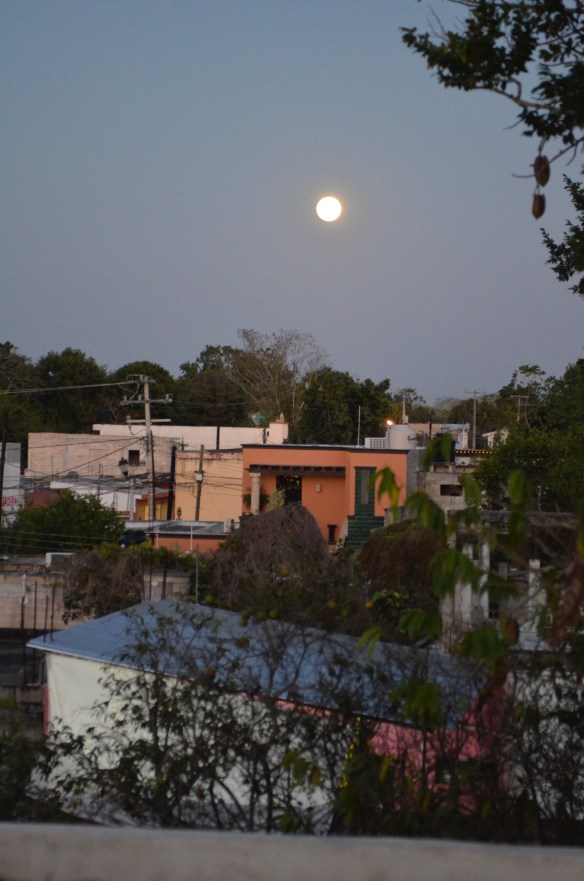
Moon over Valladolid, as seen from our hotel roof.

Moon over Valladolid, as seen from our hotel roof.

The hotel in Valledolid was charming, It reminded me of the pensions my mother used to tell me about, built around an interior courtyard. The courtyard was probably once occupied by a fountain and potted plants, but now has a pool taking up most of it. Every surface was tiled, with wrought-iron railings and bars on the windows. They had a rooftop patio where you could look out over the city, and they served breakfast up there as well. The hotel was clean and comfortable, though our window was right on the street—literally. Cars passed within inches of the wall of our room. But that didn’t keep me awake. The price of $30 a night was also very comfortable.

Valladolid town plaza with the church in the background.

Valladolid town plaza with the church in the background.

After dinner, we went for a walk to the town plaza, which was delightful. Everyone was out strolling in the cool night air, and kids were running around with balloons or eating ice cream. The church at one end of the plaza was all lit up. We were all charmed with the domesticity of the scene, and at the same time, reminded of how different our own culture is.
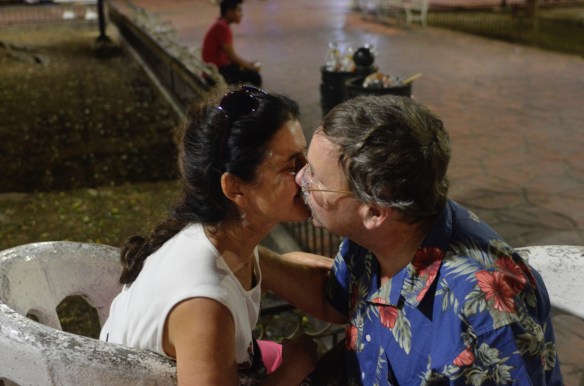
Clod and Linda, testing the "courting benches" in Valladolid's town plaza.

Clod and Linda, testing the “courting benches” in Valladolid’s town plaza.

Save

Save

Day 6: My First Crocodile and the Long, Long Road to Uxmal

This checkerboard pattern is a bit of detail from a palace at Becan.

This checkerboard pattern is a bit of detail from a palace at Becan.

We arose at the ungodly hour of 5:00 am to meet the wonderful Roberto for a nature tour in the biological reserve of Calakmul. He drove up on his motorcycle right on time. The restaurant wasn’t open until 7, and in-room coffee was not a feature, so we ventured forth, unfed and uncoffeed. It was dark and relatively cool. I have to admit after the past two days of walking, I was still tired.

We drove some 27 kilometers down the same road leading to the ruins before turning off into a wooded area. We saw spider monkeys immediately, a troop of them brachiating from branch to branch, chirping to each other. Right after that, we countered howler monkeys, a larger and slower monkey that makes up for it in volume, hooting and roaring in an unmistakable way.

Spider monkey in the Calakmul Biological Reserve. This is about the best picture we got.

Spider monkey in the Calakmul Biological Reserve. This is about the best picture we got.

Roberto moved quietly through the forest, and we imitated him. His sharp eyes would spot birds and other things we never would have seen on our own. Unfortunately I don’t remember most of what he pointed out, not being a birder, though I do remember a pair of large woodpeckers. And the crocodile.

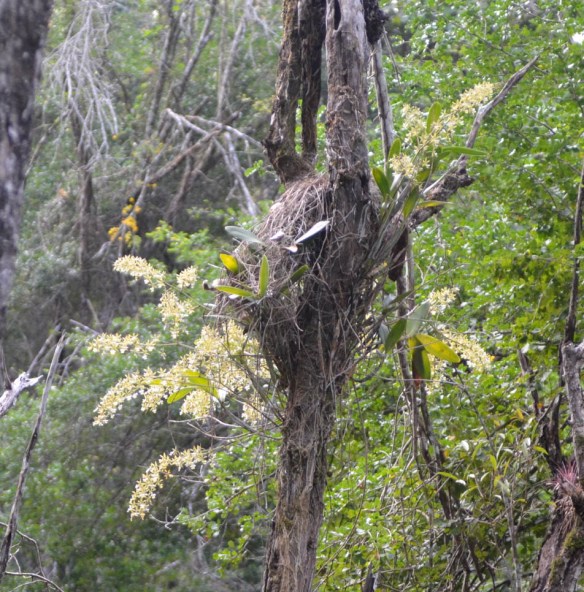
I spotted a lovely waterfall of cream-colored orchids growing on a tree in a swampy area. I moved cautiously closer to take a picture and Roberto pointed out that one of the logs in the water was actually a crocodile. But just a little one, he said–perhaps nine feet.

These are the orchids that tempted me into the crocodile-infested swamp. Well, there was one crocodile. Our pictures of him look like a distant log, which is boring.

These are the orchids that tempted me into the crocodile-infested swamp. Well, there was one crocodile. Our pictures of him look like a distant log, which is boring.

We walked a little further, but as much as I hated to admit it, I was just tired. And hungry. And I wanted coffee. So we walked back to the car. When we got there, we heard howlers again, and everyone else went to see them. I stayed with the car, I am ashamed to say, but I could hear them just fine. Roberto is a good mimic, but they seemed incensed at whatever he was saying.

I was awfully glad to get coffee and breakfast when we got back. I had chilaquiles, and they were delicious.

The next stop was Uxmal, a post-classic Maya city located far to the north of Calakmul. It was a very long drive. Tom and Clod took turns driving and navigating in the front of the car, Linda and I in the back. I have long legs, and it was like sitting in a movie theater for six hours with an occasional bathroom break. We had had a big breakfast and did not stop for lunch.

Men may want to skip this paragraph. Okay, ­I warned you. At this point, I really need to share with you a travel product for women that has been a godsend to me, especially as I’ve gotten older and my knees have become garbage. I think we’ve all been in situations where there are 1) no toilet facilities; 2) toilets with seats you wouldn’t go near if your life depended on it; 3) toilets with no seats; 4) holes in the ground. SheWee is the answer to your prayers. It enables you to pee anywhere you want. Just like a guy. And it all goes back in a discreet case small enough to fit into a purse, backpack, and even a pocket. I always carry a small packet of Kleenex to use where there’s no paper. SheWee does have to be rinsed, so do it on the spot if possible and wash with soap later. I’m not shy about rinsing it out in public, but water isn’t always an option, either. I have had to use it almost every day on this trip and I can safely say I have never loved a few pieces of plastic more.

This sporty-looking iguana was one of the few interesting things we saw on the way to Uxmal.

This sporty-looking iguana was one of the few interesting things we saw on the way to Uxmal.

Nothing of particular interest happened on the way to Uxmal, so I will say only that as we traveled north, it became discernibly drier. The vegetation was not as tall or as thick. It was mostly rural or completely undeveloped except for the little villages and a few small towns we passed, with the exception of the coastal city of Campeche, where Clod spent summers as a child. At almost every speed bump along the way, there were people selling jicama with limes, little finger bananas, pineapples, coconuts, cold drinks­—you name it.

Finally–finally–we reached Uxmal. The hotel was the grandest by far of the entire trip, and only a five-minute walk from the ruins. Hacienda Uxmal is modeled after the historical haciendas of the region, with beautiful tiled floors and walls, a sweeping staircase, and pillared verandas. Many celebrities have stayed there, from Jackie Kennedy and kids to Queen Elizabeth I.

Somehow, we were assigned enormous, luxurious rooms with elegant soaker tubs and marble showers with glass roofs giving you a panorama of the sky and tree-tops. Our room had photos of John-John and Carolyn Kennedy visiting the ruins as children, while Linda and Clod got the Jackie-only suite. We weren’t paying enough money to get these posh quarters, so I guess we just got lucky. Sadly, we didn’t get any photographs of the hotel rooms. They really were splendid.

I threw myself in the shower and then joined the others for a curiously tasteless marguerita. Dinner was outdoors, a buffet. Though we had not had any lunch, by this time I had no appetite at all and could think only of sleeping  I made myself eat some dinner, figuring that if I didn’t, I’d wake up in the middle of the night with my stomach growling. The food was also curiously tasteless. All this luxury, and they couldn’t produce food any better than your average school cafeteria.

I excused myself early and fell into bed, falling asleep as soon as my head touched the pillow.

Day 5: The Bat Tornado

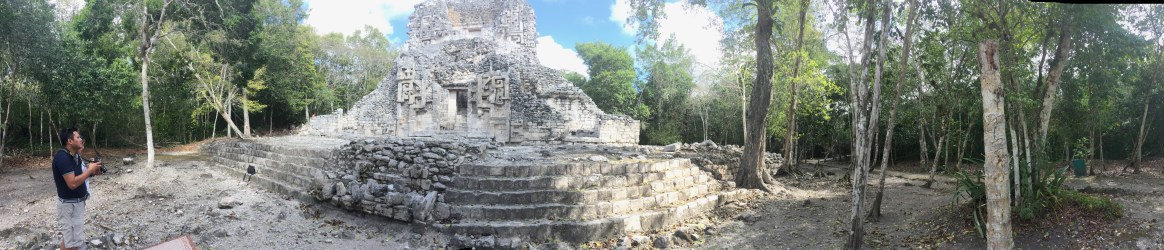
Temple at Chicaana

Temple at Chicaana

We were actually scheduled to go to three Mayan ruins this day, but I wimped out after two, Chicaaná and Bécan. The third, Xpuhil (shpoo-heel), was the last and smallest, and by the middle of the afternoon, I was sweaty, tired, and not sure I’d be able to tell one from the other.

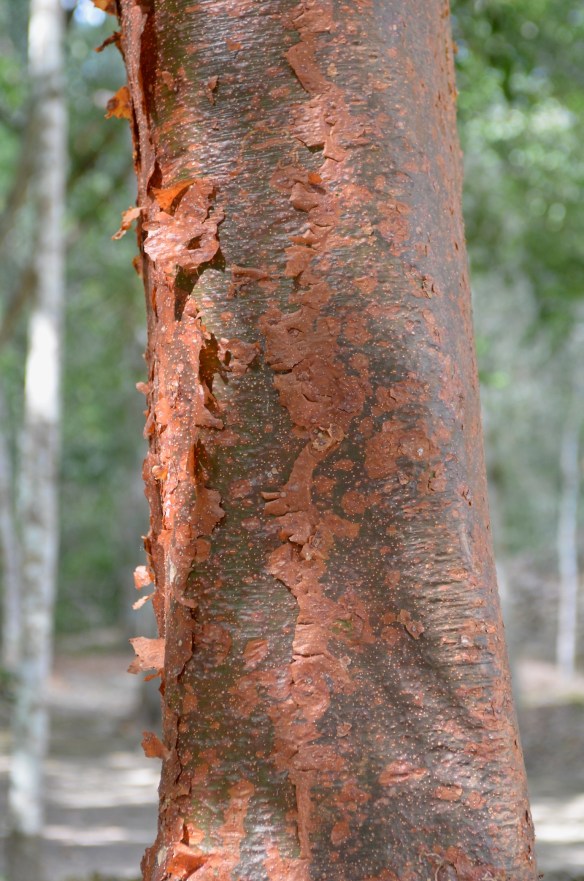
I mentioned the chaka tree yesterday. it's also called "la tourista" because of its red, peeling bark.

I mentioned the chaka tree yesterday. it’s also called “la tourista” because of its red, peeling bark.

Chicaaná, Xpuhil and Bécan were vassal cities of Calakmul, which was the big cheese in the region. As these cities are many miles apart and the jungle in those days must have been denser and more difficult to navigate back then, I asked Roberto how they traveled between cities. These cities were located many miles from Calakmul and from each other; if Calakmul didn’t have local representatives or surrogates at these cities, it would have been hard to maintain control. Roberto said they had paths between cities called sac-be—the white road. All paths and unpaved roads hereabouts are white due to the limestone that makes up the earth.

img_2308

This is one of the sleeping platforms for the elite that I mentioned in the past post. It is located in a small room in one of the palaces at Chicaana. There are two small carved faces on either side of the recess in the platform, which is speculated to be for personal possessions. The palace rooms were very small, as even the elite Maya lived mostly outdoors.

Bécan was unusual in that it had a moat surrounding the city, just like a medieval castle. There were seven entrances into the city across the moat (seven being a magical number). There were no drawbridges. Roberto said that the entrances were narrow enough that invading warriors could be picked off more or less one by one as they invaded the city but there is no evidence of invasion ever occurring at Bécan.

Temple at Becan.

Temple at Becan.

The temples here are larger than at Calakmul, and have two towers. There is a ball court at Bécan, unlike Calakmul. The ball game was central to Mayan spiritual life. It was played at least partly in tribute to Hunapu, one of the two sets of hero twins of the Popul Vuh, the Mayan origin story. Hunapu is decapitated by the lords of the underworld (Xebalba). His twin, Xbalanque (shball-ahn-kay), uses a squash as a substitute for his brother’s head, which is being used as a ball by the lords of the underworld. Xbalanque rescues the head and replaces it on his brother’s shoulders. (His brother is apparently none the worse for the wear.) Xbalanque substitutes a ball of chiclé sap for use in the ballgame. Ever after, the lords of the underworld do not receive human sacrifice, but instead must be satisfied with offerings of fragrant tree sap.

Not every Mayan city has a ball court, but the later ones do. They were not intended as a public entertainment but as a religious event, and were witnessed by priests. The captain of the winning team was decapitated as a sacrifice, and it was believed he went directly to the Mayan version of paradise. I would have been a lousy captain.

Both cities were impressive, showing increased sophistication in stone working techniques compared to Calakmul. They had attractive bas-relief carvings that are still quite crisp and clear. We went inside the palace (or one of the palaces). In the large space inside, a tiny bird was flying about from beam to beam of ironwood, a wood so hard it can last for many centuries. Roberto told us it was a red-capped manikin, and quite rare. I thought about the British birders back at the hotel, and considered walking by them, casually remarking, “…and I looked up, and there it was–a red-capped manikin!” But I didn’t.

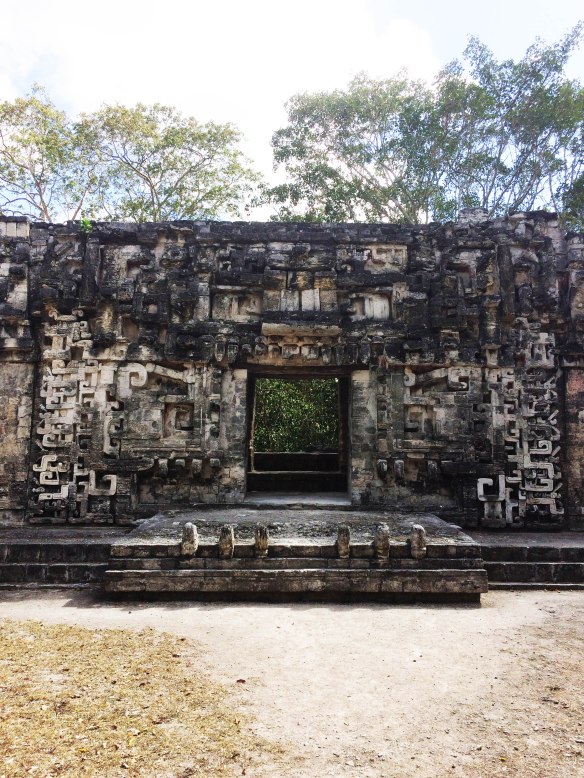
On the other side of the palace was another long, low building. The front entrance was surrounded by elaborate carving which Roberto pointed out represented the face of a jaguar. It was so abstract that I might have thought it was just stylized patterns if he hadn’t pointed it out to me. So to enter the building was to walk into the mouth of the jaguar, and it was a statement of the king’s power. The first dynasty at Calakmul was the Bat Dynasty, but they were overtaken at some point by the Jaguars. Jaguars trump bats, I guess.

The entrance to the Jaguar Palace. The stones sticking up in front are its teetch, and you can see stylized eyes and ears to either side of the doorway.

The entrance to the Jaguar Palace. The stones sticking up in front are its teeth, and you can see the nose over the door, and eyes above that.

I have forgotten a lot of what I saw and heard of Bécan and Chicaaná because I didn’t journal every day. We were busy all the time and by the time I got some alone time, I fell into bed and slept the sleep of the dead. A lesson for future research trips not to move around so much and schedule so much. I need the writing time or it all flies away.

The night before, the hotel manager stopped by our table in the restaurant to chat and asked if we had seen the bat cave. We hadn’t heard about it and were interested, so we decided to visit it this evening, as it was our last night and the cave was an easy walk from the road. Roberto pointed out the exact location to us on the way back from the village of Xpuhil (not the ruined city), where we had stopped for sundries, so we were confident of not getting lost. Besides, there were signs with bats on them when you got close to the turnout for the cave.

A little while before sunset, we pulled into the tiny turnoff and hiked a short distance up a hill. There was an enormous hole in the earth, probably 100 yards across and 250 feet deep. The sides were sheer, and Tom, who is acrophobic, grabbed the back of my shirt every time I went near enough to the edge to actually see the cave, which was a vertical gash in the rock about 200 yards down. On the rocky overhang of the cave, I could see little brown shapes. Dead bats.

Several other people joined us, some with kids. A Canadian couple next to us set up some complicated-looking equipment. It turned out they were bat experts on vacation–a lucky turn of events for us, as they provided a lot of information. The equipment was intended to record the supersonic squeaks of the bats and identify the species. There were a number of raucous birds calling in the area, and the bat experts said they preyed on the bats. Mrs. Bat Expert perched jauntily on the edge of the chasm, making Tom nervous.

By the way, here as everywhere else we went, you are expected to take care of yourself. There are no railings separating you from the edge of the great pit in the earth–not so much as a sign. If you are careless enough to break your neck, it’s just too bad.

We all sat around chatting quietly. I flirted with someone’s baby, who was delighted with touching my hand and playing peekaboo. As twilight set in, a few bats emerged from the cave. Then more. And more. And more. Hundreds of thousands of little bats flew out, circling in a great clockwise spiral, forming a literal bat tornado. My video doesn’t do it justice, and still photos didn’t show it at all, really, but it was an awe-inspiring phenomenon. My hearing isn’t good enough to hear their calls, but the sound of those thousands upon thousands of tiny wings was like a spring breeze stirring the leaves, or the sound of a gentle rain shower.

The bats circled in their spiral for a long time, each individual rising imperceptibly higher until streams of them began to break away, veering off above our heads. Several of them flew through the trees and came quite close to us, but of course never collided. The bird noise stopped as the hunters got serious and began to go after them, but I couldn’t see them.

There was something hypnotic about that spiraling tornado of tiny bodies—enormous and overwhelming, yet delicate, gentle. We watched until the great spiraling cloud had dissipated, the bats flinging themselves on the night wind, seeking food and to avoid becoming food.

Our bat experts said there were too many species in the cave–maybe six different species or more–for the equipment to identify, but they had visually identified hoary bats and ghost bats. It was a memorable experience unlike any other, and I’m grateful for it.

Days 3 and 4: The Lost City in the Jungle

calakmul


We had a journey of about three hours from Laguna Bacalar to Calakmul, the Mayan city I had most wanted to see. But before we left the lake, I wanted to swim in Cenoté Azule. The Yucatán Peninsula has no running surface water–streams or rivers–but the subterranean water rises to the surface via cenotés, which are underground caves that form in the limestone that composes the peninsula. Back in the day, many of these cenotés were repositories of virgin sacrifices, weighted down with jade and probably high on something. Xebalba (sheh-bal-bah), the Mayan underworld or place of death, is under the water. It did not pay to be a virgin in those days–if it ever did.

Many cenotés are deep holes, filled with water, but hard to get to as the water is many yards below the ground’s surface, though open to the sky. Cenoté Azule is a “mature” cenoté, which means the water is now at the surface so it is easier to get into and out of. Cenoté Azul is inevitably described as having crystal clear, pure waters, and we were advised to bring snorkeling equipment to see the underwater sights.

Cenoté Azul has restrooms and a restaurant, and a few ricketty shade structures much enjoyed by termites. Linda and I got into the water, but crystal clear is not how we would describe it. It was quite murky from the mud being stirred up by people getting in and out. I swam out further than Linda, and the water did clear up, but beneath me, intensely black, deep water was all I could see. I swam back and got out. At least I had a chance to adjust my new snorkel mask in fresh water with no waves slapping me around. And I can say I swam in a cenoté, however briefly.

Cenote Azul in the foreground. The water beyond is Laguna Bacalar; the cenote and the lake are separated only by a thin strip of land.

Cenote Azul in the foreground. The water beyond is Laguna Bacalar; the cenote and the lake are separated only by a thin strip of land.

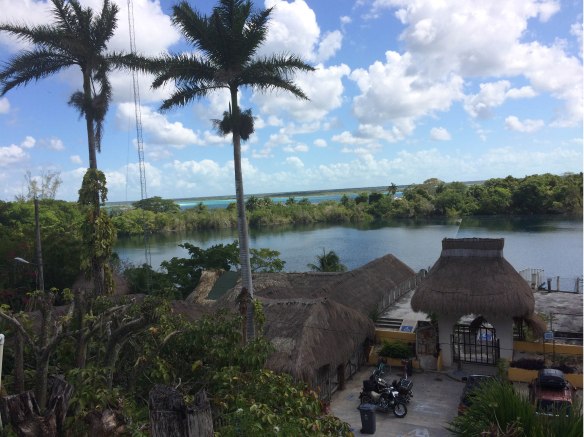
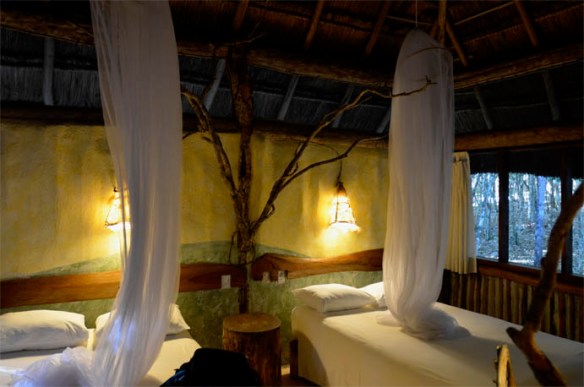
We drove to the next large city, Chetumal, needing to pick up sundries and cash as the next leg of the trip was cash-only. Then on to the Calakmul Biological Reserve, deep in the jungle near the Belize border. We had reservations at Hotel Puerta Calakmul, which is deep inside the reserve. It is the only hotel in the reserve, but it is still a LONG way from the actual ruins. The hotel reminds me of the Adirondacks, or something similar. Everything is rustic, with natural logs and branches forming the supports of the buildings. There’s lots of screening, and the buildings are all palm-thatched. There is a surprisingly good restaurant here, a pool, and not much else. Everyone here came for the ruins or for the nature reserve, or both. There’s one group of bird-watching Brits who can always be seen, all wearing khaki and carrying huge binoculars.

Home sweet home at Hotel Calakmul.

Home sweet home at Hotel Calakmul.

The jungle is not quite what I expected. There are some large trees, but not as many as I imagined. Mostly the trees are rather slender and of medium height. There is less dense undergrowth than I would have anticipated, and the place has more the feel of a young temperate forest—if it were not for the orchids and bromeliads clinging to the trees, plus the occasional monkey. I suppose this is because the Yucatán is a rather dry place–definitely not rainforest, with trees so tall that there is a complete ecosystem existing in the canopy. Mostly, there is no canopy in the jungle here.

The beds were comfy and although the mosquito netting didn’t seem necessary, we used it. I have been surprised at the lack of bugs. I knew this was the driest, coolest, least buggy time of year, but I still expected a LOT more bugs.

The next morning, we met our guide, Roberto. Roberto is a Mayan from Chiapas whose family moved here when they lost everything in a flood/mudslide. I immediately began to pick his brain.

I am particularly interested in a legendary people called aluxes (ah-LOOSH-es). They are similar to the Menehune of Hawaii and the leprechauns of Ireland in that they are small people, the size of children, and they are mischievous and curious. They are guardians of the forest. I saw them as being akin to Fred the Mannegishi, if you happen to have read “The Obsidian Mirror.” The aluxes go back at least to the time of the ancient Maya, and there are bas-relief sculptures of them from the ruins (but not the ones we were there to see.)

Aluxes from a bas-relief sculpture at Uxmal.

Aluxes from a bas-relief sculpture at Uxmal.

Roberto said he didn’t know much about aluxes, but it turned out he knew quite a lot.

He said he saw one when he was young, but he was with several other boys. No one else saw the alux, but he said it looked like a child running in the forest, wearing a shirt and shorts with a woven hat with a pointed crown and a brim all around. None of his companions saw it. When he and his brother got lost in the forest, they believed it was aluxes leading them astray because they hadn’t asked permission to hunt. He told me that if you are hunting for food and make an offering to them to ask permission, they will leave you alone. If you are hunting to sell the meat or fail to ask for permission, they will trick you and get you lost in the forest.

I asked Roberto whether he knew of other forest spirits, and he told me about Juan de Monte. “Monte” is a Spanish word for forest, and Juan de Monte is another protective forest spirit with the added characteristic of shielding wounded animals and nursing them back to health. He told us a story about a man from his village who was a very good hunter. He shot deer to sell the meat. He was hunting one day and shot a deer, but the wounded animal escaped. He followed it and came to a stone hut. Inside the hut, he saw many wounded animals. A spirit of the forest appeared to him, Juan de Monte, and told him these were all the animals he had wounded but not killed. Juan de Monte was nursing them. He told the hunter he was not allowed to hunt again. The hunter returned home but he couldn’t speak. His family took him to a curandero, who helped him to regain his power of speech. The hunter went hunting again because it was his livelihood. In the forest, an enormous deer appeared, the largest he had ever seem, and he shot it. But the deer was unwounded. He shot at it several more times with no effect. He threw down his rifle and ran home. Later, he and his brother went back to get the rifle, but the man never hunted again. I don’t know how far back Juan del Monte goes, but I plan on researching it. (I found a Mayan legend later about the “King of the Forest,” a spirit who plays the same role as Juan de Monte. I believe they are probably the same.)

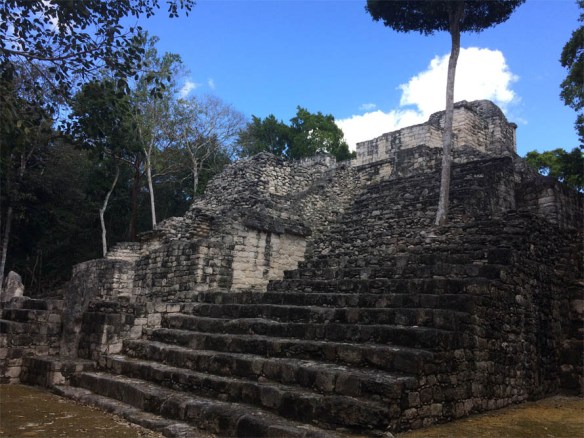
Calakmul Temple of Venus (I think).

Calakmul Temple of Venus (I think).

Our first visit was to Calakmul, a city that was founded about 700 BC and abandoned around 1200 AD. From the hotel, it is reached by a 60-kilometer-long road with many potholes. In the Classical Maya period, Calakmul was the predominant force in southern Yucatán/northern Beliz and Guatamala. At its peak, it was home to 65,000 people. Archeologists have been excavating and restoring Calakmul for decades, but much is still unexplored. There are no cenotés in the area so they had a system of rainwater catchments and storage. Unsurprisingly, the primary god of this city (and all the Mayan cities of the Yucatán) was Chaak, the god of rain and lightening. The city was abandoned because of a severe drought and crop failures. They probably thought Chaak was trying to tell them something.

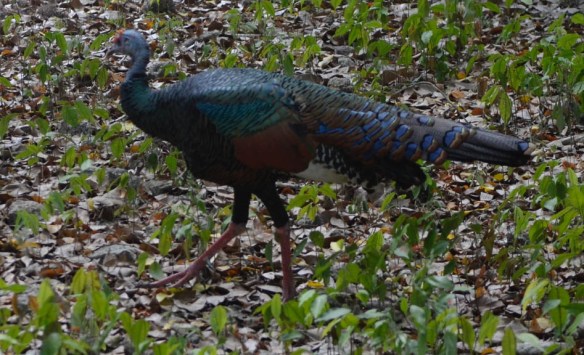
It was a very pleasant place to explore, with lots of shade. On the 1-kilometer walk to the ruins from the site entrance, we saw two spider monkeys– the first monkeys I have ever seen in the wild. We also saw oscillated turkeys, as gorgeous as peacocks, and pheasants.

Oscillated turkey.

Oscillated turkey.

Coming into the ruin feels almost as though you have discovered a lost city. There are very few other visitors there, and you can walk around alone hearing only the sounds of the leaves in the breeze or perhaps howler monkeys booming in the distance. The ruins are impressive, and you can see how the building and stone-carving techniques evolved from the older to newer buildings. There are many limestone stele, but they are so eroded that most of them resemble rotten teeth more than bas-relief sculptures. Two large stele still show the remains of a king on the right side and a queen on the left. You can just make out the faces and bodies. The queen faces right toward her husband, and the king faces left. Their feet are portrayed with left foot pointing left and right foot pointing right, knees bent, giving them the appearance of being bow-legged.

One of the least-eroded stele at Calakmul.

One of the least-eroded stele at Calakmul.

Most of the overgrowth has been removed from the excavated buildings, but strangler figs still grow on them in places, roots flowing over the stone steps like melted wax. Roberto was very informative about the animals and flora, happily pointing out the poisonous trees (chechem) and the trees (chaka) that cure the itchy rash caused by the chechem, as well as the orchids and bromiliads that have hitched a ride on many trees. The chaca tree is also called by some “la tourista” because it has a red, peeling skin–like so many Norte Americanos who come here and expose their pale skin to too much tropical sun.

Strangler fig surrounding a captive stele.

Strangler fig surrounding a captive stele.

There were many round stone altars associated with the stele. They were heavily eroded, but it was still easy to see they are nothing like the post-classic Mayan altar shaped like a human being, usually on its back (chak-mool). The Classical Maya of the Yucatán did not practice much human sacrifice. They did practice blood sacrifice, however. The royalty was expected to let their own blood, obtained by perforating lips, tongue, earlobes or genitals with a stingray spine, cactus thorns or thorny vines. I’m not talking about making a modest cut or incision, either–there is plenty of graphic evidence that they thrust the object all the way through their flesh to the other side. The blood was collected in a bowl and burned. This was the duty of royalty to assure the gods were properly worshiped. Animal sacrifice and the burning of food like maize was also practiced. Although some cities sacrificed the captain of the winning ball team, Calakmul doesn’t have a ball court­—at least none that has yet been found. More about the ball game later.

Maize was the principle crop, but they also grew beans and squash. The Maya cultivated cotton, at least in some places. The standard garb was a simple white cotton garment for men and women. Priests, warriors and elites added elaborate headdresses of feathers, jade jewelry, animal skins (the jaguar being especially significant and powerful) and other ornaments. Those heavy-looking headdresses you see in Maya murals and bas-relief sculptures? Those are highly stylized feathers.

Imagine this fresh and new, painted in bright colors.

Imagine this fresh and new, painted in bright colors.

The temples and palaces were originally covered with stucco and painted. These important buildings were oriented to the four cardinal directions. Little remains of the stucco or paint, but it is likely that each side was painted with the color associated with that direction. The only pigment remaining that I could see was red. Mayan cities, which were cleared of vegetation, must have been bright and gorgeous under the sun, richly colored and designed to impress, with their tiered temples and palaces, and spacious plazas. The red color of the paint was created with cochineal bugs.

Some temples had living quarters, maybe for priests or royals. They left little to inform us. The Maya lived outdoors for the most part, using rooms only for sleeping. The elite rooms feature a slab of stone, often quite large, as a bed—very much like the concrete slabs we slept on at Hotel Azul36. These slabs would be covered with matting or perhaps mattresses stuffed with the cottony insides of ceiba fruit. There were often niches cut in the wall or into the sides of the stone platform, perhaps for personal storage. The common people lived in wattle-and-daub round huts with palm-thatched roofs, so there is little left of them, if anything. Cooking was done outdoors, and there is no evidence here of kitchens.

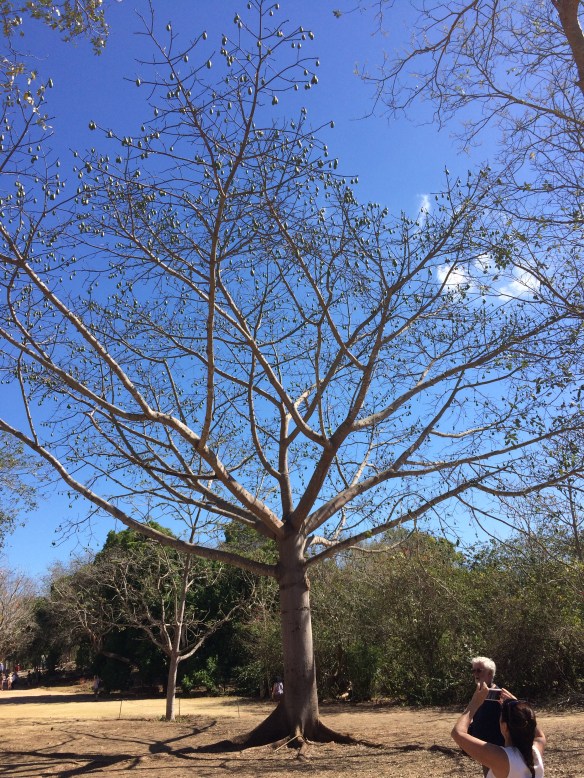
There was a magnificent ceiba tree at Calakmul, one of the largest trees in the area. At this time of year it is leafless, but we could see the many small, oval fruits on its branches. With its height, symmetry and white bark, it reminded me of the White Tree of Gondor. The Maya thought the ceiba tree was the tree of life, holding up the sky.

Ceiba tree, the Mayan tree of life.

Ceiba tree, the Mayan tree of life.

The largest pyramid was dedicated to Chaak, of course. There was also a temple dedicated to Venus (the planet, not the Greek goddess). Venus was essential in the Mayan calendar, and was also associated with Kukulcan, a feathered serpent god precursor to the Aztec god Quetzalcoatl—but Roberto said there was no evidence of Kukulcan worship at Calakmul.

As a matter of fact, there’s a lot we don’t know about the Maya. Time and the jungle obliterated much, and the Spanish took over from there. It’s only due to a few Spanish friars that any of the Mayan codices were copied and translated. Hundreds of these Maya documents were burned, and artifacts stolen or destroyed. And yet, there are still many people who speak one dialect or another of that ancient language and continue to pass down the ancient stories, one generation to the next.

The artifacts at Calakmul have either been removed to the archeological museum in Mexico City, or walled off from the public by archeologists. There were three royal tombs discovered there with jade masks. Roberto showed us photographs. They were widely separated in time. The earliest is composed of tiny pieces of jade, needed to be able to show the curvature of the face. The second uses larger pieces that have been worked to create curves, but the third, composed of large pieces, is a stunning work of art. The ability to work with jade at all is impressive, given that jade is harder than steel, and the Maya had no metal tools. They barely had any gold, as it was obtained only through trade, and they considered jade more beautiful.

The oldest jade mask found at Calakmul, using tiny jade pieces to create the contours of the face.

The oldest jade mask found at Calakmul, using tiny jade pieces to create the contours of the face.

Newest mask found at Calakmul, showing huge steps forward in jade working and artistic skill.

Newest mask found at Calakmul, showing huge steps forward in jade working and artistic skill.


We could have gone on to the merchant quarters and marketplace, but we thought we’d seen the best of Calakmul–at least that part of it that has been excavated. We walked back to the entrance, seeing a family of white-lipped peccaries on the way. They are much smaller than wild boars, but they have pretty much the same attitude. We gave them a wide berth and went on, Roberto pointing out the flora and fauna as he went. Unfortunately, I had little time to write everything down. We were scheduled to do something every day, and I was always so tired from the heat, humidity and walking that I fell asleep every night without journaling.


Save

Yucatan: Day of the Iguanas

Mr. and Mrs. Iguana

Mr. and Mrs. Iguana

In the remote eventuality that anyone was disappointed that I haven’t been blogging about my research trip to the Yucatán Peninsula, I apologize. We were often in areas where the Internet service couldn’t handle large files, and I wanted to be able to post photos and videos, so I decided to wait.

Why Yucatán, you may ask? Well, for reasons I can’t reveal, the third book in the series that began with “The Obsidian Mirror” has to take place in Yucatán. The second book, “Fire in the Ocean,” will be out later this year from Diversion Books, and all will be explained. Well, some of it, anyway.

Day 1: Tulum

We made our way to Tulum on the Mayan Riviera without much problem. Our rental condo is located in a large tract of land not too far from the beach, called Aldea Zama. Aledea means village in Spanish and Zama is the Quiché (Mayan) word for dawn. It is also the original name for the Mayan city in the area, which is why we are here.

We ate dinner in a very good Argentinian restaurant, came back to the condo and fell into bed.

The next morning, we woke late, as it is East Coast time here, we’re from the West Coast, and we were tired. Breakfast, continuing the international theme, was crepes. We asked the waiter how far it was to walk to the ruins. He told us to walk straight down the road we were on for about four kilometers. So off we went. And continued for a long way, walking in the late morning heat and sunshine. We didn’t have a lot of water with us, and I didn’t realize it, but I was becoming dehydrated.

About three miles or so down the road there was an entrance to the beach and my husband Tom headed off across the sand, intending to walk the rest of the way on the beach. By this time, my enthusiasm had flagged, although I did appreciate the white sand, fine as sugar, and the brilliant turquoise and indigo of the ocean. Linda asked a woman how far it was, and we learned to our surprise that not only had we been directed down the wrong road, we were many miles from our destination because there was no access to the ruins from the road we were on or the beach.

We flagged down one of the passing taxis which took us to the ruins, all of us thankful we hadn’t tried to walk it. The entrance to the ruins is reached on foot or by a little tram pulled by an old tractor, and to my relief we took the tram. Before we embarked for the ruins, we saw a performance by a team of voladores. Four men climbed to the top of a 40-foot pole, playing instruments and dressed in colorful costumes. Once they reached the platform at the top of the pole, they wound ropes around the pole. Then a fifth man climbed the pole and seated himself, playing the flute as the other four men looped ropes around their legs, turned upside down, and spiraled down the pole as the ropes unwound from the pole. Wikipedia says this is a very old tradition, starting with the ancient Maya. It has deep cultural significance, and to prevent the tradition from dying out, Mexico started a school to teach children how to become voladores (females need not apply).

There is a large outdoor market around the ruins, but we went straight on without looking at the amazing array of goods, ranging from Los Luchos masks to delicately woven hammocks that looked like lace.

When we got to the ticket line, I wasn’t feeling too well, so I sat down on a bench near the front of the line. Along came a coatimundi–a relative of the raccoon that looks sort of lemur-like. She plopped herself down right among the tourists’ feet, rolled over and proceeded to give herself a bath, licking delicately at armpits and tummy. A man standing right next to her leaned down and tried to pet her. Tourists feed coatis all the time at Tulum, so assuming the man had food, the coati lunged at his fingers. Startled, the man jerked back and dropped his bottle of beer, which smashed on the stone flooring. The coati promptly began licking up the beer as the man cleaned up the glass. When last seen, the coati was cuddling in a woman’s skirt and continuing her bath, drunk and happy.

By this time, I was beginning to wonder what was wrong with me. I felt utterly drained and frankly not very interested in touring the ruins. This is completely out of character for me, as I am interested in ancient Mayan culture and had come all the way from California just to see them. But I had no energy and was beginning to feel odd; I was getting chills despite the heat and felt slightly nauseous. I rested for a while in the shade, but the water was gone. There was no place to buy water inside the ruins. I dragged myself around the ruins anyway. I probably took more photos of the iguanas at the park than the ruins. Often, they lay sunning themselves in pairs like tiny prehistoric monsters; Mr.and Mrs. Iguana taking a sunbath. There were black iguanas, green iguanas, gray iguanas, and youngsters with stripes streaking around while the adults sunned. I finally found a place to sit and look at the ocean–narrowly missing stepping on an iguana–and stayed there until the rest of the party found me. Then all I wanted to do was leave. On the walk back to the tram I developed an aura, like the kind you get when a migraine is starting. My hips hurt in a way I have never experienced before, and I felt generally horrible.

There has to be an iguana in this photo somewhere.

There has to be an iguana in this photo somewhere.

Tom got me a huge bottle of water, and after drinking a good bit of it, the aura went away. When we got to the open-air market, Linda saw a Starbucks and wanted iced tea. I noticed a vendor with adorably embroidered children’s dresses. He wanted $25 each. I wanted to get out of there and was not interested in bargaining, so I said no thanks and walked away. By the time I got out of earshot, he was down to $5 each, but I just didn’t care. This is also totally weird for me, because I adore haggling.

We took a taxi back to the condo. By the time we got back, I felt a great deal better, had a cold shower and took a nap. Lesson learned: take lots of water!

Despite getting dehydrated, I enjoyed the day. I’m looking forward to the rest of the trip, and will be much more cautious about staying hydrated.


.

Save

Save

Warning: This Post Contains Shameless Self-Promotion

New Cover

Recently I finished editing the first draft of “Fire in the Ocean,” the sequel to “The Obsidian Mirror.” I sent it off to my alpha readers and editor, and I can finally relax and think about something else for a while.

Such as promoting “The Obsidian Mirror.” While I was in the throes of writing the sequel, I did next to nothing about promoting my published work. A writer’s work is never done, I guess.

Why should you read “The Obsidian Mirror”? Short answer: because it’s a fun read. I read largely for entertainment. I like books that take you away and let you live someone else’s life for a while. I wrote “Obsidian” to be that kind of book: a diversion, a book I would love reading myself. It’s probably not a coincidence that the second publisher of the book is Diversion Books—they specialize in just that kind of novel.

Another reason to read “Obsidian” is because it is based on the mythologies and folklore of the Americas, which makes it a bit different. The idea occurred to me after finishing one of Robert Jordan’s “Wheel of Time” novels. I loved the book, but started wondering why so much fantasy is based on proto-European, pre-Industrial Age tropes such as elves, faeries, dragons, and caped adventurers. The Americas have thousands of mythologies, folk tales and traditions that are largely ignored by fantasy writers.

I began writing “The Obsidian Mirror” as a kind of personal experiment. Meso-American gods and Coyote the Trickster, an Inuit ice demon and a mannegishi named Fred are some of the characters. What I did not anticipate is that I would fall in love with my characters and be driven to finish the book. Having done that, I felt compelled to get it published.

I don’t have much to brag about. I’m not a best-selling author. I have won no prestigious awards for my fiction writing. But I do have one thing that gives me modest bragging rights.

I have heard authors talk about receiving hundreds of rejection slips. One writer said he had a drawer filled with 450 rejection slips for his novel. That didn’t happen with “The Obsidian Mirror.” I approached perhaps 10 publishers and/or agents before AEC Stellar agreed to publish the book. When AEC Stellar bit the dust, I approached about five publishers before Diversion Books picked it up, re-published it and agreed to publish the sequel.

So I may not have sold a million copies, but I never had any problem finding a publisher. As a matter of fact, years after I originally submitted the manuscript to their slush pile, Baen Books got back to me and said they were interested in it. The early bird gets the book, Baen.

So why am I proud of this? Because I have some independent assessments that people will enjoy reading my novel. Add to that, the several four- and five-star reviews on Amazon, and you might conclude that you would enjoy it, too. To make it super-easy for you to find the book, here it is: http://amzn.to/1MQBvkd

I did warn you.


Diversion Books Announces Re-publication of “The Obsidian Mirror”

New Cover


FOR IMMEDIATE RELEASE

DIVERSIONBOOKS

seth@diversionbooks.com

DIVERSION BOOKS RESCUES THE OBSIDIAN MIRROR, RELEASES NEW VERSION OF FANTASY NOVEL

May 15, 2015—Diversion Books today released The Obsidian Mirror, an inventive high tech-meets-Aztec fantasy novel by Silicon Valley public relations veteran K.D. Keenan, marking the second time the novel has been issued in less than a year.

Diversion Books, which publishes a number of classic fantasy authors—including Ursula K. Le Guin, M.K. Wren and Henry Kuttner—scooped up the title after its original publisher, AEC Stellar Publishing, went out of business.  “The Obsidian Mirror is a terrifically fun read,” said acquiring editor Laura Duane. “It recalls the wit and invention of Douglas Adams, and fits perfectly with many of our other fantasy titles.”

The Obsidian Mirror tells the story of Sierra Carter, an out-of-work PR executive who receives a call from Quetzalcoatl, the plumed serpent god of the Aztecs, and discovers that her former firm’s semiconductors are a means of spreading a deadly evil around the world.  Powering these nasty vibes is Necocyaotl, Aztec god of death and destruction, who has placed his essence in every device, causing people to place their self-interest and selfish desires above all else.

Carter, with the help of some paranormal pals—Chaco, a handsome young man when he isn’t being a coyote; Fred, the mannegishi with the ability to disappear at will; and Rose, a Native American shaman—learns how to develop her inner powers. She’ll need them, because Necocyaotl’s team is playing for keeps, and the evil god brings an ice demon, dark spirits, and assorted monsters into the game to bolster his more human henchmen.

The Obsidian Mirror is available as an eBook from Diversion Books, Amazon, Apple’s store, Barnes & Noble, Kobo, and Google Books.

ABOUT DIVERSION BOOKS:

Founded in 2010, Diversion Books has emerged as a premier digital publishing house, partnering with top literary agencies, media companies, and authors to build a rapidly -growing catalog across a range of genres. With its cutting-edge marketing and versatility in the changing landscape, Diversion proudly publishes top-tier authors old and new, building the next generation publishing company, one great book at a time.

FOR MEDIA QUESTIONS, PLEASE CONTACT:

Seth Kaufman, Sales & Media Strategist

seth@diversionbooks.com


Cover Reveal for “The Obsidian Mirror” (Redux)

I am delighted to announce that Diversion Books has come up with a splendid new cover for the republished version of “The Obsidian Mirror”! It has a lot of the feel of the original, with a lot more sophistication and glamor. LeNew Covert me know what you think:


Writing: The Never-Ending Journey

Photo by Bec Brown

Photo by Bec Brown

When I first started this blog, the subtitle was “A Blog about Writing a Novel.” I thought of it as a journal documenting the process of writing my first novel and trying to get it published. Of course, at the time, I had no idea whether I would get it published (or even finished).

Well, “The Obsidian Mirror” was finished and published, and now will be republished by Diversion Books. (They are giving it a new cover as well, which should be interesting. I can’t wait.) I have a contract for the sequel from Diversion, and I have written about 20% of the first draft.

So it’s no longer a blog about writing a novel. It’s about the journey I am on as an author. I have changed the subtitle to “The Journey to Authorship.”

Now, that sounds like I will be forever journeying toward a goal, but never reaching it. That would be exactly right.

I learned a huge amount about writing a novel when I wrote “The Obsidian Mirror.” I revised it eight times. I had many people read it and comment on it, including the wonderful Gail Z. Martin, who has authored numerous fantasy novels herself.

Now I am trying to put those lessons to good use in the sequel. I am also trying out new things. For example, the antagonist in “Fire in the Ocean” (working title) is not an evil god. He’s not even evil. As a reader, I am much more interested in complex characters than cardboard cutouts, but as a writer, it’s really easy to fall into the mistake of making evil characters 100% evil, twiddling their mustachios and laughing, “BWAHAHAHAH!” (Okay, maybe not that bad, but you get the idea.) So I am trying to create a more complex character, one who is human, with human strengths and weaknesses, whose actions are not motivated by pure nastiness.

I have to admit, this is a bit scary for me, and I am proceeding with this character in baby steps. But, as in “The Obsidian Mirror,” I am still trying to understand why perfectly normal people do massively destructive things to the environment—even though they have to live the consequences along with the rest of us.

Another challenge is the setting in Hawai’i. “The Obsidian Mirror” was set in Silicon Valley, where I lived and worked for more than 30 years, so I knew it very well. I have visited Hawai’i many times and love it, but I am not as intimately familiar with it as I am with Silicon Valley. I spent eight days on Moloka’i, where much of the novel takes place, but eight days doesn’t make me an expert. Fortunately, I made some friends in Moloka’i while I was there, and I am hoping they will help to correct any inaccuracies or general idiocies I may commit.

So I am still learning and stretching my authorial wings. I am on a journey I suspect I will never complete, because I hope always to be learning more about my craft and growing as a writer. If I stop doing that, I will stop writing.

I Have a New Publisher! (She Dances for Joy)

Me doing the happy dance!

Me doing the happy dance!

I have signed with a new publisher! Diversion Books has agreed to re-publish “The Obsidian Mirror” AND the sequel, which I am now writing. I simply could not be more pleased. I emailed the manuscript and cover art to them today.

Diversion Books is located in New York City (and on Park Avenue at that. Isn’t that cool? C’mon. It’s cool.). They started as a division of Scott Waxman Literary Agency, but are now an independent company. Diversion publishes a wide range of fiction and non-fiction titles. In my genre, you might recognize authors Henry Kuttner, Ursula K. LeGuin and M.K. Wren.

I am thrilled to be in such august company, and really looking forward to working with this very professional outfit. I am also–needless to say–delighted that “The Obsidian Mirror” will see the light of day again, and that the sequel has a home as well.

I’ll be keeping you posted about the sequel. The one thing I learned from writing “The Obsidian Mirror” is to always start with a plot outline. (In all fairness to myself, I didn’t think at the time that I was actually going to write a novel.) I finished the plot outline for “Fire in the Ocean” (working title; it may change) two weeks ago and started writing it last week. So far, I’m more than 7,000 words and four and a half chapters into it. I like having a plot outline!

I’ll try asking you another question. Do you like the working title of the sequel? Not? I really am looking for feedback.