When the Going Gets Tough, the Tough Read Cozy Mysteries

When life gets tough, I tend to disappear into books. I had a rather difficult childhood and adolescence, during which I consumed literally thousands of books. As a teenager, I attended a private girls’ boarding school. I wasn’t happy with it, but I think I recognized it was a better alternative to living at home with my father, who was going through a really destructive phase of rage-drinking. During the summers I lived at home and I developed a safety schedule. I would start reading as soon as I got up, around noon. By this time, my father was out of the house and at work. I read, sequestered in my room, until around 4:00 in the morning. The primal danger was dinner time. My father would be home and drinking, and I was expected to attend a sit-down dinner with the family and assist with chores. I managed to stay out of the line of fire for the most part—reading was the one thing my father did not like to interrupt.

I still read lots of books as an adult, but since the election in November, I’ve been doing about a book and a half per day—far less than my adolescent average of four books daily, but it’s literally all that is keeping me from insanity at this point. My drug of choice? Cozy mysteries. I think it’s partly that in murder mysteries, justice is served and the wrong is righted. This is exactly what is missing from real life right now. 

The problem is that I have already read a huge number of cozy mysteries and I worked through much of my favorite authors’ work. Some are now dead, and I am not expecting much from them, but others—come ON, people, get working! G.M. Malliet, I am talking to you!

I started using Libby, the free library app for eBooks and audiobooks, and picked a few authors at random. I am overjoyed to share with you that I have discovered two authors entirely new to me that are highly binge-worthy. I am still working through their offerings and I am as happy as a pig in shit—as long as I keep reading and ignoring the world at large.

First, let’s talk about Elly Griffiths and her Ruth Galloway series. So far, I have read seven out of the seventeen books in the series. The stories are set in the north of England, in Norfolk, which makes a nice change from London, the Cotswolds, and Cornwall, which are favorite venues for murder mysteries. Ruth is a forensic archeologist who teaches at a fictional university. Because of her expertise, she is frequently called in by the local police to determine the age, gender, etc. of human remains. Ruth lives in a cottage on the Salt Marsh—another fictional location—an isolated, windswept, and bird-haunted area. Which is how Ruth likes it.

Ruth reminds me of Agatha Raisin. She isn’t like Agatha in any way other than being middle-aged, but she is an interesting and original character. She’s a bit overweight and usually prefers frumpy clothes because they are practical for digging. She’s introverted and likes her alone time out on the marshes. She’s passionate about her profession but wary of romance, although there is this one DCI who is special… One of her best friends is Cathbad the Druid. His real name is Michael Malone, but everyone calls him Cathbad, and often he turns up out of nowhere when most needed.

There is a touch of the supernatural that wends its way through these stories. It is done with a light hand and never spirals into ghost story territory. There is a tendency to use threats to children as the plot engine, but not every book is about children in danger. The sub-plots about who is sleeping with whom and who is the father of which little moppet create interesting complications that affect the main story. Who knew that Norfolk was such a hotbed of erotic passions?

Ruth is a likable protagonist because she feels real. She’s a introvert, but she cares deeply about people. She is far from perfect, but in relatable ways, like not wanting to go to a party or being annoyed with her boss. I’d love to have a glass of wine with Ruth and talk about bronze-age culture. Or murder.

The second author I discovered is Sujata Massey with her Perveen Mistry mystery series. (I love that the protagonist’s name is Mistry!) Perveen is a young Parsi (Zoroasterian) woman living in Bombay during the 1920s, while the British Raj still ruled India. Against many obstacles, Perveen has trained as a lawyer and works with her father, a well-known barrister. Under British law at the time, she could neither take her exams at Oxford, nor could she speak in court. She is allowed to work as a lawyer outside of the courts, writing contracts and so forth. Her one advantage is that she can deal directly with women in purdah for whom contact with men outside their family is forbidden. As Perveen is one of only two women lawyers in India at the time, there is a need for her services in that arena.

Perveen also must deal with the incredible complexity of the legal system in India in the 1920s. Different religious laws applied to Hindus, Muslims, Parsis, Jews, and Christians, while British law held sway over all. Despite Perveen’s family’s wealth and standing, as a woman, there is much she is unable to do professionally without jeopardizing her own reputation or that of her family or her father’s law firm. Perveen herself has a backstory that makes her life even more complicated, as she believes she can never marry or have children of her own.

The complexity of her society is part of the fascination of these stories. The caste system, the strict delineations between ethnicities and religions, the low status of women, and the divide between British and “native” all contribute to the colorful and complex tapestry of these mysteries. The stories are richly atmospheric, allowing the reader to experience second-hand the heat, the smell of spices, the texture of saris, the sounds of monkeys and birds that the author conjures up from an India of the past.

Perveen is an appealing protagonist, but not because she is “bucking the system.” I get annoyed by historical fiction depicting women living in the past but with modern sensibilities around women’s rights and behavior. Perveen is no rebel. As an Oxford-trained lawyer, she is in a peculiar situation for a young Parsi woman, but she got there in a traditional manner: by marrying the wrong man. She is just trying to make the best she can of her life without causing further problems or scandal. Her intelligence allows her to devise unusual solutions to desperate problems. 

If, like me, you need to dive into other worlds to escape the unpleasantness of this one, I highly recommend these two mystery series. (I also read a stand-alone mystery by Elly Griffiths, “The Stranger Diaries,” and could not put it down.) Here are the series book titles, in order:

Ruth Galloway Mysteries:

The Crossing Places

The Janus Stone

The House at Sea’s End

A Room Full of Bones

Ruth’s First Christmas Tree

A Dying Fall

The Outcast Dead

The Ghost Fields

The Woman in Blue

The Chalk Pit

The Dark Angel

The Stone Circle

The Lantern Men

The Man in Black

The Night Hawks

The Black Room

The Last Remains

Perveen Mistry Mysteries:

The Widows of Malabar Hill

The Satapur Moonstone

The Bombay Prince

The Mistress of Bhatia House

Ooops. Looks like I just ran out of Perveen Mistry books. Please, Ms. Massey—write more!

Star Trek, The Original Series: How Far We’ve Come Since We Boldly Went

Note: I am taking a break from “My Big Fat Weight Loss Campaign.” I hope to have positive progress soon, but right now I am stuck in the doldrum of dieting, despite Ozempic. Here’s something else to chew on.

I have been rewatching Star Trek: The Original Series (ST:TOS to fans), which is the first time I have viewed the series since its original airing in the 1960s. I just watched an episode called “Turnabout Intruder,” story by Gene Roddenberry and teleplay by Arthur H. Singer. It’s an episode I have no memory of. Apparently it was pre-empted by a presidential speech at the time it was supposed to air. It aired later, but I must have missed it.

Briefly, the story is that Kirk visits Camus II, responding to a distress call. Among the survivors are one of Kirk’s former girlfriends (right on brand here, but there’s a twist), Dr. Janice Lester, and a physician, Dr. Arthur Coleman. It quickly becomes apparent that Dr. Lester and Kirk did not part on friendly terms. Kirk was going off to be a starship captain. Lester also wanted to be a starship captain–but was not allowed to hold that position because of her gender. She was angry, and took it out on Kirk, who skedaddled off to the stars.

Hold on–it’s the year 225something, and WOMEN ARE NOT ALLOWED TO CAPTAIN STARSHIPS. It kind of made me sad that Roddenberry’s vision didn’t stretch to that.

Continuing with the story, Dr. Lester assaults Kirk and subjects him to an alien technology that switches their personalities or selves into the other’s body. So Kirk is now in Lester’s body and vice versa. Her claims that she is actually Kirk are dismissed as illness, but Spock does a mind-meld with her and knows the truth. Spock attempts to free “Lester,” but is caught.

Kirk (actually Lester) calls for a court-martial of Spock, with himself, Scotty and Bones as the judges. During the procedure, Kirk (in Dr. Lester’s body) is allowed to testify, and this is what Kirk says about Lester: “Most of all, she wanted to murder James Kirk, the man who once loved her. But her intense hatred of her own womanhood made life with her impossible.”

Really? Was it “her intense hatred of her own womanhood”? Or was she an ambitious person who was deeply thwarted, all because she lacked a penis?

During this show trial, Lester (in the person of Kirk) does some table pounding and red-faced shouting. Scotty and Bones meet outside the courtroom to confer. Scotty says. “I’ve seen the captain feverish, sick, drunk, delirious, terrified, overjoyed, boiling mad, but up to now, I have never seen him red-faced with hysteria.”

“Hysteria,” of course, is a dog-whistle for “like a woman.” I assume most people know that the word derives from a Latin word meaning “womb,” as the womb was believed to be the cause of it. Thus, men were considered incapable of hysteria.

At the end, Kirk and Lester are switched back by some unclear methodology. Janice Lester, back in her own body, collapses weeping in Kirk’s arms, and then in the arms of Dr. Armstrong, who has aided and abetted her all along. Armstrong takes charge of the sobbing woman and leads her away “to take care of her.”

Kirk puts the cap on it by noting, “Her life could have been as rich as any woman’s…if only…if only…”

I noticed he did not claim that her life could have been as rich as any man’s. And a woman’s life, it went without saying, is limited, and women should just accept these limitations and be happy with them.

Although I expected some misogyny/discrimination against women from TOS, this episode shocked me. As a woman born in 1950, it made me realize how far I have come in my own thinking that I could be shocked by this. There are now two generations of women who have grown up believing they are equal to men and deserve the same rights. I find this extremely encouraging.

Voyage to Budapest

Days 1 & 2: San Francisco to Amsterdam

We planned this trip for two years, believing that Covid might be over by then. It isn’t, of course, but we came anyway. I thought we would be traveling a lot after we retired but Covid put an end to that for a while. At my age, I don’t know how long we will be able to travel, and it is worth the risk. I, my husband Tom, and our friends Linda and Clod and Susan and David are doing a river cruise from Amsterdam to Budapest, something none of us have ever done. Apart from Amsterdam, this trip will be covering a huge swath of Europe Tom and I have never seen before. (The others in our group have seen some of the places we’re going, but not all.)

The Covid infection rate here in the Netherlands is 14 per 100,000, which is better than any place in the US. I believe this is because they are not encumbered with as many radical conservatives and conspiracy theorists, but that’s just a guess. Very few here are wearing masks, indoor or otherwise. I am not so trusting, and wear a mask indoors. If one of us gets Covid, they get kicked off the ship at the first opportunity to quarantine elsewhere, and who wants that?

We few over on United Polaris—Business Class. They have eliminated First Class. The seats fully reclined, but it didn’t help me. I have never been able to sleep on a plane. I took prescription medication in an effort to overcome this, with no success. I found it massively uncomfortable, but there were a lot of people who looked blissful tucked up in their reclining seats. Being tall does not help. The food sucked. Honestly. I can’t imagine what they served in Economy.

But it was my choice to watch “Cyrano,” with Peter Dinklage and Jennifer Lawrence. I love both of them. It was a massive waste of their considerable talent. Pretty much a hot mess with meh music and silly choreography. Cyrano is supposed to be a comedy. It opened with promise, but got less funny as time went on, with a tragic ending. Towards the finale, I found myself impatient for it to end. Don’t waste your time.

We are staying in a hotel in a park. You have to walk from the taxi drop-off to the hotel, not very far. The hotel is called “Conscious Hotel at Westerpark.” I thought that was amusing because when I am in a hotel, it is usually in an unconscious state. But the name refers to being ecology-conscious, green, etc. The front lobby looks like a snack shop, which threw us for a few minutes. The rooms are minimalist, but clean and extremely comfortable. The park is lovely. I fell asleep to the sound of happy, screaming children playing in the park. (I am only perturbed by unhappy, screaming children.)

Sitting in the middle of a pond in Westerpark. A statue of a court dress with no one in it. A statement?

The second couple, Susan and David, arrived not long after we did. We walked around looking for a restaurant with tables in the shade. The only one we could find was a vegetarian restaurant with the most wonderful veggie lasagna I have ever tasted. Then to bed again for about 10 hours of sleep. I woke up bright-eyed and bushy-tailed, with no jet lag—a first. The bed here is seriously comfy.

The next day, we decided to walk to one of David’s fave breweries, located in an old windmill. While we were hoofing it, Linda and Clod checked in to the hotel and we arranged to meet them at a restaurant for lunch. I ordered a Caesar salad, but what arrived was basically a large quantity of fried meat on a meager bed of lettuce. It did have a lot of shaved Parmesan, but it was definitely not what I wanted on a hot afternoon. And I had developed a massive blister and went back to the hotel in a cab rather than walking another 3/4 mile on my abraded and bleeding toe. So I missed the beer. I imagine there will be other opportunities.

It was fun looking in the store windows and just soaking up the city. Head shops everywhere, which I don’t remember from my last visit here. I recall we had to go to a coffee shop to get weed. Not on my to-do list this time.

Tomorrow: the Reichsmuseum! I am so looking forward to that—but I will be wearing different shoes.

Where the Ideas Live

People sometimes ask me how I get ideas for my books. The short answer is: I don’t. I think people sometimes envision authors sitting at their elaborately carved Renaissance desk, complete with quill pen, and an exclamation point appears with a brand-new, amazing idea for a story! Eureka!

Maybe that’s how it works for some authors, I don’t know. The way it works for me is that I decide what part of the world I want a story to take place in, and then I go to that place. I let the place tell me the story. If that sounds mystical or authorish, it isn’t. It’s just how it works for me.

The first book of my trilogy, “The Obsidian Mirror,” took place mostly in Silicon Valley because that’s where I was living and working at the time. I understood the high tech industries, so my protagonist, Sierra, was a high tech public relations person (as I had been, many moons ago). The idea for the basis of the story came from my familiarity with the semiconductor industry and the ubiquity of integrated circuits around the world.

The second novel, “Fire in the Ocean,” had its origins in a Hawai‘ian vacation on the island of Oahu. I decided I wanted to set a novel in Hawai’i. Once home, I began planning a research trip the way I thought an author ought to—I contacted the Bishop Museum, the leading museum of Polynesian culture in the world. I contacted the University of Hawaii Dept. of Hawaiian Studies (or some such). I made reservations to go to Oahu to meet with these knowledgeable people.

Crickets. No one ever responded to my requests. So I decided that the story would be set on Moloka‘i, because that is the island of sorcery, according to the ancient Hawai’ians, which made it extremely attractive to a fantasy writer (that would be me). I also wanted to visit my friend in Captain Cook on the Big Island, because I hoped he would introduce me to some local people who could tell me about myths and legends. I changed all the reservations, abandoning the idea of speaking to the academic experts in Oahu.

At this point in my journey, I didn’t have a story. I knew i would be using my protagonist Sierra, and probably her friend, Coyotl the Trickster, but there were several other characters involved, and I wasn’t sure how I would be using them: Clancy, Rose, Mama Labadie—and especially Fred.

So my husband Tom and I jetted off to the Big Island. My friend was not available to meet for a few days, so Tom and I found ways to entertain ourselves—snorkeling, sampling the local goods like honey and macadamia nuts and coffee. We tried the local Captain Cook grocery store for wine, but the selection was unappealing, so we made a trip to Costco in Kona. While standing in line, I noticed an enormous refrigerator nearby, full of leis. I have always wanted a maile leaf lei. They are made as garlands rather than necklaces, and they often use only the pleasantly vanilla-scented leaves, not flowers. Sure enough Costco had them, and I took my prize back to Captain Cook. 

I wore the lei the next day on a visit to Volcano National Park. Kilawea, Pele’s home volcano, was erupting, so I decided to sacrifice my lei to Pele, Goddess of Fire, and ask for her blessing on my work (which I hadn’t started because no story yet). To my disappointment, they wouldn’t let us anywhere near the actual flowing lava, but we were able to approach the rim of the caldera. It was clear this was the right place because there were other offering leis hanging in a tiny tree next to the railing, as well as on the railing itself. I held up my lei, asked for Pele’s blessing and whanged it right into the little tree, where it was securely caught in the branches. Then we turned around and started to walk away, but I wanted a photo of my lei hanging in the tree, so we went back after only a few steps. 

Flinging my maile lei into the tree at the rim of the Kilawea cauldera.

My lei had vanished. All the other leis were still there. It was absolutely still without a breath of wind. We looked all around the ground under the tree. No maile leaf lei to be seen. With that incident, the story began to take shape in my head, with Pele taking an important role. 

When I started thinking about “Lords of the Night” (I didn’t have a title at this point, by the way), I decided to write a historical fantasy—even though my characters were 21st century people. Why? I think it was the challenge. And I wanted to learn more about the ancient Maya. My mother helped to excavate several Mayan ruins in Yucatan and Guatemala, back when most of those great cities were still covered in jungle, and there were no roads to the excavation sites. So in addition to reading intensively about the Maya, their history, arts, mathematics, science, and culture, I set up a trip to the Yucatan Peninsula. (Actually, Tom does all the actual trip planning, based on what I want to see. He is wonderful that way!)

The ruins of a palace at Calakmul

I was blissfully untroubled by the problem of getting my 21st century characters back to the 5th century. This is fantasy! I can just make it up! As a writer, I adore that freedom. Why do you think I don’t write science fiction?

I also cleverly invited a couple to go along with us. Clod, the male half of the couple, was born and lived as a young person in Mexico City, with vacations in the Yucatan, which is where his father was raised. Linda studied Spanish in school. I speak Spanish like a first-year student with a strangely good accent (thanks to my Spanish-speaking mother). Tom has never studied Spanish. See how I did that?

The story began to take shape for me when we visited the ruins of Calakmul, which lie within the borders of a large biological reserve on the Guatemalan border. Calakmul had been my primary destination, though we did visit Tulum, Uxmal, and a few other archeological sites. I don’t know why Calakmul drew me so strongly. My mother didn’t excavate there, and I had never heard of it before beginning research for this trip. I had seen photos, and the city has a temple that rivals Egypt’s Great Pyramid for size. Plus, it is located in the middle of a jungle, far from the well-trod tourist trails. Intriguing, no?

There is only one hotel within the borders of the biological reserve. If you want to visit Calakmul, you more or less have to stay at Hotel Puerta Calakmul, because the hotel, deep in the jungle, is still 60 kilometers or so from the ruins, along an unpaved road. When you get to the drop-off place for the ruins, you still have to walk a kilometer to arrive at the actual city. 

At the base of one of the temples in Calakmul.

All of which made my visit to Calakmul everything I could have hoped for. As we walked along, I picked our guide’s brain about Mayan folk tales and we saw peacock-gorgeous oscillated turkeys, and monkeys, and javelinas. The ruins themselves were pleasantly shaded, with very few other people around. It was nothing like the wait-in-line-in-the-tropical-sun-with-a-million-other-tourists experience of the more popular sites. The temples, all of which have not yet been excavated, are impressive. In its time, Calakmul was one of the most powerful cities of the ancient Mayan world, and its name was Ox Té Tuun. Ox Té Tuun is central to “Lords of the Night,” and as I strolled along its broad avenues I developed the character of Ix Mol, a young Mayan girl from Ox Té Tuun with a very big problem who enlivens the pages of “Lords of the Night.”

More Calakmul.

All of which is a long-winded way of saying that place is central to my process as a writer. I have no idea why, but there’s nothing like a good trip to someplace far, far away to stimulate my creative juices.

That’s what I tell my husband, anyway.

I Finally Climaxed

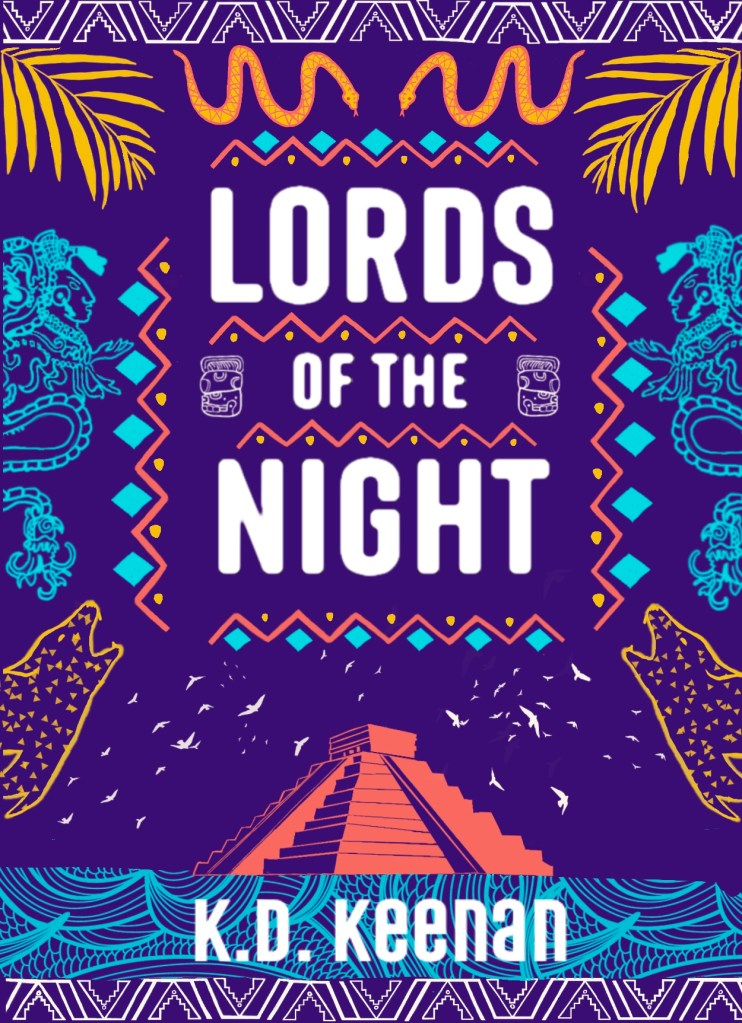
Sorry—that may have been a bit misleading. I mean that I finished the third book in my “Gods of the New World” trilogy. And it took a long time to get here. But you don’t want to hear all that—you want to know all about “Lords of the Night,” the final book? Right?

In “Lords of the Night,” Sierra and Chaco travel back in time to rescue Clancy from 6th Century Yucatan. (Spoiler Alert: Clancy didn’t die in the boiling ocean in “Fire in the Ocean” after all. Okay, I did consider letting him die in Moloka‘i. But Clancy was there at the beginning of this adventure in “The Obsidian Mirror.” After all this time, I really wanted him to be there at the end.)

 Sierra and Chaco discover that Clancy was saved from death by boiling, but is now lost in the distant past, somewhere in the huge expanse of the ancient Yucatan jungle. 

In the process of trying to locate Clancy, they encounter a young Mayan girl, Ix Mol, who has an agenda of her own. Ix Mol knows how to find Clancy, but it involves walking the White Road all the way to the great city of Ox Té Tuun, hundreds of miles away.

They arrive just in time to see Clancy sacrificed at the Temple of Chaak. 

Well, being dead didn’t stop Clancy before. But the real excitement is where Sierra and Chaco wind up. Clancy and Ix Mol also have surprise endings to their sagas.

And Fred? Well, if you want to know the role that Fred plays in this story, you’ll just have to read it.

I can say no more. But I can guarantee a satisfying climax to Sierra’s story. To read the first chapter:

Sorry—that may have been a bit misleading. I mean that I finished the third book in my “Gods of the New World” trilogy. And it took a long time to get here. But you don’t want to hear all that—you want to know all about “Lords of the Night,” the final book? Right?

In “Lords of the Night,” Sierra and Chaco travel back in time to rescue Clancy from 6th Century Yucatan. (Spoiler Alert: Clancy didn’t die in the boiling ocean in “Fire in the Ocean” after all. Okay, I did consider letting him die in Moloka‘i. But Clancy was there at the beginning of this adventure in “The Obsidian Mirror.” After all this time, I really wanted him to be there at the end.)

 Sierra and Chaco discover that Clancy was saved from death by boiling, but is now lost in the distant past, somewhere in the huge expanse of the ancient Yucatan jungle. 

In the process of trying to locate Clancy, they encounter a young Mayan girl, Ix Mol, who has an agenda of her own. Ix Mol knows how to find Clancy, but it involves walking the White Road all the way to the great city of Ox Té Tuun, hundreds of miles away.

They arrive just in time to see Clancy sacrificed at the Temple of Chaak. 

Well, being dead didn’t stop Clancy before. But the real excitement is where Sierra and Chaco wind up. Clancy and Ix Mol also have surprise endings to their sagas.

And Fred? Well, if you want to know the role that Fred plays in this story, you’ll just have to read it.

I can say no more. But I can guarantee a satisfying climax to Sierra’s story.

To read the first chapter of “Lords of the Night”: https://wordpress.com/page/theobsidianmirror.net/39

To purchase “Lords of the Night” on Amazon: https://amzn.to/3sZtqkY

The Tale of How a Little Book for Kids Grew Up and Became a Little Book for Kids


Once upon a time, many years ago (many, MANY years ago), I was a college student at Beloit College (it’s in Wisconsin and that’s all you need to know about it). I was earning a Master’s Degree in Teaching, and one of the courses I took was Children’s Literature. Much of our grade was based on two essays the professor had assigned. Two essays that I am sure the professor had selected carefully for their learning potential, but which I thought were incredibly boring.

So without any notion of what I was really doing, I asked my prof if instead of writing two essays, I could write two children’s books instead. He agreed.

I spent the better part of the next several weeks holed up in the house trailer where my husband and I lived at the time, writing a little book called “I Am Not a Bear,” and illustrating it in pen and ink and watercolor. I painted the scenes and then pasted the typewritten text onto the watercolor paper. Lacking any sort of binding option, I punched the pages with three holes and fastened them with binder rings. It was a crude production, but the best I had to hand.

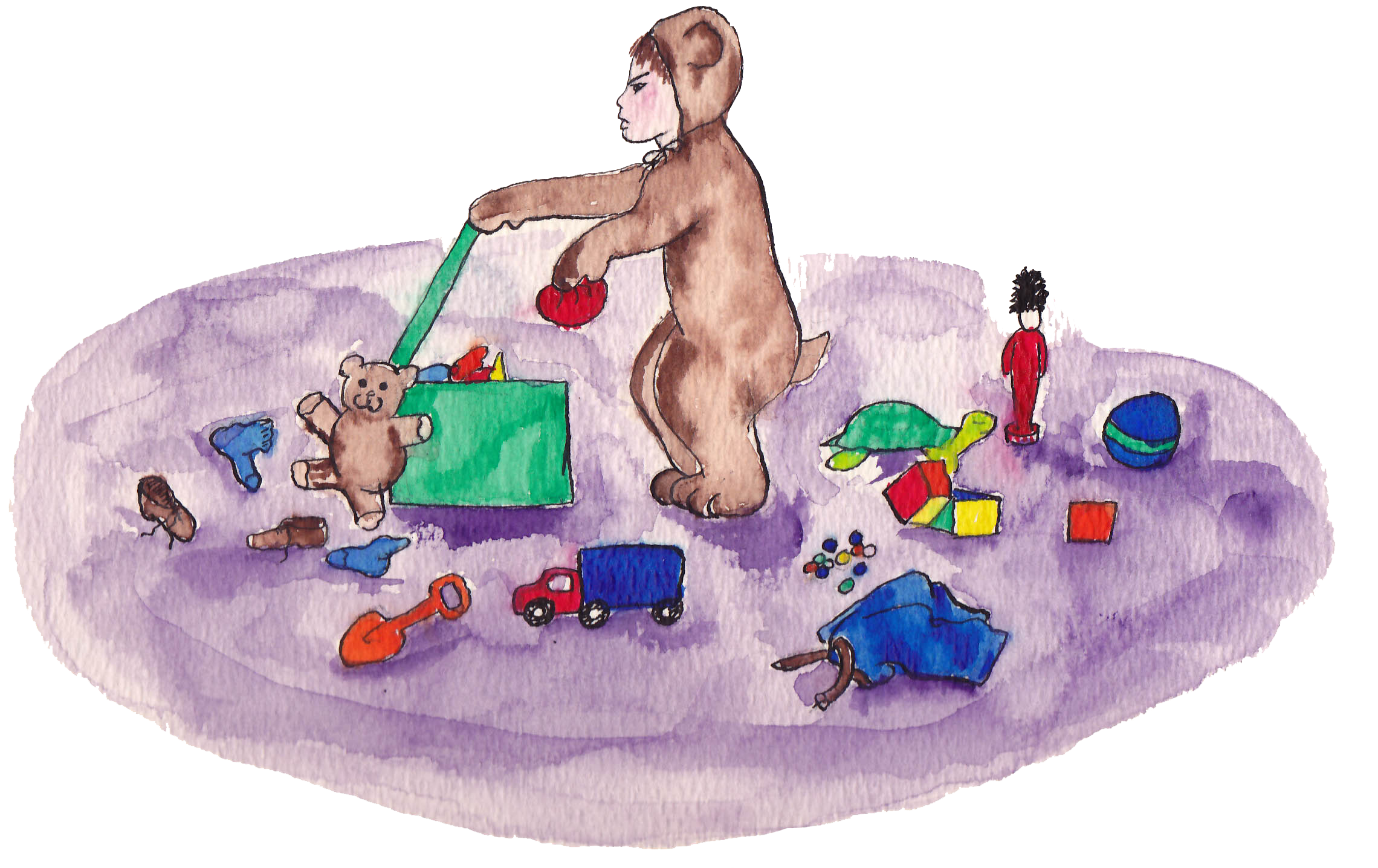
The original illustration of Paul picking up his room.


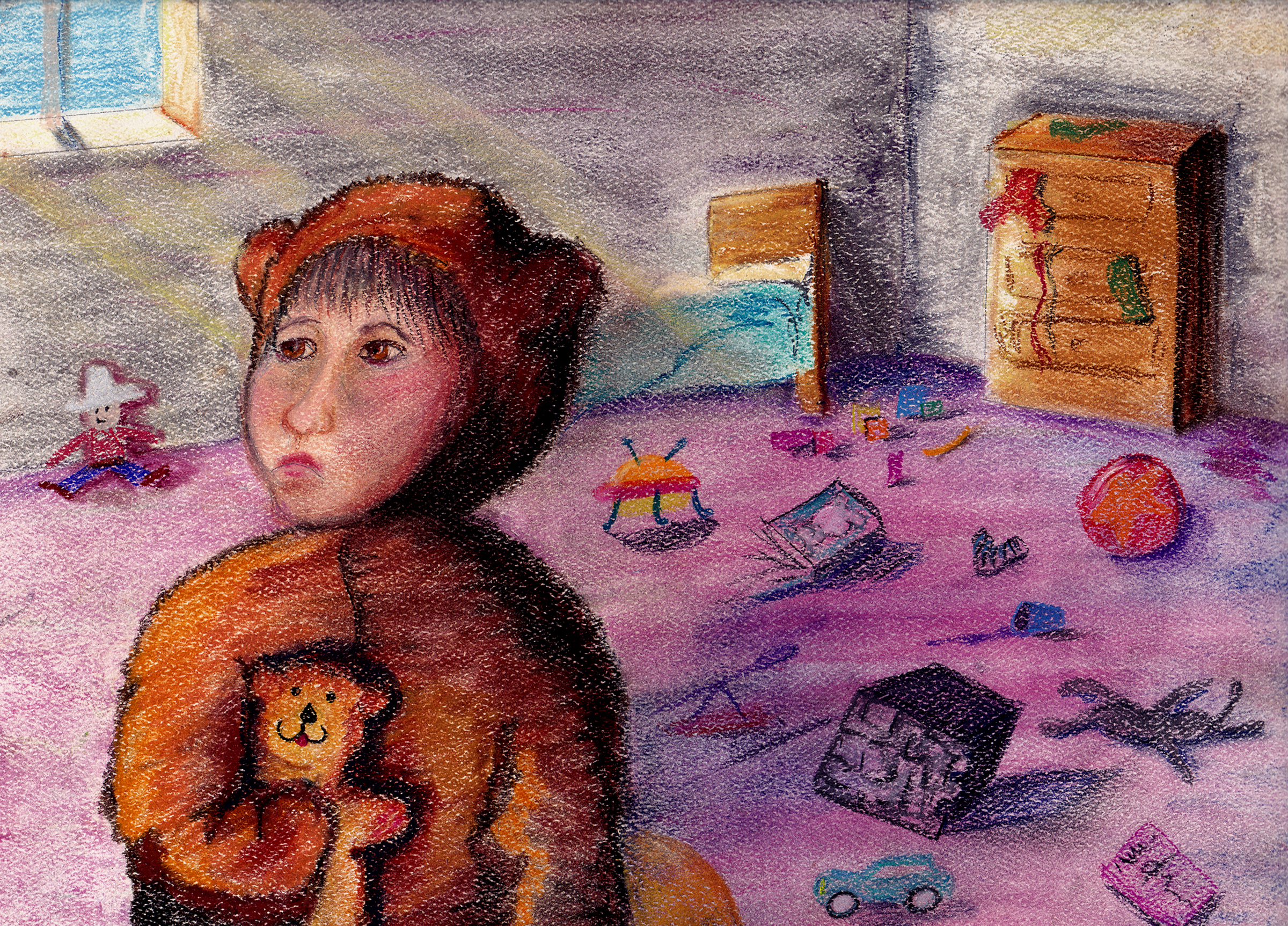
The new illustration of Paul picking up his room.

The story is about Paul, a little boy who wants to live with the bears because bears don’t have to do math, pick up their rooms, or eat oatmeal. He winds up trading places with a bear cub, Growf, who wants to live with people. Both discover there really is no place like home, but they do meet each other in the end and have a good laugh about it. It’s a simple story with a sweet message about family and home—and whether or not the grass is really greener elsewhere.

My prof liked the book and read it to his kids, who also liked it. I got an A+ in the class. End of story.

Except it wasn’t the end. I kept this opus in a file drawer for many years. When my kids hit the right age (around four years old), I pulled out my “book” and read it to them. They seemed to enjoy it, even if it didn’t become a favorite like “The Cat in the Hat.” But then, my book didn’t rhyme.

The decades passed. The grandchildren came along. I read “I Am Not a Bear” to them, too. But as I was reading it, I noticed a few things with embarrassment. It was too long and wordy for the target age. The illustrations were crude, and I had learned how to paint in oils by this time and had paintings hanging in galleries. Even more important, print-on-demand had been invented, so I could create a genuine book for my grandchildren—something they could keep if they wanted.

I rewrote the book, trying to cut verbiage and page count. Then I re-illustrated it in pastels. I wanted a soft, fuzzy look, and pastels seemed ideal. I had never used pastels before, but I didn’t let that stop me. It turned out pastels weren’t that much different from painting in oils, just…drier. Then I formatted it for lulu.com and printed a few copies for the grandchildren and sundry other kids belonging to friends and family.

I thought that was the end of this little story. But no.

I became distraught over the separation of families at the border and the imprisonment of immigrant children. I lay awake at night, agonizing over those poor kids and their families, frustrated because there was nothing I could do to help.

Then it occurred to me I could help. If I could find an appropriate organization aimed at helping immigrant families at the border, I could self-publish “I Am Not a Bear” as a bilingual English-Spanish book and donate all the proceeds to that organization to help them be more effective.

I approached only two refugee assistance organizations. The first one never replied to me. The second, the National Network for Refugee & Immigrant Rights (NNIR), responded immediately and enthusiastically that they would love to work with me on this. They have been an appreciative partner.

Just one problem. I don’t speak or write Spanish. I can find my way around a Spanish-speaking country by dint of speaking only in the present tense and waving my hands around a lot, but I didn’t even know the Spanish word for “bear cub.” (It turns out a lot of people who speak Spanish don’t know that either, which made me feel better.)

Fortunately, I have a Spanish-speaking friend who grew up in Mexico, Clod Barrera. I asked Clod if he would translate my book, for the magnificent compensation of nothing but my eternal gratitude. Clod, being a wonderful person, did so. And then I passed the translation around to a few other people to make sure all was copacetic—because I sure wouldn’t have known if there were a problem!

Finally, everything was ready to go. Except for formatting the new version of the book on lulu.com. For some reason, this took forever, and I have no intention of boring you with why, but it is finally ready to sell.

I don’t usually ask people straight out to buy my books, but I’m making an exception. If you care about the plight of children and families at the border—and know a child (around four to seven years of age) who would enjoy the book, or know of a school that could use bilingual books for young children—I’m asking you to buy “I Am Not a Bear/Yo no soy oso.” One hundred percent of the profits will be donated to the NNIR for at least two years. Here’s where to get it: http://www.lulu.com/shop/kd-keenan/i-am-not-a-bearyo-no-soy-oso/paperback/product-23979188.html

I thank you in advance. Every book that sells sends more money to help immigrants and their families.

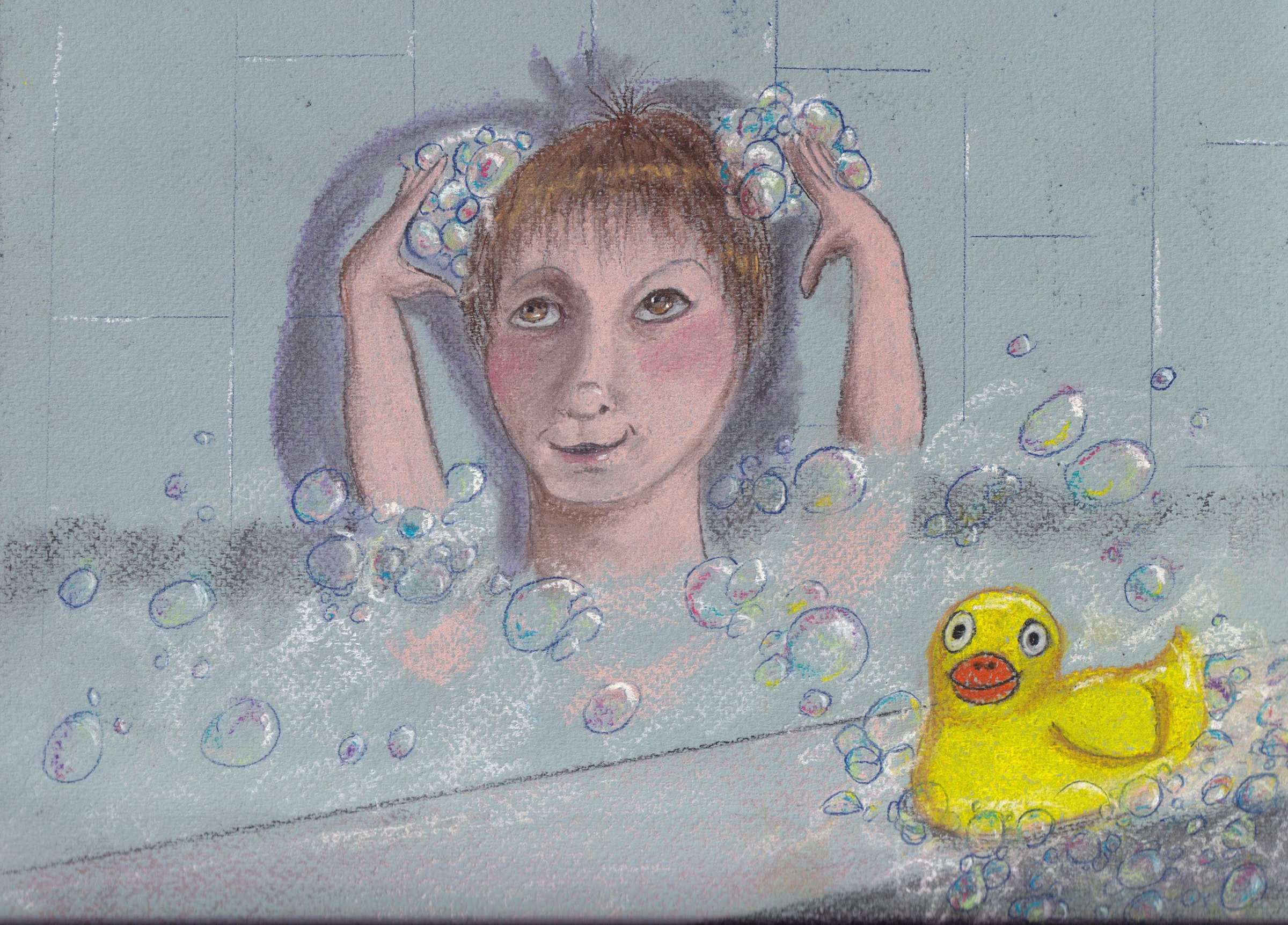
This illustration didn’t make it into the book for purely technical reasons. but I kind of like it anyway.

The Cozy Mystery Flop: A Review

I love cozy mysteries. Especially English cozies. This may be because I started with Agatha Christie—I tell a lie, it was actually Nancy Drew, so there goes that theory.

Anyway, I like the whole tea-and-crumpets thing. And I listen to a lot of audiobooks, so when someone teddibly, teddibly English narrates, like Davina Porter or Simon Vance, I feel fully immersed in jolly old Blighty.

But they have to be well plotted, too. Really, the core of a mystery is its plot. A mystery is a contract between the author and the reader. The author promises not to spring the solution to the mystery on the reader without first hinting at it or making the critical information known to the reader. The author’s skill is in disguising the information in such a way that the reader never guesses, or is at best unsure until the end. Like many mystery readers, I love to try to figure out the solution before the author reveals it—but I don’t want it to be obvious, either.

In the end, the reader has to be able either say proudly, “I figured it out, but it wasn’t easy,” or, “I should have seen that coming, but I didn’t.” Either way, it has to be a satisfactory end that explains all loose ends and does not defy the laws of reality as we know them.

A few years ago, I stumbled across G.M. Malliet’s mystery series about life in Nether Monkslip, an isolated English country village. The star is an Anglican priest, Max Tudor, an ex-M15 agent who wearied of the life of a spy and went into the god-bothering business. Being an Anglican priest, he gets to have a love life, too. The object of his affections is Rowena, the hippy-dippy owner of the village pagan/spiritual/wicca shop. I’ll just say they are a fun couple.

I adored the series, but soon read all of the existing books, so I picked up another mystery by Malliet, this time with her Detective Inspector St. Just. The first two books were not as enthralling as the Max Tudor stories, but good enough that I purchased a third, “Death at the Alma Mater.”

There are spoilers from this point forward, so please stop reading now if you intend to read “Death at the Alma Mater.”

The story takes place at the fictional St. Michael’s College of Cambridge University. The college hosts a weekend get-together for Old Boys and Girls, and they invite only the wealthiest alums because the intention is to dun them for seriously large donations. One of the guests is gorgeous and wealthy Lexy Laurent, who is famous for being famous, her ex-husband, Sir James Bellows, and his wife India, who took James away from Lexy after only three years of marriage.

It is 20 years after the graduation of these Old Boys and Girls, yet Lexy is believed to still have an obsession with Sir James. When Lexy turns up dead by the boathouse, the fun begins.

I won’t expose the entire plot, but what is supposed to have happened is that James, a writer, had published an early novel that promptly sank from view without notice. He casually gifted his then-wife, Lexy, with the rights to this novel, never thinking it would ever be worth anything. (We don’t know this detail until the exposition at the end.) Lo and behold, the novel develops a cult following and then becomes an overnight best seller years later. Movie deals are being discussed. James, knowing that Lexy will be at the reunion, asks for the rights back. Lexy, having finally reduced her passion for James to ashes, refuses. James pretends it’s no big deal, but plots her murder during the reunion at St. Mike’s.

He carries out the murder near the college boathouse before dinner. After dinner, he is seen by several people having a serious chat with Lexy in the garden. In truth, “Lexy” is a plastic blow-up doll with a Lexy wig on (she’s famous, remember?), wearing an academic robe. This is supposed to establish that Lexy was alive, though in fact she has been dead for a few hours. This gives James an alibi, as he is careful to be within sight of the other guests until the body is discovered.

This is where G.M. Malliet and I parted company. I just didn’t believe a disguised plastic blow-up doll, even if seen only from the back, could pass as a human being. And the jiggery-pokery of blowing up the doll, dressing it, moving it, making sure people saw it but that no one got close enough to see that it wasn’t Lexy, and then somehow getting it out of there without anyone seeing either him or the doll—nah. I became unwilling to suspend my disbelief. (I mean, have you SEEN one of those dolls?)

The other major point is that James killed Lexy for the rights to his book. It was never mentioned that Lexy might have a valid will leaving everything to the Orphaned Hedgehog Home or something. The ex-husband certainly would not be handed the rights back if he were not specifically granted those rights in the will. So it would have been all for nothing.

I can only recommend the St. Just series with muted enthusiasm, and “Death at the Alma Mater” not at all. However, I most heartily recommend all the Max Tudor books. They are everything English cozy mysteries should be, and satisfying reads, every one.

The Death of a Thousand Cuts

Lingchi, or the death of a thousand cuts, was a form of torturous execution practiced in China and Vietnam until the early 20th Century. Without going into too much gruesome detail, this involved cutting small pieces of a person’s body off until they died from blood loss, shock, or systemic failure. The idea was to inflict the maximum amount of pain, anticipation of death, and humiliation upon the victim.

Every woman in America knows the death by a thousand cuts. It starts when we are little kids, and as we get a little older, it only gets worse. Let me offer some examples from my own life. I am not using my experience because I want your sympathy. I want you to remember when this sort of stuff happened to you, your friend, your mother, your aunt, your sister, your classmate. And I want you to be furious and stay that way.

As a child, my father’s worst insult was to call me “girlish.” Being girlish was the worst thing you could be, that was clear, but I was at a loss as how not to be girlish, being a girl and all.

As a girl, I wanted to be an archeologist. My father talked my mother, who was a former archeologist, into telling me that female archeologists never got married. I pointed out that she had, and so had Margaret Meade—five times—but this was ignored. Nonetheless, I was told I could “be whatever I wanted to be.” Puzzling.

As a child of perhaps nine, my friend and I were pursued down the street by older boys demanding a “blow job.” Neither of us knew what that was, but we were pretty sure it was something we needed to flee from—quickly. I learned as a child to avoid groups of adolescent boys or young men when I was walking because of the filthy comments they made. Again, I didn’t understand most of them, but they conveyed a slimy contempt that frightened me.

As a seventh-grader, I was harassed on the school bus by a boy in my grade. When I turned to ask him to stop, he slapped me as hard as he could across the face before I could even speak. I wish I had been more of a fighter as a girl, but I was raised to be sugar and spice and everything nice and I had no idea how to retaliate without getting badly beaten. I turned around and said nothing and repressed my tears. I heard one of the boys behind me say, “Well, at least she didn’t cry.” When my father called his father, the boy’s father basically said suck it.

When I developed secondary sexual characteristics, of course it got much worse. I became adept at spotting and avoiding trouble by being alert for predatory males all the time. Once I was walking through a park in the afternoon and a car driven by a solitary man began following me. He followed me everywhere until I approached a family of picnickers and asked if I could sit with them until the man left. They kindly allowed me to stay and the stalker took off, but it frightened me.

The very next morning, my younger sister and I went for a walk before my parents got up. We were visiting Monterey, CA, and it was foggy. We wandered down to the wharf, not far away, and walked out to the end of the dock. On the way back, we were approached by two transients, toothless, filthy, dressed in dirty rags, who told us to go with them and have some “fun.” It was two men against two young girls (one just a child), and they were very threatening. No one else was around, and the thick fog obscured everything. I put my arm around my sister and began yelling, “NO!” They finally gave way and let us go, but that was the scariest moment of my young life.

In college, I was groped multiple times at dances by men who were just walking past, as though I were a fruit display. Casually done, as if it were their right to touch me in such a way. One man who shall remain nameless as he isn’t up for a Supreme Court judgeship, tried to rape me when he thought I was unconscious. Just napping, as it turned out, but I never trusted him again.

I remember the first time I realized that men did not have my back—even men who weren’t doing anything objectionable. I was waiting in line in a liquor store. The guy in front of me was enormous. I am nearly six feet tall, but this man dwarfed me. After he paid for his purchase, he whirled around abruptly, glowered at me and said, “You wanna go out?” Startled and a bit frightened, I stammered, “No!” He turned away and left the store. I definitely felt threatened and I was worried that he might be waiting for me outside. I looked at the men in line with me (there were no women). I looked at the checkout clerk, also a man. Their eyes were blankly unconcerned. I realized that I was completely on my own. No one was going to offer to walk outside with me to make sure I got to my car safely. I waited quite a while inside the store, peering out to see if I could spot this giant man, before I dared to leave the shelter of the store.

Much later, when I was in business, I ran into men who refused to work with women, and were fairly rude about it. One man, who probably weighed over 300 pounds, made a joking remark about my being overweight in a room filled with men who laughed at his clever joke. In another testosterone-infused business meeting, a man began loudly talking and sharing jokes during my female colleague’s presentation. He was not reprimanded by the male vice president who was running the meeting.

I can’t even tell you about all the times I’ve been catcalled, or ignored, or talked over, or had my ideas repeated by a man to general acclaim—minutes after I had suggested them and been ignored.

I’ve been followed. I’ve been stalked. I’ve had perfect strangers (men) feel free to comment on my attributes or lack of them. I’ve been called bitch, cunt, whore, and slut by people who have never met me before.

I’m not telling you this because my experience is so awful. I’ve never been raped, for instance, or physically abused by a man. No, I’m telling you because EVERY WOMAN IN AMERICA SHARES THESE EXPERIENCES WITH ME. Every. Last. One.

This is the death of a thousand cuts: every day, women and young girls face the lust, scorn, disgust, hatred, indifference, and ridicule of men. After a few decades, it feels very old indeed. The good news is, if you become fat or in any way deemed unattractive, such as getting gray hair or saggy tits, it all goes away! No one catcalls, stalks, or gropes you anymore because now you are COMPLETELY INVISIBLE! No one hears you, no one sees you. It’s better than the catcalling and groping, which should tell you something.

Obviously, I am not talking to or about the good men, of whom there are many. But sadly, because these men are good, they think that these criticisms are aimed at all men. Some get very defensive, “I don’t do those things!” and refuse to hear about it. We need these good men on our side, not defending themselves against us. Women know that “not all men.” So don’t get defensive on us when we’re asking for your support. Don’t tell us that not all men. Show us that not all men.

Thanks.

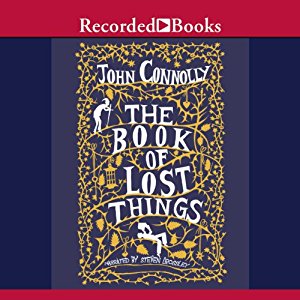
Review: “The Book of Lost Things”


“The Book of Lost Things,” by John Connolly, is a fairy story about fairy stories—and not the kind that necessarily turn out happily ever after. More the Grimm kind, where virtue isn’t always rewarded, but evil is always savagely punished. It shows again that fairy stories are primordial, ancient, bred in the bone.

David, our protagonist, is a 10-year-old English boy who loses his beloved mother in the opening days of WWII. His father and he do as well as they can together, but then David’s father marries Rose and they have a baby boy, Georgie. None of this goes down well with David, who is grieving, angry, jealous, resentful and lonely. He also starts seeing strange things like a crooked old man lurking in his brother’s room, and begins having fits.

The one solace David finds in his new situation is the books in his room. They are fairy stories, but different from the ones he has read before—darker and more disturbing. He asks Rose about them, and she tells him they belonged to a great uncle who had loved the books, but he and a young female relative had disappeared one day and were never seen again.

One night David is awakened by his mother’s voice calling him. He knows his mother is dead, but his desire that this not be true is so powerful that he wanders into a neglected sunken garden. The voice seems to be issuing from a hole beneath a great tree there. As David hesitates, he hears the screaming of a bomber overhead, disabled, on fire, and heading right for him. He dives into the hole beneath the tree and discovers himself in a strange land as the bomber crashes through and David’s escape route is blocked. Just to let you know that the story to come will not be about sweet little creatures with butterfly wings, the pilot’s head bounces by David after the crash, blackened and bloody.

David soon discovers that a great evil is growing in this new land. A wolf army is gathering, led by the Loup, half man, half wolf. The Crooked Man is here as well, and seems to want something from David. The dangers here are genuine and they are deadly. The author doesn’t flinch at detailed descriptions of some truly grotesque and bloody deaths.

Amid the growing darkness, David also meets some good people who help him. One of them tells him to seek out the king of this land because he has “The Book of Lost Things” that will help David to return home. “The Book of Lost Things” doesn’t help him to find his home, but it does clear up the central mysteries of the story, pointing David to the truth of the Crooked Man and his agenda.

David proves he is brave, loyal, and resourceful. He discovers that not everything is what it seems, and learns to be discriminating about whom he trusts—a single misstep could be fatal. In the process, he solves the mystery of what happened to Rose’s great-uncle and his young relative, and of course realizes his mistake in rejecting Rose and Georgie. By the time David finds the way home, we feel he has earned his return many times over.

The book follows David’s life after this event. It was not a life free from pain or unhappiness, but he finds love, comfort and a purpose in life. At the end—I’ll let you read the book to find out what happens at the very end. Like a good fairy story, the end wraps everything up in a most satisfactory way.

I would have to say that ‘The Book of Lost Things” is not for the faint of heart. Although the protagonist is a child and the source material is fairy stories, it is definitely not a children’s tale. I might even hesitate to recommend it to a teenager, particularly if they were going through a Goth phase. There is a lot of violence, a pervasive sense of creeping evil, and many adult themes. I would have to say that it cleaves to the original tenor of the ancient stories, though. The old fairy tales are dark and primeval. They have nothing to do with living happily ever after or marrying the prince. They teach us to beware the evil in the dark and the forces we do not comprehend. “The Book of Lost Things” is that kind of fairy tale.

Review: “My Grandmother Asked Me To Tell You She’s Sorry”

I like fairy tales. I also like fairy tales re-imagined, but not all of them. For instance, I hated Gregory McGuire’s “Wicked.” I thought it disrespected Baum’s innocent vision of Oz, though obviously I am in the minority, and Gregory McGuire is now a rich man. On the other hand, I loved McGuire’s “Lost,” which skillfully weaves together Dickens’ “A Christmas Carol,” shades of Jack the Ripper, and some other goodies into a gripping ghost story.

“My Grandmother Asked Me To Tell You She’s Sorry,” by Fredrik Backman, is a rare jewel. It is a fairy story that combines several related fairy stories and reveals the truth behind them. And it’s completely original, in that it doesn’t rehash older source material. (Not that I’m saying it’s wrong to rehash source material. What would we do without it?)

Elsa, our protagonist, is seven years old and precocious, but I am happy to say she is precocious in a believable, seven-year-old way. Her grandmother is a character, to put it mildly. Among other things, Elsa’s grandmother has taught her a secret language and told her stories of the several kingdoms of the Land of Almost-Awake. Her grandmother is her super-hero, and Elsa adores her. In fact, Granny is Elsa’s only friend, because Elsa doesn’t think much of the kids at school who don’t understand great literature. Like “Harry Potter.” And Marvel Comics.

Elsa, her mother, her grandmother, and her stepfather live in a kind of a boarding house. Some of the tenants are very much in full view, like Britt-Marie, who bosses everyone around about signs in the laundry room and strollers in the stairwell. Others are never seen, including the mysterious “Our Friend,” as Granny refers to him. Elsa’s mother works all the time, her remarried father is not a strong presence, and she resents her stepfather. Her grandmother is her rock.

And then Granny dies. But before she does, she asks Elsa to deliver a letter. Elsa does, and sets off a chain of events that reveal the true nature both of Granny’s stories and of the people in Elsa’s life. Bit by bit, she comes to understand who these people are and how they came to be who they are. She also discovers her grandmother’s hidden connection to every soul in the boarding house.

Elsa eventually discovers a mother who loves her unconditionally, a stepfather who’s actually okay, and a father who turns out to be important after all. She even makes a friend. She learns some things about adults that in the end, she knows she just has to forgive.

While the protagonist of “My Grandmother Asked Me To Tell You She’s Sorry” is a child, this is not a children’s story. The heartache and sadness are all-too-poignant, and the adults’ stories are, well, adult. The story is about a child finding her way through the complexities of life by relying on herself and her memories of her grandmother. She learns the truth behind the tales, and adult truth is sometimes difficult and scary.

Fortunately, there is enough humor in Elsa’s take on things that the book never becomes dreary—and I was pleased that the humor never condescended, even though the lead character is a child.

I had a hard time deciding whether to categorize “My Grandmother Asked Me To Tell You She’s Sorry” as a fantasy or mainstream, even though the only fantasy elements in the story are Granny’s stories. It’s a fairy tale, but although it has a happy ending, it is a realistic ending. Granny doesn’t come back to life. Britt-Marie was never a princess. “Our Friend” is not really a wurse from the Land of Almost-Awake. And yet, the fantasy carries the story. Read it and decide for yourself.