Warning: This Post Contains Shameless Self-Promotion

New Cover

Recently I finished editing the first draft of “Fire in the Ocean,” the sequel to “The Obsidian Mirror.” I sent it off to my alpha readers and editor, and I can finally relax and think about something else for a while.

Such as promoting “The Obsidian Mirror.” While I was in the throes of writing the sequel, I did next to nothing about promoting my published work. A writer’s work is never done, I guess.

Why should you read “The Obsidian Mirror”? Short answer: because it’s a fun read. I read largely for entertainment. I like books that take you away and let you live someone else’s life for a while. I wrote “Obsidian” to be that kind of book: a diversion, a book I would love reading myself. It’s probably not a coincidence that the second publisher of the book is Diversion Books—they specialize in just that kind of novel.

Another reason to read “Obsidian” is because it is based on the mythologies and folklore of the Americas, which makes it a bit different. The idea occurred to me after finishing one of Robert Jordan’s “Wheel of Time” novels. I loved the book, but started wondering why so much fantasy is based on proto-European, pre-Industrial Age tropes such as elves, faeries, dragons, and caped adventurers. The Americas have thousands of mythologies, folk tales and traditions that are largely ignored by fantasy writers.

I began writing “The Obsidian Mirror” as a kind of personal experiment. Meso-American gods and Coyote the Trickster, an Inuit ice demon and a mannegishi named Fred are some of the characters. What I did not anticipate is that I would fall in love with my characters and be driven to finish the book. Having done that, I felt compelled to get it published.

I don’t have much to brag about. I’m not a best-selling author. I have won no prestigious awards for my fiction writing. But I do have one thing that gives me modest bragging rights.

I have heard authors talk about receiving hundreds of rejection slips. One writer said he had a drawer filled with 450 rejection slips for his novel. That didn’t happen with “The Obsidian Mirror.” I approached perhaps 10 publishers and/or agents before AEC Stellar agreed to publish the book. When AEC Stellar bit the dust, I approached about five publishers before Diversion Books picked it up, re-published it and agreed to publish the sequel.

So I may not have sold a million copies, but I never had any problem finding a publisher. As a matter of fact, years after I originally submitted the manuscript to their slush pile, Baen Books got back to me and said they were interested in it. The early bird gets the book, Baen.

So why am I proud of this? Because I have some independent assessments that people will enjoy reading my novel. Add to that, the several four- and five-star reviews on Amazon, and you might conclude that you would enjoy it, too. To make it super-easy for you to find the book, here it is: http://amzn.to/1MQBvkd

I did warn you.


Authors with Feet of Clay and the Wings of Angels

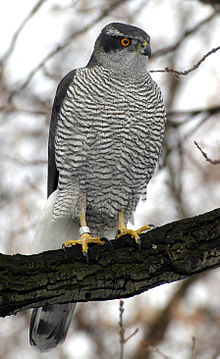
220px-Northern_Goshawk_ad_M2

This is what White meant by a “mad, marigold eye.”

Most of the books I read are fiction. I’m a writer, I love stories­—it’s natural. And while I have read much of the world’s greatest English literature (I always score well on that annual list the BBC publishes of the 100 best books in the English language), the vast majority of what I read is brain candy. Fluff. Genre books.

Mind you, I am in no way putting these books down. I read them. I pay good money for them. I like them. I write them.

But once in a while, I pick up something that breaks this pattern. Last week, I re-read “Tess of the d’Urbervilles” by Thomas Hardy, and found it lyrical, funny, and tragic all at once. (In marked contrast to my experience of reading it in high school Honors English class.) This week, I finished reading a book loaned to me by my oldest friend, “H is for Hawk” by Helen Macdonald. There was no question this was going to be an excellent book, as it is a New York Times bestseller and winner of the prestigious Samuel Johnson Prize.

However, the book was, on the surface, about training a goshawk. I probably wouldn’t have read it if my friend hadn’t said, “There’s a lot in there about T.H. White, and I know how much you like him.”

Macdonald describes T.H. White as “an unpopular author,” which shocked me, but I suppose she is right; I just have difficulty accepting that an author whose writing is so beautiful could have fallen from favor. White is the author of two of my favorite works, “The Once and Future King,” (actually five books), an epic fantasy about King Arthur, and “Mistress Masham’s Respose,” one of my childhood favorites about a lonely little girl who stumbles upon a lost colony of Lilliputians (literal Lilliputians, brought to England by Gulliver).

White’s writing is so incandescently lovely that it makes me weep. His descriptions of the English rural countryside are so evocative that as a child, I felt I knew that landscape intimately, though I had never been within five thousand miles of the place. And I remembered one powerful scene in “The Sword in the Stone” (the first of the books of “The Once and Future King), in which the young Arthur is changed by Merlin into a small hunting hawk and placed in the mews of Sir Ector’s castle. Arthur is subjected to an ordeal by the other hawks; he must stand within striking distance of Colonel Cully, a mad old goshawk, until the hawk bells are rung three times by the other birds. If he survives, he is admitted into their company. That scene is only one of many White crafted to show how Merlin educated Arthur into kingship, but it stuck with me, particularly the description of Cully’s “mad, marigold eye.”

Macdonald had read “The Goshawk,” as well as much of White’s other work, and knew more about him as a person than I did. She was obsessed with hawks and hawking from an early age, read medieval books on hawking, hung out with austringers (people who train hawks), flew them herself. She had always been intrigued by the idea of training a goshawk—maybe because White had attempted to do this himself as a young man, and failed, ultimately losing his hawk to the wild.

Different people respond to grief in different ways. When Macdonald’s beloved father died, she decided that she would acquire and train a young goshawk. Perhaps White’s account of his epic battle with his goshawk was at the bottom of it; she needed a battle to take her mind off sorrow.

Macdonald interweaves her story of acquiring and training Mabel, her goshawk, with accounts from White’s life and work. Her writing is nearly as luminous as White’s, evoking the landscape, the life of the young hawk, the tragedy of White’s life tied up with the tragedy of her father’s death.

All I can say is that the reader descends into madness with the writer and emerges with her, not unscathed. Macdonald emerges with the scars of Mabel’s talons in her flesh, but the wounds of her father’s death healed.

However, I was left with more knowledge—and less—than I wanted about T.H. White. I know that some people want to know everything there is to know about favorite authors. Not me. I much prefer to listen to the author’s voice through his or her work, and accept that as the reality the author meant for me to experience. I fell in love with many an author, only to find on reading a biography that the adored one had feet of clay and was only a weak human being after all. Like the rest of us.

For example, my mother, sister and I loved Gerald Durrell, the British author of “My Family and Other Animals” and other books detailing his love for animals and adventures as an animal collector for zoos, and later, for his own zoo on the island of Jersey. He was a funny and evocative writer and once wrote me a personal note when I sent him a letter at age 10 asking about how he became a naturalist. I was delighted to find his biography some years after his death. But when I read it, I discovered that he (like most of his talented family) was a hopeless alcoholic with a violent temper who died of liver disease. I was happier with the sunny, charming animal lover of Durrell’s books.

I had always seen White as sort of a God-like figure, someone full of age and wisdom and kindness who saw the foibles of mankind with a clear and compassionate eye. He may have been so, but he was also an alcoholic who despised himself for his homosexuality and sadism. He grew up in a family so deranged that when his mother lavished affection on her pet dogs, his father had them shot. He thought his father would shoot him some day, and his mother was cold and remote. Then, of course, they sent him to an English boarding school, where the milk of human kindness was not only spared, but completely missing.

White became a schoolmaster at another prestigious public school, but it is notable that although his sexual fantasies focused on beating adolescent boys, he never did so. He eventually fled to a cottage in the woods and decided to raise a young goshawk in the medieval manner, opening a pitched battle between man and bird. This experience informed much of his later writings, but “The Goshawk” wasn’t published until much later, because White knew how badly he had failed in training his hawk.

I am considering whether or not to read an autobiography of White. I’m not disappointed in him, more sorry that he endured so much pain. I think it’s incredibly brave that he tried so hard not to inflict pain because he knew he enjoyed doing so. I will definitely seek out and read more of White’s work. Human nature may be sad and disappointing at times, but I have never been disappointed in the writing of Terrance Hanbury White.

Oh, and I’ll also read anything else Helen Macdonald decides to write.

The Vengeance of El Niño

It’s been a while since I have shared what I am working on. I blogged extensively about my research visit to Hawai‘i in January of 2015, but I’ve been on radio silence about work ever since.

Part of that is because if I say too much about the story, why would you want to read it when it is published? Another issue is providing detail about a story that might very well change so drastically in the writing process that it becomes unrecognizable.

I did mention that it has been much easier writing with a plot outline than without one. And that was certainly true until I wrote up to the intended climax of the story—and discovered that it wasn’t actually the climax after all and I needed to extend the story (for which no plot outline yet existed).

Part of the problem was that I hit the putative climax at about 65,000 words into the story. That means that I would have wrapped it up in about 75,000 words, which is a bit light for a novel like this. “The Obsidian Mirror” was about 100,000 words, and I am aiming for a similar length for this novel.

So I hit a rough patch as I floundered around trying to figure out what comes next in the story. I hesitate to call it “writer’s block” because I wasn’t blocked. I knew where the story was going, I was just missing a piece. Sort of like Indiana Jones crawling across a rope bridge across a steep chasm and there’s ten or fifteen planks missing in the middle. And crocodiles (my publishing contract and deadline) waiting below.

And then there was getting sick. Then the holidays. El Niño came for a visit last week and flooded the basement, soaking our family photos, my oil paintings, family historiana, and a lot of other stuff. I spent this past week gently prying apart photographs and arranging them on every available surface to dry, turning them over, grouping them, and tossing the ruined ones away. I did no writing at all.

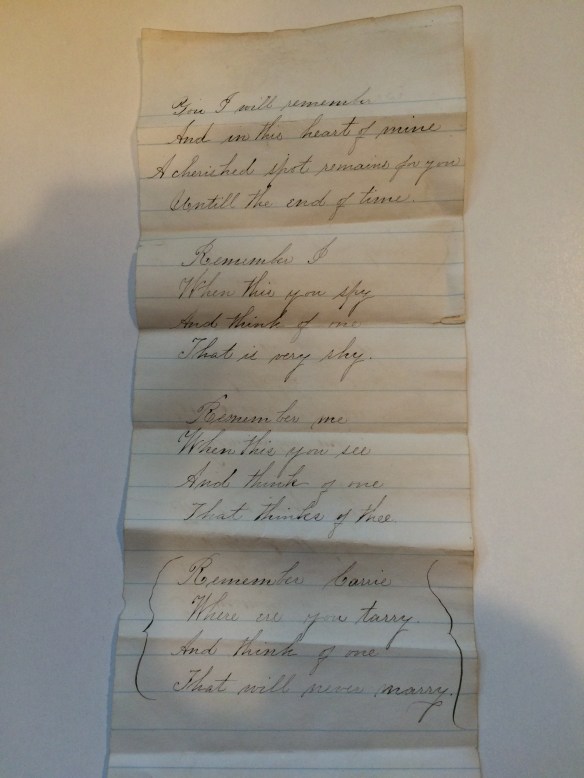
Among the things I found was a packet of letters, all dated around 1879. They were written by someone named Carrie to her cousin, William Smith of Roxbury, NY. (Mr. Smith was one of my ancestors, which is how I came by the letters, but I haven’t looked him up to determine exactly what the relationship is.) They were written in a delicate copperplate hand, very legible, the India ink still clear and sharp despite their age and the complete saturation of the paper.

I reluctantly decided I would have to throw them out. There were so many of them, and my priority was rescuing my thousands of family photos before they stuck irretrievably together. I read a few of the letters and they were fairly mundane, though written with clear affection for the recipient. I felt guilty. They had been kept perfectly for 110 years, and I was the one who trashed them.

However, I found a poignant little poem in Carrie’s spidery copperplate. Here it is:

You I will remember

And in this heart of mine

A cherished spot remains for you

Untill (sic) the end of time.


Remember I

When this you spy

And think of me that is very shy.


Remember me

When this you see

And think of me that thinks of thee.


Remember Carrie

Where ‘ere you tarry.

And think of me

That will never marry.


The last stanza was enclosed in brackets. What do you think? I don’t mean Carrie’s gifts as a poet, which are slight, but the heart of it. I think Carrie was in love with William. I have at least saved her poem, which must have cost this shy woman a great deal to share with her adored cousin.

That much of Carrie I am keeping, safe for now.

IMG_1736

Carrie’s Poem

Getting back to my current book, I am firm on the title of “Fire in the Ocean.” It is set in Hawai‘i, which was built—and is still being built—by fire in the ocean: volcanoes. It also touches on the Great Pacific Garbage Patch, where billions of tons of particulate plastic are swirling around out there like peas and carrots in alphabet soup. Hawai‘i is smack dab in the middle of it. The slow dissolution of chemicals from the plastics is another form of “fire in the ocean,” poisoning sea life. And, of course, Pele, the goddess of volcanic fire, is a featured character in the book. Those of you who followed my blog from Hawai‘i know why I couldn’t leave Pele out of the story.

I am back on the job writing. El Niño is paying another visit, but we have pumps going and sandbags. All my rescued photos are safe and dry now and my oil paintings are drying out in the bathtub. Good time to write!

DSC_2647

“The Burden” This is one of my oil paintings, now residing in my bathtub. It won a first prize somewhere obscure.

Imaginary Friends Versus Imaginary Sparkles


Rainbow of lights

When I was little, I wanted an imaginary friend. I had a Little Golden Book about a lamb who had an imaginary friend, and I thought this would be very handy when I was stuck playing by myself. But try as I might, I never did develop a convincing invisible companion.

My daughter and son both had imaginary friends. Kerry, around the age of three, had a husband named Jonah and 10 kids, most of whom were named Stinky, but one was named Salty. They lived in San Francisco for a while, then they moved to San Jose and Jonah opened a sandwich shop. Jonah suffered an unfortunate death from pneumonia when Kerry developed a crush on a three-year-old named Brian. At the age of two, Sean had Dahlilly. Dahlilly was a very tall angel with orange wings and hair and blue eyes. His favorite food was Chicken McNuggets. Dahlilly eventually turned into a Tyrannosaurus Rex, and disappeared soon after, presumably due to personality disorder.

I may not have had an imaginary friend, but I did have imaginary sparkles. Like many kids, I was afraid of the dark, so I kept my door open halfway so that the hall light would dispel the monsters. When the sparkles began I was about six years old. I was lying in bed when I noticed some sort of dust drifting slowly and gently through the half-open bedroom door and spreading throughout my darkened room. In the light from the hallway, they looked like dust motes in a sunbeam. As these motes floated into the darker areas of my room, they looked like infinitesimal points of colored light. Soon, my room was filled with tiny sparkles swimming lazily around my room on unseen currents of air. They were as silent as the stars.

I was alarmed. I had never seen this before, I had never heard anyone talk about anything like this, and I was seriously frightened. I ran downstairs to see my parents, who, predictably, told me I had been having a nightmare.

It was not a nightmare; I had been wide awake. But even at the tender age of six, I intuitively knew that insisting otherwise was a waste of my time. So I trudged back upstairs to my bedroom to face whatever fate awaited me, and was relieved to find that the sparkles had disappeared.

As soon as I went to bed and turned out the light, they drifted in again, tumbling in slow motion and twinkling like incredibly tiny Christmas tree lights—thousands upon thousands of them filling my entire room. That night, I hid my head under the covers, which was my best and only defense against the unknown.

The sparkles came back every night after that. I decided they were benign and friendly things. Maybe it was fairy dust, or the sand that the sandman brought. Or perhaps the sparkles were fairies themselves. I didn’t understand what they were, but I grew to welcome them and looked forward to seeing them every night. The cloud of little lights felt like a magical protection. I never mentioned them to my parents again. I think I casually asked one or two friends if they saw sparkles at night to see if I was the only one. I was the only one.

My parents sent me to boarding school when I was 14. I wondered if the sparkles would follow me to the school. They didn’t. When I came home for Thanksgiving, no sparkles drifted into my room, that night or any other.

I missed them. Perhaps I had outgrown my need for their magical defense. Perhaps it was a function of change in a growing brain. I don’t know.

I suppose the sparkles were a recurring hallucination. Perhaps they were a way to cope with growing up in a difficult family situation. However imaginary they may have been, they were real to me, a mystical defense, a security blanket, a pretty light show that soothed me to sleep.

I still wish the sparkles would come back. They were better than any old imaginary friend.


The Dead Authors Society

A disturbing number of my favorite authors have died recently, and it’s bugging me. I’m talking about the kind of writer whose prose delights you, for whatever reason. Maybe reading a certain author’s work feels like sinking into a warm bath, comforting and deep. Or thrills you with action. Or galvanizes you into action. Or makes you feel as though you are traveling through faerie realms. You own all of their books and re-read them from time to time, just for the pleasure of the visit.

I decided to share some of my favorite deceased writers with you. If our tastes are similar, maybe you’ll like them, too. A caveat: Not all of these authors are great prose artists. But they all have a special, um, je ne sais quois.
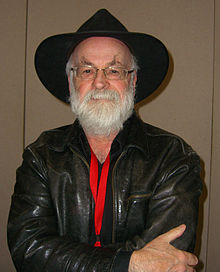
Terry Pratchett

Terry Pratchett

Sir Terry Pratchett. If you’ve been reading this blog, you already know I’m in sackcloth and ashes over Pratchett’s untimely demise from Alzheimer’s earlier this year. If not, or if you’re a glutton for punishment, you can read my tribute to Sir Terry or my review of his last Discworld book, The Shepherd’s Crown.


L.A. Meyer. Louis Meyer authored the young adult “Bloody Jack” series. I have actually never “read” one of these, but I own all of them as audiobooks. This is because the narrator for all of them, Katherine Kellgren, is absolutely brilliant. She perfectly captures the heroine’s Cockney cockiness, her bounce, optimism, kindness, and impulsiveness. Bloody

L.A. Meyer Photo Credit: Bangor Daily News

L.A. Meyer
Photo Credit: Bangor Daily News

Jack starts life in the late 18th century as Mary Jacqueline Faber, daughter of a respectable couple fallen on hard times. Her parents die and she is coldly ejected into the streets of London at age 8. She falls in with a gang of street children, and after observing that life in the streets was a short-term proposition for most kids, she disguises herself as a boy and signs on as a cabin boy with a naval ship. Her ensuing adventures are grand and hilarious to boot. Kellgren does an amazing range of male and female voices and accents. The only one she just can’t do is Scots. Fortunately, there’s only one significant Scottish character, and he’s only in the first few books.

Meyer created a memorable, lovable, and downright addictive character in Jacky Faber. The other major characters are also well delineated and engaging. He manages to sneak in a good bit of history in the process of entertaining us.

L.A. Meyer died in 2014 from Hodgkin’s lymphoma. But he finished his series before he set sail into the great beyond. I’m listening to the final book now with a mixture of enjoyment and sadness that this is the last I’ll see of Bloody Jack.

The Bloody Jack series in chronological order:

  • Bloody Jack: Being an Account of the Curious Adventures of Mary “Jacky” Faber, Ship’s Boy (2002)
  • The Curse of the Blue Tattoo: Being an Account of the Misadventures of Jacky Faber, Midshipman and Fine Lady (2004)
  • Under the Jolly Roger: Being an Account of the Further Nautical Adventures of Jacky Faber (2005)
  • In the Belly of the Bloodhound: Being an Account of a Particularly Peculiar Adventure in the Life of Jacky Faber (2006)
  • Mississippi Jack: Being an Account of the Further Waterborne Adventures of Jacky Faber, Midshipman, Fine Lady, and the Lily of the West (2007)
  • My Bonny Light Horseman: Being an Account of the Further Adventures of Jacky Faber, in Love and War (2008)
  • Rapture of the Deep: Being an Account of the Further Adventures of Jacky Faber, Soldier, Sailor, Mermaid, Spy (2009)
  • The Wake of the Lorelei Lee: Being an Account of the Adventures of Jacky Faber, on her Way to Botany Bay (2010)
  • The Mark of the Golden Dragon: Being an Account of the Further Adventures of Jacky Faber, Jewel of the East, Vexation of the West, and Pearl of the South China Sea (2011)
  • Viva Jacquelina! Being an Account of the Further Adventures of Jacky Faber Over the Hills and Far Away (2012)
  • Boston Jacky: Being an Account of the Further Adventures of Jacky Faber, Taking Care of Business (2013)
  • Wild Rover No More: Being the Last Recorded Account of the Life and Times of Jacky Faber (2014)

Source: Wikipedia

Elizabeth Peters

Elizabeth Peters

Elizabeth Peters. Elizabeth Peters’ real name was Barbara Mertz. She wrote mysteries under the name Elizabeth Peters and supernatural/gothics under the name Barbara Michaels. She was an Egyptologist by education and wrote books about the everyday life of ancient Egyptians under her own name. She died in 2013.

As Elizabeth Peters, she had several series, but my absolute favorite is the Amelia Peabody series. Amelia Peabody is a wealthy English spinster of Victorian times who decides to travel. Intrigued as many Victorians were with the mysteries of ancient Egypt, she winds up in Cairo, encounters a nasty, rude male archeologist and a few murders. She winds up saving the day with British aplomb, a stiff upper lip, and a sharp umbrella. Amelia tells her own stories, and her prose is delightful to anyone who has read much Victorian literature. Here are some selections of Amelia’s wisdom:

  • “Men always have some high-sounding excuse for indulging themselves.”
  • “Abstinence, as I have often observed, has a deleterious effect on disposition.”
  • “Godly persons are more vulnerable than most to the machinations of the ungodly.”
  • “I do not scruple to employ mendacity and a fictitious appearance of female incompetence when the occasion demands it.”

Source: http://ameliapeabody.com/fromamelia.htm

Amelia waxes positively purple over her husband, Emerson, and there are references to his “sapphirine eyes” and “manly physique” that are clearly intended for us to giggle over.

The characters in this series age and change over time. The stories are informed by the geopolitical realities of each era, as Amelia moves from Britain’s Age of Empire to the wars and disruptions of the early 20th century. Here are the Amelia Peabody books in chronological order:

  • Crocodile on the Sandbank
  • The Curse of the Pharaohs
  • The Mummy Case
  • Lion in the Valley
  • Deeds of the Disturber
  • The Last Camel Died at Noon
  • The Snake, the Crocodile, and the Dog
  • The Hippopotamus Pool
  • Seeing a Large Cat
  • The Ape Who Guards the Balance
  • Guardian of the Horizon
  • A River in the Sky
  • The Falcon at the Portal
  • The Painted Queen

Source: Wikipedia

The author knew an enormous amount about ancient Egypt and the history of Egyptology, and this background made the books fascinating on yet another level beyond the delights of the characters and the murder mystery plots.

In all honesty, not every book in the series is brilliant, but I never cared. Spending time with Amelia was worth a little disappointment once in a while.

Mary Stewart Photo Credit: Australian Consolidated Press

Mary Stewart
Photo Credit: Australian Consolidated Press

Mary Stewart. To tell you the truth, I only just looked her up to see if she were still among us—and she is not. She died in 2014 at the age of 97. Born Mary Florence Elinor Rainbow (Yes! Really!), she authored a number of thrillers with romantic subplots that made them perhaps more appealing to women than to men. Her POV character was always female. My mother and I started reading these in the 1960s and thoroughly enjoyed them. I have never liked romances, but the intelligence and eruditeness of Stewart’s writing engaged me. A few from this era that I particularly enjoyed are “Madam, Will You Talk?,” “The Moonspinners,” “This Rough Magic,” and “The Ivy Tree.”

Then she jumped genres in 1973 with the publication of the “The Crystal Cave,” the first book of what became her “Merlin Trilogy,” beautifully written and researched historical fantasies. “The Crystal Cave” was followed by “The Hollow Hills” and “The Last Enchantment.” Having always been an Arthurian enthusiast, I devoured them. Related books include “The Wicked Day” and “The Prince and the Pilgrim.” The trilogy made her an internationally famous best-selling author and she won many awards and honors for it.

So then, as far as I can tell, she went on to write little romances about rose-covered cottages in the forest and whatnot. I have read these but don’t recommend them.

Bryce Courtnay

Bryce Courtnay

Bryce Courtnay. Bryce Courtnay was a South African advertising executive who emigrated to Australia and decided to write a book. “The Power of One,” was published in 1989, and Courtnay quickly became one of Australia’s best-selling authors. He died in 2012 of gastric cancer.

Courtnay primarily wrote historical fiction, mostly set in Australia, New Zealand and South Africa, though his last novel, “Jack of Diamonds,” was set in the U.S. and Canada. He seems to catch the feel and taste of each era and locale he writes about. His stories can contain pretty dark material, but somehow you feel that it comes right in the end—mostly, anyway. His characters feel like real people, even the most bizarre ones. In “Brother Fish,” he has a German immigrant housewife living on a New Jersey farm during WWII who poisons her lumpish husband and takes a young lover­—and you completely sympathize.

Among Courtnay’s best is his “Potato Factory” trilogy, in which he follows the fictionalized family of the real-life model for Dickens’ Fagin, Ikey Solomon. “The Potato Factory” takes place in Victorian times as Ikey and his horrible bawd of a wife are deported to the prison colony of Australia. “Tommo & Hawk” follows the lives of Ikey’s adopted sons. “Solomon’s Song” takes the family into the WWI generation. Each book is dense, rich, complex and a treat to the senses as Courtney makes his stories come alive. There is something for everyone: action, tragedy, revenge, mystery, murder, love, beauty, friendship and horror.

Well, that’s it for dead authors—for now, anyway. I just wanted to say a thank you to these writers for taking me to places I have never been to meet people only they have imagined. They have given me so much enjoyment over the years, and perhaps as long as people read their work, they will never truly die.


Losing Esther: An Inadequate Tribute

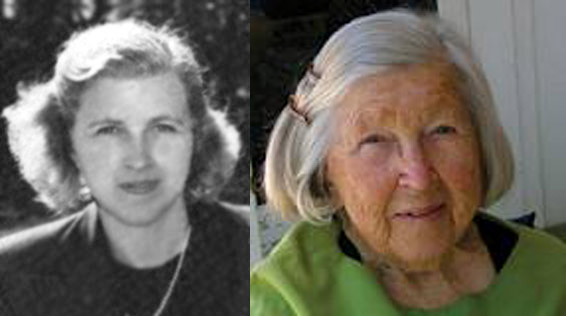
Esther Marie Isaacson

Esther Marie Isaacson

This past weekend, my husband and I traveled to Lompoc, California to attend a memorial service for one of the best women I have ever known, Esther Isaacson.

Esther was the wife of a cattle rancher, Baine Isaacson, and she worked hard all her life. She had a grip like a stevedore from all the physical work she did—forking hay off trucks for cows, digging her garden, putting in fence posts, etc. She and her husband raised three boys on their ranch, called El Chorro, “The Stream.” She had simple tastes. Her clothes were usually blue and white, she wore blue tennies most of the time, and sometimes she sported a little silk scarf at her throat. She didn’t care much about possessions, and for the last 15 years or so of her life, she tried to give them all away. The only things she collected were bells. She had jingle bells, cowbells, reindeer bells, every sort of bells. They hung on the little patio outside the front door and in her tiny breakfast nook, strung on leather straps and woven belts. Getting in and out of the nook always occasioned a good jingle or two.
Esther was my refuge. My first memory of her was when I was six years old, visiting the ranch with my family for the first time. She and Baine radiated kindness, caring and love. She sent me out to play on the ranch with her youngest son, Bob, who was perhaps eight or nine at the time. Bob was as sunny, sweet and kind as his parents. He showed me the boys’ clubhouse—a signal honor—and we caught frogs in the creek, climbed the hills, and chased the cows. One of the best days of my little life.

When I was older and my heart was broken, I came to Esther and she took me in. She never asked questions, just let me stay with her in her ranch house on the hill. I roamed all day on the ranch and in the evening helped her cook. We shopped, sat by the fire, washed dishes, and played cards while I struggled with my aching heart and damaged self-esteem. Her acceptance, quiet presence and love sustained me, and I returned to my life with a renewed sense of strength and self-respect. In truth, I have never been the same since. (My epiphany also had a lot to do with a certain coyote that lived on the ranch, but that is a different story.)

Esther Marie Ibbetson was born in 1912 in Solvang, California. Solvang was founded as a “colony” for Danish ex-patriots, a town where they could speak their own language and teach Danish to their children, eat Danish foods, sing Danish songs, folkdance, and perpetuate their culture. In the earlier days, there were no cars and few roads. Her father was a carpenter, but they lived in a one-room house with a canvas slung down the middle to separate the living quarters from his office. Esther said it was a case of the cobbler’s children—her father was so busy with other people’s houses he had no time to work on his own. However, she noted that houses were often built by the community for newcomers, and the expenses were worked out later.

My mother and Esther traveled a lot together after Baine died. They went to Mexico, Greece, Spain, New Zealand, Guatemala, Fiji, Australia, and many other places, and came home giggling together like schoolgirls. Losing my mother was a great blow to Esther, who often mentioned her with longing for their free-roaming travels.

I won’t say that Esther was amazingly progressive for a woman of her generation, because she was just amazingly progressive, period. She was not religious at all. She loved the land, and practiced her own brand of recycling and conservation long before it became mainstream. She was one of the few girls in her community who went to college, and she married late (for the era) because she didn’t want to stop working. She deplored prejudice, ideology and narrow thinking, and read and thought deeply her entire life.

Esther loved wildflowers—including weeds—and she loved her garden of native plants. She called it her “moon garden,” because it didn’t resemble a typical garden. (A casual visitor might think it was “just” weeds.) She thought planting invasive exotics like English ivy was deplorable when we had so many lovely, drought-resistant plants native to California. Walking on the ranch with her was always a lesson in the local flora and fauna—there was nothing about the land she loved so much that she did not know.

She was 102 years old when she died, and she was more than ready. She lost her husband, her youngest son, two daughters-in-law and many friends before she died herself. She told my sister that “Getting old is so boring!” and my husband (sometime during her 90’s) that “No one should have to live this long.” She didn’t die of any illness. Her heart was fine, and so was her blood pressure and pulse. She just wound down like an old clock and stopped ticking.

So I am not sad for Esther, who was prepared and ready for death. I am sad for myself, because this kind, loving, multifaceted woman is gone from me. The world has lost a treasure, but I know that every human being she touched is the better for that contact. I only hope to carry forward that gift in my own life to give to others.

Goodbye, Esther. I will always love you dearly. Thank you for your kindness and love. Thank you for offering my heart a safe place in this dangerous world.

* * * *

My thanks to the many people who spoke at Esther’s memorial for reminding me of many things I might otherwise have forgotten. Special thanks to Sally Isaacson for putting together and editing Esther’s notes about her childhood and making them available to us.

Scrambling To Get It All In: The Last Day

Our last day in Spain finally arrived. We decided to get some breakfast and head down to La Rambla, a long mall that leads down to the harbor. Traffic goes by on either side of a pedestrian mall, with booths and kiosks in the middle and shops on either side of the traffic lanes (where shops are usually located, actually). We were warned that this was a prime area for pickpockets. so we were on the alert.

There were tons of people walking la Rambla. Most of the kiosks were selling the same old stuff we had seen everywhere else in Spain–cheap “Flamenco” shawls, a Spanish dancer doll (the exact same one in every city), t-shirts–augmented by Barcelona-specific stuff like Gaudi-inspired plates and keychains. Then we came to the open-air market, La Boqueria. This was a feast for the senses, and if we had not already had breakfast, we would have bought something delicious here. The stalls were piled high with fresh fish and shellfish; eggs of all kinds, from emu to ostrich to quail; the obligatory stalls with pig haunches hanging and cured meats on display; every sort of nut you could imagine; dried and fresh chilis; sweets; exotic fruits; piles of tripe, lambs’ heads, kidneys and other offal meats; spices, teas and coffees. it was overwhelming and beautiful.

Dried chilis

Dried chilis


Offal meats

Offal meats


Shellfish

Shellfish


Every sort of egg

Every sort of egg


Seafood

Seafood


After this feast for the eyes, we continued down La Rambla, stopping just before the harbor to photograph the living statues. There was Don Quixote, a person dressed like a Salvador Dali painting, a Remington cowboy statue (probably the most boring, despite his dramatic pose), a demon (entertaining), a “bronze statue” of Galileo, and several more.

An entertaining demon

An entertaining demon


Dali lady. Not sure the person inside the costume was actually a lady, but no matter.

Dali lady


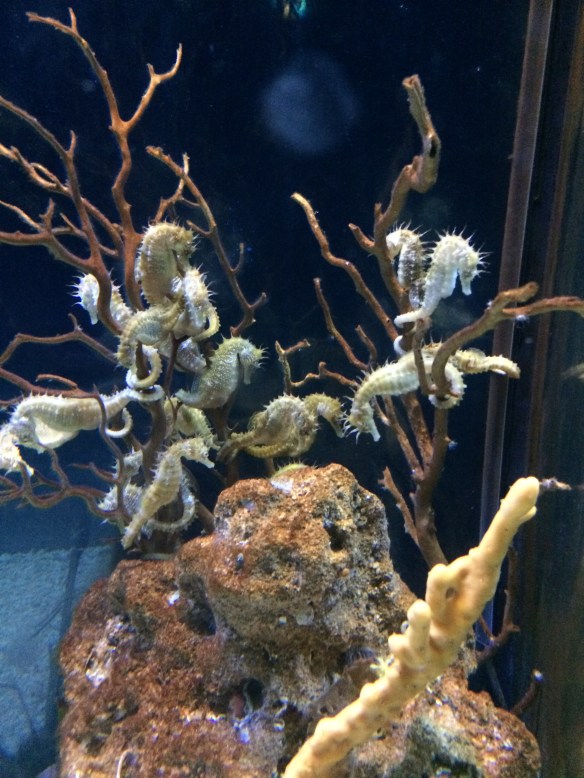
By that time it was hot, and we were reasonably near the Barcelona Aquarium, so we went there for a few hours. For people whose local fish museum is the Monterey Bay Aquarium, the Barcelona Aquarium cannot measure up, but I did see some interesting fish I hadn’t seen before. Unfortunately, labeling was kind of random. You’d see a label above one tank, with no sign of the supposed denizen, then see the same fish in another tank that had no such fish identified as being there. Nonetheless, it was a pleasant couple of hours out of the heat. I do think someone tried to pick my purse in the aquarium. I was waiting in line to buy mineral water and carelessly left the zipper open, displaying credit cards and cash. I saw a hand creep across the ledge in front of me, heading toward my purse. As soon as I clocked the hand, it suddenly became very interested in the surface of the ledge, which had nothing on it but crumbs. I zipped the bag.

Seahorses in Barcelona Aquarium

Seahorses in Barcelona Aquarium


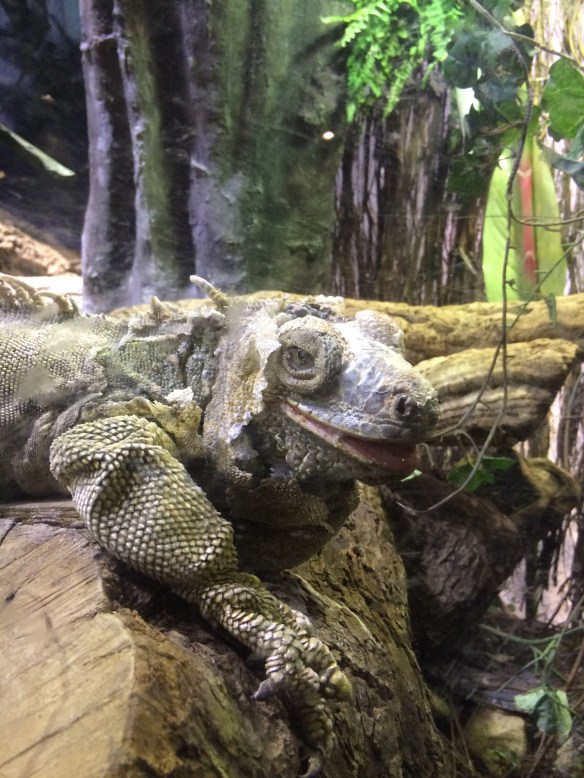
This iguana had such a pleasant expression that I just had to photograph him. Or her.

This iguana had such a pleasant expression that I just had to photograph him. Or her.


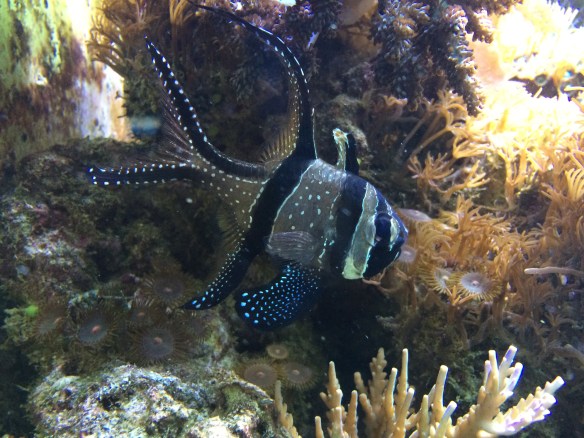
I don't know what this fish is due to random labeling, but I liked it.

I don’t know what this fish is due to random labeling, but I liked it.


In the afternoon, we went to Parc Guel. Gaudi had a house there (designed by someone else), and he designed a beautiful installation in the park that would look very familiar had we actually gone in. We already had tickets to see his house and we wandered around the free area of the park, which is also very Gaudi-esque, but not the iconic installation everybody was lined up to pay for. When we went through his house, I was astonished to find out that despite the over-the-top ornateness and whimsy of his work, Gaudi lived a very austere and simple life. His furnishings were simple and sparse. He cared nothing for clothes or material things for himself. A remarkable contrast.

The area of Parc Guel we did not go in, showing more of Gaudi's amazing work.

The area of Parc Guel we did not go in, showing more of Gaudi’s amazing work.


Kids playing with giant bubbles in Parc Guel

Kids playing with giant bubbles in Parc Guel


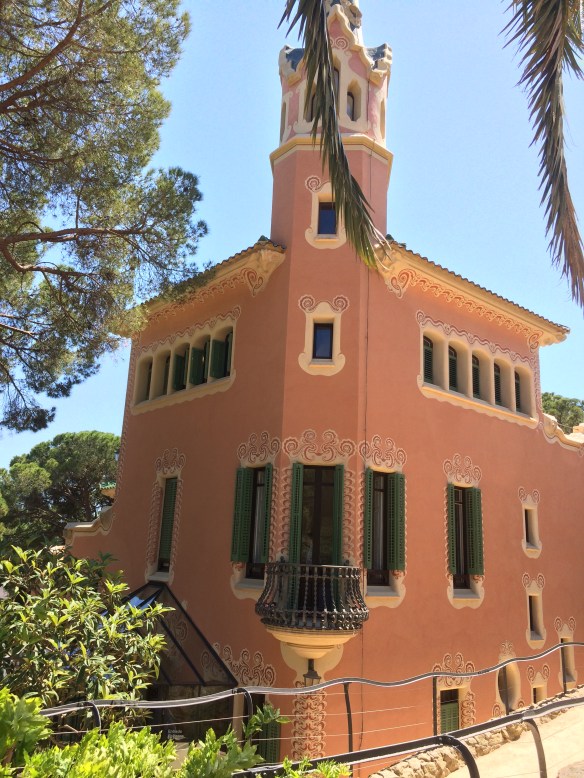
Gaudi's house in Parc Guel

Gaudi’s house in Parc Guel


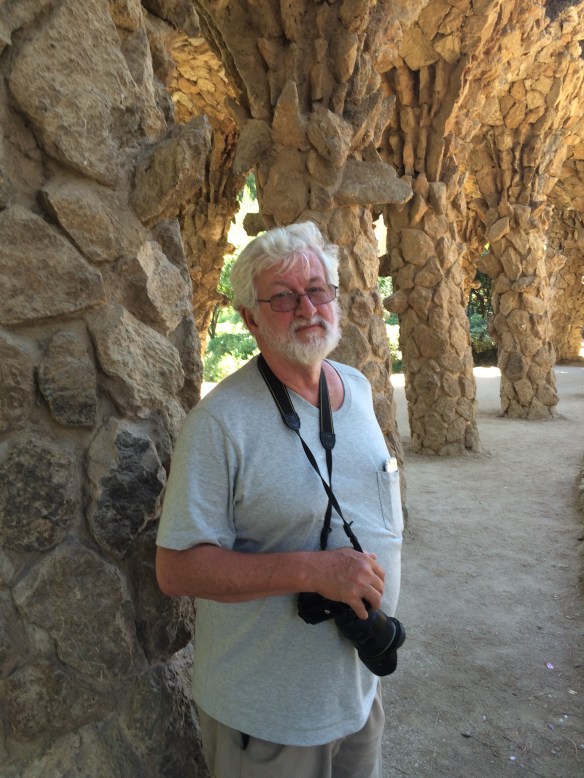
Tom standing under a Gaudi-designed bridge in Parc Guel

Tom standing under a Gaudi-designed bridge in Parc Guel


We left without paying to go into the most interesting part of the park, which I kind of regret.

We had an early dinner at a boring restaurant where a large group of people (maybe 100 or so) were playing Scrabble (in Catalan? At least they’d have a ready use for all those X’s!), and so to bed.

Adios, Spain. We had a wonderful time!

More soon about a menu that made me laugh and things I will miss/not miss so much about Spain.

Inside the Light: La Sagrada Familia

Tom and I arrived home safely after a very long travel day. After decompressing a little (we went to see “the Book of Mormon” on our first night back), I now feel ready to tackle the inside of La Sagrada Familia, Antoni Gaudi’s masterpiece in Barcelona. As it happens, this post is a lot shorter than I thought it would be because–embarrassingly, for a writer–words failed me.

While the exterior is amazing, intricate and fascinating, the inside is simply indescribable. I can’t imagine why none of the art history courses I took ever showed a photo of the interior. I’m not going to provide the statistics on how big it is, because the numbers could not possibly begin to inform as to the size, scope and vastness of this space.

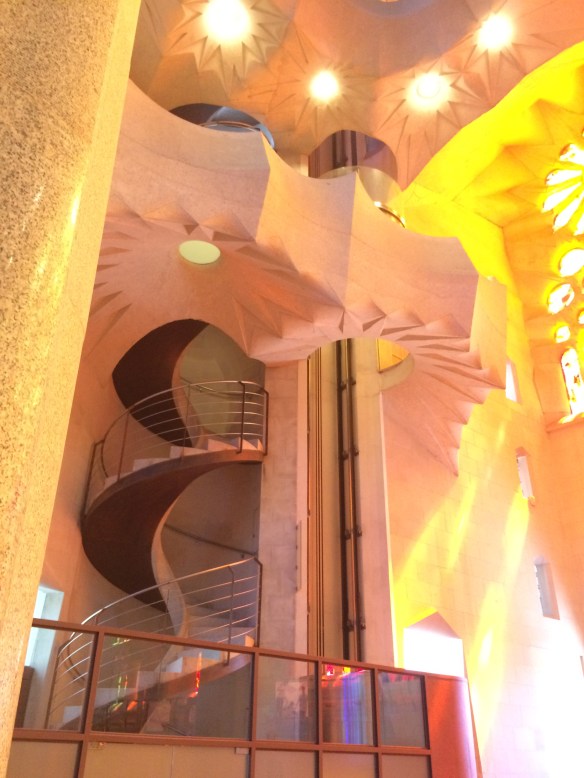
The east side of the nave has stained glass windows in blues and greens, while the west side windows are in oranges, yellows and reds. We were there in the afternoon, so the light was pouring through the west windows. The stained glass is laid in abstract patterns, not representational images, but the effect of the light was magical. It lit the cathedral in a way that cannot be described with words, and the photos don’t do it justice. The light is both ethereal and dynamic, with an energy that is alive and uplifting. I would like to see the east side in the morning to experience the effect of the light streaming through the cool-colored windows.

Light from the west windows, La Sagrada Familia

Light from the west windows, La Sagrada Familia


Interior, lit by west windows, La Sagrada Familia

Interior, lit by west windows, La Sagrada Familia


Standing o the west side of the nave, looking east, La Sagrada Familia

Standing on the west side of the nave, looking east, La Sagrada Familia


Western light, La Sagrada Familia

Western light, La Sagrada Familia


Stairs to the choir loft near the sanctuary, La Sagrada Familia

Stairs to the choir loft near the sanctuary, La Sagrada Familia


Even the organ pipes are transformed by the light

Even the organ pipes are transformed by the light


While the stonework and other elements are amazing and  impressive, for me, the experience was all about the light. I have lots of other photos, and I’d be glad to post them if anyone is interested, but I don’t think I can really say much more about it. The interior of La Sagrada Familia is a miracle of light that so encompassed and raised my spirit that the other details became unimportant. Finis.


Sand Castles in Spain

When I was a child, we used to go to the beach for a few weeks every summer. One of our favorite activities was making “drip castles” out of wet sand. We’d grab a bucket of sand and water and carefully let the wet sand drip from our fingertips, making fantastic shapes and spires. The challenge was to see how elaborate you could make your castle, and how tall your spires could reach before collapsing.

In art history, my first take on seeing a photo of Barcelona’as La Sagrada Familia (Sacred Family) cathedral, designed by Antoni Gaudi, was “Drip castle!” I never blew it on the tests, either–the mnemonic was fixed forever. Apparently I am not the only one to see this resemblance, because when I searched for images of drip castles on Google, I found some photos of La Sagrada Familia as well:

Drip castle on the left; La Sagrada Familia on the right. I'm just saying.

Drip castle on the left; La Sagrada Familia on the right. I’m just saying.


The cathedral isn’t finished and won’t be for a decade or more, although it was begun in 1882. Up close, the exterior no longer looks like wet sand. The facade in the photo above (the Nativity Facade) is the one most photographed, I believe, and close up, all those furbelows resolve themselves into exquisitely crafted details. There are the obligatory religious figures, of course, but there are also twining vines, chickens, roses, standard Gothic features like columns that somehow turn into tentacles, rabbits, turtles and trees. It is naturistically sculpted, elaborate, whimsical and ebullient.

This turtle is one of two that hold up pillars, one on either side of what is now the main door. Kind of a metaphor for how mankind treats animals, though I'm sure this was not the intention.

This turtle is one of two that hold up pillars, one on either side of what is now the main door. Kind of a metaphor for how mankind treats animals, though I’m sure this was not the intention.


Rooster and hens detail from the Glory Facade

Rooster and hens detail from the Glory Facade


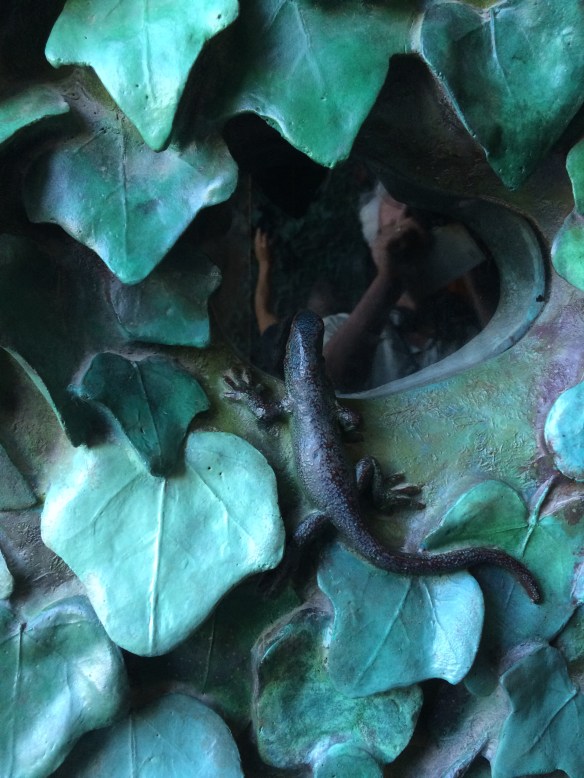
This little lizard is one of many creatures peering out from the bronze leaves that completely cover the main door

This little lizard is one of many creatures peering out from the bronze leaves that completely cover the main door. He is peering through a small glass pane. The reflection in the pane is Tom taking a picture of it.


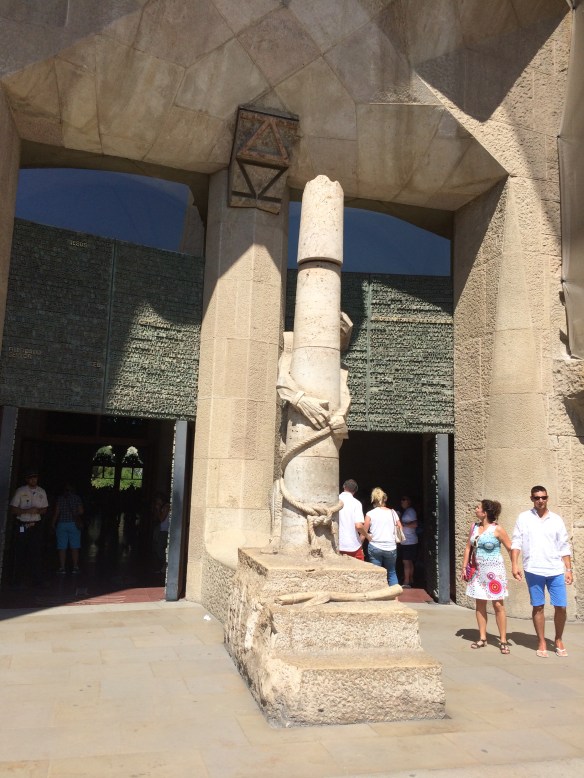
The other facades differ greatly in style. The Passion Facade, which depicts the end of Christ’s life from the Last Supper to the crucifixion, is sculpted in an austere, unelaborated and grimly modern style. some of it couldn’t be photographed because of ongoing construction.

The Passion Facade. The pillars are intended to resemble bones.

The Passion Facade. The slanted pillars are intended to resemble bones.


Kiss of Judas, Passion Facade

Kiss of Judas, Passion Facade. There’s a cryptogram square to the left, but I haven’t researched its meaning yet.


The Loneliness of Christ, Passion Facade

The Loneliness of Christ, Passion Facade


As you can see, this facade was executed in an entirely different style, and it was as deliberate as the Gothic-reminiscent naturalistic style of the Nativity Facade. There are other facades, still under construction, that are more modern still.

I took three art history courses (yes, once it was because I couldn’t pass chemistry, but the other times, it was because I WANTED to!), and not once did I see a photograph of the interior. As gob-stoppingly gorgeous as the exterior is, the interior surpasses it by several orders of magnitude. I have never seen anything like it. It comes close to being unbelievable, as though someone a 100 years ago had had the ability to use CGI to create something impossible and improbably beautiful.

Unfortunately, I have to close up shop tonight and continue tomorrow (or sometime soon), because we are catching a flight to go home. I want to give the interior of La Sagrada Familia the time and attention it deserves, so buenos noches for now, and I will be back as soon as possible.

Velasquez Paints Peter Dinklage (Or Not.)

A few more thoughts on art in the Prado:

There’s a copy of the Mona Lisa by Leonardo Da Vinci in the Prado. It was definitely painted under Leonardo’s supervision, if not by the Master himself. If you have been disappointed by the Mona Lisa that hangs in the Louvre, I strongly suggest seeing this if you get the chance. The one in the Louvre has a yellowy-green cast; this one does not, and has clear, fresh colors. The Louvre version has severe cracking in the paint and warping of the underlying poplar wood; this one was painted on more expensive and durable walnut and is in excellent condition. The Mona Lisa in the Louvre is sequestered in an acrylic box and is usually surrounded by a horde of tourists who are not at all interested in allowing you to get a closer view; the Prado version hangs unimpeded and ignored. You can walk right up and examine it as closely as you wish. This is the Mona Lisa as it must have looked 500 years ago.

I wanted to see Velasquez paintings. The great thing about Velasquez is the faces–he’s one of those artists who are able to paint the soul and personality of the subject. There was one entire room with nothing but paintings of the jesters of King Philip IV and his court. One of the paintings was of a dwarf who looked very like Peter Dinklage, down to the “Don’t fuck with me” look in his eyes.

"Sebastien de Mora" by Velasquez

“Sebastien de Mora” by Velasquez. Or a very early portrait of Peter Dinklage.


This is an allegorical painting called "The Triumph of Bacchus." Bacchus is highly idealized, but if you look at the other faces, they are very real, with great personality.

This is an allegorical painting called “The Triumph of Bacchus.” Bacchus is highly idealized, but if you look at the other faces, they are very real, with great personality.


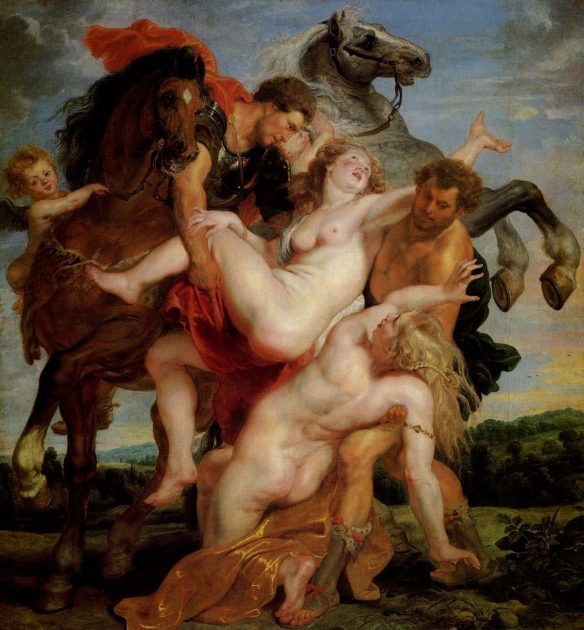
The Prado also has a number of Rubens, whom I’ve always enjoyed. First, because of his exuberance; he doesn’t just paint a horse, he paints a drama composed of glossy, bunched muscles, rolling eyes, and streaming, flossy mane and tail. (Frankly, his horses are a lot better than Velasquez’s. One or two of V’s horses looked biologically impossible.) His compositions are full of life and motion–even when the subjects themselves aren’t actually doing much. And then there’s the acres of glowing, pink flesh. The man loved ladies, and he hated to skimp on avoirdupois. The more, the better–that was Rubens. He would have adored me.

This one--I think it's the rape of the Sabine women--illustrates both my points about Rubens: horses and women. Leafing through Jansen's History of Art as a child, I used to wonder  how on earth those men were able to pick up the women.

This one–Rape of the Daughters of Leucippus by Castor and Pollux–illustrates both my points about Rubens: horses and women. Leafing through Jansen’s History of Art as a child, I I thought those guys must have been INCREDIBLY strong.


Okay, enough about art.

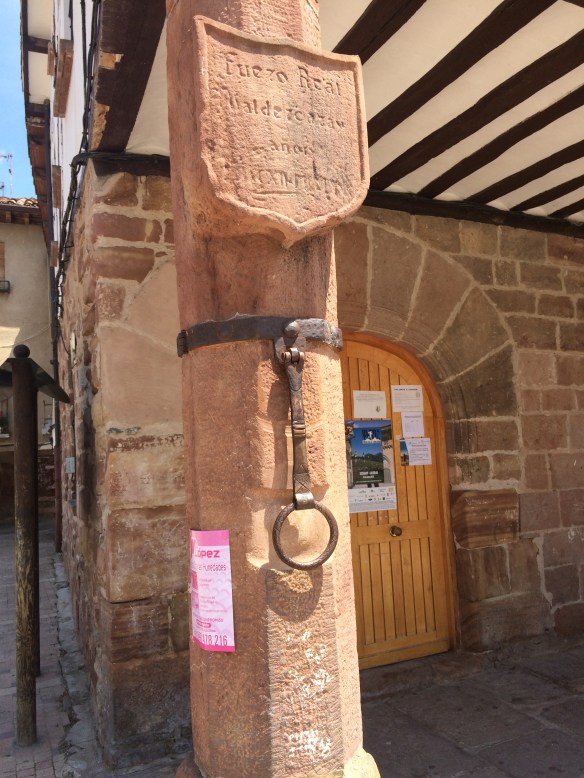
Ezcaray, where we currently are, is a village of 2,000 residents. The village also has 12 hotels and more restaurants than you would think possible in such a small place. Apparently, there has been continuous human habitation here since the Neolithic Age, followed by Romans, Visigoths, Moors, etc. Over lunch today, we had a discussion with a family about the area–they come every year. The father is from La Rioja (the region we are in), the mother is Brazilian and they live in Brazil. She told us about a ring set into a pillar on the square. The tradition was that if a bandit, Moor, or other outcast could make it through the town (with people throwing fruits and vegetables at them) and grasp the ring, they were granted sanctuary and could settle here. Whether apocryphal or not, here is the ring. It would look more impressive without the pink flyer pasted onto the pillar:

The Ring of Sanctuary. I may use that for a book title some day--it has a nice ring to it.

The Ring of Sanctuary. I may use that for a book title some day–it has a nice ring to it.


It rained the evening we arrived, and it was pleasant to watch the rain fall against the backdrop of the ancient church across the way. The temperature has been in the 70’s–a nice contrast to the heat of Madrid. The town is peaceful and tiny, bordered by small rivers and sheltered by the steep valley walls. So good to be here, after so many cities.

Although all the art, culture and history tends to be concentrated in cities, I just don’t like them. There are too many people, too many cars, too much noise–just too much of everything. My idea of a nightmare vacation is New York City. Cities just kind of oppress me in some way. I like being in the country or in small towns, closer to nature.

Our first day, we just walked around the town, taking pictures. We stopped to eat at a little bistro. It was quiet and relaxing after all the sightseeing. I am happy to be here.

The view from our hotel room in Ezcaray

The view from our hotel room in Ezcaray


A pretty little fountain in a square in Ezcaray. People sit here to read.

A pretty little fountain in a square in Ezcaray. People sit here to read.