Diversion Books Announces Re-publication of “The Obsidian Mirror”

New Cover


FOR IMMEDIATE RELEASE

DIVERSIONBOOKS

seth@diversionbooks.com

DIVERSION BOOKS RESCUES THE OBSIDIAN MIRROR, RELEASES NEW VERSION OF FANTASY NOVEL

May 15, 2015—Diversion Books today released The Obsidian Mirror, an inventive high tech-meets-Aztec fantasy novel by Silicon Valley public relations veteran K.D. Keenan, marking the second time the novel has been issued in less than a year.

Diversion Books, which publishes a number of classic fantasy authors—including Ursula K. Le Guin, M.K. Wren and Henry Kuttner—scooped up the title after its original publisher, AEC Stellar Publishing, went out of business.  “The Obsidian Mirror is a terrifically fun read,” said acquiring editor Laura Duane. “It recalls the wit and invention of Douglas Adams, and fits perfectly with many of our other fantasy titles.”

The Obsidian Mirror tells the story of Sierra Carter, an out-of-work PR executive who receives a call from Quetzalcoatl, the plumed serpent god of the Aztecs, and discovers that her former firm’s semiconductors are a means of spreading a deadly evil around the world.  Powering these nasty vibes is Necocyaotl, Aztec god of death and destruction, who has placed his essence in every device, causing people to place their self-interest and selfish desires above all else.

Carter, with the help of some paranormal pals—Chaco, a handsome young man when he isn’t being a coyote; Fred, the mannegishi with the ability to disappear at will; and Rose, a Native American shaman—learns how to develop her inner powers. She’ll need them, because Necocyaotl’s team is playing for keeps, and the evil god brings an ice demon, dark spirits, and assorted monsters into the game to bolster his more human henchmen.

The Obsidian Mirror is available as an eBook from Diversion Books, Amazon, Apple’s store, Barnes & Noble, Kobo, and Google Books.

ABOUT DIVERSION BOOKS:

Founded in 2010, Diversion Books has emerged as a premier digital publishing house, partnering with top literary agencies, media companies, and authors to build a rapidly -growing catalog across a range of genres. With its cutting-edge marketing and versatility in the changing landscape, Diversion proudly publishes top-tier authors old and new, building the next generation publishing company, one great book at a time.

FOR MEDIA QUESTIONS, PLEASE CONTACT:

Seth Kaufman, Sales & Media Strategist

seth@diversionbooks.com


Cover Reveal for “The Obsidian Mirror” (Redux)

I am delighted to announce that Diversion Books has come up with a splendid new cover for the republished version of “The Obsidian Mirror”! It has a lot of the feel of the original, with a lot more sophistication and glamor. LeNew Covert me know what you think:


Writing: The Never-Ending Journey

Photo by Bec Brown

Photo by Bec Brown

When I first started this blog, the subtitle was “A Blog about Writing a Novel.” I thought of it as a journal documenting the process of writing my first novel and trying to get it published. Of course, at the time, I had no idea whether I would get it published (or even finished).

Well, “The Obsidian Mirror” was finished and published, and now will be republished by Diversion Books. (They are giving it a new cover as well, which should be interesting. I can’t wait.) I have a contract for the sequel from Diversion, and I have written about 20% of the first draft.

So it’s no longer a blog about writing a novel. It’s about the journey I am on as an author. I have changed the subtitle to “The Journey to Authorship.”

Now, that sounds like I will be forever journeying toward a goal, but never reaching it. That would be exactly right.

I learned a huge amount about writing a novel when I wrote “The Obsidian Mirror.” I revised it eight times. I had many people read it and comment on it, including the wonderful Gail Z. Martin, who has authored numerous fantasy novels herself.

Now I am trying to put those lessons to good use in the sequel. I am also trying out new things. For example, the antagonist in “Fire in the Ocean” (working title) is not an evil god. He’s not even evil. As a reader, I am much more interested in complex characters than cardboard cutouts, but as a writer, it’s really easy to fall into the mistake of making evil characters 100% evil, twiddling their mustachios and laughing, “BWAHAHAHAH!” (Okay, maybe not that bad, but you get the idea.) So I am trying to create a more complex character, one who is human, with human strengths and weaknesses, whose actions are not motivated by pure nastiness.

I have to admit, this is a bit scary for me, and I am proceeding with this character in baby steps. But, as in “The Obsidian Mirror,” I am still trying to understand why perfectly normal people do massively destructive things to the environment—even though they have to live the consequences along with the rest of us.

Another challenge is the setting in Hawai’i. “The Obsidian Mirror” was set in Silicon Valley, where I lived and worked for more than 30 years, so I knew it very well. I have visited Hawai’i many times and love it, but I am not as intimately familiar with it as I am with Silicon Valley. I spent eight days on Moloka’i, where much of the novel takes place, but eight days doesn’t make me an expert. Fortunately, I made some friends in Moloka’i while I was there, and I am hoping they will help to correct any inaccuracies or general idiocies I may commit.

So I am still learning and stretching my authorial wings. I am on a journey I suspect I will never complete, because I hope always to be learning more about my craft and growing as a writer. If I stop doing that, I will stop writing.

I Have a New Publisher! (She Dances for Joy)

Me doing the happy dance!

Me doing the happy dance!

I have signed with a new publisher! Diversion Books has agreed to re-publish “The Obsidian Mirror” AND the sequel, which I am now writing. I simply could not be more pleased. I emailed the manuscript and cover art to them today.

Diversion Books is located in New York City (and on Park Avenue at that. Isn’t that cool? C’mon. It’s cool.). They started as a division of Scott Waxman Literary Agency, but are now an independent company. Diversion publishes a wide range of fiction and non-fiction titles. In my genre, you might recognize authors Henry Kuttner, Ursula K. LeGuin and M.K. Wren.

I am thrilled to be in such august company, and really looking forward to working with this very professional outfit. I am also–needless to say–delighted that “The Obsidian Mirror” will see the light of day again, and that the sequel has a home as well.

I’ll be keeping you posted about the sequel. The one thing I learned from writing “The Obsidian Mirror” is to always start with a plot outline. (In all fairness to myself, I didn’t think at the time that I was actually going to write a novel.) I finished the plot outline for “Fire in the Ocean” (working title; it may change) two weeks ago and started writing it last week. So far, I’m more than 7,000 words and four and a half chapters into it. I like having a plot outline!

I’ll try asking you another question. Do you like the working title of the sequel? Not? I really am looking for feedback.

American Folk Lore: There’s No Such Thing

Joseph Noel Paton [Public domain or Public domain], via Wikimedia Commons

Joseph Noel Paton [Public domain or Public domain], via Wikimedia Commons

I just finished reading Terry Pratchett’s “Folklore of Discworld,” co-written with folklorist Jacqueline Simpson. (Do people actually get paid for knowing about folklore? What a great job!) Pratchett and Simpson discuss the relationship between the Discworld’s traditions and those of Earth (with the conceit that folklore, tropes and memes are particles of inspiration that drift across the multiverse, so that myths of Discworld wind up here, and vice versa).

While reading (actually listening to) this book, it struck me how deeply I am attracted to the folklore of the British Isles (although this is obviously not a particularly rare trait, as evidenced by libraries full of epic fantasies, tales of witches and warlocks, dragons and cloaked heroes and faeries). Nothing entranced me more as a child than tales of banshees, pookahs, faeries, disappearing gold pieces, leprechauns, elves and pixies. As an adult, I am still entranced by Tolkein, C.S. Lewis, G.R.R. Martin, and many less well known authors who write in that tradition—whether humorous or not. It’s one of the reasons I adore Pratchett, who once remarked that he regarded folklore much as a carpenter regards trees.

Why be so attracted to the folklore of another place? I could put it down to my Scots-Irish ancestry. But I think the real explanation is that the folklore of my own time and place is sparse and rather unimaginative. Perhaps if I had grown up in Louisiana or some place with more history than California, I would have a healthy backlog of swamp critters, ghosts, haunted mansions, and eerie sightings to freshen the imagination. As it is, I am hard put to say exactly what constitutes folklore here.

Sure, we told each other the stories about the guy and girl making out in the car who hear on the radio about the escaped madman with a hook for a hand. And step on a crack, break your mother’s back. (As this never happened, I didn’t believe it for long.) But these things lacked the enchantment I found in fairy stories and old tales from Ireland, England, Wales and Scotland. Witches, warlocks and wizards. Spirit horses. Water nymphs. Faery gold. Selkies. Leaving milk out for the Good Folk. Strange dancing lights on the moors at night. The Wild Hunt. King Arthur.

An incredibly high percentage of American “folklore” has disappointingly mundane origins. Paul Bunyan and his giant blue ox, Babe, appears to have originated in the oral tradition of lumberjacks, but according to Wikipedia, was “later popularized by freelance writer William B. Laughead (1882–1958) in a 1916 promotional pamphlet for the Red River Lumber Company.” Rudolph the Red-Nosed Reindeer was originally a promotional character created for Montgomery Ward. Pecos Bill was a character created by short story writer Edward S. O’Reilly in the early 20th Century. Johnny Appleseed was a real person, John Chapman, but all he did was plant apple trees, not conjure gold and silver apples or something interesting like that. Santa Claus comes closest to having true folkloric origins, but in America, even he was largely shaped by modern forces in the form of Clement Moore, author of “A Visit from St. Nicholas” in 1823:

“His cheeks were like roses, his nose like a cherry;
His droll little mouth was drawn up like a bow,
And the beard of his chin was as white as the snow;
The stump of a pipe he held tight in his teeth,
And the smoke it encircled his head like a wreath.
He had a broad face, and a little round belly
That shook when he laugh’d, like a bowl full of jelly:
He was chubby and plump, a right jolly old elf,
And I laugh’d when I saw him in spite of myself…”

Moore changed the majesty of Father Christmas, a tall, thin gentleman wreathed with holly and robed in green, into a “right jolly old elf,” later immortalized in his modern incarnation by the Coca-Cola Corporation. Moore also invented the eight tiny reindeer, which were not found in the stable of Father Christmas.

Where’s the magic in all this? Sadly lacking, in my opinion. Our modern American monsters are the psychopaths, serial killers, stalkers of children, terrorists real and imagined, and that guy with the hook, who may be folkloric, but he’s not very magical. Our urban legends may technically be folklore, but flashing your headlights getting you in trouble with gangs, or tapeworm eggs in bubble gum, or waking up in a bath of ice with your kidneys missing falls well short of enchantment.

I will admit that we Americans have our share of cryptozoids. Probably the leading examples of this are Sasquatch (Bigfoot) and El Chupacabra (the goatsucker). El Chupa is an import from Mexico, where apparently they are so folklore-rich that some of it is oozing across the border. None of these to my knowledge is actually magic; it’s just that no one has ever proved they exist, so of course, lots of people believe in them. Here’s a map of North American cryptozoology, if you’re interested in more.

And, of course, there’s a lot of flying saucer lore. But I don’t think any of the anal probees would say that there was magic involved.

As I mentioned before, it may depend on where you grew up. In Hawaii it is clear that many ethnic Hawaiians (and also many non-ethnic Hawaiians) believe in the old lore. I met people who believe in ghosts, in Pele and other ancient gods, in Menehune, and in spirits generally, both good and evil.

Magic offers the possibility of the good and brave and clever overcoming evil or at least magical trickery, whereas our monsters are sometimes overcome by the judicial system (and sometimes not). Magic also casts a glamor over folk tales; in fact the word “glamor” used to mean magic or enchantment. Our “folk” heroes are artificially created to make money—although they are still presented to schoolchildren as though they were genuine. I suppose Pratchett would say that when people start to believe in something, it transforms that thing into folklore. But no one really believes in Paul Bunyan or Pecos Bill. Thank heaven, some children still believe in Santa Claus, and around a campfire at night, you can believe anything. But I still think we are a culture that is sorely deprived of a true folkloric element.

Do you agree or disagree? Did you hear a truly magical (and American) story when you were a child? Did you have a haunted house on your street where lights and music could be heard at night? Were tales of helpful pixies or harmful sprites told in your neighborhood?

I would love to hear from you if you have such stories to tell!

The Last Day on Molokai and a Return to Halawa Valley

Tom really is a hero. He agreed to drive the steep, winding, one-lane road back to Halawa Valley so that we could visit the beach there and maybe hike to the waterfalls. He surprised me–and this is after 43 years of marriage.

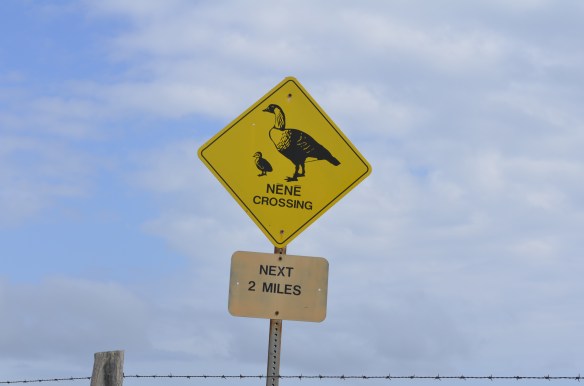
The drive was spectacular, and we stopped to take photos of things we remembered, but hadn’t stopped for the first time because of unfamiliarity with the road. For instance, there’s this sign:

Nene crossing sign.

Nene crossing sign.

Nene (pronounced nay-nay) are the native Hawaiian geese, and they are endangered. Sadly, we didn’t see any geese, just the sign. We also saw this, which we think is a roadside memorial, but it’s a bit different than the usual. In addition to the sun made of white coral, there were offerings:

Roadside memorial.

Roadside memorial.

There was no one waiting at the bottom of the road this time. We parked and walked down the dirt road to the beach. There is a river flowing into the sea here, and it’s  picturesque:

River at Halawa Valley.

River at Halawa Valley.


Beach at Halawa Valley.

Beach at Halawa Valley.


We picked our way along the beach, and I saw what I expected; lots of small pieces of plastic in the sand, white and blue, black and gray, yellow and red–the detritus of the Great Pacific Garbage Patch, collecting on this remote beach. I began picking up the larger pieces and putting them in my pocket. by the time we left, both pockets were bulging, and my arms were full of still larger chunks, bottles, and a small section of plastic fence. Tom gently makes fun of my plastic policing, but I regard it as the little that I can do to make it better. Worth nothing in the face of the magnitude of the problem, I agree. And many of the pieces were so small as to be impossible to retrieve, reminding me of “Rumplestiltskin,” where the poor girl has to count all the grains of sand or spin straw into gold.

Some of my plastic finds. Pockets are bulging with smaller bits.

Some of my plastic finds. Pockets are bulging with smaller bits.

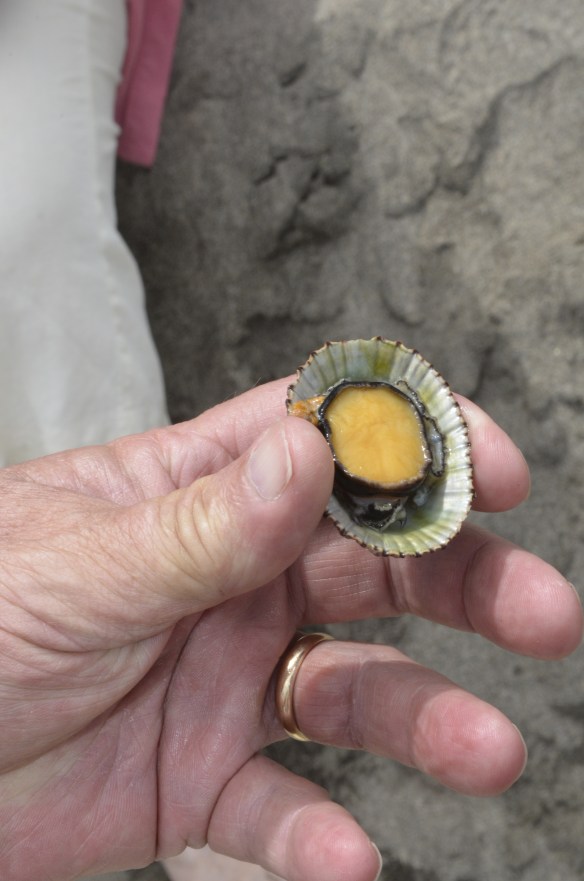
A Hawaiian family was picnicking on the beach. A young woman named Noni (noh-nee, means “beautiful”) was sitting on the sand, while her sister, husband and nephew were on the rocky point under the cliffs, fishing. We chatted for a while, and then her husband came back with a net bag full of ‘opihi (oh-pee-hee, limpets). We asked what they were going to do with them, and he said they were best barbecued, but could be eaten right out of the shell. Did we want to try one?

Yes, we did. He had lost his knife while prying ‘opihi off the rocks, but he used one limpet shell to dislodge the resident of another shell, and offered us some. They were rubbery, and the primary taste was a mild saltiness, but I’m sure they are delicious barbecued. This inside of the shell had a lovely iridescence, tinged with green. I washed mine out and brought it home with me.

Snack time!

Snack time!

We asked about the hike to the falls. Noni said it was really difficult, and she hadn’t done it in 20 years, so we decided to give it a miss. (Later, I learned that it takes two hours just to get there. I probably made the right decision.) After dumping my collected plastic in the trash bins provided, we got into our car and drove slowly back, taking pictures as we went.

Rainforest stream.

Rainforest stream.

Once we were back in two-lane country again, we stopped to take a picture of this:

Chicken condos.

Chicken condos.

I called it “chicken condos,” as they appear to be individual shelters for chickens or roosters. As I was taking the picture, a pack of dogs ran up to the fence and barked their heads off. A very large Hawaiian came down the drive, looking rather menacing. I waved and said I was just taking a picture of his chickens. He didn’t smile, but waved more or less amicably and went back down the drive. My guess is that he’s raising fighting cocks, which is abhorrent, but I don’t know.

The only real proof we saw that there are deer on Moloka'i.

The only real proof we saw that there are deer on Moloka’i.

We also stopped at a grove of coconut palms, right outside of Kaunakakai. This used to be a much larger grove called “the Queen’s Grove,” because it was planted for the wife of King Kamehameha V. It’s right by the beach, and the trees must be 100 feet tall, each with a cluster of coconuts clinging to the top under its fronds. There are piles of coconuts on the ground, both fresh, green ones and old, hairy ones. The top of my head began to feel peculiarly vulnerable as I imagined what a coconut would do to it after a drop of 100 feet, so I left.

The Queen's Grove.

The Queen’s Grove.

Then back to the condo. I was very behind in my journaling, so spent most of the late afternoon writing, listening to the waves crashing on the rocks nearby, and enjoying the trade winds. When we went to bed, another three-inch centipede was occupying the hallway upstairs, and I gave him the same treatment I gave Jesse the Centipede a few nights ago–a beating with my flip-flop. Neither centipede put up a fight, making me think they were unwell to begin with.

And so the journey came to an end, as all journeys must do–which is the beginning of another journey for me; writing a new novel. The entire experience was amazing. People were so helpful and kind, so willing to bring me into their lives a little bit. It was extremely touching, and I will never forget the experiences I had here. As a parting wave, here are the signs that greet new arrivals to Moloka’i, and bid departing travellers farewell:

Aloha!

Aloha!


Moloka’i Nuts, Coffee and Sorcerers

Day 11: Moloka’i

We were supposed to meet Auntie Opu’ulani today at 9 am, so we set our alarm. This turned out to be unnecessary, but as we were getting ready to go, We got a call on the condo phone from Auntie saying she had to babysit her grandchildren that day. (I still don’t know how she figured out the number–remember my iPhone was sacrificed to the sea gods.) She’s pretty jammed for the rest of the time she will be here because of the upcoming Makahiki Festival.

Makahiki is the ancient Hawaiian new year festival. It used to be four months long. It was a time when many of the repressive kapu were lifted, and there were athletic competitions, hula, games, feasts, and fun. Today it is a week long, and a celebration of Hawaiian culture. I am kicking myself that we are leaving just as Makahiki begins, but I probably wouldn’t have been able to do what I needed to do here because everyone would have been too busy.

So I offered to treat her to dinner, and we agreed to meet at Paddler’s Inn at 7 pm. That left the day wide open, so we decided to explore. First, we drove to Purdy’s Macadamia Farm, the only mac grower on Molokai. This consists of 50 trees that were planted 90 years ago on five acres. The entrance to the farm has this sign, homemade and similar to other signs you see on the island:

Asking the tourists to go with the flow on Moloka'i.

Asking the tourists to go with the flow on Moloka’i.

As we walked down the road, we were greeted by a small, skinny black cat. I miss my kitty, so I stopped to pet it. It turned out there were several other small cats, employed on the farm to kill rats, who eat the nuts.


We arrived in the middle of a tour. There was a wooden trough set up with whole mac nuts. There were holders made out out of old rubber tires and hammers to crack the nuts on pieces of stone in the trough. This is, of course, not how they are commercially processed. Mac nuts have a thick outer husk. The guy in charge of the tour bit into a husk and removed it to demonstrate. Then they have a very hard inner shell. If you whang them with a hammer, you can get at the nut meat inside. This was being directed by a short, fit Hawaiian with an attitude. He was the first Molokaiian we have met who was not pleasant, and the feeling we both got from him was open disdain.

Mac nut cracking station.

Mac nut cracking station.

After the nutcracking exercise, we tasted roasted and salted nuts (all natural, no other chemicals like the preservatives in canned or packaged nuts. Nothing added but sea salt, according to our surly host.), then got to taste raw coconut dipped in macadamia flower honey, which is not made on the farm. That was delicious and different. As this was going on, I noticed a dark, raffish-looking fellow with gold chains who was looking on, extracting raw coconut from a shell and throwing pieces for the cats to eat. The cats all scrambled for this coconut as though it were Li’l Friskies.

The grove of nut trees was immaculate. They don’t pick the nuts; when the nuts are ripe, they fall to the ground and they are harvested daily. The ground was absolutely bare between the trees except for a few piles of leaves that had been collected. Like coffee, mac trees have flowers and nuts in every stage of development at the same time.

After the mac nut farm, we drove to nearby Kualapu’u, which is where Coffees of Hawaii is. I wandered into the gift store intending to buy some coffees and spied the raffish cat-feeder. He was leaning casually against the counter, talking to the clerk.

“You look familiar,” I said. He looked surprised, then said, “You were at Purdy’s just now, weren’t you?”

I agreed this was so and commented that the host there was the only unfriendly person we had encountered here. He said he brought tours over from Maui on the ferry, and he always told them that the guy worked with nuts all his life, and so of course, he was a little nuts himself. Clearly a stock comment that he used all the time. He also said the man didn’t like it when you played with his cats, because they had jobs to do. I didn’t ask how our crabby host felt about feeding his cats coconut.

Tom went to the coffee bar and ordered two Mocha Mamas, the speciality of the house. This was sort of a coffee smoothie, with Molokai coffee, chocolate, ice cream, and whipped cream. Hardly any calories at all. It was delicious, but I couldn’t finish it.

On the way out of town (which takes about 60 seconds), I spied a gift store tucked into the Kualapu’u Business Park. Tom patiently parked the car and I went in. I had nosed around in several gift stores, but no joy. Either the stuff was complete junk, or it was truly original, handmade, beautiful, and hideously expensive.

To my surprise, this place had lovely things, reasonably priced. I saw this necklace, the octopus carved of mother-of-pearl, with jade beads on a beautifully knotted cord:

My new octopus.

My new octopus.

It was reasonably priced, so I bought it, along with some pretty mother-of-pearl earrings that, if anything, were underpriced. I very much wanted a large, carved turtle for my bathroom wall, but my suitcase is already perilously close to getting charged for being overweight, so the turtle remained where he was.

A side note: the octopus (he’e in Hawaiian, pronounced hay-ay) is associated with the sea god Kanaloa because the octopus is slippery, sly and sneaky (though sometimes it is the squid, not the octopus that is associated). Kanaloa is kind of like Satan. He created all the stinging, poisonous creatures that plague the people. He presents himself as beneficial sometimes, but will trick you. He rebelled against the chief god, Kane, and was forced to descend to the underworld, where he is known as Milu. (Sound familiar?)

Personally, I like octopi, and think they are fascinating. You wouldn’t expect a mollusk to have much of a brain, and most don’t, but octopi are smart. Look at this video:

http://www.youtube.com/watch?v=IvvjcQIJnLg

Given how dependent the ancient Hawaiians were on the ocean for food, and how much time they spent in it surfing, swimming and sailing, you wouldn’t think the ocean god would be a Satan-equivalent. But the ocean, too, can be deceptive, changeable, dangerous and cruel, so I guess it makes sense.

After that, we returned to Paniolo Hale. I wrote the rest of the afternoon, and then  we drove into Kaunakakai to the Paddlers Inn. This is a hopping’ place at night, and we had trouble finding parking. I went into the restaurant and looked around. A band was playing Hawaiian music in the corner. The room was filled, and the waitress said because we didn’t have reservations, and there was a large group of tourists that had to be fed, we would have to wait. I asked her if she knew Auntie Opu’ulani, and she shook her head. I saw the waitress who had served us before, an older woman, and asked her. She said yes, she knew Auntie, and pointed to a woman sitting at a side table. I went to introduce myself.

Auntie Opu’ulani is a woman of about my age with dark, curly hair frosted with silver, and a wide, friendly face. She greeted me warmly, and then I set about trying to solve the seating problem. I had noticed when we came in that the bar was completely empty, and I asked our helpful waitress if we could get served in the bar. That suited me much better, anyway–it was quieter, so we could talk and actually hear each other. She said of course we could, so Tom and I and Auntie retired to the bar.

Auntie Opu'ulani.

Auntie Opu’ulani.

I asked Auntie Opu’ulani about mo’olelo. She asked how I intended to use them. I said my motivation in learning them was to better understand Hawaiian culture. I did not intend to retell them, but rather to have them inform my story. Tom chimed in with a description of “The Obsidian Mirror,” and explained how that related to what I was doing on Molokai.

She said she had learned the chants from her grandparents. She had been the 6th of 12 children, and her mother was ill when she was born, so her grandparents adopted her–very much in the old Hawaiian way. She said they had been born in the 1890’s. They were very strict, but loving. They believed that one’s possessions should be cared for, and that nothing was to be treated casually, as people do today. She loved them dearly, and they taught her the proper way to be Hawaiian, as well as the old chants. Auntie said the chants unique to Molokai had never been written down before, but that was her task now that she was retired.

Auntie Opu’ulani is a retired teacher. She teaches the Hawaiian language, although she was reluctant to do so at first. She said it all had to do with her name. I said I thought Opu’ulani meant “Heavenly House,” as Jeanine had told me, but she said no. It meant the tip of the incoming wave before it has broken–or the tip of the tooth of a sperm whale (highly valued). She used to be teased at school because the other children said pu’u meant she had a fat stomach (remember my lesson from Leimana at the fishpond?). She was unhappy, and asked her grandmother why she had been named that (traditionally, grandparents named the children, trying to give them a name that would signify their character). Her grandmother just looked at her and said, “Someday, you will understand the meaning of your name,” and that was that. Years later, she realized that her role was to help perpetuate the Hawaiian language and culture. She has published two books in Hawaiian, with the assistance of Jeanine. (I must find out more about Jeanine!) Auntie said Hawaiian was taught at a very simple level to small children–and then at a very complex level to older kids. There was a gap, and she bridged it with a textbook and a novel aimed at middle-schoolers. So she has been the tip of the wave, bringing back the culture to other Molokaiians. My interpretation; as I have mentioned, Hawaiian is highly metaphorical.)

I asked about menehune, and she told me that her grandfather had seen one. He was walking in the high country and stopped to rest in the shade, but someone kept throwing nuts at him. He saw two small feet dangling from a branch, then a tiny man jumped down and ran into the brush. The menehune was warning her grandfather not to rest there. I asked if they were still around, and she said yes. There are plenty of places in the back country where they live. Menehune work closely with pohaku (poh-hah-koo, rocks), to build things like fishponds. By this, I think she means the rocks contribute as much a part of the work as the menehune.

She said there are many things in the chants that actually exist. Her son, who loved to hike, once found a spring in the high country that flowed out of the rock, then disappeared back into it again–something described in one of the chants. He filled bottles with this water and brought it home. When Opu’ulani drank it, she thought he had added something to it because it was so sweet, but her son said no, that was just the way it tasted.

Auntie believes the Ali’i, (ah-lee-ee, the upper class/nobility of ancient Hawaiian society) came originally from the Americas. (There is a generally accepted theory that they came from Tahiti. The mo’olelo refer to the original Ali’i coming from “Kahiki-nui,” or “great Tahiti.” However, DNA testing of any group of people is far from complete, and there have been some very surprising finds. for instance, DNA analysis of extremely ancient human remains found in Peru show direct a relationship with both the Ainu of Japan and with Australian Aborigines. So I wasn’t about to argue.) Her own ancestors came from Maui, she said, but when they got here, there were many uhane ino (oo-hahn-ay ee-no, bad spirits) who possessed peoples’ bodies, and the people had to get rid of them with prayer and fasting to live here.

I told her the story of the doomed lovers that Leimana had told me, and asked what it had to do with the big turtle rock in the channel. She told me, but that is part of her mo’olelo, so I can’t repeat it. I said the story of the two lovers sounded like it really happened, and she said that it did. She agreed with me that it sounded like something two teenagers might do. I also asked about the heiau on Molokai. I had read that Molokai was known for its powerful sorcerers, and they had built this enormous heiau on the Maui-facing side of the island to intimidate potential invaders from that island. It was a place of much human sacrifice, and there is the story of a kahuna (priest) who lost seven sons to this practice.

Auntie Opu’ulani confirmed the heiau as a place of sorcery. She used to take people from other islands on tours there (it is on private property and you have to get permission to visit). One day, she was guiding a group of kupuna (elders) from Maui. She and another lady sat down on some rocks to rest. Suddenly, the other lady jumped up and went directly back to the bus. Opu’ulani later found out that the lady felt that the rock was “trying to enter her.” She said the heiau was a bad place because of the human sacrifice, and if we visited, not to sit on the stones.

Auntie Opu’ulani was exactly the person I had wanted to meet. Educated, dedicated to her culture, and a believer. I decided to tell her my experience with the lei at Kilauea. When I described turning around to find the lei gone, she nodded quietly and said, “Pele accepted it.” I asked her to read the manuscript for the book I am working on (once I actually have a manuscript), and I offered to pay her for it. She said she would be glad to. As we prepared to leave, I asked if I might contribute to her work, remembering what Jeanine told me about offering money, but Auntie would not accept it. Of course, I offered to send her “The Obsidian Mirror” as a way of saying thank you, and this she accepted.

What a beautiful, gentle woman. I am so lucky to have met her!

But I don’t think we’ll be going to the heiau.

The Precipitous Drive to Halawa Valley and Two Kupuna

Day 9: Moloka’i

In the morning I called Auntie Opu’ulani. If you recall, this is one of the people Janine, the helpful lady at the airport, had recommended I talk to. I got through to Auntie and we made arrangements to meet on Wednesday.

Then I called a boat tour place and made reservations to snorkel on Thursday. I cannot be on a tropical island and not snorkel; it would be unnatural. Molokai has a long, shallow reef surrounding it. You can get to the reef from the shore, but the snorkeling is better further out. So they say, anyway. I’ll let you know.

I had decided not to look up some of the other people Janine recommended, including Uncle Pilipo, who is a kupuna (elder) who knew a great deal about mo’olelo Moloka’i old tales of Moloka’i). This was mainly because I didn’t have Uncle Pilipo’s contact info, but also because I felt I was making good progress and didn’t want to get greedy.

Feeling pleased with these arrangements, we started up the road, heading for Halawa (hah-lava) Valley, looking for the ancient fishpond along the way. We saw a fishpond, but no sign that anyone lived nearby, so kept on going.

It became more lush as we went along, the dry, red-earth grassy areas giving way to thick stands of trees and broad-leaved tropical undergrowth. The road hugged the coast, and in places, there was little between us and the water except for rocks. Not long after the fishpond, the road became one lane, sometimes with room for another car to squeak by–and sometimes not. The road started to climb, and we began to see vistas of the ocean far beneath. We could clearly see the island of Maui across the channel.

I mentioned that Tom and I are acrophobic. But we differ in our reactions. I don’t mind hiking trails with steep drop-offs or driving roads with same. I don’t like climbing ladders, being on roofs, walking over transparent supports (you’ll never get me out on those glass platforms over the Grand Canyon), or actually being on the edge of a high cliff with no barrier between me and a five-second drop to eternity. Tom doesn’t like any of that, but he would rather drive if he is on a cliff road. He drives white-knuckled and sweating bullets, though.

So I enjoyed the drive, and Tom didn’t. He really is a hero sometimes.

There are people living out here, and even farms. The residences were scattered, but there was this tiny church along the way:

Tiny church on the road to Halawa Valley.

Tiny church on the road to Halawa Valley.

We passed this beautiful zigzag pole fence:
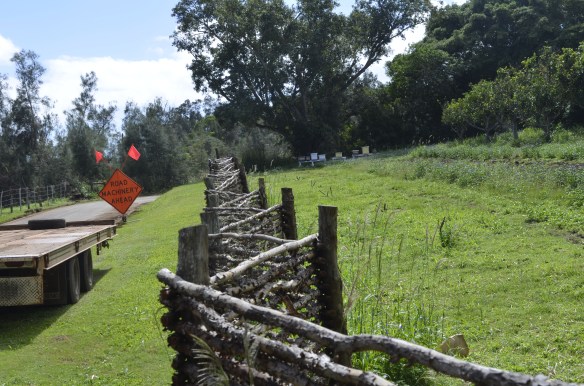
Zig-zag pole fence.

Zig-zag pole fence.


As we approached the descent into Halawa Valley, we could see two waterfalls pouring hundreds of feet down into the valley. I tried to take photos, but they were too far away. Finally, we got to to the valley floor, a rainforest jungle. There was a sort of public park building there, and then there was a dirt road to the beach.

Tom by now was quite ready to turn around and depart as fast as possible. There were three Hawai’ans sitting to one side of the road on a low rock wall. The one on the left was a heavyset fellow of middle age. The young man on the right was dressed in a short lava-lava (I don’t know what the Hawaiian word is; it’s a sort of kilt arrangement made of patterned cotton cloth), a shell necklace on a braided cord, and nothing else. The gentleman in the middle was elderly. (That means older than me. I figure he is about 76.) He wore unremarkable clothes and a faded baseball cap. He was very thin and his face under the brim of his cap was weathered. Neither Tom nor I can remember exactly what was said. I know we exchanged aloha, and I think they asked us why we were there. I responded that I was looking for mo’olelo Moloka’i.

The men to left and right looked at the man in the middle, and simultaneously said, “This is the guy you want to talk to.”

I leapt out of the car and walked up to the older man. He was shaking his head, so I said, “Come on, Uncle, please tell me some stories.” (Remember, “uncle” is respectful when speaking to someone  older or wiser than oneself. The Hawaiians have great respect for their kupunas, unlike the typical American, who sees them as old and in the way. I’m liking Hawaii better every year.) The gentleman replied that he didn’t just tell stories, I needed to make an appointment. He insisted on  this several times. I took this as a message that he took what he did extremely seriously, and he wasn’t sure that I did.

I didn’t press him, but told him I was meeting with Auntie Opu’ulani on Wednesday and snorkeling on Thursday, and leaving on Saturday, and in any case, my husband would not drive back down that road. At this point, the heavyset guy offered to drive me, which I thought was incredibly kind.

The kupuna finally asked why I wanted to know these stories. I told him I was a writer, and wanted to set my next novel in Hawaii. He asked what my last novel was about, and I tried to tell him. I found it amazingly difficult to summarize a 350-page novel, especially as I had no idea what his background was. He had as much trouble pronouncing Quetzalcoatl and Necocyaotl as I do with many Hawaiian words.

I have found that when I tell people I want to hear their stories, they are cautious. Once I say I am a writer, they open up. I am not sure why this is so.

He talked to me for quite a while about good and evil. He said everyone has capacity for both, and we each must choose which way to go. He also talked about not giving over your power to another person. He waxed so philosophical that after a while, I asked him if he was a kahuna.

“People don’t understand what kahuna means,” he told me severely. “Kahuna is an educated person. My grandfather told me we are all kahuna, just not everybody knows it. There are good kahuna and bad kahuna. You understand?”

I said I did. I hope I did. Mostly, I kept my mouth shut, and he kept talking. He often spoke in Hawaiian, which sounded to me like water running over smooth stones. Beautiful. He eventually stopped talking in abstract terms and began to tell me a story. He told it in the first person, as though he were the young boy in the tale. Seeing my puzzled expression, he said, “Now I am telling mo’olelo, you understand.” Here is the story, as much as I can recall, because I was listening, not taking notes. I have retold it, so it is in the third person:

A young boy was born in Halawa Valley, the youngest of seven siblings. He was chosen to be the cultural teacher (teacher is not the word he used, but it is close) in his family, the one who would preserve the ‘ohana’s cultural wisdom (‘ohana means family). He was not allowed to swim in the sea or go to the waterfall like his brothers and sisters and he was unhappy and thought this was unfair. One day his grandfather told him they were going to the waterfall, which is called mo’o-ula (red lizard) because a mo’o lives there. (Mo’o are mythical lizards. They were huge, and no actual beast of this sort has ever lived in the Hawaiian Islands. Some mo’o were kindly toward people–some not.) If you threw in a ti (pronounced tee) leaf in the pool beneath the fall and it sank, you were not allowed to swim in the pool because that meant the mo’o was in the pool. The boy wanted to know why they were visiting the pool, but his grandfather told him not to ask questions.

There were ti bushes that had been planted by the people all along the path, so the boy broke a leaf off as they walked. When they got to the pool under the falls, the grandfather broke off a big clump of ti leaves, fastened it to a stone, and tossed it in. “One ti leaf is not enough,” he told his grandson. The ti leaves floated around this way and that, then sank. This meant the boy could not swim because the mo’o was using the pool and anything could happen to him.

Then the kupuna began to relate things from his own life. He told me that when he was a boy, his grandfather told him that the beach at Halawa Bay was the burial ground of his ancestors. He asked a lot of questions, but his grandfather told him not to ask questions and took him to the beach (sound familiar?). The boy said he could see no graves. When the tsunami of 1946 washed out the beach, he saw the bones scattered all over the beach, uncovered by the ocean, and knew his grandfather was right.

His grandfather also took him to the falls and told him the mapmakers had made a mistake (again, no questions allowed). They called the falls red chicken falls (moa-ula) instead of mo’o-ula (red lizard). The grandfather pointed up to the falls and said, “Do you see a red chicken?” The boy did not. Then a mist came in, and his grandfather told him it was the spirits of his ancestors. When the mist cleared, the grandfather pointed again to the  top of the falls. “Look again, what do you see?” He looked again, and saw the head of a huge lizard peering over the edge.

He then told me that he had told archeologists where to find ancient remains of firepits and fishponds. The scientists dated the fishpond at 650 AD, the oldest yet found in Hawaii. It is believed that Halawa Valley is the oldest continually occupied site in the islands. I haven’t checked this, but it seems probable, if what he told me is true–and why not?

The kupuna had told us that he would need to leave soon, as he was taking his haole (pronounced how-lee, means Caucasian) son to the airport. After some time, a young, blond man came walking down the road and my kupuna told me he had to go.

I asked him what his name was.

“Uncle Pilipo,” he replied.

I stared at him. “You’re Pilipo?” I stammered. “Janine Rossa told me to find you.”

“Well, you found me!” he replied, climbed into a truck, said “Aloha,” and drove away.

Uncle Pilipo. I don't know who that woman is, but I'm starting a diet as soon as we get back.

Uncle Pilipo. I don’t know who that woman is, but I’m starting a diet as soon as we get back.

OK, there’s only 8,000 people on this island. But I was completely gob-stopped. Of all the people who might have been waiting by the roadside at a place we arbitrarily decided to visit, how likely is it that it was one of the three people I had been told to see?

While I am being woo-woo, I noticed that on the Big Island, when I told people about my experience in Kilauwea, they were quietly accepting. Here, they are skeptical, which is interesting, because Moloka’i is supposed to be the island where the magic still exists. Perhaps Pele has been gone too long from Moloka’i for people to pay much heed to her. I think most Hawaiians here are Catholic, judging by the number of Catholic churches, which, given Father Damien’s popularity, is not surprising. I don’t think they want to talk about the old gods much.

So Tom and I started back up the narrow, winding road, Tom not being interested in going to the beach or to the falls. (I was, but I understood his need to get back to nice, flat land as quickly as possible. He had sacrificed enough already.) I missed a lot of fine scenery on the way back because I was frantically typing Pilipo’s stories into my iPad. I had taken no notes at the time because I was trying to concentrate 100% on what he was saying. (It also seemed like a bad idea to ask questions given his stories.)

As we passed the ancient fishpond, I spied something that looked like an old Hawaiian hale, or house, near the pond, and some sort of palm-thatched structures tucked under the trees. There was a young woman talking to the passenger of a car that had pulled off the road. I got Tom to stop (we were at sea-level again, so no problem), and told the woman I was looking for Ray Naki.

“You found him,” she said. She pointed at a thatched structure under the trees. “He’s over there.”

I walked in as though I knew what I was doing (Tom was parking). There was a Hawaiian about my age with shoulder-length gray, curly hair, wearing a traditional loincloth (malo), a large bone fishhook like the New Zealanders make, hanging from a thick, braided cord, a bemused expression, and nothing else.

Lei-mana blowing a conch shell horn.

Lei-mana blowing a conch shell horn.

I said, “Your niece April in Captain Cook said I should look you up.”

He looked at me blankly. “Who?”

Ulp. “Are you Ray Naki?”

“Yes, that’s me. Who did you say?”

“April, April Qina. That’s her married name.”

He pondered that for a minute, then his face cleared. “Ah, ‘Apilela. That’s her name!” (‘Apelela is April in Hawaiian.)

He wanted to know why Apelela said I should see him, but I couldn’t tell him because April never told me. I just blindly did as she had suggested. I honestly never questioned why, to tell the truth, and had no particular expectations, which has been my modus operandi on this trip. I certainly was not expecting a loincloth-clad man living in a thatched hut.

Lei-mana.

Lei-mana.

Tom came in from the road, and Ray pulled three eyeshades hand-woven of palm fronds from a supporting branch of the lanai, donning one himself and offering the others to us. We put them on as directed and he invited us to sit at the picnic table.

I should describe the place before going further. The fishpond is enormous, maybe two or three hundred yards across, constructed of low lava rock walls that begin high up the beach and extend into the calm waters quite a way, making the pond more or less circular. The walls are frosted with pieces of white coral. There is a “gate” where fish can swim in or out. On either side of this gap, there are bamboo poles with clusters of coconuts. There is a similar structure on the inland side of the pond, standing in the sand. A small, white power boat floating on the waters of the pond was anchored to the shore by three rocks.

When I walked into this establishment, I was greeted by a pack of medium-sized, short-haired, golden-brown dogs, many with ridged fur down their spines. There were also a couple of vaguely chihuahua-looking dogs, though they were the same color as the others.

Dogs

They greeted me by licking my hands and crowding around my knees. I wondered if they were related to the “poi dogs” the ancient Hawaiians used for food. I looked this up and found that the poi dog is extinct. The Hawaiians fed them on poi, the mashed and cooked root of the taro plant, which is used as a condiment here and is pretty much pure starch. So the poi dogs didn’t chew tough food and their skulls became deformed through muscle disuse, becoming flattened. They were described as fat, stupid and slow. Often when a child was born, he was given a poi dog. If the child died in infancy, the dog was killed and buried with it. If the child survived infancy, the dog’s teeth were pulled and fashioned into a protective necklace for the child. So the poi dogs are probably better off extinct, poor things.

There was a frame for a traditional hale, but it was unthatched at present. The kitchen–a camp stove and picnic table–was set up under a thatched lanai (and by “lanai,” I mean nothing fancier than a shelter). There was an old international cargo container with doors cut into it next to the lanai, apparently to provide protection from rain and wind. The lanai was hung with fishing nets and other paraphernalia. (But Ray has a cell phone. He likes to play the unsophisticated “native,” I think, but he is a sharp old fox.)

A couple of small children, including a fat baby in diapers, were wandering around. They were some of Ray’s five grandchildren. He lives with his wife, daughter and son, grandchildren, and I don’t know who else. The two-year-old went down to the fishpond with me and dragged away the stones that secured the boat anchor. I think he wanted to show off the anchor to me. His grandfather roared at him in Hawaiian, and I didn’t need a translation.

Ray’s Hawaiian name is Lei-mana, the powerful lei, so I will call him that. He is the brown of medium-roast coffee beans, big-bellied, but firm. Because of his attire, I was also able to observe that he has firm, smooth buttocks.

Lei-mana used to be a construction worker, but gave it up to pursue a more or less traditional lifestyle at the fishpond. He fishes the pond and his ‘ohana has a taro patch at Halawa Valley. He teaches school children about how their ancestors lived–also hula and the Hawaiian language. I gathered that in addition to school field trips, he has visitors from other areas of Polynesia, like New Zealand. A Maori from New Zealand gave him the fishhook necklace he was wearing.

Conversation with Lei-mana was somewhat awkward. He has a way of falling into silence for a while, then coming at you with questions. Yet he frequently did not answer my questions, greeting them with thoughtful silence. Then he would start talking about something unrelated. As it was a disjointed method of talking and I wasn’t taking notes, I have noted most of what I remember already.

I gave Lei-mana April’s phone number and took his address so that I could send him a copy of “The Obsidian Mirror” (I have made this offer to anyone who has helped me on this trip). I also offered him some money (as I did Uncle Pilipo), because Janine advised me to do so.

“Don’t think they will be offended,” she told me. “They won’t be.” So far, utterly true.

Lei-mana asked if we wanted to return the next day and learn what he teaches. We agreed to come back at noon the following day. I leaned forward to kiss his cheek as Janine had instructed me, and then Lei-mana said, “Here is the old Hawaiian way to kiss, nose to nose and forehead to forehead,” and proceeded to do just that. We removed our palm shades, but Lei-mana insisted they were gifts, so we took them.

Tom, me, and Lei-mana.

Tom, me, and Lei-mana.

I was a bit overwhelmed at this point. We stopped for a very late lunch at Paddler’s Inn. We ordered the day’s special, Chinese chicken salad, which bore no resemblance to any dish by that name we had ever eaten previously, and I had another excellent daiquiri. Then we stopped in town for dinner makings and went home. I wrote furiously all through lunch, then started writing again when we got back to Paniolo Hale. We ate leftovers for dinner because we were tired, and then I wrote some more until about 10:30 pm. I was making lots of mistakes by that time, though I had only journaled through Uncle Pilipo, so I joined Tom in the enormous humid marshmallow of a bed and dropped into a sound sleep.

Sleepy Moloka’i Sunday and Random Observations

Day 8: Molokai

I forgot to mention that April, of Ma’s Kava in Kona, had grown up on Molokai. She told us we should visit her Uncle Ray Naki at the fishponds on the way to Halawa Valley, an area we planned to visit anyway. Jody, one of the sellers at the farmer’s market in Kaunakakai, knew Ray and described his house to us. (She was selling trinkets to fund her son’s trip to New Zealand with his singing group. I bought a kukui nut and shell lei from her to help out.)

Me modeling the kukui nut and shell lei.

Me modeling the kukui nut and shell lei.

Of course, April also told us that the people here were kind of stand-offish. If these people are stand-offish, I am a Ford Agency fashion model. Everyone we talk to is chatty and helpful. Did I mention chatty?

We decided to try to find Uncle Ray, even though all the information we had by way of finding him is that he lived next to the ancient fishpond on the road to Halewa Valley. The night before, I had called Auntie Opu’ulani (“Heavenly House”), a kupuna (elder) who is an expert on mo’olelo Molokai (legends of Moloakai). I left a message, so I thought I would wait a bit to see if she would call back. So I had sort of planned to seek out Uncle Ray today, or at least drive up there and see what could be seen. We started out at dawn going back to Popohaku Beach, but it was readily apparent that the swell had not subsided, so we turned around and came back for breakfast. I cut up a pineapple and made Molokai coffee, then started writing, trying to catch up on my journal.

I caught up, all right. At about 2:00 pm or so.

The stores and other businesses are all closed today. Tom and I walked down to Make Horse Beach. I encountered a Swiss man, Olivier, who speaks about five languages, and I got to practice my French for a while.

The red path to Maka Horse Beach.

The red path to Maka Horse Beach.

I noticed a lot more shells on Make Horse. They were small, but they augured greater success than Popohaku. I determined to come back in the morning. Make Horse is a lovely little beach that must be a lot of fun when the surf isn’t so high. There are lots of tide pools, but I didn’t get anywhere near them.


Make Horse Beach. Credit, as with almost all photos because my iPhone is dead, to Tom Keenan.

Make Horse Beach. Credit, as with almost all photos because my iPhone is dead, to Tom Keenan.

Then we came back to the condo. I located the barbecue facilities, then we made teriyaki steak for dinner with rice and asparagus that was actually not terribly expensive.

When I went upstairs to the bathroom after dinner, I left my flip-flops downstairs because Scott (one of the managers) had requested it. They had just installed new carpet on the stairs and second level, and didn’t want it tracked up with the red dirt of the island. When I turned on the light in the bathroom, I immediately saw a three-inch-long centipede, curved into a graceful S-shape on the bathmat.

Wildflowers on the path to Maka Horse.

Wildflowers on the path to Maka Horse.

This was no skinny, mainland-type centipede. It was hefty, with nasty-looking pointy things at front and rear.

I respect nature, but there is a limit. I went down to get my flip-flops, proceeded to beat the damned thing to a pulp, and decided there was no way I was going to walk around barefoot from now on, Scott or no Scott.

Here are a few random comments:

There are deer on Molokai. In 1867, speckled Indian deer were delivered to Molokai at the request of King Kamehameha V. They were released on the island and flourished. There are various signs of them, though I have yet to see one alive. Misaki’s Market, one of the two grocery stores in Kaunakakai, has deer heads mounted on supports on every aisle. We passed a fence completed covered with antlers. We haven’t yet seen deer burgers on a menu though. Much less venison.

The Humane Society consists of two small storage shipping containers with a pen in between. I haven’t seen any animals there, but I don’t know if that’s good or bad.

You can see three other islands from Molokai: Oahu, Lanai and Maui. There is an outrigger race every year from Molokai to Waikiki. Given that this is 38+ miles across very rough water, this is a serious athletic event.

There are huge, black moths here with wingspans of five or six inches. Gorgeous. We will (Tom will) try to get a picture.

The fishponds on Molokai are the oldest in the islands. More on these later. They are constructed of lava rock (not that there is any other kind) walls out into the water where the wave action is low. There is usually a gate where fish can swim in. They could swim out again if they chose, but perhaps they were fed inside the pond, keeping them around. I will find out more tomorrow.

Because Tom Keenan is an amazing photographer!

Because Tom Keenan is an amazing photographer!

A Happy Welcome to Moloka’i Followed by Near-Disaster

Day 7: Hawaii to Moloka’i

Today was a travel day, which is boring. All airlines lead to Honolulu to catch flights to other islands. Our plane to Moloka’i (I have always pronounced it moh-lah-kai, but here it is pronounced moh-lah-kah-ee) was a small prop plane. We crossed the channel from Oahu to Moloka’i, and I had the window seat, graciously ceded by Tom, even though his window seat from Kona to Honolulu was right next to the jet engine, which blocked the view. It was easy to see that the water in the channel was extremely rough, and the little prop plane wobbled a bit as we landed in the adorably tiny airport at Kaunakakai, which is the largest of Molokai’s three towns. And by “town,” I really mean “hamlet,” although they are not especially quaint. The wind was whipping the palm trees around, and leaves were flying everywhere.

We entered the airport. The rental car offices were right inside the door, and a line had formed, so I sat down on what appeared to be a convenient metal bench. After a bit, I began to wonder where the luggage was and asked a pretty, brown-haired woman sitting next to me.

She patted the “bench.” “This is where they put it,” she said cheerfully. “Give them a few minutes.” She asked me where we were staying and why we were here. When I told her, she gave me the following information:

  • Where to find the best meat and produce
  • Where to see hula and music performances
  • Which grocery stores to go to, and their hours
  • -Where and when the farmer’s market was
  • The name and contact info for the local experts on ancient Hawaiian protocol
  • The Aunty who knew the most about local mythology
  • Who the best boat captains were and how to get to the best snorkeling
  • Where and when and from whom to get a hula lesson
  • How to greet people properly in Hawaii (lean forward, touch the right cheek with your right cheek and kiss the cheek once)
  • How to address persons older than oneself, or indicate respect (aunty, uncle)

Needless to say, I was amazed and grateful. I said I would send her a copy of “The Obsidian Mirror” as a way of thanking her.

It took almost no time for Tom to pick up the car (again, I had specified el cheapo mucho, but we got a Jeep instead because they were out of Sparkies), and I had to drag two suitcases and all carry-ons a mere 10 steps to the car. We set off for our rented condo on the west side of Moloka’i.

But before we get to my personal observations of the island, let’s talk a bit about some factors the Moloka’i kama’aina (residents) are facing.

Molokai is one of the least-populated islands. The majority of the state’s citizens live on Oahu, primarily in Honolulu, therefore the political power and money is centered there. The Molokai (I have to stop using the apostrophe to indicate the glottal stop because it’s just too hard to type it  frequently on an iPad keyboard) Ranch Corporation owns virtually all of the leeward side of the island, where most of the arable land is. They used to operate a farm, ranch, hotel, golf course  and other amenities here. The Ranch decided to build some luxury condominiums on the west side near where we are staying.

Molokai kama’aina (Yea! Autocorrect did it for me!) objected to this plan. They don’t want the island to be the next Maui or Oahu, with high-rise hotels and tourist luaus. They like it small, slow, and old-fashioned, a place for the ‘ohana (family). They were successful in blocking the Ranch’s development plans.

The Ranch, the largest employer on the island, retaliated by shutting down ALL operations on Molokai. The ranch land is idle, the hotel is shuttered, the golf course overtaken by weeds and trees. All Molokai employees were laid off.

I am far from being anti-capitalist, but this just seemed incredibly spiteful to me.

Then about two years ago, a power company wanted to put windmills on the west side to generate power, running a cable undersea from Molokai to Oahu. Hawaiians in general seem to agree that the political system here is completely corrupt, largely because of the imbalance of power between Oahu and the other islands. Politicians and money were lined up behind the windmill project, but the Molokai kama’aina objected.

“How reactionary!” you might say. Renewable power is a non-trivial issue out here in the middle of the Pacific, where every drop of fuel must be shipped in.

However, the issue is that NONE of that windmill-generated electricity would be made available to the people of Molokai. You would think that the power company would build one or two extra just to placate the residents by providing them with cheaper electricity, but no. The windmills and cable project were blocked, but wtf?

While I’m on the subject, there’s also the issue of island-to-island travel. Back in the day when Tom and I visited, there were kama’aina prices for inter-island travel, which were lower than tourist prices. There was also a ferry to and from some islands.

All that is gone (except for the ferry between Molokai and Maui, primarily to get workers to Maui). Kama’aina pay the same as tourists for airfare. Hawaiians who want to travel within their own state are stuck paying tourist-level prices for the privilege of traveling a distance that in other states could be easily accomplished by car, bus, or train. You can probably charter a boat, but that is hardly a cheap solution.

I guess my point is that the residents of Molokai are a pretty brave bunch of people. They stand up for what they believe in, even if it hurts them. And Hawaiians in general outside of the population center are being, to put it frankly, screwed over.

Back to our adventure. We drove to the west side where our condo complex is located. The land on this side is bright red earth, mostly covered with grasses and scrubby acacia. Where the earth has eroded, the bones of old lava stick up through it like rotten teeth.

Molokai was formed by two volcanoes, one on the east side, one on the west. Both have been  extinct since before human beings evolved. The one on the east exploded 1.5 million years ago and most of its remains lie at the bottom of the ocean. Its demise left the high sea cliffs (pali) that separated Kalaapapa, the leper colony, from the rest of the island.

Most people have heard of Kalaupapa because of Father Damien and Mother Marianne Cope, who lived with and cared for these unfortunates until their own deaths. They were both recently canonized. Leprosy, or as it is known  today, Hansen’s Disease, is now curable. However, some of the very elderly lepers still live at Kalaupapa, even though they have been cured.

The story of Kalaupapa is a fascinating, terrible and inspiring story, but we will not be visiting. You can hike there or ride a mule down the sheer pali, which is not happening for several reasons, one of which is that Tom and I are both acrophobic (I caught it from him). You can take a helicopter there, which is also not happening, due to my first and only helicopter ride. It was a trip through Waimea Canyon on Kauai. The pilot was an ex-Vietnam fighter pilot who derived a sadistic joy from scaring the crap out of me. He succeeded. There are no boat tours. I don’t feel strongly enough about visiting to charter a boat. So sorry–no Kalaupapa.

Our condo is not near anything, which is great, but we needed to stock up. We drove into Kaunakakai, making our first stop at Paddler’s Inn for lunch. Paddler’s is a local hangout. It’s largely open-air, and like everything here, shabby and comfortable. We both had saimin and poke, and I had a daiquiri–one of the best I have ever had.

Then to the two grocery stores in the island’s largest town, Kaunakakai. The selection is a bit different in each store, and there are a lot of local faves, like Spam. We were a bit disappointed there was not more local fresh fish. We didn’t feel up to gutting and filleting the fish being sold out of a pickup truck on the street, so we bought Atlantic farmed salmon (which I normally never would do; I follow the sustainability guidelines issued by the Monterey Bay Aquarium), and some other necessities. The liquor store in Kaunakakai had a wonderful selection, so that was good, having poured the last of our wine in honor of Joan and Casey back in Captain Cook.

We arrived at the condo complex, which is called Paniolo Hale (cowboy house). We found the condo and got the key out of a lockbox. Then we encountered our first obstacle: we could not figure out how to unlock the door. Our condo managers, Scott and Chad, had thoughtfully given me the number of the housekeeper, whom we called. Fern gave us the magic trick for opening the lock, and we walked in.

We have a two-story condo facing the ocean, which is a few hundred feet away. There is a screened lanai, separated from the living area by huge, louvered glass doors. It was hot and stuffy inside, so we immediately tried to open the louvres and encountered our second obstacle: they wouldn’t budge. I called Fern again, and she called Scott and Chad, and Scott said they would be there shortly.

In the meantime, we went upstairs, where there is a bedroom and bathroom. The bedroom has no windows facing the ocean; this amenity has been sacrificed in favor of the lanai. But it did have a small, screened-in balcony facing mauka-side. As the complex is nicely landscaped with lots of shady trees, this is actually pretty. It has some sort of fine, grassy groundcover that smells like dill when you walk on it.

Paniolo Hale

Paniolo Hale

Scott and Chad arrived and opened the louvres immediately. The problem was that Tom and I, both with Master’s degrees, had been trying to pull them towards us, but they have to be pushed out. Which reminds me of this wonderful Gary Larson cartoon, below.

Cartoon by Gary Larsen

Cartoon b y Gary Larsen

We asked lots of other questions and Chad went upstairs to open a stuck window in the bedroom. We could see huge, turquoise waves dashing against the rocks not far away–the same swell that had kept us out of the water at Honaunau. So I asked Scott if it is safe to swim here once the swell has subsided. The answer was that we could walk down to our right to Make Horse Beach (Dead horse beach. Romantic!), and that was much better, but that winter is a tricky time to swim anyway. I could see another long beach past a rocky point tooth elect and asked about it.

Scott gave me directions to get there. It’s a beach park called Papohaku. “After a big swell like this,” said Scott, “there are lots of shells. You don’t usually find shells there, but you might even find a sunrise shell at Popohaku.”

Well, Scott had me at the word “shell.” I adore shells, and have spent many hours collecting them on beaches around the world and getting seriously sunburned. The albedo of my skin is approximately that of new-fallen snow, so I have to be careful. I wear sunscreen all the time on my face, and when in the tropics, slather it everywhere, whether I plan to be outdoors or not.

Anyway, nothing would make me happier than shell hunting–and I particularly would love to find a sunrise shell. They are both rare and gorgeous. Mind you, I never buy shells or take a live one, because the commerce in shells is creating devastation among the world’s little shell-builders. The rarer the shell, the worse the damage. But any shell I find myself that is not currently occupied is fair game. Here’s a sunrise shell, just to show you how exciting it would be to find one (at least if you were a bit nuts, like me):

Sunrise shell

Sunrise shell

We sat and watched the huge waves for a while, reading and writing, until the sun went down. The wind was still fierce. I began trying to find my way around the kitchen. I wanted to roast some potatoes, but we had neglected to buy any oil (butter, but not oil), I found an unlabeled container of something I was pretty sure was coconut oil in the fridge, so I melted it and dribbled it over the potatoes. Then I discovered there was no salt, except for a bag of sea salt flavored with balsamic vinegar. I sprinkled this over the spuds and stuck them in the oven. I also steamed some broccoli. It was all delicious, and the coconut-balsamic-sea-salt potatoes were lovely.

We were both exhausted and went to bed early. One of my criteria for places to stay, if at all possible, is a king-size bed. Tom and I are largish people, tall and far from slender, so a small bed is uncomfortable. This bed is the softest I have ever encountered. It was like sinking into a humid marshmallow. I was afraid I would wake up with a sore back, but not at all.

Day 8: Molokai

The next morning, I woke early, with shells on the brain. It was still dark, but I roused my patient husband and told him we were going to Papohaku Beach to look for shells. (He really is a saint sometimes.) I should have taken more note of the massive surf still crashing on the rocks out front; the swell had not subsided.

We found Papohaku without much difficulty. It was a little after 7:00 am, and no one else was around. To get to the beach, you walk through a rather enchanting little forest of acacias. It looks like fairies might live there. The beach itself is a long, curving stretch of golden sand.

Fairy forest at Papohaku Beach.

Fairy forest at Papohaku Beach.

I walked along for a while, looking for shells. Of course, there were none–the swell was still going strong. I had a plastic bag with me and picked up the few pieces of plastic I could find. (More about plastic in the oceans later.)

Golden beach at Papohaku.

Golden beach at Papohaku.

I love the ocean. I grew up playing in the surf in Southern California. I am a good swimmer and learned very young how to avoid riptides and getting “boiled” in a big wave. I body-surfed. I used to be able to swim the length of a swimming pool and back under water, though I probably couldn’t do it now. I also learned not to turn your back on the waves, because sometimes a “sneaker” wave can come along without warning.

But I didn’t intend to even get my feet wet on this expedition. I was walking with Tom above the line where the waves were reaching, and forgot to be alert. A huge wave surged up the beach and knocked me down.

I lack the words to tell you how powerful the wave was. It felt like the inexorable hand of God, and I only a gnat spinning out of control. I fell to all fours and the wave closed over me and began to drag me out to sea. I was screaming, but Tom couldn’t even hear me. He grabbed the waistband of my shorts and held on for dear life. It was absolutely terrifying.

The wave receded, and Tom yelled at me to get up, but I couldn’t. I was as shocked and terrified as I have ever been, and weirdly weak. I did manage to crawl on all fours away from the water, and shakily regained my feet, completely soaked.

Tom said, “Did you bring your iPhone?” Of course, I had. I reached into my pocket and withdrew my phone, dripping and covered with sand. Dead. I told Tom that my enthusiasm for shell hunting had been dampened, and started trudging toward the car, dripping sand and salt water in my wake.

Tom said, “I guess the sea god is pissed off because you sided with Pele.” Ulp. I hadn’t even thought about that. I have always been a friend to the sea and vice versa. I somehow was still clutching my plastic bag with plastic debris in it–didn’t that count for something? I confess that I am still a little uneasy about this. After all, if I can accept that Pele has blessed me, how can I then reject out of hand that Kanaloa (the sea god and one of Hawaii’s four top gods) or Pele’s sea-goddess sister who hates her, Na-maka-o-kaha‘i, isn’t miffed by Pele’s blessing?

Scoff if you will. People believe in these things here, at least many do. I hope my iPhone, my dear companion of boring times when I have to wait in doctors’ offices or checkout lines, is sufficient enough sacrifice, but I am not taking any chances until I have had an opportunity to placate whatever is out there.

On my way back, I snagged a piece of white plastic the size of a toddler’s chair, intending to deposit it in the trash. (See, Kanaloa?) I stopped at the restroom in the park to rinse off. I had sand everywhere, but was able to remove only some of it. The rest had to wait until I could get into a blessedly hot shower at the condo, where I discovered sand in places I didn’t know I had places.

Having washed and recovered, Tom and I set off to explore. It was raining, which it did the rest of the day. The first stop was a grocery store in Kualapuu, where we bought a large bag of rice, intending to bury my iPhone in it. This sometimes will dry the phone out sufficiently to get it working again, but I have my doubts; it was completely drenched, and in salt water to boot. We went to the Kualapuu Cook House across the street for lunch. The Cook House is in a small building that, like most places on Molokai, has seen better days. It’s not fancy, and the green and white curtains are grimy. They are a cash-only establishment.

Tom ordered BBQ pork and I had a BLT, feeling the need for comfort food. Both were excellent. Then we started to look for the meat cooperative, said to be the best source of beef on the island, all grass-fed, and Kumu Gardens, the best produce stand. It was Saturday, and there are no stores here open on Sunday except for Misaki’s in Kaunakakai, and that closes early.

Both the meat coop and Kumu were closed on Saturday as well, as it turned out. So we drove into Kaunakakai to stock up. We lucked out and found a tiny farmer’s market there, just starting to pack up. We got into a lengthy conversation with two ladies in the market, who were delighted to share information about the island. People here are incredibly friendly. They know everybody else who lives here, and if they are native Hawaiians, they are also probably related to everyone else.

We returned to our condo with our spoils. Dinner was poke from the market, to which I added an avocado the size of a small balloon, plus some seasonings from the cupboard. I don’t know what all of them are, exactly, but it was great. I served the poke over the rice I didn’t use to bury my iPhone.

Tom said the swell was supposed to be gone the next day. I secretly planned to return to Papohaku Beach the following morning. And this time, I would be a much humbler and more cautious woman.