Costa Rica, Day 12

I am still laughing at myself, 24 hours after it happened. We were on the way back from Dr. Piloto’s office. I had trouble getting into the taxi van because the first step is quite high, and the van was parked at an angle that made it even higher. My walking sticks signal to most people that I am not terribly agile right now. There were other people in the taxi, and when the driver pulled away. I thought he was leaving. But instead, he reparked the van to make it easier for me to get in and offered me the shotgun seat. I was grateful, but when I tried to tell him my knee required surgery, I misspelled surgery in my translation app and told him that “My knee requires sugar (azucar).” I KNOW the word azucar but said it anyway. He was such a kind man that he did not burst out laughing, which he was certainly entitled to do! He seemed to get it, but I’ve been breaking out in little burst of laughter ever since.

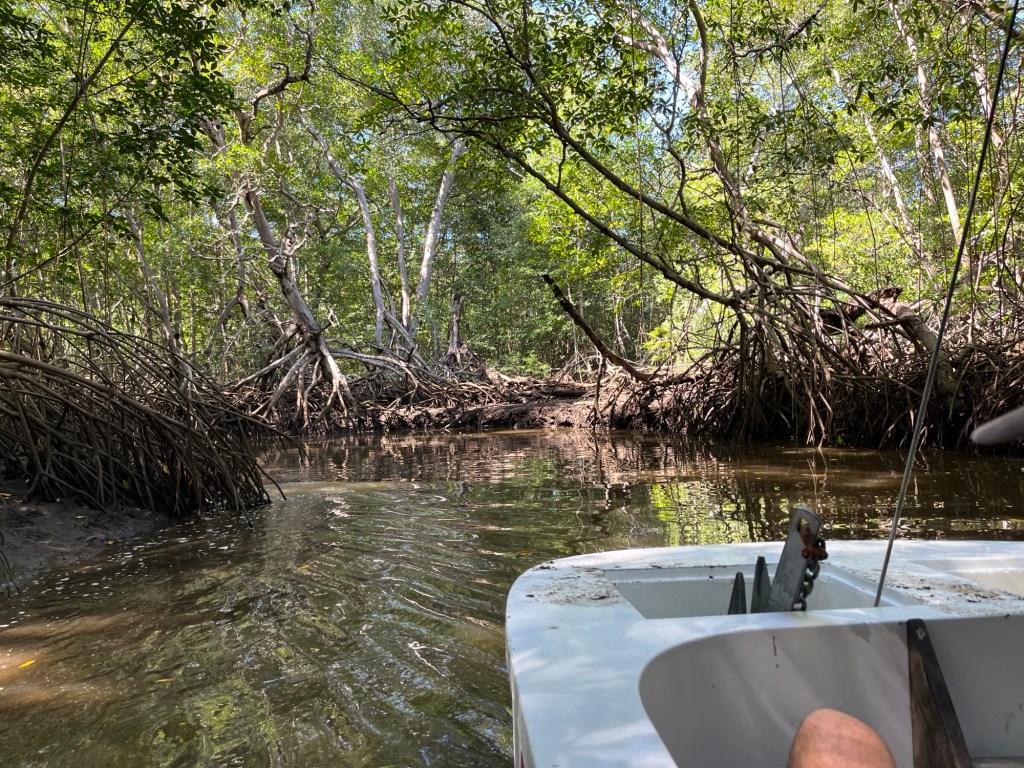
Today we took an estuary tour by boat through the mangrove swamps. We had to leave before our hotel served breakfast, so we walked into town. Most restaurants were closed, but we found a breakfast place and had fruit, avocado toast, yogurt, and coffee. Perfect.

The estuary tour was via a small boat with a canopy, powered by an outboard motor. The guide pointed out several different varieties of mangroves ( I had no idea), and my favorite was the “gentleman mangrove.” Our guide didn’t really know why it was called that.

Gentleman mangroves.

It was very low tide, and the boat got hung up on sandbars several times. This did not worry the men in charge of the boat; they always got us safely sailing again. At the beginning of our tour, the mangrove roots were high out of the water, and they looked like fingers reaching for the tide. By the time we returned, they were underwater again.

We wandered down some very narrow channels. Then we had to wander out again before getting stuck.

We saw a good variety of birds. They don’t have toucans, or macaws (none of which I have seen yet), but we did see:

Yellow-crowned night heron

White ibis (not my photo)

We didn’t get photos of most of them because they were too far away, but we also saw:

Green-backed heron

Little blue heron, adult and juvenile

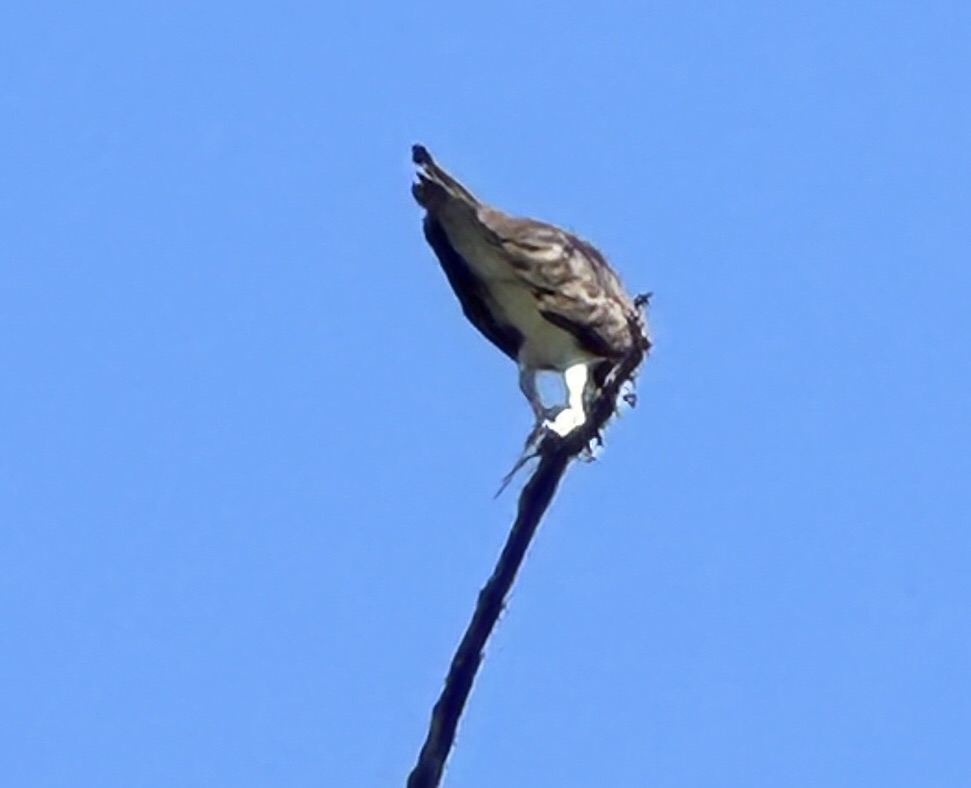
Osprey, sitting in a tree and lunching on a silvery fish

Common black hawk

Great blue heron

Whimbrels

Willets ( migratory birds that look identical to the ones on our beach at Aptos, CA)

Sandpipers (also migratory)

Kingfishers

Mangrove hummingbird

Black-throat trogon (maybe)

About midway along, they served us fresh-cut pineapple, which was refreshing. I guess someone threw extra pineapple onto the beach, because on the way back, there was a very happy and very large iguana chowing down on it.

Happy iguana eating pineapple. What a find for him or her!

We also saw several baby crocodiles in the water. None of them more more than two years old. Sadly, none of the croc videos wants to load.

The guides anchored the boat next to a muddy bank with mangrove roots sticking out of it and invited us to climb up so we could go see howler monkeys. I and my bum knee and torn rotator cuff opted to stay in the boat, much to their surprise, but I was happy with my decision.

At one point, there were howler monkeys in the trees right next to the water, so I got to see them anyway. One of the other boats had a guide who could imitate the howler call and got a rather lackadaisical response from the male troupe leader. You know, it was hot.

Howler monkey.

Costa Rica, Day 8

The view from our room this morning. I keep trying to memorize the Spanish word for fog (niebla), but for some reason my brain absolutely refuses to retain this.

Today we visited a butterfly sanctuary, located in a tiny pueblo about 30 minutes from La Fortuna. It’s on the opposite side of the Arenal volcano from our hotel, which is also the side of the volcano that gets all the lava. It you wouldn’t know that at the sanctuary, which has never gotten lava flow (in historical times, anyway)

We were greeted by the owner of the sanctuary, a man who moved here from Texas 27 years ago. (We agreed that Texas was a good state to be FROM). He proceeded to go over the butterfly life cycle, and I patiently prepared to be bored (I nailed this in elementary school). But he pointed something out that caught my attention; he said the reason for the larval stage is because the tiny eggs just don’t have enough energy to produce a butterfly. The caterpillar stage is intended to store up enough energy for the ultimate transformation. I guess that’s obvious, but I had never viewed it in quite that light before. What an amazing adaptation.

He also told us that moths (which he insisted on calling “night butterflies”) came before butterflies, evolutionarily. I didn’t know that.

We walked down the rather steep but paved path into the sanctuary, first encountering the butterfly habitats. There were three large, domed cages, each providing a slightly different environment for the different butterflies. The first cage featured many owl-faced butterflies, like the one we saw on the sloth walk, each almost as large as my hand. The defensive side of their wings has a very scary brown owl face, and their attractant side is brilliantly colored.

A couple of owl-faced butterflies having a romantic moment.

Owl-faced butterflies feeding.

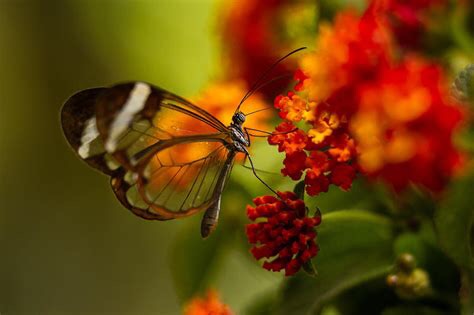
The next enclosure featured glass-winged butterflies. There weren’t a lot of them and they weren’t interested in sitting still for a photo. They are almost entirely invisible when they aren’t flying, and when they are flying, I can see they would be confusing to predators—they sort of flicker in the air like tiny ghosts.

Glass wing butterfly photo found on the Internet. We were not so lucky as to get a photo of these elusive little guys.

The final enclosure held many, many morphos—the national butterfly of Costa Rica, and surely one of the most beautiful of all butterflies. They are as big as my hand, and far from shy. Several landed on my hat for a brief rest, and I could hear their tiny feet scraping against the cloth. To our surprise, we also saw monarch butterflies. I didn’t get a photo of the morphos (the available specimens were bedraggled and clearly at the end of their short days), but I did get some of the others.

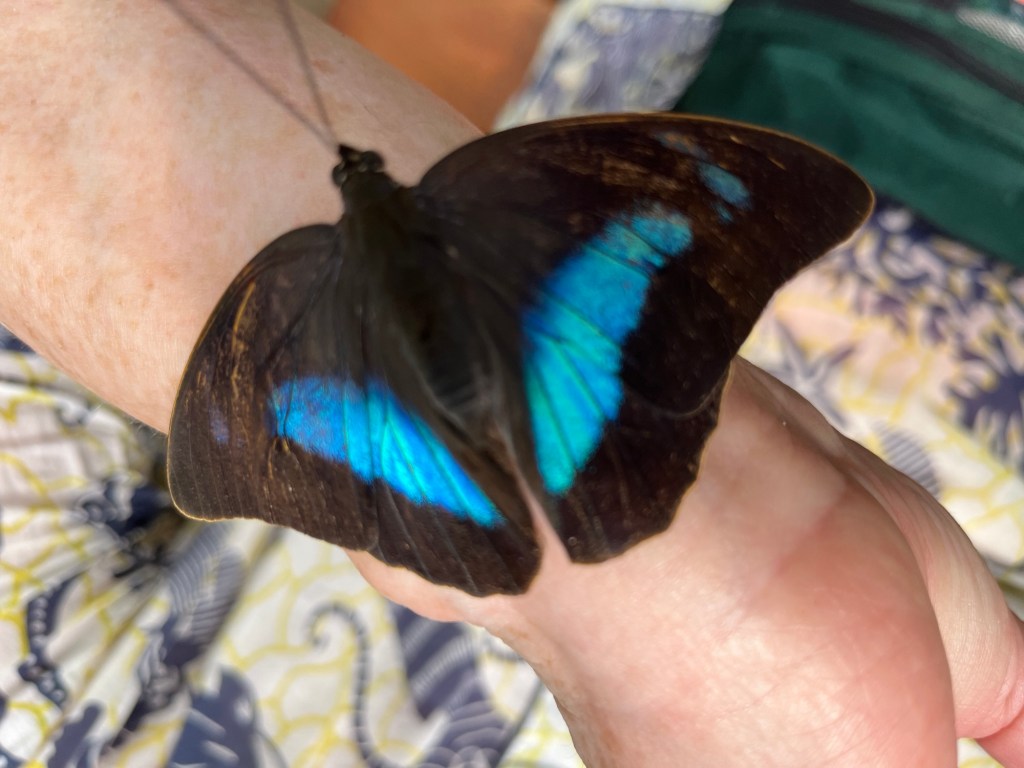
The prepona butterflies were quite friendly and sat on my hat and arms.
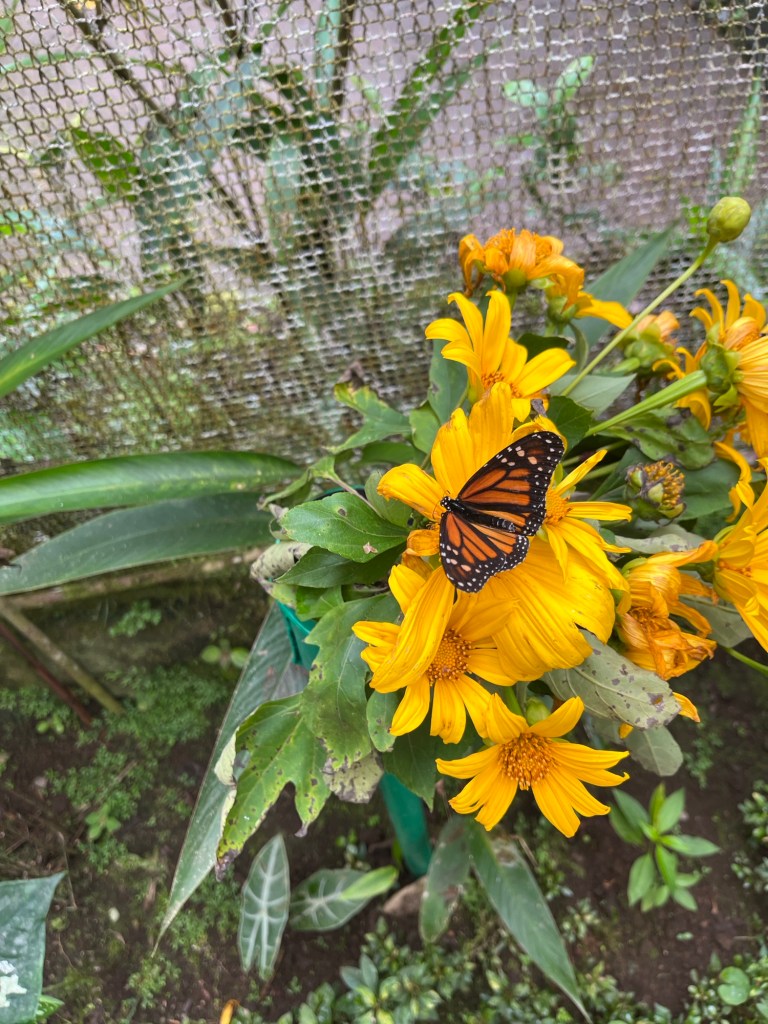
Monarch butterfly
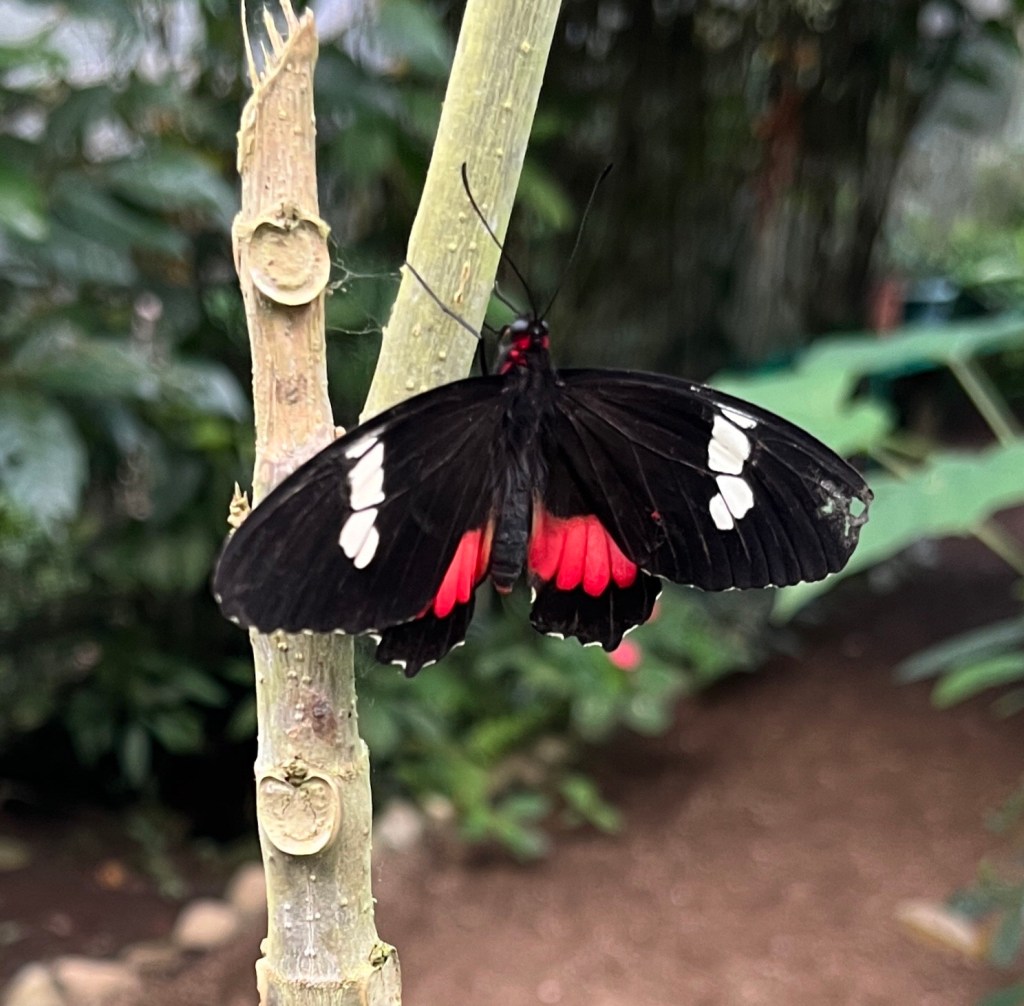
Paridies butterfly.

The next stop was the frog enclosure. The butterflies are free to mate and reproduce here, but the frogs are separated by gender. It has to do with laws restricting the breeding of frogs for the pet and zoo trade. It was broad daylight, and frogs being nocturnal, they were all tucked away out of sight. Fortunately, a docent arrived to open the cages and gently part the leaves to reveal the frogs. The first frog we saw was the national frog of Costa Rica, the red eyed frog. But her eyes were very small, sunken into her Kermit-colored face. The docent said she was asleep, but showed us another one, an apparent insomniac who was wide awake. Her eyes were popping out of her face and a brilliant red. Now I know how to tell if a frog is asleep or awake! There must be a Girl Scout badge for this.

Sleeping red-eyed frog.
Wide-awake red-eyed frog.

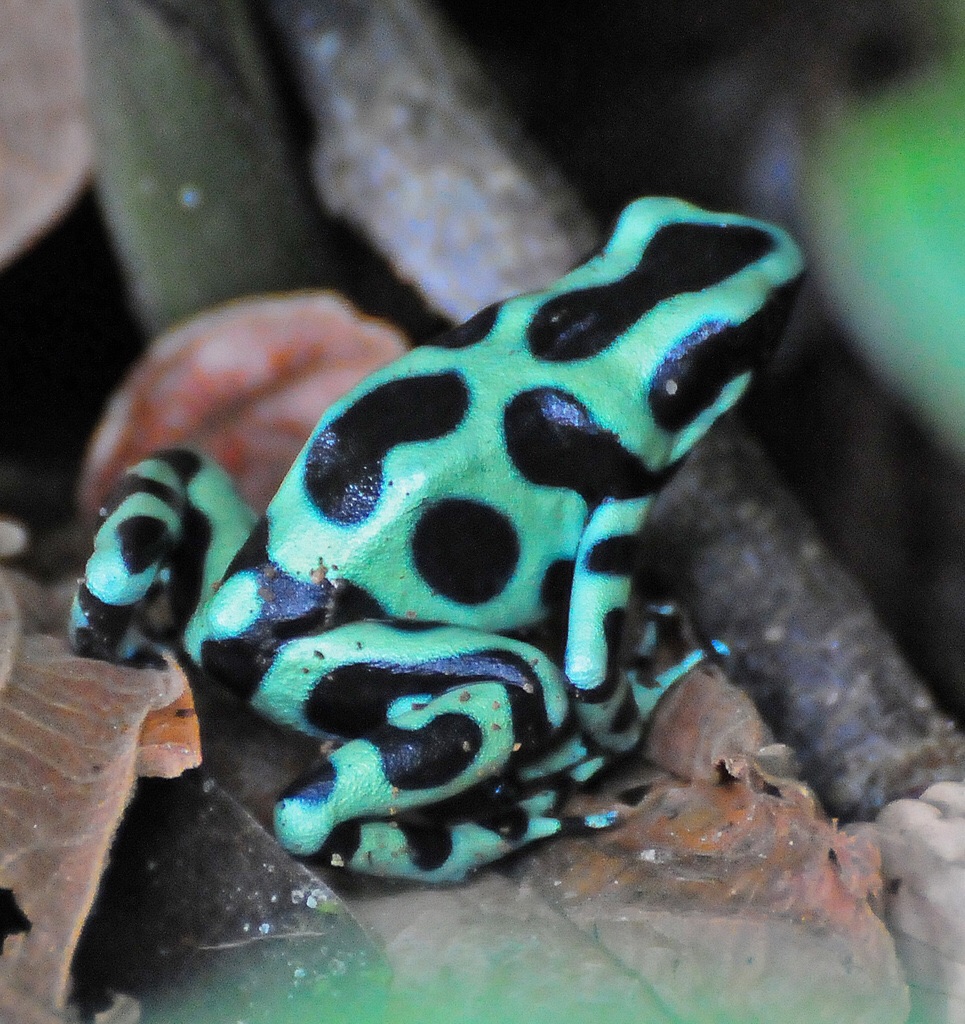
We encountered many other amphibians, including our old friend the blue jean poison dart frog,also called the strawberry poison dart frog. They also had another type of poison dart frog, which has the creative name of “green and black poison dart frog.” The photo below illustrates that this is far from being a misnomer.

The eponymous green and black poison dart frog.

Our docent mentioned that the indigenous peoples who used the poison from these frogs did not kill them—merely rubbed the darts over their backs because the toxin sits on the skin. No tocar los ranos.

This frog’s skin changes color in response to how much light is striking it. In direct sunlight, it changes to brown. At night, it turns bright green. This little guy was sitting in mottled sun and shade, resulting in nice camouflage.

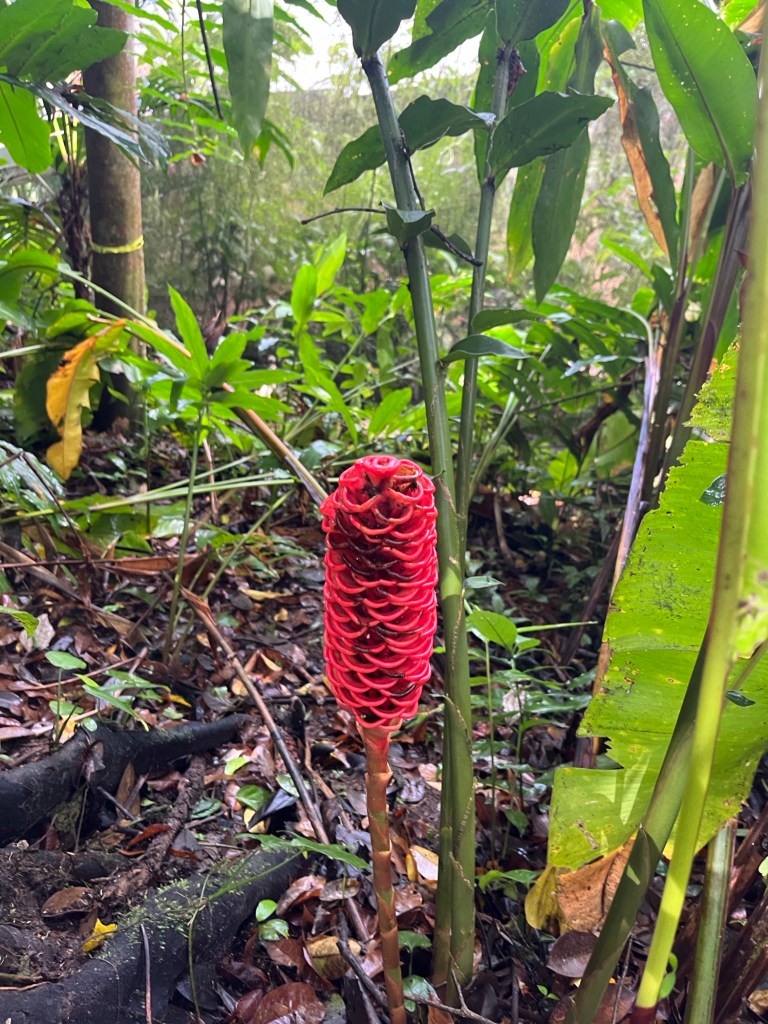
We also saw some rather exotic flowers in the sanctuary. The weirdest-looking ones tended to be some sort of ginger.

Yeah. Ginger.
I have no idea what this is.
This is Hairyensis Trumpiana. No, actually I have no idea.
I don’t remember the name of this frog, but at rest, it looks like a snake, which is enough for many animals to vacate the area.

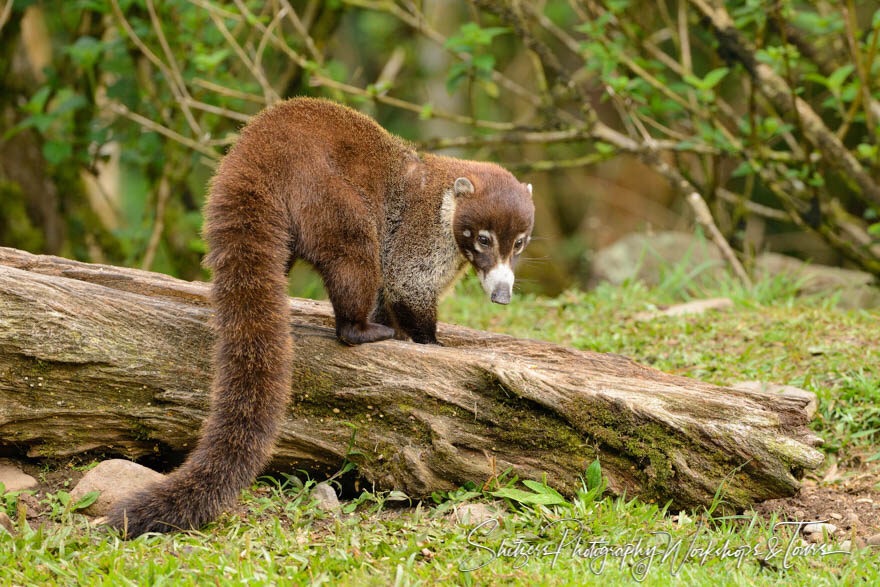
On the way back to the hotel, we saw a coatimundi in the road, stopping traffic and begging for food. It’s the largest one I have ever seen—about the size of a medium-sized dog and four feet from tail to snout. He was a handsome character, too, but I took too long to get my phone out to take a photo, and he wandered off, disappointed. I wasn’t about to roll down the window or get out of the car.

Our coati friend looked a lot like this. They are related to raccoons, and are just as cute and clever and obnoxious as raccoons.

We leave this hotel tomorrow and have hired a car and driver to take us to Tamarindo. The lady at the front desk asked if we were going to party. So did everyone else. I have a sneaking suspicion that Tamarindo is a party town. Don’t know why.

Warning: This Post Contains Shameless Self-Promotion

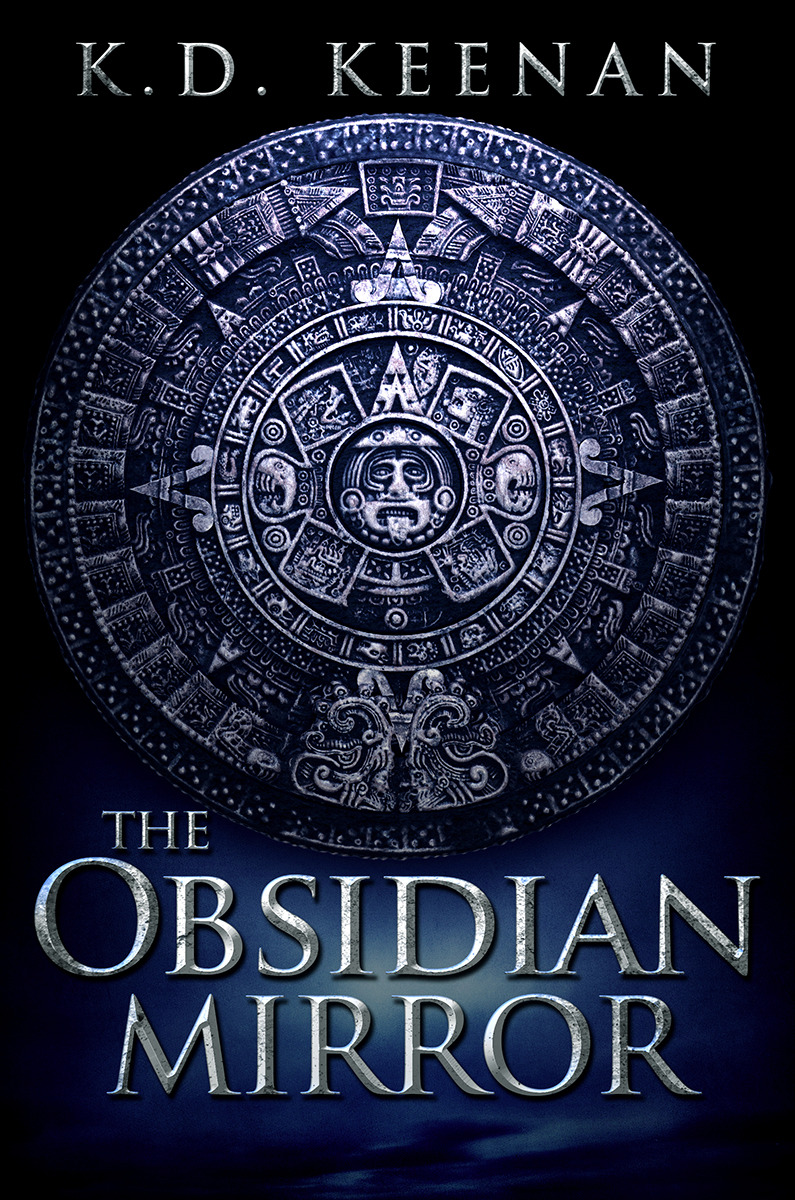
New Cover

Recently I finished editing the first draft of “Fire in the Ocean,” the sequel to “The Obsidian Mirror.” I sent it off to my alpha readers and editor, and I can finally relax and think about something else for a while.

Such as promoting “The Obsidian Mirror.” While I was in the throes of writing the sequel, I did next to nothing about promoting my published work. A writer’s work is never done, I guess.

Why should you read “The Obsidian Mirror”? Short answer: because it’s a fun read. I read largely for entertainment. I like books that take you away and let you live someone else’s life for a while. I wrote “Obsidian” to be that kind of book: a diversion, a book I would love reading myself. It’s probably not a coincidence that the second publisher of the book is Diversion Books—they specialize in just that kind of novel.

Another reason to read “Obsidian” is because it is based on the mythologies and folklore of the Americas, which makes it a bit different. The idea occurred to me after finishing one of Robert Jordan’s “Wheel of Time” novels. I loved the book, but started wondering why so much fantasy is based on proto-European, pre-Industrial Age tropes such as elves, faeries, dragons, and caped adventurers. The Americas have thousands of mythologies, folk tales and traditions that are largely ignored by fantasy writers.

I began writing “The Obsidian Mirror” as a kind of personal experiment. Meso-American gods and Coyote the Trickster, an Inuit ice demon and a mannegishi named Fred are some of the characters. What I did not anticipate is that I would fall in love with my characters and be driven to finish the book. Having done that, I felt compelled to get it published.

I don’t have much to brag about. I’m not a best-selling author. I have won no prestigious awards for my fiction writing. But I do have one thing that gives me modest bragging rights.

I have heard authors talk about receiving hundreds of rejection slips. One writer said he had a drawer filled with 450 rejection slips for his novel. That didn’t happen with “The Obsidian Mirror.” I approached perhaps 10 publishers and/or agents before AEC Stellar agreed to publish the book. When AEC Stellar bit the dust, I approached about five publishers before Diversion Books picked it up, re-published it and agreed to publish the sequel.

So I may not have sold a million copies, but I never had any problem finding a publisher. As a matter of fact, years after I originally submitted the manuscript to their slush pile, Baen Books got back to me and said they were interested in it. The early bird gets the book, Baen.

So why am I proud of this? Because I have some independent assessments that people will enjoy reading my novel. Add to that, the several four- and five-star reviews on Amazon, and you might conclude that you would enjoy it, too. To make it super-easy for you to find the book, here it is: http://amzn.to/1MQBvkd

I did warn you.


Interview with K.D. Keenan on (r)Evolution with HiC

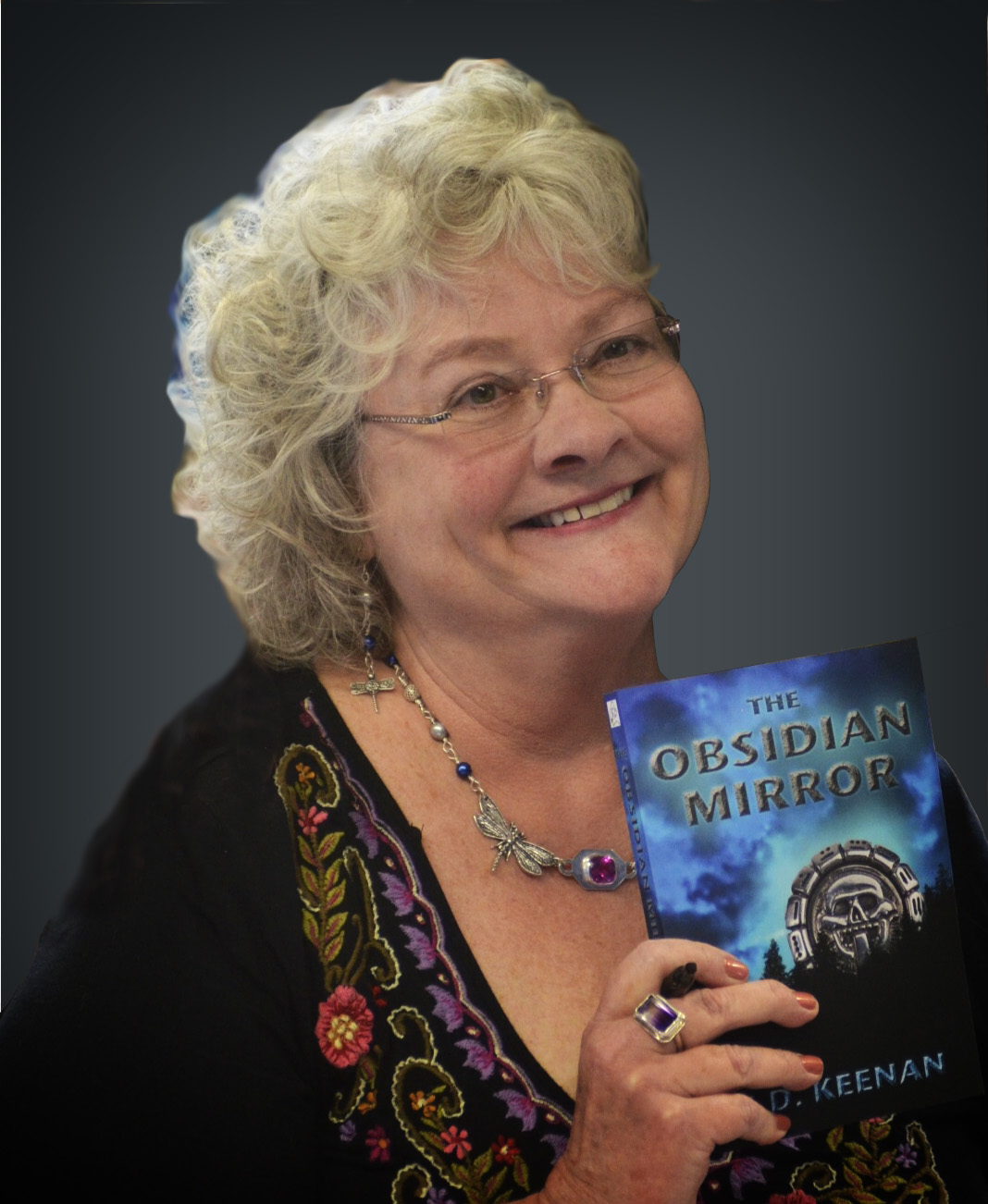
K.D. Keenan, author of "The Obsidian Mirror"

K.D. Keenan, author of “The Obsidian Mirror”

http://player.cinchcast.com/?platformId=1&assetType=single&assetId=5859167

Check Out Books Podcasts at Blog Talk Radio with Firefly Willows LIVE on BlogTalkRadio

The Launch Party, Coyotes, Mannegishi, and What Comes Next

Chaco, the Coyote Trickster

The launch party for “The Obsidian Mirror” went beautifully last Saturday afternoon. Kepler’s Bookstore in Menlo Park, CA graciously hosted the event, and there was a good crowd of people there. I did a very brief reading and answered questions.

Here’s a sampling of what I was asked:

Q: Is your protagonist (Sierra) autobiographical?

A: Sierra is concerned about the environment; so am I. Sierra is a PR executive, and used to be one. Sierra designs silver jewelry, and I do, too. There the resemblance ends because Sierra is way cooler than I am. (I didn’t mention this, but she’s also younger and more athletic than me.)

Q: What started you writing the book?

A: I had recently finished a Robert Jordan novel that involved riding horses, armor, swords, sorcery, etc. I really enjoyed the book, but later I wondered why, with thousands of legends, mythologies, folk tales and traditions, the New World is rarely used as inspiration for fantasy. Most epic fantasy, at any rate, is usually set in some pre-Industrial Age, pseudo-European environment. Elves, faeries, trolls, ogres, goblins, vampires, etc. are staple fare.

I love swords-and-sorcery, don’t get me wrong! But I had time (my freelance writing business was slow at the time), so I began writing a story based on New World traditions as an experiment. Before long, the characters took over and I HAD to finish the story.

Q: Is Chaco (Coyotl the Trickster) based on a person in your life?

A: I said Chaco was based on my husband, Tom, but I was kidding. Coyotl the Trickster is a folk hero among many of the Native American tribes. I should have mentioned that appearance-wise, I saw Chaco, in his manifestation as a deliciously sexy young man (as opposed to his coyote gig), as Gael García Bernal, the excellent Mexican actor who (among many other roles) played Ché Guevara in “The Motorcycle Diaries.”

One person thanked me for not making Chaco the villain. I started out thinking that since Chaco was The Trickster, he ought to be rather ambiguous; the reader would not be sure whether he was good or bad. I really, truly would have liked to write him that way, but he came out more of a scamp than a real rogue. (That was all his doing, not mine. I had other ideas.)

Q: What other characters are in the book?

A: There’s Fred the Mannegishi. Mannegishi are sort of like leprechauns in that they are small and green, but mostly because they are mischievous. Mannegishi are from legends of the Cree tribe. Fred is truly unreliable, but as one person present said (she had edited the manuscript for me), “Fred seemed like a pain in the butt at first, but he became my favorite character.”

I was asked if I made up Fred’s appearance, but I followed the description of Mannegishi in Wikipedia. I rarely made up anything about the supernatural characters; I tended to follow the traditional descriptions if they were available. Of course, much of my research consisted of strolling around the Internet when I needed a new monster. As the New Yorker cartoon has it, “Nobody knows you’re a dog on the Internet.” By the same token, it’s hard to know whether you’re reading something authentic, or a made-up legend by a tequila company or something. As “The Obsidian Mirror” is fiction—and fantasy fiction at that—I didn’t worry too much about academic purity.

 Q: Do you have a sequel planned?

 A: Yes, two. The next book will be set in Hawai’I, where Fred might meet some cousins of his. “The Obsidian Mirror” has an underlying theme of threat to our natural environment, which will continue to be a theme of my work. I am very concerned about the Pacific Gyre, also known as the Pacific Garbage Patch, a continent-size vortex of plastic particles in the ocean swirling around Hawai’i. But I do not plan on getting preachy. The books have to be fun to read, or no one will read them.

Of course, I may have to make the ultimate sacrifice and travel to Hawai’i to do research. A writer’s life is so hard.

The third sequel will be set in Mexico, and will have something to do with the Virgin of Guadalupe as Tonantzin, the Aztec flower goddess. I don’t know much more about it yet.

After answering questions, I sat down at the assigned table and signed books. The store sold out, with Kepler’s purchasing the last one for the staff. I hope they enjoy it as much as I enjoyed the party. I got a ton of compliments on the food—which I never touched because I was too wound-up!

From Sea to Poisoned Sea

Image: High Contrast

Image: High Contrast

Growing up, I learned in school about the natural wonders of our great land—the deep forests, crystalline rivers, wide and sweeping plans, and pristine deserts. This was probably reinforced by various Disney nature films depicting animals in the wild, with not a telephone line in sight.

Imagine my surprise when I got a little older and found out about “dead” lakes so polluted that nothing much could live in them. Rivers that caught on fire from time to time. Sweeping landscapes of gray factories belching dirty smoke into the air, surrounded by heaps of toxic slag. And because I lived a mere 100 miles from Los Angeles, that mother of all urban blight, the pall of grayish-brown smog that obscured the nearby 8,000-foot-plus-high mountains on many days.

I know it sounds as if I were a complete naïf, but I was stunned. The people who were dumping toxins and garbage into the water had to live here, too. Their children were being exposed to poison in the air and water. They had to look at the blight of human ingenuity, right along with the rest of us. So what could they possibly be thinking?

Many decades later, I am still wondering. It has never made sense to me that people would crap all over their own dinner tables. And it has never made sense to me that governments allow them to do this. Every time I read about some scheme to defang the EPA, or lower air and water quality standards, or build another nuclear power plant even after the disasters at Three-Mile Island, Chernobyl and Fukishima, I am newly gob-stopped. Why would anyone knowingly and deliberately destroy the only home we possess?

That’s one reason I wrote “The Obsidian Mirror.” In it, the ancient and evil Necocyaotl devises a new way to entice people to “look into the obsidian mirror,” after which they become so focused on their personal wants and desires that they are willing to despoil the earth to obtain them. He does this by spreading his evil essence in a fiendishly clever way, using modern technology.

To be honest, it’s the only explanation I can understand. Nothing else makes any sense at all. Profit motive, you say? That’s like burning down your own house to warm your hands for a bit. Until I get a better explanation, I’m sticking with the Necocyaotl Theory.

I Took My Skull Back to the Place It Came From (Almost)

When I turned six years old, my grandfather gave me a present. It wasn’t wrapped, as I recall, but just placed in a plain cardboard box. As it happened, it was my favorite gift that year: a genuine human skull.

My grandfather, Frank W. Moore, was an adventurous man. In the earlier days of the 20th century, he helled around California in a Model T, driving across the desert before there was such a thing as “off-road” driving. He had a sailboat called “Amy H” in which he explored the California coast and offshore islands. (My grandmother was not named Amy H. I think the boat came with the name and he never got around to changing it.) In those days, California was underpopulated and he had the freedom to go pretty much wherever he wanted to do whatever he felt like. One of the things he liked to do was go out with his buddy, Dr. Walter B. Power, and cut down billboards.

On one occasion in 1917, he landed on San Nicholas Island, later made famous by writer Scott O’Dell as “The Island of the Blue Dolphins.” On or near the beach, he saw a white dome poking up out of the sand. He uncovered it and found a skull with half of its lower mandible. The teeth (those that were left) were ground down quite smooth as a result of the inhabitants’ diet of shellfish which contained a lot of sand. My grandfather took the skull home, where it became an object of envy for my mother, who had ambitions of becoming an archeologist (and eventually did). Mom named it Yorick after the skull in “Hamlet.”

In those days, there was no Native American Repatriation Act, aimed at restoring the remains of Native Americans to their tribes and homelands. The battle of Wounded Knee was a mere 27 years in the past when my grandfather found the skull, and the term “Native American” hadn’t yet been coined. Indians, in short, were not highly regarded by the mainstream culture back then. No one thought twice about my grandfather taking Yorick from his resting place on San Nicholas Island.

In 1917, there were no inhabitants on the island. The Nicoleños (or Ghalas-at) had been almost exterminated by Russian fur-trappers. In 1835, the padres of the California mission system moved five of the six remaining inhabitants to the mainland. The one who stayed, Juana Maria, became known as “The Lone Woman.” She lived there, utterly alone, until her removal from the island in 1853. She died not long after.

My mother thought the skull was that of a young male in his 20’s, pointing to the supra-orbital ridges and cranial sutures, and we continued to refer to it as Yorick. Sensibilities toward Native Americans hadn’t improved too much by the time my childhood rolled around, so I happily took Yorick to show-and-tell sessions at school–and I have to tell you, he never failed to make a hit appearance. No one could top me when it came to show-and-tell; imagine following my human skull with your toy cap gun (also a perfectly acceptable show-and-tell item in the 1950’s).

I took as much care of Yorick as a small child might be expected to do, but one day, something heavy fell on him as he rested in my off-duty Easter basket. My mother undertook to glue him back together–and while she was engaged in this project, the chipmunk I had taken home for the weekend from my third grade classroom escaped in the family room and took up residence in the couch. Mom thought this would be a good way to start a book: “While I was glueing my daughter’s skull back together, the chipmunk got loose.” I thought this had promise, but she never did write the book.

When my own children were in elementary school, I let them take Yorick to their show-and-tell sessions. He was as much a hit as ever, but I heard back from one teacher that Yorick was an inappropriate show-and-tell subject. She mentioned the Native American Repatriation Act, and I realized with something of a shock that Yorick was, of course, subject to that law. That ended Yorick’s career in show-and-tell.

I suppose I should have realized earlier that Yorick had been a human being whose remains had been wrested from his native land in an insensitive and chauvinistic manner. But Yorick had been a fixture in my life, and I hadn’t really thought of him as such. He spent the next couple of decades in a cardboard box. Out of sight, out of mind.

When I finished “The Obsidian Mirror” and began to look for a publisher, I remembered my unfulfilled obligation. My novel is based on New World legends, myths, and folk tales, and I recognized my enormous debt to the Native Americans and their many cultures. I thought if I got published–by a real publisher, not self-published–the finest way to celebrate this would be to repatriate Yorick to whichever Native American tribe now held the responsibility for those long-dead people of San Nicholas Island. I thought the Chumash were the most likely, as they are the tribe that lives around Santa Barbara now. I pledged to Yorick and the Powers That Be that I would repatriate Yorick if my book were picked up by a publisher. (I planned to self-publish if I failed to find a publisher, but I didn’t even contemplate what I would do with Yorick in that case.)

Well, AEC Stellar Publishing is bringing out “The Obsidian Mirror” sometime this summer. So I had a promise to keep.

To be honest, I had never before investigated where San Nicholas Island was, precisely, or what had become of it. I had assumed, as the island is considered part of the Channel Islands group, it had been rid of its introduced species like rats and goats and made into a nature preserve like Anacapa. A group of us sat in our living room this past holiday season and did some research. Some of us (not me) were voluble in proposing that we hire a fishing boat and go out to San Nicholas to rebury Yorick ourselves.

It turned out that San Nicholas Island is considerably south of the other Channel Islands (except for Santa Catalina and San Clemente), and sits perhaps 100 miles out to sea from the Southern California coast.

The Channel Islands

The Channel Islands

It also turned out that the island is under the jurisdiction of the United States Navy, which uses it for weapons research. The occupants of a fishing boat that attempted to land would probably be arrested. Some of the group still wanted to do it. “We’ll just tell them we’re old and we got lost,” said my friend Meg. Nope. Nope. Nope. Not going there. I reserve my feckless adventuring for my fiction writing.

I contacted my cousin Sally, who lives near Santa Barbara. Sally suggested contacting Dr. John Johnson, an anthropologist specializing in the Channel Island Indians. Dr. Johnson, a very kind and knowledgeable man, explained that there was an investigation underway to try to determine who (if any) were the legitimate descendants of the Nicoleños. And the organization in charge of the investigation? The U.S. Navy. I don’t have a whole lot of faith that the U.S. Navy feels any urgency about resolving this problem, but according to Dr. Johnson, there isn’t any alternative. Repatriated remains go to the Santa Barbara Museum of Natural History, where Dr. Johnson works. He assured me that there is a special area where these remains are kept until they can be interred in an appropriate manner and place. Yorick would stay in the museum until the Navy decided where he belonged.

Well, Santa Barbara was at least closer to San Nicholas Island than Yorick has been in more than half a century. I made an appointment with Dr. Johnson to turn Yorick over.

When my husband and I went to Santa Barbara, Dr. Johnson spent some time examining the skull, then said, “I think what we have here is actually Yoricka.” He believes that the skull was that of an older woman, not a young man, and showed us why he thought so. (Sorry, Mom. I think he’s right.) He asked me details about my grandfather and mother and I filled out some paperwork. Then it was time to say goodbye. On the way out of the museum, my husband turned to me and asked, “Feeling a little sad?”

I said, “Yes.” I wish I had taken a picture of Yorick before we left. After all, he–she–was a member of my family for 97 years. I wish I had known who you really were, Yorika. I hope you find your way back to your Island of the Blue Dolphins.

How’s This Coyote? I’d Really Like Your Opinion.

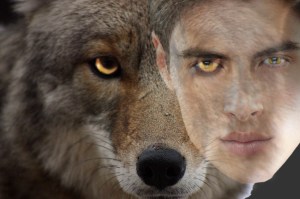
Many of you were kind enough to comment on three different versions of Chaco: my supernatural character who can appear either as a ridiculously beautiful young man, or as a coyote. (But not just any coyote; he is Coyotl the Trickster).

My publisher had asked for a somewhat lighter feel to the image because the tone of the book overall is light. Chaco is (usually) a cheerful guy.

The vote was overwhelmingly in favor of my original, Chaco #1, with 10 votes, #2 got three votes, and #3 got two votes. I also favor the original.

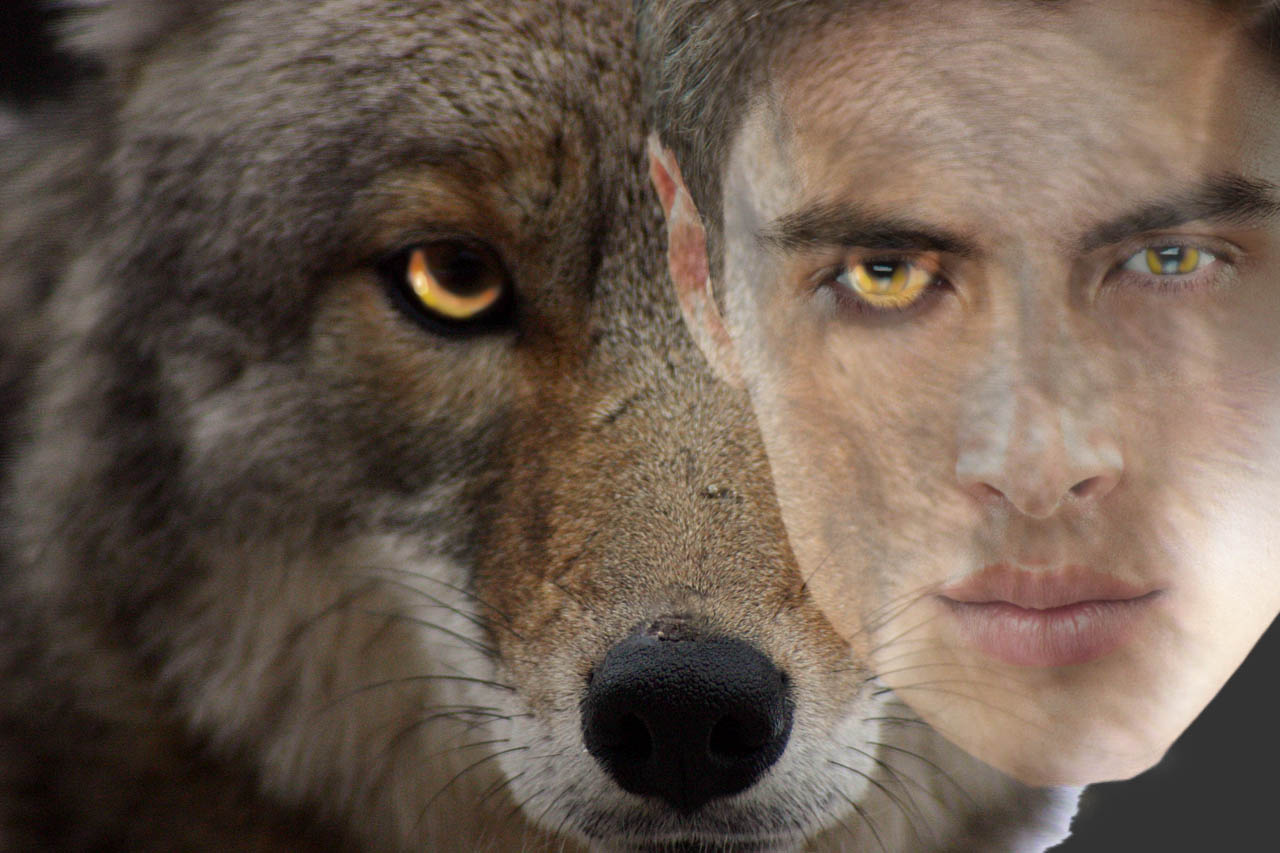
However, my friend Erica Chase asked, “Is there a happier looking coyote?” I thought this was nothing short of brilliant (typical of Erica). So I went looking for a coyote whose expression was less threatening and more upbeat. And then tried to match the coyote with an image of a young man that more or less matched (or was at least complementary to) the coyote’s expression. The image below is the result, and if you would be so obliging, I’d like to know if you think this is an improvement. Or not. (To see the three images I posted for comment, please go to https://obsidianmirrorblog.wordpress.com/2013/12/13/vote-for-your-favorite-coyote/)

New Coyote/Chaco

New Coyote/Chaco

Vote for Your Favorite Coyote!

I sent last week’s cover art to my publisher. One of his comments was: “…the book itself also felt a bit more light hearted than the dark cover with the serious boy (who was definitely not so serious in my mind, as I read anyway).”

The man (Chaco) changing into a coyote is central to my story. Chaco is Coyotl, the trickster folk hero of many Native American cultures. He can shift back and forth at will, and this comes in handy several times during the story. So I’d really like to use the image of the shape-shifting man-coyote. But my publisher is right: the tone of the book is on the lighter side.

I picked out a few more handsome latino men from iStock.com, where there is a plethora of such men on sale for very little money, and created two alternatives to my original. I present them here for your deliberation: which is the best Chaco: #1, #2, or #3?

I eagerly await your judgement!

Chaco #1

Chaco #1

Chaco #2

Chaco #2

Chaco #3

Chaco #3

Whack Me Twice and I’ll Listen

Smack Me

Despite my conviction that I had finished rewriting my novel, “The Obsidian Mirror,” I once again found myself in the throes of a rewrite.

Rewriting sucks. You know that if you’re a writer. It’s like taking apart a complex piece of machinery and putting it all back together so that it works better than it did before. You don’t want to go through all that labor, sigh happily at your achievement—then spy a couple of leftover parts on the floor that are absolutely required for the thing to operate.

But I suddenly became convinced that yes, indeed, I needed to revise the prologue and first two chapters. It came about because of a comment I received from a publisher. He said that the first chapter was full of a lot of unimportant stuff that didn’t push the plot forward, and it took too long to get to the intriguing fantasy elements.

To be honest, I had heard this before. An agent said the first chapter was “boring, boring, boring.” With a crit like that, you’d have thought I’d have jumped on it. However, the agent in question turned out not to be interested in fantasy. I questioned the judgment of someone who didn’t even care about my genre. Also, the manuscript had been read carefully by a published fantasy writer who did a fantastic job of reviewing the book and giving me feedback—and she was cool with the first chapter, so I figured what does the non-fantasy-reading agent know? I was wary of succumbing to self-doubt as well, because self-doubt will suck all the vitality out of your writing if you let it.

But a second critique that basically said the same thing convinced me that self-doubt was very far from being the issue here. A rereading of the prologue and first two chapters confirmed it.

There was nothing wrong with the prologue; it just needed to be tucked into the first chapter in a logical way. But the first chapter—oh, dear. It was all about how my heroine, Sierra, got fired. It contained a lot of backstory, which would be needed at some point, but I focused on her firing, talking about it to her friend Kaylee, going home, feeling bad, etc. In my naiveté, I thought this would introduce conflict and engage the reader. But I guess getting fired isn’t as interesting as I had assumed. In fact, I was personally bored with the whole thing.

So I condensed the prologue and chapters one and two into a single chapter. It’s a long one—about 4,000 words. I slashed about 3,000 words from the overall length of the novel, bringing it to nearly 100,000. I was worried about losing critical backstory, but I found various places in the early chapters to slip it all in. (Fingers crossed. Knock on wood and all that.)

I’m very happy with the result. It pulls the reader in quickly, keeps the action moving, introduces the fantasy elements immediately, and (I hope) piques the reader’s curiosity from the start.

I’d be humbly delighted if you would take a little time to read the new chapter one of my novel. If you agree with me that it works well, would you be kind enough to leave a comment? And if you don’t agree with me, I’d like to hear that, too.

I do listen. Most of the time. Really.