Recently I finished editing the first draft of “Fire in the Ocean,” the sequel to “The Obsidian Mirror.” I sent it off to my alpha readers and editor, and I can finally relax and think about something else for a while.
Such as promoting “The Obsidian Mirror.” While I was in the throes of writing the sequel, I did next to nothing about promoting my published work. A writer’s work is never done, I guess.
Why should you read “The Obsidian Mirror”? Short answer: because it’s a fun read. I read largely for entertainment. I like books that take you away and let you live someone else’s life for a while. I wrote “Obsidian” to be that kind of book: a diversion, a book I would love reading myself. It’s probably not a coincidence that the second publisher of the book is Diversion Books—they specialize in just that kind of novel.
Another reason to read “Obsidian” is because it is based on the mythologies and folklore of the Americas, which makes it a bit different. The idea occurred to me after finishing one of Robert Jordan’s “Wheel of Time” novels. I loved the book, but started wondering why so much fantasy is based on proto-European, pre-Industrial Age tropes such as elves, faeries, dragons, and caped adventurers. The Americas have thousands of mythologies, folk tales and traditions that are largely ignored by fantasy writers.
I began writing “The Obsidian Mirror” as a kind of personal experiment. Meso-American gods and Coyote the Trickster, an Inuit ice demon and a mannegishi named Fred are some of the characters. What I did not anticipate is that I would fall in love with my characters and be driven to finish the book. Having done that, I felt compelled to get it published.
I don’t have much to brag about. I’m not a best-selling author. I have won no prestigious awards for my fiction writing. But I do have one thing that gives me modest bragging rights.
I have heard authors talk about receiving hundreds of rejection slips. One writer said he had a drawer filled with 450 rejection slips for his novel. That didn’t happen with “The Obsidian Mirror.” I approached perhaps 10 publishers and/or agents before AEC Stellar agreed to publish the book. When AEC Stellar bit the dust, I approached about five publishers before Diversion Books picked it up, re-published it and agreed to publish the sequel.
So I may not have sold a million copies, but I never had any problem finding a publisher. As a matter of fact, years after I originally submitted the manuscript to their slush pile, Baen Books got back to me and said they were interested in it. The early bird gets the book, Baen.
So why am I proud of this? Because I have some independent assessments that people will enjoy reading my novel. Add to that, the several four- and five-star reviews on Amazon, and you might conclude that you would enjoy it, too. To make it super-easy for you to find the book, here it is: http://amzn.to/1MQBvkd
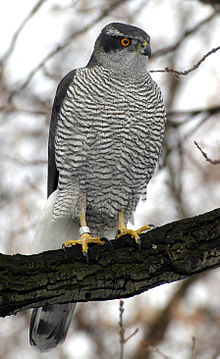
This is what White meant by a “mad, marigold eye.”
Most of the books I read are fiction. I’m a writer, I love stories—it’s natural. And while I have read much of the world’s greatest English literature (I always score well on that annual list the BBC publishes of the 100 best books in the English language), the vast majority of what I read is brain candy. Fluff. Genre books.
Mind you, I am in no way putting these books down. I read them. I pay good money for them. I like them. I write them.
But once in a while, I pick up something that breaks this pattern. Last week, I re-read “Tess of the d’Urbervilles” by Thomas Hardy, and found it lyrical, funny, and tragic all at once. (In marked contrast to my experience of reading it in high school Honors English class.) This week, I finished reading a book loaned to me by my oldest friend, “H is for Hawk” by Helen Macdonald. There was no question this was going to be an excellent book, as it is a New York Times bestseller and winner of the prestigious Samuel Johnson Prize.
However, the book was, on the surface, about training a goshawk. I probably wouldn’t have read it if my friend hadn’t said, “There’s a lot in there about T.H. White, and I know how much you like him.”
Macdonald describes T.H. White as “an unpopular author,” which shocked me, but I suppose she is right; I just have difficulty accepting that an author whose writing is so beautiful could have fallen from favor. White is the author of two of my favorite works, “The Once and Future King,” (actually five books), an epic fantasy about King Arthur, and “Mistress Masham’s Respose,” one of my childhood favorites about a lonely little girl who stumbles upon a lost colony of Lilliputians (literal Lilliputians, brought to England by Gulliver).
White’s writing is so incandescently lovely that it makes me weep. His descriptions of the English rural countryside are so evocative that as a child, I felt I knew that landscape intimately, though I had never been within five thousand miles of the place. And I remembered one powerful scene in “The Sword in the Stone” (the first of the books of “The Once and Future King), in which the young Arthur is changed by Merlin into a small hunting hawk and placed in the mews of Sir Ector’s castle. Arthur is subjected to an ordeal by the other hawks; he must stand within striking distance of Colonel Cully, a mad old goshawk, until the hawk bells are rung three times by the other birds. If he survives, he is admitted into their company. That scene is only one of many White crafted to show how Merlin educated Arthur into kingship, but it stuck with me, particularly the description of Cully’s “mad, marigold eye.”
Macdonald had read “The Goshawk,” as well as much of White’s other work, and knew more about him as a person than I did. She was obsessed with hawks and hawking from an early age, read medieval books on hawking, hung out with austringers (people who train hawks), flew them herself. She had always been intrigued by the idea of training a goshawk—maybe because White had attempted to do this himself as a young man, and failed, ultimately losing his hawk to the wild.
Different people respond to grief in different ways. When Macdonald’s beloved father died, she decided that she would acquire and train a young goshawk. Perhaps White’s account of his epic battle with his goshawk was at the bottom of it; she needed a battle to take her mind off sorrow.
Macdonald interweaves her story of acquiring and training Mabel, her goshawk, with accounts from White’s life and work. Her writing is nearly as luminous as White’s, evoking the landscape, the life of the young hawk, the tragedy of White’s life tied up with the tragedy of her father’s death.
All I can say is that the reader descends into madness with the writer and emerges with her, not unscathed. Macdonald emerges with the scars of Mabel’s talons in her flesh, but the wounds of her father’s death healed.
However, I was left with more knowledge—and less—than I wanted about T.H. White. I know that some people want to know everything there is to know about favorite authors. Not me. I much prefer to listen to the author’s voice through his or her work, and accept that as the reality the author meant for me to experience. I fell in love with many an author, only to find on reading a biography that the adored one had feet of clay and was only a weak human being after all. Like the rest of us.
For example, my mother, sister and I loved Gerald Durrell, the British author of “My Family and Other Animals” and other books detailing his love for animals and adventures as an animal collector for zoos, and later, for his own zoo on the island of Jersey. He was a funny and evocative writer and once wrote me a personal note when I sent him a letter at age 10 asking about how he became a naturalist. I was delighted to find his biography some years after his death. But when I read it, I discovered that he (like most of his talented family) was a hopeless alcoholic with a violent temper who died of liver disease. I was happier with the sunny, charming animal lover of Durrell’s books.
I had always seen White as sort of a God-like figure, someone full of age and wisdom and kindness who saw the foibles of mankind with a clear and compassionate eye. He may have been so, but he was also an alcoholic who despised himself for his homosexuality and sadism. He grew up in a family so deranged that when his mother lavished affection on her pet dogs, his father had them shot. He thought his father would shoot him some day, and his mother was cold and remote. Then, of course, they sent him to an English boarding school, where the milk of human kindness was not only spared, but completely missing.
White became a schoolmaster at another prestigious public school, but it is notable that although his sexual fantasies focused on beating adolescent boys, he never did so. He eventually fled to a cottage in the woods and decided to raise a young goshawk in the medieval manner, opening a pitched battle between man and bird. This experience informed much of his later writings, but “The Goshawk” wasn’t published until much later, because White knew how badly he had failed in training his hawk.
I am considering whether or not to read an autobiography of White. I’m not disappointed in him, more sorry that he endured so much pain. I think it’s incredibly brave that he tried so hard not to inflict pain because he knew he enjoyed doing so. I will definitely seek out and read more of White’s work. Human nature may be sad and disappointing at times, but I have never been disappointed in the writing of Terrance Hanbury White.
Oh, and I’ll also read anything else Helen Macdonald decides to write.
It’s been a while since I have shared what I am working on. I blogged extensively about my research visit to Hawai‘i in January of 2015, but I’ve been on radio silence about work ever since.
Part of that is because if I say too much about the story, why would you want to read it when it is published? Another issue is providing detail about a story that might very well change so drastically in the writing process that it becomes unrecognizable.
I did mention that it has been much easier writing with a plot outline than without one. And that was certainly true until I wrote up to the intended climax of the story—and discovered that it wasn’t actually the climax after all and I needed to extend the story (for which no plot outline yet existed).
Part of the problem was that I hit the putative climax at about 65,000 words into the story. That means that I would have wrapped it up in about 75,000 words, which is a bit light for a novel like this. “The Obsidian Mirror” was about 100,000 words, and I am aiming for a similar length for this novel.
So I hit a rough patch as I floundered around trying to figure out what comes next in the story. I hesitate to call it “writer’s block” because I wasn’t blocked. I knew where the story was going, I was just missing a piece. Sort of like Indiana Jones crawling across a rope bridge across a steep chasm and there’s ten or fifteen planks missing in the middle. And crocodiles (my publishing contract and deadline) waiting below.
And then there was getting sick. Then the holidays. El Niño came for a visit last week and flooded the basement, soaking our family photos, my oil paintings, family historiana, and a lot of other stuff. I spent this past week gently prying apart photographs and arranging them on every available surface to dry, turning them over, grouping them, and tossing the ruined ones away. I did no writing at all.
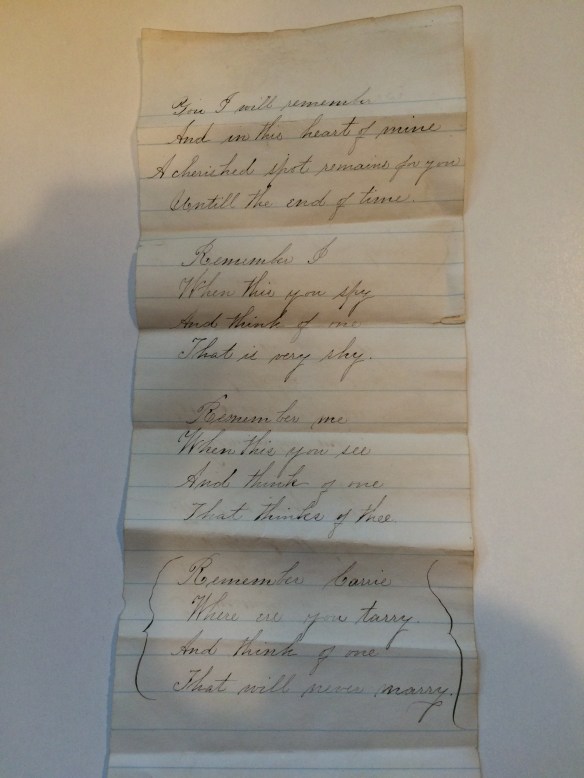
Among the things I found was a packet of letters, all dated around 1879. They were written by someone named Carrie to her cousin, William Smith of Roxbury, NY. (Mr. Smith was one of my ancestors, which is how I came by the letters, but I haven’t looked him up to determine exactly what the relationship is.) They were written in a delicate copperplate hand, very legible, the India ink still clear and sharp despite their age and the complete saturation of the paper.
I reluctantly decided I would have to throw them out. There were so many of them, and my priority was rescuing my thousands of family photos before they stuck irretrievably together. I read a few of the letters and they were fairly mundane, though written with clear affection for the recipient. I felt guilty. They had been kept perfectly for 110 years, and I was the one who trashed them.
However, I found a poignant little poem in Carrie’s spidery copperplate. Here it is:
You I will remember
And in this heart of mine
A cherished spot remains for you
Untill (sic) the end of time.
Remember I
When this you spy
And think of me that is very shy.
Remember me
When this you see
And think of me that thinks of thee.
Remember Carrie
Where ‘ere you tarry.
And think of me
That will never marry.
The last stanza was enclosed in brackets. What do you think? I don’t mean Carrie’s gifts as a poet, which are slight, but the heart of it. I think Carrie was in love with William. I have at least saved her poem, which must have cost this shy woman a great deal to share with her adored cousin.
That much of Carrie I am keeping, safe for now.
Carrie’s Poem
Getting back to my current book, I am firm on the title of “Fire in the Ocean.” It is set in Hawai‘i, which was built—and is still being built—by fire in the ocean: volcanoes. It also touches on the Great Pacific Garbage Patch, where billions of tons of particulate plastic are swirling around out there like peas and carrots in alphabet soup. Hawai‘i is smack dab in the middle of it. The slow dissolution of chemicals from the plastics is another form of “fire in the ocean,” poisoning sea life. And, of course, Pele, the goddess of volcanic fire, is a featured character in the book. Those of you who followed my blog from Hawai‘i know why I couldn’t leave Pele out of the story.
I am back on the job writing. El Niño is paying another visit, but we have pumps going and sandbags. All my rescued photos are safe and dry now and my oil paintings are drying out in the bathtub. Good time to write!
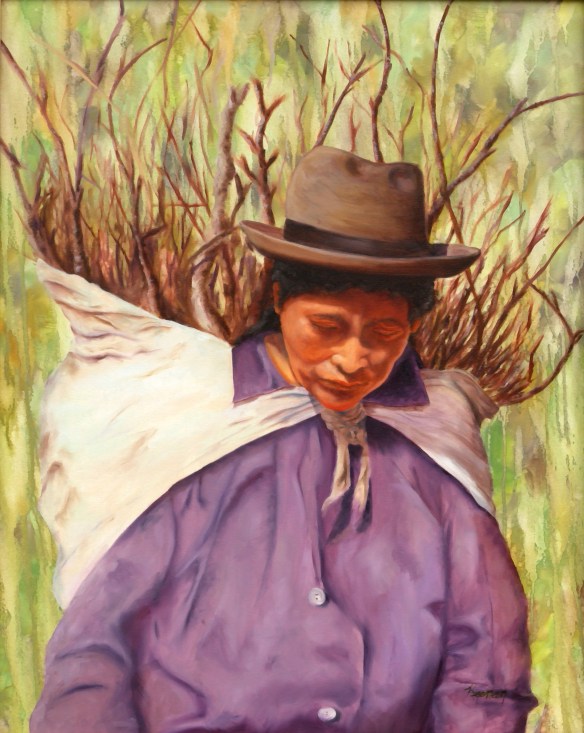
“The Burden” This is one of my oil paintings, now residing in my bathtub. It won a first prize somewhere obscure.
A disturbing number of my favorite authors have died recently, and it’s bugging me. I’m talking about the kind of writer whose prose delights you, for whatever reason. Maybe reading a certain author’s work feels like sinking into a warm bath, comforting and deep. Or thrills you with action. Or galvanizes you into action. Or makes you feel as though you are traveling through faerie realms. You own all of their books and re-read them from time to time, just for the pleasure of the visit.
I decided to share some of my favorite deceased writers with you. If our tastes are similar, maybe you’ll like them, too. A caveat: Not all of these authors are great prose artists. But they all have a special, um, je ne sais quois.
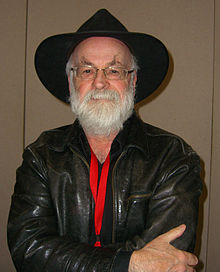
Terry Pratchett
Sir Terry Pratchett. If you’ve been reading this blog, you already know I’m in sackcloth and ashes over Pratchett’s untimely demise from Alzheimer’s earlier this year. If not, or if you’re a glutton for punishment, you can read my tribute to Sir Terry or my review of his last Discworld book, The Shepherd’s Crown.
L.A. Meyer. Louis Meyer authored the young adult “Bloody Jack” series. I have actually never “read” one of these, but I own all of them as audiobooks. This is because the narrator for all of them, Katherine Kellgren, is absolutely brilliant. She perfectly captures the heroine’s Cockney cockiness, her bounce, optimism, kindness, and impulsiveness. Bloody
L.A. Meyer Photo Credit: Bangor Daily News
Jack starts life in the late 18th century as Mary Jacqueline Faber, daughter of a respectable couple fallen on hard times. Her parents die and she is coldly ejected into the streets of London at age 8. She falls in with a gang of street children, and after observing that life in the streets was a short-term proposition for most kids, she disguises herself as a boy and signs on as a cabin boy with a naval ship. Her ensuing adventures are grand and hilarious to boot. Kellgren does an amazing range of male and female voices and accents. The only one she just can’t do is Scots. Fortunately, there’s only one significant Scottish character, and he’s only in the first few books.
Meyer created a memorable, lovable, and downright addictive character in Jacky Faber. The other major characters are also well delineated and engaging. He manages to sneak in a good bit of history in the process of entertaining us.
L.A. Meyer died in 2014 from Hodgkin’s lymphoma. But he finished his series before he set sail into the great beyond. I’m listening to the final book now with a mixture of enjoyment and sadness that this is the last I’ll see of Bloody Jack.
The Bloody Jack series in chronological order:
Bloody Jack: Being an Account of the Curious Adventures of Mary “Jacky” Faber, Ship’s Boy (2002)
The Curse of the Blue Tattoo: Being an Account of the Misadventures of Jacky Faber, Midshipman and Fine Lady (2004)
Under the Jolly Roger: Being an Account of the Further Nautical Adventures of Jacky Faber (2005)
In the Belly of the Bloodhound: Being an Account of a Particularly Peculiar Adventure in the Life of Jacky Faber (2006)
Mississippi Jack: Being an Account of the Further Waterborne Adventures of Jacky Faber, Midshipman, Fine Lady, and the Lily of the West (2007)
My Bonny Light Horseman: Being an Account of the Further Adventures of Jacky Faber, in Love and War (2008)
Rapture of the Deep: Being an Account of the Further Adventures of Jacky Faber, Soldier, Sailor, Mermaid, Spy (2009)
The Wake of the Lorelei Lee: Being an Account of the Adventures of Jacky Faber, on her Way to Botany Bay (2010)
The Mark of the Golden Dragon: Being an Account of the Further Adventures of Jacky Faber, Jewel of the East, Vexation of the West, and Pearl of the South China Sea (2011)
Viva Jacquelina! Being an Account of the Further Adventures of Jacky Faber Over the Hills and Far Away (2012)
Boston Jacky: Being an Account of the Further Adventures of Jacky Faber, Taking Care of Business (2013)
Wild Rover No More: Being the Last Recorded Account of the Life and Times of Jacky Faber (2014)
Source: Wikipedia
Elizabeth Peters
Elizabeth Peters. Elizabeth Peters’ real name was Barbara Mertz. She wrote mysteries under the name Elizabeth Peters and supernatural/gothics under the name Barbara Michaels. She was an Egyptologist by education and wrote books about the everyday life of ancient Egyptians under her own name. She died in 2013.
As Elizabeth Peters, she had several series, but my absolute favorite is the Amelia Peabody series. Amelia Peabody is a wealthy English spinster of Victorian times who decides to travel. Intrigued as many Victorians were with the mysteries of ancient Egypt, she winds up in Cairo, encounters a nasty, rude male archeologist and a few murders. She winds up saving the day with British aplomb, a stiff upper lip, and a sharp umbrella. Amelia tells her own stories, and her prose is delightful to anyone who has read much Victorian literature. Here are some selections of Amelia’s wisdom:
“Men always have some high-sounding excuse for indulging themselves.”
“Abstinence, as I have often observed, has a deleterious effect on disposition.”
“Godly persons are more vulnerable than most to the machinations of the ungodly.”
“I do not scruple to employ mendacity and a fictitious appearance of female incompetence when the occasion demands it.”
Amelia waxes positively purple over her husband, Emerson, and there are references to his “sapphirine eyes” and “manly physique” that are clearly intended for us to giggle over.
The characters in this series age and change over time. The stories are informed by the geopolitical realities of each era, as Amelia moves from Britain’s Age of Empire to the wars and disruptions of the early 20th century. Here are the Amelia Peabody books in chronological order:
The author knew an enormous amount about ancient Egypt and the history of Egyptology, and this background made the books fascinating on yet another level beyond the delights of the characters and the murder mystery plots.
In all honesty, not every book in the series is brilliant, but I never cared. Spending time with Amelia was worth a little disappointment once in a while.
Mary Stewart Photo Credit: Australian Consolidated Press
Mary Stewart. To tell you the truth, I only just looked her up to see if she were still among us—and she is not. She died in 2014 at the age of 97. Born Mary Florence Elinor Rainbow (Yes! Really!), she authored a number of thrillers with romantic subplots that made them perhaps more appealing to women than to men. Her POV character was always female. My mother and I started reading these in the 1960s and thoroughly enjoyed them. I have never liked romances, but the intelligence and eruditeness of Stewart’s writing engaged me. A few from this era that I particularly enjoyed are “Madam, Will You Talk?,” “The Moonspinners,” “This Rough Magic,” and “The Ivy Tree.”
Then she jumped genres in 1973 with the publication of the “The Crystal Cave,” the first book of what became her “Merlin Trilogy,” beautifully written and researched historical fantasies. “The Crystal Cave” was followed by “The Hollow Hills” and “The Last Enchantment.” Having always been an Arthurian enthusiast, I devoured them. Related books include “The Wicked Day” and “The Prince and the Pilgrim.” The trilogy made her an internationally famous best-selling author and she won many awards and honors for it.
So then, as far as I can tell, she went on to write little romances about rose-covered cottages in the forest and whatnot. I have read these but don’t recommend them.
Bryce Courtnay
Bryce Courtnay. Bryce Courtnay was a South African advertising executive who emigrated to Australia and decided to write a book. “The Power of One,” was published in 1989, and Courtnay quickly became one of Australia’s best-selling authors. He died in 2012 of gastric cancer.
Courtnay primarily wrote historical fiction, mostly set in Australia, New Zealand and South Africa, though his last novel, “Jack of Diamonds,” was set in the U.S. and Canada. He seems to catch the feel and taste of each era and locale he writes about. His stories can contain pretty dark material, but somehow you feel that it comes right in the end—mostly, anyway. His characters feel like real people, even the most bizarre ones. In “Brother Fish,” he has a German immigrant housewife living on a New Jersey farm during WWII who poisons her lumpish husband and takes a young lover—and you completely sympathize.
Among Courtnay’s best is his “Potato Factory” trilogy, in which he follows the fictionalized family of the real-life model for Dickens’ Fagin, Ikey Solomon. “The Potato Factory” takes place in Victorian times as Ikey and his horrible bawd of a wife are deported to the prison colony of Australia. “Tommo & Hawk” follows the lives of Ikey’s adopted sons. “Solomon’s Song” takes the family into the WWI generation. Each book is dense, rich, complex and a treat to the senses as Courtney makes his stories come alive. There is something for everyone: action, tragedy, revenge, mystery, murder, love, beauty, friendship and horror.
Well, that’s it for dead authors—for now, anyway. I just wanted to say a thank you to these writers for taking me to places I have never been to meet people only they have imagined. They have given me so much enjoyment over the years, and perhaps as long as people read their work, they will never truly die.
When I first started this blog, the subtitle was “A Blog about Writing a Novel.” I thought of it as a journal documenting the process of writing my first novel and trying to get it published. Of course, at the time, I had no idea whether I would get it published (or even finished).
Well, “The Obsidian Mirror” was finished and published, and now will be republished by Diversion Books. (They are giving it a new cover as well, which should be interesting. I can’t wait.) I have a contract for the sequel from Diversion, and I have written about 20% of the first draft.
So it’s no longer a blog about writing a novel. It’s about the journey I am on as an author. I have changed the subtitle to “The Journey to Authorship.”
Now, that sounds like I will be forever journeying toward a goal, but never reaching it. That would be exactly right.
I learned a huge amount about writing a novel when I wrote “The Obsidian Mirror.” I revised it eight times. I had many people read it and comment on it, including the wonderful Gail Z. Martin, who has authored numerous fantasy novels herself.
Now I am trying to put those lessons to good use in the sequel. I am also trying out new things. For example, the antagonist in “Fire in the Ocean” (working title) is not an evil god. He’s not even evil. As a reader, I am much more interested in complex characters than cardboard cutouts, but as a writer, it’s really easy to fall into the mistake of making evil characters 100% evil, twiddling their mustachios and laughing, “BWAHAHAHAH!” (Okay, maybe not that bad, but you get the idea.) So I am trying to create a more complex character, one who is human, with human strengths and weaknesses, whose actions are not motivated by pure nastiness.
I have to admit, this is a bit scary for me, and I am proceeding with this character in baby steps. But, as in “The Obsidian Mirror,” I am still trying to understand why perfectly normal people do massively destructive things to the environment—even though they have to live the consequences along with the rest of us.
Another challenge is the setting in Hawai’i. “The Obsidian Mirror” was set in Silicon Valley, where I lived and worked for more than 30 years, so I knew it very well. I have visited Hawai’i many times and love it, but I am not as intimately familiar with it as I am with Silicon Valley. I spent eight days on Moloka’i, where much of the novel takes place, but eight days doesn’t make me an expert. Fortunately, I made some friends in Moloka’i while I was there, and I am hoping they will help to correct any inaccuracies or general idiocies I may commit.
So I am still learning and stretching my authorial wings. I am on a journey I suspect I will never complete, because I hope always to be learning more about my craft and growing as a writer. If I stop doing that, I will stop writing.
I have signed with a new publisher! Diversion Books has agreed to re-publish “The Obsidian Mirror” AND the sequel, which I am now writing. I simply could not be more pleased. I emailed the manuscript and cover art to them today.
Diversion Books is located in New York City (and on Park Avenue at that. Isn’t that cool? C’mon. It’s cool.). They started as a division of Scott Waxman Literary Agency, but are now an independent company. Diversion publishes a wide range of fiction and non-fiction titles. In my genre, you might recognize authors Henry Kuttner, Ursula K. LeGuin and M.K. Wren.
I am thrilled to be in such august company, and really looking forward to working with this very professional outfit. I am also–needless to say–delighted that “The Obsidian Mirror” will see the light of day again, and that the sequel has a home as well.
I’ll be keeping you posted about the sequel. The one thing I learned from writing “The Obsidian Mirror” is to always start with a plot outline. (In all fairness to myself, I didn’t think at the time that I was actually going to write a novel.) I finished the plot outline for “Fire in the Ocean” (working title; it may change) two weeks ago and started writing it last week. So far, I’m more than 7,000 words and four and a half chapters into it. I like having a plot outline!
I’ll try asking you another question. Do you like the working title of the sequel? Not? I really am looking for feedback.
Tom really is a hero. He agreed to drive the steep, winding, one-lane road back to Halawa Valley so that we could visit the beach there and maybe hike to the waterfalls. He surprised me–and this is after 43 years of marriage.
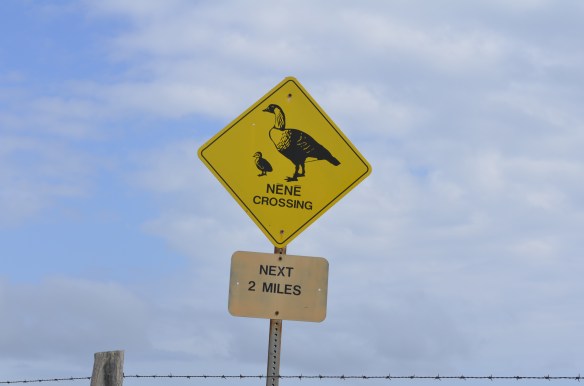
The drive was spectacular, and we stopped to take photos of things we remembered, but hadn’t stopped for the first time because of unfamiliarity with the road. For instance, there’s this sign:
Nene crossing sign.
Nene (pronounced nay-nay) are the native Hawaiian geese, and they are endangered. Sadly, we didn’t see any geese, just the sign. We also saw this, which we think is a roadside memorial, but it’s a bit different than the usual. In addition to the sun made of white coral, there were offerings:
Roadside memorial.
There was no one waiting at the bottom of the road this time. We parked and walked down the dirt road to the beach. There is a river flowing into the sea here, and it’s picturesque:
River at Halawa Valley.
Beach at Halawa Valley.
We picked our way along the beach, and I saw what I expected; lots of small pieces of plastic in the sand, white and blue, black and gray, yellow and red–the detritus of the Great Pacific Garbage Patch, collecting on this remote beach. I began picking up the larger pieces and putting them in my pocket. by the time we left, both pockets were bulging, and my arms were full of still larger chunks, bottles, and a small section of plastic fence. Tom gently makes fun of my plastic policing, but I regard it as the little that I can do to make it better. Worth nothing in the face of the magnitude of the problem, I agree. And many of the pieces were so small as to be impossible to retrieve, reminding me of “Rumplestiltskin,” where the poor girl has to count all the grains of sand or spin straw into gold.
Some of my plastic finds. Pockets are bulging with smaller bits.
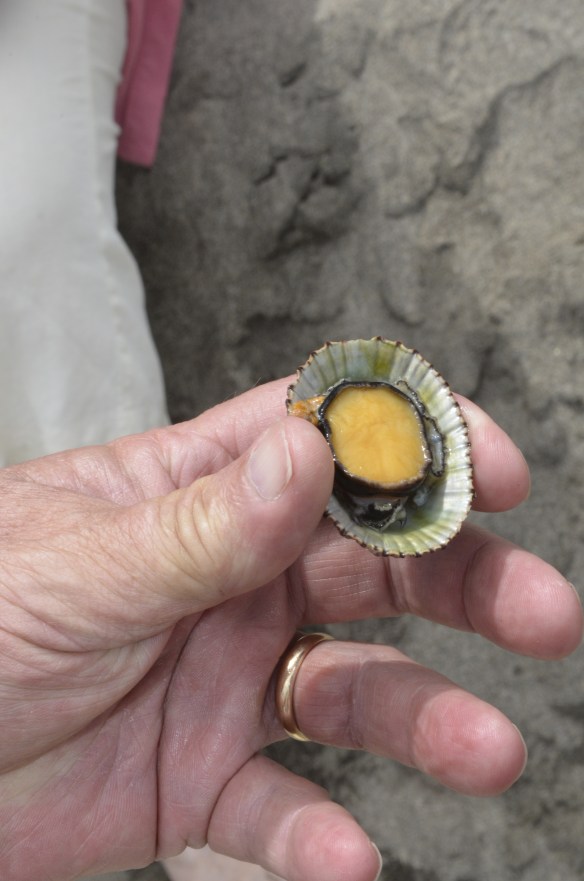
A Hawaiian family was picnicking on the beach. A young woman named Noni (noh-nee, means “beautiful”) was sitting on the sand, while her sister, husband and nephew were on the rocky point under the cliffs, fishing. We chatted for a while, and then her husband came back with a net bag full of ‘opihi (oh-pee-hee, limpets). We asked what they were going to do with them, and he said they were best barbecued, but could be eaten right out of the shell. Did we want to try one?
Yes, we did. He had lost his knife while prying ‘opihi off the rocks, but he used one limpet shell to dislodge the resident of another shell, and offered us some. They were rubbery, and the primary taste was a mild saltiness, but I’m sure they are delicious barbecued. This inside of the shell had a lovely iridescence, tinged with green. I washed mine out and brought it home with me.
Snack time!
We asked about the hike to the falls. Noni said it was really difficult, and she hadn’t done it in 20 years, so we decided to give it a miss. (Later, I learned that it takes two hours just to get there. I probably made the right decision.) After dumping my collected plastic in the trash bins provided, we got into our car and drove slowly back, taking pictures as we went.
Rainforest stream.
Once we were back in two-lane country again, we stopped to take a picture of this:
Chicken condos.
I called it “chicken condos,” as they appear to be individual shelters for chickens or roosters. As I was taking the picture, a pack of dogs ran up to the fence and barked their heads off. A very large Hawaiian came down the drive, looking rather menacing. I waved and said I was just taking a picture of his chickens. He didn’t smile, but waved more or less amicably and went back down the drive. My guess is that he’s raising fighting cocks, which is abhorrent, but I don’t know.
The only real proof we saw that there are deer on Moloka’i.
We also stopped at a grove of coconut palms, right outside of Kaunakakai. This used to be a much larger grove called “the Queen’s Grove,” because it was planted for the wife of King Kamehameha V. It’s right by the beach, and the trees must be 100 feet tall, each with a cluster of coconuts clinging to the top under its fronds. There are piles of coconuts on the ground, both fresh, green ones and old, hairy ones. The top of my head began to feel peculiarly vulnerable as I imagined what a coconut would do to it after a drop of 100 feet, so I left.
The Queen’s Grove.
Then back to the condo. I was very behind in my journaling, so spent most of the late afternoon writing, listening to the waves crashing on the rocks nearby, and enjoying the trade winds. When we went to bed, another three-inch centipede was occupying the hallway upstairs, and I gave him the same treatment I gave Jesse the Centipede a few nights ago–a beating with my flip-flop. Neither centipede put up a fight, making me think they were unwell to begin with.
And so the journey came to an end, as all journeys must do–which is the beginning of another journey for me; writing a new novel. The entire experience was amazing. People were so helpful and kind, so willing to bring me into their lives a little bit. It was extremely touching, and I will never forget the experiences I had here. As a parting wave, here are the signs that greet new arrivals to Moloka’i, and bid departing travellers farewell:
This was our snorkeling day, so we set our alarm. We had to be at the Kaunakakai Wharf by 6:45. We ate a quick breakfast and set out in the dark. We could see the bright lights at the tiny Molokai airport as well as the wharf as we came down the rise from the west end of the island; Molokai is only 38 miles long from the west end to the east.
I thought Tom should leave his camera in the car. It is large (especially the lenses) and heavy, and I was afraid it might get damaged or get water in it. So no pictures, but I’ll post a few photos of the kinds of fish we saw, even if they aren’t the actual fish we met.
We drove straight out onto the wharf and parked near our boat, the Coral Queen. A young Hawaiian man told us nicely not to park there or we would get a ticket. This turned out to be Gabe, the boat’s one crewman. He would take the divers down while the captain kept an eye on the snorkelers.
This was a surprise. Diving implied deep water, so I asked about it. The captain (whose name I failed to remember) said they had more than 40 different places to take people, depending on whether they had a mixed group (snorkelers and divers), or just one or the other, and of course depending on tides, currents and weather.
There were about a dozen of us. They waited a while for some latecomers who never showed, then set out along the eastern shore in the dawn light. On our way out, they pointed out a handsome white yacht moored offshore and said it was Larry Ellison’s.
The Molokaiians are very hopeful about Mr. Ellison, the fifth wealthiest man in the world, and the founder and former CEO of Oracle Corporation. As you may know, he bought the entire island of Lanai a little while ago (98% of it, anyway). The people of Lanai have been very happy with the changes he has brought to that island, and the Molokaiians are hopeful that he will buy up the now-idle holdings of the Molokai Ranch. This would certainly make a huge difference; it remains to be seen if it’s a difference the people of Molokai will like. They have a slogan here: “Don’t change Molokai, let Molokai change you.”
It was calm, quite unlike the first few days we were here. It was interesting to try to locate landmarks on shore that we had earlier seen from the road, but we never got as far as Leimana’s fishpond.
Someone asked about sharks. Gabe said they tended to see black-tipped reef sharks, white-tipped reef sharks, hammerheads, scalloped hammerheads, and tiger sharks.
Tiger shark. I mean, come on. Is this something you want to go swimming with?
I said, “I don’t mind black tips, and I have swum with them, but the others…tell me that there won’t be any sharks out there today.”
Gabe struggled with his conscience for a moment, then looked straight at me and said, “There won’t be any sharks out here today.”
Bless the boy. I am sure I would have to change my bathing suit if I saw a hammerhead. Or any other shark, for that matter.
We saw humpback whales as we chugged along. They never came very close, but we did see them spouting and breaching a little ways off.
This is a picture of a humpback whale Tom took when we went whale watching in Monterey Bay.
Eventually, we anchored (using a special anchor to avoid damaging the coral) and the captain pointed out the area the divers would explore, and further toward shore, the snorkelers’ area. As we were preparing to go in, a manta ray swam slowly next to the boat–the first I have ever seen.
As I flapped my way to the stern in my fins, a woman in a shortie wetsuit said with surprise, “No wetsuit?” I was surprised by the question. This was Hawaii, right? Who needs a wetsuit? They had them aboard the Coral Queen, but it hadn’t occurred to me to don one. I penguined onto the platform that had been lowered from the stern and fell backward into the water. It felt fine, neither warm nor especially cool. Tom joined me and we headed out.
Molokai is surrounded by a fringe reef that extends outward from the island a long way. You could walk out a mile in some places and still be in water up to your knees. We were probably a mile and a half from shore, in water that was about 12 feet deep. There were lots of fish to gawk at–schools of goatfish and convict tangs, triggerfish, butterflyfish of several varieties, birdand rainbow wrasses, pink and silver juvenile parrotfish, mature rainbow parrotfish (a blaze of different colors), and one humu-humu-nuku-nuku-a’pu’a’a. I am never quite content snorkeling until I see this dapper little fish with his colorful suit and enormously long name.
School of convict tangs. This really looks like what we saw.
Humu-humu-nuku-nuku-apu’a’a.
Longnose butterflyfish.
To my surprise, my hands began to get numb and they turned white (whiter than they usually are, that is). That had never happened before while snorkeling. I didn’t think we had been out more than a half an hour, but I told Tom I wanted to go in. He agreed and we headed back to the boat–to find that we had been out an hour and fifteen minutes, and it was time to go anyway.
It appeared that we were going to go to another spot to explore. I felt quite chilled and decided not to get back in.
I struck up a conversation with Gabe. Tom had discovered that Gabe was a third cousin to Leimana, so I mentioned this and said we had enjoyed our time with Leimana at the fishpond.
“Yeah, he’s really something, isn’t he, with his thing…” Gabe indicated the swimsuit zone.
“Malo,” I said helpfully.
“…malo, and you can see his whole butt hanging out,” said Gabe.
“Well, to give credit where credit is due,” I said, “It’s a nice butt.”
Gabe looked profoundly shocked. I guess he thought pudgy old ladies were past appreciating these things, or perhaps he had never viewed his third cousin in that light.
I went forward to sit in the sun and get warm. This felt great, and my hands got warm again. However, after a bit, I felt my Irish skin had had as much solar exposure as was wise, and went back under cover. While I was sunning, though, I saw a huge turtle swim by under the deep turquoise water. He swam slowly, balletically, and I watched him until he disappeared into the depths.
While we were waiting for the others, we chatted with the captain. He had been a “bean-counter,” his words, in Minnesota. He used to come to Hawaii on vacation, and finally realized he didn’t have to live in Minnesota.
“Why Molokai?” we asked.
“It was the last island I visited,” he said.
He bought Molokai Fish and Dive, then bought the gas station next door. (Giving us the opportunity to buy gasoline at a filling station called Fish and Dive.) We commented on the high prices in the islands. Gas in our area is now close to $2 a gallon, but in Hawaii, it is more than $4. He told us that their prices were dependent on the last tanker, and they didn’t change until the next one arrived. I noticed that Fish & Dive gas prices were identical to the one other station on Molokai, a Chevron.
The divers and snorkelers came back raving about the wonders they had seen–turtles, mantas, even a sleeping white-tipped reef shark. Someone said that the water seemed warmer at this spot, and the captain said, “Yes, it is. There are freshwater springs back at the other place that make it colder.”
I said, “It would’ve been nice of you to have mentioned that an hour ago.”
But I think staying out of the water at the second location was the right decision. After we came back, Tom and I were exhausted. We had lunch at the Kualapu’u Cookhouse, and I could hardly keep my eyes open. I had fried saimin with vegetables, which proved to also have Spam and fake crab in it. Spam, in case you aren’t aware, is a favorite here in the islands. If you are eating in an establishment frequented by locals, you will find it on the menu.
I fell asleep on the ride home, and as soon as we rinsed ourselves and our equipment, we both fell into bed and slept the sleep of the truly depleted. We awoke in the early evening, forced ourselves to cook dinner (we had purchased grass-fed beef from the Molokai Meat Cooperative), ate it, and went gratefully to bed without doing the dishes.
We were supposed to meet Auntie Opu’ulani today at 9 am, so we set our alarm. This turned out to be unnecessary, but as we were getting ready to go, We got a call on the condo phone from Auntie saying she had to babysit her grandchildren that day. (I still don’t know how she figured out the number–remember my iPhone was sacrificed to the sea gods.) She’s pretty jammed for the rest of the time she will be here because of the upcoming Makahiki Festival.
Makahiki is the ancient Hawaiian new year festival. It used to be four months long. It was a time when many of the repressive kapu were lifted, and there were athletic competitions, hula, games, feasts, and fun. Today it is a week long, and a celebration of Hawaiian culture. I am kicking myself that we are leaving just as Makahiki begins, but I probably wouldn’t have been able to do what I needed to do here because everyone would have been too busy.
So I offered to treat her to dinner, and we agreed to meet at Paddler’s Inn at 7 pm. That left the day wide open, so we decided to explore. First, we drove to Purdy’s Macadamia Farm, the only mac grower on Molokai. This consists of 50 trees that were planted 90 years ago on five acres. The entrance to the farm has this sign, homemade and similar to other signs you see on the island:
Asking the tourists to go with the flow on Moloka’i.
As we walked down the road, we were greeted by a small, skinny black cat. I miss my kitty, so I stopped to pet it. It turned out there were several other small cats, employed on the farm to kill rats, who eat the nuts.
We arrived in the middle of a tour. There was a wooden trough set up with whole mac nuts. There were holders made out out of old rubber tires and hammers to crack the nuts on pieces of stone in the trough. This is, of course, not how they are commercially processed. Mac nuts have a thick outer husk. The guy in charge of the tour bit into a husk and removed it to demonstrate. Then they have a very hard inner shell. If you whang them with a hammer, you can get at the nut meat inside. This was being directed by a short, fit Hawaiian with an attitude. He was the first Molokaiian we have met who was not pleasant, and the feeling we both got from him was open disdain.
Mac nut cracking station.
After the nutcracking exercise, we tasted roasted and salted nuts (all natural, no other chemicals like the preservatives in canned or packaged nuts. Nothing added but sea salt, according to our surly host.), then got to taste raw coconut dipped in macadamia flower honey, which is not made on the farm. That was delicious and different. As this was going on, I noticed a dark, raffish-looking fellow with gold chains who was looking on, extracting raw coconut from a shell and throwing pieces for the cats to eat. The cats all scrambled for this coconut as though it were Li’l Friskies.
The grove of nut trees was immaculate. They don’t pick the nuts; when the nuts are ripe, they fall to the ground and they are harvested daily. The ground was absolutely bare between the trees except for a few piles of leaves that had been collected. Like coffee, mac trees have flowers and nuts in every stage of development at the same time.
After the mac nut farm, we drove to nearby Kualapu’u, which is where Coffees of Hawaii is. I wandered into the gift store intending to buy some coffees and spied the raffish cat-feeder. He was leaning casually against the counter, talking to the clerk.
“You look familiar,” I said. He looked surprised, then said, “You were at Purdy’s just now, weren’t you?”
I agreed this was so and commented that the host there was the only unfriendly person we had encountered here. He said he brought tours over from Maui on the ferry, and he always told them that the guy worked with nuts all his life, and so of course, he was a little nuts himself. Clearly a stock comment that he used all the time. He also said the man didn’t like it when you played with his cats, because they had jobs to do. I didn’t ask how our crabby host felt about feeding his cats coconut.
Tom went to the coffee bar and ordered two Mocha Mamas, the speciality of the house. This was sort of a coffee smoothie, with Molokai coffee, chocolate, ice cream, and whipped cream. Hardly any calories at all. It was delicious, but I couldn’t finish it.
On the way out of town (which takes about 60 seconds), I spied a gift store tucked into the Kualapu’u Business Park. Tom patiently parked the car and I went in. I had nosed around in several gift stores, but no joy. Either the stuff was complete junk, or it was truly original, handmade, beautiful, and hideously expensive.
To my surprise, this place had lovely things, reasonably priced. I saw this necklace, the octopus carved of mother-of-pearl, with jade beads on a beautifully knotted cord:
My new octopus.
It was reasonably priced, so I bought it, along with some pretty mother-of-pearl earrings that, if anything, were underpriced. I very much wanted a large, carved turtle for my bathroom wall, but my suitcase is already perilously close to getting charged for being overweight, so the turtle remained where he was.
A side note: the octopus (he’e in Hawaiian, pronounced hay-ay) is associated with the sea god Kanaloa because the octopus is slippery, sly and sneaky (though sometimes it is the squid, not the octopus that is associated). Kanaloa is kind of like Satan. He created all the stinging, poisonous creatures that plague the people. He presents himself as beneficial sometimes, but will trick you. He rebelled against the chief god, Kane, and was forced to descend to the underworld, where he is known as Milu. (Sound familiar?)
Personally, I like octopi, and think they are fascinating. You wouldn’t expect a mollusk to have much of a brain, and most don’t, but octopi are smart. Look at this video:
Given how dependent the ancient Hawaiians were on the ocean for food, and how much time they spent in it surfing, swimming and sailing, you wouldn’t think the ocean god would be a Satan-equivalent. But the ocean, too, can be deceptive, changeable, dangerous and cruel, so I guess it makes sense.
After that, we returned to Paniolo Hale. I wrote the rest of the afternoon, and then we drove into Kaunakakai to the Paddlers Inn. This is a hopping’ place at night, and we had trouble finding parking. I went into the restaurant and looked around. A band was playing Hawaiian music in the corner. The room was filled, and the waitress said because we didn’t have reservations, and there was a large group of tourists that had to be fed, we would have to wait. I asked her if she knew Auntie Opu’ulani, and she shook her head. I saw the waitress who had served us before, an older woman, and asked her. She said yes, she knew Auntie, and pointed to a woman sitting at a side table. I went to introduce myself.
Auntie Opu’ulani is a woman of about my age with dark, curly hair frosted with silver, and a wide, friendly face. She greeted me warmly, and then I set about trying to solve the seating problem. I had noticed when we came in that the bar was completely empty, and I asked our helpful waitress if we could get served in the bar. That suited me much better, anyway–it was quieter, so we could talk and actually hear each other. She said of course we could, so Tom and I and Auntie retired to the bar.
Auntie Opu’ulani.
I asked Auntie Opu’ulani about mo’olelo. She asked how I intended to use them. I said my motivation in learning them was to better understand Hawaiian culture. I did not intend to retell them, but rather to have them inform my story. Tom chimed in with a description of “The Obsidian Mirror,” and explained how that related to what I was doing on Molokai.
She said she had learned the chants from her grandparents. She had been the 6th of 12 children, and her mother was ill when she was born, so her grandparents adopted her–very much in the old Hawaiian way. She said they had been born in the 1890’s. They were very strict, but loving. They believed that one’s possessions should be cared for, and that nothing was to be treated casually, as people do today. She loved them dearly, and they taught her the proper way to be Hawaiian, as well as the old chants. Auntie said the chants unique to Molokai had never been written down before, but that was her task now that she was retired.
Auntie Opu’ulani is a retired teacher. She teaches the Hawaiian language, although she was reluctant to do so at first. She said it all had to do with her name. I said I thought Opu’ulani meant “Heavenly House,” as Jeanine had told me, but she said no. It meant the tip of the incoming wave before it has broken–or the tip of the tooth of a sperm whale (highly valued). She used to be teased at school because the other children said pu’u meant she had a fat stomach (remember my lesson from Leimana at the fishpond?). She was unhappy, and asked her grandmother why she had been named that (traditionally, grandparents named the children, trying to give them a name that would signify their character). Her grandmother just looked at her and said, “Someday, you will understand the meaning of your name,” and that was that. Years later, she realized that her role was to help perpetuate the Hawaiian language and culture. She has published two books in Hawaiian, with the assistance of Jeanine. (I must find out more about Jeanine!) Auntie said Hawaiian was taught at a very simple level to small children–and then at a very complex level to older kids. There was a gap, and she bridged it with a textbook and a novel aimed at middle-schoolers. So she has been the tip of the wave, bringing back the culture to other Molokaiians. My interpretation; as I have mentioned, Hawaiian is highly metaphorical.)
I asked about menehune, and she told me that her grandfather had seen one. He was walking in the high country and stopped to rest in the shade, but someone kept throwing nuts at him. He saw two small feet dangling from a branch, then a tiny man jumped down and ran into the brush. The menehune was warning her grandfather not to rest there. I asked if they were still around, and she said yes. There are plenty of places in the back country where they live. Menehune work closely with pohaku (poh-hah-koo, rocks), to build things like fishponds. By this, I think she means the rocks contribute as much a part of the work as the menehune.
She said there are many things in the chants that actually exist. Her son, who loved to hike, once found a spring in the high country that flowed out of the rock, then disappeared back into it again–something described in one of the chants. He filled bottles with this water and brought it home. When Opu’ulani drank it, she thought he had added something to it because it was so sweet, but her son said no, that was just the way it tasted.
Auntie believes the Ali’i, (ah-lee-ee, the upper class/nobility of ancient Hawaiian society) came originally from the Americas. (There is a generally accepted theory that they came from Tahiti. The mo’olelo refer to the original Ali’i coming from “Kahiki-nui,” or “great Tahiti.” However, DNA testing of any group of people is far from complete, and there have been some very surprising finds. for instance, DNA analysis of extremely ancient human remains found in Peru show direct a relationship with both the Ainu of Japan and with Australian Aborigines. So I wasn’t about to argue.) Her own ancestors came from Maui, she said, but when they got here, there were many uhane ino (oo-hahn-ay ee-no, bad spirits) who possessed peoples’ bodies, and the people had to get rid of them with prayer and fasting to live here.
I told her the story of the doomed lovers that Leimana had told me, and asked what it had to do with the big turtle rock in the channel. She told me, but that is part of her mo’olelo, so I can’t repeat it. I said the story of the two lovers sounded like it really happened, and she said that it did. She agreed with me that it sounded like something two teenagers might do. I also asked about the heiau on Molokai. I had read that Molokai was known for its powerful sorcerers, and they had built this enormous heiau on the Maui-facing side of the island to intimidate potential invaders from that island. It was a place of much human sacrifice, and there is the story of a kahuna (priest) who lost seven sons to this practice.
Auntie Opu’ulani confirmed the heiau as a place of sorcery. She used to take people from other islands on tours there (it is on private property and you have to get permission to visit). One day, she was guiding a group of kupuna (elders) from Maui. She and another lady sat down on some rocks to rest. Suddenly, the other lady jumped up and went directly back to the bus. Opu’ulani later found out that the lady felt that the rock was “trying to enter her.” She said the heiau was a bad place because of the human sacrifice, and if we visited, not to sit on the stones.
Auntie Opu’ulani was exactly the person I had wanted to meet. Educated, dedicated to her culture, and a believer. I decided to tell her my experience with the lei at Kilauea. When I described turning around to find the lei gone, she nodded quietly and said, “Pele accepted it.” I asked her to read the manuscript for the book I am working on (once I actually have a manuscript), and I offered to pay her for it. She said she would be glad to. As we prepared to leave, I asked if I might contribute to her work, remembering what Jeanine told me about offering money, but Auntie would not accept it. Of course, I offered to send her “The Obsidian Mirror” as a way of saying thank you, and this she accepted.
What a beautiful, gentle woman. I am so lucky to have met her!
I awoke about 6:00 am, as I have been doing for a while. It was still dark. I went downstairs to make some excellent Moloka’i-grown coffee, then began writing, trying to catch up on our adventures with Leimana. We didn’t have to be at the fishpond until noon, so there was plenty of time to write, for once.
The drive to the fishpond is about an hour. There aren’t a lot of roads on Moloka’i, and no stop lights at all. The pace of life here is relaxed, and people are patient. Vehicles always stop if you are trying to cross the road. When you pass someone on the road, you wave whether you know them or not. People always say hi when they encounter you (or aloha). When you ask for directions or information, they drop everything to attend to you. It’s very like New Zealand in that respect. Not that the people of the other Hawaiian Islands are unfriendly or rude; there’s just a lot more “aloha” on Moloka’i. (Aloha means hello and goodbye, but it also means “love.”)
We arrived a little after noon. Leimana, in malo and fishhook necklace, was at the pond waiting for us. His first lesson was a lot of Hawaiian words. I did not retain all of them, but I did get a few questions answered.
I didn’t ask these questions; Leimana never answered a direct question with a direct answer. But he inadvertently defined the difference between “mauka” and “mauna,” both of which I understood to mean mountain. As it turns out, mauna, as in Mauna Loa, the volcano, means big mountain. Mauka (as in the common usage “mauka-side,” or toward the mountains), means smaller mountain. Then there were words for successively smaller hills and mounds, which I don’t remember. Except for pu’u, meaning a small hill, but this is used for other things, as we shall see.
Leimana was writing these words in the sand with a stick. He has lovely, clear sandwriting, like a schoolteacher.
Leimana’s chalkboard.
I also had been wondering what a pi-pi-pi looked like. Pi-pi-pi means “small-small-small.” In Hawaiian, when a word is repeated, it creates an emphasis. So pi-pi-pi means extremely small. I knew they were a small mollusk that people ate. Leimana had a number of of these clinging to the walls of the fishpond. They are small black sea snails. (I told you I was nuts about shells.)
I asked about the clusters of coconuts at the fish gate. He gave me a rambling answer about coconuts symbolizing food, therefore home, therefore hospitality. I am beginning to understand that Hawaiian is a highly metaphorical language. All languages have metaphors (I think), but in Hawaiian, you might talk about the fishpond as a pu’u, small hill, because it is rounded, and because you might also call someone’s prominent belly pu’u, and the fishpond also fills the belly. Someone like me might easily misunderstand, but to a Hawaiian, it would be obvious.
Leimana demonstrates the way to place rocks for a fishpond. He says hula builds up the right muscles for this.
Which means I have no hope of actually learning Hawaiian. Which is probably OK. I have promised myself for years now that the next language I learn will be Spanish, which is a much better choice in California.
Leimana also showed us some hula moves and explained what they mean. Hula that men perform is quite different from the gentle swaying of women’s hula. His movements were decisive, abrupt, masculine, conveying the blowing of wind, rough water, paddling a canoe, fighting–but nonetheless graceful. He said hula made him strong, so he could lift the rocks when repairing the fishpond. He also said hula was originally performed only by men. I asked when women started hula, but he told me to ask Auntie Opu’ulani. Another direct question successfully deflected.
Somehow, we got on the subject of the Pacific gyre, which is actually one of the reasons I’m in Hawaii. Leimana didn’t seem to know what that was, so I took his stick and illustrated how the currents in the Pacific form a gyre, an immense circular river in the sea. In this gyre, plastic has accumulated over the years from dumping, people leaving junk on beaches all over the Pacific, maritime accidents, carelessness, etc. This is all swirling around in the gyre, which is often referred to as the Great Pacific Garbage Patch. Wikipedia says of its size, “Estimates of size range from 700,000 square kilometres (270,000 sq mi) (about the size of Texas) to more than 15,000,000 square kilometres (5,800,000 sq mi) (0.41% to 8.1% of the size of the Pacific Ocean), or in some media reports, up to ‘twice the size of the continental United States'”.[20]
When I first heard about this, I thought, “Someone could probably make money by scooping up the plastic and recycling it, and that would help clean it up.”
But there’s a catch. The plastic in the gyre has been broken up into tiny particles, some microscopic. It’s not as if someone can just scoop up the water bottles and sand buckets. And there are tons and tons of this stuff out there.
This enormous pile of particularized plastics is leaching chemicals into the water that are ingested or absorbed by sea life of all sorts, which means that it is coming back to us in the form of sea food. Fish and birds ingest particles, thinking they are food, which kills them.
And Hawaii is smack dab in the middle of this. There’s so much plastic out there that accretions of plastic, coral and rocks have started washing up on the once-pristine shores of the Hawaiian Islands. These have their own name, “plastiglomerates.” Kamilo Beach on the Big Island is littered with tons of garbage from the gyre because of the currents there.
I told Leimana that I wanted to use my next book to help educate people about the gyre and the tons of plastic in the ocean.
Leimana was horrified. “What can I do?” he asked.
“Don’t use plastic,” I replied, but there’s really nothing he can do. It will take an enormous effort and a lot of ingenuity to solve this problem. People are working on it–that’s the good news. The bad news is that we use plastic in increasing amounts all the time. It’s handy, cheap, and incredibly useful, and many people can’t afford alternatives. Check out the price of a nice wooden table and chairs for your toddler and then compare that to the price of a L’il Tykes set made of plastic. Price-wise, plastic wins every time.
Explaining the Great Pacific Garbage Patch.
Leimana pointed out a large rock, standing by itself in the ocean. He called it a honu (turtle). I figured there must be a mo’olelo there, and asked about it. Leimana told me about the tragic love between a woman from Kaulapapa (the peninsula where the leper colony was and is, but this was long before), and a man from the other side of Moloka’i. They each got in a canoe and tried to meet in the middle, but the sea was too rough and they wound up drowning. He never mentioned the role that the turtle rock played in this. (I found out later from someone else, but I can’t tell you. More on that in another post.)
During the course of the conversation, we discovered that the fishpond belongs to a “rich lady.” Apparently she is fine with Leimana living there–indeed, there are other ancient fishponds quite nearby, and it is clear that he has restored, maintained and improved the pond he uses, so why would she not? He doesn’t get paid to teach the children or the groups that come through to learn from him (although donations are cheerfully accepted). He gets a bit of money from the government, and otherwise lives on fishing, taro farming, eggs from a relative that keeps chickens, and so forth. It seems to me that he is more than repaying whatever he is given by preserving his culture and teaching it to others.
The hale (traditional Hawaiian house) Leimana built at the fishpond. He has plans to thatch it.
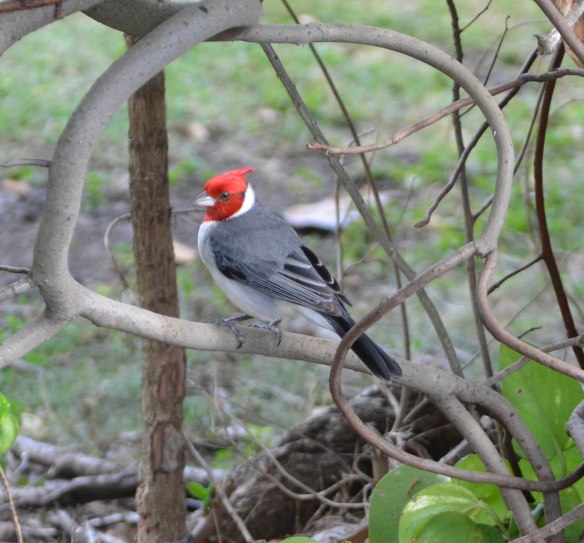
We finally parted. He offered to treat us to lunch, but I was afraid he meant to spend money on us, so declined. It was long past lunchtime, so we drove to a little grocery along the highway that had a food counter. It’s definitely a local hangout, called Goods ‘n Grinds. They offered deer burgers, the first I’ve seen so far, and we have tried pretty much every restaurant on the island by now. Though half the menu on offer was burgers, they were out of burgers that day. The special of the day was beef tostadas, and we each got one. We sat at a picnic table in the shade and ate our tostadas. The young lava-lava wearer of Halawa Valley drove up in a truck and we exchanged aloha. We also saw these gorgeous birds:
Crested cardinal.
They look like cardinals wearing woodpecker costumes. They are, in fact, crested cardinals. I tempted them closer by throwing some tostada shell crumbs on the ground, which were also appreciated by the ubiquitous blue doves.
I wanted to see the forest park where the trail to Kalaupapa begins. We had no intention of hiking the trail, for reasons already stated, but I knew it was a forested upland area, and very different from the scrubby grasslands of the area where most of the island’s population lives. The road seems to climb gradually, but goes to about 2,000 feet above sea level, where it ends in Palau State Park. It ends for a good reason–the next step is 2,000 feet straight down.
There is an overlook at the top of the pala from which you can see Kalaupapa. It’s like being in an airplane, and you must be able to see a 100 miles or more out to sea.
Tom’s view of Kaulapapa.
This is one of those things Tom doesn’t like (though that may be an understatement). I was fine with it because there was a nice, substantial rock wall separating me from the drop. Tom sat with his back against a large tree, across the path that skirted the wall and declined to come any closer. I admired the view and took pictures.
My view of Kaulapapa.
We walked back to the parking lot through the pines. The pines are unusual, with soft needles fully a foot long, giving them a “Cousin It” appearance for those who remember “The Addams Family.” I had earlier seen some coil baskets made of these needles in a gift store. I have seen pine needle baskets before and admired them, but these needles must have been particularly well-suited to basketry. The two baskets in the otherwise junky gift store were very well made and decorated with small shells. The one about the size of a hummingbird’s nest was priced at $100, so it was safe from me.
It was also cool in the forest–so cool it made me wish I had worn warmer clothes (not that I have warm clothes with me.) As a matter of fact, it has never been uncomfortably warm and is often downright cool, especially at night.
Then we went to look at the other attraction up here. It was indicated by a sign that read, “Phallic Rock.” This trail, unlike the concrete path to the edge of the pali, was unimproved and rather rough. I regretted not having changed from flip-flops into walking shoes, but managed OK. Tom, believing we were getting near the pali again, decided to wait for me on the trail, but I went to the end.
Yup, it was kind of phallic all right:
Phallic rock.
Someone had left an offering in a bowl in the rock, carved either by man or nature. The rock is sacred to the Hawaiian people, who viewed sexual mana as powerful and beautiful. Ku, the chief god, also means “erect,” in every sense of the word, including standing tall agains aggression or oppression. I often see offerings left at heiau or other sacred places.
Offering at phallic rock.
However, some asshole named Jesse carved his name into this rock. I can only imagine what his punishment will be. Probably he’ll be doomed to live his entire life as a stupid person, with all rights and privileges thereto. If I had my way, the centipede I mashed the other night was named Jesse.
The rock was nowhere near the edge of the pali. I picked my way carefully down the rough trail, but Tom wasn’t interested. Tom was interested in descending to lower, flatter ground.
Then we drove back into the metropolis of Kaunakakai to get some groceries, then back to the condo. We were actually too tired to cook again and made do with cheese and crackers. I was even too tired to write!











 obsidianmirrorblog