We’re in Cordoba now, having spent three nights in Sevilla, during which I was too tired to post anything.
I slept quite late the first full day, which was a Sunday, so there wan’t much open in any case. We walked around, took some pictures, got rained on, had some tapas and tried to get oriented.
One of Sevilla’s tiny streets in the old Jewish Quarter
We actually didn’t do much in Seville except for walk. Our hotel was reasonably near the Alcazar and the cathedral–but we never made it inside the cathedral. We spent a lot of time walking through the narrow, winding streets of the old Jewish Quarter (pre-expulsion). The houses are four stories high, and in some places I could almost touch the houses to either side of the street with outstretched arms. Cars can access some (but not all) of these cobbled streets, and when a car came along, we stepped into a doorway or onto the narrow sidewalk, if there was one. In addition to negotiating the Medieval and Renaissance walking surfaces, we had to keep a sharp eye (and nose) out for horse and dog poop. There are a lot of horses and lovely carriages in the old city that tourists can hire for merely exorbitant prices.
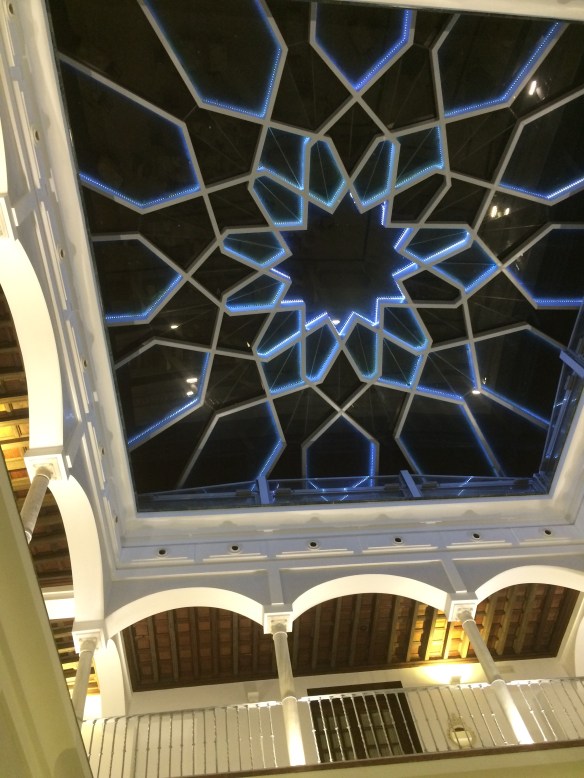
While walking, we passed by an interesting-looking restaurant, Sagardi. It had a small foyer for tapas, and a restaurant in a large, enclosed atrium. We checked out the menu and decided to come back when we were hungry. We had dinner there, and it was every bit as wonderful as we had hoped. We vowed to return for tapas another time.
Atrium roof, Sagardi restuarant
Magnificent old tree in central Sevilla
The hotel we stayed in, La Casa de Maestro Boutique, was an old house on one of the non-car-accessible streets, but we did get a parking spot nearby. The hotel has oodles of charm, but the room was small and the shower miniscule. Once in the shower, if I dropped my shampoo (inevitable, as there was very little place to put anything), it was nearly impossible to pick it up. However, the room was clean and the bed was comfortable, and that counts for a lot.
Driving in this part of Seville is madness for a tourist, so we walked to the Alcazar the second morning. Flamenco is very big in Sevilla, and there are stores selling very high-quality Flamenco-related goods such as fans, silk shawls, dresses, castenets, etc. (You can also get el cheapo versions of these in gift stores). My sister wanted a Spanish shawl, so I went into one of these upscale stores to find one. While there, I saw the most gorgeous shawl I have ever seen in my entire life, or hope to. I have extremely good (read “expensive”) tastes: it was the equivalent of $1500 US. It was love at first sight, but it will have to be a long-distance relationship.
Lusting in my heart for this shawl. All hand-embroidered in silk. Wouldn’t this be a lovely Christmas present for me? I thought so, too.
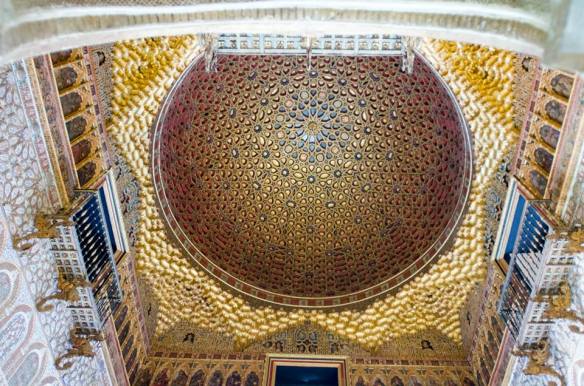
The Alcazar of Seville was build by King Pedro the Just or Pedro the Cruel, depending on whether you were one of the people (the Just) or an aristo or member of the clergy (the Cruel). Pedro really liked the Moorish style or architecture and ornamentation, and used it throughout his palace. It is fronted by a 12th-century gate, very rustic and antique-looking, considering the elegance lying just beyond. You walk into a vast plaza, flanked on three sides by different buildings. One is Pedro’s palace, one was the house of someone else important–the mayor of Seville?–done in a more traditional Spanish style, and one is another wing of the palace built by a later monarch who very much disapproved of Pedro’s taste in architecture, because it is a thoroughly Italianate Renaissance building. So it’s a rather odd mishmash. Pedro’s palace is rich in lacy Moorish stonework (even bearing the name of Allah in this most Christian palace), brilliant tile work, Moorish arches, carved, painted and gilded ceilings, and fountains. One room, the Ambassadors Hall, is completely tiled up to the ceiling, three stories up.
The Alcazar, showing Pedro’s palace to the left, and the important person’s house to the right.
Ceiling of the Ambassadors Hall, the Alcazar Seville
The Alcazar is the residence of Spain’s current king and queen when in Sevilla, but we had an impression that they don’t stay here much. Hard to imagine they would want to stay at a place that is overrun with tourists all the time. We bought tickets for the private royal chambers, which are upstairs, but I’d be willing to bet they have other, much more private chambers there for their actual use. These rooms reminded me of other palaces in other places, with many oil paintings of ladies in voluminous dresses and men in tight white pants, crystal chandeliers, gilded clocks, etc., etc.
Reflecting pool, the Alcazar
There are many lovely courtyards, reflecting pools and fountains throughout the palace, and the whole is surrounded by yet more gardens. It’s a gorgeous place, but I have to admit I was not as thrilled as I should have been because my feet hurt. A lot. I disappointed myself in my unwillingness to do more exploring, but there we have it. We found the cafeteria and had some wine and split a sandwich, then left. We found a horse and carriage next to the cathedral and got a ride back to the hotel, which I thoroughly enjoyed, largely because I wasn’t walking, but I do enjoy the clip-clop of horses and yes, the way they smell.
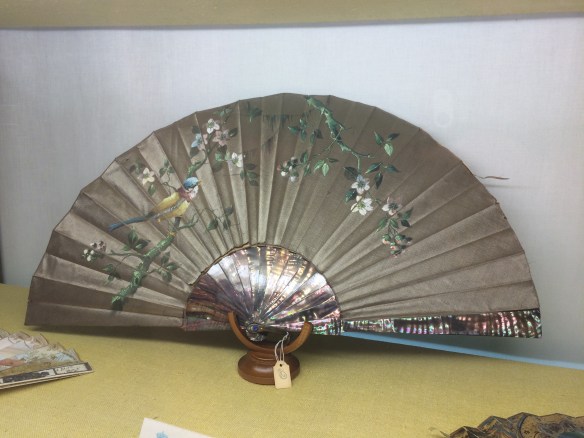
Gorgeous antique fan on display at the Alcazar
Later, we walked to Sagardi for tapas and wine. The tapas were delicious, but we decided to find another tapas place–it’s what people do in Sevilla. While wending our way through the tiny streets trying to find another tapas bar (a specific one; there were plenty of tapas bars. It made me wonder if anyone cooks at home in Sevilla.), I realized I had a blister. A quick trip to the pharmacy solved that problem, and we eventually found our tapas place, situated on a plaza across from City Hall. We had more excellent tapas, but by this time, we were both full. We did stop on the way back to the hotel for small ice creams, but this hardly counts. I feel like we should have gone to the cathedral–it’s the largest in Spain (that means very, very large)–but couldn’t work up enough enthusiasm.
Then it was early (for Spain) to bed, with Cordoba awaiting the next day. I mean, after we pick up our laundry, that is.
I have begun to suspect that Tom planned this trip to Spain as ameans of whipping me into shape (I admit this is needed, but still). Yesterday wesaid farewell to lovely Granada and headed toward Seville. It turned out to be oh, so much more than merely a travel day. I may never recover, in fact.
Actually, the first part was entirely my fault. I asked if we could visit Ronda on the way. Ronda is not a female friend, but one of the “White Towns” of Spain’s Andelucia hill country. (Apparently sometime a long time ago, white was the de rigeur color for houses here, and it hasn’t changed since.) The town is bisected by a deep gorge and is very picturesque.
Then Tom mentioned that near Ronda, there was a cave with prehistoric paintings in it, la Cueva Pileta. Well, that cinched it as far as I was concerned (innocent that I was).
We found Ronda without difficulty and headed toward a part of town our guide assured us was more for locals, parked with difficulty and tried to find a restaurant (as recommended by the book). The first place turned us away for reasons unknown (my Spanish isn’t very good, so I wasn’t sure what his excuse was). The second place was so full of people I thought I might become agoraphobic if we tried to eat there. The third place said they had a large party coming in, but as we were leaving, they called us back and set up a small table for us.
Bagpipe band in Ronda
While we were waiting for food, the party arrived, complete with bagpipers and drummers, sounding very Celtic. This makes sense for Northern Spain, as the Celts in ancient times went through there as a stopover on the way to Ireland, as Tom, the man of 100% Irish extraction, pointed out. It turned out that the large party was indeed a group of people from Northern Spain. We enjoyed the music (most of the musicians were in full traditional outfits) and the lunch, which consisted of fried padrone peppers, local snails in their stripy shells (yum!) and cured chorizo. Oh, and some local red wine.
We tried calling the cave a couple of times, but no one answered. We decided to go there anyway and come back to Ronda if it was closed. The cave belongs to the family of the farmer who originally found it, and it is operated by the family, not the government, so it has somewhat irregular hours.
We traveled up into the craggy hills along windy roads, passing through more White Towns. We finally came to the end of the road, or nearly so. There is a small sign and a parking area, but otherwise nothing but an extremely steep flight of stone steps heading up through the chaperral. I left my purse in the car, as I didn’t want to accidentally bump any formations with it (I’ve been in a few caves before, and they frown on this).
Stairs to the Cueva Pileta. Trust me, this was just the beginning of a very long climb.
The stairs went up. And up. And up. In addition to being steep, the steps were of varying depths, and there is a lot of loose scree making it hazardous. At the top, there is a hole in a rock face, and we went in. The young lady inside would not take a credit card or American cash, and the only Spanish cash we had was down, down, down at the car in the purse I had so thoughtfully left behind. To my immense relief, she agreed to come down to the car with us after the tour to get her money.
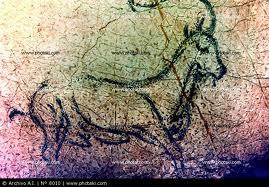
The cave is beautiful even without the cave paintings, with impressive stalactites, stalagmites, draperies, and sparkling crystal formations. Some of the formations were dark with prehistoric smoke, some tinted with cobalt and other minerals. I have never before seen any cave paintings (though I have seen prehistoric pictographs in California and Hawaii). They have a freshness and energy that looks modern, and it is exciting to think I was looking at the handiwork of someone who lived and died perhaps 30,000 years ago. How they managed to negotiate the cave with only torches is astonishing enough; I had trouble even with the rock steps, steel handrails and clutching Tom the whole way.
Horse in Cueva Pileta
Because, you see, there were no lights. They give you a feeble little lantern to hold when you come in. This lantern completely blinded me until I figured out how to block the light coming toward me and direct it only at the ground. The guide had a good light that she used to help us, but I am increasingly night blind, and found the whole thing nerve-wracking in the extreme. Add to that a LOT of uneven stairs and very slippery footing. The guide book said to bring something warm because the cave was cold, but I sweated gallons. By the end of the tour, my hair was streaming with sweat and my glasses were steamed up as though I had been in a Turkish bath.
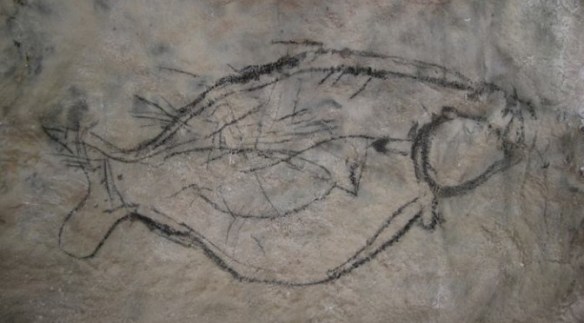
And I wouldn’t have missed it for the world. The paintings are amazing. There is a very rare depiction of a fish, quite large, and inside it, you can see another fish. There were paintings of horses, bison, goats and deer, beautifully rendered and informing us what these ancient animals looked like with a few perfectly placed lines and shading. There are strange scratchings, straight lines and bars. The guide said it was to count full moons. Other scratches she said were depictions of vulvas, a symbol of fertility. Maybe, but you can see the same thing in any men’s bathroom. I don’t think adolescent males have changed that much over the millenia. It hardly matters whether these paintings and markings bear deep religious significance or were merely the exercise of horniness and creative expression; they are the only messages we have from our early ancestors.
Fish in Cueva Pilete. Note the fish inside the fish.
Goat in Cueva Pileta
Once we emerged from the cave, there was of course, the descent down the rocky hillside to the car. Once we paid our patient guide, we took off in search of the road to Seville–but first, some water. Our GPS system (which was finally speaking English instead of Spanish, thanks to Tom, although the English voice cannot pronounce Spanish place names) wanted to direct us down tiny roads through the mountains. We knew there was a nice highway not too far distant and ignored her. On the way to the highway, we stopped at a little hillside bar for agua minerale. The people there seemed very excited to meet Americans, and several friendly people stopped by to say hello, which was very cheering.
On the road to Seville, I started falling asleep. I don’t sleep in cars any better than I do on airplanes, and kept jerking awake. Exhaustion dragged at me like water-soaked clothing on a drowning man, and by the time we reached our hotel, I was a zombie.
The hotel is a charming four-story building that was once the residence of Flamenco guitarist maestro Nino Ricardo. Our room is on the second floor, which means up three narrow flights of steep stairs, dragging suitcases because there is no elevator. Although the concierge took my big bag, I was still feeling more than exhausted to begin with, so this did not refresh me.
The living room at the Casa de Maestro has a decoration resembling the strings and sound hole of a guitar. The “strings” reach from the four-story ceiling to the floor.
We went out for tapas at a recommended bar and sat outside on the sidewalk, watching the people streaming by us. The food was delicious–scrambled eggs with black rice, calamari and crayfish, salmon in some yummy sauce, jamon Iberico and something else we can’t remember because we were both tired.
Then back to the hotel, where I completely lost it. All I’m going to say about this dark episode is that Tom is a saint. Once I got to bed I lost consciousness for about 10 hours and awoke refreshed with all evil spirits completely exorcised.
This is the first long-haul trip I’ve been on in a long time that I didn’t just about die from jet lag. Tom and I landed in Madrid in the morning and napped for a few hours in the hotel before heading out for what passes for an early dinner in Spain at 9:00pm. (Tom is in heaven. Nine o’clock dinners and lunch at 4 pm.) We went to bed at about 11 and woke at 6 am. I felt wonderful, and we were now attuned to the Spanish timetable. Absolute magic, especially since the trip lasted approximately 20+ hours in all, and I was awake for the entire time. plus travel to and from airports, because I don’t sleep on airplanes. Please don’t send me your sleep remedy–I’ve tried them all. This time I drank three glasses of wine and took two Xanax and DID NOT GO TO SLEEP. (Also please do not send me warnings about mixing pills and alcohol. I normally would not, but I was desperate–and yet I still didn’t conk out.) It’s been this way since I started flying at the age of two. I am not anxious about flying or tense during a flight. I just Do. Not. Sleep. It’s a major frustration, and sometimes leads to up to three vacation days just recovering from jet lag.
But this morning I was bright eyed and bushy tailed. We rented a car and Tom headed to Granada with no maps or GPs and got us there without any problem. Andalucia reminds me a lot of California, except instead of miles and miles of grape vines, there are kilometers and kilometers of olive trees.
We are staying at the Parador de Granada, which is actually inside the Alhambra Palace complex. We had a bit of trouble figuring out where to go and how to get there without buying a ticket to the palace (we are getting these through the parador). So we parked in one of the paid lots, which is a long way from the parador. As we were walking, we saw a woman sitting sideways in the open driver’s seat of her car with her legs spread wide, peeing on the asphalt. Well, they say travel broadens the mind, and that certainly was a completely new sight in my experience.
Our bedroom at the Parador de Granada
The parador is gorgeous, and everything here is amazing. There are nightingales singing in the trees! We couldn’t be happier with the room(s) (yeah, it’s pretty swank, but Tom tells me not to get used to it), and tomorrow we tour the palace.
Sparkling wine and yummy treats awaited us in our sitting room at the parador
Cool archway in the parador. The paving is made of different colored pebbles in intricate patterns, but it’s hard to see in this photo.
Oh, and I have been able to navigate in Spanish and make myself understood, which thrills me because I never studied it. I probably owe this to my mother, who was bilingual English/Spanish, but who for some reason wanted me to take French. (French speakers in California are extremely thin on the ground.) Thanks, Mom! Your blessings continue to enrich my life.
With the spate of recent police killings of blacks and the resultant urban riots, race has bullied its way to the forefront of American consciousness yet again. Along with the rest of you, I have read the various postings and news stories—and been horrified by the nasty, cruel, bigoted comments that follow.
What astounds me is that people still think race is a thing. With DNA science and technology, it has been proven beyond any shadow of a doubt that the concept of race is completely, utterly false. There is no such thing as race.
Let that sink in: there is no such thing as race.
According to the National Human Genome Research Institute of the National Institutes of Health, “All human beings are 99.9 percent identical in their genetic makeup.” The remaining 0.1% difference accounts for diversity in skin tone, eye color and shape, and thousands of other variations between one individual and another. It has also been shown that every human being on Earth can trace his or her DNA ancestry back to Ethiopia of about 150,000 years ago. We are ALL out of Africa, every last one of us.
This means that a bushman in the Kalahari Desert, an office worker of European descent in New York and a factory worker in Taiwan are almost literally brothers. All that hatred, violence, fear, injustice, and bloodshed is over a 0.1% difference between us that takes place in structures so small we can’t see them without a scanning electron microscope.
Racism has apparently been with us as long as there have been hominids. Jane Goodall observed young male chimpanzees band together to hunt and bludgeon to death chimps of a different social group (a phenomenon that caused her a great deal of disillusionment and sorrow). There is some archeological evidence that homo sapiens may have caused the demise of other early hominids such as Neanderthals and Denisovans. Maybe we shouldn’t be surprised—after all, human DNA differs from chimpanzee DNA by only 1.2% (http://humanorigins.si.edu/evidence/genetics). That makes us cousins, if not brothers.
So here we are, thousands upon thousands of years later, still beating each other up for being different. During the 19th Century, (white) anthropologists and others tried to deploy science to support race theory. “Scientists” measured skulls and defined “racial” characteristics to prove that there were different races of men. Of course, they had already decided—scientifically, of course!—that Adam and Eve were white, making the white race the “original” and the peak of creation. Falling short of the white measurement stick, all other races were deemed inferior. All kinds of ludicrous models were set up to “prove” this, spawning horrors like eugenics, genocide and the Nazi Holocaust.
In the clear light of DNA science, all these antique constructions were blown away like the dark and ugly cobwebs they were. Unfortunately, much of the world does not seem to have received the message. Although the concept of “race” is utterly false, racism is very real.
I read recently (sorry, can’t remember where) that racism today is really tribalism—“Us” versus “Them”—and that race has little to do with it. That may be true, but if you ask a white bigot about why he hates blacks, you’ll hear a lot of claptrap about the differences between the “races.”
There’s also nonsense coming from the side of the oppressed, probably in natural retaliation for the crimes of racism. For instance, I have read that there is no such thing as reverse racism. The idea is that if you are not a member of an oppressed minority, you cannot be victimized by racism; racism can be directed only from the empowered toward the powerless. C’mon, guys. That’s just justifying racism under a new euphemism. It’s a made-up notion with no more basis in fact than “blacks aren’t intelligent enough to go to college.” Human beings have a tragic penchant for attacking “The Other,” and what color you are makes no difference.
My granddaughters are of “mixed” DNA. We know from DNA tests of their parents that they have genes inherited from almost every group on Earth. (There must be some interesting stories back there!) They are beautiful, tender, loving, and they have no idea at all that there is a concept called ”race.”
I want these children to grow up in a world where “race” is viewed as a hideous artifact of a long-dead age. There is no such thing as race. There are only human beings in their infinite and interesting variety. Help me get the word out.
I have signed with a new publisher! Diversion Books has agreed to re-publish “The Obsidian Mirror” AND the sequel, which I am now writing. I simply could not be more pleased. I emailed the manuscript and cover art to them today.
Diversion Books is located in New York City (and on Park Avenue at that. Isn’t that cool? C’mon. It’s cool.). They started as a division of Scott Waxman Literary Agency, but are now an independent company. Diversion publishes a wide range of fiction and non-fiction titles. In my genre, you might recognize authors Henry Kuttner, Ursula K. LeGuin and M.K. Wren.
I am thrilled to be in such august company, and really looking forward to working with this very professional outfit. I am also–needless to say–delighted that “The Obsidian Mirror” will see the light of day again, and that the sequel has a home as well.
I’ll be keeping you posted about the sequel. The one thing I learned from writing “The Obsidian Mirror” is to always start with a plot outline. (In all fairness to myself, I didn’t think at the time that I was actually going to write a novel.) I finished the plot outline for “Fire in the Ocean” (working title; it may change) two weeks ago and started writing it last week. So far, I’m more than 7,000 words and four and a half chapters into it. I like having a plot outline!
I’ll try asking you another question. Do you like the working title of the sequel? Not? I really am looking for feedback.
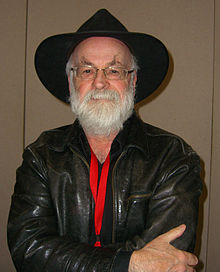
Today, I was going to write about some good news, but then the sad news arrived: Terry Pratchett died.
I have written about Pratchett before in these pages because he is one of my best-loved authors. He was a fantasy writer who was also a brilliant satirist and humorist of the highest order. Reading a new Pratchett book was for me as richly satisfying as artisan chocolate, and it lasted a good deal longer. (Plus I can go back and re-experience the books, which is hard, not to say disgusting, when chocolate is involved.)
Pratchett used his fantasy creation, the Discworld, to satirize our absurdities in this world. Nothing was off-limits for him. Personally, I think one of his finest pieces was “Monstrous Regiment,” which satirized bias against women and the absurdity of religion, which are deeply interconnected. Unlike fellow satirist and countryman Evelyn Waugh, Pratchett never indulged in invective; instead he made you laugh. And when you laugh, you become more open. And becoming open to new perspectives is how hearts and minds get changed.
There are, according to Wikipedia, 41 novels in the Discworld series. Pratchett also wrote several other novels, including “Good Omens” with the luminous Neil Gaiman, a series of children’s books, “The Long Earth” series with Stephen Baxter, and numerous handy guides to Discworld, short stories, and more. There’s a lot more to say about this man. He was awarded an O.B.E. and later knighted, so he is officially Sir Terry Pratchett. He suffered from a particularly vicious form of Alzheimer’s disease for eight years, and bore it with humor and bravery. He was deeply knowledgeable about the folklore of the British Isles, and commented to a meeting of folklorists that he viewed folklore much as a carpenter views trees. Wikipedia has an exhaustive amount of material on Pratchett and also his novels, so I won’t go into a lot of detail here–but he was a man of many parts.
I enjoy everything Pratchett wrote, but Discworld holds a special place in my heart (me and millions of others). He created a world so rich in detail, teeming with fascinating characters and creatures, that a return to Discworld was a richly enjoyable experience every time. I love his witches, especially grumpy and wise old Granny Weatherwax and Nanny Ogg, who had a lively girlhood and likes her pint or two. I love brave Captain Carrot, the 6 foot-plus dwarf who is the unacknowledged King of Ankh-Morpork, Discworld’s largest and (probably) most noisome city. And Lord Vetinari, the ultimate politician who always manages to keep things on course without too much bloodshed. And Death, who always SPEAKS IN CAPITALS (and has the last word). In Discworld, you meet hundreds of characters who are so beautifully drawn that they leave the mark of their personalities with you forever.
But the real reason I cried when I heard he had died is because he was kind to me once. I have related this before, but here it is again:
You see, I met Connie Willis first. I was in the vendors’ hall at Worldcon when it came to San Jose, CA several years ago. I happened to glimpse her nametag. Connie Willis is also a favorite author, so I introduced myself—and proceeded to commit every rabid-fan sin it is possible to commit in attempting to praise her work. Even as I heard the vapid words burbling out of my mouth, I knew I was doomed. The expression of pain on Ms. Willis’ face only confirmed my gauche blundering. I attempted to extricate myself by saying, “Well, I’m starting to drool on you, so I guess I’d better go now.” Ms. Willis nodded mute agreement, and I slunk away with my tail between my legs, feeling like a complete moron.
I was standing at a vendor’s stall wondering if it is possible to actually die of embarrassment when a tidy gentleman with a gray beard and a black fedora walked up. I thought he looked familiar, but when the vendor called him “Mr. Pratchett,” my suspicions were confirmed. He stood right next to me as the vendor handed him a CD, saying, “I’ve been saving this for you, but I was afraid I might come across as a rabid fan.” (Like me, I thought.)
Pratchett took the CD and said, “I adore rabid fans!”
I turned to him and said, “Well, then, would you mind if I drooled on your shoulder?”
Pratchett responded, “Not at all—but would you mind drooling on this shoulder”—he patted his right shoulder—“as the other one is already rather damp?”
Instantly, the oppressive cloud of feeling foolish lifted and disappeared. I will never forget how Terry Pratchett’s humor and kindness brightened my day and turned my embarrassment into laughter. (Not that I mean to say Connie Willis made me feel bad. I made myself feel bad. I should’ve kept my mouth shut.)
And now this kind, brilliant, prolific and amazing writer is gone. There will be no more tales of Discworld to anticipate with glee. His brilliance continues to shine in his work, which will live for a long, long time. He set a high standard for humanity. I only hope that someday we live up to it.
The last Tweet on Pratchett’s account. Fans will know who is speaking.
Joseph Noel Paton [Public domain or Public domain], via Wikimedia Commons
I just finished reading Terry Pratchett’s “Folklore of Discworld,” co-written with folklorist Jacqueline Simpson. (Do people actually get paid for knowing about folklore? What a great job!) Pratchett and Simpson discuss the relationship between the Discworld’s traditions and those of Earth (with the conceit that folklore, tropes and memes are particles of inspiration that drift across the multiverse, so that myths of Discworld wind up here, and vice versa).
While reading (actually listening to) this book, it struck me how deeply I am attracted to the folklore of the British Isles (although this is obviously not a particularly rare trait, as evidenced by libraries full of epic fantasies, tales of witches and warlocks, dragons and cloaked heroes and faeries). Nothing entranced me more as a child than tales of banshees, pookahs, faeries, disappearing gold pieces, leprechauns, elves and pixies. As an adult, I am still entranced by Tolkein, C.S. Lewis, G.R.R. Martin, and many less well known authors who write in that tradition—whether humorous or not. It’s one of the reasons I adore Pratchett, who once remarked that he regarded folklore much as a carpenter regards trees.
Why be so attracted to the folklore of another place? I could put it down to my Scots-Irish ancestry. But I think the real explanation is that the folklore of my own time and place is sparse and rather unimaginative. Perhaps if I had grown up in Louisiana or some place with more history than California, I would have a healthy backlog of swamp critters, ghosts, haunted mansions, and eerie sightings to freshen the imagination. As it is, I am hard put to say exactly what constitutes folklore here.
Sure, we told each other the stories about the guy and girl making out in the car who hear on the radio about the escaped madman with a hook for a hand. And step on a crack, break your mother’s back. (As this never happened, I didn’t believe it for long.) But these things lacked the enchantment I found in fairy stories and old tales from Ireland, England, Wales and Scotland. Witches, warlocks and wizards. Spirit horses. Water nymphs. Faery gold. Selkies. Leaving milk out for the Good Folk. Strange dancing lights on the moors at night. The Wild Hunt. King Arthur.
An incredibly high percentage of American “folklore” has disappointingly mundane origins. Paul Bunyan and his giant blue ox, Babe, appears to have originated in the oral tradition of lumberjacks, but according to Wikipedia, was “later popularized by freelance writer William B. Laughead (1882–1958) in a 1916 promotional pamphlet for the Red River Lumber Company.” Rudolph the Red-Nosed Reindeer was originally a promotional character created for Montgomery Ward. Pecos Bill was a character created by short story writer Edward S. O’Reilly in the early 20th Century. Johnny Appleseed was a real person, John Chapman, but all he did was plant apple trees, not conjure gold and silver apples or something interesting like that. Santa Claus comes closest to having true folkloric origins, but in America, even he was largely shaped by modern forces in the form of Clement Moore, author of “A Visit from St. Nicholas” in 1823:
“His cheeks were like roses, his nose like a cherry;
His droll little mouth was drawn up like a bow,
And the beard of his chin was as white as the snow;
The stump of a pipe he held tight in his teeth,
And the smoke it encircled his head like a wreath.
He had a broad face, and a little round belly
That shook when he laugh’d, like a bowl full of jelly:
He was chubby and plump, a right jolly old elf,
And I laugh’d when I saw him in spite of myself…”
Moore changed the majesty of Father Christmas, a tall, thin gentleman wreathed with holly and robed in green, into a “right jolly old elf,” later immortalized in his modern incarnation by the Coca-Cola Corporation. Moore also invented the eight tiny reindeer, which were not found in the stable of Father Christmas.
Where’s the magic in all this? Sadly lacking, in my opinion. Our modern American monsters are the psychopaths, serial killers, stalkers of children, terrorists real and imagined, and that guy with the hook, who may be folkloric, but he’s not very magical. Our urban legends may technically be folklore, but flashing your headlights getting you in trouble with gangs, or tapeworm eggs in bubble gum, or waking up in a bath of ice with your kidneys missing falls well short of enchantment.
I will admit that we Americans have our share of cryptozoids. Probably the leading examples of this are Sasquatch (Bigfoot) and El Chupacabra (the goatsucker). El Chupa is an import from Mexico, where apparently they are so folklore-rich that some of it is oozing across the border. None of these to my knowledge is actually magic; it’s just that no one has ever proved they exist, so of course, lots of people believe in them. Here’s a map of North American cryptozoology, if you’re interested in more.
And, of course, there’s a lot of flying saucer lore. But I don’t think any of the anal probees would say that there was magic involved.
As I mentioned before, it may depend on where you grew up. In Hawaii it is clear that many ethnic Hawaiians (and also many non-ethnic Hawaiians) believe in the old lore. I met people who believe in ghosts, in Pele and other ancient gods, in Menehune, and in spirits generally, both good and evil.
Magic offers the possibility of the good and brave and clever overcoming evil or at least magical trickery, whereas our monsters are sometimes overcome by the judicial system (and sometimes not). Magic also casts a glamor over folk tales; in fact the word “glamor” used to mean magic or enchantment. Our “folk” heroes are artificially created to make money—although they are still presented to schoolchildren as though they were genuine. I suppose Pratchett would say that when people start to believe in something, it transforms that thing into folklore. But no one really believes in Paul Bunyan or Pecos Bill. Thank heaven, some children still believe in Santa Claus, and around a campfire at night, you can believe anything. But I still think we are a culture that is sorely deprived of a true folkloric element.
Do you agree or disagree? Did you hear a truly magical (and American) story when you were a child? Did you have a haunted house on your street where lights and music could be heard at night? Were tales of helpful pixies or harmful sprites told in your neighborhood?
I would love to hear from you if you have such stories to tell!
Tom really is a hero. He agreed to drive the steep, winding, one-lane road back to Halawa Valley so that we could visit the beach there and maybe hike to the waterfalls. He surprised me–and this is after 43 years of marriage.
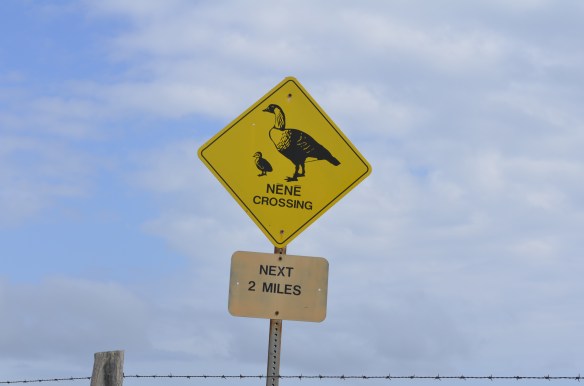
The drive was spectacular, and we stopped to take photos of things we remembered, but hadn’t stopped for the first time because of unfamiliarity with the road. For instance, there’s this sign:
Nene crossing sign.
Nene (pronounced nay-nay) are the native Hawaiian geese, and they are endangered. Sadly, we didn’t see any geese, just the sign. We also saw this, which we think is a roadside memorial, but it’s a bit different than the usual. In addition to the sun made of white coral, there were offerings:
Roadside memorial.
There was no one waiting at the bottom of the road this time. We parked and walked down the dirt road to the beach. There is a river flowing into the sea here, and it’s picturesque:
River at Halawa Valley.
Beach at Halawa Valley.
We picked our way along the beach, and I saw what I expected; lots of small pieces of plastic in the sand, white and blue, black and gray, yellow and red–the detritus of the Great Pacific Garbage Patch, collecting on this remote beach. I began picking up the larger pieces and putting them in my pocket. by the time we left, both pockets were bulging, and my arms were full of still larger chunks, bottles, and a small section of plastic fence. Tom gently makes fun of my plastic policing, but I regard it as the little that I can do to make it better. Worth nothing in the face of the magnitude of the problem, I agree. And many of the pieces were so small as to be impossible to retrieve, reminding me of “Rumplestiltskin,” where the poor girl has to count all the grains of sand or spin straw into gold.
Some of my plastic finds. Pockets are bulging with smaller bits.
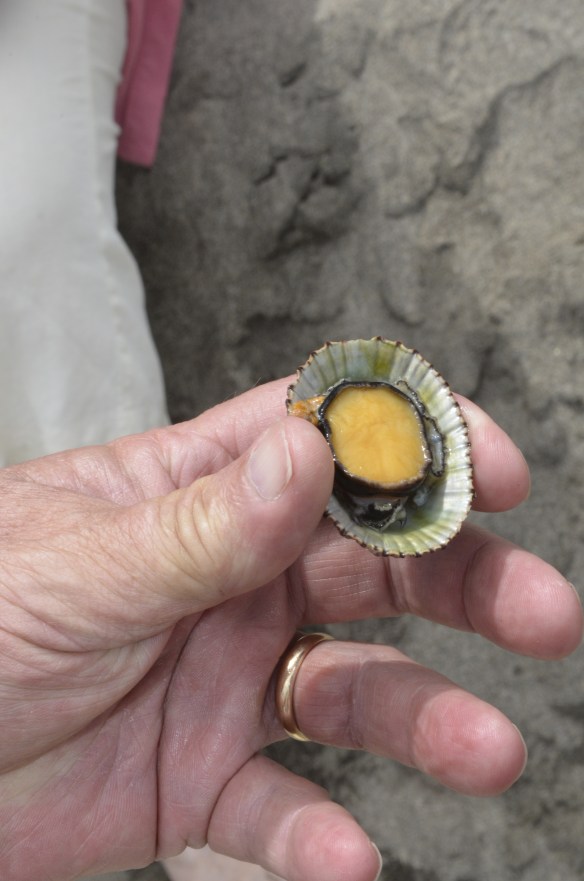
A Hawaiian family was picnicking on the beach. A young woman named Noni (noh-nee, means “beautiful”) was sitting on the sand, while her sister, husband and nephew were on the rocky point under the cliffs, fishing. We chatted for a while, and then her husband came back with a net bag full of ‘opihi (oh-pee-hee, limpets). We asked what they were going to do with them, and he said they were best barbecued, but could be eaten right out of the shell. Did we want to try one?
Yes, we did. He had lost his knife while prying ‘opihi off the rocks, but he used one limpet shell to dislodge the resident of another shell, and offered us some. They were rubbery, and the primary taste was a mild saltiness, but I’m sure they are delicious barbecued. This inside of the shell had a lovely iridescence, tinged with green. I washed mine out and brought it home with me.
Snack time!
We asked about the hike to the falls. Noni said it was really difficult, and she hadn’t done it in 20 years, so we decided to give it a miss. (Later, I learned that it takes two hours just to get there. I probably made the right decision.) After dumping my collected plastic in the trash bins provided, we got into our car and drove slowly back, taking pictures as we went.
Rainforest stream.
Once we were back in two-lane country again, we stopped to take a picture of this:
Chicken condos.
I called it “chicken condos,” as they appear to be individual shelters for chickens or roosters. As I was taking the picture, a pack of dogs ran up to the fence and barked their heads off. A very large Hawaiian came down the drive, looking rather menacing. I waved and said I was just taking a picture of his chickens. He didn’t smile, but waved more or less amicably and went back down the drive. My guess is that he’s raising fighting cocks, which is abhorrent, but I don’t know.
The only real proof we saw that there are deer on Moloka’i.
We also stopped at a grove of coconut palms, right outside of Kaunakakai. This used to be a much larger grove called “the Queen’s Grove,” because it was planted for the wife of King Kamehameha V. It’s right by the beach, and the trees must be 100 feet tall, each with a cluster of coconuts clinging to the top under its fronds. There are piles of coconuts on the ground, both fresh, green ones and old, hairy ones. The top of my head began to feel peculiarly vulnerable as I imagined what a coconut would do to it after a drop of 100 feet, so I left.
The Queen’s Grove.
Then back to the condo. I was very behind in my journaling, so spent most of the late afternoon writing, listening to the waves crashing on the rocks nearby, and enjoying the trade winds. When we went to bed, another three-inch centipede was occupying the hallway upstairs, and I gave him the same treatment I gave Jesse the Centipede a few nights ago–a beating with my flip-flop. Neither centipede put up a fight, making me think they were unwell to begin with.
And so the journey came to an end, as all journeys must do–which is the beginning of another journey for me; writing a new novel. The entire experience was amazing. People were so helpful and kind, so willing to bring me into their lives a little bit. It was extremely touching, and I will never forget the experiences I had here. As a parting wave, here are the signs that greet new arrivals to Moloka’i, and bid departing travellers farewell:
This was our snorkeling day, so we set our alarm. We had to be at the Kaunakakai Wharf by 6:45. We ate a quick breakfast and set out in the dark. We could see the bright lights at the tiny Molokai airport as well as the wharf as we came down the rise from the west end of the island; Molokai is only 38 miles long from the west end to the east.
I thought Tom should leave his camera in the car. It is large (especially the lenses) and heavy, and I was afraid it might get damaged or get water in it. So no pictures, but I’ll post a few photos of the kinds of fish we saw, even if they aren’t the actual fish we met.
We drove straight out onto the wharf and parked near our boat, the Coral Queen. A young Hawaiian man told us nicely not to park there or we would get a ticket. This turned out to be Gabe, the boat’s one crewman. He would take the divers down while the captain kept an eye on the snorkelers.
This was a surprise. Diving implied deep water, so I asked about it. The captain (whose name I failed to remember) said they had more than 40 different places to take people, depending on whether they had a mixed group (snorkelers and divers), or just one or the other, and of course depending on tides, currents and weather.
There were about a dozen of us. They waited a while for some latecomers who never showed, then set out along the eastern shore in the dawn light. On our way out, they pointed out a handsome white yacht moored offshore and said it was Larry Ellison’s.
The Molokaiians are very hopeful about Mr. Ellison, the fifth wealthiest man in the world, and the founder and former CEO of Oracle Corporation. As you may know, he bought the entire island of Lanai a little while ago (98% of it, anyway). The people of Lanai have been very happy with the changes he has brought to that island, and the Molokaiians are hopeful that he will buy up the now-idle holdings of the Molokai Ranch. This would certainly make a huge difference; it remains to be seen if it’s a difference the people of Molokai will like. They have a slogan here: “Don’t change Molokai, let Molokai change you.”
It was calm, quite unlike the first few days we were here. It was interesting to try to locate landmarks on shore that we had earlier seen from the road, but we never got as far as Leimana’s fishpond.
Someone asked about sharks. Gabe said they tended to see black-tipped reef sharks, white-tipped reef sharks, hammerheads, scalloped hammerheads, and tiger sharks.
Tiger shark. I mean, come on. Is this something you want to go swimming with?
I said, “I don’t mind black tips, and I have swum with them, but the others…tell me that there won’t be any sharks out there today.”
Gabe struggled with his conscience for a moment, then looked straight at me and said, “There won’t be any sharks out here today.”
Bless the boy. I am sure I would have to change my bathing suit if I saw a hammerhead. Or any other shark, for that matter.
We saw humpback whales as we chugged along. They never came very close, but we did see them spouting and breaching a little ways off.
This is a picture of a humpback whale Tom took when we went whale watching in Monterey Bay.
Eventually, we anchored (using a special anchor to avoid damaging the coral) and the captain pointed out the area the divers would explore, and further toward shore, the snorkelers’ area. As we were preparing to go in, a manta ray swam slowly next to the boat–the first I have ever seen.
As I flapped my way to the stern in my fins, a woman in a shortie wetsuit said with surprise, “No wetsuit?” I was surprised by the question. This was Hawaii, right? Who needs a wetsuit? They had them aboard the Coral Queen, but it hadn’t occurred to me to don one. I penguined onto the platform that had been lowered from the stern and fell backward into the water. It felt fine, neither warm nor especially cool. Tom joined me and we headed out.
Molokai is surrounded by a fringe reef that extends outward from the island a long way. You could walk out a mile in some places and still be in water up to your knees. We were probably a mile and a half from shore, in water that was about 12 feet deep. There were lots of fish to gawk at–schools of goatfish and convict tangs, triggerfish, butterflyfish of several varieties, birdand rainbow wrasses, pink and silver juvenile parrotfish, mature rainbow parrotfish (a blaze of different colors), and one humu-humu-nuku-nuku-a’pu’a’a. I am never quite content snorkeling until I see this dapper little fish with his colorful suit and enormously long name.
School of convict tangs. This really looks like what we saw.
Humu-humu-nuku-nuku-apu’a’a.
Longnose butterflyfish.
To my surprise, my hands began to get numb and they turned white (whiter than they usually are, that is). That had never happened before while snorkeling. I didn’t think we had been out more than a half an hour, but I told Tom I wanted to go in. He agreed and we headed back to the boat–to find that we had been out an hour and fifteen minutes, and it was time to go anyway.
It appeared that we were going to go to another spot to explore. I felt quite chilled and decided not to get back in.
I struck up a conversation with Gabe. Tom had discovered that Gabe was a third cousin to Leimana, so I mentioned this and said we had enjoyed our time with Leimana at the fishpond.
“Yeah, he’s really something, isn’t he, with his thing…” Gabe indicated the swimsuit zone.
“Malo,” I said helpfully.
“…malo, and you can see his whole butt hanging out,” said Gabe.
“Well, to give credit where credit is due,” I said, “It’s a nice butt.”
Gabe looked profoundly shocked. I guess he thought pudgy old ladies were past appreciating these things, or perhaps he had never viewed his third cousin in that light.
I went forward to sit in the sun and get warm. This felt great, and my hands got warm again. However, after a bit, I felt my Irish skin had had as much solar exposure as was wise, and went back under cover. While I was sunning, though, I saw a huge turtle swim by under the deep turquoise water. He swam slowly, balletically, and I watched him until he disappeared into the depths.
While we were waiting for the others, we chatted with the captain. He had been a “bean-counter,” his words, in Minnesota. He used to come to Hawaii on vacation, and finally realized he didn’t have to live in Minnesota.
“Why Molokai?” we asked.
“It was the last island I visited,” he said.
He bought Molokai Fish and Dive, then bought the gas station next door. (Giving us the opportunity to buy gasoline at a filling station called Fish and Dive.) We commented on the high prices in the islands. Gas in our area is now close to $2 a gallon, but in Hawaii, it is more than $4. He told us that their prices were dependent on the last tanker, and they didn’t change until the next one arrived. I noticed that Fish & Dive gas prices were identical to the one other station on Molokai, a Chevron.
The divers and snorkelers came back raving about the wonders they had seen–turtles, mantas, even a sleeping white-tipped reef shark. Someone said that the water seemed warmer at this spot, and the captain said, “Yes, it is. There are freshwater springs back at the other place that make it colder.”
I said, “It would’ve been nice of you to have mentioned that an hour ago.”
But I think staying out of the water at the second location was the right decision. After we came back, Tom and I were exhausted. We had lunch at the Kualapu’u Cookhouse, and I could hardly keep my eyes open. I had fried saimin with vegetables, which proved to also have Spam and fake crab in it. Spam, in case you aren’t aware, is a favorite here in the islands. If you are eating in an establishment frequented by locals, you will find it on the menu.
I fell asleep on the ride home, and as soon as we rinsed ourselves and our equipment, we both fell into bed and slept the sleep of the truly depleted. We awoke in the early evening, forced ourselves to cook dinner (we had purchased grass-fed beef from the Molokai Meat Cooperative), ate it, and went gratefully to bed without doing the dishes.
We were supposed to meet Auntie Opu’ulani today at 9 am, so we set our alarm. This turned out to be unnecessary, but as we were getting ready to go, We got a call on the condo phone from Auntie saying she had to babysit her grandchildren that day. (I still don’t know how she figured out the number–remember my iPhone was sacrificed to the sea gods.) She’s pretty jammed for the rest of the time she will be here because of the upcoming Makahiki Festival.
Makahiki is the ancient Hawaiian new year festival. It used to be four months long. It was a time when many of the repressive kapu were lifted, and there were athletic competitions, hula, games, feasts, and fun. Today it is a week long, and a celebration of Hawaiian culture. I am kicking myself that we are leaving just as Makahiki begins, but I probably wouldn’t have been able to do what I needed to do here because everyone would have been too busy.
So I offered to treat her to dinner, and we agreed to meet at Paddler’s Inn at 7 pm. That left the day wide open, so we decided to explore. First, we drove to Purdy’s Macadamia Farm, the only mac grower on Molokai. This consists of 50 trees that were planted 90 years ago on five acres. The entrance to the farm has this sign, homemade and similar to other signs you see on the island:
Asking the tourists to go with the flow on Moloka’i.
As we walked down the road, we were greeted by a small, skinny black cat. I miss my kitty, so I stopped to pet it. It turned out there were several other small cats, employed on the farm to kill rats, who eat the nuts.
We arrived in the middle of a tour. There was a wooden trough set up with whole mac nuts. There were holders made out out of old rubber tires and hammers to crack the nuts on pieces of stone in the trough. This is, of course, not how they are commercially processed. Mac nuts have a thick outer husk. The guy in charge of the tour bit into a husk and removed it to demonstrate. Then they have a very hard inner shell. If you whang them with a hammer, you can get at the nut meat inside. This was being directed by a short, fit Hawaiian with an attitude. He was the first Molokaiian we have met who was not pleasant, and the feeling we both got from him was open disdain.
Mac nut cracking station.
After the nutcracking exercise, we tasted roasted and salted nuts (all natural, no other chemicals like the preservatives in canned or packaged nuts. Nothing added but sea salt, according to our surly host.), then got to taste raw coconut dipped in macadamia flower honey, which is not made on the farm. That was delicious and different. As this was going on, I noticed a dark, raffish-looking fellow with gold chains who was looking on, extracting raw coconut from a shell and throwing pieces for the cats to eat. The cats all scrambled for this coconut as though it were Li’l Friskies.
The grove of nut trees was immaculate. They don’t pick the nuts; when the nuts are ripe, they fall to the ground and they are harvested daily. The ground was absolutely bare between the trees except for a few piles of leaves that had been collected. Like coffee, mac trees have flowers and nuts in every stage of development at the same time.
After the mac nut farm, we drove to nearby Kualapu’u, which is where Coffees of Hawaii is. I wandered into the gift store intending to buy some coffees and spied the raffish cat-feeder. He was leaning casually against the counter, talking to the clerk.
“You look familiar,” I said. He looked surprised, then said, “You were at Purdy’s just now, weren’t you?”
I agreed this was so and commented that the host there was the only unfriendly person we had encountered here. He said he brought tours over from Maui on the ferry, and he always told them that the guy worked with nuts all his life, and so of course, he was a little nuts himself. Clearly a stock comment that he used all the time. He also said the man didn’t like it when you played with his cats, because they had jobs to do. I didn’t ask how our crabby host felt about feeding his cats coconut.
Tom went to the coffee bar and ordered two Mocha Mamas, the speciality of the house. This was sort of a coffee smoothie, with Molokai coffee, chocolate, ice cream, and whipped cream. Hardly any calories at all. It was delicious, but I couldn’t finish it.
On the way out of town (which takes about 60 seconds), I spied a gift store tucked into the Kualapu’u Business Park. Tom patiently parked the car and I went in. I had nosed around in several gift stores, but no joy. Either the stuff was complete junk, or it was truly original, handmade, beautiful, and hideously expensive.
To my surprise, this place had lovely things, reasonably priced. I saw this necklace, the octopus carved of mother-of-pearl, with jade beads on a beautifully knotted cord:
My new octopus.
It was reasonably priced, so I bought it, along with some pretty mother-of-pearl earrings that, if anything, were underpriced. I very much wanted a large, carved turtle for my bathroom wall, but my suitcase is already perilously close to getting charged for being overweight, so the turtle remained where he was.
A side note: the octopus (he’e in Hawaiian, pronounced hay-ay) is associated with the sea god Kanaloa because the octopus is slippery, sly and sneaky (though sometimes it is the squid, not the octopus that is associated). Kanaloa is kind of like Satan. He created all the stinging, poisonous creatures that plague the people. He presents himself as beneficial sometimes, but will trick you. He rebelled against the chief god, Kane, and was forced to descend to the underworld, where he is known as Milu. (Sound familiar?)
Personally, I like octopi, and think they are fascinating. You wouldn’t expect a mollusk to have much of a brain, and most don’t, but octopi are smart. Look at this video:
Given how dependent the ancient Hawaiians were on the ocean for food, and how much time they spent in it surfing, swimming and sailing, you wouldn’t think the ocean god would be a Satan-equivalent. But the ocean, too, can be deceptive, changeable, dangerous and cruel, so I guess it makes sense.
After that, we returned to Paniolo Hale. I wrote the rest of the afternoon, and then we drove into Kaunakakai to the Paddlers Inn. This is a hopping’ place at night, and we had trouble finding parking. I went into the restaurant and looked around. A band was playing Hawaiian music in the corner. The room was filled, and the waitress said because we didn’t have reservations, and there was a large group of tourists that had to be fed, we would have to wait. I asked her if she knew Auntie Opu’ulani, and she shook her head. I saw the waitress who had served us before, an older woman, and asked her. She said yes, she knew Auntie, and pointed to a woman sitting at a side table. I went to introduce myself.
Auntie Opu’ulani is a woman of about my age with dark, curly hair frosted with silver, and a wide, friendly face. She greeted me warmly, and then I set about trying to solve the seating problem. I had noticed when we came in that the bar was completely empty, and I asked our helpful waitress if we could get served in the bar. That suited me much better, anyway–it was quieter, so we could talk and actually hear each other. She said of course we could, so Tom and I and Auntie retired to the bar.
Auntie Opu’ulani.
I asked Auntie Opu’ulani about mo’olelo. She asked how I intended to use them. I said my motivation in learning them was to better understand Hawaiian culture. I did not intend to retell them, but rather to have them inform my story. Tom chimed in with a description of “The Obsidian Mirror,” and explained how that related to what I was doing on Molokai.
She said she had learned the chants from her grandparents. She had been the 6th of 12 children, and her mother was ill when she was born, so her grandparents adopted her–very much in the old Hawaiian way. She said they had been born in the 1890’s. They were very strict, but loving. They believed that one’s possessions should be cared for, and that nothing was to be treated casually, as people do today. She loved them dearly, and they taught her the proper way to be Hawaiian, as well as the old chants. Auntie said the chants unique to Molokai had never been written down before, but that was her task now that she was retired.
Auntie Opu’ulani is a retired teacher. She teaches the Hawaiian language, although she was reluctant to do so at first. She said it all had to do with her name. I said I thought Opu’ulani meant “Heavenly House,” as Jeanine had told me, but she said no. It meant the tip of the incoming wave before it has broken–or the tip of the tooth of a sperm whale (highly valued). She used to be teased at school because the other children said pu’u meant she had a fat stomach (remember my lesson from Leimana at the fishpond?). She was unhappy, and asked her grandmother why she had been named that (traditionally, grandparents named the children, trying to give them a name that would signify their character). Her grandmother just looked at her and said, “Someday, you will understand the meaning of your name,” and that was that. Years later, she realized that her role was to help perpetuate the Hawaiian language and culture. She has published two books in Hawaiian, with the assistance of Jeanine. (I must find out more about Jeanine!) Auntie said Hawaiian was taught at a very simple level to small children–and then at a very complex level to older kids. There was a gap, and she bridged it with a textbook and a novel aimed at middle-schoolers. So she has been the tip of the wave, bringing back the culture to other Molokaiians. My interpretation; as I have mentioned, Hawaiian is highly metaphorical.)
I asked about menehune, and she told me that her grandfather had seen one. He was walking in the high country and stopped to rest in the shade, but someone kept throwing nuts at him. He saw two small feet dangling from a branch, then a tiny man jumped down and ran into the brush. The menehune was warning her grandfather not to rest there. I asked if they were still around, and she said yes. There are plenty of places in the back country where they live. Menehune work closely with pohaku (poh-hah-koo, rocks), to build things like fishponds. By this, I think she means the rocks contribute as much a part of the work as the menehune.
She said there are many things in the chants that actually exist. Her son, who loved to hike, once found a spring in the high country that flowed out of the rock, then disappeared back into it again–something described in one of the chants. He filled bottles with this water and brought it home. When Opu’ulani drank it, she thought he had added something to it because it was so sweet, but her son said no, that was just the way it tasted.
Auntie believes the Ali’i, (ah-lee-ee, the upper class/nobility of ancient Hawaiian society) came originally from the Americas. (There is a generally accepted theory that they came from Tahiti. The mo’olelo refer to the original Ali’i coming from “Kahiki-nui,” or “great Tahiti.” However, DNA testing of any group of people is far from complete, and there have been some very surprising finds. for instance, DNA analysis of extremely ancient human remains found in Peru show direct a relationship with both the Ainu of Japan and with Australian Aborigines. So I wasn’t about to argue.) Her own ancestors came from Maui, she said, but when they got here, there were many uhane ino (oo-hahn-ay ee-no, bad spirits) who possessed peoples’ bodies, and the people had to get rid of them with prayer and fasting to live here.
I told her the story of the doomed lovers that Leimana had told me, and asked what it had to do with the big turtle rock in the channel. She told me, but that is part of her mo’olelo, so I can’t repeat it. I said the story of the two lovers sounded like it really happened, and she said that it did. She agreed with me that it sounded like something two teenagers might do. I also asked about the heiau on Molokai. I had read that Molokai was known for its powerful sorcerers, and they had built this enormous heiau on the Maui-facing side of the island to intimidate potential invaders from that island. It was a place of much human sacrifice, and there is the story of a kahuna (priest) who lost seven sons to this practice.
Auntie Opu’ulani confirmed the heiau as a place of sorcery. She used to take people from other islands on tours there (it is on private property and you have to get permission to visit). One day, she was guiding a group of kupuna (elders) from Maui. She and another lady sat down on some rocks to rest. Suddenly, the other lady jumped up and went directly back to the bus. Opu’ulani later found out that the lady felt that the rock was “trying to enter her.” She said the heiau was a bad place because of the human sacrifice, and if we visited, not to sit on the stones.
Auntie Opu’ulani was exactly the person I had wanted to meet. Educated, dedicated to her culture, and a believer. I decided to tell her my experience with the lei at Kilauea. When I described turning around to find the lei gone, she nodded quietly and said, “Pele accepted it.” I asked her to read the manuscript for the book I am working on (once I actually have a manuscript), and I offered to pay her for it. She said she would be glad to. As we prepared to leave, I asked if I might contribute to her work, remembering what Jeanine told me about offering money, but Auntie would not accept it. Of course, I offered to send her “The Obsidian Mirror” as a way of saying thank you, and this she accepted.
What a beautiful, gentle woman. I am so lucky to have met her!












![Joseph Noel Paton [Public domain or Public domain], via Wikimedia Commons](https://theobsidianmirror.net/wp-content/uploads/2015/03/a_midsummer_nights_dream.jpg?w=584&h=483)




 obsidianmirrorblog